
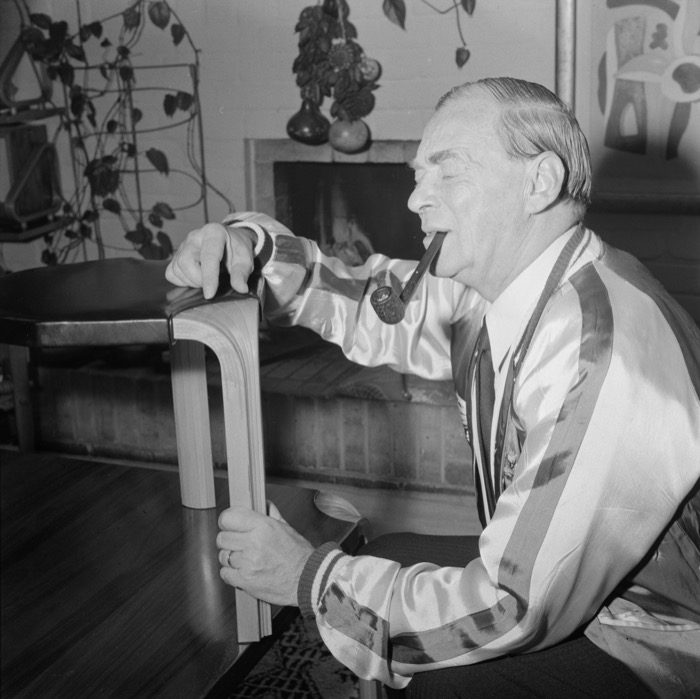
Alvar Aalto
The great humanist of the Modern Movement — who gave the machine age a soul
Photo: Hans Gerber / ETH-Bibliothek Zürich, CC BY-SA 4.0, via Wikimedia Commons
Movements
Signature works
- Paimio Sanatorium (1933)
- Viipuri Library
- Villa Mairea, Noormarkku (1939)
- Baker House dormitory, MIT (1948)
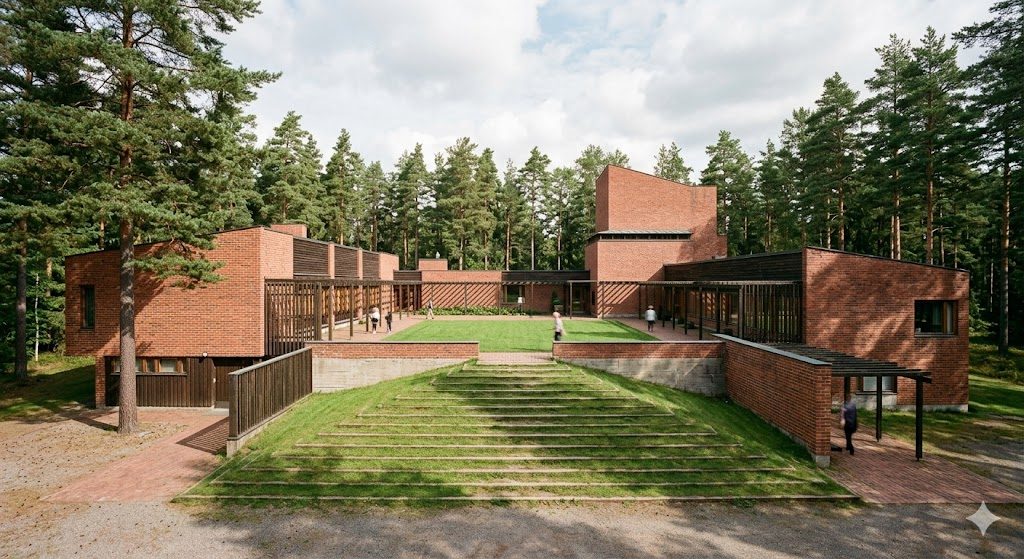
- Saynatsalo Town Hall (1952)
Lie back on one of the white iron beds in a patient room at the Paimio Sanatorium, deep in the Finnish pine forest, and look up. The ceiling above you is not the cold flat white of an institution; it is a warm, carefully chosen colour, angled and shadow-free, so that an eye staring upward through long months of convalescence finds nothing harsh to rest on. The heating is at your feet, not over your head. The window beside you is tall enough to pour the low northern sun across the room without dazzle. Even the basin in the corner has been reshaped so the water runs down its porcelain in silence, sparing the patient in the next bed. Nothing here was chosen for how it photographs. Everything was chosen for the body that must inhabit it.
The architect who thought all the way down to the splash of a tap was Alvar Aalto, and across half a century he became the great humanist of modern architecture — the man who gave the machine age a soul.
His single great idea was that a building exists for the human being who uses it — not for a style, a theory or a manifesto. Where much of the Modern Movement worshipped the smooth white machine, Aalto answered with wood and brick and undulating walls, with daylight bounced softly off shaped ceilings, with acoustics tuned to the ear and thresholds tuned to the hand. He kept all the rigour of modernism and added what it most lacked: warmth, nature, and an unbroken attention to how it actually feels to be a person inside a room.
The idea: architecture for "the little man"
The heroic phase of modern architecture, in the 1920s, was a revolution of the machine. Buildings were to be clean white volumes, mass-produced, freed of ornament and history, "machines for living in." It was a thrilling and necessary purge — but it could turn cold, and it often forgot the warm, irregular, sensory creature it was built to shelter.
Aalto's whole life was an argument with that coldness from the inside. He never rejected modernism; he was one of its leaders, exhibited beside the masters, fluent in steel and glass and the open plan. But he insisted that the new architecture serve what he called the ordinary person — "the little man" — and that it answer not just the eye but the whole body: the foot on the stair, the hand on the rail, the ear in the hall, the skin against the wall on a cold morning.
This led him to a distinctly organic modernism. Where the International Style loved the straight line and the right angle, Aalto let his plans and ceilings and walls undulate in long free curves drawn, he said, from the forest, the lake and the contour of the Finnish land. Where others stripped buildings bare, he warmed the white wall with timber, brick, leather and bronze — materials the hand wants to touch and that age gracefully rather than weathering into stains. And where the machine aesthetic gloried in glare and hard surfaces, Aalto obsessed over indirect daylight and acoustics, shaping ceilings and skylights so that light arrived soft and sound was gathered kindly.
The result was a body of work that feels, even now, astonishingly humane — modern without being clinical, rigorous without being cold. It is the difference between a building you admire and a building you want to live inside.
Life and path
Hugo Alvar Henrik Aalto was born on 3 February 1898 in Kuortane, in rural western Finland, a country still then a grand duchy under the Russian crown and on the very eve of nationhood. He grew up among forests, lakes and the timber-building traditions of the north — a landscape and a craft that would surface in everything he later made. He studied architecture at the Helsinki University of Technology, graduating in the early 1920s into a young, independent Finland hungry to build a modern identity of its own.
His early work was tinged with the Nordic Classicism then in fashion, but by the late 1920s he had turned decisively toward the new functionalist architecture sweeping Europe. The hinge of his career, and the building that announced him to the world, was the Paimio Sanatorium, won in competition and completed in 1933 — a tuberculosis hospital so completely thought-through, down to the furniture and the fittings, that it became a manifesto for human-centred design before the phrase existed.
Aalto's life was a true partnership. His first wife, the architect Aino Marsio-Aalto, was his close collaborator and an equal force in the studio; together they shaped the furniture, the interiors and the firm's whole sensibility, and together with Maire Gullichsen and Nils-Gustav Hahl they founded Artek in 1935 to manufacture and sell their designs. Aino's death in 1949 was a profound loss. Aalto later married the architect Elissa Aalto, who became his partner in the practice through the great public works of his maturity and who carried the office forward after his own death.
That maturity was prolific and international. After the Second World War he taught for a period in the United States, where he designed Baker House, the serpentine student dormitory at MIT, completed in 1948. Back in Finland he turned increasingly to civic architecture — town halls, churches, cultural centres, libraries and concert halls — culminating in the white marble of Finlandia Hall in Helsinki in 1971. He kept working almost to the end, dying in Helsinki on 11 May 1976, by then revered as one of the supreme architects of the century.
The signature works
Aalto's catalogue runs from a single tea trolley to a national concert hall, and that range is itself the point — he designed at every scale with the same care. A handful of works carry the whole argument.
| Building | Place & year | Why it matters |
|---|---|---|
| Paimio Sanatorium | Paimio, 1933 | The human-centred manifesto — every detail, from glare-free ceilings to the silent basin, designed for the reclining patient. |
| Viipuri Library | Viipuri, early 1930s | The undulating timber-acoustic ceiling and round roof-lights — daylight and sound shaped as carefully as space. |
| Villa Mairea | Noormarkku, 1939 | A house for the Gullichsens where modernism meets the Finnish forest — columns bound in rattan, free-flowing rooms, a wooded garden brought indoors. |
| Baker House | MIT, Cambridge, 1948 | A student dormitory whose serpentine brick wall turns every room toward the light and the river — humane housing at scale. |
| Saynatsalo Town Hall | Saynatsalo, 1952 | Brick, timber and a grass-stepped courtyard climbing to a soaring council chamber — civic dignity in a tiny municipality. |
| Finlandia Hall | Helsinki, 1971 | His white-marble concert and congress hall — the late, public summation of a lifetime of acoustics and form. |
Paimio remains the heart of his legend. Asked to design a sanatorium for tuberculosis patients — who in that pre-antibiotic age lay still for months taking rest, fresh air and sun as their only cure — Aalto designed the building as an instrument of healing. He oriented the patient wing to the sun, gave each room generous daylight and air, placed the heating low and the colours warm, tilted ceilings to remove glare from upturned eyes, and even designed a special non-splashing washbasin so a resting patient would not be disturbed. He went further still and designed the Paimio chair, its frame of bent laminated wood angled to ease the breathing of a seated patient. No building states more plainly that architecture is, first and last, for the body.
At the Viipuri Library he turned his attention to two senses architecture usually ignores: light and sound. He flooded the reading rooms with even, shadowless daylight through dozens of round conical skylights, and he shaped the ceiling of the lecture hall into a long undulating wave of timber, calculated so that a speaker could be heard clearly from every seat. It is one of the first buildings in which acoustics became a sculptural, visible part of the design.
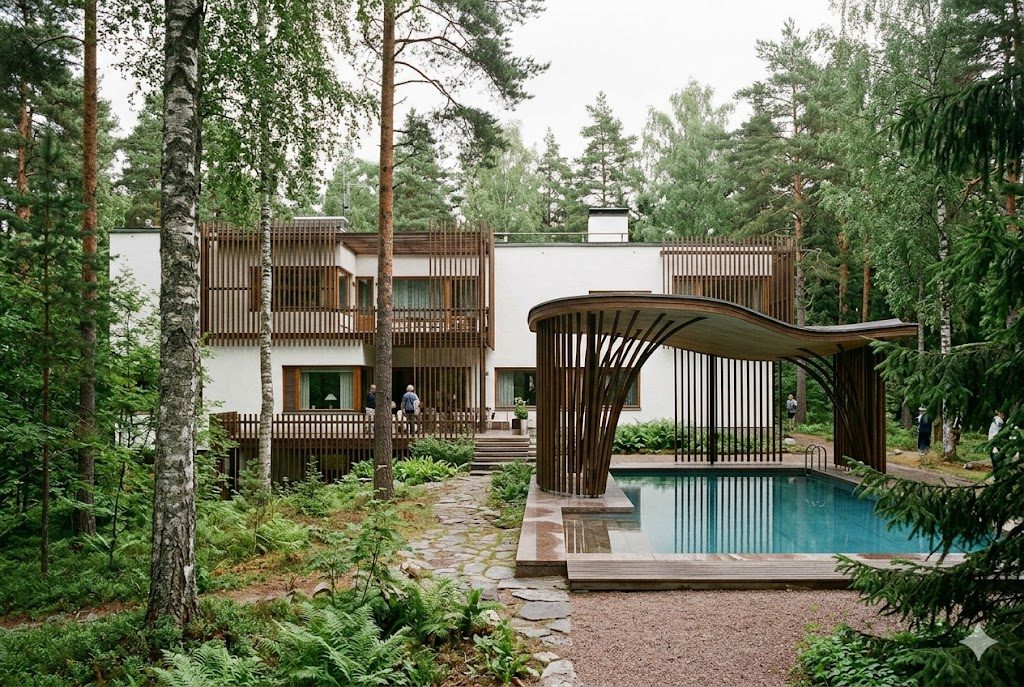
Villa Mairea, built for his friends and Artek co-founders Maire and Harry Gullichsen, is perhaps his most beloved house. Here modernism and the Finnish woodland fuse completely: slender columns are wrapped in rattan and birch as if echoing the trunks of the forest outside, the plan flows freely and irregularly, a sauna and a kidney-shaped pool sit among the pines, and the boundary between the white modern house and the dark northern forest is deliberately, lovingly blurred. It is the organic idea made domestic.
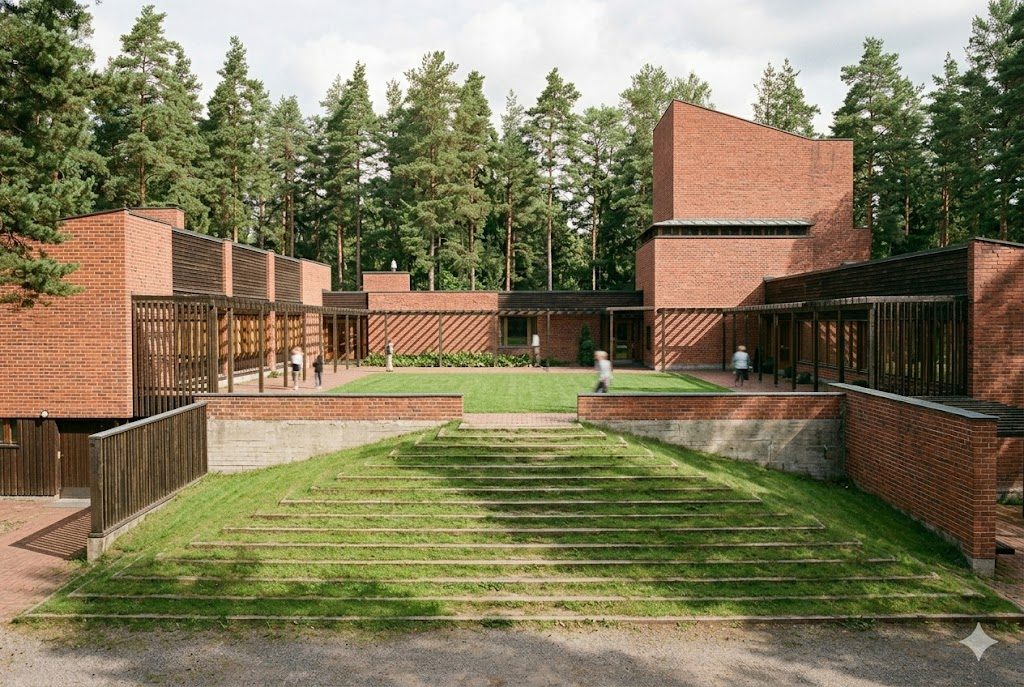
His civic masterpiece is Saynatsalo Town Hall. For a tiny forested municipality he built a council complex of warm red brick gathered around a raised inner courtyard — a courtyard you climb to by a flight of grass-planted steps, as if ascending into a clearing. From it rises the council chamber, its roof carried on splayed timber trusses that fan out like the branches of a tree. It is a building that gives a small place real dignity, and it shows Aalto's belief that even the humblest civic body deserves architecture of feeling.
Aalto's design did not stop at the wall. Through Artek, founded in 1935, he pioneered the bending and laminating of plywood into furniture that was light, organic and humane: the Paimio chair, the stacking Stool 60 with its patented L-shaped bent-wood leg, and a long line of trolleys, lamps and tables still in production today. In 1936 he designed the free-form Aalto vase — also called the Savoy vase — whose undulating outline, said to echo a Finnish lake shore, became one of the most recognisable objects of the century. Furniture, glass and building were for him one continuous act of care.
The philosophy
Aalto rarely wrote manifestos and distrusted those who did; he believed architecture was felt and made, not theorised. But his work amounts to one of the clearest philosophies in modern building, and it sits at the meeting point of two ideas this series traces in depth.
The first is human-centred design. Long before it became a discipline with a name, Aalto practised it absolutely: he started every problem from the person who would use the result, and he followed that person's comfort all the way down to the most minor fitting. The reclining patient at Paimio, the reader at Viipuri, the councillor at Saynatsalo — each room was tuned to a real human in a real posture, attending to light, sound, warmth, colour and touch together. You can read the lineage of that approach in our guide to what is human-centered design; Aalto is one of its founding figures.
The second is organic architecture. Like Frank Lloyd Wright, with whom he is often paired, Aalto believed a building should grow in harmony with nature and the human being rather than being imposed as an abstract form. But where Wright drew his organic line from the American prairie and the cantilever, Aalto drew his from the Finnish forest and the curving shoreline — translating the irregular, branching, flowing logic of the natural world into undulating ceilings, fan-shaped plans, timber columns and free-form glass. His organicism was northern, tactile and intimate. Explore that tradition in our guide to organic architecture explained.
Underlying both is his lifelong loyalty to natural materials. Aalto used reinforced concrete and steel and glass as freely as any modernist, but he refused to let them chill the room. He warmed them with brick laid by hand, with birch and pine, with leather, copper and bronze — materials that carry the marks of their making, that age into beauty rather than decay, and that connect an industrial building back to the forest and the craft it came from.
Aalto held that the true task of architecture is to stand on the side of the ordinary, frail, human being — to reconcile the machine with nature and the senses, so that a building shelters not just the body but the whole person.
India
Alvar Aalto never built in India, and this profile will not pretend otherwise. Yet few foreign architects speak more directly to the deepest instincts of Indian building than this Finn from the far north — because his core convictions are, in a different climate and idiom, India's own.
Consider his loyalty to local material and climate. Aalto built in brick and timber because they were the honest materials of his land, laid by the craftspeople of his region, and because they tempered the harsh northern light and cold. India's vernacular traditions run on exactly the same logic — laterite, lime, country brick, stone and local timber, worked by hand and chosen because they answer the place and the sun. Aalto's belief that the new architecture should grow out of regional material and craft, rather than arrive as an imported white box, is precisely the argument India's best modern architects had to win for themselves.
Consider, too, his obsession with softened, indirect light. In Finland the problem is too little sun; in much of India it is too much. But the design instinct is identical — never to admit raw glare, always to bounce, filter and temper daylight so a room is luminous without being harsh. Aalto's conical skylights and shaped ceilings are first cousins of the courtyard, the jali and the deep verandah that Indian builders have used for centuries to turn fierce sun into gentle light. His approach to daylight rhymes with the whole tradition of designing for the Indian climate.
And consider his humanism — his architecture for "the little man." This is the thread that ties him most closely to India's own masters. Laurie Baker, the British-born architect who became Indian, spent fifty years in Kerala building beautiful, dignified, climate-wise homes from local brick for ordinary people, letting the material make the ornament — an Aalto-like marriage of warmth, economy and respect. Charles Correa built his entire career on the conviction that climate and the human being, not imported style, should generate Indian form. And Frank Lloyd Wright, Aalto's great organic counterpart, sent his own organic conviction to India through his apprentice Nari Gandhi. Different hemispheres, one belief: that a building belongs to its place and serves the person inside it.
For contemporary Indian practice — designing for a hot, varied, deeply regional country, for clients who are usually the "little man" rather than the millionaire — Aalto offers a Western confirmation of an Eastern instinct. Use your own materials. Temper your own light. Begin with the body. Make modernism belong.
Legacy and what we can learn
Aalto's influence is quieter than Le Corbusier's or Wright's, but in some ways it has outlasted theirs. The warm, material, daylight-conscious, human-scaled strand of modern architecture — the one that gives us timber libraries, brick civic halls, soft-lit reading rooms and houses that meet the landscape gently — descends in large part from him. Generations of Nordic and then global architects learned from Aalto that you could be fully modern without being cold, and the whole contemporary interest in wellbeing, biophilia and sensory comfort in buildings is, in effect, catching up with what he did in 1933.
His furniture has had a second life entirely its own. The bent-plywood techniques he and Aino pioneered at Artek shaped a century of modern furniture, and Stool 60 and the Savoy vase still sit, undated, in homes around the world. Few architects have touched daily life at so many scales.
For anyone building or commissioning a home or a workplace today, his lesson is bracingly concrete. Start with the person who will use the room, and follow their comfort all the way down — to the light on the ceiling, the warmth underfoot, the sound in the hall, the feel of the door handle in the hand. Use real, regional materials that age well. Temper your daylight. Let the plan breathe and curve where life wants it to. The result will not be a fashion that dates, but a building that cares for you.
Aalto's principles live on in how we design today — at DesignAI you can explore warm, naturally lit, human-scaled interiors for your own home, and gauge how well a space connects you to nature and natural light with our biophilic score tool.
References
- Goran Schildt, "Alvar Aalto: The Complete Catalogue of Architecture, Design and Art" (Academy Editions).
- Goran Schildt, "Alvar Aalto: A Life's Work — Architecture, Design and Art" (Otava).
- Alvar Aalto, "Sketches" (collected essays and writings, ed. Goran Schildt, MIT Press).
- Richard Weston, "Alvar Aalto" (Phaidon, 1995).
- Sigfried Giedion, "Space, Time and Architecture" (Harvard University Press) — on Aalto and the irrational/organic in modernism.
- William J. R. Curtis, "Modern Architecture Since 1900" (Phaidon, 1996).
- Alvar Aalto Foundation / Alvar Aalto Museum, Jyvaskyla, archives.
Continue with Frank Lloyd Wright, Laurie Baker and Charles Correa, and read the philosophies he championed in what is human-centered design and organic architecture explained.
Philosophies they championed