
Balkrishna Doshi
First Indian Pritzker Laureate — who taught Indian modernism to belong to India
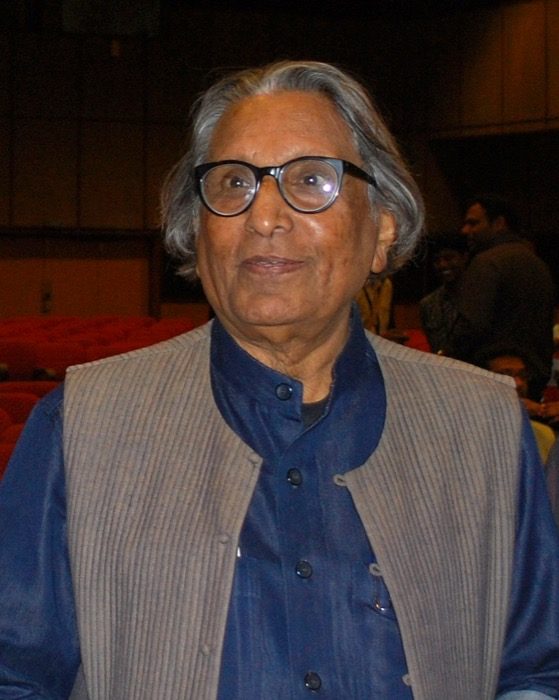
Photo: Sanyam Bahga, CC BY-SA 3.0, via Wikimedia Commons
Movements
Signature works
- Sangath studio, Ahmedabad (1980)
- Aranya Low-Cost Housing, Indore (1989)
- Indian Institute of Management Bangalore (1977–1992)
- CEPT University campus, Ahmedabad
- Amdavad ni Gufa (Hussain-Doshi Gufa)
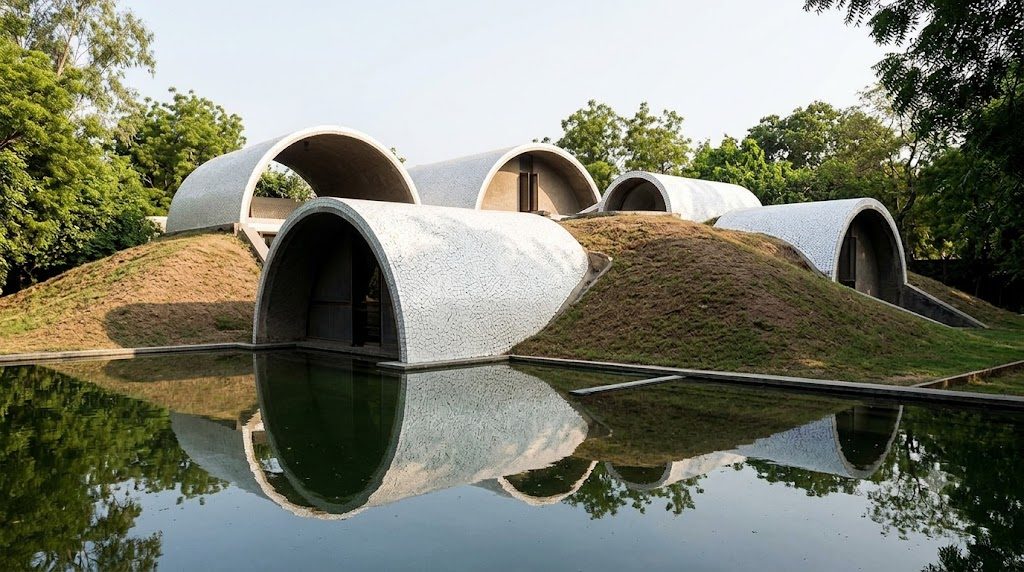
Step down into Sangath, and the city of Ahmedabad seems to fall away. The roofs are not roofs at all but long vaults of broken white china-mosaic, half-buried in grassed earth, curving low over a studio floor that has been sunk below the ground. Light arrives sideways and cool. A channel carries the last of the monsoon down the vault skins to a lily pool. You are inside a building, but it behaves like a landscape — and that was exactly the point.
Balkrishna Vithaldas Doshi — B.V. Doshi to almost everyone — was the architect who taught Indian modernism how to belong to India. Born in Pune in 1927 and dying in Ahmedabad in 2023, he carried the lessons of two of the twentieth century's giants, Le Corbusier and Louis Kahn, and bent them, patiently and without apology, toward the Indian sun, the courtyard, the festival and the ordinary family.
His central contribution was to prove that modern architecture did not have to be a foreign import. (For a close reading of his building skins — the earth-bermed china-mosaic vault, honest brick-and-concrete, and Aranya's incremental open-framework front — see our B. V. Doshi facade signature guide.) It could be grounded in climate, in community, in the rituals of Indian life — and still be rigorous, inventive and entirely of its time. In 2018 he became the first Indian architect to receive the Pritzker Architecture Prize, the discipline's highest honour, a recognition that arrived after six decades of building for, as he put it, the life that goes on around a building rather than the building itself.
The idea
Doshi's architecture begins with a refusal. He refused the idea that to be modern, a building in India had to look like a building in Chicago or Paris. He had been close enough to the masters of the International Style to know its power — and close enough to know its blind spots in a country of fierce heat, monsoon, scarcity and dense, layered communal life.
In their place he offered a different proposition: that the deepest sources of architecture were not styles but life itself — how people gather, where they find shade, how a threshold mediates between the family and the street, how a festival spills out of a house into a courtyard. Architecture, for Doshi, was the considerate making of the spaces where life unfolds. A wall was less interesting than the verandah beside it; a room less interesting than the in-between space — the chowk, the veranda, the shaded passage — that connected it to everything else.
This is why his buildings so often dissolve into the ground, open into courtyards, and treat circulation as the main event. It is also why he could move so naturally from a research institute to a low-cost housing settlement: in both, the real design problem was the same — to make a frame generous enough for people to fill with their own lives.
Five convictions run through everything Doshi built, and it is worth naming them at the outset because they recur in every project, large or small. First, that architecture exists for the people who use it, not for the eye that photographs it. Second, that climate and the courtyard are the architect's truest materials in India. Third, that housing the poor demands humility — give a family a beginning and let them finish it. Fourth, that an institution should be planned like a small city, with streets and squares and shade, so that life happens between the rooms. And fifth, that form, climate and craft should be a single idea, expressed in a material language of vaults, earth and broken china-mosaic.

Life and path
Doshi was born in 1927 into a Pune family connected to the furniture trade — an early, hands-on intimacy with making that never left him. He studied architecture at the Sir J.J. School of Art in Bombay, but his formation truly began when, as a young man with little money and less English, he made his way to Europe and into the orbit of Le Corbusier.
From the early 1950s — roughly 1951 to 1954 — Doshi worked in Le Corbusier's atelier on the Rue de Sèvres in Paris. It was an intense, sometimes bruising apprenticeship in the discipline of form, proportion and conviction. When Corbusier took on commissions in Ahmedabad, Doshi returned to India to supervise them on the ground, becoming the master's man in Gujarat and absorbing, at first hand, both the genius and the limits of imported modernism under the Indian sun.
A second, equally formative collaboration followed. When Louis Kahn was commissioned for the Indian Institute of Management in Ahmedabad, Doshi worked alongside him, helping to anchor Kahn's monumental brick masterpiece in its Indian setting. To have apprenticed under both Corbusier and Kahn — two architects who otherwise stand at opposite poles of modern thought — gave Doshi an unusually wide inheritance. The rest of his life was spent metabolising it into something of his own.
In Ahmedabad he established his practice, which he named Vastushilpa, and later the Vastushilpa Foundation for research into low-cost housing and urbanism. He was also a builder of institutions in the literal sense: in 1962 he founded the School of Architecture in Ahmedabad that grew into CEPT University, one of the most influential design schools in the subcontinent. For Doshi, teaching and building were never separate acts; the studio and the classroom were the same project. Honours accumulated late but decisively — the Pritzker Prize in 2018, the Padma Bhushan in 2020, and the RIBA Royal Gold Medal — before his death in 2023 at the age of ninety-five.

What he took from his two masters is worth naming precisely, because he was honest about it all his life. From Le Corbusier he absorbed a faith in form, in proportion and in the sculptural power of concrete — and, just as importantly, the courage to invent rather than copy. But he also watched, on the hot ground of Ahmedabad, how Corbusier's brise-soleil and raw surfaces sometimes struggled with the local climate, and he resolved to do better by it. From Louis Kahn he learned a slower, more meditative lesson: that materials have an order and a dignity of their own, that light is a primary building material, and that an institution can carry a sense of the timeless. Doshi often spoke of architecture in spiritual terms, of a building as something that should make the inhabitant feel calm and held; that sensibility owes much to Kahn. The synthesis — Corbusier's invention tempered by Kahn's gravity, both bent toward the Indian street — is the signature of everything he built afterward.
The signature works
Doshi's career is unusually legible: a handful of buildings, each one a clear argument. Together they trace an arc from the institution to the home, and from monument to community.
| Work | Place & date | Why it matters |
|---|---|---|
| Sangath | Ahmedabad, 1980 | His own studio: earth-bermed china-mosaic vaults, a sunken floor and water channels — climate and craft fused into one form. |
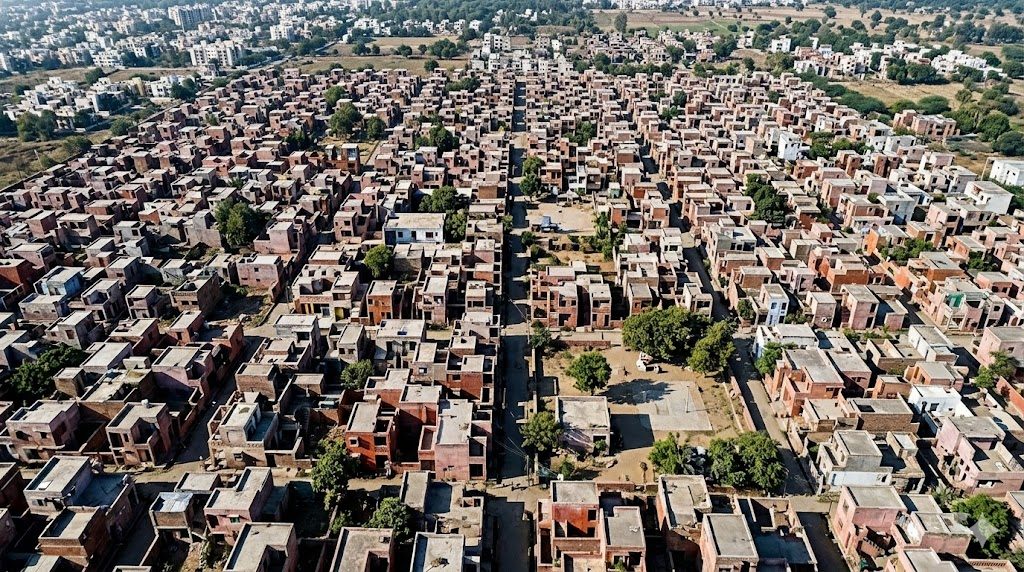
| Aranya Low-Cost Housing | Indore, 1989 | An incremental township for some 80,000 people; won the Aga Khan Award. Doshi designed the streets, cores and services, and let families build the rest. |
| IIM Bangalore | 1977–1992 | A campus of corridors and courtyards drawn from Fatehpur Sikri — a learning city of shaded streets, pergolas and stone. |
| Amdavad ni Gufa | Ahmedabad, 1990s | The cave-like underground gallery (the Hussain-Doshi Gufa) built with painter M.F. Husain — domes and grottoes for art. |
| CEPT campus | Ahmedabad, from 1960s | An open, porous school of architecture with few doors and many thresholds — the building as a pedagogy. |
| Tagore Memorial Hall & Premabhai Hall | Ahmedabad | Early concrete public works, muscular and Corbusian, where his civic ambitions first took built form. |
Sangath (the word means "moving together") is the key that unlocks all the rest. Completed in 1980 as Doshi's own office, it sinks below grade for coolness, vaults its roofs in a low chain of forms covered in earth and broken china-mosaic, and lets monsoon water run off the vaults in channels to a small amphitheatre and pool. It is at once a workplace, a garden and a manifesto: architecture as climate, landscape and craft, indivisible.
Aranya, near Indore, is the social conscience of the practice. Rather than impose finished flats on the poor, Doshi and the Vastushilpa Foundation laid out an entire township of plots, each with a built core — a room, a service wall, a toilet — and a clear set of rules, then let residents complete and extend their own houses over time. The result is a living settlement of courtyards and narrow shaded streets that has grown organically while remaining coherent, and which won the Aga Khan Award for Architecture. It remains one of the most-studied examples of incremental, dignified, low-cost housing anywhere.
IIM Bangalore, built across the 1970s and 80s, is the campus as a city. Doshi looked back to Fatehpur Sikri — Akbar's red-sandstone city of courts and corridors — and translated its logic into a modern institute: long pergola-shaded corridors, interlocking courtyards, and stone surfaces softened by planting, so that the spaces between the lecture halls become the real life of the place. Learning, the building insists, happens in the in-between.
The same climatic intelligence that animates the campus runs through the section of his smaller buildings, and Sangath shows it most clearly. The diagram below traces how the studio works: the floor sunk below grade so the earth itself moderates temperature, the vaults bermed with grassed earth, the white china-mosaic skin throwing back the harsh sun, and the channels that gather the monsoon off the curved roofs and walk it down to a pool. Nothing here is decorative; every move is a response to heat, light or water.

Alongside these landmarks sit the smaller works that complete the portrait. The Amdavad ni Gufa, made with the painter M.F. Husain, is a half-buried gallery of interlocking domes and grottoes — an architecture of caves for an artist's imagination. The Tagore Memorial Hall and Premabhai Hall are robust early concrete works where his civic voice first found scale. And projects such as the Life Insurance Corporation housing in Ahmedabad extended his housing thinking into the formal middle-class flat, exploring how units could interlock and share without losing the dignity of a home. Across all of them, the through-line is constant: shade, threshold, courtyard, and a deep respect for how Indians actually inhabit space.
The philosophy
Doshi is most often, and rightly, described as a master of critical regionalism — the conviction that good architecture resists both bland international sameness and nostalgic pastiche, instead drawing on the climate, materials, light and culture of its place while remaining fully modern. His whole life's work is a sustained argument for that position. He took the abstractions of Corbusier and Kahn and re-rooted them in Indian ground: the courtyard, the verandah, the festival, the monsoon, the way an Indian family actually lives. To understand the lineage he carried forward, see what is critical regionalism.
His early public buildings — the Tagore and Premabhai halls — also place him within the story of Brutalism: board-marked, sculptural concrete shaped for the Indian sun. But where much Brutalist work prized its own monumentality, Doshi quickly turned the language toward shelter, shade and the human scale, softening raw concrete with planting, water and the textures of craft.
Above all, Doshi belongs to the tradition of human-centered design. Aranya, CEPT and his housing research all begin from the same question — what do people actually need to live well? — and trust the inhabitant to complete the architect's work. He saw the building as a beginning, not an end; a generous, unfinished frame.
For Doshi, a house was not an object to be admired but a setting for life — and the highest praise a building could earn was that people made it their own.
India
For an Indian architect, India is not a chapter; it is the whole book — and Doshi's is among the most consequential careers in the country's modern history. He arrived just as independent India was building its institutions, and he helped give them architectural form. Ahmedabad, his adopted city, became a laboratory: through Corbusier's commissions, Kahn's IIM, and then his own Sangath, CEPT, the Gufa and a stream of civic and academic buildings, Doshi turned a Gujarati industrial town into one of the great destinations of modern architecture in Asia.
His influence runs even deeper through teaching. By founding the school that became CEPT, he shaped generations of Indian architects, embedding in them the idea that climate, community and craft were not constraints to be overcome but the very material of design. The Vastushilpa Foundation took that ethos into the hard problem of housing the poor, producing in Aranya a model that planners across the developing world still study.
His lessons map directly onto the questions Indian designers face today — how to build for heat and monsoon, how to use the courtyard, how to make modern homes that still feel Indian. Those threads run through guides on climate-responsive courtyard homes and sustainable home design in India, and they sit at the heart of any honest contemporary Indian practice. When the Pritzker jury honoured him in 2018, it was not only crowning a single architect; it was acknowledging an entire way of building that India had given to the world.
Legacy and what we can learn
Doshi's influence is visible in nearly every Indian architect who takes climate and community seriously — and his ideas resonate far beyond India, in any place wrestling with how to be modern without becoming placeless. He stands in close kinship with his teachers, Le Corbusier and Louis Kahn, and with his great contemporary Charles Correa, with whom he shared the project of inventing an architecture that was modern, Indian and humane all at once.
The practical lesson for today is quietly radical: design the frame, then trust the inhabitant. Doshi's best work — Aranya above all — succeeds because it leaves room for life to complete it. He reminds us that orientation, shade, courtyard and threshold are not decorative afterthoughts but the structure of comfort itself; that a building set into the earth and skinned to reflect the sun can be cooler, calmer and more beautiful than one that fights the climate with machinery. For anyone designing a home in India, those are not historical curiosities but working tools — the kind of climate-and-life thinking you can begin to test with a biophilic score.
His principles — climate, courtyard, community, craft — live on in how we design today, and you can bring the same instincts to your own spaces with DesignAI.
References
- The Pritzker Architecture Prize, 2018 Laureate citation and jury statement, Balkrishna Doshi.
- William J.R. Curtis, "Balkrishna Doshi: An Architecture for India" (Rizzoli / Mapin).
- William J.R. Curtis, "Modern Architecture Since 1900" (Phaidon).
- Vastushilpa Foundation / Sangath archives, Ahmedabad.
- The Aga Khan Award for Architecture, Aranya Community Housing, Indore — project documentation.
- Balkrishna Doshi, "Paths Uncharted" (selected writings and reflections).
- RIBA Royal Gold Medal materials on Balkrishna Doshi.
Explore the philosophies Doshi championed — critical regionalism, Brutalism and human-centered design — and the architects beside him: Le Corbusier, Louis Kahn and Charles Correa.
Philosophies they championed