
Tadao Ando
The self-taught boxer who builds with concrete, water and light
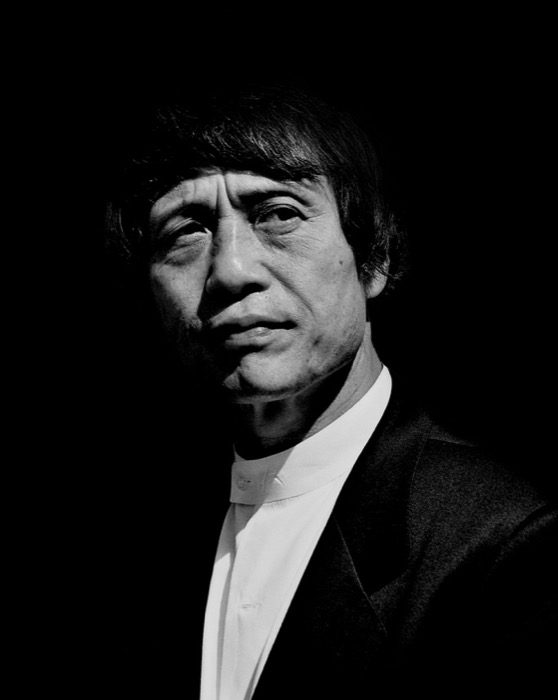
Photo: Christopher Schriner, CC BY-SA 2.0, via Wikimedia Commons
Movements
Signature works
- Row House (Azuma House), Osaka (1976)
- Church on the Water, Hokkaido (1988)
- Church of the Light, Osaka (1989)
- Chichu Art Museum & Benesse House, Naoshima
- Modern Art Museum of Fort Worth (2002)
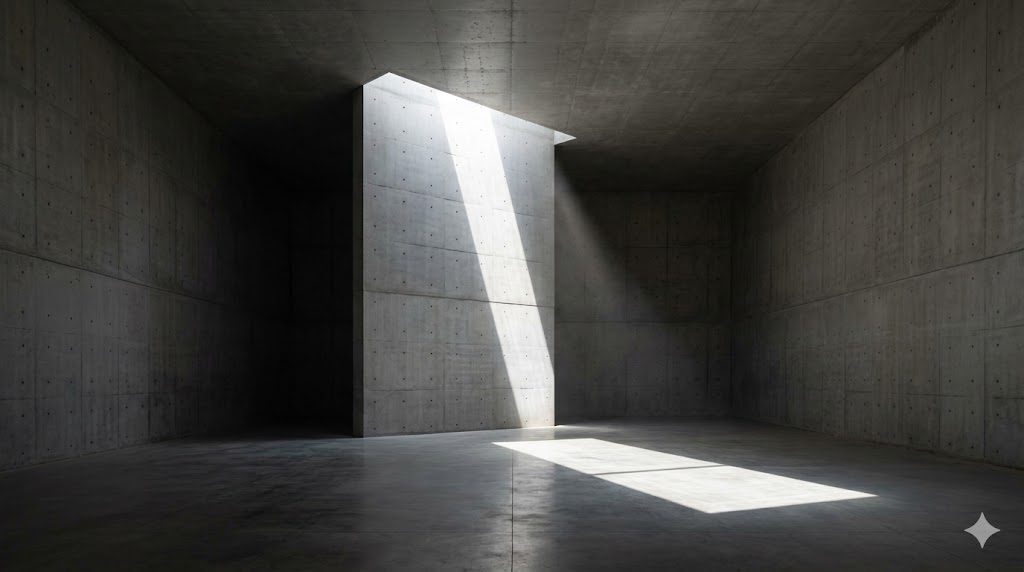
Step out of the noise of Osaka and into a plain concrete box in Ibaraki. The room is bare. The walls are smooth grey concrete, almost soft to the eye. The floor steps down toward a wall, and behind the altar that wall is cut — a thin vertical slit and a thinner horizontal one crossing it. Through that cut, daylight pours in the exact shape of a cross. There is no painted symbol, no stained glass, no ornament of any kind. The cross is not a thing hung on the wall. It is an absence. It is made entirely of light.
This is the Church of the Light, and the man who designed it is Tadao Ando — a former boxer from Osaka who never went to architecture school, taught himself the discipline by travelling and by studying buildings, and went on to win the Pritzker Architecture Prize, the field's highest honour. He is, by common consent, one of the great living architects.
Ando's contribution is a paradox carried out in the hardest of materials. Working almost entirely in smooth, fair-faced concrete and pure geometry, he makes buildings whose real subject is the immaterial — light, water, wind, shadow, silence and emptiness. He takes the deep Japanese sensibilities of restraint, of nature, of the charged void called "ma," and of the beauty of plainness called wabi-sabi, and gives them a wholly modern, abstract form. His architecture does not decorate; it concentrates. It removes everything so that you finally notice the sun moving across a wall. (For a close reading of his building skins — the silky off-form concrete, the tatami-proportioned formwork panel and the signature tie-hole grid — see our Tadao Ando facade signature guide.)
The idea: building with light, water and emptiness
Most architects think of light as something that arrives after the building is made — you cut a window, and light comes in. Ando reverses this. For him, light is a building material as real as concrete, and the concrete exists largely to give that light something to act upon.
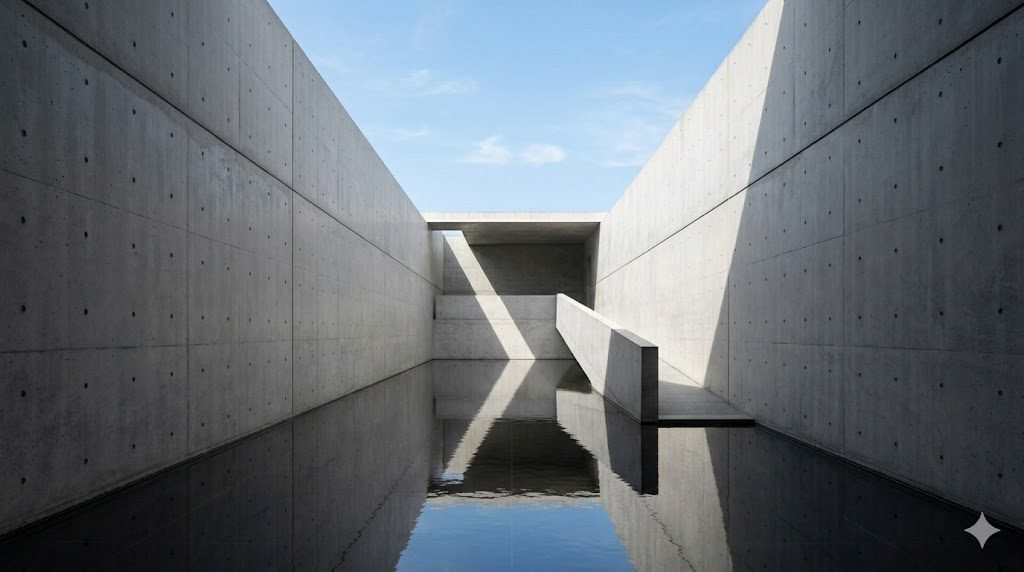
A solid wall is poured. Then it is cut, precisely, so that at a certain hour the sun lays a blade of brightness across its surface. A pool of water is set beside a chapel so that the sky and the chapel are doubled, trembling, in its reflection. A long approach is walled on both sides so that you cannot see your destination until you turn the final corner and it is suddenly revealed. The drama is built from nothing you can touch — sun, sky, water, the act of walking.
This is why his concrete matters so much. Ando's concrete is famous for being almost impossibly smooth and even, with the form-tie holes left in a calm regular grid, like a quiet rhythm. It is what the Japanese tradition would call honest: it is not clad in marble or plaster, it is simply itself, its own finish. And because the surface is so plain and uniform, it becomes a near-perfect screen. Light has nothing to compete with. Shadow reads cleanly. The concrete is the blank page; light writes on it.
Underneath all of it sits a deeply Japanese idea: that emptiness is not nothing. The interval, the pause, the bare room, the void in the plan — these are charged, active, meaningful. Ando does not fill space; he composes it and then leaves it alone, trusting silence to do the work.
Life and path: the boxer who taught himself
Tadao Ando was born in 1941 in Osaka and grew up in its working districts. His route into architecture is one of the most unusual of any major figure in the field, and it shaped everything about him. As a young man he boxed; he did not attend a university school of architecture. He had no professor, no formal training, no obvious door into the profession.
Instead he taught himself. He read, he visited buildings, and above all he travelled — through Japan, then to Europe, the United States and beyond in the 1960s — studying the great works of architecture directly, by standing inside them. He absorbed both his own country's traditions, the temples and tea houses and timber houses with their discipline of proportion and emptiness, and the lessons of Western modern masters. He has often spoken of the importance of Le Corbusier to his formation; studying that work was part of how he built his own architectural mind from the outside in.
In the late 1960s he established his own practice in Osaka, working at first on small houses on tight, difficult urban sites — exactly the kind of cramped plots a young, unconnected architect could get. Out of these constraints came his breakthrough. He was not handed grand commissions; he made small, severe, uncompromising buildings, and the world slowly came to him. By the 1980s his reputation had spread internationally; in 1995 he received the Pritzker Prize, an extraordinary arrival for a self-taught outsider. He has also taught — including at the University of Tokyo — and has remained, into his eighties, one of the most recognisable voices in world architecture.
His self-teaching is not a footnote; it is the key. Because no one taught Ando the "right" way to make a building, he built from conviction rather than convention. The severity, the singularity, the refusal to dilute an idea — these come from a man who answered to no school but his own eyes.
The signature works
Ando's buildings reward being read one at a time, because each is an experiment in how little is needed to produce a powerful experience.
| Work | Place & year | Why it matters |
|---|---|---|
| Row House (Azuma House) | Sumiyoshi, Osaka, 1976 | The breakthrough. A tiny concrete house whose centre is an open-air courtyard. To cross from one room to another you must step outside into the open — sun, rain or cold. Comfort is traded for a daily, intimate contact with nature and sky. |
| Koshino House | Hyogo, 1980s | Two long concrete bars set into a wooded slope, joined by light. A study in how solid geometry can sit quietly in nature and let the trees and sun do the speaking. |
| Church on the Water | Hokkaido, 1988 | A chapel that opens fully onto a still, man-made pool with a cross standing in the water. Nature, framed by concrete, becomes the altarpiece. |
| Church of the Light | Ibaraki, Osaka, 1989 | His most famous image. A plain concrete box; the end wall cut with a cruciform slit so that light itself forms the cross. Absence and daylight do the work of ornament. |
| Benesse House & Chichu Art Museum | Naoshima, 1990s–2000s | On a small island, Ando helped turn a place into a destination for art. The Chichu Art Museum is largely buried underground, lit from above by carefully shaped openings, so the art is seen by daylight that is sculpted rather than switched on. |
| Modern Art Museum of Fort Worth | Texas, USA, 2002 | A major American museum: long concrete and glass pavilions set beside a broad reflecting pool, so the galleries seem to float on water. |
Beyond these, his reach is wide. He created the Pulitzer Arts Foundation in St. Louis; he reworked historic Venetian buildings into contemporary art spaces, including the Punta della Dogana; and at the Hill of the Buddha in Sapporo he set a great Buddha statue within a hill, approachable through a long passage and revealed beneath an open ring of sky. Across all of it, the constants hold: pure geometry, fair-faced concrete, water, and light treated as the principal guest.
What links these very different projects — a one-room chapel, an underground museum, a buried Buddha, a Texan art gallery — is a single attitude toward the visitor. Ando never lets you arrive instantly. He makes you walk, turn, descend, wait, and only then delivers the view. At the Hill of the Buddha you do not see the statue from the road at all; you pass through a long, narrow, walled corridor, and the great head appears only at the end, crowned by the open sky. At Chichu you go down into the ground, away from the bright island, so that when daylight reaches a gallery it feels found rather than given. This choreography of delay and reveal is as central to his work as the concrete itself. The building is not an object to be photographed; it is a sequence to be moved through, an experience that unfolds in time.
The philosophy: a modern face for an old sensibility
Ando is usually described in Western terms — a minimalist, a modernist working in concrete. Both are true on the surface. But his roots run into older soil.
His work is, first, an expression of Japanese architecture carried into the present. The discipline of the bare room, the careful proportion, the love of natural materials weathering honestly, the sense that a space should connect you to season and time of day — these are the values of the temple and the traditional house, abstracted into concrete and glass. He keeps the spirit while changing the material.
It is also deeply connected to wabi-sabi — the Japanese aesthetic that finds beauty in plainness, imperfection, age and transience. Ando's bare grey surfaces, his refusal of decoration, his interest in how light and shadow shift and how concrete will weather — all of this is wabi-sabi translated into the modern idiom. Beauty, for Ando, is not added; it is what is left when everything unnecessary has been removed.
And his career is one of the clearest cases of critical regionalism — the idea that the best modern architecture resists becoming a placeless international product, and instead binds the universal techniques of modern building to the light, climate, culture and feeling of a specific place. Ando uses the universal language of concrete and pure geometry, but he bends it to a Japanese sense of nature, restraint and emptiness. The result is unmistakably modern and unmistakably of its place.
Ando has often returned to a simple conviction: that he wants people, inside his buildings, to feel nature — the light, the wind, the rain, the passing of the day — rather than be sealed away from it.
India: why Ando matters for how we build here
Ando has no famous building in India, and it would be wrong to invent one. His importance to Indian architecture is real but indirect — and, once you see it, very large.
For Indian architects and students raised on the long shadow of Le Corbusier and Louis Kahn — both of whom built in raw, board-marked concrete here, at Chandigarh and at Ahmedabad — Ando offers the other face of concrete. Where their concrete is muscular and rough, his is smooth, silent and contemplative. He proves that the same humble, locally available material that built so much of modern India can also be made serene. In a country where reinforced concrete is the default of almost every home and building, that is a profound and practical lesson: exposed concrete, done with care, need not be brutal — it can be calm.
His treatment of light speaks directly to Indian conditions. India is a land of fierce, abundant sun. Ando's lesson is that this sun is not a problem to be merely blocked but a resource to be shaped — admitted through a slit, bounced off a wall, filtered and choreographed. That is exactly the instinct behind the courtyard homes of our own tradition and behind serious passive design across India's climate zones: you do not fight the sun, you compose with it. The Sumiyoshi courtyard — a house split open to the sky — is, in its way, a radical cousin of the Indian courtyard house, which for centuries has organised the home around an open square of light and air.
There is a temperamental kinship, too, with India's own quieter modernists. The restraint and material honesty that Laurie Baker brought to brick, or the meditative spatial sense in the best Indian work, share Ando's belief that less surface can mean more feeling. And for the growing Indian appetite for calm, uncluttered interiors, Ando is a touchstone — his discipline underlies a great deal of minimalist architecture in the Indian context, where the goal is not coldness but a kind of curated emptiness in which light and material can be felt.
It is worth being honest about the gap, too, because that is where the real lesson lies. Ando's smooth fair-faced concrete is the product of exacting formwork, fanatical site supervision and a building culture willing to pay for getting one surface perfect. In India, where speed and cost pressures are relentless and exposed concrete is too often patched and painted over, achieving an Ando-grade wall is genuinely hard. But the ambition translates even when the finish cannot be matched exactly: design the building so that its few surfaces are the right ones; give light a clean plane to fall on; let a courtyard or a water body do the cooling and the drama that an expensive material never could. For an Indian practice, the takeaway is not "pour Japanese concrete" but "concentrate your effort." Decide what the one unforgettable moment of the house will be — a shaft of morning light down a stair, the reflection of the sky in a shallow pool, a threshold that opens onto a framed garden — and spend your care there.
Legacy and what we can learn
Ando's influence is everywhere, often invisibly. A generation of architects across the world learned from him that a single material, handled with total conviction, can carry an entire building — and that the most luxurious thing a space can offer is not finish or fittings but silence, daylight and a view of the sky. The smooth-concrete-and-water aesthetic of countless contemporary museums, chapels, hotels and houses traces back, in part, to his example.
For anyone designing today, in India or anywhere, his work suggests a few durable lessons. Restraint is a discipline, not a deprivation: removing things is harder and braver than adding them. Light is a material — plan for where the sun will fall, not just where the windows go. A building should be experienced as a journey of thresholds and reveals, not consumed in a single glance. And honesty in material — letting concrete be concrete, brick be brick — ages far better than disguise.
Perhaps the deepest lesson is biographical. A boxer with no degree, working on scraps of land in Osaka, built an architecture so singular that the world reorganised itself around it. Ando is proof that conviction, patience and the willingness to look hard at real buildings can matter more than pedigree.
These principles — light treated as material, restraint as luxury, nature invited inside — live on in how we approach space at DesignAI, where the aim is rooms that feel calm, considered and connected to light rather than merely filled.
References
- The Pritzker Architecture Prize, 1995 Laureate citation and jury statement, Tadao Ando.
- Tadao Ando, "Tadao Ando: Complete Works" (Phaidon) — collected projects and the architect's own writings.
- Kenneth Frampton, "Modern Architecture: A Critical History" — on critical regionalism and Ando's place within it.
- William J. R. Curtis, "Modern Architecture Since 1900" — context for late-modern and regionalist currents.
- Masao Furuyama, "Tadao Ando" (Taschen) — survey monograph of the major works.
- Philip Jodidio, "Ando: Complete Works" (Taschen) — illustrated overview of the buildings.
To continue: read about the philosophies Ando carries forward in Japanese architecture, wabi-sabi architecture and critical regionalism; meet the modern masters whose concrete he answered, Le Corbusier and Frank Lloyd Wright; and see how his calm runs through minimalist architecture in the Indian context. To shape your own light, try the Sun Path Analyzer.
Philosophies they championed