
Charles Correa's Façade Signature: How India's Master Made the Climate-Correct Wall
How Charles Correa eroded the flat sealed wall into deep, shaded, porous layers — verandahs, terraces, pergolas and open-to-sky courts — so the Indian façade filters sun and drives air instead of sealing it out.
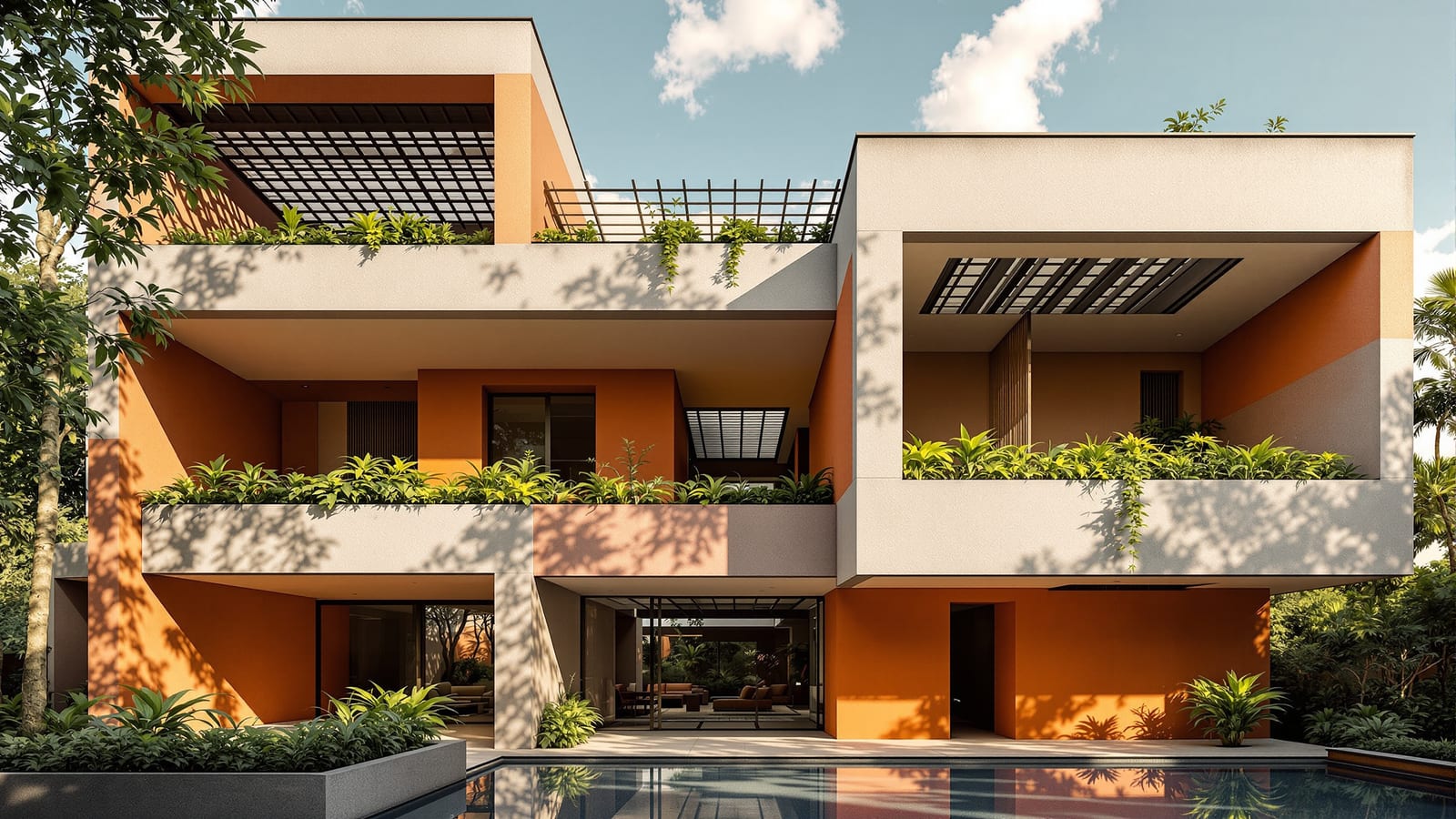
Stand in front of a Charles Correa building and you quickly notice what is missing: there is no single flat wall to look at. Where you expect a sealed surface, the building has been carved open — a deep verandah here, a double-height terrace there, a pergola throwing a grid of shadow, a sliver of courtyard open straight to the sky. The façade is not a skin stretched over the building. It is a series of shaded layers you can almost step into. The sun never reaches the inner wall directly; it is filtered, broken and cooled by everything Correa has placed in front of it.
This was not decoration. It was the whole point. Correa (1930–2015), widely called independent India's greatest architect, spent his career answering one stubborn question: how should a wall behave in a hot country? His answer — "form follows climate" — became the most important idea in modern Indian architecture. A building in Mumbai or Ahmedabad does not need a glass curtain wall that traps heat and then fights it with air-conditioning. It needs a façade that does what the old verandah, courtyard and jaali always did: shade the wall, slow the sun, and pull air through the rooms.
This is part of our Building Façades series — specifically our Masters of the Façade set, profiling how a single great architect designed façades. We already cover the man in our Charles Correa biography and one building in depth in our Kanchanjunga Apartments case study, so we will not repeat those here. This article is narrowly about his façade language — and because Correa's entire project was the climate-correct Indian wall, it is also the most India-relevant article in this whole set. Read it alongside our climate-responsive façades guide, the jaali and traditional Indian façades guide, and the brise-soleil and louvre façades guide.
1. "Form follows climate" — the façade as a climate device first
The American architect Louis Sullivan gave the twentieth century its slogan, "form follows function." Correa rewrote it for the tropics. In a famous 1980 lecture he made form follows climate — the idea that in a hot country the climate, not the structural frame or the fashion, should shape the building — into a rallying cry for Indian architects.
What this means for the façade is simple but radical. The first job of a wall in India is not to look modern or to maximise glazed views. It is to manage the sun, the heat and the monsoon rain. So before Correa decided what a building looked like, he decided what the building had to do to the climate — and the look followed from that. The façade is therefore a climate device: an instrument for shading, ventilating and cooling, whose appearance is the by-product of doing that job honestly.
This put him directly against the glass-and-steel tower being imported from cooler countries. A sealed glazed box in Mumbai is a greenhouse; it overheats by day and can only be made liveable with relentless mechanical cooling. Correa rejected that approach. This is the same climate logic our Le Corbusier façade guide describes — Corbusier gave India the deep concrete sun-breaker at Chandigarh — but Correa took it further and made it tropical, open and rooted in Indian living patterns rather than imposed on them.
2. Open-to-sky space — the most important room has no roof
Correa's single most original idea was open-to-sky space: in a warm climate, he argued, the most important "room" in a house is the one open to the sky. The terrace, the courtyard, the verandah — the half-outdoor spaces where Indians actually sleep on hot nights, dry their chillies, sit in the evening — are not leftover bits between the real rooms. They are the heart of the home.
"There is nothing so profoundly moving as stepping out into that open-to-sky space and feeling the great arch of the sky above," he said. He treated these spaces as fully designed rooms — and that decision is what shapes his façades. Because the open-to-sky room is carved into the building mass, the wall around it becomes deep, layered and porous rather than a flat sealed plane. A Correa façade has pockets of shadow and sky punched into it: the building breathes through these openings, light floods in sideways, and air moves through naturally.
This is the opposite of the sealed glass tower, where the most important room is the air-conditioned interior and the façade is a continuous barrier against the outside. Correa inverts it. The wall is not a barrier; it is a filter with shaded outdoor rooms built into it.
Open-to-sky and the layered façade
Here is the technical heart of Correa's façade language, and the core Indian lesson.
A conventional modern wall is a single plane: glass or masonry, sun hitting it directly, heat passing straight through into the room behind. Correa erodes that plane. Instead of one surface doing all the work, he stacks several shaded layers in front of the inner wall, so the sun is intercepted again and again before it can reach a heated room:
- A deep verandah — a roofed, open-sided outdoor corridor — sits in front of the living spaces, so direct sun lands on the verandah floor, not on the glass.
- A double-height terrace — an open-air room two storeys tall — is cut into the mass, giving a tall protected pocket of shade.
- A pergola — an open grid of beams overhead — throws a lattice of shadow over courts and terraces, cutting glare without sealing them.
- A courtyard or open-to-sky court draws light and air deep into the plan from above rather than through the outer wall.
- Jaali — a perforated screen — and deep window reveals shade the actual openings.
Define this as the deep, layered, porous façade: the wall is no longer a thin skin but a thick zone of shade, perhaps two or three metres deep, made of in-between spaces. Sun is filtered through these layers; air is invited through the gaps. Combine it with thermal mass — heavy concrete, stone or brick that absorbs heat slowly during the day and releases it at night — and the interior stays cool without machinery.
This is the single most important move in this whole series for India. The imported answer is to seal the wall and chill the air behind it. Correa's answer is to open the wall into shaded layers so it filters the sun and moves the air for you. One fights the climate; the other works with it.
3. The tube house — shaping the section to drive air
In the 1960s Correa designed the Tube House in Ahmedabad as low-cost housing, and it shows his façade thinking at its most stripped-down. The house is a long, narrow strip — only about 3.6 metres (12 feet) wide — with a dramatically sloped roof. Here the section, not the elevation, is the façade.
The trick is stack-effect (also called chimney) ventilation: hot air rises, so if you let it escape high up, it pulls cool air in low. Correa placed a low inlet at one end and a high vent at the apex of the sloping roof. Warm air rises along the slope and escapes through the high slit; that suction draws cooler air in at the bottom, setting up a continuous convection current that ventilates and cools the house with no fan and no power. The steep roof also shades the inner volume from the harsh Ahmedabad sun, and a small internal court is covered with a pergola grid for shade and security.
The lesson is that the very shape of the building — its cross-section and roof profile — can become a passive cooling machine. The façade is shaped by airflow. Correa drew on the wind-catcher houses of Sind for the principle, then turned it into a buildable, award-winning model for affordable Indian housing.
4. The section as the real façade
At Kanchanjunga and the tube house alike, the most important "drawing" is not the elevation but the cross-section — what Correa called designing the section as façade. The way the rooms are stacked, stepped and interlocked in section is what produces the shaded pockets you see on the outside.
His signature device here is the interlocking section: apartment units shifted vertically against each other so that the gaps between them become protected open-air rooms. At Kanchanjunga, several unit types are interlocked at staggered levels, and the half-level shifts open up double-height terraces — open-air garden rooms two storeys tall, cut into the corners of the tower. Because each flat has its verandah carved into the corner, no flat faces Mumbai's harsh western sun or driving monsoon rain directly: the deep terrace is a buffer, a first line of defence, exactly as the wrap-around verandah protected the old Mumbai bungalow. The dramatic stepped silhouette of the building is simply the section made visible.
5. Honest local materials — and bold colour
Correa rejected the glass-and-steel palette and built instead with honest local materials: in-situ concrete, local stone, laterite, brick, plaster. These are heavy, high-thermal-mass materials that keep interiors cool, and they are buildable anywhere in India by local labour without imported components.
He also used colour fearlessly. Where many modernists left concrete grey, Correa painted façades in bold ochres, reds and earth tones drawn from Indian towns and folk traditions. Colour, for him, was not a finishing touch but part of the cultural identity of the wall — a way of rooting a modern building in its place rather than making it look like it had landed from a colder, paler country.
6. Geometry rooted in Indian cosmology — the mandala plan
Correa's façades were never only about climate; they also carried meaning. His deepest engagement with symbolism is the mandala / navagraha plan at the Jawahar Kala Kendra in Jaipur (designed 1986, completed 1991). He laid the arts centre out as nine interlocking squares — the navagraha or nine-house yantra that governed Jai Singh II's original plan of Jaipur — with one square pivoted out to mark the entrance, exactly as one square is displaced in the historic city.
The façade carries that cosmology outward. High walls of red sandstone define the squares, echoing Jaipur's old fortification walls, and each planet's symbol is inlaid into the sandstone in white marble and granite. The wall becomes a symbolic surface — a ritualistic pathway through a building that doubles as a diagram of the cosmos. This is the ceremonial, processional side of Correa: the façade not just as a climate filter but as a carrier of Indian myth and memory.
Real buildings, not renders
Five verified projects, and how the façade actually works in each:
- Kanchanjunga Apartments, Mumbai (1970–83). A tall tower whose interlocked units open up double-height verandah-terraces cut into the corners. The alternating deep open terraces and solid walls give the famous stepped silhouette — and shield every flat from sun and monsoon. See our full Kanchanjunga case study.
- Tube House, Ahmedabad (1960s). Low-cost housing whose steep-roofed, narrow section drives stack-effect ventilation: cool air in low, warm air out through a high roof slit. An award-winning demonstration that climate-correct design could be affordable.
- Jawahar Kala Kendra, Jaipur (1986–91). A nine-square navagraha mandala plan; red sandstone façades with planetary symbols inlaid in marble and granite. The most symbolic façade Correa built.
- Kala Academy, Goa, Panaji (1973–83). A cultural centre on the Mandovi riverfront where the upper floors form a continuous roof over an open ground level. Smooth concrete beams and pergolas play against textured laterite walls, and pedestrian routes are drawn through open-to-sky courts to the river edge — a building that is mostly verandah, court and shaded in-between space.
- Gandhi Smarak Sangrahalaya, Sabarmati, Ahmedabad (1958–63). The Gandhi memorial museum, built as a grid of modular pavilions with tiled pyramidal roofs, brick walls and stone floors around a water court. There is no glass anywhere; light and air come through openable wooden louvres and the open-to-sky courts woven between the pavilions — the vernacular village made into modern architecture.
(His British Council, New Delhi (1992) adds a more symbolic note: the front carries a large mural by Howard Hodgkin, the wall as image rather than as climate filter.)
What this means for India
This is the heart of the matter. Correa already solved the climate-correct Indian façade decades ago. The lesson is not to invent something new — it is to stop doing the wrong thing.
The wrong thing is the air-conditioned sealed glass tower: a continuous glazed skin that overheats in our sun, traps that heat, and then masks the problem with permanent mechanical cooling and a permanent electricity bill. It is the imported answer, designed for cold cities, and in India it fights the climate every hour of the day. Our climate-responsive façades guide spells out why that approach is so costly here, and our Norman Foster façade guide shows that even the masters of the glass tower only made it work by burying serious environmental engineering inside the skin.
Correa's answer is to do the opposite. Stop sealing the wall. Instead:
- Layer the wall with shade — deep verandahs, terraces, pergolas, deep window reveals and jaali screens, so the sun is filtered through shaded in-between zones before it touches a heated room. See the jaali and brise-soleil and louvre guides for the specific devices.
- Drive ventilation through the section — use the stack effect, the courtyard and the cross-breeze, as the tube house does, so air moves without fans.
- Use thermal mass and honest local materials — concrete, stone, brick, laterite — that buffer the day's heat and cost nothing to import.
- Rediscover the open-to-sky room — bring back the terrace, the courtyard and the verandah as designed spaces, not afterthoughts.
These moves are low-tech, low-cost and locally buildable. They are not luxuries for landmark buildings; they belong in ordinary homes. The honest caveat: open, porous façades need genuinely good rain detailing for the monsoon — flashings, drips, slopes and drains all worked out — and they are harder on dense, secure or polluted urban sites where you cannot simply open the wall to the street. But the principle holds, and it is the single most important one in this entire series for India: a wall in our climate should filter and breathe, not seal.
What this means for you
If you are building or renovating a home in India, you do not need Correa's budget or his symbolism — you need his instinct. Before you choose the colour or the cladding, ask the climate question: which way does the harsh afternoon sun come from, where does the monsoon hit, and where does the breeze move? Then put shade in front of the glass instead of behind it.
In practice that means a deep verandah or pergola on the hot face rather than a flush glazed wall; at least one open-to-sky court or terrace that you treat as a real room; jaali, louvres or deep reveals on the windows that take the most sun; heavy, locally available materials for the walls that take the heat; and openings placed so air crosses the rooms. Detail the monsoon carefully. Do these things and you will spend far less on air-conditioning, your rooms will stay cooler on their own, and your home will feel like it belongs to its place — which is exactly what Correa spent his life proving an Indian building should do.
Sources
- Charles Correa, "Form Follows Climate" (lecture, 1980) and essays — Charles Correa Foundation.
- Charles Correa Foundation: Kanchanjunga, Jawahar Kala Kendra, Gandhi Smarak Sangrahalaya, Kala Academy project pages.
- RIBA — Royal Gold Medal awarded to Charles Correa, 1984.
- ArchEyes / ArchDaily: Kanchanjunga Apartments; Jawahar Kala Kendra (navagraha mandala, nine squares, red sandstone with inlaid planetary symbols); Gandhi Smarak Sangrahalaya (modular pavilions, tiled roofs, no glass).
- Architectuul / Pidgeon Digital: Tube House, Ahmedabad — stack-effect ventilation, sloped roof, low-cost housing.
- Encyclopaedia and project records: British Council, New Delhi (1992, Howard Hodgkin mural); Charles Correa awards (RIBA Royal Gold Medal 1984, UIA Gold Medal 1990, Praemium Imperiale 1994, Aga Khan Award 1998, Padma Vibhushan 2006).
- Studio Matrx in-house: Charles Correa biography, Kanchanjunga Apartments case study, climate-responsive façades.
Export this guide
Related Guides — Deep-dive reading
Kanchanjunga Apartments, Mumbai — Charles Correa's Verandah in the Sky
How Correa carved interlocking double-height garden terraces into a concrete tower to give every flat the shaded, breezy verandah of the old bungalow — thirty storeys up.
Design StylesJawahar Kala Kendra: How Charles Correa Turned a City's Horoscope into a Building
In Jaipur, Charles Correa organised a national arts centre as nine squares of the navagraha mandala — the same cosmic diagram that laid out the eighteenth-century city around it — then prised one square loose and hollowed out the centre. A study of the plan as argument: how an 'archaic notion of the Cosmos' became a working piece of contemporary civic architecture, and what its inward, fortress-walled world tells us about where architecture goes when it stops copying tradition and starts thinking with it.
The Future of ArchitectureKanchanjunga Apartments: How Charles Correa Stacked the Indian Bungalow into the Sky
Charles Correa's 1983 tower on Cumballa Hill lifts the wrap-around verandah of the old Bombay bungalow twenty-eight storeys into the Mumbai air — a slender concrete shaft of interlocking split-level flats and double-height corner gardens that argues density and the private house were never enemies. A study of its central core, its cantilevered terraces, its climate logic, and the luxury critique the form invites.
The Future of ArchitectureRelated Tools — Try Free
Brise-Soleil Visualizer
Interactive horizontal-louvre cut-off angle calculator — sun altitude, louvre depth, and spacing inputs with a live shadow preview. Computes θ = arctan(spacing/depth) for façade shading, ECBC envelope compliance, hospital daylight design, and tropical sun-control detailing.
Sun Shading ToolCross-Ventilation Analyzer
Estimate airflow and air changes per hour (ACH) from room size, window areas, layout, and local wind — with NBC 2016 Part 8 compliance check.
Ventilation CalculatorBefore & After Studio
Generate AI before-and-after renders to preview how your redesign could look.
DesignAI