
What Is Japanese Architecture?
From the timber temple to Tadao Ando's concrete — restraint, nature, and the art of the in-between
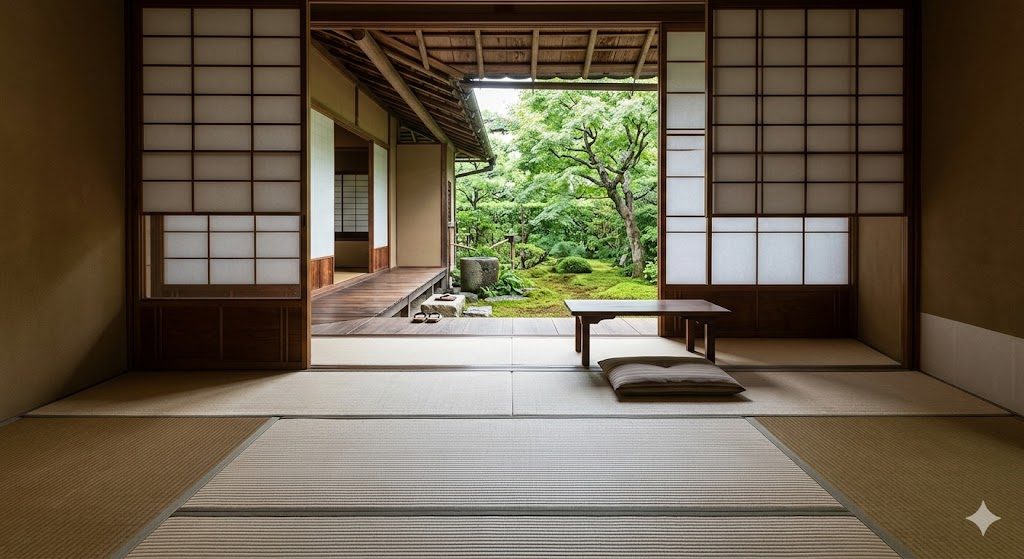
Step out of your shoes at the threshold and onto a floor of woven straw, and the room receives you differently. The light is not bright; it has been filtered through paper, laid down soft and grey across the tatami. A single scroll hangs in a recessed alcove, and beside it, a branch of plum in a rough vase — one object, deliberately alone. The wall to the garden is not a wall at all but a screen that slides away, so that the maple beyond becomes the room's fourth side. Nothing presses on you. There is more emptiness here than furniture, and the emptiness feels intentional, even kind.
Japanese architecture is the building tradition of the Japanese islands — a thousand-year lineage of timber post-and-beam construction, modular planning, and a profound relationship with nature, impermanence, and the spaces in between — that has flowed, almost without a break, into the work of modern masters like Tadao Ando and Kengo Kuma.
Its deepest idea is restraint: the belief that what you leave out matters as much as what you put in, that a building should defer to nature rather than conquer it, and that the most charged element in any room may be the empty space at its centre.
What it is
To call Japanese architecture "minimalist" is to start at the answer and skip the question. The minimalism is a by-product. The actual organising principles are older and stranger.
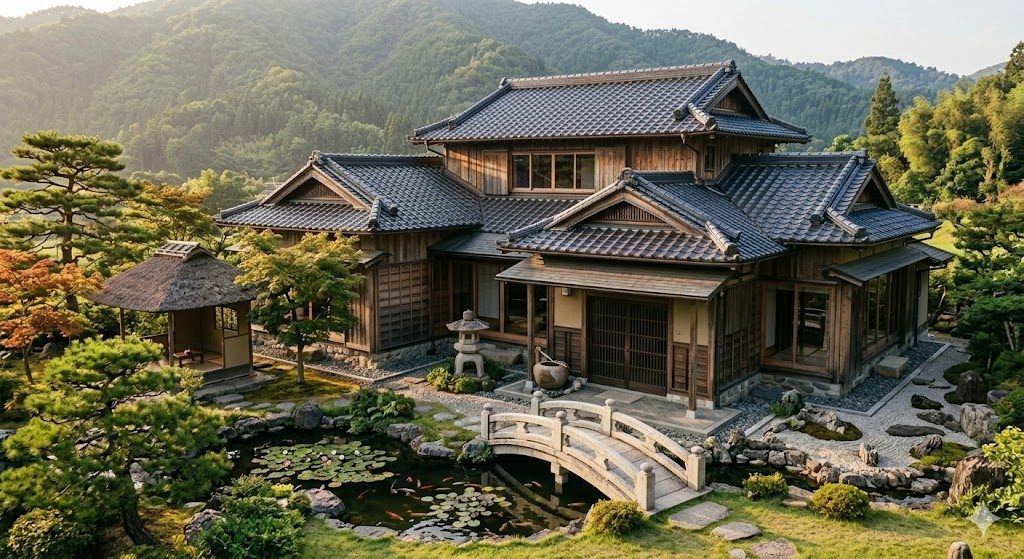
The first is harmony with nature. Japanese buildings do not sit on the land as objects placed upon it; they are tuned to climate, site, and the seasons. The deep eaves shade the high summer sun and admit the low winter one. The garden is not a view to be admired through plate glass but a continuation of the interior, brought right up to the floorboards. The architecture is porous — designed to breathe in a hot, humid, monsoon-prone climate.
The second is impermanence — what Buddhism calls mujo, the truth that all things pass. Nowhere is this more astonishing than at the Ise Grand Shrine, where the entire sacred complex has been demolished and rebuilt, identically, on an adjacent plot every twenty years for over a millennium. The most recent rebuilding was completed in 2013; the next is due in 2033. Permanence, here, is achieved not by resisting decay but by renewing the craft. The building is mortal; the knowledge is immortal.
The third — the hardest to translate and the most rewarding to understand — is ma, usually rendered as the "negative space," the pause, the charged void, the gap between things. Ma is the silence between two notes, the interval that gives rhythm its shape. In architecture it is the empty centre of a room, the breathing gap around a single object, the threshold you cross slowly. A Japanese space is composed of its emptiness as deliberately as a Western room is composed of its furniture.
"In the mathematics of architecture, the space contained is more important than the structure that contains it." — the spirit of ma, after the Tao Te Ching, long quoted in Japanese design thinking.
The fourth is the module — the ken grid. Traditional houses are dimensioned not in arbitrary numbers but in multiples of the ken (roughly 1.8 metres), and the tatami mat (about 90 by 180 cm) became the unit of the floor. Rooms are still sized in Japan by their mat count — a "six-mat room," an "eight-mat room." This modular order gives Japanese architecture its uncanny calm: everything is in proportion because everything derives from the same measure.

Where it came from
The roots are in timber. Japan is a forested, earthquake-prone, humid archipelago, and over centuries its builders perfected a system of post-and-beam construction in wood — flexible enough to sway through a tremor, raised off the damp ground on stone footings, joined with breathtaking carpentry rather than nails. The hinoki cypress carpenter, the miyadaiku temple builder, became one of the most revered craftsmen in the culture.
From this timber frame grew the whole vocabulary. Because the structure was carried on posts, the walls became non-structural — they could be light, movable, even absent. So Japanese builders filled the gaps not with masonry but with shoji, sliding lattice screens faced in translucent washi paper that turned harsh daylight into a soft glow, and fusuma, opaque sliding panels that redrew the floor plan at will. A house could be one great room in summer and many small ones in winter. Space was fluid, reconfigured by hand.
The floor was laid in tatami, and the engawa — a narrow timber veranda running along the garden edge, under the protection of the deep eave — became the celebrated threshold, the place that is neither inside nor out. In the formal room sat the tokonoma, a shallow recessed alcove for a single scroll and a seasonal flower: the one spot where beauty was permitted to be displayed, and only one thing at a time.
Three lineages shaped the aesthetic. The Shinto shrine at Ise gave the tradition its reverence for raw, unpainted cypress and its philosophy of ritual renewal. The teahouse of the tea ceremony, refined in the 16th century by the tea master Sen no Rikyu, gave it wabi-sabi — the beauty of the humble, the weathered, the imperfect, and the incomplete. The teahouse is deliberately small, rough-walled, low — you stoop to enter through a tiny door, leaving rank and ego outside. And the Katsura Imperial Villa in Kyoto, completed in the 17th century, gave it the summit of refined residential design: a composition of pavilions, modular rooms, framed garden views and impeccable restraint that, when the German modernist Bruno Taut visited in the 1930s, he hailed as a revelation — proof that Japan had practised a kind of modernism centuries before the West invented the word.

The modern masters
What is remarkable about Japan is that this tradition did not die when modernism arrived. It absorbed it, and then exported it back, transformed.
Kenzo Tange was the bridge. Trained in the modernist idiom but steeped in the timber tradition, he designed the Hiroshima Peace Memorial (1955) and the soaring suspended roofs of the Yoyogi National Gymnasium for the 1964 Tokyo Olympics — structures that read at once as cutting-edge engineering and as descendants of the great curving temple roof. From Tange's circle came Metabolism, the radical 1960s movement that imagined cities as living organisms of replaceable cells — most famously Kisho Kurokawa's Nakagin Capsule Tower (1972), a stack of plug-in pods. Metabolism took the ancient idea of renewal at Ise and projected it into a science-fiction future.
Tadao Ando is the master most of the world now pictures when it thinks "Japanese architecture," and he works almost entirely in raw concrete. A self-taught former boxer, Ando makes walls of smooth, board-marked concrete so precise they read as silk, and then he carves them with light and water. His Church of the Light (Ibaraki, 1989) is a plain concrete box slit by a cross-shaped opening, so that a luminous crucifix of pure daylight hangs in the darkness. His Church on the Water and his Koshino House (1984) dissolve the boundary between heavy mass and shifting nature. Ando is not the opposite of tradition — he is ma and wabi-sabi rendered in concrete, the empty charged room reborn in a modern material.
Kengo Kuma pushed in the opposite direction, back toward natural materials and what he calls the "anti-object" — architecture that does not stand as a proud, isolated form but dissolves into its setting, woven from slats of timber, stone, paper and tile. His Yusuhara Wooden Bridge Museum and his work on Tokyo's new National Stadium for the 2020 Olympics share a fascination with breaking solid mass into a porous, layered weave of small parts. Kuma is the engawa and the shoji at architectural scale.
And SANAA — the partnership of Kazuyo Sejima and Ryue Nishizawa, Pritzker laureates in 2010 — took the tradition's lightness to an almost dematerialised extreme: glass pavilions so transparent and thin-edged they seem to vanish, like the Rolex Learning Center in Lausanne or the New Museum in New York. To them one should add Shigeru Ban, who builds elegant structures from paper tubes and timber and has devoted much of his career to disaster-relief housing — wabi-sabi humility turned into a social ethic.

The defining signatures
Strip away the centuries and the same handful of moves recur, from the teahouse to the concrete church.
| Signature | What it is | Why it matters |
|---|---|---|
| Ma | The charged empty space, the pause, the in-between | Emptiness is composed as deliberately as form; it gives a room its calm |
| Engawa | The veranda threshold under the deep eave | Neither inside nor out — it makes the boundary soft, gradual, habitable |
| Shakkei | "Borrowed scenery" — framing a distant view as part of the design | A single mountain or tree becomes the room's most precious object |
| Modular order (ken / tatami) | Planning in repeated standard units | Proportion without effort; everything relates to one measure |
| Shoji & fusuma | Sliding paper and panel screens | Walls become light, movable; space flows and reconfigures |
| Deep eaves | Broad roof overhangs | Climate control — shade in summer, low sun in winter, rain shed clear |
| Natural materials | Unpainted timber, paper, clay, straw, stone | The material is allowed to be itself, to age and weather honestly |
| Light as material | Daylight filtered, slotted, pooled | Light is treated as something to be built with, not merely admitted |
| Wabi-sabi | Beauty in the humble, weathered, imperfect, incomplete | The crack in the bowl, the patina on the post — value in transience |
Notice that several of these are not features at all but relationships: ma is a relationship between objects, shakkei a relationship with the horizon, the engawa a relationship between the house and the weather. Japanese architecture is, at bottom, less about things than about the spaces and transitions between them.
Materials, form and light
The traditional palette is short and natural: hinoki and sugi cedar for posts and beams, washi paper for screens, rice straw for tatami, clay and lime for the few solid walls, stone for footings, and bamboo throughout. Nothing is painted to hide its grain; the cypress at Ise is left bare precisely so that it can silver and weather and be renewed. This is honesty of material long before the Western moderns made a slogan of it.
The form is low and horizontal. Where Gothic Europe reached upward, the Japanese house spreads sideways, hugging the ground, its strongest line the long shadow under the eave. The roof — once the great visual event, with its sweeping concave curve — gives the silhouette its grace, but inside, the ceiling is low and the eye is drawn out, level, to the garden.
And light is the secret protagonist. The novelist Junichiro Tanizaki wrote an entire essay, "In Praise of Shadows" (1933), arguing that the beauty of a Japanese room lives in its dimness — in the way gold leaf gleams faintly in the gloom of the tokonoma, in the soft glow through paper. Tadao Ando translated that essay into concrete: a building, for him, is an instrument for capturing a single shaft of light. Where the West floods a room evenly, the Japanese tradition pools and rations light, and lets the shadows do their work.
In the Indian context
It is tempting to file Japanese architecture under "exotic import," but for India the deeper truth is climatic kinship. Both are monsoon civilisations. Both face long months of heavy rain, fierce sun and high humidity — and, working independently, both arrived at the same essential answers.
The Japanese deep eave and the Indian verandah are the same instinct: a shaded, roofed in-between zone that keeps rain and sun off the wall while staying open to the breeze. The engawa, climatically, is a verandah; the chajja, the deep overhang of Indian vernacular and of much of Charles Correa's work, is the eave. Where the Japanese filtered light through paper shoji, the builders of Rajasthan and the Deccan filtered it through carved stone and timber jaali — perforated screens that cut glare, cast shifting shadow patterns, and let the air move. The shoji and the jaali are cousins: both turn the wall into a breathing, light-modulating membrane rather than a solid barrier.
The courtyard completes the parallel. Where the Japanese house opens to a garden, the Indian house — from the Kerala nalukettu to the Gujarati haveli — turns inward to a central court, pulling sky and air and a single tree into the heart of the plan. Both refuse the sealed box. India's modern masters worked in this spirit: B.V. Doshi, India's first Pritzker laureate, layered courtyards, terraces and shaded transitions through Sangath and the Aranya housing; Geoffrey Bawa, across the water in Sri Lanka, dissolved the boundary between building and tropical landscape so completely that one is never sure where his houses end and the garden begins — a thoroughly engawa sensibility. The restraint and craft devotion of Japanese building also rhymes with India's own tradition of the master mason and the carved temple, and with the quiet of contemporary Indian work that values material honesty over ornament — the territory explored in our guide to minimalist architecture in the Indian context.
There is a climatic caution, though. Japan's humid summers are cooler than India's pre-monsoon furnace, so a literal copy fails. The Japanese answer is shade and cross-breeze; the Indian home needs that plus a heavier dose of thermal mass and night-flush cooling in hot-dry zones. The discipline to borrow is the principle — porosity, the soft threshold, the framed view — not the thin timber wall. For the full climate logic, see our work on passive design across India's climate zones and courtyard homes as a climate response.
And where does Japandi fit? Japandi is the interior-decor fusion of Japanese restraint with Scandinavian warmth — a furnishing style, not a building tradition. It is the cousin who decorates the rooms; Japanese architecture is the grandparent who built the house. If you love the look, our guide to the Japandi apartment covers it directly — but the architecture here goes deeper than palette into structure, threshold and light.
How to bring it into your home
You do not need a Kyoto villa to live with these ideas. Most are about subtraction and intention, which makes them unusually affordable.
Think in thresholds. Create a moment of arrival — a Japanese house has a genkan, a recessed entry where you pause, change shoes, and shed the street. Even a small lowered tile zone with a bench at your front door changes how it feels to come home.
Think in screens rather than walls. A sliding panel, a timber-slat divider, a sheer linen layer, or a jaali-inspired perforated screen can separate without sealing, and filter light the way shoji do. Let a room be reconfigurable.
Frame one view. Find the best thing visible from your main room — a tree, a sky, a distant ridge — and compose a window around it like a picture, the way shakkei borrows the landscape. One framed view, uncluttered, beats five competing ones.
Honour ma — leave the centre empty. Resist the urge to fill every surface. A single beautiful object in a clear space carries more than a shelf of many. This is the hardest discipline and the most transformative.
Use natural material and low horizontal lines. Real timber, allowed to show its grain and age; low furniture that drops the eye-line and makes the ceiling feel generous; long horizontal datums that calm the room. Pair them with the deep-overhang and verandah logic India already knows.
Bring it home, in order
1. Make an entry ritual. Add a genkan-style threshold — a lowered or tiled zone, a bench, a place for shoes — so arrival has a pause.
2. Open one wall to the outside. Convert your strongest room-to-garden or room-to-balcony edge into a soft threshold with sliding doors and, if you can, a verandah deck.
3. Filter the light. Replace heavy curtains on a glare-prone window with a screen, sheer, or jaali that softens and patterns the sun.
4. Frame a single view. Identify the one thing worth seeing and compose around it; remove visual clutter around the frame.
5. Empty a centre. Clear one room or alcove to near-emptiness and place a single seasonal object there — your tokonoma.
6. Lower the horizon. Choose low, horizontal furniture and a continuous natural-timber datum to settle the eye.
7. Let materials age honestly. Use real wood, stone, lime and paper; allow patina rather than fighting it.
Misconceptions, and where it goes wrong
The biggest mistake is reading Japanese architecture as cold, white minimalism. It is not white and it is not cold — it is warm timber, soft paper light, weathered surfaces and shadow. Wabi-sabi is the opposite of the glossy, sterile minimalism it is often confused with; it prizes the worn and the imperfect, the wabi-sabi imperfection that gives a space its soul.
The second error is treating it as mere style — slapping shoji-pattern screens and a bonsai onto a conventional plan. The power is structural and spatial: the porosity, the modular calm, the threshold, the empty ma. Skip those and you have a costume, not a building.
The third is forgetting the climate fit. Borrow the principle of the breathing, shaded, indoor-outdoor house — which suits the Indian monsoon beautifully — but do not import paper-thin walls into a 45-degree summer. This kinship with nature is exactly what the biophilic and organic architecture traditions also chase, by different routes; read them alongside this for the fuller picture.
Used well, the Japanese way gives you something rare and quietly radical: a home that asks for less, holds more silence, and lets the garden, the light and the seasons back in.
Want to find where your own taste sits along the Japanese-to-minimal-to-organic spectrum, and plan a room around a single framed view and an empty centre? Try our DesignAI studio — start with the style finder to pin down your direction, then use the layout planner to test thresholds, screens and an emptied centre before you commit a single rupee.
References
1. Tanizaki, Junichiro. In Praise of Shadows (1933) — the founding meditation on Japanese light, shadow and material.
2. Koren, Leonard. Wabi-Sabi for Artists, Designers, Poets & Philosophers (1994).
3. Taut, Bruno. Houses and People of Japan (1937) — the Western modernist "discovery" of Katsura.
4. Engel, Heino. The Japanese House: A Tradition for Contemporary Architecture (1964) — the classic technical study of the ken module and timber frame.
5. Frampton, Kenneth. Towards a Critical Regionalism (1983) — on rooting modern architecture in place and climate.
6. Jodidio, Philip. Ando: Complete Works and Kengo Kuma: Complete Works (Taschen) — the modern masters in depth.
7. Curtis, William J. R. Balkrishna Doshi: An Architecture for India — the Indian counterpart of climate-rooted, courtyard-led modernism.
If this way of building speaks to you, follow the thread to its siblings: wabi-sabi architecture, organic architecture and biophilic architecture — and, for the interior-style cousin, the Japandi apartment and minimalist architecture in the Indian context.
Export this guide
Related Guides — Deep-dive reading
Church of the Light: How Tadao Ando Built a Room Out of Nothing but a Cross
In a suburb north of Osaka, Tadao Ando took three concrete cubes, a wall tilted fifteen degrees, and a single cruciform slit in the east wall — and made one of the most powerful rooms of the twentieth century. A study of the 1989 chapel: its tatami-scaled concrete, the argument over the glass, and why a building that subtracts almost everything still tells us where architecture is going.
The Future of ArchitectureNakagin Capsule Tower: The Building That Was Designed to Be Replaced
Kisho Kurokawa bolted 140 prefabricated capsules onto two concrete cores in Ginza and called it architecture that could grow, shed and renew itself like a living organism. Fifty years later it was demolished having never once been renewed — the most instructive failure in the whole Metabolist project, and a question modern architecture is still trying to answer.
The Future of ArchitectureTadao Ando's Façade Signature: Silky Off-Form Concrete and the Tie-Hole Grid
How Tadao Ando turned exposed concrete into the world's most disciplined façade language — the tatami-proportioned formwork panel, the rhythmic six-hole grid, and walls that frame light, water and sky instead of opening to the street.
Building FacadesRelated Tools — Try Free
Cross-Ventilation Analyzer
Estimate airflow and air changes per hour (ACH) from room size, window areas, layout, and local wind — with NBC 2016 Part 8 compliance check.
Ventilation CalculatorBrise-Soleil Visualizer
Interactive horizontal-louvre cut-off angle calculator — sun altitude, louvre depth, and spacing inputs with a live shadow preview. Computes θ = arctan(spacing/depth) for façade shading, ECBC envelope compliance, hospital daylight design, and tropical sun-control detailing.
Sun Shading ToolInterior Layout Planner — Printable Graph Grid
Printable graph grid to sketch room layouts to scale before committing to furniture placement.
Layout Tool