
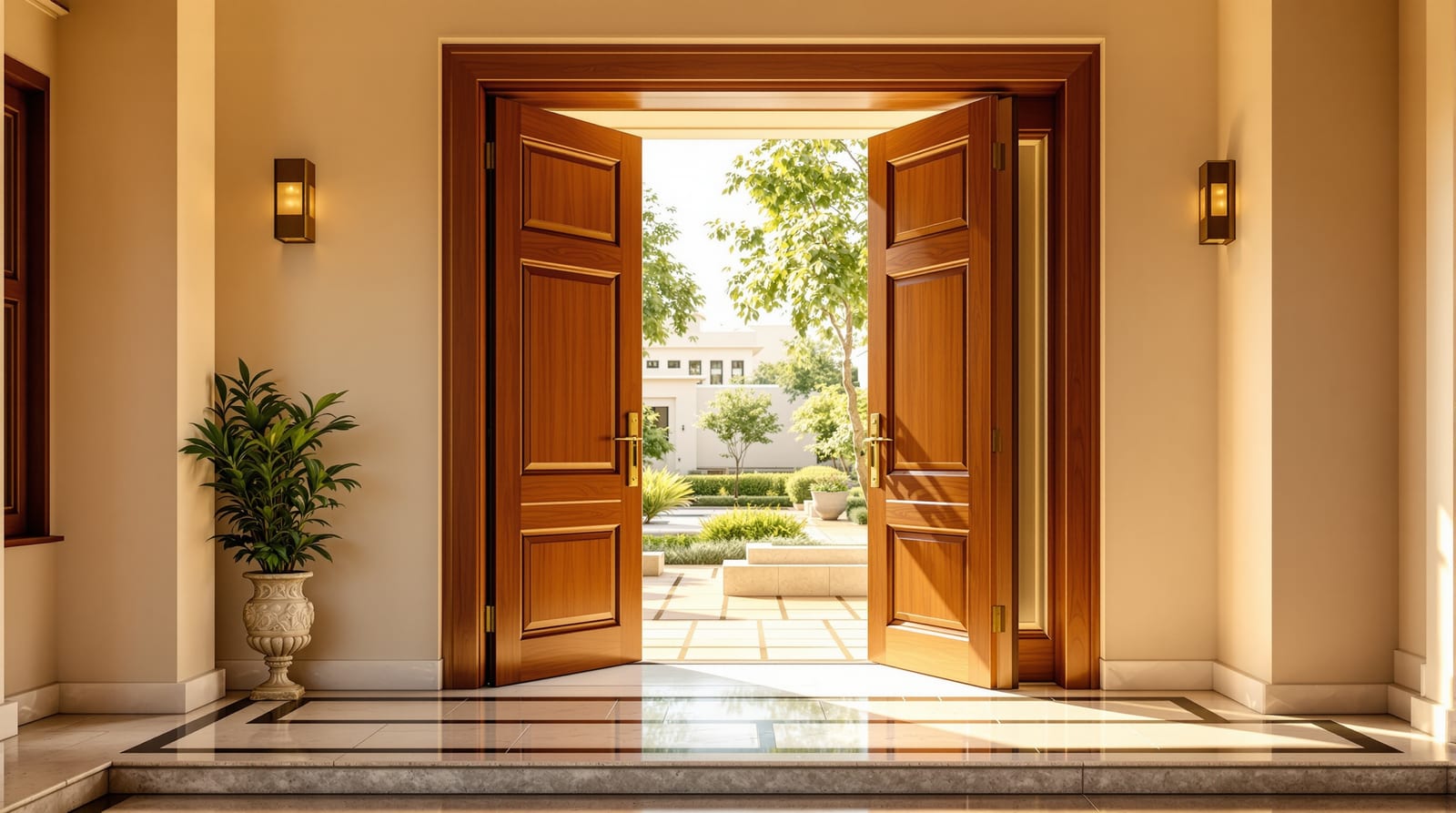
Double Doors in India (2026): Two-Leaf Entrances, Proportions, Hardware & Cost
When a double-leaf door makes sense for Indian main entrances, pooja rooms and master suites, plus active/inactive leaf hardware, the Vastu note on even panels, security at the meeting stile and the rupee premium over a single door.
A double door is simply one opening filled by two shutters that meet in the middle instead of a single wide leaf. In Indian homes it is the classic move for a grand main entrance, a formal pooja room, or a master suite that wants to feel like a destination rather than a corridor. But a double door is not just "two doors" priced twice over. It introduces an active and an inactive leaf, a meeting stile that has to be both weather-tight and burglar-resistant, flush bolts that most homeowners never learn to use properly, and a symmetry that the eye reads instantly when it is even slightly off. This guide covers exactly when a double-leaf door earns its premium and how to specify one that works.
For the wider picture of where a double door sits among hinged, sliding and folding options, start with the complete guide and the types of doors hub. If you are still deciding between one leaf and two, the dedicated comparison in single vs double door goes head to head; this guide assumes you are leaning towards two and want to do it well.
When a double door actually makes sense
A double door is the right answer when the opening is genuinely wide, not when you simply want it to look expensive. The trigger is usually one of four things.
- Wide opening (1.5 m and above). A single leaf wider than about 1100-1200 mm becomes heavy, sags on its hinges over the years, and needs a deep swing arc. Once your structural opening is 1500 mm or more, splitting it into two 750-900 mm leaves keeps each shutter light, square and easy to hang. This is the single most practical reason.
- Grand or symmetrical entrance. For a main door on the north or east face of a bungalow or a villa, a balanced pair reads as formal and welcoming in a way an off-centre single leaf cannot. Symmetry is the whole point.
- Furniture and appliance movement. A 750 mm single leaf gives roughly 700-720 mm of clear width. A double door, with both leaves open, can clear 1300 mm-plus, which is what you need to move a sofa, a double-door fridge, a wardrobe carcass or a hospital bed without scratching frames. You keep the inactive leaf bolted for everyday use and open it only when needed.
- Pooja rooms and formal halls. A small double door, even at a modest 1200-1350 mm opening, gives a pooja room a temple-like threshold and lets the deity be seen and aired during aarti. See pooja room door for the design language.
If none of these apply, a well-made single leaf is cheaper, more secure and easier to weather-seal. Don't fit a double door on a 900 mm bedroom just for looks.
Proportions and the active or inactive leaf
The thing that separates a confident double door from an awkward one is proportion. Each leaf, drawn in elevation, should read as a portrait rectangle, taller than it is wide. At a 2100 mm (7 ft) standard height, each leaf at 750 mm gives a leaf ratio close to 2.8:1, which looks tall and elegant. Go wider than about 900 mm per leaf and the pair starts to look squat; go narrower than 600 mm and they look like cupboard shutters.
There are two ways to split the opening.
- Equal leaves (symmetric). Both shutters the same width. This is the standard for main entrances and anywhere symmetry is the goal. Both leaves can be made operable, but in practice one is kept bolted.
- Unequal leaves (leaf-and-a-half, or "one-and-a-half"). A wide active leaf for daily use plus a narrow inactive leaf opened only for large items. Common where the opening is wide but everyday traffic is one person at a time. The narrow leaf is typically 300-450 mm.
The active leaf is the one you open every day; it carries the lock or latch. The inactive (or "passive" or "standing") leaf stays bolted top and bottom into the head and threshold, and the active leaf latches against it. The inactive leaf effectively becomes part of the frame until you release its bolts. Getting this role assignment right at the design stage decides where your handle, lock and bolts go, so settle it before the carpenter cuts mortices.
Single versus double: a quick comparison
| Factor | Single leaf | Double leaf (two shutters) |
|---|---|---|
| Typical opening width | 900-1200 mm | 1500-2400 mm |
| Clear passage (everyday) | ~700-720 mm | ~700-720 mm (active leaf only) |
| Clear passage (both open) | n/a | 1300 mm-plus |
| Cost vs single | Baseline | Roughly 1.8-2.4x (two leaves + extra hardware) |
| Best use | Bedrooms, baths, most internal doors | Main entrances, pooja rooms, formal halls, master suites |
| Weak point for security | Lock stile | Meeting stile / inactive leaf bolts |
| Weather sealing | One stile gap | Central meeting joint needs astragal + seal |
The clear-passage row is the one most people miss: for daily walking-through, a double door gives you no more width than a single leaf, because you only open the active leaf. You buy the second leaf for symmetry and for the occasional wide clearance, not for everyday flow. If everyday width is your only concern, a single 900 mm leaf is cheaper and tighter. For the full trade-off see single vs double door.
Hardware: flush bolts, astragal and multi-point locks
Hardware is where double doors live or die. A poorly bolted inactive leaf rattles, lets in monsoon water, and gives a burglar a soft target.
- Flush bolts (or tower bolts) on the inactive leaf. Two bolts, one shooting up into the frame head and one down into the threshold, hold the inactive leaf rigid. Flush bolts (let into the leaf edge, flush with the surface) look cleaner than surface-mounted tower bolts but cost more and need a neat morticing job. For a main door, specify a deep bolt throw (20 mm-plus) into a metal strike, not a shallow one into bare timber.
- Astragal. This is the moulding or rebate at the meeting stile that closes the central gap. A T-astragal or a rebated (rabbeted) meeting stile makes the two leaves overlap rather than just butt, which blocks light, draught, dust and monsoon water, and crucially hides the gap a pry-bar would attack. On exterior doors the astragal usually carries a brush or EPDM weather seal. Do not skip it on a main door.
- Active leaf lock. The active leaf latches against the now-rigid inactive leaf. For a main entrance, a multi-point lock (which throws bolts at the top, middle and bottom of the leaf in one turn) is far stronger than a single mortice deadbolt, because it pins the leaf to the frame at several heights. Mid-range mortice handle-sets run roughly the costs in the door hardware guide; add a night latch or smart lock on the active leaf if you want keyless entry.
- Hinges. Each leaf needs three to four hinges (four for a heavy teak main-door leaf). Use ball-bearing SS-304 hinges on exterior doors so the salt air and weight don't seize them. Concealed or 3D-adjustable hinges help you fine-tune the meeting line, which on a double door must be dead straight or the gap shows.
- Threshold / dehleez. A double door benefits from a defined threshold both for weather sealing the bottom flush bolt and for the traditional dehleez. Keep any raised threshold to 12 mm or less if you also care about wheelchair access (accessible doors).
The Vastu note: even number of leaves and panels
Vastu Shastra views the main door as the mukhya dwar through which energy enters, and it specifically prefers an even number of leaves and an even number of panels on the shutter. A two-leaf door is therefore considered auspicious by default, which is one reason grand traditional entrances are so often double. Even panel counts (two, four, six per leaf) on a carved or panelled door are likewise preferred over odd counts, and the door is meant to open inward and clockwise into the home, drawing energy in rather than pushing it out.
Treat these as tradition and belief layered with sensible practice: opening inward keeps the threshold and dehleez intact and stops the shutters fouling the porch, and a symmetric pair simply looks balanced. We do not re-explain direction, threshold or the dwar in full here; for the complete framing see vastu for the main door and entrance vastu. The takeaway for this guide is narrow: a double door's two-leaf, even-panel form already satisfies the count preference, so you can lean into symmetry without a Vastu conflict.
Materials for a double door
Because both leaves are visible at once and usually at the entrance, material choice carries more weight than on a hidden internal door.
| Material | Indicative cost | Notes for a double door |
|---|---|---|
| Solid teak (Burma / CP) | ₹800-1,500+/sq ft; carved sets ₹50,000-2,00,000+ | The classic grand main door; carve both leaves to match; heavy, so four hinges per leaf |
| Engineered wood / solid panel | ₹4,000-12,000 per shutter | Stable, less prone to monsoon warping than wide solid planks; good value pair |
| Flush + veneer | ₹4,000-9,000 per veneered shutter | Clean modern pair; book-match veneer across both leaves for symmetry |
| WPC | ₹75-150/sq ft | Waterproof, termite-proof; good for a pooja or utility double door, less premium feel |
| Aluminium / glass | ₹450-1,200/sq ft of opening | For a modern glazed double entrance or hall; see glass doors |
The monsoon caution matters more on double doors: a wide solid-timber leaf can swell and bind at the meeting stile in the wet season, throwing the central line off. Engineered or well-seasoned timber and a rebated meeting stile with a small clearance gap reduce this. For the full material decision see the materials comparison and best door material for India; for design language, main door design and traditional Indian doors.
What a double door costs versus a single
A double door is not exactly twice a single, but it is close, and the extra hardware widens the gap. Budget roughly 1.8 to 2.4 times the cost of an equivalent single leaf:
- Two leaves instead of one. Two shutters of half the width each cost a little more than one full-width leaf because you pay twice for edge-banding, finishing and (on carved doors) carving labour.
- Extra hardware. Flush bolts (₹400-2,000 a pair for the inactive leaf), an astragal/rebated meeting stile, an extra set of hinges, and often a multi-point lock instead of a simple deadbolt. Hardware alone can add ₹3,000-15,000 over a single door.
- Wider, stronger frame (chowkat). A 1500-2400 mm opening needs a heavier head and a properly anchored frame; sal or teak chowkat runs ₹350-900 per running foot.
- Fitting labour. Hanging and aligning two leaves so the meeting line is straight takes longer; budget ₹1,500-4,000 fitting for a double main door versus ₹800-2,000 for a single.
As an indicative all-in, a mid-range engineered/veneered double main door with good hardware and frame lands around ₹35,000-90,000 fitted; a carved teak pair can run well past ₹1,50,000. All figures are indicative and vary by city and vendor, and most quotes attract 18% GST. Use the door cost benchmark and main door cost to pressure-test a quote.
Security at the meeting stile
The honest weakness of any double door is the centre. A single door is pinned to a solid frame on the lock side; a double door's active leaf latches against the inactive leaf, which is itself only held by bolts. If those bolts are shallow or the meeting stile just butts edge-to-edge, a pry-bar at the centre can spring the pair. Close the gap:
- Use a rebated (overlapping) meeting stile or a T-astragal so there is no straight slot for a tool, and the leaves overlap rather than meet face to face.
- Specify deep flush bolts (20 mm-plus throw) into metal strikes at both head and threshold on the inactive leaf, not shallow bolts into bare timber that split.
- Fit a multi-point lock on the active leaf so it pins at top, middle and bottom, spreading any force.
- On a main entrance, add a safety grill or collapsible gate outside for a second layer (safety grill doors) and consider a video door system. For the full hierarchy see door security.
Done right, a double door is no less secure than a single; done cheaply, the centre is the obvious target. The hardware spend is not optional on an exterior pair.
Frequently asked questions
What is the minimum opening width for a double door?
Around 1500 mm. Below that, two leaves become too narrow and squat (under ~600 mm each) and you get all the cost and weather-sealing complexity of a double with none of the grandeur. For openings of 900-1200 mm, a single leaf is the better, cheaper, more secure choice. A pooja-room double door can work a little narrower, around 1200-1350 mm, because proportion matters less there.
Do both leaves of a double door open every day?
No. In daily use you open only the active leaf, which gives the same clear width as a single door (~700-720 mm). The inactive leaf stays bolted top and bottom and is released only when you need to move furniture or appliances, or for a formal occasion. That is why a double door buys you symmetry and occasional wide clearance, not extra everyday width.
Is a double main door good as per Vastu?
Generally yes. Vastu prefers an even number of leaves and even panel counts, so a two-leaf door with two/four/six panels per leaf satisfies that preference by default, and the form suits a grand north or east entrance. Direction, threshold (dehleez) and inward clockwise opening still apply; see vastu for the main door and entrance vastu for the full guidance.
Is a double door less secure than a single?
Only if you cut corners at the centre. The meeting stile is the natural weak point, so use a rebated/overlapping stile or astragal, deep flush bolts into metal strikes on the inactive leaf, and a multi-point lock on the active leaf. Specified properly, a double main door is as secure as a single; the extra hardware is essential, not optional. See door security.
How much more does a double door cost than a single?
Budget roughly 1.8 to 2.4 times an equivalent single leaf, driven by two shutters, a wider stronger frame, flush bolts, an astragal and usually a multi-point lock. A mid-range engineered/veneered double main door lands around ₹35,000-90,000 fitted; carved teak pairs run past ₹1,50,000. Figures are indicative, vary by city and vendor, and usually carry 18% GST. Check against the door cost benchmark.
Export this guide
Related Guides — Deep-dive reading
The Complete Home Door Guide for Indian Homes (2026): Types, Materials, Cost, Security & Vastu
Everything an Indian homeowner needs to specify the right door for every opening — from main entrance to bathroom — with real 2026 prices, IS/NBC standards and Vastu sense.
Home Doors & EntrancesSingle vs Double Door (2026): Which to Choose for Indian Homes
A head-to-head decision guide for Indian homes: how opening width, grandeur, cost, security, furniture movement, Vastu and maintenance settle whether you fit one leaf or two, plus where the leaf-and-a-half option wins.
Home Doors & EntrancesAnti-Theft Door Guide India: Affordable Ways to Burglar-Proof Your Entry (2026)
A practical, layered checklist of low-cost upgrades — deadbolts, strike-plate reinforcement, hinge bolts, viewers, grill doors and smart alerts — to make any Indian home door far harder to force.
Home Doors & EntrancesRelated Tools — Try Free
Door Material Comparison Tool
Compare 2–4 door materials on cost, durability, maintenance, security and moisture resistance.
Comparison ToolDoor Security Rating Calculator
Score your main door out of 100 across leaf, frame, lock and hardware — and see the top upgrades.
Security ToolDouble Door Planner
Decide single vs double from your opening width and get leaf sizes, hardware and a Vastu even-leaf note.
Door Planner