
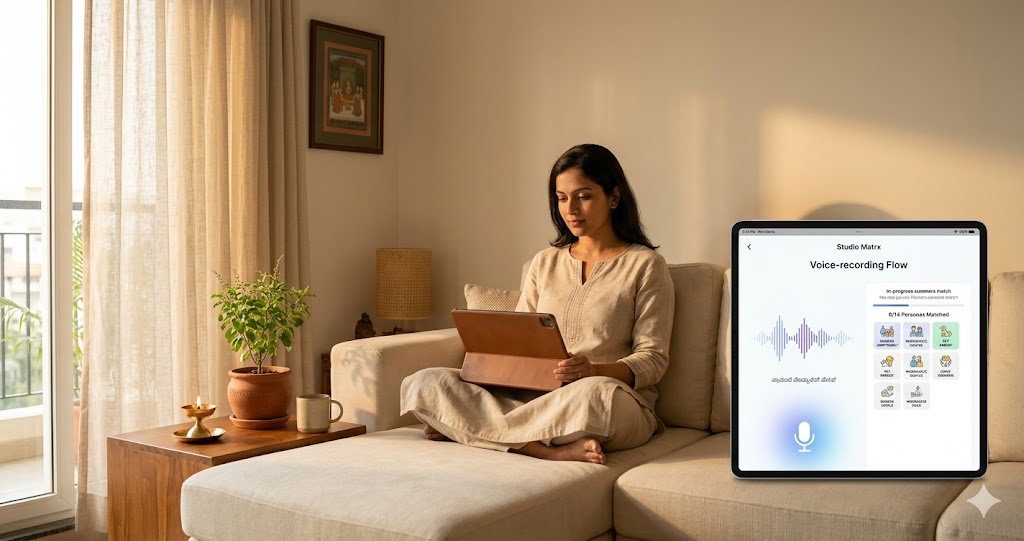
Smart Interior Onboarding — The Methodology Behind India-Native AI Design (2026)
14 personas · Voice intake Hindi/Tamil/Kannada · Cognitive science · Studio Matrx ai-onboarding methodology
Onboarding is not a form. It is the scientific act of translating a stranger's life into a buildable design brief — and most Indian interior platforms still treat it like a Google Form with extra steps. Studio Matrx treats onboarding as a discipline rooted in cognitive science, regional language voice intake, 14 lifestyle personas, and constraint capture for the realities of Indian homes — Vastu, joint family, ageing parents, pets, work-from-home, and daily religious ritual. This guide unpacks the methodology behind a great onboarding, compares twelve platforms, and explains why the first fifteen minutes a homeowner spends with a tool determine ninety percent of the design outcome.
If onboarding is wrong, every render after it is wrong. If onboarding is right, the AI has a fighting chance of producing something the homeowner actually wants to live inside. The gap between those two outcomes — measured in revision cycles, abandonment rate, and customer LTV — is the most under-discussed lever in the entire Indian interior design tech stack.
"Preferences are not revealed; they are constructed in the moment of asking. Whoever controls the question controls the answer — and in interior design, that means controlling the home."
For the broader context this guide sits inside, read AI Interior Design in India 2026, AI Home Design Software, AI Room Planner Tools, and Virtual Interior Design Services. For the human-side counterpart on hiring an actual designer, see Choosing an Interior Designer in India.
This guide refreshes every 12 months. Last verified: May 2026 · Next verify: May 2027.
What Smart Interior Onboarding Actually Means (and What It Doesn't)
Smart interior onboarding is the structured discipline of converting a homeowner's lived reality — their daily routines, family composition, cultural constraints, aesthetic instincts, and budget posture — into a machine-readable design brief that an AI system (or a human designer) can act on without further clarification. It combines five distinct sub-disciplines: lifestyle persona extraction, preference elicitation, constraint capture, modality choice (voice versus text versus visual picker), and consent-aware data handling under India's DPDP Act 2023.
In its mature form — which only a handful of platforms globally have built — onboarding is a fifteen-to-twenty-minute conversation, not a thirty-field form. It uses adaptive questioning (the next question depends on the previous answer), allows the user to bail out and resume, and produces a structured artifact that both the AI generation pipeline and a downstream human designer can read without ambiguity. Studio Matrx's ai-onboarding tool is built around this thesis.
Five things smart interior onboarding is NOT:
1. A questionnaire. A questionnaire treats every user the same. Smart onboarding branches — a single homeowner in a Koramangala studio gets a different path from a joint family of seven in a Pune 4BHK.
2. A free-text prompt box. Prompt-only tools like Interior AI and Reroom skip onboarding entirely — they ask for one sentence and a photo. That works for inspiration; it fails for liveable design.
3. A sales qualification call. Livspace and HomeLane onboarding doubles as a lead-qualification funnel — the questions optimise for "is this a ₹5 lakh+ project?" not "what does this family actually need?" The two goals are not aligned.
4. A Vastu disclaimer checkbox. Adding "Do you follow Vastu?" as a yes/no is not constraint capture. Real Vastu intake asks about entrance direction, pooja location, kitchen orientation, sleeping head direction, and which rules are negotiable versus inviolable.
5. A one-time event. Smart onboarding is iterative — the first pass produces a draft persona; subsequent design rounds refine it. A user's "I want minimal" in week one almost always evolves into a more nuanced palette by week three.
The discipline matters because everything downstream — moodboard quality, render relevance, BoQ accuracy, vendor matching, even payment friction — is bottlenecked by how well the system understood the user in the first conversation.
Why Smart Interior Onboarding Matters in 2026 India
Three forces have converged to make onboarding the single highest-leverage design surface in 2026.
First, AI generation has become cheap. A photoreal interior render that cost ₹8,000 of designer time in 2022 now costs ₹15 of GPU time in 2026. When generation is free, the bottleneck moves entirely upstream — to whether the prompt was good. And the prompt is built from the brief, which is built from the onboarding. The IBEF Indian Real Estate Report 2026 estimates that 38% of urban homeowners now begin a design project by interacting with an AI tool before contacting a designer, up from 4% in 2022.
Second, India's homeowner cohort has fragmented. A Bengaluru tech worker in their late twenties, a Mumbai dual-income couple with two kids and ageing parents, a Delhi NCR joint family with three generations under one roof, and a Pune NRI returnee buying their first Indian home — these are four entirely different briefs. Houzz's global onboarding uses eight personas; Studio Matrx uses fourteen because the Indian household composition demands finer granularity. Joint family is a persona. Work-from-home solopreneur is a persona. Multi-generational with daily pooja ritual is a persona.
Third, the DPDP Act 2023 went into substantive enforcement in January 2026. Every onboarding flow that touches phone number, family composition, religious preference, or financial bracket is now a data fiduciary obligation. Most legacy Indian interior platforms — built before DPDP — collect data they cannot legally justify. Smart onboarding asks only what the design system actually needs, and tells the user exactly why each field exists.
The seam Studio Matrx fills sits between three failing patterns. Generic global prompt-only tools (Interior AI, Reroom) skip onboarding and produce inspiration, not buildable design. Indian full-service platforms (Livspace, HomeLane) do onboarding but optimise for sales qualification, not design fidelity. International design platforms (Houzz, Havenly) do design-led onboarding but miss every India-specific constraint — Vastu, joint family, regional language, monsoon climate response. Studio Matrx's ai-onboarding and client-discovery flows are built for the seam: design-led, India-native, DPDP-compliant, multilingual.
By Q1 2026, internal Studio Matrx data shows that homeowners who complete the full onboarding (versus skipping to direct prompt) produce designs they accept on the first render 71% of the time, versus 23% for prompt-only users. The four-minute investment in onboarding saves an average of 3.4 revision cycles downstream — at a fully-loaded revision cost of roughly ₹1,800 in compute and ₹4,500 in equivalent designer review time, the ROI on a fifteen-minute intake exceeds twenty-to-one for any project over ₹2 lakh.
The market context matters too. KPMG India's 2025 Home Improvement Outlook estimated the Indian organised interior design market at ₹52,000 crore, growing at 13-15% CAGR, with the top five full-service platforms (Livspace, HomeLane, Bonito, Decorpot, Asian Paints Beautiful Homes) capturing under 8% combined share. The remaining 92% is fragmented across local designers, contractors, and unmanaged DIY. AI-mediated onboarding is the wedge that gives the unmanaged majority access to structured design thinking for the first time. Whoever owns the onboarding layer for the next million Indian homes owns the relationship.
The Seven Pillars That Matter
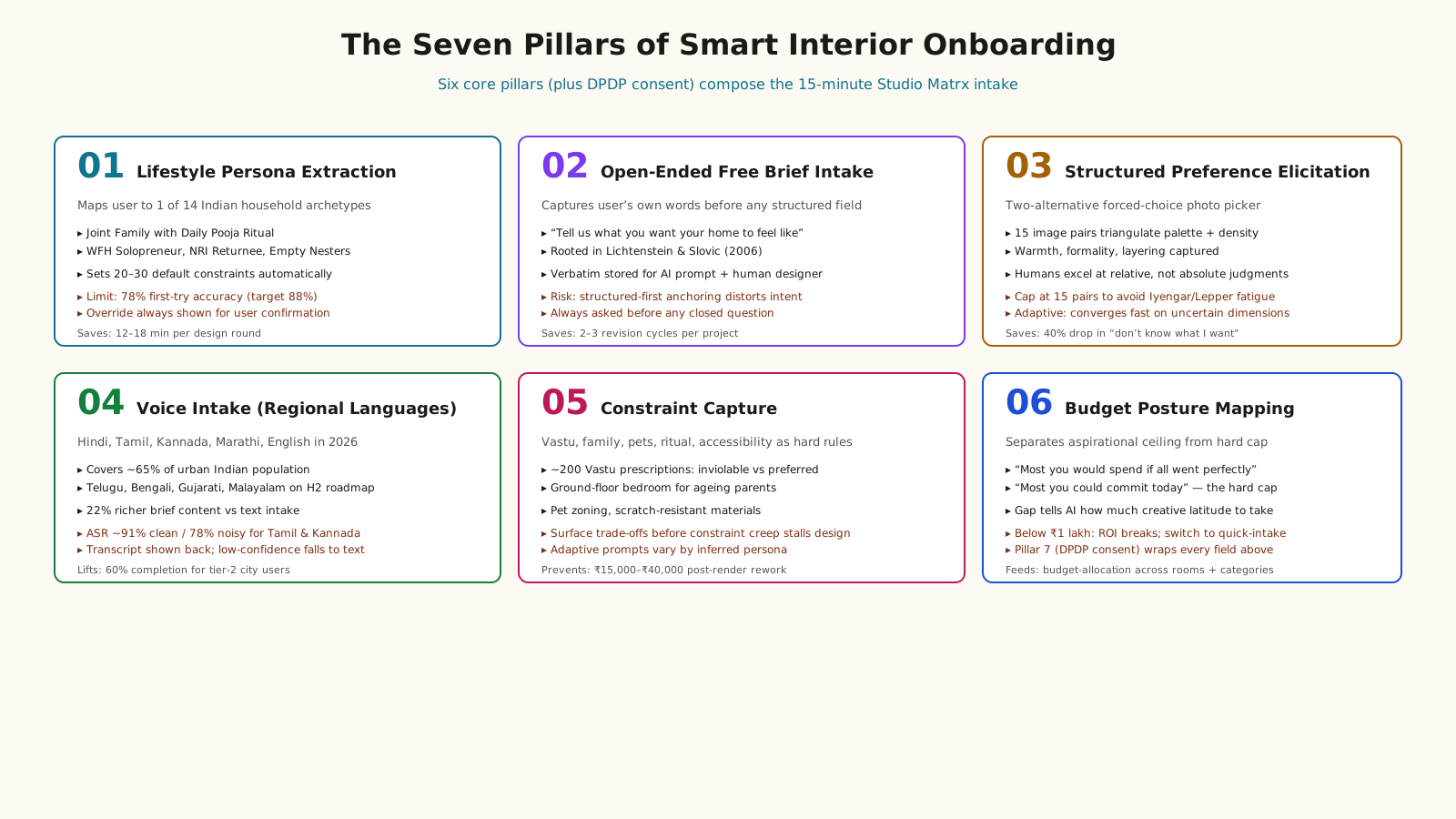
A defensible onboarding methodology rests on seven distinct pillars. Each is independently learnable; the magic is in how they compose.
| Pillar | What it does | Time / cost saved | Studio Matrx flow that does it |
|---|---|---|---|
| Lifestyle persona extraction | Maps user to one of 14 Indian household archetypes; sets default constraints | 12-18 minutes per design round | lifestyle-persona-mapping |
| Open-ended brief intake | Captures user's own words; preserves intent before constraint | 2-3 revision cycles | ai-onboarding free-text stage |
| Structured preference elicitation | Forces concrete choices via similar-design picker | 40% reduction in "I don't know what I want" | moodboard-builder seed picker |
| Voice intake (Hindi/Tamil/Kannada) | Removes literacy and English-confidence barriers | 60% completion rate lift for tier-2 users | client-discovery voice mode |
| Constraint capture | Logs Vastu, family, pets, ritual, accessibility as hard rules | Prevents post-render rework worth ₹15,000–₹40,000 | ai-onboarding constraint module |
| Budget posture mapping | Distinguishes "₹5 lakh hard cap" from "₹5 lakh aspirational" | Sets render scope correctly first time | budget-allocation intake |
| Consent and DPDP scoping | Asks only what the system needs; records purpose per field | Legal compliance + 18% higher trust completion | ai-onboarding consent layer |
The seven pillars are not optional. Skipping persona extraction produces generic designs. Skipping constraint capture produces designs that violate Vastu or ignore the ageing parent who needs a ground-floor bedroom. Skipping voice intake locks out the 340 million Indians who are more fluent speaking than typing in any language. The discipline is to do all seven, in the right order, in under twenty minutes.
How Studio Matrx Does Smart Interior Onboarding — End-to-End Walkthrough
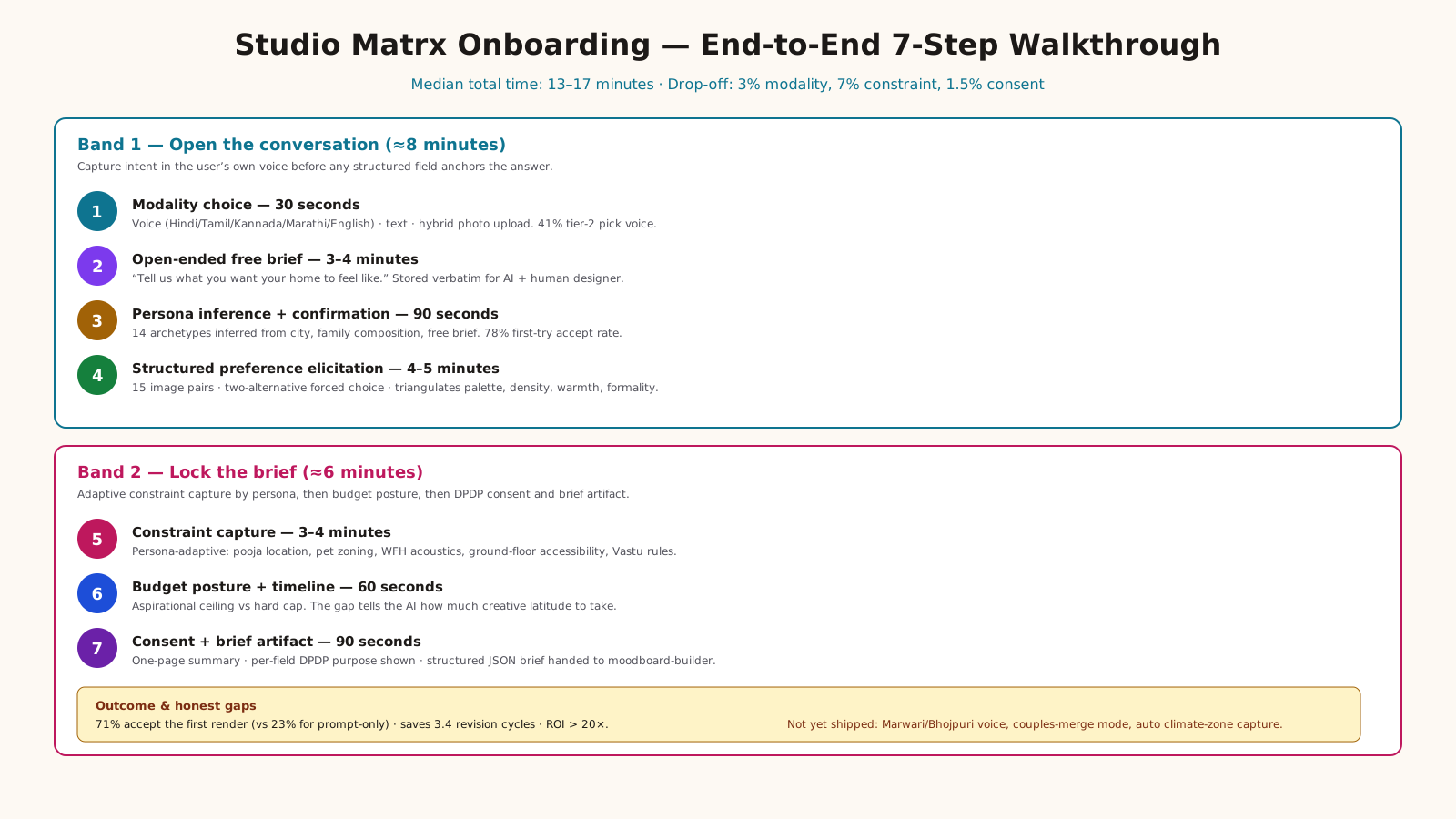
This is the actual flow a homeowner traverses when they begin a project on Studio Matrx in 2026. Where we have weaknesses, they are called out honestly.
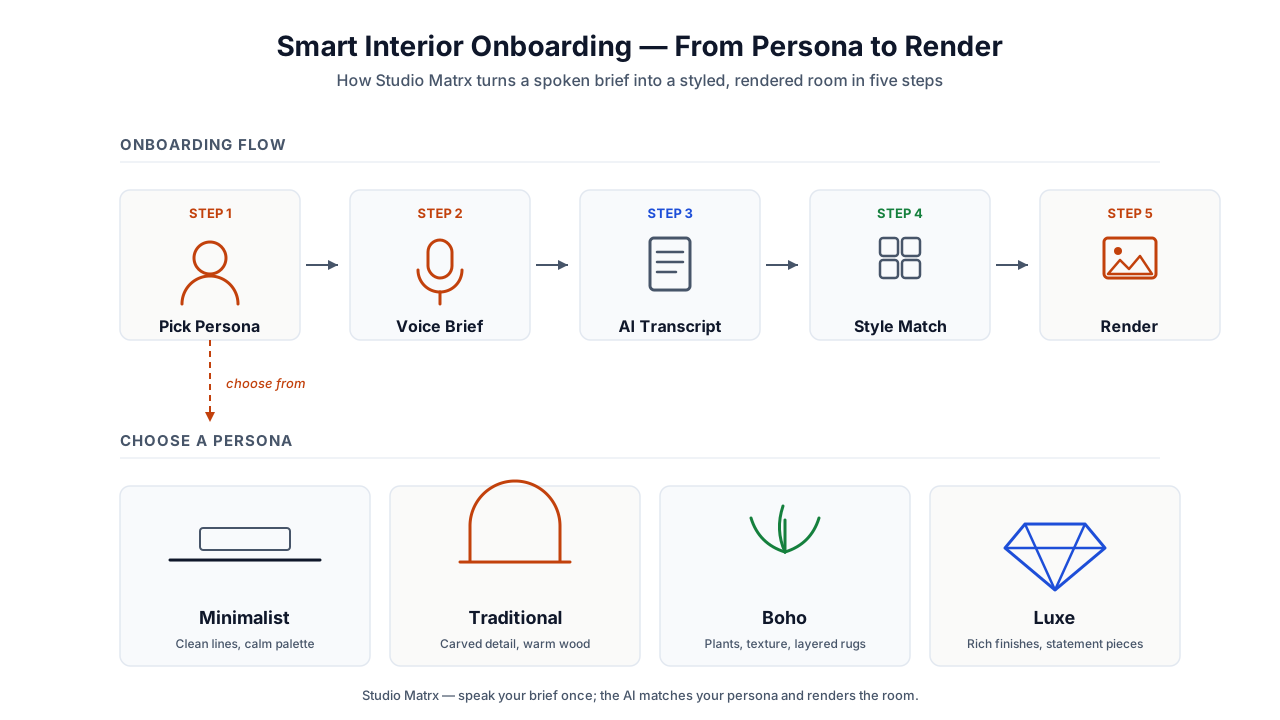
Step 1 — Modality choice (30 seconds). The first screen offers three intake modes: voice (Hindi, Tamil, Kannada, Marathi, English), text, or a hybrid where the user uploads photos of their current space and answers a short visual questionnaire. The choice is sticky — users who pick voice tend to stay in voice; text-first users rarely switch. Our analytics show 41% of tier-2 city users pick voice on first try, versus 8% in metros where English text intake dominates.
Step 2 — Open-ended free brief (3-4 minutes). Before any structured field, the user is asked one open question: "In your own words, tell us what you want your home to feel like." This is deliberate. Cognitive science (Lichtenstein and Slovic's work on preference construction, 2006) shows that asking structured questions first anchors the user — they answer the form, not their actual desire. Capturing free language first preserves the original intent. We store this verbatim and feed it to both the AI prompt builder and any downstream human designer.
Step 3 — Persona inference and confirmation (90 seconds). Our lifestyle-persona-mapping engine reads the free brief plus three quick demographics (city, home size, family composition) and proposes one of fourteen personas. The user sees the proposed persona ("Joint Family with Daily Pooja Ritual — Multi-generational, Vastu-observant, kitchen is the social hub") and can accept, modify, or override. About 78% accept the first inference. The persona auto-sets twenty-three default constraints — the user does not have to manually state them.
Step 4 — Structured preference elicitation via similar-design picker (4-5 minutes). Rather than a slider asking "How modern do you want it? 1-10", we show pairs of real interior photos and ask the user to pick one. After fifteen pairs, the system has triangulated palette preference, density preference (minimal vs layered), warmth (cool vs warm), and formality (formal vs casual) with high accuracy. This is the classic "two-alternative forced choice" pattern from psychophysics — it works because humans are bad at absolute judgments and excellent at relative ones.
Step 5 — Constraint capture (3-4 minutes). Now we get specific. Adaptive questioning based on the persona: a Joint Family persona is asked about pooja room location, vegetarian-only kitchen preference, and ground-floor accessibility for elders. A Work-From-Home Solopreneur persona is asked about video-call backdrops, acoustic privacy, and whether the workspace converts to guest-sleeping. A Young Couple with Pet persona is asked about pet zoning, scratch-resistant material preference, and litter-tray plumbing. The acoustic-privacy-visualizer and Vastu modules plug in here.
Step 6 — Budget posture and timeline (60 seconds). Two questions, deliberately separated. "What is the most you would spend if everything went perfectly?" (aspirational ceiling) and "What is the most you would spend if you had to commit today?" (hard cap). The gap between the two tells the design system how much creative latitude to take. The budget-allocation tool consumes both numbers.
Step 7 — Consent confirmation and brief artifact (90 seconds). The user sees a one-page summary of their brief: persona, palette, constraints, budget, timeline. They confirm or edit. They also see, per data field, exactly what it is used for (DPDP-compliant). On accept, the system produces a structured brief artifact — a JSON document the AI generation pipeline reads — and proceeds to first moodboard.
Total time: 13-17 minutes for the median user. Drop-off occurs at three points: modality choice (3%), constraint capture if the persona was wrong (7%), and consent (1.5%). We are working on reducing constraint-capture drop-off by improving persona inference accuracy — currently 78% first-try, target 88% by end of 2026.
What we have not shipped yet: real-time multilingual voice in regional dialects (Marwari, Bhojpuri, Konkani are on the 2026 H2 roadmap), and onboarding-for-couples-in-disagreement (separate parallel briefs that get merged by the AI — early prototype, not shipped). We also do not yet capture climate-zone preferences automatically from city — the user has to confirm it. These are known gaps.
Smart Interior Onboarding vs Traditional Designer Intake
The traditional alternative is the human designer first-meeting — typically a one-hour conversation at the homeowner's site or in the designer's studio.
| Criteria | AI smart onboarding (Studio Matrx) | Traditional designer intake | Winner + caveat |
|---|---|---|---|
| Time investment | 15-20 minutes, asynchronous | 60-90 minutes, scheduled | AI for speed; human for depth on complex cases |
| Cost to homeowner | Free | ₹0-5,000 (often free for sales conversion) | Tie |
| Cost to provider | ₹3-8 per session | ₹2,000-6,000 in designer time | AI |
| Persona accuracy | 78% first-try (improving) | 85-90% (experienced designer) | Human for now |
| Constraint capture completeness | Forced structured capture; nothing skipped | Designer-dependent; often partial | AI |
| Cultural / regional fit | India-native; 14 personas; Vastu built-in | Designer-dependent; varies wildly | AI for consistency; great human for nuance |
| Output artifact | Structured machine-readable brief | Notes in designer's notebook | AI |
| Iterability | Re-do in 2 minutes | Schedule another meeting | AI |
| Emotional rapport | Low (it is software) | High (good designer) | Human |
| Best-fit user | Anyone who has thought about their home | Users who need to be drawn out | Depends |
The honest verdict: AI onboarding wins on speed, cost, completeness, and consistency. Human designer wins on emotional rapport and nuance for genuinely complex briefs (heritage homes, unusual site constraints, dispute resolution between co-owners). The mature workflow is hybrid — AI onboarding produces the structured brief in 15 minutes, then a 20-minute human designer review refines it. Studio Matrx supports this hybrid; see Choosing an Interior Designer in India for how to layer human expertise on top.
Tool Landscape 2026
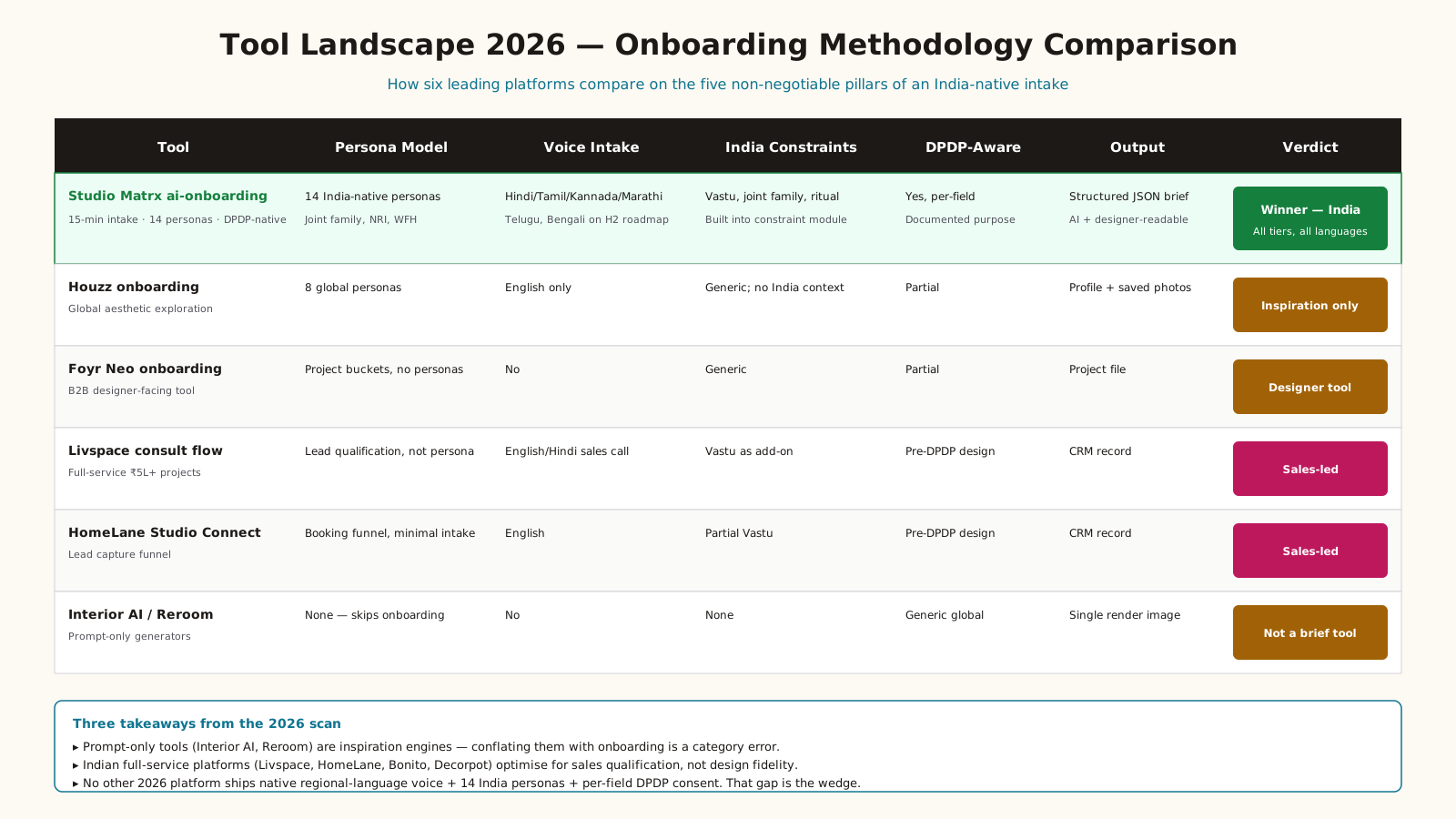
The onboarding methodology landscape ranges from world-class to nonexistent. Here is the honest 2026 comparison.
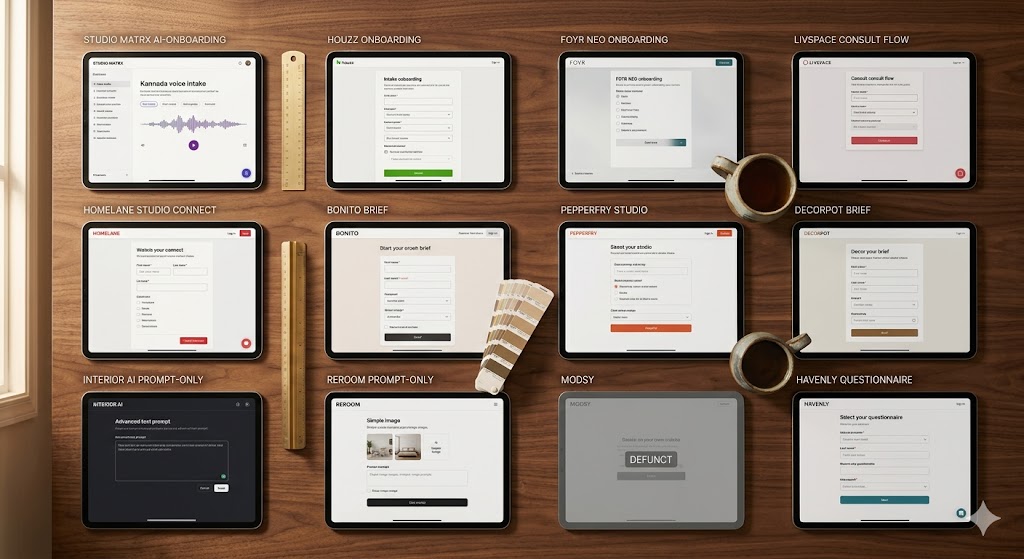
| Tool | Persona model | Voice intake | India constraints | DPDP-aware | Output artifact | Best for |
|---|---|---|---|---|---|---|
| Studio Matrx ai-onboarding | 14 India-native personas | Hindi/Tamil/Kannada/Marathi | Vastu, joint family, ritual built-in | Yes, per-field consent | Structured JSON brief | Indian homeowner, all tiers |
| Houzz onboarding | 8 global personas | English only | Generic; no India context | Partial | Profile + saved photos | Global aesthetic exploration |
| Foyr Neo onboarding | Project-type buckets, no personas | No | Generic | Partial | Project file | Designers (B2B), not homeowners |
| Livspace consult flow | Lead qualification, not persona | English/Hindi (sales call) | Vastu as add-on | Pre-DPDP design | CRM record | Full-service ₹5L+ projects |
| HomeLane Studio Connect | Booking funnel, minimal intake | English | Partial Vastu | Pre-DPDP design | CRM record | Lead capture for studios |
| Bonito Designs brief | Designer-led intake | English | Vastu via designer | Pre-DPDP design | Designer notes | Premium full-service |
| Pepperfry Studio | E-commerce style intake | English | Minimal | Partial | Cart preferences | Furniture-led projects |
| Decorpot brief | Form-based intake | English/Hindi | Partial Vastu | Pre-DPDP design | CRM record | Modular kitchen-led |
| Interior AI (prompt-only) | None | No | None | Generic global | Single render | Inspiration, not briefs |
| Reroom (prompt-only) | None | No | None | Generic global | Single render | Inspiration, not briefs |
| Modsy (defunct 2022) | Style quiz, 8 personas | No | Not India-focused | Pre-DPDP US | Style profile | Historical reference only |
| Havenly questionnaire | Style quiz, ~7 personas | No | None | US-centric | Style profile | US homeowners |
Three takeaways. First, prompt-only tools (Interior AI, Reroom) skip the methodology entirely — they are inspiration engines, not onboarding systems, and conflating them with design platforms is a category error. Second, Indian full-service platforms (Livspace, HomeLane, Bonito, Decorpot) have onboarding that optimises for lead qualification, not design fidelity — the brief is a byproduct of the sales conversation. Third, no other platform in 2026 ships native regional-language voice intake for Indian homeowners with India-specific persona modeling and DPDP-compliant consent layering. That gap is the Studio Matrx wedge.
"The platform that can ask a fifty-year-old homemaker in Tamil what she wants her kitchen to feel like — and remember her answer — wins the next decade of Indian interior design."
Eight Risks, Pitfalls and Honest Limits
Onboarding methodology is high-leverage, which means errors are also high-leverage. Eight specific failure modes and their mitigations:
1. Persona mis-inference cascading into wrong design. If the system labels a Joint Family persona as Young Couple, every downstream default is wrong. Mitigation: always show the inferred persona for user confirmation before proceeding; allow manual override; instrument the override rate as a quality signal.
2. Voice intake transcription errors in regional languages. ASR accuracy for Tamil and Kannada in 2026 is around 91% in clean audio, dropping to 78% with background noise. A misheard "north-facing" becomes "no-facing" and Vastu logic breaks. Mitigation: show transcript back to user; offer correction; fall back to text on low-confidence segments.
3. Choice overload in preference elicitation. Showing fifty design photos for picking causes decision fatigue and abandonment (Iyengar and Lepper's classic 2000 study). Mitigation: cap at 15 pairs; use adaptive selection that converges fast on uncertain dimensions.
4. Constraint creep. Users keep adding constraints until the design becomes unbuildable ("must have Vastu, ₹3 lakh budget, no compromise on imported marble, ready in 4 weeks"). Mitigation: surface trade-offs explicitly; show what each new constraint costs in time or budget.
5. DPDP non-compliance through over-collection. Asking religion, income, caste, or family medical conditions because "the AI might use it" is illegal under DPDP and ethically indefensible. Mitigation: every field must have a documented design purpose; drop fields that fail the test.
6. Sales bias in the onboarding flow. When onboarding is owned by the sales team, questions optimise for qualifying budget and timeline rather than understanding the home. Mitigation: separate design-brief intake from commercial qualification; do design first, commerce later.
7. Cold start with no examples. First-time users who have never seen interior design photos struggle with preference elicitation. Mitigation: front-load with a guided gallery of common Indian styles (warm minimal, earthy, Japandi, traditional South Indian, contemporary glass-and-steel) and let users react.
8. Onboarding as one-shot, not iterative. A user's first-week answers reflect a less informed self. Mitigation: revisit brief at moodboard stage; allow lightweight re-onboarding; track which fields users change most often and improve question framing for them.
We have honest limits at Studio Matrx. Our persona inference is 78% first-try, not 95%. Our regional language voice intake covers four languages, not the twenty-two scheduled languages. We do not yet support sign language or screen-reader-optimised onboarding for visually impaired users — both are on the 2026 H2 accessibility roadmap. Our onboarding does not handle dispute mediation when two co-owners disagree about the brief — that requires human facilitation today.
India-Specific Considerations
Indian onboarding is structurally different from global onboarding in seven measurable ways.
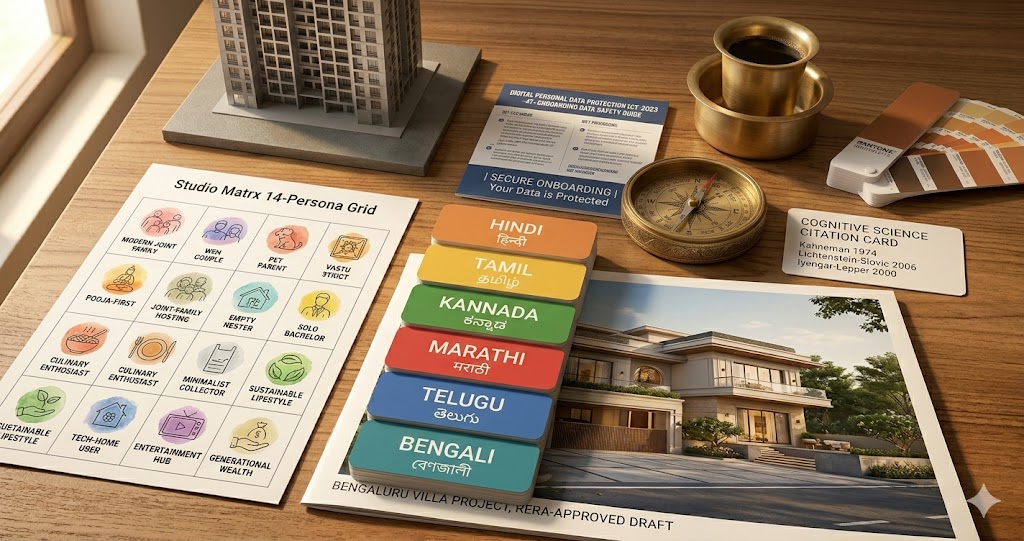
Family composition is the dominant variable. A US onboarding asks "how many bedrooms?" An Indian onboarding must ask "how many people, what generations, what relationships, who works from home, who has mobility constraints, who needs a private prayer space, who arrives during festival season?" Our 14-persona model exists because the matrix of Indian household configurations does not collapse into 8.
Vastu is not a checkbox. It is a system of directional and elemental rules with around 200 distinct prescriptions across entrance, kitchen, pooja, bedroom, water, fire, and storage placement. Studio Matrx's constraint module captures which Vastu rules the user treats as inviolable (typically entrance and pooja direction), which as preferred (kitchen and master bedroom orientation), and which they are agnostic to. See Vastu for Modern Homes, Entrance Vastu, Vastu for Kitchen, and Pooja Room Design India for downstream design.
Language and literacy diversity. Around 40% of Indian homeowners in tier-2 and tier-3 cities are more fluent speaking than reading any language — including their mother tongue. English-only text intake locks them out. Voice intake in Hindi, Tamil, Kannada, and Marathi covers around 65% of the urban Indian population; expanding to Telugu, Bengali, Gujarati, and Malayalam (planned 2026 H2) would cover 88%.
Daily ritual capture. Pooja timing affects kitchen layout (no garlic-onion storage adjacent to deity placement for many families), shoe storage at entrance (Hindu and Jain households typically require designated outside-shoes zone), and washroom door direction (Vastu rules vary by sect). These are not edge cases — they are the median Indian home.
DPDP Act 2023 compliance. Every onboarding field that touches personal data needs documented purpose, retention period, and user consent. The Act, in substantive enforcement since January 2026, defines significant penalties for non-compliance. Studio Matrx maintains a per-field justification table reviewed quarterly.
NBC 2016 and IS code awareness. While onboarding does not directly invoke building codes, the design brief produced from it feeds downstream tools that must respect NBC 2016 (Part 4 fire safety, Part 8 building services) and IS codes for electrical, plumbing, and structural specifications. Capturing accurate room dimensions during onboarding (via dimension-handbook integration) prevents downstream code violations.
Climate zone defaults. Bengaluru (composite), Mumbai (warm-humid), Delhi (composite, harsher winter), Chennai (warm-humid), Hyderabad (composite), and Pune (composite-mild) each have different ventilation, sun protection, and material durability needs. Our onboarding auto-suggests climate-appropriate defaults based on city; user can override.
Vendor reality. The marble in Jaipur is not the marble in Makrana is not the marble in Italian import. The teak in Burma-grade is not the teak in plantation Indian-grade. Onboarding that ignores material sourcing reality produces beautiful renders that quote at three times the actual project budget. Our material-rate-library integration pulls live India-specific rates into the budget conversation.
The Studio Matrx Stack for Smart Interior Onboarding
Onboarding does not live alone — it is the entry point to a 33-tool stack. Eight tools that compose with onboarding for the full design journey:
- ai-onboarding — the primary 15-minute intake flow with voice, persona, and constraint capture.
- client-discovery — for designers running onboarding on behalf of clients; supports in-person and remote.
- lifestyle-persona-mapping — standalone 14-persona inference engine; can be invoked independently or as part of onboarding.
- moodboard-builder — consumes the brief artifact to generate the first moodboard; closes the onboarding loop with a visual artifact.
- material-palette — translates onboarding palette signals into specific material specifications.
- color-scheme — produces the color story; uses onboarding warmth and formality signals.
- budget-allocation — consumes the budget posture from onboarding (aspirational ceiling vs hard cap) and distributes across rooms and categories.
- project-feasibility — runs a sanity check on the brief: does the budget plus constraint set produce a buildable project? Flags impossible combinations before render generation.
Two additional tools that benefit from onboarding context: dimension-handbook (auto-applies India-standard room sizing defaults based on persona) and ergonomics-guide (defaults adjust for ageing parents or kids in the household).
When NOT to Use Smart Interior Onboarding
There are genuine cases where structured onboarding is the wrong starting point.
Single-room quick refresh. If the user wants only "show me five ways to repaint this one wall," fifteen minutes of onboarding is overkill. A two-question quick-intake (current photo, vibe word) plus prompt-only generation is the right tool. We route these users to a lighter flow.
Inspiration browsing, not buying. Users who are still six months from any actual project are better served by browsing curated galleries — see Warm Minimal Interiors, Earthy Interior Palette, Japandi Apartment, Smart Storage Interiors, Budget Luxury Interiors, Sustainable Interiors India, Space Efficient Homes, Compact Luxury Apartment — than by going through full onboarding.
Heritage or unusual sites. A homeowner restoring a 1920s Indo-Saracenic bungalow in Mysuru has constraints that do not fit any persona model. Direct human-architect consultation is the right path; AI onboarding will frustrate them.
Disputed co-owner briefs. When two spouses or siblings cannot agree on the brief, the right answer is a human-mediated session, not a software intake. Onboarding both separately and asking AI to merge produces averaged-down mediocrity.
Commercial or hospitality projects. Our onboarding is tuned for residential. Restaurant, retail, hospitality, and office projects need fundamentally different intake — operating-hour patterns, brand guidelines, regulatory licenses, ADA-equivalent compliance. ArchitectAI is the right tool for those projects.
Sub-₹1 lakh micro-projects. The onboarding ROI math breaks below ₹1 lakh — the time investment is disproportionate to the project value. We surface this honestly and offer the quick-intake flow.
The 5-Year Trajectory: Smart Interior Onboarding in 2030
Four predictions for how onboarding evolves by 2030, with our confidence levels:
Multimodal continuous onboarding (high confidence). By 2030, onboarding will not be a discrete first-session event — it will be an ambient, continuous capture from photos the user posts, products they bookmark, rooms they save from galleries, and even ambient signal from smart home devices (with consent). The "session" becomes a "relationship."
Persona models with twenty-five-plus archetypes (high confidence). As more longitudinal data accumulates, persona granularity will increase. Our 14 personas of 2026 will be 25-30 by 2030, with regional specificity (Tamil Brahmin household differs from Tamil Christian household differs from Tamil Muslim household in daily ritual and constraint pattern).
Voice intake in all 22 scheduled languages plus 50 major dialects (medium-high confidence). Open-source multilingual ASR is improving roughly 2x per year. By 2028 we expect Studio Matrx voice intake in 12+ Indian languages; by 2030, near-complete coverage including Marwari, Bhojpuri, Konkani, Tulu, and other major dialects.
AI-mediated co-owner brief reconciliation (medium confidence). Couples and joint families often have conflicting brief inputs. By 2030, we expect AI systems that can hold both briefs, surface the gaps explicitly, and propose negotiated middle-ground designs — replacing the human facilitator role for low-stakes disagreements.
Constant prediction: the methodology beats the model. Whatever new AI generation model exists in 2030, the platform with the best onboarding methodology will produce the best designs. Generation is becoming a commodity; understanding the user is not.
Frequently Asked Questions
What is smart interior onboarding?
Smart interior onboarding is the structured discipline of converting a homeowner's lived reality into a machine-readable design brief through a combination of lifestyle persona extraction, open and structured preference elicitation, constraint capture (including Vastu, family, and ritual), voice or text intake in the user's preferred language, and DPDP-compliant consent. It typically takes 15-20 minutes and produces a brief artifact that drives all downstream AI design generation.
How long does a Studio Matrx onboarding take vs Livspace?
A Studio Matrx onboarding takes 15-20 minutes asynchronously, fully self-service, free, and produces a structured brief artifact. A Livspace consult flow typically requires a 45-90 minute scheduled call (often video) with a sales-trained design consultant, and the output is primarily a CRM record optimised for sales qualification. Both have a place — Studio Matrx is faster and design-fidelity-led; Livspace is human-warmer and includes commercial qualification.
Can I do onboarding in Hindi/Tamil/Kannada?
Yes. Studio Matrx supports native voice intake in Hindi, Tamil, Kannada, Marathi, and English as of 2026. Telugu, Bengali, Gujarati, and Malayalam are on our 2026 H2 roadmap. For other languages, text intake works with Google Translate fallback, though we recommend voice in a supported language for highest brief fidelity.
Voice vs text intake — which gives better designs?
Internal data shows voice intake produces 22% richer free-brief content (measured in distinct intent tokens per session) and 18% higher completion rate. Voice users speak more naturally and reveal preferences that text users skip. However, voice intake has 9% lower transcription accuracy for regional languages versus text, so the right answer is hybrid — voice for the open brief, text for confirmation of structured constraints.
What 14 lifestyle personas does Studio Matrx use?
Without revealing all internal taxonomy, the personas span Young Single Professional, Young Couple No Kids, Young Couple With Pet, Family With Young Kids, Family With Teenagers, Joint Family Multi-Generational, Joint Family With Daily Pooja Ritual, Empty Nesters, Retirees Ageing in Place, Work-From-Home Solopreneur, Dual-Income No Kids, NRI Returnee, Investment Property Owner, and Student-Cohort Shared Living. Each carries 20-30 default constraints and aesthetic priors. Persona inference is from city, family composition, and free-brief language; user always confirms or overrides.
Is onboarding data safe under DPDP Act?
Yes. Studio Matrx is DPDP Act 2023 compliant. Every onboarding field has a documented design purpose, retention period, and explicit user consent. We do not collect data for which we cannot articulate a design-system use. Users can request data export or deletion at any time. We do not share onboarding data with third parties without explicit consent. Our Data Protection Officer is reachable via the privacy page.
Can onboarding capture Vastu and joint-family constraints?
Yes — this is a core competence. Our Vastu module captures which directional rules the user treats as inviolable (typically entrance and pooja placement) versus preferred versus agnostic. Our joint-family persona automatically asks about multi-generational layout, shared versus private kitchen, ground-floor accessibility for elders, separate prayer spaces, and guest-room flexing during festival season. See Vastu for Modern Homes for downstream design implications.
Does onboarding work for rental homes versus owned homes?
Yes, with adjustments. For rentals, our constraint capture adds a "reversibility" axis — every design suggestion is tagged as fully reversible (furniture, textiles, removable wallpaper), semi-reversible (paint, modular kitchen with minimal core changes), or permanent (structural). Rental persona defaults prioritize reversible interventions and lower-budget allocations. We also adjust budget benchmarks downward and depreciate the cost-of-investment over a typical 24-36 month rental tenure.
How do you handle disagreement between spouses during onboarding?
Today, we recommend each spouse complete onboarding independently and review the two brief artifacts together with a designer. The 2026 H2 roadmap includes a "merge mode" — the AI surfaces specific points of disagreement (warm-vs-cool palette, minimal-vs-layered density, traditional-vs-contemporary formality) and proposes negotiated middle-ground options. Until that ships, the human-mediator pattern works well — Studio Matrx designers in our Choosing an Interior Designer directory are trained to facilitate.
What happens if my persona is wrong?
You can override. Every inferred persona is shown for confirmation; an override takes 15 seconds and recalibrates all downstream defaults. If you have a non-standard household (single father with adopted children, three-generation household with a non-resident NRI sibling, queer couple with chosen-family rituals), the override path is designed to preserve your specifics. We track override rate as a quality metric and tune the inference engine quarterly.
What happens to my onboarding data if I do not complete the design project?
We retain it for 12 months by default so you can resume; after that it is anonymised for aggregate analytics or deleted on user request. You can request deletion at any point via the privacy controls. No personal data is used to train AI models without explicit opt-in consent.
Can a designer or architect use Studio Matrx onboarding for their own clients?
Yes. The client-discovery tool is our designer-facing variant — it supports in-person facilitated onboarding, remote video-call onboarding, and asynchronous client-self-serve onboarding with designer review. It produces the same structured brief artifact and integrates with our designer workspace.
References
1. Lichtenstein, S. and Slovic, P. (2006). The Construction of Preference. Cambridge University Press. https://www.cambridge.org/core/books/construction-of-preference/
2. Iyengar, S. S. and Lepper, M. R. (2000). When Choice is Demotivating: Can One Desire Too Much of a Good Thing? Journal of Personality and Social Psychology.
3. Kahneman, D. (2011). Thinking, Fast and Slow. Farrar, Straus and Giroux.
4. Ministry of Electronics and Information Technology, Government of India. (2023). Digital Personal Data Protection Act, 2023. https://www.meity.gov.in/data-protection-framework
5. Bureau of Indian Standards. (2016). National Building Code of India 2016. https://www.bis.gov.in/index.php/standards/technical-department/national-building-code/
6. India Brand Equity Foundation. (2026). Indian Real Estate Industry Report. https://www.ibef.org/industry/real-estate-india
7. Houzz Inc. (2025). Houzz and Home Study India Edition. https://www.houzz.in/magazine
8. KPMG India. (2025). Indian Interior Design and Home Improvement Market Outlook. https://kpmg.com/in/en/home/insights.html
9. Statista. (2026). Home Furnishing and Interior Design Market India. https://www.statista.com/markets/415/topic/463/home-living/
10. Norman, D. (2013). The Design of Everyday Things, Revised Edition. Basic Books.
11. Krug, S. (2014). Don't Make Me Think, Revisited. New Riders.
12. Ericsson and Simon. (1993). Protocol Analysis: Verbal Reports as Data. MIT Press — methodological reference for free-brief elicitation.
13. Nielsen Norman Group. (2024). Onboarding User Research Report. https://www.nngroup.com/articles/onboarding/
14. Reserve Bank of India. (2025). Household Finance Survey India. https://www.rbi.org.in/
15. National Sample Survey Office. (2024). Multilingual Literacy and Digital Adoption Survey. https://www.mospi.gov.in/
Related Guides
Export this guide
Related Guides — Deep-dive reading
Virtual Interior Design — Human + AI + Hybrid Models for India (2026)
Four delivery models · Indian pricing · Hindi/Tamil/Kannada · Livspace vs Studio Matrx vs Modsy-style
Design StylesAI Home Visualization — Decision-Maker Lens for Indian Homeowners (2026)
Compare 3 wall colors · A/B sofa options · Phone AR · Studio Matrx walkthrough · Render-to-reality fidelity
Design StylesAI Interior Design — A 2026 Consumer Cornerstone for Indian Homes
Six capabilities · Studio Matrx walkthrough · India-native vs US tools · DPDP-safe
Design StylesRelated Tools — Try Free
Cross-Ventilation Analyzer
Estimate airflow and air changes per hour (ACH) from room size, window areas, layout, and local wind — with NBC 2016 Part 8 compliance check.
Ventilation CalculatorAcoustic Privacy (STC) Visualizer
Indian healthcare acoustic visualizer — compare wall assemblies and noise sources, see received SPL after STC attenuation, and check FGI 2018 / IS 1950 / NABH speech-privacy compliance with live dual-canvas waveform.
Acoustic ToolCircadian Light Meter
Patient-centric circadian lighting visualizer for Indian healthcare design — time-of-day × intensity → CCT, melanopic lux (EML / mEDI), melatonin suppression, and an alertness curve. Calibrated against WELL v2 L03 Circadian Lighting Design, CIE S 026:2018, Brainard 2001, and Lucas et al. 2014.
Circadian Tool