
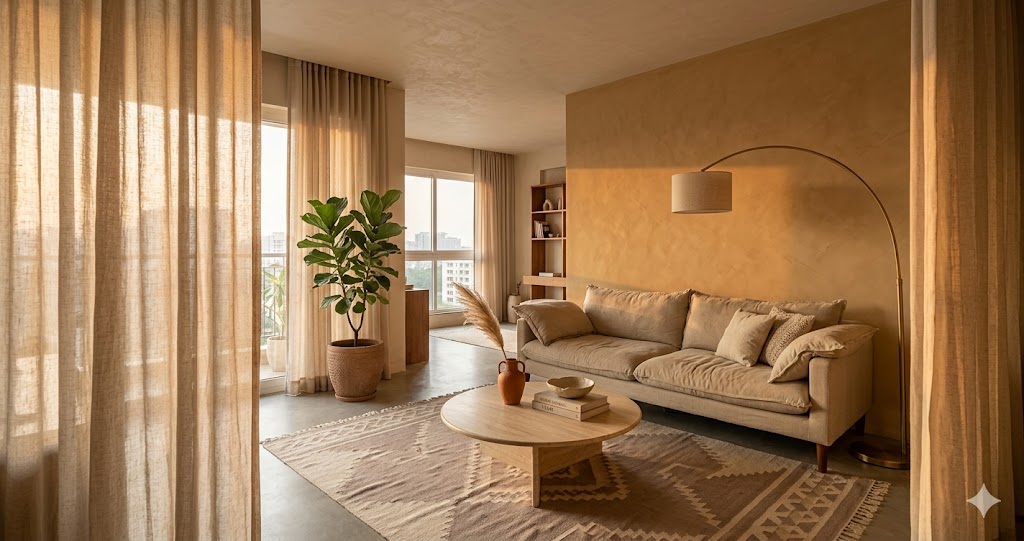
Warm Minimal Interiors — A 2026 Style Guide for Indian Homes
Restraint with warmth · Oat & oak & linen · Curated negative space
Warm minimalism is the dominant interior style for premium Indian homes in 2026. It is the answer to two parallel fatigues — the cold-clinical minimalism of the 2010s (white walls, chrome handles, downlights) and the cluttered maximalist showpiece-everything of the 2020s. Warm minimalism strips ornament but adds back warmth through material, light, and tactility.
This is a 22-minute working reference for homeowners and interior designers building warm minimal interiors in Indian apartments. It covers the five structural principles, a fifteen-tone working palette with hex codes and Indian paint references, room-by-room application across a 2-3 BHK, three budget tiers from ₹4 L DIY to ₹80 L bespoke, ten common pitfalls, sourcing guidance, and how warm minimal differs from adjacent styles.
Restraint is the discipline. Warmth is the reward. The room should feel both generous and calm — restful but not sterile, refined but not precious. Get one of those two wrong and the style collapses into either cold minimalism or cluttered modern.
For complementary depth see Wardrobe Finish Ideas, Modular Kitchen Design Guide, False Ceiling Design Guide, Japandi Apartment Interior Guide, and Earthy Interior Palette.
This guide refreshes every 12 months — palette + sourcing trends shift annually. Last verified: May 2026 · Next verify: May 2027.
What Warm Minimalism Is
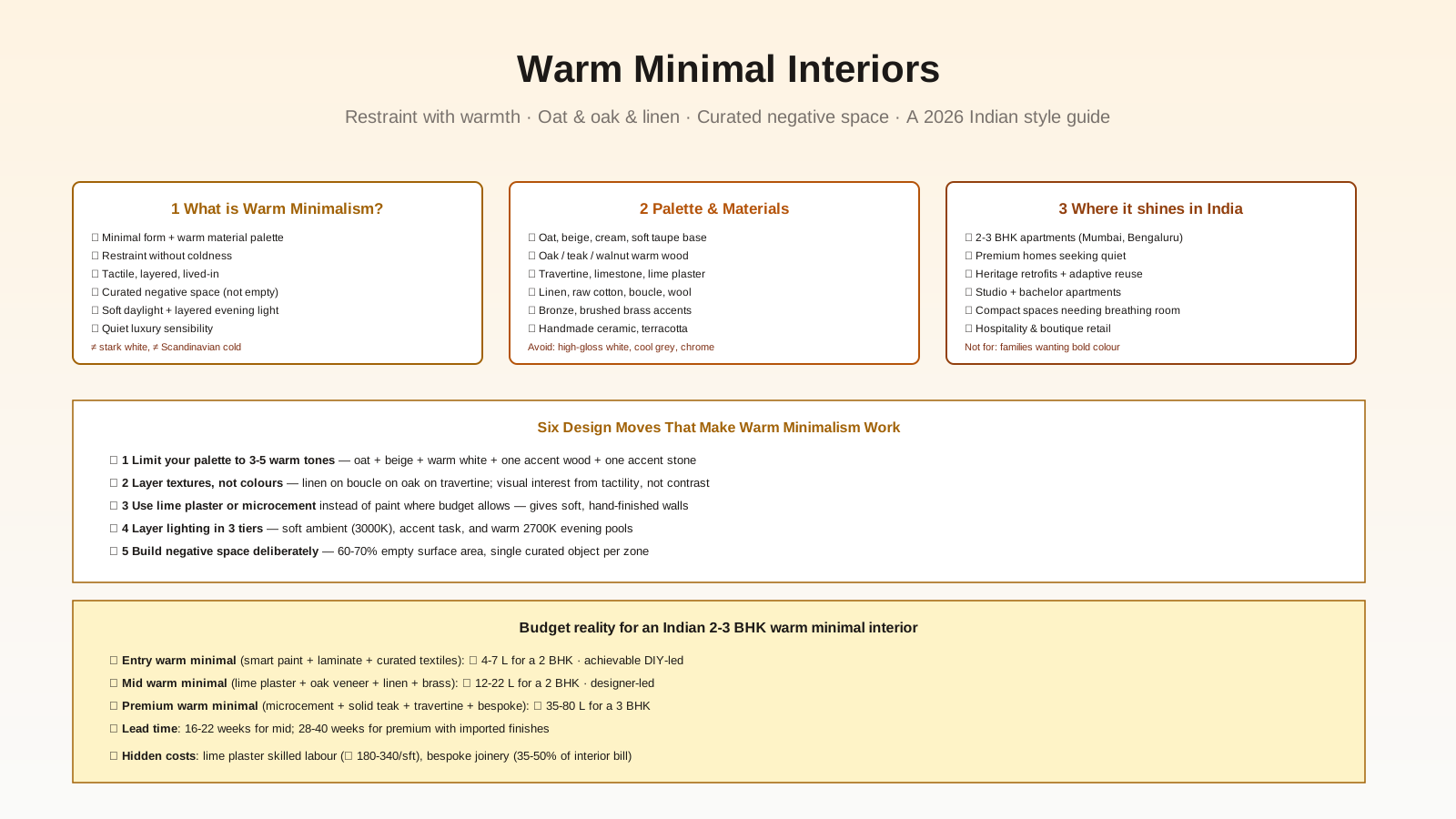
Warm minimalism is minimalism with the heat turned up. It keeps the discipline of minimalism — visual restraint, edited objects, generous negative space — but rejects the cold material vocabulary that made 2010s minimalism feel like a hospital corridor.
The core idea: strip ornament, but layer materiality. A warm minimal room contains fewer objects than a typical Indian living room, but the objects and surfaces present are richer in texture and warmer in tone. Lime plaster instead of paint. Oat linen instead of leatherette. Travertine instead of granite. Warm 2700K pendant pools instead of cool overhead downlight grids.
Five things warm minimalism is NOT
1. Not Scandinavian minimalism — Scandi runs cooler (whiter walls, pale birch, grey-blue accents), driven by the Northern light deficit. Warm minimal runs warmer because Indian light is already warm and golden.
2. Not Wabi-Sabi — Wabi-Sabi celebrates imperfection, age, and asymmetry explicitly. Warm minimal is cleaner and more composed. Wabi-Sabi is rustic; warm minimal is refined.
3. Not Japandi — Japandi is a fusion of Japanese restraint + Scandinavian functionality with darker woods and lower furniture. Warm minimal is broader, more Mediterranean-leaning, with curvilinear forms welcome.
4. Not "neutral interior" — Beige walls + grey sofa is not warm minimalism. Warm minimal requires material depth (lime plaster, real wood, natural fibre) — not just neutral colour.
5. Not "quiet luxury" alone — Quiet luxury is a sourcing aesthetic (expensive things that don't shout). Warm minimal is a design philosophy. The overlap is large but they're not synonyms.
The Five Principles That Make Warm Minimalism Work
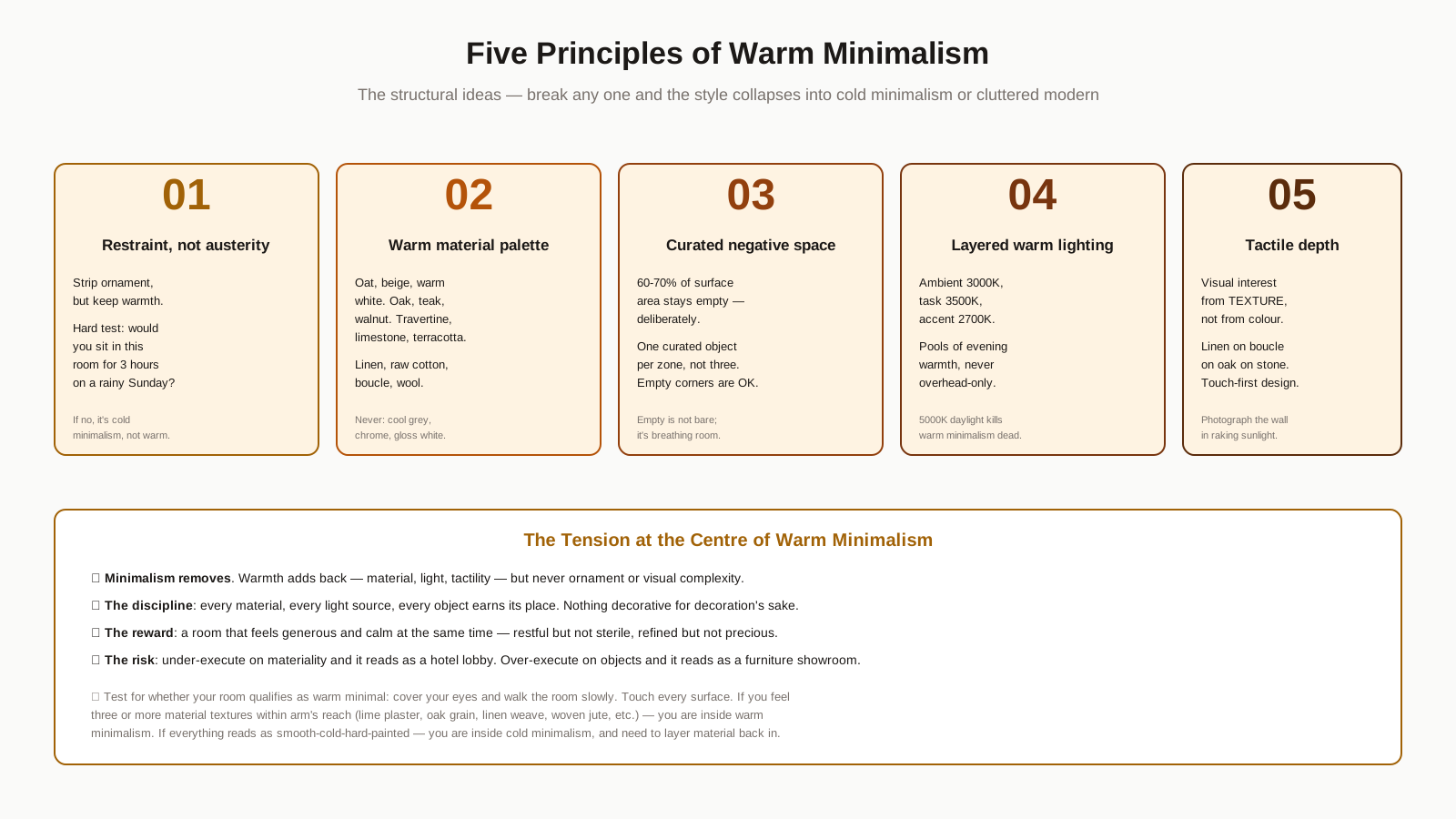
1. Restraint, not austerity
Strip ornament. Strip visual complexity. Strip object count. But keep warmth — through material, through light, through tactility. The hard diagnostic: would you sit in this room for three hours on a rainy Sunday afternoon, alone, without your phone? If the answer is no — too cold, too uncomfortable, nothing to settle into — you have cold minimalism, not warm minimalism.
2. Warm material palette
Every material decision tilts toward warm. Oat, beige, warm white walls. Oak, teak, walnut, cane wood. Travertine, limestone, lime plaster, terracotta stone. Linen, raw cotton, boucle, wool textile. Brushed brass, aged bronze hardware. Hand-thrown ceramic, hand-woven jute, hand-troweled lime plaster accents. Never cool grey, chrome, polished steel, gloss white, lacquered black.
3. Curated negative space
60-70% of horizontal and vertical surface area stays deliberately empty. One curated object per zone, not three. Empty corners are not failures — they are breathing room. The discipline test: photograph the room and crop to a 1:1 square. Does each square have at most one or two visual focal points? If every square is busy, you have not curated; you have arranged.
4. Layered warm lighting in three tiers
Ambient lighting at 3000K (general overhead, indirect). Task lighting at 3500K (work surfaces, reading). Accent lighting at 2700K (evening pools, mood). Every room needs at least three light sources at different heights and warmths. Single-source overhead downlights are the death of warm minimalism — they flatten material into a single plane and strip atmosphere completely. Always specify dimmable, always specify CRI ≥ 90.
5. Tactile material depth
Visual interest comes from texture, not from colour. The wall is lime plaster (rough, hand-finished) → the curtain is heavy linen (woven) → the sofa is boucle (looped pile) → the cushion is raw cotton (slubbed) → the floor is oak (grained) → the rug is wool (knotted). Six material textures within arm's reach, all warm-toned, all natural. Touch-first design, not look-first.
The Working Colour Palette — Fifteen Tones with Hex Codes
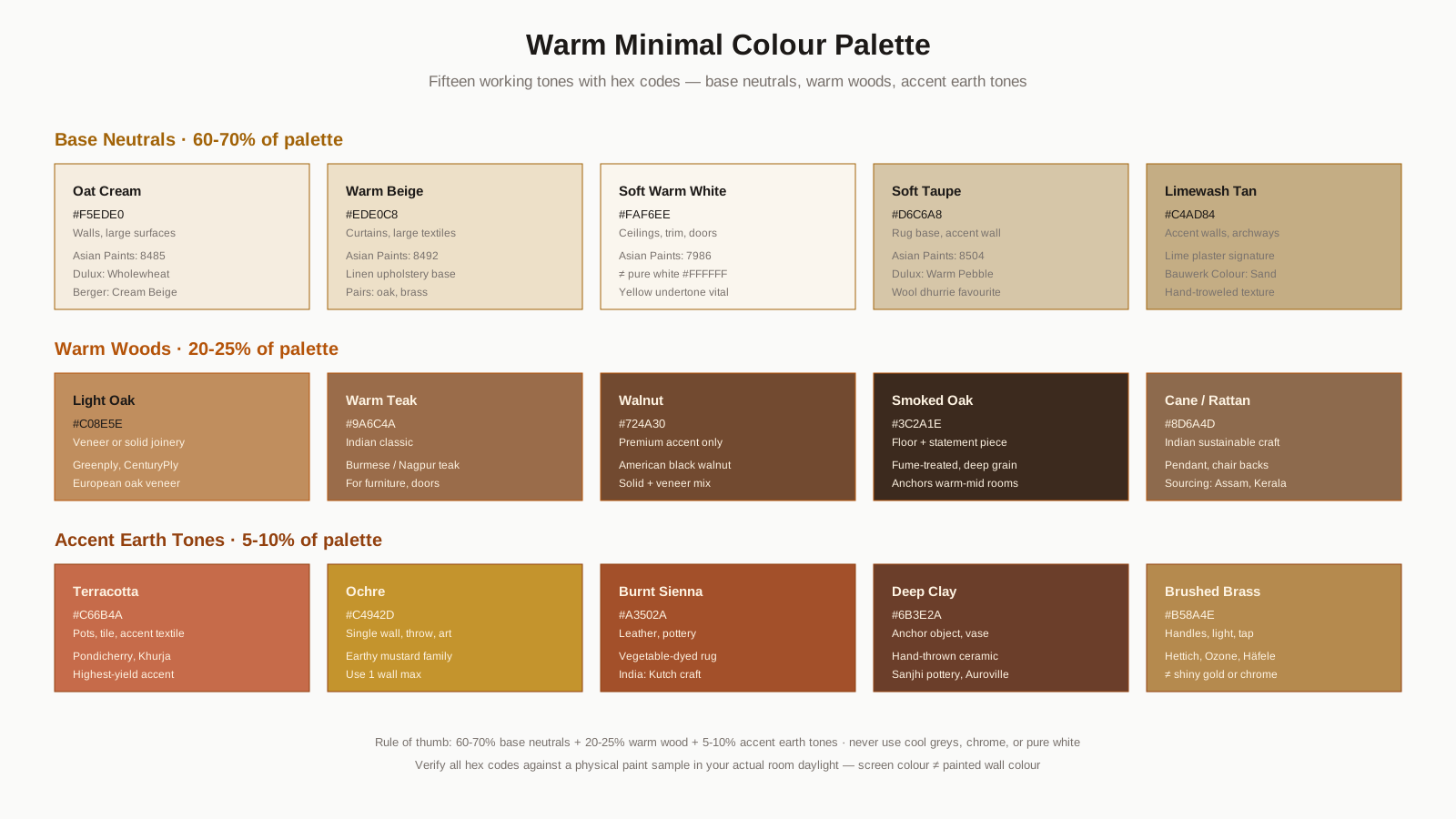
Base neutrals — 60-70% of palette
| Tone | Hex | Use | Indian paint reference |
|---|---|---|---|
| Oat Cream | #F5EDE0 | Walls, large surfaces | Asian Paints 8485 · Dulux Wholewheat |
| Warm Beige | #EDE0C8 | Curtains, large textiles | Asian Paints 8492 |
| Soft Warm White | #FAF6EE | Ceilings, trim, doors | Asian Paints 7986 (NOT pure white #FFFFFF) |
| Soft Taupe | #D6C6A8 | Rug base, accent wall | Asian Paints 8504 · Dulux Warm Pebble |
| Limewash Tan | #C4AD84 | Accent wall, archway | Lime plaster · Bauwerk Sand |
The base neutral test: paint a small swatch on the actual wall under actual room daylight before committing. Warm whites can shift dramatically against ambient yellow Indian sunlight — what reads as "oat" on a sample card can read as "yellow" on the wall.
Warm woods — 20-25% of palette
| Tone | Hex | Use | Sourcing notes |
|---|---|---|---|
| Light Oak | #C08E5E | Veneer, joinery | Greenply / CenturyPly European oak |
| Warm Teak | #9A6C4A | Furniture, doors | Burmese / Nagpur teak |
| Walnut | #724A30 | Premium accent only | American black walnut |
| Smoked Oak | #3C2A1E | Floor, statement piece | Fume-treated, deep grain |
| Cane / Rattan | #8D6A4D | Pendant, chair backs | Assam, Kerala craft |
Solid wood always reads warmer than veneer of the same species — the grain depth carries the warmth. Use solid where touch is frequent (table tops, chair arms, door handles); veneer is fine for vertical surfaces.
Accent earth tones — 5-10% of palette
| Tone | Hex | Use | Indian craft source |
|---|---|---|---|
| Terracotta | #C66B4A | Pots, tile, accent textile | Pondicherry · Khurja pottery |
| Ochre | #C4942D | Single wall, throw, art | Earthy mustard family |
| Burnt Sienna | #A3502A | Leather, pottery, rug | Kutch craft, vegetable-dyed |
| Deep Clay | #6B3E2A | Anchor object, vase | Sanjhi · Auroville pottery |
| Brushed Brass | #B58A4E | Handles, light, tap | Hettich / Ozone / Häfele |
The accent tones are the spice. Use them as a single moment per room, not as a palette layer. One terracotta vessel in the living room; one ochre throw in the bedroom; one brass tap in the kitchen. Three accent moments per apartment, not thirty.
What to avoid completely
- Cool grey in any saturation (#B0B7BE, #94A3B8, etc.) — kills warmth on contact
- Pure white #FFFFFF — too clinical, too cold, no undertone
- Chrome / polished steel — visually cold, fingerprints loudly
- High-gloss laminates — reflect surrounding cold light, defeat tactility
- Saturated jewel tones (navy, forest, plum) — they belong to dramatic modern, not warm minimal
Room-by-Room Application — Indian 2-3 BHK Apartment
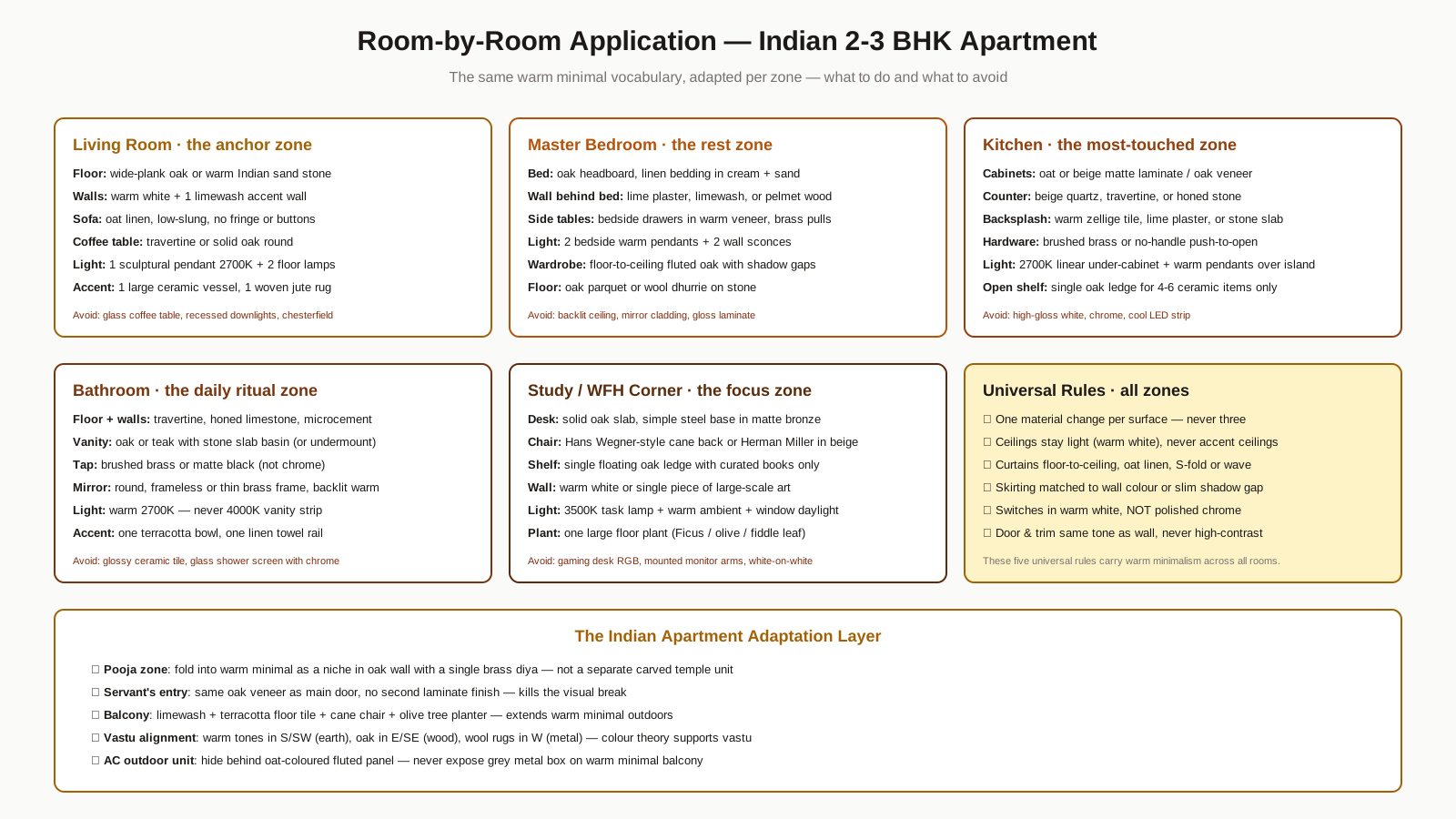
Living room — the anchor zone
The living room sets the warm minimal tone for the whole apartment. Floor is wide-plank oak or warm Indian sandstone (Jaisalmer, Dholpur). Walls are warm white with one limewash accent wall behind the sofa or TV unit. Sofa is oat-coloured heavy linen, low-slung (seat height 38-42 cm), no fringe or buttoning or chesterfield tufting. Coffee table is travertine slab on a powder-coated steel base, or a solid oak round.
Lighting layers: one sculptural pendant (Klove, Beem, or Studio Pepe-spec) over the seating cluster at 2700K, two floor lamps (one each end of the sofa), wall sconces flanking any art. No recessed downlight grid. The accent layer is one large ceramic vessel (Auroville or Pondicherry hand-thrown), one woven jute or wool rug (8×10 ft minimum), and a small stack of architecture or art books on the coffee table.
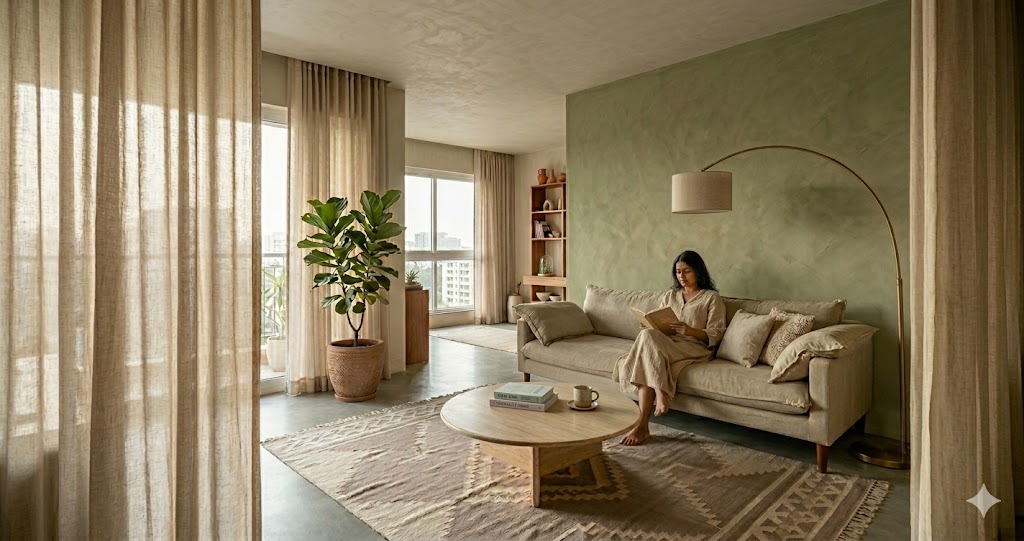
Master bedroom — the rest zone
Bed is a low-slung oak-headboard platform with linen bedding in cream and sand layering. Wall behind the bed is either lime plaster, limewash, or a full-height wood-pelmet feature wall in fluted oak with shadow-gap joinery. Side tables are bedside drawers in warm oak veneer with brushed brass cup pulls. Wardrobe is floor-to-ceiling in matched fluted oak with shadow-gap divisions — never a contrasting laminate.
Lighting is two bedside warm pendants (suspended, not table lamps — saves bedside-table real estate) plus two wall sconces flanking the bed (for reading). All bedroom lighting at 2700K, dimmable to 10%. Floor is oak parquet or a generous wool dhurrie over the existing stone.
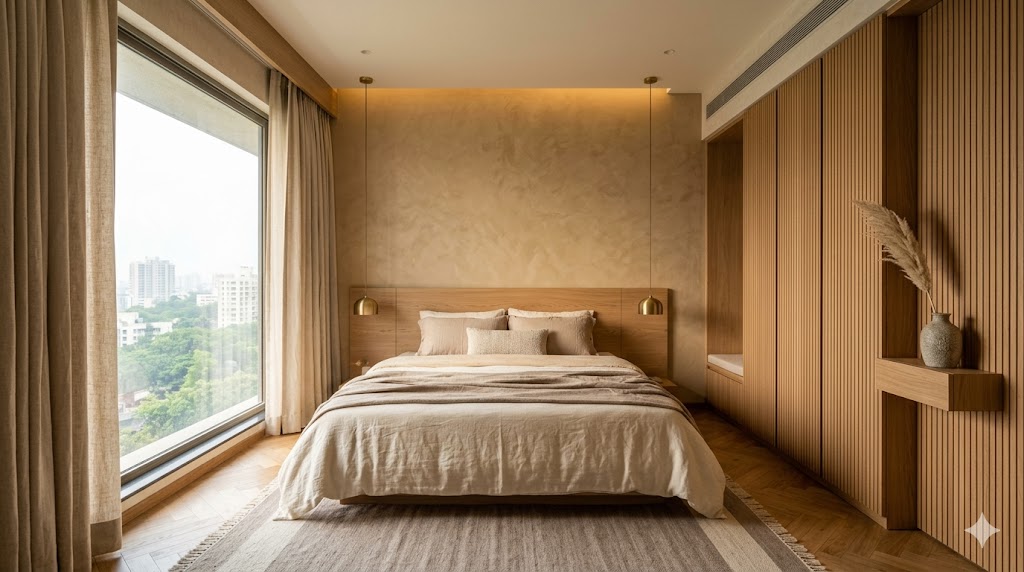
Kitchen — the most-touched zone
Cabinets in oat or beige matte laminate (Greenlam SwitchSuede, Merino Soft Matte) or oak veneer for premium. No high-gloss white anywhere — it reflects the kitchen LED and reads cold. Counter is beige quartz, travertine, or honed Italian limestone. Backsplash is warm zellige tile, lime plaster, or a single stone slab to ceiling.
Hardware is brushed brass cup pulls or no-handle push-to-open (Hettich Veosys, Häfele systems). Lighting is 2700K linear under-cabinet (CRI 90+, never the standard 4000K kitchen strip) plus warm pendants over the island. Open shelf is one single oak ledge above the counter — for four to six ceramic items only, never twelve.
Bathroom — the daily ritual zone
Floor and walls in travertine, honed limestone, or microcement (Bauwerk, Marrakech Design, Domus Innova). Vanity is oak or teak with a stone slab basin or undermount. Tap is brushed brass or matte black — never chrome. Mirror is round, frameless or with a thin brass frame, backlit warm 2700K (never the 4000K vanity-strip default). One terracotta bowl on the vanity, one linen towel rail.
Study / WFH corner — the focus zone
Desk is a solid oak slab on a simple powder-coated bronze steel base. Chair is a Hans Wegner-style cane-back or a Herman Miller Aeron / Sayl in warm beige. Shelf is a single floating oak ledge with curated books and one ceramic object. Wall behind the desk is warm white or a single large piece of art (commission Indian — Ranjit Hoskote, Anjolie Ela Menon affordable prints, Khoj artist studio). Lighting is a 3500K Anglepoise-style task lamp plus warm ambient plus generous daylight from a south-facing window if possible.
Universal rules across all rooms
- One material change per surface — never three on a single wall
- Ceilings always stay light (warm white) — never accent ceilings
- Curtains always floor-to-ceiling, oat or beige linen, S-fold or wave fold
- Skirting matched to wall colour or replaced with a slim shadow-gap detail
- Switches in warm white or matte brushed brass — never polished chrome
- Doors and trim in the same tone as the walls — never high-contrast frames
The Indian apartment adaptation layer
- Pooja zone: fold into a niche in the oak wall with a single brass diya — not as a separate carved teak temple unit
- Servant's entry: same oak veneer as the main door — never a second contrasting laminate finish
- Balcony: limewash walls + terracotta floor tile + cane chair + olive tree planter — extends warm minimal outdoors
- Vastu alignment: warm tones in the south-west (earth element), oak in the east (wood), wool rugs in the west (metal) — colour theory naturally supports vastu
- AC outdoor unit: hide behind an oat-coloured fluted panel — never expose a raw grey metal box on a warm minimal balcony
Three Budget Tiers — All-in Estimates
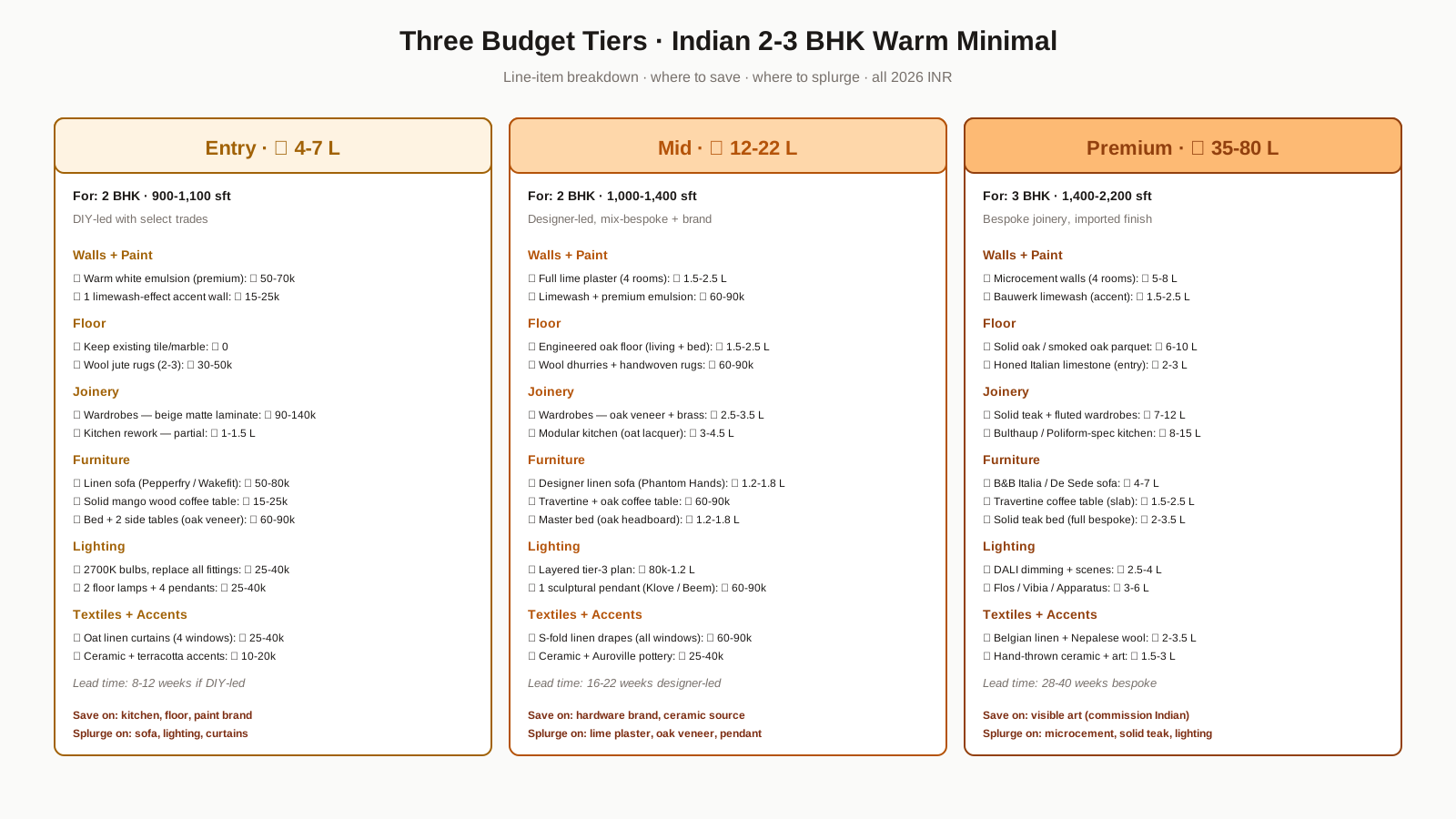
Entry tier — ₹ 4-7 L for a 2 BHK (900-1,100 sft)
DIY-led with select trades. Keep existing flooring; pivot through paint, textiles, and select joinery. Save on: kitchen, floor, paint brand (premium emulsion is enough, no need for lime plaster). Splurge on: sofa quality, curtain weight (heavy linen reads warmer), lighting fittings.
Typical mix: premium emulsion paint walls, one limewash-effect accent wall, beige matte laminate wardrobes, partial kitchen rework, linen sofa from Wakefit / Pepperfry / Urban Ladder, solid mango wood coffee table, oak veneer bed, 2-3 wool jute rugs, oat linen ready-made curtains, 2700K bulb replacement throughout, two floor lamps, 4-6 ceramic and terracotta accents. Lead time 8-12 weeks DIY-led.
Mid tier — ₹ 12-22 L for a 2 BHK (1,000-1,400 sft)
Designer-led, mix of bespoke and brand. Lime plaster on at least one full room, engineered oak floor in living and master, designer linen sofa (Phantom Hands, Sage Living, Beyond Designs), travertine and oak coffee table, full oak-veneer wardrobes with brushed brass hardware, modular kitchen in oat lacquer (Häfele, Sleek), layered tier-3 lighting plan, one sculptural pendant (Klove or Beem), S-fold linen drapes throughout, hand-thrown Auroville ceramic accents.
Save on: hardware brand (Hettich works as well as Häfele at half the price), ceramic source (direct from Auroville or Khurja saves 40-60% over retail). Splurge on: lime plaster (skilled labour is the differentiator), oak veneer quality (European oak from CenturyPly reads warmer than Vietnamese), the one sculptural pendant. Lead time 16-22 weeks designer-led.
Premium tier — ₹ 35-80 L for a 3 BHK (1,400-2,200 sft)
Bespoke joinery, imported finishes. Microcement walls in four rooms (Bauwerk certified applicator), Bauwerk limewash accents, solid oak or smoked oak parquet floors, honed Italian limestone entry, solid teak with fluted wardrobes, Bulthaup or Poliform-spec kitchen, B&B Italia or De Sede sofa, travertine slab coffee table, solid teak bespoke bed, DALI dimming with scene control, Flos / Vibia / Apparatus pendants, Belgian linen and Nepalese wool textiles, hand-thrown ceramic and original Indian art.
Save on: visible art (commission emerging Indian artists, save 70-90% over imported galleries). Splurge on: microcement application (it's the signature wall finish), solid teak joinery (it's the warmth anchor for the next twenty years), the lighting plan (it's what photographs and what your eye reads continuously). Lead time 28-40 weeks bespoke.
Hidden costs to budget for
- Lime plaster skilled labour: ₹ 180-340 per sft applied (material alone is ₹ 80-120; the labour is the cost)
- Bespoke joinery: typically 35-50% of total interior bill, not 15-20%
- Microcement application: needs a certified Bauwerk or Domus Innova applicator — ₹ 500-900 per sft applied
- Solid wood lead time: 8-14 weeks from order to delivery for bespoke teak or oak
- Imported lighting: 6-10 weeks shipping + customs (15-28% duty on lighting fixtures)
- Linen washing + softening: budget ₹ 8-15k for proper pre-wash before installation — straight-from-loom linen reads stiff
Ten Common Pitfalls That Kill the Style
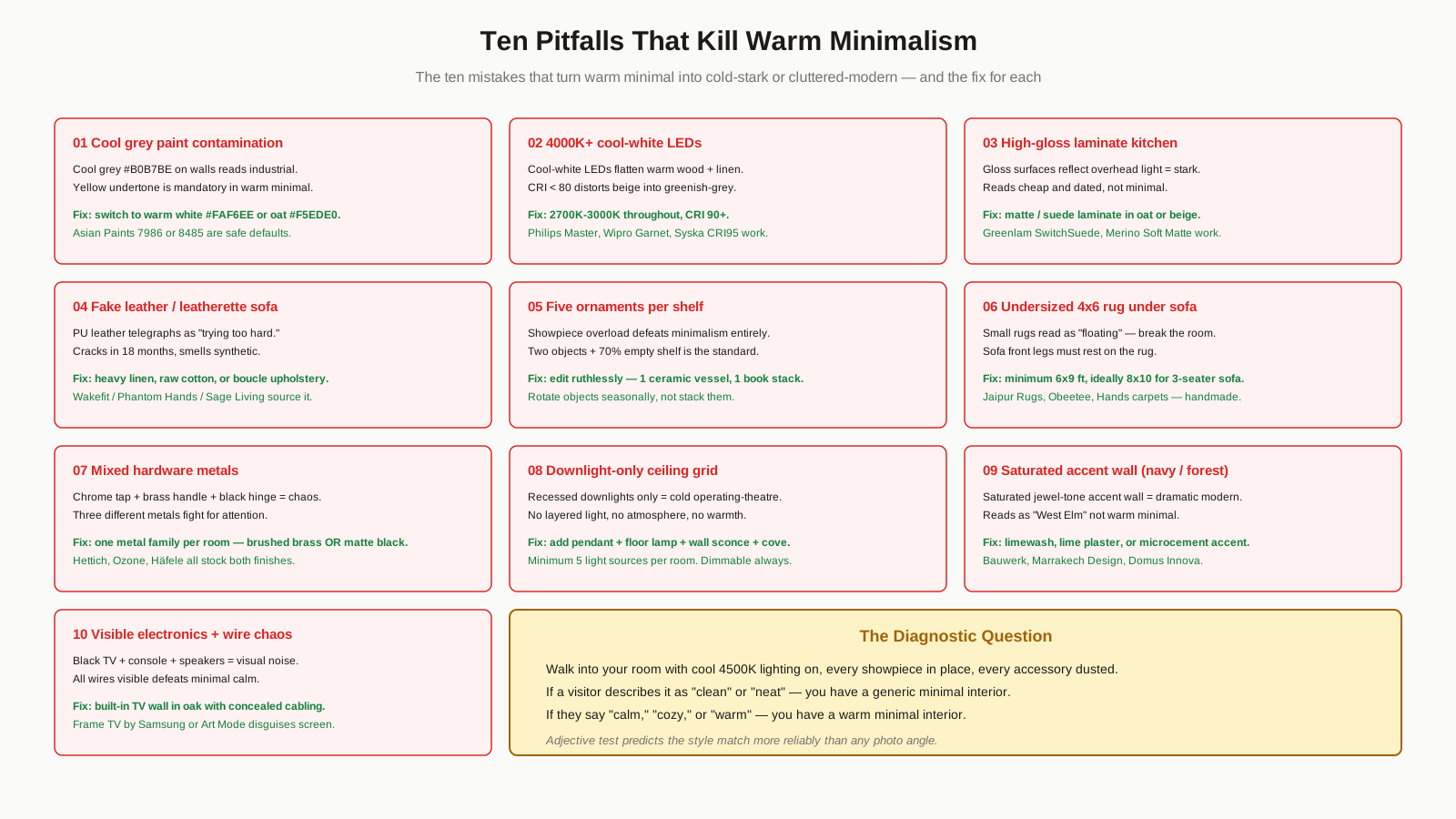
1. Cool grey paint contamination. Any cool grey on walls reads industrial; warm minimal requires yellow undertone. Fix: switch to warm white #FAF6EE or oat #F5EDE0.
2. 4000K+ cool-white LEDs. Cool-white LEDs flatten warm wood and linen into greenish-grey. Fix: 2700-3000K throughout, CRI 90+.
3. High-gloss laminate kitchen. Gloss reflects overhead light and reads stark. Fix: matte / suede laminate in oat or beige.
4. Fake leather / leatherette sofa. PU leather telegraphs as "trying too hard," cracks in 18 months. Fix: heavy linen, raw cotton, or boucle.
5. Five ornaments per shelf. Showpiece overload defeats the discipline. Fix: edit ruthlessly — one ceramic vessel, one book stack, 70% empty shelf.
6. Undersized 4×6 rug under the sofa. Small rugs float; sofa front legs must rest on the rug. Fix: minimum 6×9 ft, ideally 8×10 ft for a 3-seater.
7. Mixed hardware metals. Chrome tap + brass handle + black hinge = chaos. Fix: one metal family per room.
8. Downlight-only ceiling grid. Single-source overhead light kills atmosphere. Fix: layered tier-3 lighting plan, minimum five sources per room, all dimmable.
9. Saturated jewel-tone accent wall. Navy / forest / plum reads as dramatic modern, not warm minimal. Fix: limewash, lime plaster, or microcement accent in earth tone.
10. Visible electronics + wire chaos. Black TV + console + speakers + tangled wires destroy minimal calm. Fix: built-in TV wall in oak with concealed cabling, or Samsung Frame TV in art mode.
The diagnostic question
Walk into your room with cool 4500K lighting on, every showpiece in place, every accessory dusted. Invite a guest. If they describe it as "clean" or "neat" — you have generic minimal interior. If they describe it as "calm," "cozy," "warm," or "settled" — you have warm minimal interior. The adjective test predicts the style match more reliably than any photo angle.
Indian Sourcing Guide
Furniture
- Phantom Hands (Bangalore) — Hans Wegner reissues, solid teak / oak, the gold standard for warm minimal Indian sourcing
- Sage Living (Mumbai) — Linen upholstery, oak case goods, designer-led modern Indian
- Beyond Designs (Delhi NCR) — Premium bespoke, lime plaster expertise
- Wakefit — Entry-tier linen sofa and oak veneer beds
- Pepperfry — Solid mango wood, decent oak veneer, mid-budget
- Urban Ladder — Reliable mid-tier, decent linen options
- Sage of West End — Custom oak joinery, Mumbai/Bangalore
Lime plaster, microcement, limewash
- Bauwerk Colour — Australian limewash, premium, certified Indian applicators
- Marrakech Design — Lime plaster, Italian
- Domus Innova — Microcement, Spanish, applicator network in metros
- Tadelakt India — Moroccan-tradition lime plaster, niche applicator base
Textiles
- Jaipur Rugs — Hand-knotted wool, custom sizing
- Obeetee — Premium wool and silk, larger sizes
- Hands Carpets — Knotted in Bhadohi, mid-premium
- Fabindia (linen line) — Affordable linen drapery and bedding
- Anokhi — Block-printed cotton for accent throws
- Good Earth — Premium textiles, ceramic, lifestyle (luxury tier)
Ceramic and pottery
- Auroville pottery studios — Hand-thrown stoneware, terracotta
- Sanjhi pottery (Mathura) — Traditional craft, contemporary forms
- Khurja pottery (UP) — Affordable terracotta and stoneware
- Mai Hauus — Modern ceramic, Auroville school
- Andretta Pottery (HP) — Studio ceramics, signature pieces
Lighting
- Klove — Studio Mumbai-spec sculptural pendants, premium
- Beem Light Atelier — Bangalore, contemporary warm pendants
- White Teak — Mid-tier, decent warm minimal range
- Foscarini, Flos, Vibia (imported via Magnum Opus / Lights & Shadows) — premium tier
Hardware
- Hettich (German engineering, Indian assembly) — workhorse, brushed brass and matte black available
- Häfele — premium tier, full warm minimal range
- Ozone — mid-tier, good brass finishes
- Blum — Austrian, premium hinges and drawer systems
How Warm Minimalism Differs from Adjacent Styles
| Style | Palette | Wood | Furniture form | Best for |
|---|---|---|---|---|
| Warm Minimal | Oat, beige, warm white + earth accents | Oak, teak, walnut, cane | Low-slung, curvilinear welcome | Premium Indian homes seeking calm |
| Scandinavian Minimal | Cool white, pale blue-grey, pale wood | Birch, ash, beech | Low, geometric, hygge accents | Cooler climates, daylight-deficit |
| Japandi | Off-white + black + smoked wood | Smoked oak, walnut, dark cane | Very low, geometric, restrained | Compact urban, dual influences |
| Wabi-Sabi | Earth tones + raw textures | Reclaimed, weathered | Imperfect, asymmetric, hand-formed | Heritage, slow-life sensibility |
| Mediterranean Modern | Warm white + terracotta + olive | Olive, oak, cane | Curvilinear, rustic | Warm climates, sea-leaning |
| Quiet Luxury | Neutral palette, no rules | Whatever the budget allows | Whatever the budget allows | Sourcing aesthetic, not a style |
The closest cousin is Mediterranean modern (similar palette, similar lime plaster, similar curvilinear forms) — warm minimalism is essentially the Indian / urban / apartment-scale adaptation of the Mediterranean instinct. The closest competitor is Japandi (next guide in this series) — Japandi is darker, lower, more geometric; warm minimal is lighter, taller, more flowing.
When Warm Minimalism Is the Wrong Style for You
Warm minimalism is the right answer for ~40% of premium Indian homes. It is the wrong answer for:
- Families with three or more children under 10 — the discipline of single objects + 70% empty surfaces does not survive Lego season
- Joint-family households with multi-generational object accumulation — warm minimal requires editing inherited furniture out of the room; this is socially difficult
- Homeowners who derive joy from collecting and displaying — books, art, sculpture, antiques. Warm minimal forces aggressive curation
- Homes where the primary entertaining is large extended family gatherings — warm minimal seating geometries don't scale well past 6-8 guests
- First-time DIY homeowners on tight budgets — the entry tier works, but warm minimal requires more design discipline than maximal styles where clutter can hide mistakes
If any of the above describes you, consider Earthy Interior Palette (similar warmth, more forgiving), Modular Kitchen Design Guide (functional baseline), or contemporary Indian eclectic (works with collections).
Where to Go Next
- For palette deep-dive — Earthy Interior Palette
- For Japandi-style fusion — Japandi Apartment Interior Guide
- For storage in warm minimal apartments — Smart Storage Interiors
- For tight-budget warm minimal — Budget Luxury Interiors
- For fluted oak wall detail — Fluted Panel Design Guide
- For sustainable material sourcing — Sustainable Interiors India Guide
- For compact apartment adaptation — Compact Luxury Apartment Guide
- For wardrobe finish specifics — Wardrobe Finish Ideas
- For kitchen scope — Modular Kitchen Design Guide
- For false ceiling planning — False Ceiling Design Guide
References
1. Kelley Wearstler (2019). Evocative Style. Rizzoli. (Material-rich warm interior reference.)
2. Axel Vervoordt (2010). Wabi Inspirations. Flammarion. (Adjacent Wabi-Sabi reference for material depth.)
3. John Pawson (2010). Minimum. Phaidon. (The cold minimalism reference — useful contrast.)
4. Vincent Van Duysen (2016). Vincent Van Duysen — Complete Works 1989-2016. Thames & Hudson. (Belgian warm minimalist master.)
5. Studio KO (2018). Studio KO. Rizzoli. (Moroccan-Mediterranean warm minimal reference.)
6. Bawa, G. + Robson, D. (2002). Geoffrey Bawa — The Complete Works. Thames & Hudson. (Tropical warmth + minimal restraint, foundational Indian reference.)
7. Pallasmaa, J. (2012). The Eyes of the Skin — Architecture and the Senses. Wiley. (Tactility theory underlying warm minimal.)
8. Zumthor, P. (2006). Atmospheres. Birkhäuser. (Atmospheric warmth without ornament — theory.)
9. Le Corbusier (1923). Vers une Architecture. (Foundation of minimalism — useful counterpoint.)
10. Indian Standard IS 2046:1995. High-Pressure Decorative Laminates. (For laminate specification.)
11. Bauwerk Colour Application Guide (2024). Limewash and lime plaster application standards.
Author's note: Warm minimalism is the style I would specify in 80% of new premium Indian apartment commissions in 2026. The reason is durability — not just material durability (lime plaster outlasts paint by 15-20 years), but visual durability. A warm minimal room shot in 2026 will still read as current in 2036, because it is built on material truth rather than trend colour. The styles that don't survive a decade are the ones that lean on a specific saturated colour (Pantone of the Year, etc.) or a specific furniture silhouette (mid-century revival, etc.). Warm minimal sidesteps both. Built right, it is the longest-life style choice available to an Indian homeowner today.
Disclaimer: Material costs, brand sources, and paint references are 2026 indicative and shift with currency, import duties, and supply. Verify sourcing with current vendor quotes. Hex codes are approximate references — always confirm against a physical paint swatch under the room's actual daylight before committing. Vendor mentions are illustrative; Studio Matrx has no commercial relationship with any brand named. Studio Matrx, its authors and contributors are not responsible for procurement or installation outcomes based on this guide.
Export this guide
Related Guides — Deep-dive reading
Japandi Apartment — A 2026 Style Guide for Compact Indian Homes
Japanese restraint × Scandinavian function · Low furniture · Two-wood discipline
Design StylesEarthy Interior Palette — A 2026 Style Guide for Indian Homes
Rooted · Regional · Biophilic · Indian craft-anchored
Design StylesCompact Luxury Apartment — A 2026 Working Reference for Premium 1-2 BHK Indian Homes
Four-pillar discipline · Ten signature moves · Three budget tiers ₹22-90L
Room PlanningRelated Tools — Try Free
Circadian Light Meter
Patient-centric circadian lighting visualizer for Indian healthcare design — time-of-day × intensity → CCT, melanopic lux (EML / mEDI), melatonin suppression, and an alertness curve. Calibrated against WELL v2 L03 Circadian Lighting Design, CIE S 026:2018, Brainard 2001, and Lucas et al. 2014.
Circadian ToolCross-Ventilation Analyzer
Estimate airflow and air changes per hour (ACH) from room size, window areas, layout, and local wind — with NBC 2016 Part 8 compliance check.
Ventilation CalculatorApartment Interior Planning Checklist
51-item checklist across structural, ceiling, lighting, furniture, storage, electrical, kitchen, bathroom.
Checklist