
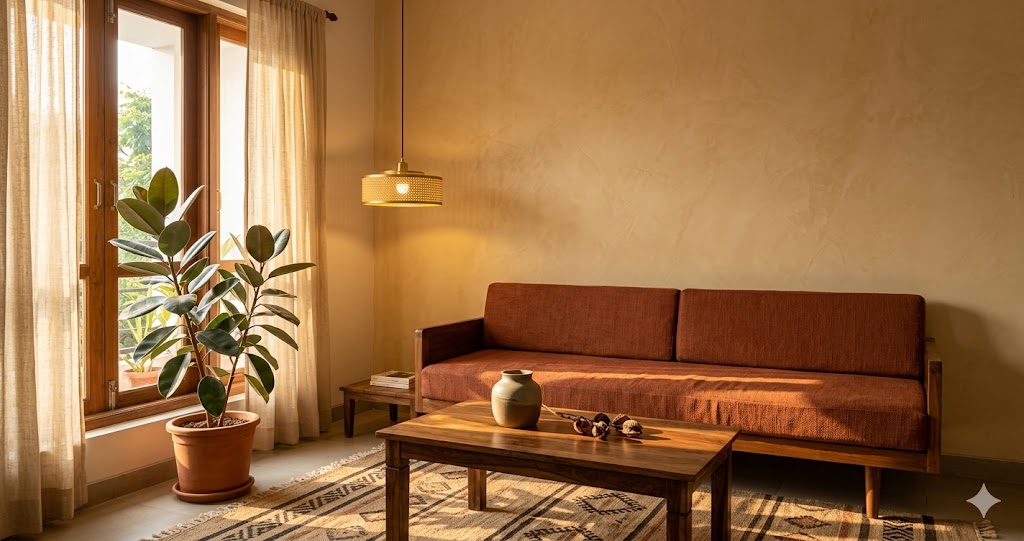
Sustainable Interiors India — A 2026 Working Reference for Eco-Conscious Indian Homes
Six dimensions · 12-category material swap · Cost-vs-impact matrix
Sustainability in Indian interiors is mis-framed as a premium luxury. In fact, 70% of the highest-impact sustainable moves cost LESS than the conventional equivalent — low-VOC paint is cheaper than solvent enamel, LED is cheaper than halogen on day one, low-flow taps pay back in a single summer, second-hand teak is a fraction of new vitrified flooring, and lime plaster is competitive with cement-and-POP once skilled labour rates are normalised across the project. What gets sold as "green premium" — reclaimed Burmese teak floor, imported Italian eco-tile, hand-woven New Zealand wool — is mostly sustainability theatre. The supply chain breaks the claim. The real Indian sustainable interior is built from materials that exist within a day's truck-drive of the apartment.
This is a 22-minute working reference for homeowners and interior designers building sustainable interiors in Indian apartments in 2026. It covers the six dimensions of sustainability (material origin, energy, water, waste, indoor air quality, social), a 12-category material swap map with embodied-carbon savings, room-by-room application across a 2-3 BHK, a cost-vs-impact matrix that tells you what to do first and what to skip, Indian certifications (GRIHA, IGBC, LEED-India, FSC India, ECBC, BEE), three budget tiers from ₹1.5 L starter to ₹55 L deep, ten common greenwashing pitfalls, and how a genuinely sustainable interior differs from both greenwash and conventional.
The highest-impact sustainable moves are also the cheapest — low-VOC paint, LED swap, low-flow taps, sheer linen drapes, second-hand teak furniture. The lowest-impact moves are the most-marketed — reclaimed teak floor flown from Myanmar, eco-certified ceramic tile shipped from Spain, hand-woven imported wool. Get the sequence right and sustainability costs less than conventional. Get it wrong and you pay a 40% premium for a worse outcome.
For complementary depth see Warm Minimal Interiors, Earthy Interior Palette, Japandi Apartment Interior Guide, Budget Luxury Interiors, Smart Storage Interiors, AI-Powered Interiors, Wardrobe Finish Ideas, Modular Kitchen Design Guide, False Ceiling Design Guide, and Waterproofing Guide.
This guide refreshes every 12 months — material brands, certification scopes, and Indian-craft sourcing leads shift annually. Last verified: May 2026 · Next verify: May 2027.
What Sustainable Interior Actually Means in India
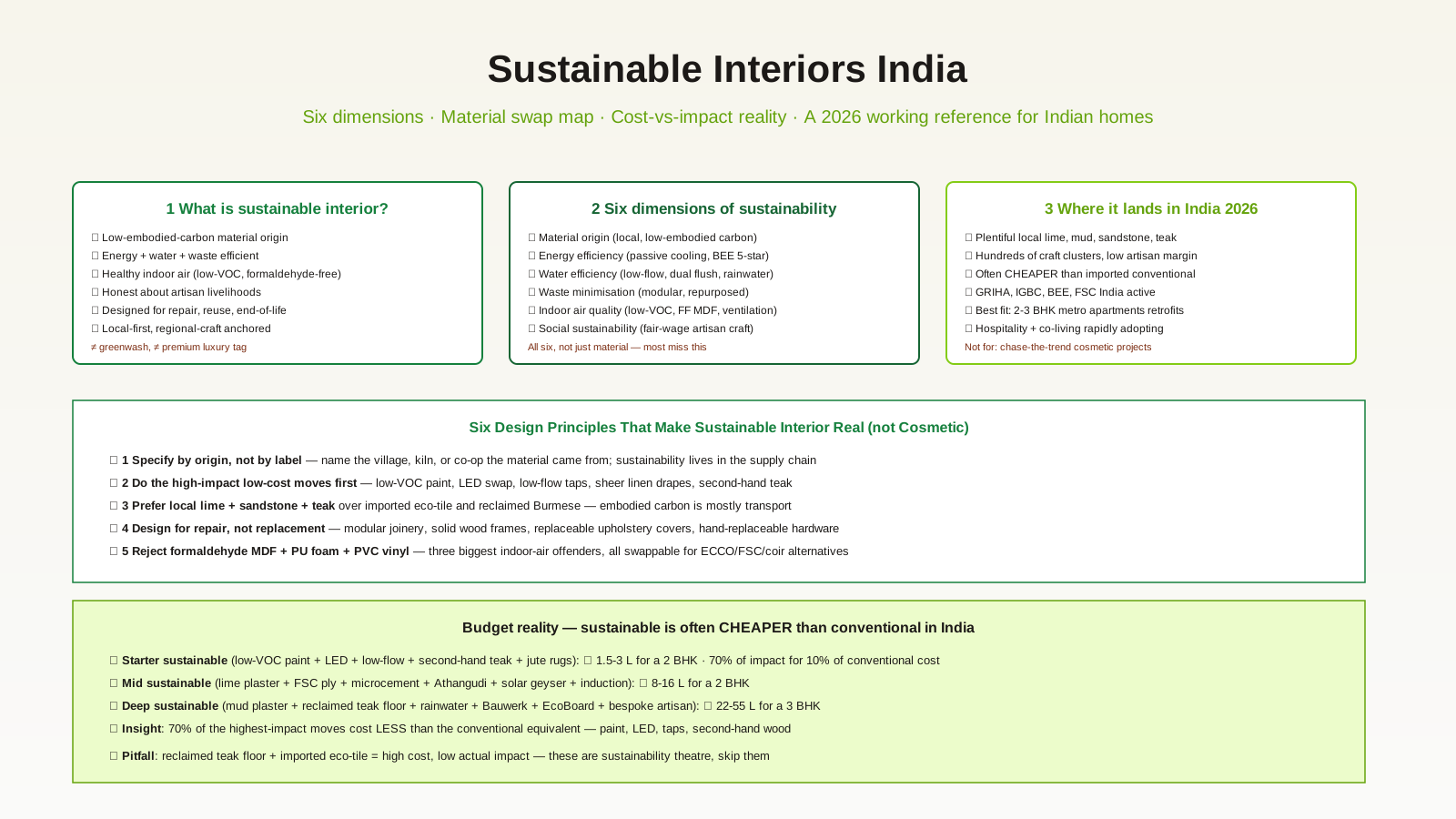
A sustainable Indian interior is an interior in which every material, every appliance, every textile, and every finish has been chosen across six axes — origin, energy, water, waste, air quality, and the livelihood of the person who made it — and where the supply chain is short enough that the claim survives scrutiny. It is not a paint colour. It is not a label. It is not a project tagline.
The core idea: the supply chain is the sustainability story. A "low-VOC" wall painted with imported Italian milk paint flown from Milan is less sustainable than the same wall painted with an Indian-manufactured low-VOC emulsion from Asian Paints Royale Atmos or Berger Breathe Easy — because the embodied carbon of paint is mostly the transport, not the chemistry. A "reclaimed teak" floor shipped from Yangon to Mumbai is less sustainable than second-hand teak salvaged from a Bengaluru demolition. Every sustainable spec should answer two questions: where did the material come from, and who made it.
Five things sustainable interior is NOT
1. Not "green-certified product" shopping. A LEED-rated tile from Spain shipped to India often has a worse lifecycle footprint than uncertified Athangudi tile from Chettinad. Sustainability is the whole supply chain, not a logo on the box.
2. Not "premium eco" tier pricing. This is the most damaging myth. In India, sustainable choices are frequently CHEAPER than the imported conventional alternative — lime is cheaper than imported tile, second-hand teak is cheaper than vitrified, LED is cheaper than halogen on day one.
3. Not "natural materials" alone. Solid teak is natural; if it is freshly logged from primary forest with no FSC chain of custody, it is unsustainable. "Natural" without origin is meaningless.
4. Not "minimal use" alone. A small apartment with PVC vinyl flooring, formaldehyde MDF carcasses, and a polyester sofa is not sustainable just because it is small. Footprint is per-unit-area, not absolute.
5. Not retrofittable in one weekend. A genuine sustainable interior is sequenced — paint and LED first, plumbing fixtures next, joinery during a renovation cycle, walls and floor during a major rework. Trying to do it all in one go quadruples the cost and usually still leaves the social-sustainability dimension untouched.
The Six Dimensions of Sustainability
1. Material origin (local + low embodied carbon)
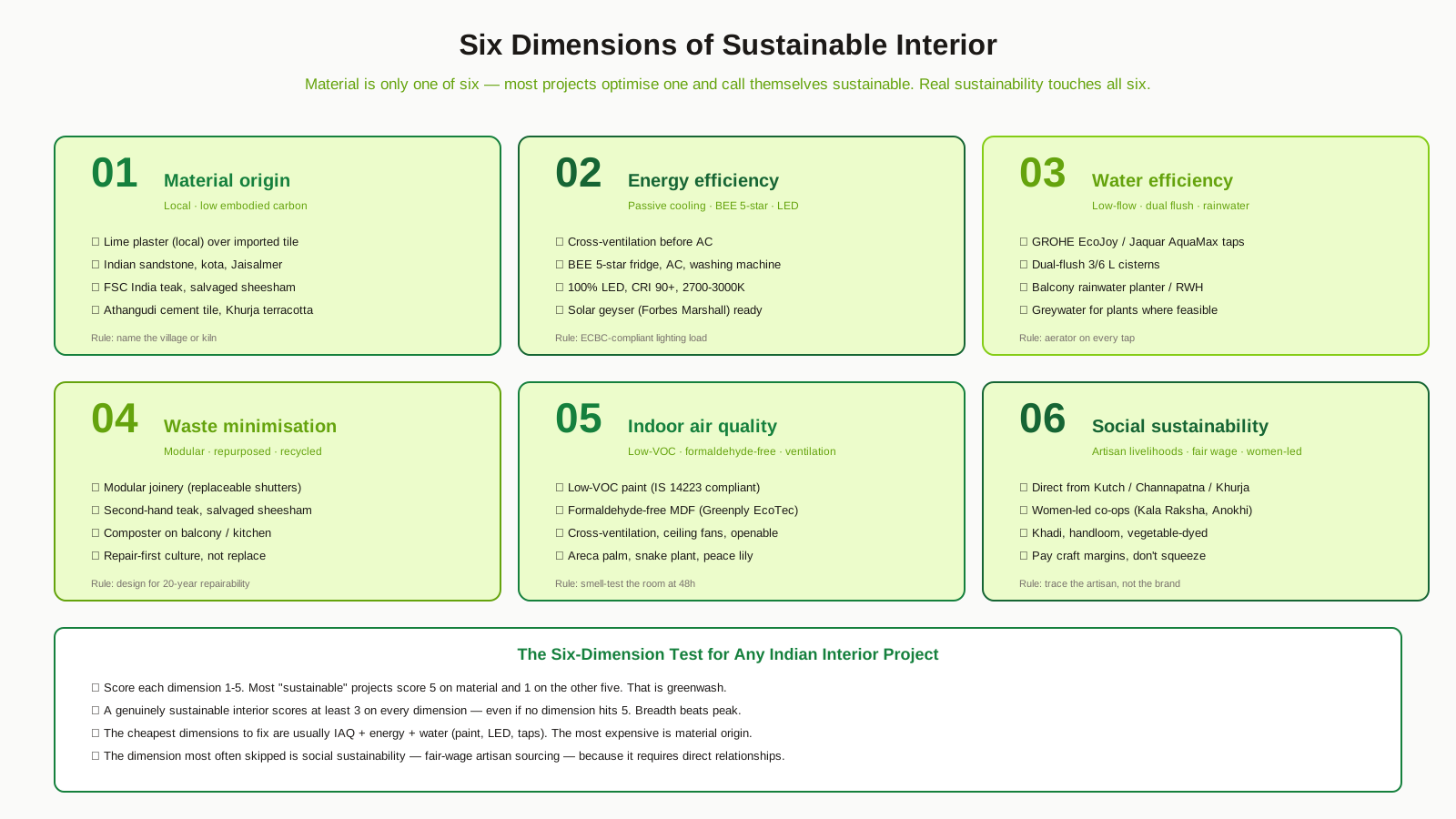
The single biggest lever. Embodied carbon is the CO2 emitted to extract, manufacture, and transport a material to your site — and for most interior surfaces it dominates the lifetime footprint. The rule: prefer materials that exist within 500 km of your apartment. Lime plaster from Rajasthan or Tamil Nadu. Kota stone from Kota. Jaisalmer sandstone from Jaisalmer. Athangudi handmade cement tile from Chettinad. Khurja terracotta from UP. Auroville stoneware from Pondicherry. FSC-certified teak from Indian plantations rather than reclaimed Burmese. Salvaged sheesham from a local demolition over freshly logged. Name the village, name the kiln, name the co-op — if you cannot, you do not know the origin.
2. Energy efficiency (passive cooling, BEE 5-star, LED)
Indian apartments waste energy primarily through lighting, air conditioning, and water heating. Three moves capture most of the addressable load: switch every bulb to LED at 2700-3000K with CRI 90+ (cuts lighting load 70-85% versus halogen, 30-45% versus CFL); specify BEE 5-star for fridge, AC, washing machine, and water heater (cuts that appliance group's energy 30-50% over BEE 3-star or unrated); design for cross-ventilation so AC runs three to five months a year instead of nine. A solar geyser ready-roof (Forbes Marshall, Tata Solar) pays back in 3-5 years on a Bengaluru or Pune duty cycle. Indian residential lighting loads should target ECBC-compliant 5-7 W/m².
3. Water efficiency (low-flow, dual flush, rainwater)
India is water-stressed across most metros and will be more so by 2030. The bathroom is the single biggest water consumer in any apartment. Replace every tap aerator with a low-flow (2-4 LPM) version — GROHE EcoJoy, Jaquar AquaMax, or even ₹150 generic aerators retrofit to existing taps. Replace single-flush WCs with dual-flush 3/6 L cisterns at the next renovation. If the apartment supports it, run a balcony rainwater catchment of 100-500 L for monsoon plant irrigation. In a Bengaluru 3 BHK, these three moves drop water consumption 30-45%.
4. Waste minimisation (modular, repurposed, recycled)
Interior renovation is one of the largest construction-waste streams in Indian cities — old joinery, broken tile, ripped-up flooring all go to landfill. The discipline: design for repair, not replacement. Modular kitchen carcasses with replaceable shutters last 25+ years (one carcass cycle, three or four shutter cycles). Solid wood furniture frames with replaceable upholstery covers last decades. A composter on the balcony (Daily Dump, Bokashi) diverts 30-50% of household waste from the municipal stream. Second-hand teak, salvaged sheesham, repurposed colonial-era furniture from Chor Bazaar (Mumbai) or Sunday Market (Delhi) saves new embodied carbon entirely.
5. Indoor air quality (low-VOC paint, formaldehyde-free MDF, ventilation)
The most-underrated dimension and the most directly health-relevant. Volatile organic compounds (VOCs) off-gassing from paint, urea-formaldehyde from MDF carcasses, and phthalates from PVC vinyl drive measurably worse indoor air than outdoor air in most new Indian apartments. The fixes: low-VOC paint conforming to IS 14223 standards (Asian Paints Royale Atmos, Berger Breathe Easy, Nerolac Impressions Eco Clean); formaldehyde-free MDF and ply (Greenply EcoTec, CenturyPly Stayfair, EcoBoard agri-fibre); cross-ventilation as the default operating mode; air-purifying plants (areca palm, snake plant, peace lily, money plant) at one plant per 9 m² of floor area. The 48-hour smell test: after paint and joinery installation, if the room still smells chemical at 48 hours, the IAQ spec failed.
6. Social sustainability (artisan livelihoods, fair wage, women-led co-ops)
The most-skipped dimension. A material with low embodied carbon, sourced locally, that nonetheless squeezes the artisan to a sub-minimum-wage margin, is not sustainable on any honest accounting. The fix is structural: buy direct from craft co-operatives wherever possible (Kala Raksha for Kutch textiles, Dastkar for cross-craft, Anokhi for Jaipur block-print, Channapatna co-ops for lacquered wood, Hunnarshala for plaster, Auroville for ceramic). Khadi India for handloom cotton, with the bonus that the chain is documented end-to-end. Women-led co-ops (SEWA, Kala Raksha, several Auroville studios) keep margin within marginalised communities. Pay the asked price — bargaining the artisan down breaks the social dimension instantly.
The six-dimension test
Score each dimension 1-5 for a project. Most "sustainable" interiors score 5 on material, 1 on energy, 1 on water, 1 on waste, 2 on IAQ, 0 on social. That is greenwash. A genuinely sustainable interior scores at least 3 on every dimension, even if no dimension peaks at 5. Breadth beats peak. Six dimensions at 3 beats one dimension at 5.
The Material Swap Map — 12 Categories
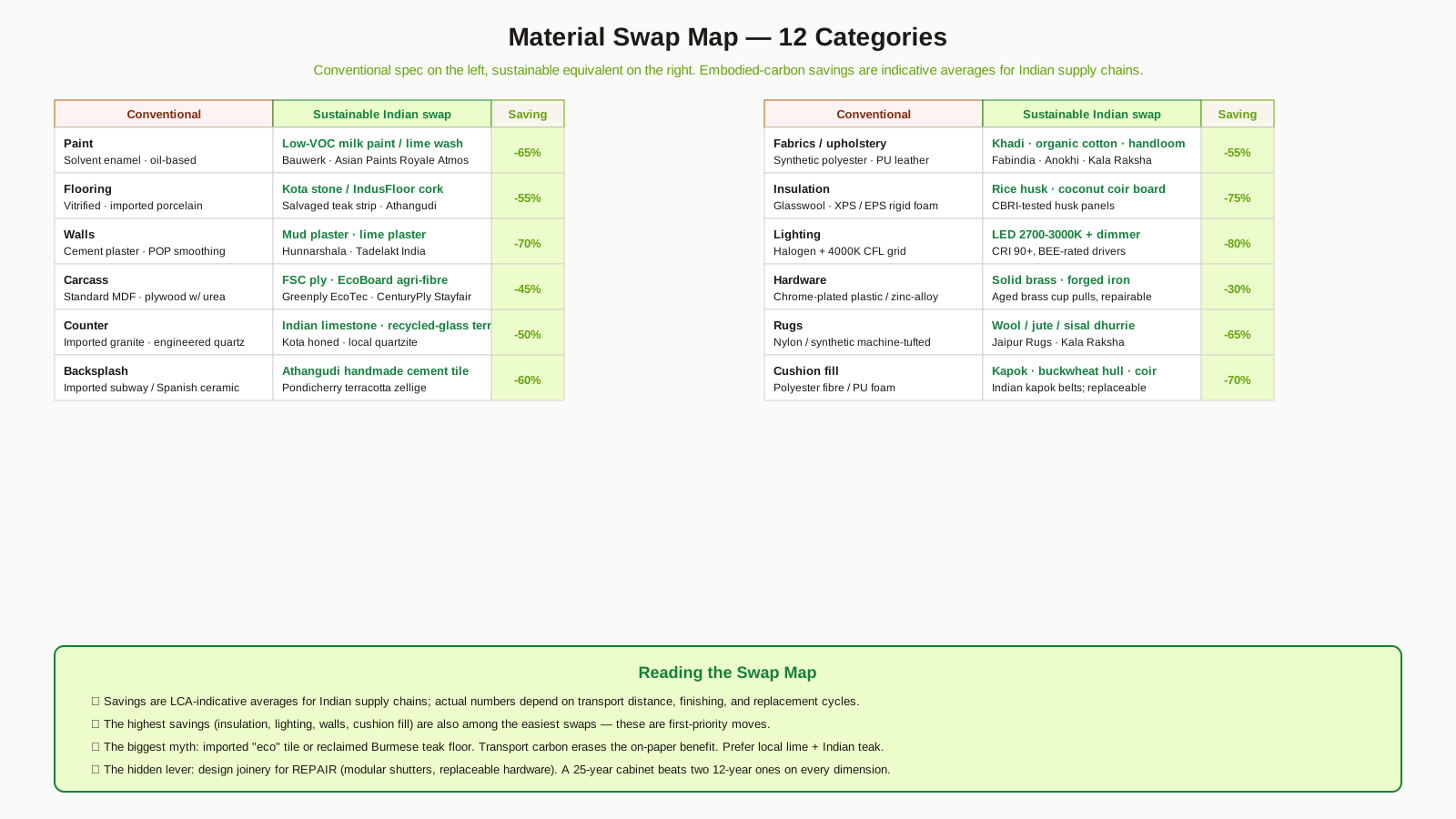
Twelve practical category-level swaps that capture most of the addressable embodied-carbon reduction in an Indian 2-3 BHK interior. The swaps are not aspirational — every one is available within the Indian market in 2026, at price points that range from cheaper than to modestly above the conventional equivalent.
| Category | Conventional | Sustainable Indian swap | Embodied carbon saving | Indicative cost delta |
|---|---|---|---|---|
| Paint | Solvent enamel, oil-based | Low-VOC milk paint, lime wash (Bauwerk, AP Royale Atmos) | -65% | -10 to +5% |
| Flooring | Vitrified, imported porcelain | Kota stone, salvaged teak strip, IndusFloor cork | -55% | -20 to +10% |
| Walls | Cement plaster, POP smoothing | Mud plaster, lime plaster (Hunnarshala, Tadelakt India) | -70% | -5 to +20% |
| Carcass | Standard MDF / urea-formaldehyde ply | FSC ply, EcoBoard agri-fibre, Greenply EcoTec | -45% | +5 to +15% |
| Counter | Imported granite, engineered quartz | Indian limestone, kota, recycled-glass terrazzo | -50% | -15 to +10% |
| Backsplash | Imported subway, Spanish ceramic | Athangudi handmade cement tile, Pondicherry zellige | -60% | -10 to +20% |
| Fabrics | Synthetic polyester, PU leather | Khadi, organic cotton, handloom (Fabindia, Anokhi) | -55% | 0 to +25% |
| Insulation | Glasswool, XPS / EPS rigid foam | Rice husk, coconut coir board (CBRI-tested) | -75% | -20 to +5% |
| Lighting | Halogen + 4000K CFL grid | LED 2700-3000K, CRI 90+, BEE-rated drivers | -80% | -40 to -20% |
| Hardware | Chrome-plated plastic, zinc alloy | Solid brass, forged iron (repairable) | -30% | +10 to +40% |
| Rugs | Nylon / synthetic machine-tufted | Wool, jute, sisal dhurrie (Jaipur Rugs, Kala Raksha) | -65% | -20 to +30% |
| Cushion fill | Polyester fibre, PU foam | Kapok, buckwheat hull, coir (Indian) | -70% | 0 to +20% |
Reading the swap map. Five of the twelve categories — paint, flooring, walls, counter, insulation, lighting — are CHEAPER on average in sustainable Indian form than in conventional form. Three more are price-neutral (carcass, fabrics, cushion fill). Only hardware reliably commands a premium. The "sustainable is expensive" myth is empirically wrong in the Indian context; it was imported from Western markets where local sustainable supply is scarce.
The single biggest avoidable mistake is to spec imported eco-tile or reclaimed Burmese teak floor. The transport carbon and supply-chain opacity erase the on-paper sustainability gain. Athangudi tile from Chettinad beats every imported eco-ceramic on lifecycle. Indian-plantation FSC teak beats every reclaimed Southeast Asian board. Local first, always.
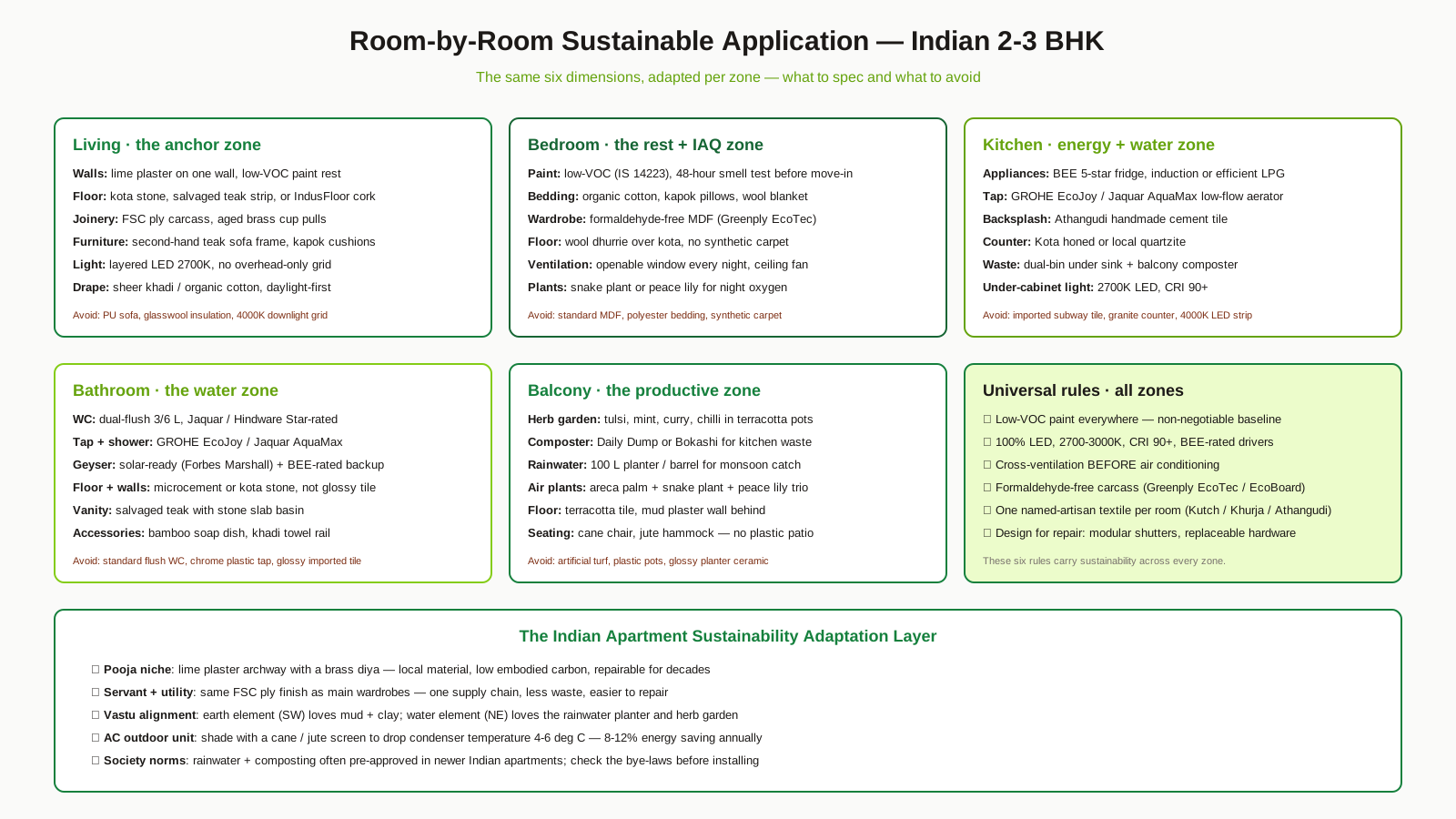
Room-by-Room Sustainable Application
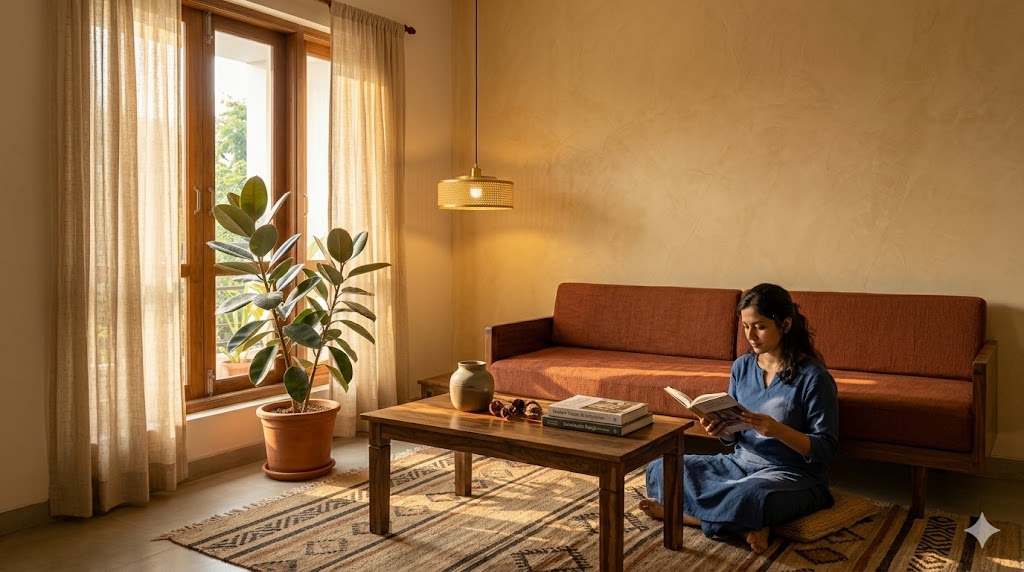
Living room — the anchor zone
Walls in lime plaster on one feature wall (Bauwerk Colour, Tadelakt India, or a Hunnarshala-trained applicator) with low-VOC emulsion on the rest. Floor in kota stone, salvaged teak strip, or IndusFloor cork — never imported vitrified. Sofa frame from a second-hand teak source (Chor Bazaar Mumbai, Sunday Market Delhi, Bengaluru salvage yards) upholstered with replaceable handloom cotton or khadi covers over kapok-filled cushions. Coffee table in salvaged colonial sheesham or solid local mango wood on aged-iron base. Lighting layered in LED 2700K with CRI 90+: one cane-and-brass pendant from Oorjaa or Sahil & Sarthak, two floor lamps each end of the sofa, no overhead downlight grid. Drape in sheer khadi or organic cotton, floor-to-ceiling, S-fold, daylight-first.
Bedroom — the rest + IAQ zone
The room where you spend 8 hours a day breathing in everything you specified, so IAQ leads. Paint in low-VOC emulsion compliant with IS 14223 (Asian Paints Royale Atmos, Berger Breathe Easy, Nerolac Impressions Eco Clean) with the 48-hour smell test as the go/no-go before move-in. Bedding in organic cotton from Fabindia, Maspar, or No-Nasties; pillows in Indian kapok; blanket in wool from Himachal or Kashmir. Wardrobe carcass in formaldehyde-free MDF (Greenply EcoTec) or FSC ply (CenturyPly Stayfair) — never standard urea-formaldehyde MDF. Floor in a wool dhurrie from Jaipur Rugs over kota stone — no synthetic carpet, which off-gases for years. Cross-ventilation as the default operating mode, ceiling fan first, AC only when ambient exceeds 32 deg C. One snake plant and one peace lily for night-time oxygen exchange.
Kitchen — the energy + water zone
The room where the biggest energy and water savings live. Appliances: BEE 5-star fridge (mandatory; the differential pays back inside 3 years), induction cooktop for primary cooking with an efficient LPG stove as backup, BEE-rated dishwasher if used. Tap: GROHE EcoJoy single-lever with 2-4 LPM aerator, or Jaquar AquaMax. Backsplash: Athangudi handmade cement tile from Chettinad in soft ochre + terracotta. Counter: Kota honed or local quartzite — never imported granite or engineered quartz. Waste management: dual-bin under-sink (wet + dry) feeding a balcony composter (Daily Dump, Bokashi). Under-cabinet lighting in 2700K LED at CRI 90+, never the default 4000K cool-white kitchen strip. Cabinets in clay-tone matte laminate over FSC ply carcass with aged-brass cup pulls — push-to-open or replaceable hardware, never glued-on chrome plastic.
Bathroom — the water zone
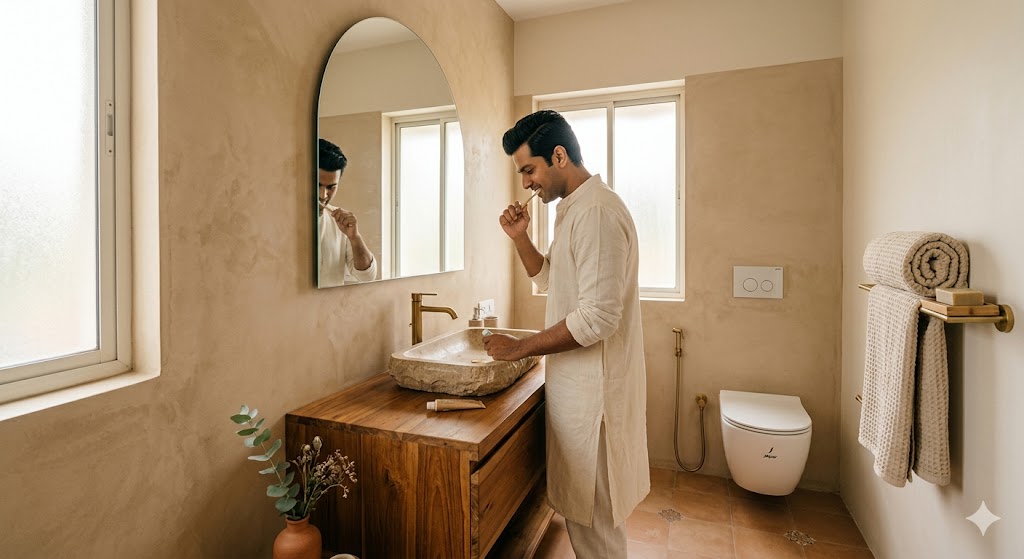
WC: dual-flush 3/6 L from Jaquar, Hindware Star or Cera Star — the single biggest water saving in the entire apartment. Tap and shower: GROHE EcoJoy or Jaquar AquaMax with low-flow aerators (2-4 LPM tap, 6-9 LPM shower). Geyser: solar-ready with rooftop collector (Forbes Marshall, Tata Solar) and a BEE 5-star instant electric backup for cloudy days — 60-80% annual water-heating energy saving. Floor and walls: microcement (Bauwerk, Domus Innova) or kota stone — never glossy imported tile that requires solvent-based grout and breaks the IAQ spec. Vanity: salvaged teak with a stone-slab basin or a Khurja ceramic vessel basin. Accessories: bamboo soap dish, khadi waffle towel, brass towel rail — never chrome plastic.
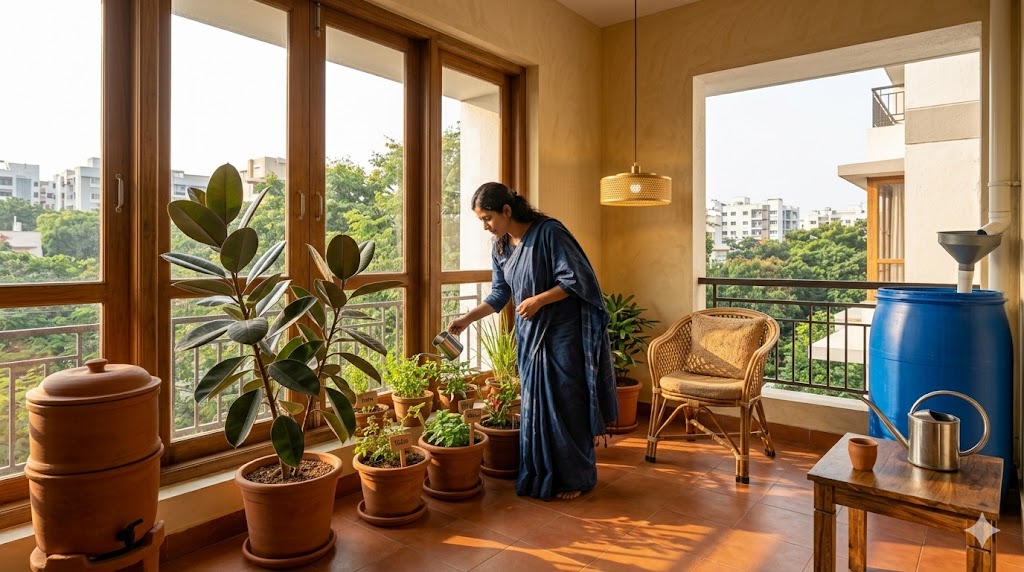
Balcony — the productive zone
The most-underused zone in most Indian apartments and the easiest to convert into a daily sustainability anchor. Herb garden in five to eight terracotta pots: tulsi, mint, curry leaf, chilli, lemongrass, coriander, methi. Composter (Daily Dump three-pot terracotta unit or a Bokashi anaerobic bucket) in one corner. Rainwater catchment: a 100-500 L food-grade barrel or planter capturing monsoon runoff for plant irrigation through dry months. Air-quality plants: areca palm, snake plant, peace lily — the three IAQ workhorses, all happy on a partially shaded Indian balcony. Floor in terracotta or kota tile, wall in mud plaster (if the building allows) or low-VOC textured paint. Seating: a cane chair and a jute hammock — no plastic patio furniture.
Universal rules across all rooms
- Low-VOC paint everywhere — non-negotiable baseline at all budget tiers
- 100% LED at 2700-3000K, CRI 90+, BEE-rated drivers
- Cross-ventilation as default, air conditioning as backup
- Formaldehyde-free carcass (Greenply EcoTec, CenturyPly Stayfair, EcoBoard) across all joinery
- One named-artisan textile per room (Kutch wool dhurrie, Khurja vessel, Athangudi tile, khadi drape)
- Design for repair: modular shutters, replaceable hardware, separable upholstery covers
- One supply chain per category — pick one ply brand, one paint brand, one tap brand and stay with them
The Indian apartment sustainability adaptation layer
- Pooja niche: a lime plaster archway with a single brass diya — local material, low embodied carbon, repairable for decades, replaces a separate carved teak temple unit
- Servant + utility zone: the same FSC ply finish as the main wardrobes — one supply chain, less waste, easier to repair
- Vastu alignment: the earth element in the south-west loves mud + clay surfaces; the water element in the north-east loves the rainwater planter and herb garden — sustainable interventions naturally align with traditional Vastu zoning
- AC outdoor unit: shade with a cane or jute screen to drop condenser temperature 4-6 deg C — an 8-12% annual cooling-energy saving with no equipment cost
- Society bye-laws: rainwater harvesting and balcony composting are now pre-approved in most post-2020 Indian apartment buildings; check before installing but expect approval
Cost-vs-Impact Matrix — Do First, Invest, Skip, Nice Adds
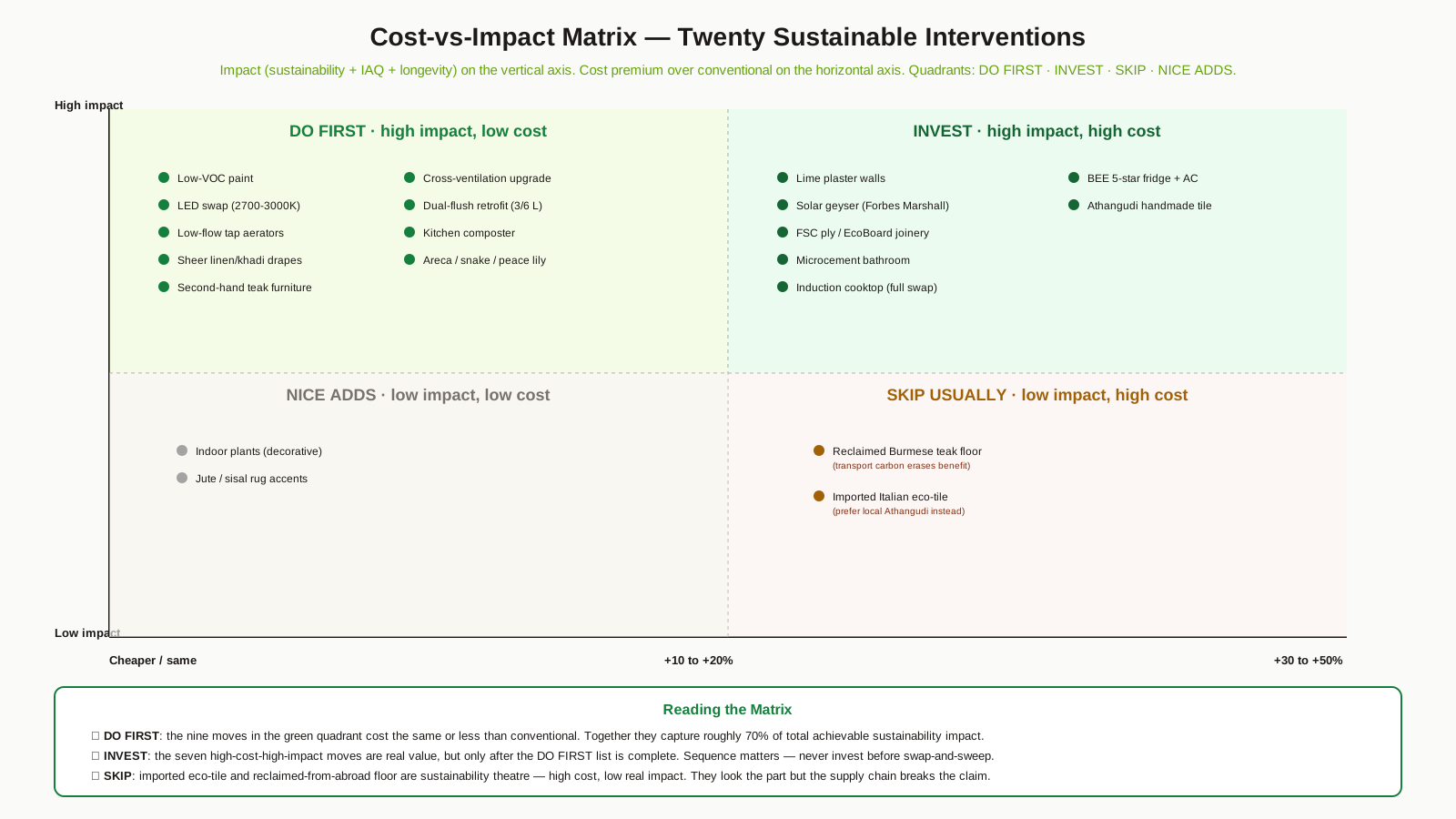
Sustainability moves are not equal. Twenty common interventions, plotted by impact (sustainability + IAQ + 20-year longevity) and cost premium over conventional, fall into four quadrants. Sequence matters: complete the DO FIRST list before spending a rupee on the INVEST list, and never spend on SKIP items at all.
| Quadrant | Interventions | Action |
|---|---|---|
| DO FIRST (high impact, low or negative cost) | Low-VOC paint · LED 2700K swap · low-flow tap aerators · sheer linen/khadi drapes · second-hand teak furniture · cross-ventilation upgrade · dual-flush WC retrofit · kitchen composter · IAQ plants (areca, snake, peace lily) | Do these in the first 6 weeks regardless of budget tier. ~70% of total achievable sustainability impact, at zero net cost. |
| INVEST (high impact, +10 to +30% cost) | Lime plaster walls · solar geyser · FSC ply / EcoBoard joinery · microcement bathroom · induction cooktop · BEE 5-star fridge + AC · Athangudi handmade tile | Sequence after DO FIRST is complete. Real value, but only after low-hanging fruit. |
| SKIP USUALLY (low impact, +20 to +50% cost) | Reclaimed Burmese teak floor · imported Italian eco-tile · imported New Zealand wool · "sustainable" certified shipped furniture | Sustainability theatre — high cost, low real impact, transport carbon erases the claim. Do not spend here. |
| NICE ADDS (low impact, low cost) | Decorative indoor plants beyond IAQ minimum · jute/sisal rug accents · brass towel rails · bamboo accessories | Add freely as budget allows; no urgency, no sequencing pressure. |
The 70/10 rule
In Indian residential sustainability, the cheapest 10% of moves (the DO FIRST quadrant) capture roughly 70% of the achievable impact. The most expensive 30% (the SKIP quadrant) capture less than 5%. This is the inverse of how the market sells sustainability — which is why genuinely sustainable interiors usually cost less, not more, than conventional. Sequence is the strategy. Paint and LED before lime plaster. Aerators and dual-flush before solar geyser. FSC carcass before bespoke artisan tile. Each tier earns the next.
Indian Certifications and Standards
The Indian sustainability standards landscape is more developed than most homeowners realise. Use these as filters, not as goals — a project that ticks GRIHA boxes but ignores the social-sustainability dimension is still a partial project.
| Certification / Standard | Scope | Use case for interior project |
|---|---|---|
| GRIHA (Green Rating for Integrated Habitat Assessment) | Whole-building, government-of-India-backed | Reference framework; even non-certified projects benefit from following GRIHA interior criteria |
| IGBC (Indian Green Building Council) | LEED-aligned, CII-driven | LEED-India for whole-building; the Green Homes rating system is the residential-interior subset |
| LEED-India | US Green Building Council, India chapter | Useful for premium projects targeting international resale or rental; weaker on local supply chain |
| FSC India | Forest Stewardship Council, Indian chain of custody | Mandatory filter for any wood, plywood, MDF spec — the only credible chain of custody for Indian timber |
| ECBC (Energy Conservation Building Code) | Bureau of Energy Efficiency, govt of India | Sets minimum performance for lighting, AC, envelope — interior baseline for energy spec |
| BEE Star Rating | Bureau of Energy Efficiency | Mandatory for fridges, ACs, washing machines, geysers; specify 5-star, accept 4-star, reject 3-star and below |
| IS 14223 | Bureau of Indian Standards | Low-VOC paint standard; reference for any paint spec |
| IS 1077 | Bureau of Indian Standards | Burnt clay brick spec; reference for any masonry layer |
| Cradle to Cradle Certified | Cradle to Cradle Products Innovation Institute | International product-level certification; useful for furniture imports |
| ISO 14001 | International Organization for Standardization | Environmental management system at the manufacturer level; check brand-level not product-level |
| ASTM E2129 | American Society for Testing and Materials | Standard practice for data collection for sustainability evaluation of building products |
The practical filter stack for an Indian residential project: FSC India for all wood + ply, BEE 5-star for all appliances, IS 14223 for all paint, GRIHA / IGBC criteria as the design reference even when not formally certified, direct artisan sourcing for social dimension. This combination captures 80%+ of the value of full certification at zero certification cost.
Three Budget Tiers
Starter sustainable — ₹ 1.5-3 L for a 2 BHK (900-1,100 sft)
The DO FIRST list, complete. Low-VOC paint throughout (Asian Paints Royale Atmos or Berger Breathe Easy), 100% LED swap at 2700-3000K, low-flow tap aerators on every tap, dual-flush WC retrofit, sheer khadi or organic cotton drapes from Fabindia, one second-hand teak coffee table from a salvage yard, IAQ plants (areca, snake, peace lily) in terracotta pots, balcony composter (Daily Dump three-pot ₹ 2,500-4,000), wool dhurrie 6 × 9 from Jaipur Rugs entry line.
Captures roughly 70% of the achievable sustainability impact at roughly 10% of a conventional renovation budget. Lead time 4-8 weeks DIY-led. No designer required. This is the tier every Indian homeowner should hit before considering anything more ambitious — it is the highest ROI sustainability spend in the entire matrix.
Mid sustainable — ₹ 8-16 L for a 2 BHK (1,000-1,400 sft)
The DO FIRST list plus selective INVEST moves. Lime plaster on one or two feature walls (Bauwerk Colour applicator), FSC ply or EcoBoard carcass for all wardrobes and kitchen, microcement bathroom floor + walls (Domus Innova), induction cooktop replacing traditional gas, BEE 5-star fridge + AC + washing machine + geyser, Athangudi handmade tile backsplash in kitchen, solid-brass hardware throughout, designer-led lighting plan with CRI 90+ LEDs, one full set of named-artisan textiles (Kutch dhurrie, Khurja vessel, khadi drape).
Save on: hardware brand (Hettich brass works as well as Häfele at half the cost), tile (Athangudi direct from Chettinad saves 40% over retail). Splurge on: lime plaster skilled labour (this is the differentiator), the induction cooktop (it is a 25-year decision), the solar geyser if rooftop access exists. Lead time 12-18 weeks designer-led.
Deep sustainable — ₹ 22-55 L for a 3 BHK (1,400-2,200 sft)
The full programme. Mud plaster or lime plaster across all walls (Hunnarshala-trained applicator), salvaged or FSC-Indian teak floor in living and bedrooms, microcement in all wet zones, complete solar PV + geyser + EV-ready installation, dedicated rainwater harvesting (1,500-3,000 L), bespoke FSC-teak joinery from Phantom Hands or a local artisan, Bauwerk limewash on key walls, complete BEE 5-star appliance suite, sourcing trip to Kutch + Chettinad + Channapatna for direct artisan textiles + tile + furniture, dedicated IAQ ventilation upgrade with HEPA filtration on AC units.
Save on: visible art (commission emerging Indian artists), imported furniture (Phantom Hands matches international quality at half the price). Splurge on: skilled lime / mud plaster labour, rainwater + solar infrastructure (the 20-year payback is the case), the artisan sourcing trips (the social-sustainability dimension lives here). Lead time 24-36 weeks bespoke.
Hidden costs to budget for
- Lime plaster skilled labour: ₹ 180-340 per sft applied; the labour, not the material, is the cost
- Bauwerk applicator certification premium: 25-40% over generic limewash labour, justified by finish durability
- Microcement application: needs a certified applicator at ₹ 500-900 per sft
- Rainwater system: ₹ 35,000-1.5 L installed depending on tank size and roof retrofit complexity
- Solar geyser: ₹ 35,000-80,000 for a 200 L rooftop system, payback 3-5 years on Bengaluru / Pune duty cycle
- Direct artisan sourcing: budget 2-4 weeks lead time and 10-20% margin uplift over retail to protect artisan livelihood
- IS 14223 paint premium: 0-15% over standard emulsion, no premium for the largest brands
Ten Common Pitfalls — The Greenwashing Edition
1. Imported "eco" tile. Spanish, Italian, or Vietnamese ceramic shipped to India. The transport carbon erases the certification. Fix: Athangudi handmade cement tile from Chettinad, or Pondicherry terracotta zellige.
2. Reclaimed Burmese teak floor. Beautiful, expensive, and unsustainable on lifecycle. Fix: salvaged teak from a local demolition yard, or FSC-Indian plantation teak.
3. "Low-VOC" paint with no IS 14223 reference. Marketing claim without a standard. Fix: insist on the IS 14223 reference number on the data sheet — Asian Paints Royale Atmos, Berger Breathe Easy, Nerolac Impressions Eco Clean all comply.
4. Bamboo from Vietnam, jute from Bangladesh. Local-sounding fibres, imported origin. Fix: Indian bamboo from Assam / NE India, Indian jute from West Bengal — both available domestically at lower carbon and lower cost.
5. Solar panel with no PMI install path. Panel on the rooftop, no inverter, no net metering. Fix: full grid-tie or hybrid system through an MNRE-empanelled installer, with the net-metering paperwork done.
6. BEE 3-star appliances on the "we will upgrade later" plan. "Later" rarely arrives. Fix: 5-star at purchase; the 3-year payback beats the 7-year replacement cycle.
7. Synthetic rugs labelled "natural fibre blend." 30% jute + 70% polyester is a polyester rug. Fix: insist on 100% wool, jute, sisal, or coir; check the label.
8. Formaldehyde-free claim with no E1 / E0 grade. Marketing without standard. Fix: insist on E1 or E0 (Greenply EcoTec, CenturyPly Stayfair, EcoBoard); reject "E2" or unrated.
9. Composter purchased, never used. Daily Dump unit in the corner gathering dust. Fix: commit to two-week onboarding (free Daily Dump guidance available), accept odour-free composting takes 2-3 weeks to balance.
10. Artisan brand at retail markup. The product is sustainable, the supply chain extracts margin from the artisan. Fix: direct from co-operative (Kala Raksha, Anokhi, Channapatna co-ops) or from verified fair-margin retailers (Fabindia, Dastkar, Good Earth's craft line).
How Sustainable Differs from Greenwash and Conventional
| Dimension | Conventional interior | Greenwash interior | Genuinely sustainable interior |
|---|---|---|---|
| Material origin | Cheapest available globally | One certified imported item, rest conventional | Local first, named-village provenance |
| Energy spec | BEE 3-star or unrated appliances | LED swap only, BEE 3-star appliances | LED + BEE 5-star + solar-ready + cross-vent |
| Water spec | Standard taps, single-flush WC | Low-flow taps only | Low-flow + dual-flush + rainwater + greywater |
| Joinery | Standard MDF, glued hardware | One FSC item, rest standard | Full formaldehyde-free, modular, repairable |
| Indoor air quality | No spec; smells chemical for weeks | "Low-VOC paint" claim, no standard | IS 14223 paint + FF MDF + 48-hour smell test |
| Social dimension | Retail-margin opaque | One "artisan" label item | Direct from co-op, traced supply chain, fair margin |
| Cost | Baseline | +20 to +40% over baseline | -10 to +15% over baseline |
The greenwash project pays more for less. The genuinely sustainable project, sequenced correctly, often costs less than the conventional baseline.
When Full Sustainability Is Not Achievable
Sustainability is a programme, not a binary. Some Indian homeowners cannot achieve every dimension because of:
- Rental apartments — landlord refusal to retrofit joinery, plumbing, or wall finishes. Solution: hit the portable subset (low-VOC paint with permission, LED swap, low-flow tap aerators that detach at move-out, dual-flush retrofit if landlord permits, balcony composter, plants, textiles).
- Heritage building constraints — protected facade or interior elements that cannot be altered. Solution: focus on appliances, paint, textiles, and IAQ where heritage rules do not apply.
- Society bye-law restrictions — some older societies prohibit solar PV, rainwater retrofit, or visible balcony composting. Solution: indoor Bokashi (odour-free, invisible), focus on appliance + paint + lighting dimensions.
- Tight liquidity — even the ₹ 1.5 L starter tier is out of reach in a given quarter. Solution: sequence over six months — paint and LED in month one (~₹ 30k), aerators in month two (~₹ 2k), composter in month three (~₹ 4k), dhurrie + drapes in month four (~₹ 25k), formaldehyde-free wardrobe shutters at next renovation cycle.
- Joint-family decision-making — sustainability requires alignment that joint families do not always have. Solution: start with the rooms you control (own bedroom + own bathroom), demonstrate liveability, expand by demonstration.
Partial sustainability beats no sustainability every time. Do not let the perfect become the enemy of the good.
Where to Go Next
- For warm-toned sustainable palette pairing — Warm Minimal Interiors
- For local-craft palette deep-dive — Earthy Interior Palette
- For low-budget sustainable luxury — Budget Luxury Interiors
- For storage in sustainable apartments — Smart Storage Interiors
- For Japandi-style fusion (also low-waste-friendly) — Japandi Apartment Interior Guide
- For AI-assisted sustainable design iterations — AI-Powered Interiors
- For wardrobe spec (FSC ply + finish) — Wardrobe Finish Ideas
- For sustainable modular kitchen scope — Modular Kitchen Design Guide
- For false ceiling planning (LED + acoustic insulation) — False Ceiling Design Guide
- For monsoon-ready sustainable building envelope — Waterproofing Guide
References
1. GRIHA Council (2024). GRIHA for Existing Buildings — Manual v3. GRIHA Council, New Delhi. (The Indian residential green-building reference framework.)
2. Indian Green Building Council (2023). IGBC Green Homes Rating System v3.0. CII Sohrabji Godrej Green Business Centre. (LEED-aligned Indian residential certification.)
3. Bureau of Energy Efficiency (2024). Star Labelling Programme — Schedules for Residential Appliances. Ministry of Power, Government of India.
4. Bureau of Energy Efficiency (2017). Energy Conservation Building Code (ECBC) 2017. Ministry of Power, Government of India. (Minimum performance standards for lighting, envelope, HVAC.)
5. Forest Stewardship Council India (2024). FSC India — Chain of Custody Standard. FSC India, Bengaluru. (The credible Indian timber and ply chain-of-custody.)
6. Bureau of Indian Standards (2010). IS 14223 — Methods of Test for Volatile Organic Compounds in Paint. BIS, New Delhi. (The Indian low-VOC paint reference.)
7. Bureau of Indian Standards (1992). IS 1077 — Common Burnt Clay Building Bricks — Specification. BIS, New Delhi.
8. Auroville Earth Institute (2021). Compressed Stabilised Earth Blocks (CSEB) — Manual. Auroville, Tamil Nadu. (Foundational reference for earth-based wall systems.)
9. Hunnarshala Foundation (2020). Vernacular Building Techniques — Bhuj Region. Hunnarshala, Bhuj. (Field reference for lime + mud plaster trades.)
10. Centre for Science and Environment (2023). State of India's Environment — Built Environment Chapter. CSE, New Delhi. (Annual sustainability data + critique.)
11. Down to Earth (2024 monthly issues). Built Environment + Climate Reporting. Society for Environmental Communications, New Delhi.
12. Bauwerk Colour (2024). Limewash and Lime Plaster Application Guide — India Edition. Bauwerk Colour, Margaret River + India applicators.
13. Cradle to Cradle Products Innovation Institute (2023). Cradle to Cradle Certified Product Standard v4.0. C2CPII, Oakland CA. (International product-level circular-economy certification.)
14. ASTM International (2019). ASTM E2129-19 — Standard Practice for Data Collection for Sustainability Assessment of Building Products. ASTM, West Conshohocken PA.
15. International Organization for Standardization (2015). ISO 14001:2015 — Environmental Management Systems. ISO, Geneva. (Manufacturer-level environmental management.)
16. Khadi and Village Industries Commission (2024). Khadi India — Handloom Provenance Standards. KVIC, Mumbai. (Traceability framework for khadi cotton textile.)
Author's note: Sustainability in Indian interiors is mostly a sequencing problem, not a budget problem. The DO FIRST quadrant — low-VOC paint, LED swap, low-flow taps, sheer drapes, second-hand teak, dual-flush retrofit, composter, IAQ plants — captures ~70% of available impact at a cost lower than conventional. Every Indian homeowner I have advised in the past three years who started here ended up either money-ahead or money-neutral versus a conventional renovation, while ending up materially more sustainable. The myth that sustainability is a premium is a Western-market import; in India, where local lime + sandstone + teak + cotton + craft are abundant, the supply chain favours the sustainable option. Do the cheap stuff first. Sequence the rest. Skip the imported eco-theatre entirely.
Disclaimer: Material costs, brand sources, certification scopes, and embodied-carbon savings are 2026 indicative and shift with currency, import duties, supply chain, and methodology updates. Verify with current vendor quotes and the latest published standard documents before specifying. Embodied-carbon percentages are LCA-indicative averages for Indian supply chains and depend on transport distance, finishing, and replacement cycles. Vendor mentions are illustrative; Studio Matrx has no commercial relationship with any brand named. Studio Matrx, its authors and contributors are not responsible for procurement, installation, or certification outcomes based on this guide.
Export this guide
Related Guides — Deep-dive reading
Earthy Interior Palette — A 2026 Style Guide for Indian Homes
Rooted · Regional · Biophilic · Indian craft-anchored
Design StylesBudget Luxury Interiors — How to Get Premium Indian Apartment Design Under ₹10 Lakhs
Splurge-save discipline · Impostor-tier tricks · Three sub-budget tiers
Design StylesGreen Building Materials Guide (India): Low-Carbon, Healthy & Sustainable Choices (2026)
What actually makes a building material green - low embodied carbon and energy, recycled and renewable content, local sourcing, durability, recyclability, low VOC and water efficiency - mapped honestly across the whole Indian building, with the lifecycle nuance no label can give you.
Building MaterialsRelated Tools — Try Free
Rainwater Tank Sizer
How big should your rainwater tank be? Computes annual harvest, recommended tank capacity in litres, water-bill savings, and payback — for 10 Indian cities.
RWH CalculatorCross-Ventilation Analyzer
Estimate airflow and air changes per hour (ACH) from room size, window areas, layout, and local wind — with NBC 2016 Part 8 compliance check.
Ventilation CalculatorFalse Ceiling Cost Estimator
Live ₹/sqft across 8 ceiling types — POP, gypsum, designer, metal, PVC, wooden — with cove and spot lighting for 20 Indian cities.
Cost Calculator