
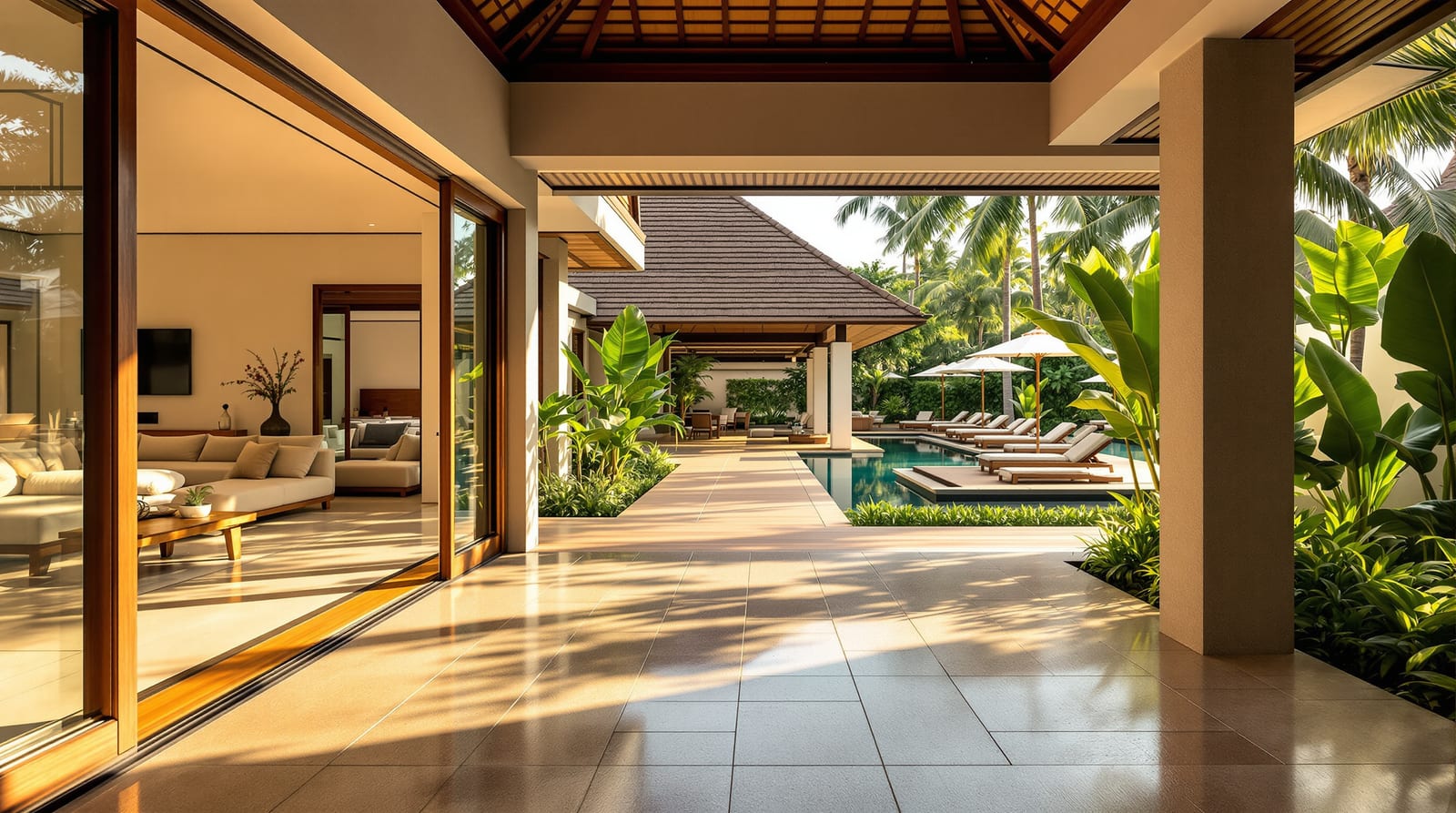
Resort Flooring in India: Natural, Barefoot, Anti-Slip Floors for Villas, Pools & Decks
How to specify earthy, indoor-outdoor, climate-tough floors for coastal, hill and backwater resorts — from kota and sandstone to WPC deck tiles and IPS.
A resort floor is judged with bare feet, in wet weather, by guests who paid to relax — not to slip. The brief is unlike any other commercial space: it must feel natural and rooted in place, flow seamlessly from air-conditioned villa to open deck to pool coping, stay cool and grippy when soaked by monsoon or a dripping swimmer, and survive years of salt, sun and chlorine with grace rather than wear. This guide ranks the floors that deliver that across India's coastal, hill and backwater resorts, zone by zone, with real ₹/sq ft benchmarks and the anti-slip ratings that keep a property out of a liability claim.
What makes resort flooring different
Most commercial flooring optimises for footfall and cleaning. Resort flooring optimises for experience and safety in wet, barefoot, outdoor conditions — a harder problem. Six demands drive every choice:
- Sense of place and natural aesthetic. Guests pay for an escape, not an airport lounge. Earthy, tactile, locally-rooted materials — stone, terracotta, timber, lime — sell the fantasy. A polished mirror-gloss tile reads "office", not "Goan villa".
- Indoor-outdoor flow. The signature resort move is a single material (or a matched family) running from the bedroom across the threshold to the verandah and out to the deck, dissolving the boundary. That demands materials that work both sides of the glass.
- Barefoot comfort. Surfaces must be smooth enough not to abrade, cool enough underfoot in heat (light stone, terracotta and timber stay far cooler than dark granite or vitrified tile in full sun), and free of sharp arrises.
- Anti-slip when wet. This is non-negotiable around pools, in bathrooms, on rain-lashed verandahs and on beach-access paths. Specify DIN 51130 ratings: R10 minimum for wet circulation, R11-R12 for pool surrounds and showers, and barefoot ramp ratings A/B/C per DIN 51097 for pool decks.
- Coastal and humidity durability. Salt air corrodes, humidity feeds mould, and chlorine attacks. Materials and fixings must resist all three; this is where careless specs fail within two seasons.
- Sustainability and cost. Eco-credentials are now a marketing asset (low-embodied-carbon stone, IPS, reclaimed timber), and ₹/sq ft must still close the project.
For the underlying material science behind each pick, link out rather than re-explaining here — this guide is about the application. See how to choose flooring for Indian weather and anti-slip flooring for wet areas for the foundations.
The resort flooring palette, ranked
1. Natural stone — the resort default
Stone is the spine of the Indian resort floor: earthy, anti-skid when finished correctly, and it ages into character rather than out of warranty. The key is finish, not just material — never polished for wet or outdoor zones; specify honed, sandblasted, flamed (thermal), leathered or natural-cleft surfaces.
- Kota stone — the workhorse. Cool underfoot, naturally grippy when honed or river-finished, cheap, and quintessentially Indian. Ideal for verandahs, courtyards, corridors and back-of-house.
- Sandstone — warm earthy tones (Dholpur beige, Mint, Rainbow), naturally textured, excellent barefoot and around pools in a natural-cleft or sandblasted finish.
- Slate — riven texture gives superb grip and a rugged, hill-resort character; darker tones suit Himalayan and Western Ghats properties.
- Granite — reserve the flamed (not polished) finish for high-traffic lobbies, steps and pool coping where durability outranks coolness.
2. Wood and WPC deck tiles — decks, pools, jetties
Real timber decking (teak, ipe, thermally-modified pine) is the luxe choice but demands maintenance in coastal salt and monsoon. WPC and outdoor deck tiles are the pragmatic modern answer: click-lay over pedestals or a slope, warm and soft underfoot, splinter-free, rot-proof, and ideal for pool decks, villa sundecks, backwater jetties and spa pods. For the wider timber options see wooden flooring and WPC flooring.
3. Polished concrete and IPS / red-oxide — modern and eco resorts
Contemporary and eco-luxury resorts increasingly use seamless, monolithic floors for a calm, gallery-like backdrop that lets the landscape star. Polished concrete suits modern villa interiors and lobbies; IPS and red-oxide deliver a low-cost, low-carbon, handcrafted finish with deep regional roots — red-oxide in particular is a heritage Kerala and South-Indian signature, cool and beautiful barefoot. Specify a matte, lightly-textured trowel finish, never burnished gloss, in any zone that gets wet.
4. Terracotta and china-mosaic — Goan and heritage character
For heritage, Goan-Portuguese and Indo-Saracenic properties, terracotta tiles bring warmth, breathability and an instantly-aged patina, while china-mosaic delivers the classic broken-white terrace and courtyard finish that is also heat-reflective — doubly useful on terraces. Both read authentically Indian and cost little.
5. Anti-slip everything
Whatever the material, the wet zones get an explicit slip strategy: the right factory finish, an anti-skid floor treatment where needed, generous falls to drains, and ratings on the drawing. Make monsoon-ready flooring a project-wide rule, not an afterthought.
Zone-by-zone recommendation and cost table
The table maps each resort zone to its recommended floor, the reason, and an indicative installed ₹/sq ft (2026). Verify current rates with the flooring cost calculator.
| Resort zone | Recommended floor | Why it wins here | ₹/sq ft (installed) |
|---|---|---|---|
| Villa bedroom / suite (indoor) | Engineered wood, IPS, honed kota | Warm, calm, barefoot-cool; flows to deck | 90-800 |
| Living / lounge (indoor) | Polished concrete, honed sandstone, large-format stone | Seamless, earthy, durable | 130-420 |
| Verandah / sit-out | Honed kota, sandstone, terracotta | Cool, anti-skid, indoor-outdoor continuity | 70-220 |
| Pool deck & coping | Flamed/sandblasted stone, R11-R12 porcelain, WPC deck tiles | Anti-slip (R11-R12 / barefoot A-C), cool, salt/chlorine-proof | 120-400 |
| Pool surround steps / showers | Sandblasted sandstone, leathered granite | Maximum wet grip, no polish | 120-300 |
| Spa / wellness wet area | Anti-slip vitrified, honed stone, IPS | Easy-clean, R11 grip, serene | 90-300 |
| Jetty / boardwalk (backwater/beach) | WPC / composite deck tiles, treated hardwood | Rot-proof, splinter-free, marine-tough | 150-500 |
| Courtyard / heritage zone | Kota, sandstone, terracotta, china-mosaic | Traditional, cool, heat-reflective | 60-220 |
| Restaurant / cafe (open) | Anti-slip porcelain, polished concrete, terracotta | Grease + slip + style | 120-350 |
| Lobby / reception | Flamed granite, large-format stone, terrazzo | Impressive, heavy footfall, durable | 130-450 |
| Garden / beach access path | Flagstone, sandstone, pebble, stepping stones | Natural, permeable, grippy underfoot | 60-200 |
| Driveway / porte-cochere | Paver blocks, exposed aggregate, flamed granite | Load, grip, drainage | 60-200 |
Indoor-outdoor floor flow: the villa-to-pool diagram
The diagram below shows the signature resort move — one earthy material family carrying the eye from the air-conditioned suite, across a flush (≤12 mm, RPwD-compliant) threshold, onto the verandah, and out to an anti-slip pool deck that falls away from the building to a perimeter channel.
Two rules govern the flow: keep the threshold flush (≤12 mm) so guests — and wheelchairs, per accessible flooring standards — cross without a trip step; and always slope wet decks away from the building (about 1:50 to 1:80) to a perimeter channel, so monsoon and splash drain instantly rather than pooling underfoot.
Climate playbook: coastal, hill and backwater
- Coastal (Goa, Konkan, Kerala beaches, Andamans). Salt is the enemy. Favour stone, terracotta and WPC over metal-trimmed systems; specify marine-grade or stainless fixings; avoid cheap laminate and any non-rated outdoor timber. Anti-slip is critical with sand-plus-water on every surface.
- Hill (Himalayas, Western Ghats, Nilgiris). Cooler, damper, mould-prone. Slate and riven sandstone give grip on frost-slick or rain-slick paths; timber and warm stone counter the chill underfoot indoors; ensure drainage and avoid water-trapping joints that freeze.
- Backwater (Kerala, Sundarbans, Coorg estates). Persistent humidity and standing water nearby. Rot-proof WPC decking on jetties and walkways, IPS and red-oxide for cool breathable interiors, and raised, ventilated deck construction to keep timber off damp ground.
For the broader weather logic see monsoon-ready flooring and heat-reflective terrace flooring.
Do and don't
- Do specify DIN 51130 R-ratings and DIN 51097 barefoot ratings on every wet-zone drawing; pool decks earn R11-R12 / A-B-C, not "anti-skid" as a vague note.
- Do keep thresholds flush and decks sloped to drains — guest safety and accessibility in one move.
- Do choose light-toned stone, terracotta or timber for sun-exposed barefoot zones; dark granite and dark vitrified can burn feet.
- Don't use polished or high-gloss finishes anywhere that gets wet — it is the single most common (and litigable) resort flooring error.
- Don't specify untreated mild-steel fixings or trims in coastal air; they bleed rust within a season.
- Don't lay water-sensitive laminate or unsealed engineered wood on verandahs or near pools.
Care and lifecycle
Stone and concrete floors want periodic resealing to resist salt, chlorine and stains — plan an annual cycle for outdoor stone; see the floor resealing guide. WPC decking needs only washing-down. Terracotta and red-oxide reward waxing for patina. Build a simple SOP into housekeeping and audit slip-resistance after each monsoon, because grip degrades as biofilm builds — a quick reapplication of anti-skid treatment restores it. For everyday method see the floor cleaning guide.
Cross-references for the project
This guide sits within the wider commercial flooring guide for India and its sibling hotel flooring guide; for the dedicated wet-zone deep-dive use pool deck flooring. To pick and price floors fast, the space flooring selector and pool-deck flooring selector shortlist by zone, and the commercial flooring cost calculator closes the budget.
Frequently asked questions
What is the best flooring for a resort pool deck in India?
A sandblasted or flamed natural stone (sandstone, kota, granite) or an R11-R12 anti-slip porcelain, with WPC deck tiles for timber-look zones. The deck must be slip-rated R11-R12 (and barefoot-rated A-C), light-toned to stay cool, and sloped away from the building to a drainage channel. Never use polished finishes around water.
How much does resort flooring cost per square foot in India?
Indicatively (2026): honed kota and terracotta verandahs ₹60-220, polished concrete and IPS interiors ₹130-420, anti-slip stone and porcelain pool decks ₹120-400, WPC jetty decking ₹150-500, and stone or terrazzo lobbies ₹130-450. Confirm live rates with the commercial flooring cost calculator.
Which flooring gives the best indoor-outdoor flow in a villa resort?
A single earthy material family — honed kota or sandstone, or a matched IPS/polished-concrete pairing — run across a flush (≤12 mm) threshold from suite to verandah to deck. The continuity dissolves the boundary while the threshold stays trip-free and accessible.
Is wood or WPC better for resort decks and jetties?
WPC (or composite) deck tiles are the safer default in India's coastal and backwater climates: rot-proof, splinter-free, salt- and chlorine-resistant, and low-maintenance. Reserve real teak or thermally-modified hardwood for premium decks where the budget and a maintenance crew support annual care.
How do I keep a resort floor anti-slip over time?
Specify the right factory finish and R-rating upfront, slope wet zones to drains, then audit slip resistance after every monsoon. Biofilm and wear erode grip, so re-apply an anti-skid floor treatment as part of the post-monsoon maintenance cycle and reseal stone annually.
Export this guide
Related Guides — Deep-dive reading
Anti Slip Flooring for Bathroom and Wet Areas in India: R-Ratings, Finishes and Genuinely Safe Tile Choices
How to choose genuinely safe flooring for bathrooms, kitchens, balconies, pools, entrances and elderly- or child-friendly homes — the R-rating system, finishes that grip wet feet, anti-skid natural stone, slope to drains and the tiles to avoid.
Flooring & SurfacesPatio Flooring in India: Best Decks & Outdoor-Seating Floors for Weather, Grip & Looks
How to floor a patio, deck or outdoor lounge in India so it shrugs off UV and monsoon, grips wet feet, stays barefoot-friendly and still looks like a place you want to entertain.
Flooring & SurfacesPool Deck Flooring in India: Anti-Slip, Cool, Barefoot-Safe Poolside Floors
Wet, barefoot and sunbaked, a pool deck is the one floor where anti-slip is non-negotiable — here is how to pick R11-R12 stone, porcelain pavers, WPC deck tiles and more, with ₹/sq ft costs.
Flooring & SurfacesRelated Tools — Try Free
Flooring Cost Calculator
Estimate the all-in cost of a floor — material, laying, wastage, skirting and GST — by area and material.
Flooring CalculatorDoor Material Comparison Tool
Compare 2–4 door materials on cost, durability, maintenance, security and moisture resistance.
Comparison ToolFlooring Material Selector
Get the best flooring material for your room, budget and climate, with anti-slip checks for wet areas.
Flooring Tool