
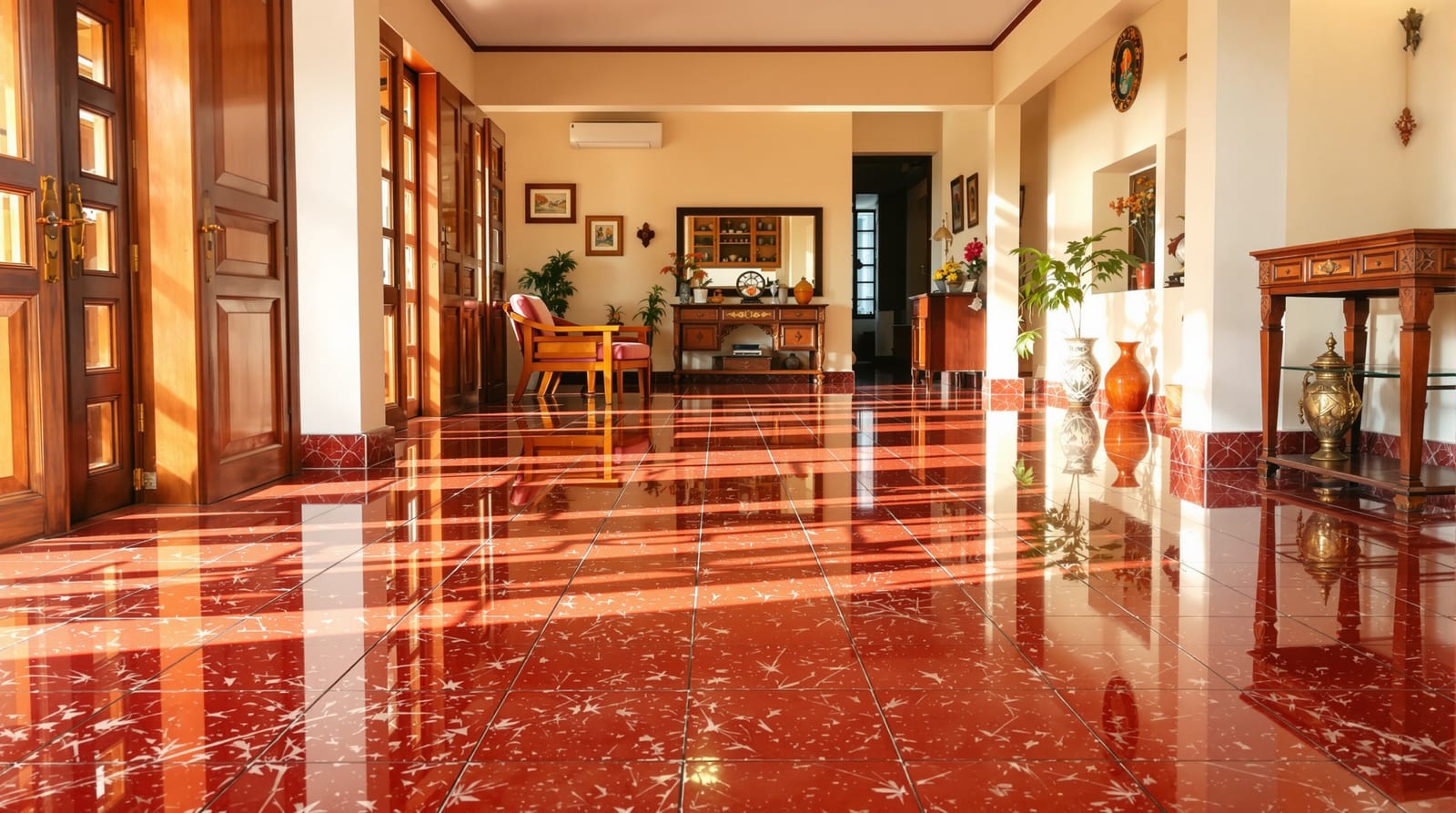
Red Oxide Flooring India: The Glossy Handcrafted Deep-Red Cement Floor, Process, Cost and Care
The classic glossy deep-red, hand-finished cement floor of Kerala, Karnataka, Tamil Nadu and Maharashtra — what red oxide flooring is, how artisans make and polish it, its cool-underfoot comfort, the patina it builds with age, colours, cost, the slippery-when-wet caveat and how to care for it.
Walk into an old Kerala tharavadu, a Mangalore courtyard house, or a Chettinad mansion in Tamil Nadu, and your eyes are pulled down to the floor — a deep, glowing terracotta-red surface so smooth and lustrous it looks almost wet. That is red oxide flooring: not a tile, not a paint, but a hand-finished cement floor coloured with iron-oxide pigment and burnished to a glassy sheen by skilled artisans. Cool underfoot in the worst of the South Indian heat, beautiful as it ages, and quietly back in fashion after decades of being dismissed as old-fashioned, it is one of India's great traditional floors.
This guide explains exactly what red oxide flooring is, how it is made and polished by hand, what it costs, the colours beyond the classic red, where it suits, the one safety caveat you must respect, and how to care for it so it keeps glowing for generations.
What red oxide flooring actually is
Red oxide flooring is a form of in-situ cement flooring — the same family as Indian Patent Stone, or IPS. A cement-and-fine-aggregate topping is laid wet over the slab, and into it (or as a thin top layer) is mixed natural red iron-oxide pigment, the very same mineral that gives bricks and laterite soil their colour. The artisan then trowels, presses and burnishes the surface repeatedly as it cures, compacting the cement paste to the top so it finishes dense, smooth and naturally glossy without any tiles or joints.
The result is a seamless, monolithic floor in a rich deep red — anywhere from a warm terracotta to an almost maroon oxblood, depending on the pigment dose and the cement used. Because it is poured and finished by hand, no two red oxide floors are identical, and small variations in tone across a room are part of its character, not a defect.
It is sometimes called red oxide IPS, oxide flooring, or simply oxide floor. The technique is centuries old in the warm, humid belt of Kerala, coastal and inland Karnataka, Tamil Nadu and Maharashtra, where masons passed the craft down through generations. For the parent technique without pigment, see our guide to IPS flooring in India; red oxide is essentially IPS taken to a handcrafted, coloured, high-polish finish.
Why South India loves it: cool underfoot
The first thing anyone notices stepping onto a red oxide floor barefoot in May is how cool it feels. Dense cement has high thermal mass and conducts heat away from your skin, so the floor sits noticeably below body temperature through the hot, humid months. In an era before air-conditioning, this was not a luxury but a survival strategy — and it is exactly why the floor took hold across hot-humid Kerala and the Deccan rather than the cold north.
That coolness pairs with a deep, calming colour that hides dust and small stains, a seamless jointless surface that is easy to sweep and mop, and a material that is breathable and free of the plastics and adhesives in modern floors. For homeowners chasing natural, low-toxicity interiors today, that combination is a large part of the revival — see our guides on eco-friendly flooring in India and on flooring and thermal comfort in India for how it fits the wider picture.
How a red oxide floor is made
This is a craft floor, and the quality lives entirely in the hands of the artisan and the patience of the curing. A typical sequence runs like this:
1. Base preparation. The RCC slab or a levelling screed is cleaned, roughened and soaked so the new topping bonds well. A neat cement slurry coat is applied just before laying.
2. The oxide layer. A cement-and-fine-sand mortar is mixed with red iron-oxide pigment in a careful ratio — too little and the colour is weak, too much and the floor can dust or crack. Many artisans lay a base cement layer first and apply a richer pigmented top layer of a few millimetres for depth of colour.
3. Trowelling and compaction. As the surface begins to stiffen, the artisan trowels it again and again, drawing the cement-rich paste to the top. This compaction is what gives the finished floor its density and natural shine.
4. Burnishing. With a steel trowel or a smooth stone, and often a sprinkle of dry oxide-cement, the surface is rubbed and polished by hand until it gleams. This is the slow, skilled stage that separates a good floor from a flat one.
5. Panelling / grooving. Like all in-situ cement floors, red oxide is divided into panels with thin brass strips or grooves to control shrinkage cracking — these also become a decorative grid.
6. Wet curing. The floor is kept damp for one to two weeks (often longer) so the cement gains strength slowly and resists cracking. Rushed curing is the most common cause of failure.
7. Oil and wax polishing. Once cured and dry, the floor is traditionally rubbed with coconut oil, linseed oil or a natural wax, then buffed. This feeds the surface, deepens the red, and brings up the signature glossy sheen.
Relevant Indian standards for the underlying in-situ cement work are IS 2571 (laying in-situ cement concrete / IPS flooring) and IS 1443 (laying and finishing of cement concrete flooring), though red oxide as a craft finish is governed more by artisan skill than by code.
The layered build-up of a red oxide floor
The diagram below shows a cross-section of a typical hand-finished red oxide floor, from the slab up to the burnished oxide skin:
Cost of red oxide flooring in India
Red oxide is moderately priced — cheaper than most natural stone or quality wood, but pricier than a plain grey IPS or basic tiles because the colour, the polishing and the artisan time all add up. The bigger variable is labour: a genuinely skilled oxide artisan commands a premium, and the floor is only as good as the hand that finishes it.
Prices below are indicative India ranges for 2026, applied and finished on site; they vary by city, oxide colour, artisan skill, area and number of layers, and 18% GST applies on materials and contracted work:
| Floor / option | Look | Cost (₹/sq ft) | Best use |
|---|---|---|---|
| Plain grey IPS (for reference) | Matte / polished grey cement | 40 to 120 | Budget, utility, minimalist |
| Red oxide, standard finish | Deep red, hand-polished sheen | 60 to 110 | Living rooms, bedrooms, halls |
| Red oxide, premium artisan finish | Rich glossy oxblood, multi-layer | 100 to 150 | Heritage homes, feature floors |
| Yellow / green / grey / black oxide | Coloured hand-polished cement | 70 to 150 | Accent rooms, bathrooms, courtyards |
A like-for-like comparison: a red oxide floor often lands close to a mid-range vitrified tile or a budget natural stone all-in, but buys you a seamless, jointless, handcrafted surface with a character no factory product matches. To estimate your job, use the Studio Matrx IPS flooring cost calculator and the flooring cost calculator; the floor polishing cost calculator helps with the polish line item. For how it stacks against other floors overall, see flooring cost per square foot in India.
Colours: it is not only red
Although red is the classic and most loved, the same technique works with other iron-oxide and mineral pigments, giving a small but lovely palette of hand-polished oxide floors:
- Classic red — the iconic deep terracotta-to-oxblood; warm, traditional, hides dust.
- Yellow / ochre oxide — a warm golden-mustard, sunny and cheerful, often used in courtyards and pooja rooms.
- Green oxide — a soft muted sage-to-bottle green, increasingly popular in contemporary homes for a calm, earthy floor.
- Grey / black oxide — cool charcoal to near-black, modern and minimalist, sometimes used to mimic a darker polished-concrete look.
- Combinations and borders — artisans sometimes set contrasting borders, bands or simple inlays between brass strips for a bespoke pattern.
Each colour shares the same handcrafted process, cool feel and patina behaviour; only the pigment changes. The deep, saturated colours suit warm South Indian light especially well.
The patina that improves with age
Unlike a tile that looks its best on day one and only degrades, a red oxide floor matures. With years of barefoot use, sweeping, mopping and periodic oiling, the surface develops a soft, deep, lived-in glow — a patina that genuinely improves the floor rather than wearing it out. The colour mellows and gains depth, minor scuffs blend in, and the oil polishing builds up a warm sheen. This is exactly why hundred-year-old red oxide floors in old Kerala and Chettinad homes are often more beautiful than new ones, and why the craft is treasured in heritage restoration. For the broader story of India's traditional craft floors, read regional flooring traditions of India.
The one big caveat: slippery when wet
A well-polished red oxide floor is smooth and glossy by design, and a glossy cement surface is slippery when it gets wet. This is the single most important thing to understand before choosing it:
- It is excellent for dry interior areas — living rooms, bedrooms, halls, dining rooms, pooja rooms.
- It needs care in wet zones — bathrooms, washing areas, open verandahs in monsoon, and anywhere water pools. A high-gloss red oxide floor in a bathroom can be genuinely hazardous unless given a less-polished, more textured finish or fitted with mats.
- For wet areas, ask the artisan for a matte or lightly-burnished finish rather than a mirror polish, which trades a little shine for grip.
For the full picture on managing this, see our guides on anti-slip flooring for wet areas in India. It is the same trade-off that affects polished stone — gloss looks wonderful and is easy to clean, but grip falls as shine rises, so match the finish to the room.
Where red oxide flooring suits — and where it does not
It excels in:
- Living rooms, halls and bedrooms — its dry-area home, where the cool surface and deep colour shine.
- Heritage and traditional homes — Kerala, Mangalorean, Chettinad and Deccan-style houses where it is the authentic floor.
- Courtyards and shaded verandahs — with a matte finish for grip.
- Pooja rooms and feature zones — the warm red or ochre suits the mood.
- Eco-conscious modern homes — as a natural, plastic-free, breathable alternative to vinyl and laminate.
It is less ideal where you need a hard-wearing wet floor without care (a glossy bathroom, an open monsoon-lashed terrace), where you cannot find a skilled oxide artisan, where you want a perfectly uniform machine-made tone, or where you cannot give the floor its slow curing and occasional oiling. Crucially, it depends entirely on artisan skill — a poorly made red oxide floor can crack, dust, or come out blotchy, so the craftsman matters more than the material.
Red oxide vs its cousins
| Floor | Made by | Look | Cost (₹/sq ft) | Note |
|---|---|---|---|---|
| Red oxide | Hand-finished in-situ, pigmented, oil-polished | Glossy deep red, seamless | 60 to 150 | Handcrafted, patina improves with age |
| Plain IPS | Hand-finished in-situ cement | Grey, matte to polished | 40 to 120 | The parent technique, no colour |
| Athangudi tiles | Handmade on glass plates, coloured cement | Vivid patterns, seamless-look | 80 to 250 | Chettinad craft, decorative tiles |
| Polished concrete | Machine-ground concrete slab | Industrial grey sheen | 100 to 400 | Mechanised, very low maintenance |
If you love the handcrafted craft-floor idea, also look at Athangudi tiles of India, the vivid coloured-cement tiles handmade in Chettinad, Tamil Nadu, which share red oxide's artisanal spirit. For the full map of alternative and specialty floors beyond mainstream tiles and stone, start with our specialty flooring guide for India.
Care and maintenance
A red oxide floor is easy to live with but rewards gentle, traditional care — and punishes harsh chemicals:
- Mop with plain water or a mild pH-neutral cleaner. The seamless surface sweeps and mops in minutes.
- Never use acids or harsh chemicals. Cement is alkaline; acidic cleaners, strong descalers, bleach and toilet acid etch and dull the surface and can lift the colour. This is the cardinal rule.
- Oil-polish periodically. The traditional upkeep is to rub the floor with a little coconut oil, linseed oil or a natural floor wax every few months to a year, then buff it. This feeds the surface, restores the sheen and deepens the patina.
- Wipe spills quickly. Oil, turmeric, lime juice and coloured liquids can mark a cement floor; blot promptly.
- Expect minor settling cracks. Fine hairline cracks at panel edges are normal in cement floors over time and are part of its honest character; major cracking points to rushed curing or a poor base.
- Re-buff when it dulls. Years on, an artisan can re-polish and re-oil the floor to bring back its full glow rather than replacing it.
Our floor cleaning guide covers routine upkeep, and because oiling is the heart of red oxide care, treat the floor as something you feed, not just clean.
Frequently asked questions
Is red oxide flooring still a good choice today?
Yes. It is enjoying a strong revival precisely because it is seamless, cool underfoot, natural and free of plastics, and develops a beautiful patina with age. It suits dry interior areas of homes especially well and is favoured in eco-conscious and heritage-style projects. The two things to plan for are finding a genuinely skilled artisan and respecting its slippery-when-wet nature in bathrooms and open wet areas.
How much does red oxide flooring cost per square foot in India?
Indicatively ₹60 to ₹150 per sq ft applied and finished in 2026 — roughly ₹60 to ₹110 for a standard red oxide finish and ₹100 to ₹150 for a premium multi-layer artisan finish or for coloured oxides. The big variables are artisan skill, the number of layers and your city, with 18% GST extra. Ranges are indicative and vary by vendor and region.
Is red oxide flooring slippery?
A high-gloss red oxide floor is smooth and can be slippery when wet, so it is best for dry interior areas. For bathrooms, washing areas and open verandahs, ask the artisan for a matte or lightly-burnished finish that trades some shine for grip, and use mats where water pools. In dry living rooms and bedrooms it is perfectly safe.
How do you maintain and clean a red oxide floor?
Mop with plain water or a mild pH-neutral cleaner and never use acids, bleach or harsh chemicals, which etch the surface and can lift the colour. Periodically — every few months to once a year — rub the floor with coconut oil, linseed oil or a natural wax and buff it to restore the sheen and deepen the patina. Wipe spills promptly.
Can red oxide flooring be other colours besides red?
Yes. The same hand-finished cement technique works with yellow or ochre, green, and grey or black oxide pigments, giving warm golden, muted sage-green, and cool charcoal floors respectively. Classic deep red remains the most popular and traditional, but green and grey oxides are increasingly chosen for contemporary homes.
Export this guide
Related Guides — Deep-dive reading
Athangudi Tiles in India: Handmade Chettinad Cement Tiles, Patterns, Cost & Care
Vivid, one-of-a-kind handmade cement tiles from Athangudi village in Chettinad, Tamil Nadu — poured by hand onto patterned glass plates, sun-and-water cured, cool underfoot — here is how they are made, the bold floral and geometric patterns, costs of ₹80–250 per sq ft, laying, sealing and the coconut-oil care.
Flooring & SurfacesIPS Flooring in India: Indian Patent Stone Cost, Laying, Grooves & Pros and Cons
IPS (Indian Patent Stone) is the in-situ cement floor — trowel-finished, grooved into panels with brass, glass or aluminium strips to control cracking — that costs just ₹40–120 per sq ft and is now driving a modern minimalist revival; here is how it is laid, cured, pigmented and polished.
Flooring & SurfacesComplete Home Flooring Guide for Indian Homes (2026)
The authoritative overview of every flooring family — tiles, stone, wood, vinyl and seamless — with India ₹/sq ft costs, room-by-room logic and laying basics.
Flooring & SurfacesRelated Tools — Try Free
Flooring Cost Calculator
Estimate the all-in cost of a floor — material, laying, wastage, skirting and GST — by area and material.
Flooring CalculatorIPS Flooring Cost Calculator
Estimate the cost of an in-situ cement floor — plain or pigmented IPS, red oxide, lime or granolithic.
Flooring CalculatorInterior Budget Planner
Live room-wise and component-wise cost breakdown in ₹ with contingency, GST, and PDF summary.
Budget Calculator