
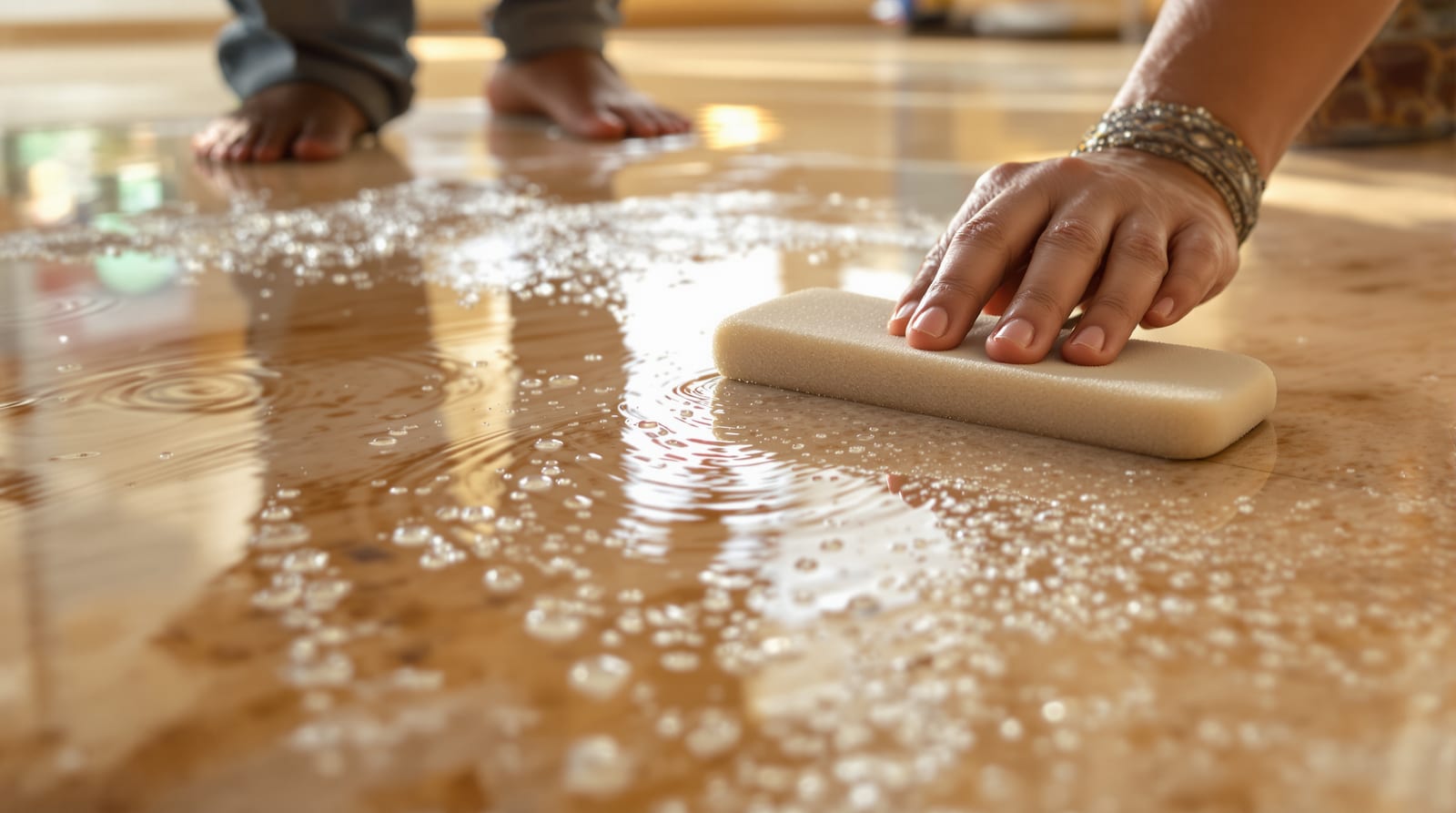
Floor Sealing and Resealing Guide India: How to Seal Marble, Granite, Kota, Sandstone, Terrazzo and Cement Grout
Why porous natural stone and cement grout floors need sealing, the simple water-drop test to check if resealing is due, penetrating versus topical sealers, how to clean-dry-coat-buff, how often to reseal, and what you should never seal.
A sealer is the invisible raincoat on your floor. Natural stone like marble, Kota, sandstone and terrazzo, and the cement grout between your tiles, are full of microscopic pores that quietly drink up water, oil, chai, turmeric and hard-water minerals, which is why an unsealed floor stains and dulls long before it should. Sealing fills or coats those pores so spills bead up and wipe away instead of soaking in, and resealing on a sensible cycle keeps that protection alive. This guide explains why porous floors need it, how to test whether your floor is due, which sealer to buy, exactly how to apply it, how often to redo it, and the surfaces you should never seal.
Why porous floors need sealing
Stone is a natural material with a structure full of tiny channels and pores. Lighter, softer stones are the thirstiest. Marble, Kota, sandstone, limestone and cement-based terrazzo all absorb liquids to some degree, and so does ordinary cement grout, which is essentially porous concrete in thin lines all over your floor. When a drop of water, oil or coloured liquid lands on an unsealed porous surface, capillary action pulls it below the surface where you cannot wipe it away. The result is the familiar dark water ring under a planter, the yellow turmeric blotch near the kitchen, the oil shadow by the dining table, and grout lines that grey and yellow over a year or two.
A sealer changes the physics. A penetrating sealer soaks into those pores and lines them with a water-and-oil-repelling barrier, so liquids stay on the surface as beads long enough for you to mop them up. It does not make stone bulletproof, an acid spill on marble will still etch the polish whatever sealer is under it, but it buys you crucial minutes and dramatically slows everyday staining. On grout it slows the yellowing and mould that make a good tile job look cheap. Importantly, sealer is a maintenance product, not a one-time job: it wears out with foot traffic, mopping and time, which is why resealing matters as much as the first seal.
The water-drop test: is your floor due for resealing?
You do not need a professional to tell you whether your floor needs resealing. The water-drop absorption test takes two minutes and is the single most useful habit for stone and grout owners.
Pour a small puddle of clean water, roughly the size of a 10-rupee coin, onto the stone or directly on a grout line. Wait, and watch.
| What you see | What it means | Action |
|---|---|---|
| Water beads up and sits on top | Sealer is intact and working | No resealing needed; retest in 6-12 months |
| Water stays as a flat film for a few minutes, then slowly darkens | Sealer is wearing thin | Plan to reseal in the next few weeks |
| Water soaks in within 1-2 minutes and leaves a dark patch | Little or no protection left | Reseal now |
| Dark patch lightens and disappears as it dries | Confirms it absorbed (it was not staining, just wetting) | Reseal; the patch fading is normal |
Do the test in a few spots, the high-traffic doorway and the kitchen approach wear first, while a corner under furniture may still be sealed. If even one busy area fails, it is time to reseal at least that zone. Wipe up the test water afterwards. This test works on marble, granite, Kota, sandstone, terrazzo and cement grout alike, and it settles arguments far better than guessing by the calendar.
Sealer types: penetrating versus topical
There are two fundamentally different families of floor sealer, and choosing the wrong one is the most common mistake.
A penetrating sealer, also called an impregnating sealer, soaks into the stone and works below the surface. It leaves no film and does not change how the floor looks or feels, the stone keeps its natural finish and its natural breathability. This is the right choice for almost every natural-stone floor and for cement grout. Penetrating sealers are usually fluoropolymer or silane/siloxane based, and the better ones are described as oleophobic (oil-repelling) as well as hydrophobic (water-repelling), which matters in Indian kitchens.
A topical sealer sits on top as a thin film or coating, like a clear varnish. It can add gloss and is sometimes used to give a wet look or extra sheen, but it has real drawbacks on floors: it can wear unevenly into traffic lanes, scratch and scuff, trap moisture under it, and eventually peel and need stripping rather than simple recoating. Topical coatings have their place, for example a sacrificial finish on some terrazzo or a decorative seal on cement-finish floors, but for everyday marble, granite, Kota and sandstone, a penetrating sealer is almost always the smarter, lower-maintenance buy.
| Sealer type | How it works | Look and feel | Best for | Watch out for |
|---|---|---|---|---|
| Penetrating / impregnating | Soaks into pores, repels water and oil from within | Invisible, natural finish, breathable | Marble, granite, Kota, sandstone, terrazzo, cement grout | Slightly higher price per litre; still does not stop acid etching |
| Topical / film-forming | Forms a clear coat on the surface | Adds gloss or wet look; alters finish | Some terrazzo, decorative cement floors, low-traffic accents | Wears in traffic lanes, can peel, needs stripping not just recoating |
Look for water-based, low-VOC penetrating sealers where you can, they are far less smelly to apply indoors and kinder to indoor air; this fits the wider low-VOC approach Studio Matrx covers in its guide on low-VOC flooring. Sealers from stone-care and tile-care ranges (MYK Laticrete, Roff/Pidilite and dedicated stone-care brands) are widely available in India.
How sealed stone behaves: a quick picture
The difference between a sealed and an unsealed surface is easiest to see in section. On the left below, water sinks into the open pores of unsealed stone and darkens it. On the right, a penetrating sealer has lined the pores, so the same drop beads up and stays on the surface.
How to apply: clean, dry, coat, buff
Sealing is well within the reach of a careful homeowner, and the method is the same whether you are doing a whole floor or just resealing a worn zone. The golden rule: a sealer locks in whatever is on the floor when you apply it, so the floor must be genuinely clean and bone dry first.
1. Clean thoroughly. Mop the floor with a pH-neutral cleaner to lift oil, grease and grime, never an acid or harsh cleaner on stone or cement grout. Let any existing stains be treated and lifted before sealing, because sealing over a stain traps it permanently. For grout, scrub the lines clean (and whiten if needed) first.
2. Dry completely. This is the step people rush and regret. The stone and grout must be fully dry, ideally 24 hours after washing in humid weather, longer in the monsoon. Trapped moisture under a fresh seal causes haze and poor bonding. A fan helps.
3. Apply the sealer thinly and evenly. Work in small sections of one to two square metres. Spread the sealer with a clean microfibre pad, lint-free cloth, foam applicator or low-pressure sprayer, following the product instructions. For grout-only resealing, a small applicator bottle with a roller tip lets you run sealer down the lines without flooding the tiles.
4. Let it dwell. Give the sealer the dwell time on the label, often 5-15 minutes, so it soaks into the pores. On thirsty stone like sandstone or rough Kota a second coat after the first has dwelled is common; on dense granite one thin coat is usually enough.
5. Wipe off all excess and buff. This is critical for penetrating sealers. Before the sealer dries on the surface, wipe off every bit of residue with a clean dry cloth and buff the floor, otherwise the excess dries to a cloudy, sticky haze that is a nuisance to remove. The floor should look exactly as it did before, just protected.
6. Cure before use. Keep foot traffic off for the time stated, often a few hours to overnight, and avoid washing the floor for 24-48 hours so the sealer cures fully.
A 1-litre bottle of penetrating sealer typically covers roughly 150-400 square feet per coat depending on how porous the stone is, dense granite goes far, thirsty sandstone far less. Indicative DIY sealer cost runs about ₹2-6 per sq ft in materials per reseal; a professional reseal as part of a polishing visit folds the labour into the polishing rate (plus 18% GST; indicative, varies by city and product).
How often to reseal
Frequency depends on the stone, the traffic and the area, and the water-drop test always beats the calendar. As a planning baseline:
| Surface | Seal it? | Typical reseal frequency |
|---|---|---|
| Marble | Yes | Every 1-2 years; sooner in kitchens and entries |
| Granite (light/porous varieties) | Yes | Yearly for light stone; dense dark granite can go 2-3 years |
| Kota stone | Yes | Every 1-2 years; it benefits from a penetrating seal |
| Sandstone (interior) | Yes, often two coats | Every 1-2 years; it is thirsty and wears faster |
| Terrazzo / mosaic / IPS (cement-based) | Yes | Every 1-2 years (penetrating); topical coats wear faster |
| Cement grout | Yes | Every 1-2 years, especially kitchens and bathrooms |
| Vitrified / porcelain / glazed tile | No (see below) | Not applicable |
| Epoxy grout | No | Sealed by its own non-porous chemistry |
High-traffic doorways, the kitchen approach and bathroom floors wear fastest, so test and reseal those zones more often than a quiet bedroom corner. Resealing one worn lane is perfectly normal, you do not have to redo the whole floor every time.
What you should NOT seal
Sealing the wrong surface wastes money and can leave a hazy or sticky film. Do not seal:
- Vitrified and porcelain tiles. These are fired so dense that their water absorption is below 0.5 percent (IS 15622), so they are effectively non-porous, a penetrating sealer has nothing to soak into and just dries as a film on top. Glazed ceramic and glazed vitrified tiles (GVT/PGVT) have a vitrified glass surface that is already sealed by the glaze. Seal the cement grout between them if you wish, but not the tile faces. Studio Matrx covers day-to-day care of these in its guide on vitrified tile maintenance.
- Epoxy grout. It is non-porous by chemistry and needs no sealer, that is exactly why it does not yellow.
- Fully topically coated or factory-finished floors such as laminate, SPC, WPC, vinyl, and pre-finished engineered wood, which already carry a wear layer or factory finish. Site-finished solid wood is recoated or refinished with wood-specific products, not stone sealer.
- Any floor that is wet, dirty or freshly stained, fix that first, because sealing locks the problem in.
If you are unsure how porous your stone is, the water-drop test answers it: a surface that does not absorb water does not need (and will not accept) a penetrating sealer.
Pairing sealing with your wider floor care
Sealing is one layer of protection, not the whole job. It works best alongside the right cleaner and the right polish for each surface. For marble, sealing goes hand in hand with avoiding acids and the diamond polishing cycle Studio Matrx details in marble polishing and care. Granite owners can pair yearly sealing with the routine in granite floor care. Kota and terrazzo owners will find finish-specific tips in Kota stone flooring and terrazzo flooring. And for grout specifically, sealing follows on naturally from the tile grouting guide. To estimate how much sealer to buy for your floor area, the Studio Matrx floor sealer calculator does the maths.
Frequently asked questions
How do I know if my floor needs resealing?
Use the water-drop test. Put a coin-sized puddle of water on the stone or grout and watch. If it beads on top, the seal is fine. If it soaks in and leaves a dark patch within a minute or two (the patch fades as it dries), the protection is gone and it is time to reseal. Test the busy doorway and kitchen approach, which wear first.
Will sealing stop my marble from etching with lemon or vinegar?
No. Etching is a chemical reaction where acid dulls the polished surface, and it happens whatever sealer is underneath. Sealing slows staining (oil, turmeric, chai soaking in), but it cannot stop acid etching. The only protection against etching is keeping acids off marble entirely and using a pH-neutral cleaner.
Can I seal vitrified or glazed tiles?
There is no point. Vitrified and porcelain tiles absorb less than 0.5 percent water and glazed tiles have a glass surface, so a penetrating sealer has nothing to soak into and just dries as a haze. Seal the cement grout between the tiles instead, and leave the tile faces alone.
Penetrating or topical sealer, which should I buy?
For everyday floors, a penetrating (impregnating) sealer. It soaks in, leaves no film, keeps the stone's natural look and breathability, and is recoated easily. Topical film-forming sealers add gloss but wear unevenly in traffic, can peel and eventually need stripping, so they suit decorative or low-traffic use only.
Do I have to reseal the whole floor every time?
No. The water-drop test usually shows that high-traffic lanes, doorways, kitchen and bathroom approaches, wear out first while quiet corners are still protected. You can reseal just the worn zones. Always clean and fully dry the area first, because sealer locks in whatever is on the floor.
Export this guide
Related Guides — Deep-dive reading
Vitrified Tile Maintenance: How to Care for Vitrified & PGVT Floors in India
Vitrified and PGVT tiles are India's most common, near maintenance-free floor; the real weak point is the cement grout, not the tile, so this guide shows the simple routine, post-construction haze and stain removal, and how to keep the gloss.
Flooring & SurfacesTile Grouting Guide India: Cement vs Epoxy Grout, Joint Width, Mixing, Curing and Sealing
How to grout tile floors properly in Indian homes: choosing cement versus stain-proof epoxy grout, getting timing and joint width right, floating it in, clearing haze, curing and sealing.
Flooring & SurfacesFlooring Materials Explained: Every Type for Indian Homes (2026)
One scannable reference to every flooring material family — tiles, natural stone, wood, resilient and seamless — with look, durability, water resistance, ₹/sq ft cost band and where each suits Indian homes.
Flooring & SurfacesRelated Tools — Try Free
Floor Sealer Calculator
Estimate stone and grout sealer in litres, bottles and cost by area, surface porosity and coats.
Flooring CalculatorDoor Material Comparison Tool
Compare 2–4 door materials on cost, durability, maintenance, security and moisture resistance.
Comparison ToolFlooring Cost Calculator
Estimate the all-in cost of a floor — material, laying, wastage, skirting and GST — by area and material.
Flooring Calculator