
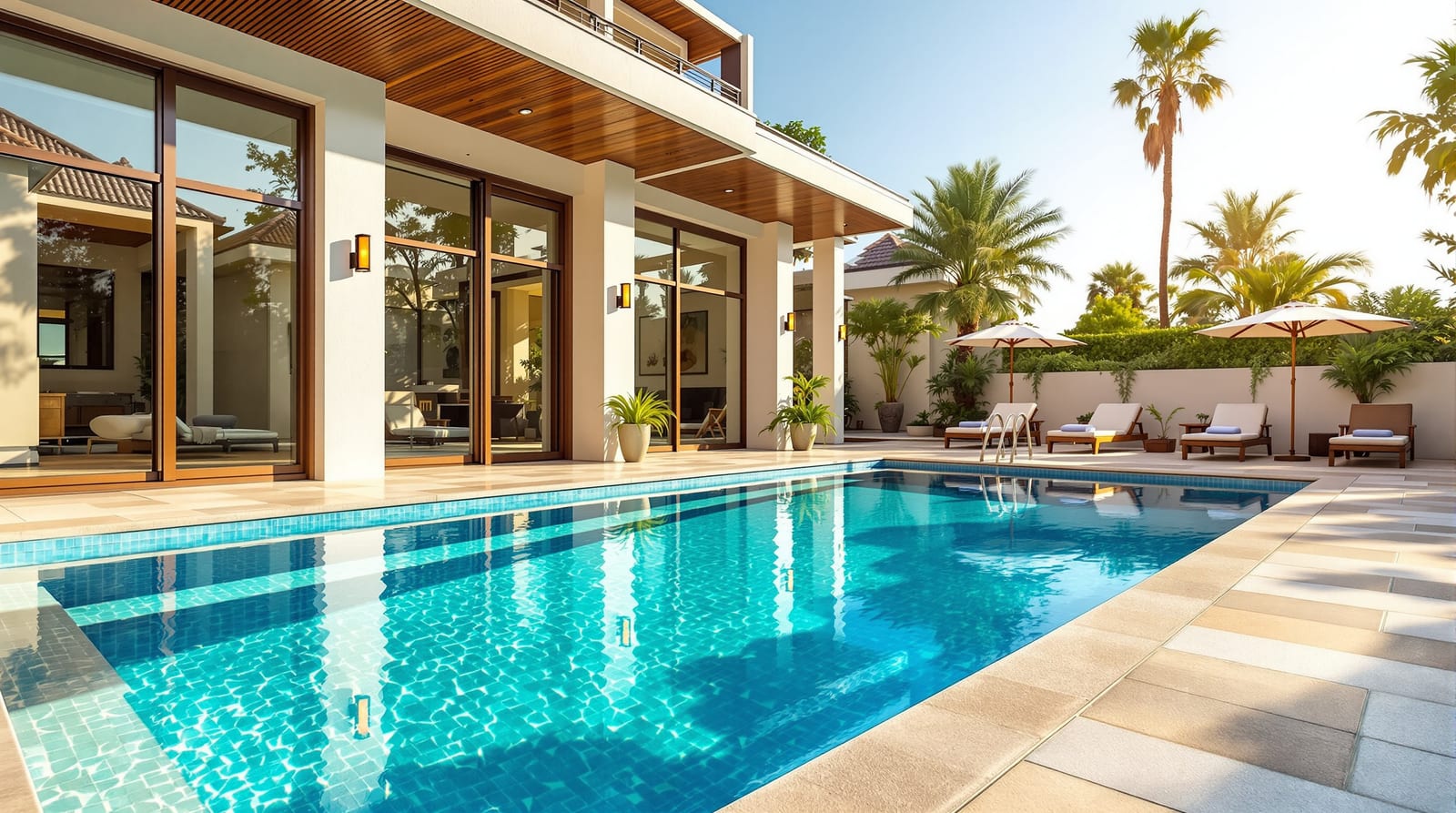
Pool Deck Flooring in India: Anti-Slip, Cool, Barefoot-Safe Poolside Floors
Wet, barefoot and sunbaked, a pool deck is the one floor where anti-slip is non-negotiable — here is how to pick R11-R12 stone, porcelain pavers, WPC deck tiles and more, with ₹/sq ft costs.
A pool deck is the single floor in the whole house where getting it wrong can hurt someone. It is walked on barefoot, almost always wet, and baked by direct Indian sun — three conditions that pull in opposite directions. The glossy stone or vitrified tile that dazzles in the living room becomes a sheet of ice the moment a swimmer steps out streaming water, and the dark granite that looks luxurious will scald the soles of children at 2 pm in May. Around a pool, anti-slip is not a nice-to-have. It is the whole brief. This guide ranks the surfaces that stay grippy when wet, cool enough for bare feet, and tough enough to survive chlorine, salt and monsoon — and tells you what each costs per square foot.
What a pool deck floor really has to survive
Before you fall for a finish, be honest about the five demands a poolside floor faces at once:
- Wet barefoot grip — the non-negotiable. People step out of the pool soaking, onto a surface that is constantly splashed. The floor must be slip-safe under a wet bare foot, not just a dry shoe. Aim for DIN 51130 R11-R12 (ramp test) and, more relevant here, the barefoot classification DIN 51097 class B or C (C for the steepest wet-foot areas, steps and ramps). A polished mirror finish is genuinely dangerous here — treat it as banned. Our anti-slip flooring standards guide explains the R and barefoot ratings.
- Cool underfoot in the sun. Bare feet meet this floor at the hottest hour. Dark, dense, polished materials store heat and burn; light-coloured, textured, lower-density surfaces (light sandstone, light porcelain, WPC/wood, exposed aggregate) stay far more comfortable. Colour and texture matter as much as the material.
- Chlorine and salt resistance. Pool water — whether chlorinated or salt-chlorinated — splashes the deck constantly and dries to leave aggressive residue. The surface, and especially the grout and any fixings, must resist chemical attack and efflorescence. Use chlorine-stable, low-absorption materials and epoxy or chemical-resistant grout, not ordinary cement grout that pits and whitens.
- Drainage away from the pool. Splash-out and rain must run off the deck, away from the pool and the house, into a perimeter channel — never pond on the deck or drain back into the pool carrying grit and suncream. A fall of roughly 1 in 50 to 1 in 80 away from the pool coping, plus a deck drain or slot channel, is standard. See monsoon-ready flooring.
- Freeze-thaw and UV in some regions, heat everywhere. Hill-station pools see frost; everywhere else the surface bakes year-round. Choose UV-stable, low-absorption, non-fading materials so the deck does not chalk, craze or pop after a couple of summers.
A pool deck splits into zones, and you can mix materials: the immediate wet zone and steps (most slip-critical, class C), the lounging/sunbed zone (cool-touch matters most), and the path back to the house (durable and continuous). Pick deliberately for each.
The top picks, ranked
1. Anti-skid porcelain pavers (20 mm) — the modern default
Thick 20 mm porcelain pavers in a structured, anti-slip finish (R11 or R12, barefoot class B/C) are the contemporary go-to for a reason. Porcelain is near-zero absorption, so it shrugs off chlorine, salt and frost, will not stain from suncream or leaves, and the colour is fixed and fade-proof. Light, stone-look or wood-look pavers stay reasonably cool, and the 20 mm thickness lets them be laid on adjustable pedestals over a drained void — water vanishes straight through the joints — or bedded conventionally with chemical-resistant grout. Matching bullnose pieces give a safe, rounded pool edge. It is mid-to-premium in price but the lowest-maintenance choice. See porcelain tile flooring and the outdoor-specific outdoor deck tiles guide.
2. Flamed or leathered natural stone — grip plus Indian character
A flamed (thermally textured) or leathered finish turns natural stone into one of the grippiest wet surfaces available, while the natural mineral body stays cooler than a dense polished slab. Light-toned options are best for bare feet: flamed sandstone (Dholpur, Mint, Kandla, Teakwood) is light, grippy and beautifully suited to Indian poolsides; flamed granite is the toughest and near-stain-proof; kota stone in a honed or leather finish is cheap, cool and traditional. The golden rule: never use polished stone around a pool — only flamed, leathered, sandblasted or honed. See sandstone flooring, granite flooring and kota stone flooring.
3. Wood / WPC deck tiles — warm, barefoot-friendly, free-draining
For the lounging and sunbed zone, nothing beats a timber-look deck for barefoot warmth and resort feel. WPC (wood-plastic composite) deck tiles are the practical Indian choice: they will not rot, splinter or warp like real hardwood, resist chlorine and water, stay far cooler than stone in the sun, and the gapped boards drain instantly. They clip onto pedestals or a joist sub-frame over a drained, sloped slab. Real hardwood decking (teak, IPE) is gorgeous but high-maintenance and pricier; WPC gets you 90% of the look with a fraction of the upkeep. See WPC flooring and outdoor deck tiles.
4. Exposed aggregate — grippy, monolithic, hides everything
Exposed aggregate concrete (the cement washed back to reveal stone chips) gives a hard-wearing, naturally anti-skid, jointless deck with excellent wet grip. The pebbly texture drains well, hides leaf and suncream marks, and a light pebble mix stays comfortably cool. It is one of the best-value contemporary pool surrounds, poured in place with proper control joints and a sound, sloped base. Patch repairs show more than swapping a paver, but as a continuous surface it ages gracefully. See exposed aggregate flooring.
5. Anti-slip vitrified tiles — budget option, specified correctly
You can tile a pool deck with matt, structured, anti-skid (R11) vitrified tiles, full-bedded with chemical-resistant grout — the budget route that still passes the safety test. Insist on a genuine outdoor anti-skid rating and light colours; standard glossy vitrified is unsafe here. It is less premium and less cool-touch than the options above, but the most affordable safe choice. See vitrified tile flooring and the anti-skid floor treatment guide if you ever need to retrofit grip onto an existing too-smooth deck.
Comparison: surface vs grip, heat, chemicals, cost
The table ranks the realistic pool-deck choices. Slip and barefoot ratings are the headline; cost is indicative installed 2026 ₹/sq ft and varies with city, finish and base prep.
| Surface | Wet grip (target) | Barefoot heat (light colour) | Chlorine / salt | Drainage | Cost (₹/sq ft) |
|---|---|---|---|---|---|
| Anti-skid porcelain paver 20 mm | Excellent (R11-R12, class B/C) | Cool-to-moderate | Excellent (non-absorbent) | Excellent (pedestal/joints) | 120-300 |
| Flamed sandstone | Excellent (flamed) | Cool (light tone) | Good (seal it) | Good (sloped, jointed) | 90-220 |
| Flamed / leathered granite | Excellent (flamed) | Moderate-warm | Excellent | Good (sloped) | 130-350 |
| Kota stone (leather/honed) | Good | Cool | Good (seal it) | Needs slope | 60-150 |
| WPC / wood deck tiles | High (gapped boards) | Coolest, warm-feel | Good (WPC) | Excellent (gaps) | 90-400 |
| Exposed aggregate | High (textured) | Cool (light mix) | Good (seal it) | Good (sloped slab) | 120-220 |
| Anti-skid vitrified (R11) | High (matt R11) | Moderate | Very good | Needs slope | 80-220 |
For zoning the wider outdoor area and choosing between materials, see our room-by-room flooring guide, and to mix a barefoot deck with cool stone in a holiday-home setting, the resort flooring guide. For the specific science of wet-area grip, read anti-slip flooring for wet areas.
How a safe pool edge is built: grip, slope and drainage
The pool coping and the first metre of deck are the most slip-critical strip on the whole plot. The diagram shows the standard build-up: a rounded, anti-slip coping, a deck that falls away from the pool toward a slot channel, and water carried off the deck rather than back into the pool.
Give the deck a fall of about 1 in 50 to 1 in 80 away from the pool to a perimeter slot drain or deck channel, so splash-out and rain never run back into the water or pond underfoot. Use a rounded, anti-slip coping at the very edge, waterproof the deck slab, and bed everything in chemical-resistant (epoxy) grout. Add a movement joint in any large poured slab to control thermal cracking in the heat.
Design tips for an Indian poolside
- Go light, go textured. Light sandstone, light porcelain, pale exposed aggregate and WPC stay barefoot-cool in May sun; charcoal granite and dark tiles can scald. Texture both grips and reflects heat.
- Zone the materials. Use the grippiest class-C surface (flamed stone, structured porcelain) at the steps and immediate wet edge; warm WPC or wood deck tiles for sunbeds; continuous stone or porcelain for the path to the house.
- Mind the transitions. Keep the deck-to-lawn and deck-to-house transitions flush and trip-free, with the accessible flooring standards threshold limit (<=12 mm) in mind if anyone uses a wheelchair or is elderly.
- Seal porous stone. Sandstone, kota and exposed aggregate should be sealed against chlorine, salt and suncream staining; reseal periodically — see the floor resealing guide.
- Not sure which to specify? Try the pool deck flooring selector to match grip, heat and budget to your zones.
Do and don't
- Do specify R11-R12 / barefoot class B-C anti-slip finishes for the whole deck, and class C for steps and ramps.
- Do choose light colours and textured surfaces so bare feet stay cool in direct sun.
- Do slope the deck away from the pool to a perimeter channel, and use chemical-resistant (epoxy) grout and chlorine-stable fixings.
- Don't ever use polished stone, glossy vitrified or any mirror finish around a pool — it is genuinely dangerous wet.
- Don't lay dark, dense, heat-storing materials in the barefoot sun zones.
- Don't let deck run-off drain back into the pool or pond on the surface; don't skip waterproofing the deck slab.
Care and upkeep
Hose grit and suncream off regularly so it does not grind the surface or get slippery. Clean leaf litter and organic film promptly — biofilm makes any deck slick. Reseal porous stone, kota and exposed aggregate periodically for stain and chemical resistance, and check epoxy grout joints for any pitting. Brush WPC deck tiles and clear the gaps so they keep draining. See the floor cleaning guide for surface-by-surface routines. If an existing deck is too smooth, an anti-slip etch or coating can retrofit grip — but new-build always beats a fix.
Frequently asked questions
What is the best anti-slip flooring for a swimming pool deck in India?
Anti-skid 20 mm porcelain pavers and flamed or leathered natural stone (light sandstone, flamed granite) are the safest, longest-lasting choices — aim for DIN 51130 R11-R12 and barefoot class B or C. WPC deck tiles and exposed aggregate are also excellent. Never use polished stone or glossy vitrified around a pool.
Which pool deck flooring stays coolest underfoot in the sun?
Light-coloured, textured, lower-density surfaces stay coolest: WPC and wood deck tiles feel warmest-of-touch, then light sandstone, kota, pale exposed aggregate and light porcelain. Avoid dark granite and dark tiles, which store heat and can scald bare feet at midday.
Is polished granite or marble okay around a swimming pool?
No. Polished stone becomes dangerously slippery the moment it is wet, which around a pool is constant. If you love granite, specify a flamed or leathered finish; for marble, keep it indoors. Around water, only flamed, leathered, sandblasted, honed or structured finishes are safe.
How do you stop a pool deck from being slippery and from flooding?
Specify an R11-R12 / barefoot class B-C anti-slip finish, slope the deck about 1 in 50 to 1 in 80 away from the pool to a perimeter slot drain, use a rounded anti-slip coping at the edge, and keep the surface clear of biofilm and suncream. Free-draining surfaces like WPC tiles and pedestal-laid porcelain drain fastest.
How much does pool deck flooring cost per sq ft in India?
Indicatively in 2026: anti-skid porcelain pavers ₹120-300, flamed sandstone ₹90-220, flamed granite ₹130-350, kota ₹60-150, WPC/wood deck tiles ₹90-400, exposed aggregate ₹120-220 and anti-skid vitrified ₹80-220 per sq ft installed. Finish, edge detailing, drainage and city rates shift these figures; verify current quotes locally.
Export this guide
Related Guides — Deep-dive reading
Anti Slip Flooring for Bathroom and Wet Areas in India: R-Ratings, Finishes and Genuinely Safe Tile Choices
How to choose genuinely safe flooring for bathrooms, kitchens, balconies, pools, entrances and elderly- or child-friendly homes — the R-rating system, finishes that grip wet feet, anti-skid natural stone, slope to drains and the tiles to avoid.
Flooring & SurfacesPatio Flooring in India: Best Decks & Outdoor-Seating Floors for Weather, Grip & Looks
How to floor a patio, deck or outdoor lounge in India so it shrugs off UV and monsoon, grips wet feet, stays barefoot-friendly and still looks like a place you want to entertain.
Flooring & SurfacesTerrace Flooring in India: Best Heat-Reflective, Waterproof Rooftop Options (2026)
An Indian terrace takes full sun, heavy monsoon and daily thermal expansion, so the floor is the second line of defence over a sound waterproofing layer and slope: cool-roof china mosaic, heat-reflective and anti-skid vitrified pavers, Kota and Tandur, deck and WPC tiles, pedestal pavers and artificial grass, with ₹/sq ft, expansion joints and the waterproofing-first rule.
Flooring & SurfacesRelated Tools — Try Free
Flooring Cost Calculator
Estimate the all-in cost of a floor — material, laying, wastage, skirting and GST — by area and material.
Flooring CalculatorChild & Elder Home-Safety Audit
Room-by-room safety audit for households with children or seniors — 10 categories, 70+ checkpoints tagged by audience.
Safety AuditFlooring Material Selector
Get the best flooring material for your room, budget and climate, with anti-slip checks for wet areas.
Flooring Tool