
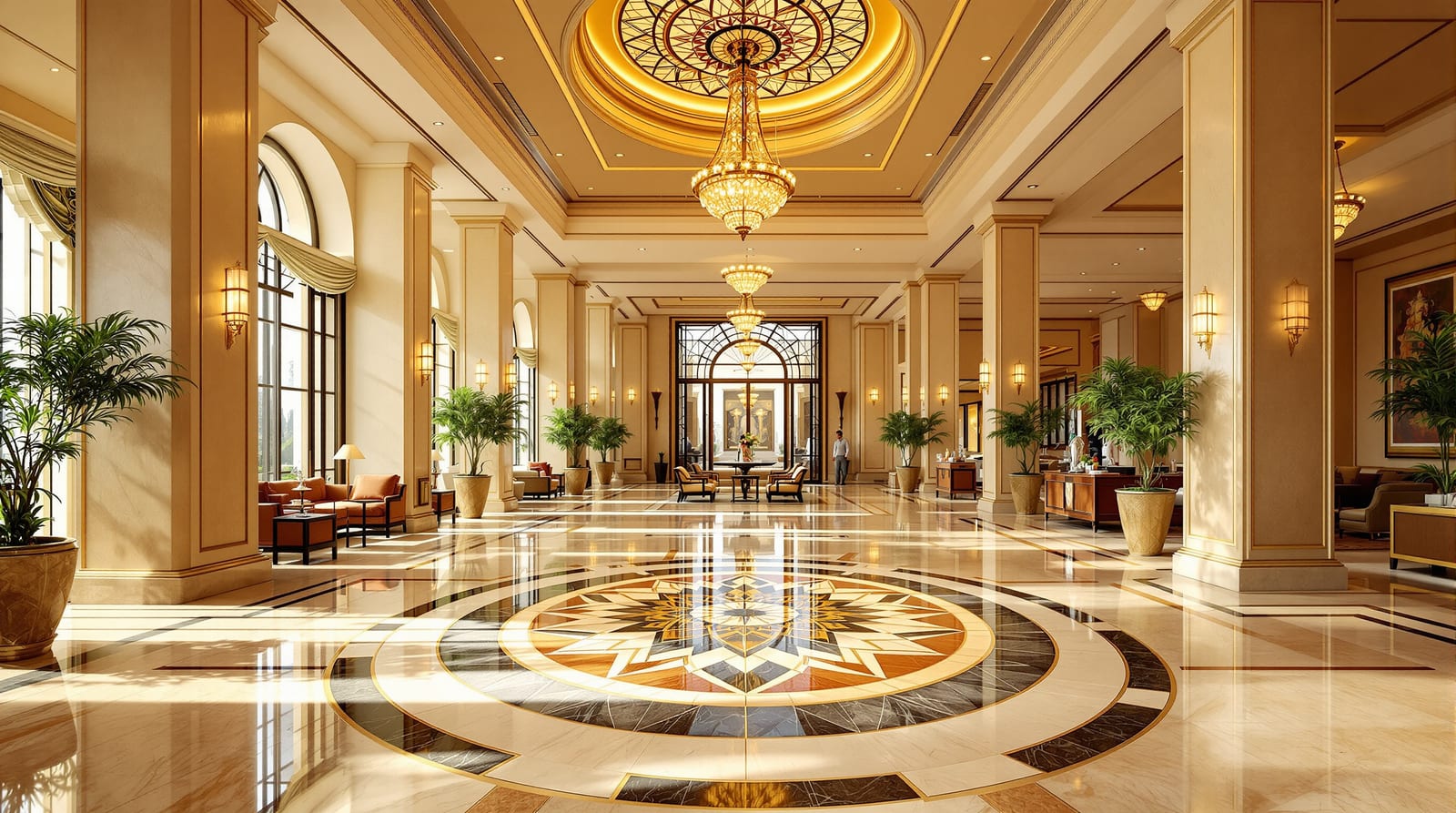
Hotel Flooring in India: Lobby, Guest Room, Corridor & Spa Floors by Zone
A zone-by-zone flooring playbook for Indian hotels — marble lobbies, carpeted rooms and corridors, anti-slip spa and pool decks, durable back-of-house, with R-ratings and cost per square foot.
A hotel floor carries two jobs that pull in opposite directions. It must sell a luxury image the instant a guest walks in, and it must survive 24x7 housekeeping, rolling luggage, banquet crowds, monsoon-wet entrances and decades of mop water without ever looking tired. No single material does both across every space, which is why hotel flooring is never one decision — it is a zone-by-zone strategy where the lobby, guest room, corridor, restaurant, spa and back-of-house each get the floor that fits its specific brief.
This guide maps that strategy for Indian hotels: which floor for which zone, why, the slip and fire codes that govern wet and public areas, and the cost per square foot to budget. For the broader category logic, the commercial flooring guide for India sits one level up; this page drills into hospitality.
The five forces that drive every hotel floor
Before any material is chosen, six demands compete for priority, and their weight shifts dramatically from zone to zone:
- Brand image. The lobby, atrium and restaurant are the floors a guest photographs and remembers. Here the floor is marketing — it must read as expensive, grand and on-brand. A five-star property cannot put a budget tile where the porte-cochere meets the reception desk.
- Acoustics and guest comfort. Guest rooms and corridors are where the floor protects sleep. Hard floors transmit footfall, trolley rumble and door slams; soft floors absorb them. Quiet underfoot directly drives guest reviews.
- Durability under 24x7 housekeeping. Hotels never close. Floors are mopped, scrubbed, buffed and trafficked around the clock, and trolleys, vacuum cleaners and luggage hammer them. A floor that scratches, dulls or stains under that regime fails fast and re-floors expensively.
- Slip safety. Lobbies in the monsoon, spa wet decks, pool surrounds and bathroom floors are slip-liability zones. Indian hotels face genuine guest-injury exposure here, and codes set minimums.
- Fire and accessibility codes. NBC 2016 governs flame-spread of finishes on escape routes (lobbies, corridors, stairs), and the Rights of Persons with Disabilities (RPwD) Act 2021 mandates accessible thresholds, ramps and tactile guidance through public areas.
- Lifecycle cost. The purchase price is a fraction of the story. A floor that needs annual re-polishing, or carpet that must be replaced every five to seven years, can cost more over fifteen years than a pricier floor that lasts. Hotels budget on lifecycle, not just supply rate.
The art is reading which forces dominate each zone, then choosing accordingly.
Zone-by-zone: which floor, and why
Lobby and atrium — the grand first impression
The lobby is the hotel's handshake. It is the most photographed, most trafficked public floor and the one expected to look unmistakably premium. The default palette here is natural stone and large-format hard flooring:
- Marble is the classic five-star statement — book-matched panels, inlay borders and medallion centrepieces under the chandelier. Imported white and beige marbles read as luxury; the trade-off is upkeep, etching from spills and the need for periodic diamond-polishing. See the marble flooring guide and, for premium imports, the Italian marble flooring guide.
- Granite is the workhorse of grand-but-tough. Harder, denser and far more stain- and scratch-resistant than marble, it survives luggage trolleys and monsoon grit while still polishing to a mirror. Many Indian hotels use granite borders and high-traffic bands with marble fields. The granite flooring guide covers finishes.
- Large-format vitrified (GVT/PGVT) and porcelain now deliver convincing marble and stone looks at a fraction of the cost and with near-zero maintenance — increasingly the choice for four-star and mid-luxury lobbies, and for back-bands in five-star ones. The PGVT tile guide and vitrified tile flooring guide explain grades.
- Terrazzo is having a strong revival in design-led and boutique hotels — seamless, custom-pigmented, terrazzo gives a bespoke designer floor that is also extremely durable. The terrazzo flooring guide has the details.
The critical caveat for Indian lobbies: the entrance band gets wet in the monsoon. Polished marble at the threshold is a slip-and-fall lawsuit waiting to happen. Specify a flamed, leathered or honed anti-slip zone (or recessed entrance matting) for the first few metres, even if the floor is polished beyond it. The anti-slip flooring standards guide sets out the R-ratings.
Guest rooms — warmth, quiet and a wet bathroom
The guest room floor is judged on comfort and silence, not grandeur. Two strategies dominate:
- Carpet (broadloom or carpet tile) is the traditional luxury-hotel choice: it is the warmest and quietest floor, absorbing footfall and giving the plush, hushed feel guests associate with a good night's sleep. The downside is hygiene and stain risk; solution-dyed nylon carpet tiles let housekeeping swap a single stained tile rather than re-carpet a room.
- Engineered wood, laminate or wood-look SPC has surged in modern and resort hotels — warm underfoot, photogenic, easier to keep hygienic than carpet, and resistant to the allergy concerns some guests raise about carpet. Pair it with a bedside rug for warmth and acoustic damping.
Whatever covers the bedroom, the bathroom is a separate, non-negotiable wet zone: anti-slip porcelain, vitrified or natural stone with an R10+ rating, falls to a drain, and waterproofing underneath. Never carry carpet or wood into a hotel bathroom. For the material logic, the carpet flooring guide, wooden flooring guide and anti-slip standards all apply.
Corridors — acoustic, branded and hard-wearing
Corridors run the longest distance in a hotel and shape the guest's walk to the room. Patterned broadloom or carpet tile dominates for two reasons: acoustics (it muffles trolley rumble, footfall and door noise at 2 a.m.) and branding (custom-woven patterns and logo-keyed colours carry the hotel's identity down every floor). Solution-dyed nylon with a heavy-traffic rating and modular carpet tiles for spot replacement is the standard. Some contemporary and resort properties use LVT or wood-look planks in corridors for a harder, lower-maintenance look, accepting the acoustic trade-off.
Restaurant and banquet — slip, grease and style
Front-of-house dining is a hybrid: it must look refined yet tolerate dropped food, spilled wine and constant mopping. Anti-slip vitrified or porcelain, wood-look LVT, terrazzo and polished concrete all work, chosen for slip rating and cleanability. Banquet halls, which flip between weddings, conferences and buffets, lean toward durable large-format vitrified or carpet for ballrooms. The dedicated restaurant flooring guide covers the dining-versus-kitchen split in full — and the kitchen behind it is a specialist R11-R12 zone covered in the commercial kitchen flooring guide.
Spa, pool and wet leisure — anti-slip is the law
This is the highest-risk zone in the hotel. Wet feet, bare feet and water mean slip resistance is the first specification, not an afterthought. Use flamed or leathered natural stone, anti-skid porcelain, or WPC/wood deck tiles around pools — never polished anything. DIN 51130 ratings of R11-R12 (and barefoot ratings of Class B/C for the immediate pool surround) are the working benchmark. The resort flooring guide goes deep on pool decks, sun terraces and outdoor leisure, and the anti-slip flooring standards guide sets out the R and barefoot classes to specify.
Back-of-house — invisible but mission-critical
Service corridors, housekeeping stores, laundry, plant rooms and the kitchen are where the hotel actually runs. Guests never see these floors, so the brief flips entirely to durability, hygiene and slip safety: anti-slip vitrified, epoxy or PU resin. Kitchens demand coved, seamless, R11-R12 resin; laundries and plant rooms suit epoxy; service passages take tough vitrified. The epoxy flooring guide and PU resin flooring guide cover the resilient options.
Hotel flooring recommendation table
| Zone | Recommended floor | Why | ₹/sq ft (2026) |
|---|---|---|---|
| Lobby / atrium | Marble, granite, large-format vitrified, terrazzo | Grand brand image; granite and vitrified add trolley-proof durability; anti-slip entrance band | 150-1500 (marble) · 130-350 (granite) · 90-250 (terrazzo/vitrified) |
| Guest room (bedroom) | Carpet tile or engineered wood / SPC | Warmth + acoustics for sleep; wood for a modern, hygienic feel | 80-400 (carpet) · 110-800 (wood/SPC) |
| Guest bathroom | Anti-slip porcelain / vitrified / stone, R10+ | Wet zone; slip safety, drainage, waterproofing | 120-300 |
| Corridor | Broadloom / carpet tile (heavy-traffic nylon) | Acoustic damping + custom branding; modular spot-replace | 80-400 |
| Restaurant / banquet | Anti-slip vitrified, porcelain, LVT, terrazzo, polished concrete | Slip + grease + style; cleanable under constant service | 90-420 |
| Spa / pool deck | Flamed/leathered stone, anti-skid porcelain, WPC deck tiles | R11-R12 wet slip safety; never polished | 120-350 |
| Back-of-house / kitchen | Anti-slip vitrified, epoxy, PU resin (coved, R11-R12 in kitchen) | Durability, hygiene, slip safety; invisible to guests | 80-500 |
Costs are indicative installed rates and vary widely with import grade, design complexity and city. Run live numbers through the flooring cost per square foot guide and the commercial flooring cost calculator.
Codes you cannot skip
- NBC 2016 fire and life-safety. Finishes on escape routes — lobbies, corridors, stairs — are governed for flame-spread and smoke. Carpet on corridors and stairs must meet the relevant flammability class, and hotels above defined heights face stricter material limits. The NBC flooring requirements guide summarises the duties.
- Slip resistance. Wet public zones (entrance bands, pool decks, spa, bathrooms) should specify DIN 51130 R-values: R10+ for guest bathrooms, R11-R12 for spa and pool, R11-R12 for commercial kitchens. The anti-slip flooring standards guide maps the classes.
- Accessibility (RPwD Act 2021 + NBC). Thresholds limited to about 12 mm, ramps at 1:12, tactile guidance and continuous accessible routes through public areas are mandatory for hotels. The accessible flooring standards guide covers the requirements.
Lifecycle cost: the number that actually matters
A hotel that buys on supply rate alone gets burned. Three lifecycle truths drive hospitality flooring economics:
- Carpet is cheap to lay, expensive to own. Heavy-traffic hotel carpet typically needs replacement every five to eight years, plus deep-cleaning cycles. Budget the replacements, not just the install.
- Marble looks premium but demands re-polishing. A high-traffic marble lobby needs periodic diamond grinding and polishing to stay mirror-bright, plus sealing against etching. Granite and large-format vitrified avoid most of this — a key reason vitrified is winning mid-luxury lobbies.
- Closing a zone to re-floor costs revenue, not just money. A floor that fails forces a room, restaurant or lobby out of service. Specifying a durable floor first time protects occupancy. The honest discipline is to spend on durability where downtime is costliest.
Do and don't
- Do specify an anti-slip entrance band at the lobby threshold — polished marble that gets monsoon-wet is the single biggest slip-liability in an Indian hotel.
- Do use modular carpet tiles in corridors and rooms so housekeeping can swap one stained tile, not re-carpet a whole floor.
- Do treat guest bathrooms, spa and pool as R11-R12 wet zones with proper falls and waterproofing.
- Do budget on fifteen-year lifecycle cost, including re-polishing and carpet replacement, not just supply rate.
- Don't carry carpet or wood into any wet zone — bathroom, spa or pool surround.
- Don't put a budget-looking tile in the lobby or porte-cochere; that floor is brand marketing.
- Don't ignore NBC flame-spread limits on corridor and stair finishes — life-safety compliance is non-negotiable for hotels.
Caring for hotel floors under 24x7 housekeeping
Each zone needs its own routine. Stone lobbies want pH-neutral cleaners, prompt spill wiping to prevent etching, and scheduled diamond-polishing; never acidic cleaners on marble. Carpet needs daily vacuuming, scheduled hot-water extraction, and spot treatment kits on every housekeeping trolley. Vitrified and porcelain take routine mopping with neutral detergent. Resin and epoxy back-of-house floors need degreasing and periodic re-coating. For products and rhythm across surfaces, the floor cleaning guide for India and the floor resealing guide keep every zone presentable around the clock.
Frequently asked questions
What flooring do five-star hotels use in the lobby?
Most use natural stone — marble for the showpiece field, often with granite borders and high-traffic bands because granite resists trolley scratches and monsoon grit far better. Large-format vitrified and terrazzo are increasingly used for their near-zero maintenance and convincing stone looks. Whatever the field, the wet entrance band should be anti-slip, not polished.
Should hotel guest rooms have carpet or wooden flooring?
Both are valid. Carpet is the warmest and quietest option — the traditional luxury feel that protects sleep — but raises hygiene and allergy concerns and stains. Engineered wood, laminate or wood-look SPC gives a modern, easier-to-clean look and is winning in resorts and contemporary hotels. Many properties pair a hard floor with a rug for warmth. The bathroom must always be anti-slip tile or stone.
What anti-slip rating does a hotel pool deck and spa need in India?
Specify DIN 51130 ratings of R11 to R12 for spa wet floors and pool surrounds, plus the barefoot ratings (Class B or C) for areas walked on bare feet. Use flamed or leathered stone, anti-skid porcelain or WPC deck tiles — never polished surfaces. The anti-slip flooring standards guide details the classes to call out in the spec.
How much does hotel flooring cost per square foot in India?
It varies enormously by zone: lobbies run roughly ₹130-1500 per sq ft (granite to imported marble, less for vitrified), guest rooms ₹80-800 (carpet to engineered wood), corridors ₹80-400 for carpet, spa and pool decks ₹120-350 for anti-slip stone or porcelain, and back-of-house ₹80-500. Budget on fifteen-year lifecycle cost, including re-polishing and carpet replacement, rather than supply rate alone.
What flooring is best for hotel corridors?
Heavy-traffic broadloom or carpet tile in solution-dyed nylon is the standard, chosen for two reasons: it absorbs trolley and footfall noise for guest comfort, and custom-woven patterns carry the hotel's branding down every floor. Carpet tiles let housekeeping spot-replace a single damaged module. Some modern and resort hotels use LVT or wood-look planks for a harder, lower-maintenance corridor, accepting the acoustic trade-off.
Export this guide
Related Guides — Deep-dive reading
Mall Flooring in India: The Right Floor for Concourse, Atrium, Food Court and Anchor Stores, with Costs
Shopping malls floor millions of footfalls a year while projecting a premium image and passing slip checks — here is the floor, ₹/sq ft and key driver for the concourse, atrium feature, food court, entrance, anchor stores, lift lobbies, parking and washrooms.
Flooring & SurfacesAnti Slip Flooring for Bathroom and Wet Areas in India: R-Ratings, Finishes and Genuinely Safe Tile Choices
How to choose genuinely safe flooring for bathrooms, kitchens, balconies, pools, entrances and elderly- or child-friendly homes — the R-rating system, finishes that grip wet feet, anti-skid natural stone, slope to drains and the tiles to avoid.
Flooring & SurfacesCommercial Flooring Guide India: The Right Floor for Every Sector, with Costs and Codes
The complete commercial flooring decision framework for India — how commercial differs from home (footfall, durability, slip, fire and accessibility codes, hygiene, lifecycle cost, downtime, brand image), plus the recommended floor, ₹/sq ft and key driver for offices, retail, restaurants, hotels, hospitals, schools, gyms, salons, banks, malls, warehouses, commercial kitchens and data centres.
Flooring & SurfacesRelated Tools — Try Free
Flooring Cost Calculator
Estimate the all-in cost of a floor — material, laying, wastage, skirting and GST — by area and material.
Flooring CalculatorAcoustic Privacy (STC) Visualizer
Indian healthcare acoustic visualizer — compare wall assemblies and noise sources, see received SPL after STC attenuation, and check FGI 2018 / IS 1950 / NABH speech-privacy compliance with live dual-canvas waveform.
Acoustic ToolMarble Flooring Cost Calculator
Estimate installed marble-floor cost — material, laying, grinding and polishing, sealing, wastage and GST.
Flooring Calculator