
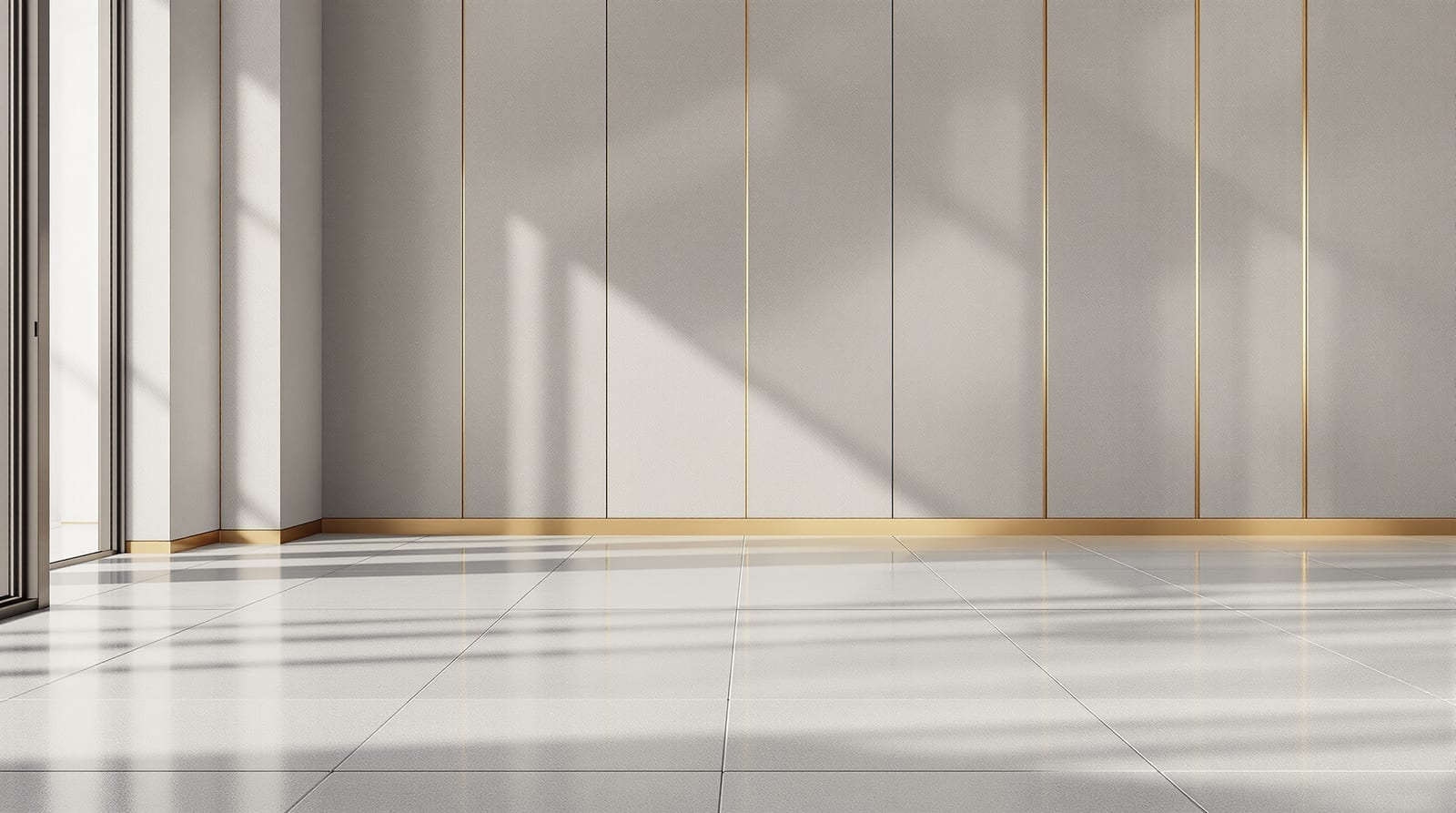
IPS Flooring in India: Indian Patent Stone Cost, Laying, Grooves & Pros and Cons
IPS (Indian Patent Stone) is the in-situ cement floor — trowel-finished, grooved into panels with brass, glass or aluminium strips to control cracking — that costs just ₹40–120 per sq ft and is now driving a modern minimalist revival; here is how it is laid, cured, pigmented and polished.
IPS — Indian Patent Stone — is the humble grey cement floor that nearly every older Indian home, school, factory and verandah was built on, and it is now back in fashion. It is concrete laid in place, smoothed by a mason's trowel, and divided into neat panels by brass, glass or aluminium strips. At ₹40–120 per sq ft it is one of the cheapest, coolest and most durable floors you can lay — and stripped of nostalgia, that bare cement look is exactly what minimalist designers now want.
This guide explains what IPS actually is, how it is laid and cured on Indian sites, why the grooves and divider strips matter so much, your plain-grey versus pigmented options, polished and waxed IPS, where it suits, and the honest pros and cons.
What IPS flooring is
IPS stands for Indian Patent Stone. Despite the name, there is nothing patented or stone-like about it today — it is simply an in-situ (cast-on-site) cement-concrete floor finish. A bonding layer and then a topping of cement, sand and fine aggregate is laid over your structural slab or base, screeded level, and trowel-finished to a smooth, dense, matte-to-semi-gloss surface. It is the original seamless floor: no tiles, no grout lines, one continuous monolithic skin.
Because it is poured wet and cured hard, IPS belongs to the same family of in-situ cementitious floors as red oxide, screed and polished concrete. The difference is mostly in pigment, finish and how far you take the polishing. Plain grey IPS is the base from which red oxide flooring (IPS tinted with red iron-oxide) and pigmented IPS all derive. It is governed by IS 1443 (code of practice for laying and finishing cement concrete flooring) and IS 2571 (code of practice for laying in-situ cement concrete flooring), which is where the proportions, thickness and curing periods come from.
The look is deliberately raw and understated — flat, slightly mottled grey with the soft variation of a hand-finished surface. That honest, unpretentious quality is precisely why it suits modern minimalist, industrial-chic and warm-Scandinavian interiors that want a calm, neutral floor.
How IPS is laid: step by step
IPS is a wet trade done by your regular mason — no exotic skills, but the sequencing, proportions and curing are unforgiving. A good IPS floor is roughly 20–40 mm thick laid over a clean, sound base. The table below sets out the typical stages and specifications.
| Stage | What happens | Typical spec |
|---|---|---|
| Base preparation | Slab cleaned, roughened, made fully wet; loose laitance removed | Sound RCC slab or PCC base, saturated surface dry |
| Bonding coat | Cement slurry (or cement + bonding agent) brushed on so topping grips | Neat cement slurry, applied just before topping |
| Divider strips | Brass, aluminium, glass or PVC strips fixed in a grid to form panels | Panels ~1 m × 1 m to 1.2 m × 1.2 m; strips set to finished level |
| Topping / laying | Cement-sand-fine aggregate (commonly 1:2:4 or 1:1.5:3) laid, screeded, compacted | 20–40 mm thick; richer mix for harder wear |
| Floating & trowelling | Surface floated, then steel-trowelled in stages as it stiffens for density and smoothness | Multiple trowel passes; pigment + extra cement worked into surface if coloured |
| Curing | Kept continuously wet (ponding / wet hessian) so it hardens without cracking | 7–14 days moist curing, IS 1443/2571 |
| Sealing / polishing | Optional — wax, floor sealer, or mechanical grinding and polishing | After full cure; see polished IPS below |
The single most important — and most often skipped — stage is curing. IPS cracks because cement shrinks as it dries; flooding the floor with water (ponding) for one to two weeks lets it gain strength slowly and shrink less. A floor that is allowed to dry out fast in hot Chennai or Delhi sun, or left uncured to meet a deadline, will craze and crack no matter how good the mason was.
Why grooves and divider strips matter
Cement shrinks as it cures and moves with temperature. A large unbroken cement floor will inevitably develop random shrinkage cracks. The classic IPS solution is to divide the floor into small panels using thin divider strips set into the wet floor in a grid, and to lay (or at least finish) the floor panel by panel.
These strips do three jobs:
- Control cracking. They create planned weak lines so that any movement happens at the joint, not as an ugly random crack across the middle of a panel. Each panel is small enough to shrink harmlessly within its border.
- Define the look. The grid of bright brass, soft aluminium, or coloured glass lines is the signature aesthetic of IPS — it turns a plain grey floor into a designed, gridded surface. Strip spacing, material and pattern (square, diagonal, banded) are all design choices.
- Aid laying. The strips act as level guides ("screed rails") so the mason can finish each panel flat and to the right height.
Panels are usually kept around one metre square — smaller for richer patterns or fussy shapes, never much larger or the crack-control benefit is lost. The diagram below shows a typical brass-divider panel layout in plan, with a section through the floor build-up alongside.
Plain grey versus pigmented IPS
Plain grey IPS is just the natural colour of cement — the cheapest option and the one minimalist designers most often want. The shade varies subtly with the cement, sand and trowelling, giving a soft, lived-in grey.
Pigmented IPS adds a colour oxide to the topping mix or, more commonly, dusts a pigment-plus-cement layer into the surface during the final trowel passes. Iron-oxide pigments give earthy reds, ochres, browns, charcoal-greys and blacks; the most famous is red oxide, which deserves its own treatment because the deep oxblood-red Kerala and Tamil Nadu floors are a distinct craft. Greens, yellows and greys are all achievable. Pigmented IPS costs a little more for the oxide and the extra care, but the colour is integral and won't peel like paint. Be realistic about uniformity: hand-pigmented IPS is mottled by nature, which is part of its charm but not for anyone wanting tile-flat consistency.
Polished and waxed IPS
Bare IPS is porous and shows water marks, so it is almost always sealed or polished. The options range from cheap to luxurious:
- Wax / sealer finish. A traditional wax or a modern penetrating floor sealer is rubbed in, giving a soft sheen, easier cleaning and stain resistance. Wax needs periodic reapplication; a good penetrating sealer lasts longer. This is the standard finish for grey and red-oxide IPS.
- Hand-polished IPS. Repeated steel-trowelling and oiling/waxing burnishes the surface to a satin glow — the classic look of old red-oxide and grey IPS floors.
- Mechanically polished IPS. Diamond grinding and polishing the cured floor (the same process used for polished concrete) produces a hard, glossy, low-maintenance surface. This is where IPS overlaps with polished concrete — the difference is mainly scale of machinery and how much aggregate you grind into.
A polished, waxed surface looks beautiful but turns slippery when wet, so keep high-gloss finishes out of bathrooms and use a matte sealer with anti-skid additive in wet zones. For wet-area grip strategy, Studio Matrx covers anti-slip floor treatment separately.
Where IPS suits — and where it doesn't
IPS is genuinely versatile. It works in:
- Modern minimalist homes — bare grey IPS as a calm, seamless living-room, bedroom or whole-floor surface.
- Balconies, verandahs and utility areas — cheap, cool, weather-tolerant when sealed; a longtime Indian favourite for these spaces.
- Commercial and industrial floors — shops, cafes, workshops, garages and warehouses, where a tougher, richer mix (or a granolithic topping) takes heavy wear.
- Traditional and heritage homes — red-oxide and grey IPS are the authentic period floor across Kerala, Karnataka, Tamil Nadu and Maharashtra.
It is less ideal where you want perfectly uniform colour, in damp-prone areas without good sealing, or where the base is structurally moving (movement will crack even a panelled floor). It also takes time — laying plus 7–14 days of curing is slower than dropping tiles, so it suits new builds and full renovations more than quick fixes.
IPS cost in India
IPS is among the most affordable floors available. Indicative 2026 ranges, varying by city, vendor and finish (add 18% GST; divider strips, pigment and polishing are extras):
| Finish | Indicative cost (₹/sq ft) | Notes |
|---|---|---|
| Plain grey IPS, sealed | ₹40–80 | Cheapest; standard topping, wax/sealer finish |
| Pigmented IPS (oxide colour) | ₹60–120 | Colour oxide + extra surface care |
| Red-oxide IPS, hand-polished | ₹70–150 | Skilled artisan craft (see red oxide guide) |
| Mechanically polished IPS / concrete | ₹100–400 | Diamond-grinding machinery, near-zero maintenance |
Brass divider strips add to the figure; aluminium and PVC are cheaper, glass is a feature cost. To estimate your own floor against panel size, strip material and finish, use the Studio Matrx ips flooring cost calculator. For a wider price view, the cluster's flooring cost per square foot benchmarks put IPS firmly at the budget end alongside Kota and Shahabad stone.
Pros and cons of IPS flooring
| Pros | Cons |
|---|---|
| Very low cost (₹40–120/sq ft) | Cracks if poorly cured or base moves |
| Seamless — no tiles, no grout to fail | Porous; must be sealed/polished against stains |
| Cool underfoot, suits hot Indian climate | Hand-finished, so colour is mottled, not uniform |
| Durable; richer mixes take heavy traffic | Polished surface slippery when wet |
| Modern minimalist look without imported materials | Slow to lay (curing takes 1–2 weeks) |
| Repairable and re-polishable in place | Quality depends heavily on the mason's skill |
How IPS fits the rest of your flooring choices
If you like the seamless cement look, IPS sits next to several siblings worth comparing. Red oxide flooring is pigmented IPS taken to its richest, oxblood-red, hand-polished extreme. Polished concrete is essentially IPS or a concrete slab ground and polished by machine to a glossy industrial finish. Microcement is a thin modern polymer-cement coating that gives a similar seamless look over existing floors without a thick pour. Screed flooring is the raw sand-cement screed left exposed as a minimalist finish. For the wider landscape of cement, terrazzo, Athangudi and lime floors, the specialty flooring guide maps how they all relate, and the regional flooring traditions guide places IPS and red oxide in their cultural home across South and West India.
Frequently asked questions
What is the full form of IPS flooring?
IPS stands for Indian Patent Stone. In practice it simply means an in-situ cement-concrete floor — a cement, sand and fine-aggregate topping laid over the slab, trowelled smooth, and grooved into panels with divider strips. It is governed by IS 1443 and IS 2571.
Does IPS flooring crack?
It can, but well-laid IPS resists cracking. The two safeguards are dividing the floor into small panels (around one metre) with brass, aluminium or glass strips so movement happens at the joints, and curing the floor under water for 7–14 days so the cement shrinks slowly. Cracks usually trace back to skipped curing or a moving base.
Is IPS flooring good for modern homes?
Yes — plain grey IPS is a favourite for modern minimalist and industrial-chic interiors precisely because of its bare, seamless, understated look. It is cool, durable and inexpensive, and the brass-strip grid gives a designed finish without any imported material.
How much does IPS flooring cost in India?
Indicatively ₹40–120 per sq ft in 2026 — roughly ₹40–80 for plain grey sealed IPS, ₹60–120 for pigmented, and more for hand-polished red oxide or machine-polished concrete. Divider strips, pigment and polishing are extras. Use the Studio Matrx ips flooring cost calculator for your own estimate.
Is IPS flooring slippery?
Bare and matte-sealed IPS gives reasonable grip, but heavily polished or waxed IPS becomes slippery when wet. Keep high-gloss finishes out of bathrooms and wet areas, and use a matte anti-skid sealer there instead.
Export this guide
Related Guides — Deep-dive reading
Epoxy Grout vs Cement Grout for Tiles in India: Which to Specify (2026)
A plain-English guide to tile grouts for Indian homes: what grout does, how cementitious grout compares with epoxy grout on cost, stain and water resistance, hygiene and durability, and exactly where each one belongs - kitchens, bathrooms, pools, dry rooms and more.
Building MaterialsMicrocement Flooring in India: The Seamless 2-3 mm Concrete Look
A thin, hand-applied cement-polymer coating that gives a jointless concrete or stone surface over your existing floors, tiles and walls — no demolition.
Flooring & SurfacesAthangudi Tiles in India: Handmade Chettinad Cement Tiles, Patterns, Cost & Care
Vivid, one-of-a-kind handmade cement tiles from Athangudi village in Chettinad, Tamil Nadu — poured by hand onto patterned glass plates, sun-and-water cured, cool underfoot — here is how they are made, the bold floral and geometric patterns, costs of ₹80–250 per sq ft, laying, sealing and the coconut-oil care.
Flooring & SurfacesRelated Tools — Try Free
Flooring Cost Calculator
Estimate the all-in cost of a floor — material, laying, wastage, skirting and GST — by area and material.
Flooring CalculatorInterior Budget Planner
Live room-wise and component-wise cost breakdown in ₹ with contingency, GST, and PDF summary.
Budget CalculatorIPS Flooring Cost Calculator
Estimate the cost of an in-situ cement floor — plain or pigmented IPS, red oxide, lime or granolithic.
Flooring Calculator