
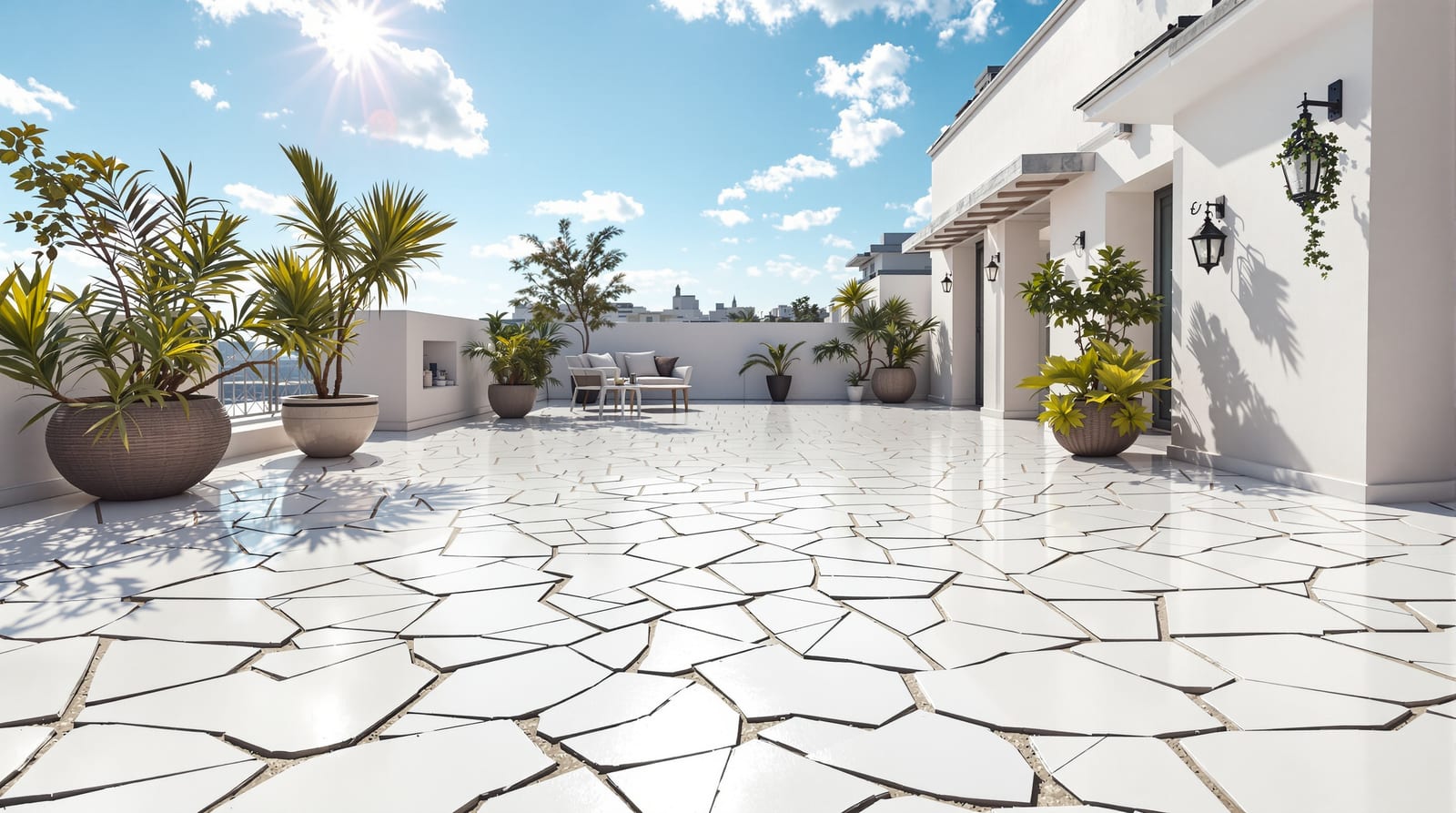
Heat-Reflective Terrace Flooring in India: Cool-Roof Floors That Keep Rooms Below Cooler
How a hot terrace bakes the rooms underneath, and which reflective floor finishes — china mosaic, broken-china, high-SRI cool-roof tiles, terracotta and white IPS over proper waterproofing — cut your indoor heat.
In most Indian homes the hottest room in summer sits directly under the terrace. A bare or dark concrete roof can reach 60-70 degrees Celsius in the afternoon sun, and that heat soaks through the slab and radiates down into the bedroom or living room below for hours after sunset. The single cheapest fix is not an air conditioner, it is the colour and material of your terrace floor. A bright, reflective terrace finish bounces most of the sun's energy back into the sky instead of storing it, and a well-chosen heat-reflective terrace flooring can drop the ceiling temperature of the room below by several degrees. This guide explains exactly how a hot roof bakes the rooms underneath, which reflective finishes work in Indian conditions, and how to lay them over proper waterproofing so you do not trade a cooler home for a leaking one.
How a hot terrace bakes the rooms below
A flat concrete terrace is a giant heat collector. Through the long Indian summer day the sun pours energy onto the slab. A dark or grey surface absorbs most of it; the concrete heats up, stores that heat in its mass, and then slowly releases it in two directions. Some radiates back to the sky after sunset, but a large share conducts straight down through the slab and emerges as a warm ceiling in the room below. That is why an upstairs bedroom stays uncomfortable late into the night long after the air outside has cooled, and why the air conditioner there works twice as hard.
Two surface properties decide how much heat a roof collects and keeps:
- Solar reflectance (albedo) is the fraction of sunlight a surface bounces back rather than absorbs. A fresh white surface reflects 0.7 to 0.8 of the sun's energy; bare grey concrete reflects only about 0.2 to 0.3; a dark or weathered surface even less. The higher the reflectance, the less heat enters the slab.
- Thermal emittance is how readily a surface sheds the heat it does absorb, by radiating it away as infrared. A high-emittance surface stays cooler because it lets go of heat quickly.
The two combine into the Solar Reflectance Index (SRI), a single 0-to-100-plus number that rates how cool a roof surface stays in the sun. A standard black surface is defined as SRI 0 and a standard clean white as SRI 100; many cool-roof finishes exceed 100. The higher the SRI, the cooler the surface and the less heat reaches the room below. A "cool roof" is simply a roof finished in a high-SRI, high-reflectance material, and a heat-reflective terrace floor is the walk-on version of the same idea.
The diagram below shows the difference between a dark, absorbing roof and a bright, reflective one over the same room.
The payoff is real and well documented: a high-reflectance terrace can run 15-30 degrees Celsius cooler at the surface than a bare dark roof on a peak summer afternoon, and that typically shaves a few degrees off the ceiling and air temperature of the room directly below, cutting both discomfort and air-conditioning load. It will not turn a top-floor room into a basement, but combined with insulation, ventilation and shading it is one of the highest-value, lowest-cost moves you can make.
The non-negotiable base: waterproofing and slope first
Before any of the reflective finishes below, understand the most important rule of terrace flooring: the cooling finish goes on top of a sound waterproofing and drainage system, never instead of it. A terrace is exposed to the full force of monsoon rain, standing water and brutal thermal movement, and a leak that ruins the ceiling below undoes every benefit of a cooler room.
A proper Indian terrace build-up, from the structural slab upwards, is:
1. Structural RCC slab, clean and cured.
2. Waterproofing membrane or treatment over the slab and turned up the parapet by at least 150-300 mm. Common systems are integral-crystalline or admixture waterproofing per IS 2645, acrylic/polymer or polyurethane (PU) liquid-applied coatings, or APP/SBS bituminous membranes. Brands such as Dr Fixit (Pidilite), MYK Laticrete, Roff and Fosroc are widely used.
3. Protective screed / brick-bat coba that also creates the slope. Traditional brick-bat coba (broken-brick set in lime or cement mortar) both insulates and forms the fall; modern jobs use a cement-sand screed laid to slope.
4. Slope of about 1:100 to 1:80 towards the rainwater outlets so water drains fast and never ponds. Standing water defeats waterproofing, breeds algae and makes any floor slippery and stained.
5. The reflective finish (china mosaic, tiles, terracotta or IPS) laid over the slope.
Skip the waterproofing or the slope, and a beautiful white terrace becomes a leaking, ponding, algae-streaked liability within one monsoon. For a fuller treatment of outdoor surface selection and drainage, see Studio Matrx on the outdoor flooring guide and on building floors to suit Indian weather.
China mosaic: the traditional reflective terrace floor
The classic, time-tested Indian answer is china mosaic, also called broken-china flooring. Workers press broken pieces of white glazed ceramic or crockery into a cement mortar bed over the waterproofing, leaving thin gaps that are then filled and the whole surface rubbed smooth. The result is a hard, jointless, brilliant-white skin that reflects sunlight superbly, sheds water, and protects the waterproofing layer beneath it from UV and foot traffic.
China mosaic earns its long popularity for good reasons. White china pieces give a very high solar reflectance, so the surface stays markedly cooler than bare concrete. It is monolithic with very few joints, so there is little for water to penetrate, and it doubles as a sacrificial protective layer over the waterproofing. It is walkable, repairable and made from cheap, often recycled, ceramic offcuts, which keeps it inexpensive and low in embodied carbon. Its limitations are that the brightness dulls as dust and algae build up over the years, so it needs occasional washing, and the broken-edge surface, while textured, can become slippery when wet and slimy if algae is left to grow. A periodic scrub and, where needed, an anti-skid treatment keep it both bright and safe; for that, see Studio Matrx on anti-skid floor treatment.
A white china mosaic over the waterproofing membrane is, for most Indian homes, the best value heat-reflective terrace floor there is: high reflectance, protective, cheap and proven over decades.
Cool-roof SRI tiles, terracotta and white IPS
Beyond china mosaic, several other finishes deliver heat reflection with different looks, walkability and price.
High-SRI cool-roof tiles are the modern, engineered option: factory-made white or pale tiles, often ceramic or specially coated, sold with a published Solar Reflectance Index (look for SRI well above 80, ideally 100-plus, and the initial and three-year aged values). They give a clean, uniform finish, are easy to lay on tile adhesive over the screed, and hold their reflectance better than site-mixed surfaces because the white is built into the tile body or a durable coating. They cost more than china mosaic but are tidy and predictable, and they suit homeowners who want a finished, walkable terrace that looks deliberate rather than rustic.
Terracotta tiles (clay tiles, including the traditional Mangalore-pattern flat tiles) are a natural, breathable choice. Their fired-clay colour is mid-toned rather than brilliant white, so their reflectance is lower than china mosaic or white tile, but clay has useful thermal mass, stays cooler underfoot than dark concrete, looks warm and traditional, and is fully natural and recyclable. Terracotta suits homeowners who want a heritage, eco-leaning look and are willing to trade some peak reflectance for natural materials and breathability.
White or light IPS (Indian Patent Stone) is a cement-based in-situ floor, a smooth troweled cement topping that can be made pale with white cement and oxide, and sometimes finished with a reflective or elastomeric cool-roof coating. IPS gives a seamless, jointless, low-cost surface that is easy to repair, but plain cement is only moderately reflective and prone to hairline cracks, so it is best when made deliberately light and over-coated with a white cool-roof paint to lift its SRI. For a fuller view of cement-based seamless floors, see Studio Matrx on microcement flooring and terrazzo flooring.
A fifth, complementary option is a white elastomeric cool-roof coating painted over an existing terrace tile or IPS: it instantly lifts reflectance and bridges fine cracks, though it needs recoating every few years as it weathers and dulls.
SRI and option comparison
This table compares the main heat-reflective terrace finishes for an Indian home. Reflectance and SRI figures are indicative for a clean, fresh surface; all finishes lose some brightness as dust and algae accumulate, so periodic washing matters.
| Finish | Typical solar reflectance / SRI | Heat-reflection performance | Walkability & anti-skid | Indicative laid cost | Notes |
|---|---|---|---|---|---|
| White china mosaic (broken-china) | Reflectance ~0.6-0.75, high SRI | Excellent | Good textured grip; can get slimy with algae | ₹60-130 per sq ft | Best value; monolithic, protects waterproofing; needs washing |
| High-SRI cool-roof tiles | SRI 80-110-plus (check rating) | Excellent, holds best over time | Choose matte / R10-plus anti-skid variant | ₹90-200 per sq ft | Tidy, uniform; ask for initial and aged SRI in writing |
| Terracotta / clay tiles | Reflectance ~0.3-0.4, moderate SRI | Moderate; cooler than dark concrete | Naturally grippy when dry; matte | ₹70-160 per sq ft | Natural, breathable, heritage look; lower peak reflectance |
| White / light IPS (cement) | Reflectance ~0.4-0.5 plain, higher if coated | Moderate; good with white cool-roof coating | Trowel-finished; can be floated anti-skid | ₹50-110 per sq ft | Seamless, cheap; over-coat white to boost SRI; prone to hairline cracks |
| White elastomeric cool-roof coating (over existing) | Reflectance ~0.7-0.85 when fresh | Excellent initially, recoat every few years | Depends on base; some are gritted anti-slip | ₹25-70 per sq ft | Quick retrofit; bridges fine cracks; needs periodic recoating |
| Bare grey RCC / dark tile (for reference) | Reflectance ~0.2-0.3, low SRI | Poor, absorbs and stores heat | Varies | baseline | The problem you are solving |
All costs are indicative and vary by city, vendor, terrace size, quality of waterproofing below and current cement, tile and labour rates; add 18 percent GST on materials. For a quick area-and-rate estimate before you call contractors, Studio Matrx's flooring cost calculator and tile quantity calculator help you sanity-check quotes.
Walkability, anti-skid and durability
A terrace floor is not just a roof finish, you walk, dry clothes, sit and sometimes garden on it, so grip and durability matter as much as reflectance. A wet white terrace, especially china mosaic with a film of monsoon algae, can be dangerously slippery. Keep the surface safe by choosing textured or matte finishes, washing off algae before the monsoon, and applying an anti-slip treatment on smooth tiled terraces; for wet zones around the water tank or washing area, aim for an R10-plus rating. The slope of 1:100 to 1:80 that drains rainwater also keeps the surface from staying wet long enough to grow slime.
Durability comes from the layers below. The reflective finish protects the waterproofing from UV and abrasion, and in turn the waterproofing protects the slab. Inspect the terrace before each monsoon for cracked finish, blocked rainwater outlets, ponding low spots and lifting at the parapet upstand, and repair early, because a small finish crack lets water reach the membrane and a blocked outlet causes the ponding that defeats the whole system. White finishes also reveal dirt and algae sooner than dark ones, which is actually a feature: it tells you when to wash, and a clean white terrace reflects far better than a grimy one.
Where heat-reflective flooring fits in a cooler home
A reflective terrace floor is the most cost-effective single step, but it works best as part of a package. Pair it with roof insulation (an insulation board or the thermal mass of brick-bat coba under the finish), good cross-ventilation in the room below, and shading such as a pergola, plants or a high-level cover over part of the terrace. Together these tackle the heat that a reflective floor alone cannot: the slab still stores some heat, and a shaded, ventilated, reflective terrace stays far cooler than any one measure on its own.
Think about the whole house too. The same hot-climate logic, light colours and reflective, cool-mass surfaces, runs through Studio Matrx's guidance on flooring for hot-dry climates and on overall thermal comfort from flooring. And because a terrace shares many concerns with smaller open surfaces, see how the same drainage, slope and anti-skid thinking applies on a balcony, on a terrace generally, and through the monsoon. A bright, well-drained, reflective terrace floor laid over honest waterproofing is one of those rare upgrades that makes the home cooler, the ceiling below drier, and the electricity bill smaller, all at once.
Frequently asked questions
Does heat-reflective terrace flooring really make the room below cooler?
Yes, measurably. A high-reflectance white terrace can run 15-30 degrees Celsius cooler at the surface than a bare dark roof on a peak afternoon, and that typically lowers the ceiling and air temperature of the room directly below by a few degrees, easing discomfort and reducing air-conditioning load. It is not a substitute for insulation and ventilation, but combined with them it is one of the cheapest, highest-value cooling steps for a top-floor home.
Is white china mosaic still the best choice, or should I use modern cool-roof tiles?
For value, china mosaic is hard to beat: very high reflectance, monolithic, cheap, made largely from recycled ceramic, and it doubles as a protective layer over the waterproofing. Modern high-SRI cool-roof tiles cost more but give a tidier, uniform finish and hold their reflectance better over the years because the white is engineered into the tile. Choose china mosaic for best value and a traditional look; choose SRI tiles for a clean, finished, predictable terrace and ask for the rated initial and aged SRI in writing.
Can I lay a reflective finish straight over my existing terrace?
Only if the waterproofing and slope underneath are sound. The cooling finish always sits on top of a working waterproofing system that is turned up the parapet, plus a slope of about 1:100 to 1:80 to the rainwater outlets. If your terrace already leaks or ponds, fix the waterproofing and drainage first, otherwise a bright new floor will simply hide a worsening leak. A quick retrofit on a sound terrace is a white elastomeric cool-roof coating, which lifts reflectance and bridges fine cracks but needs recoating every few years.
Will a white terrace get slippery and dirty?
White finishes show dust and algae sooner than dark ones, which actually tells you when to clean. The real safety issue is monsoon algae on a wet surface; keep the floor textured or matte, wash off algae before and during the rains, ensure the slope drains water fast, and apply an anti-skid treatment on smooth tiled terraces, aiming for an R10-plus rating around wet zones. A clean, well-drained reflective terrace is both safer and more reflective than a grimy one.
What does heat-reflective terrace flooring cost in India?
Indicatively, white china mosaic runs about ₹60-130 per sq ft laid, high-SRI cool-roof tiles ₹90-200, terracotta ₹70-160, light or coated IPS ₹50-110, and a white elastomeric cool-roof coating over an existing floor ₹25-70 per sq ft. These vary widely by city, terrace size, the waterproofing quality below and current material and labour rates, and exclude the waterproofing itself; add 18 percent GST on materials. Estimate your area and quotes with the Studio Matrx flooring cost calculator before committing.
Export this guide
Related Guides — Deep-dive reading
The Cool Roof Guide
The reflective roof that bounces the sun's heat back to the sky — one of the cheapest, highest-impact upgrades for a hot Indian home. What makes a roof cool (solar reflectance and thermal emittance, combined as SRI), the options from white paint to china mosaic, the temperature drops you can expect, the fast payback, and how a cool roof fits alongside insulation and green roofs. Plain language, India-grounded.
RoofingPlaster, Render and Texture-Paint Facades in India: The Honest Guide to the Country's Default Wall Finish
A building-physics guide to cement and lime render, exterior emulsion and weatherproof paints, and textured coatings — how these everyday facades are built, why they crack, streak and grow algae, and what actually keeps them looking good in the Indian monsoon.
Building FacadesFlat Roof & Terrace Waterproofing
The flat RCC terrace is India's most common roof and its most common leak — because water barely slopes off it. This guide explains why flat roofs are the hardest to keep dry, the traditional methods (brick-bat coba, mud-phuska, lime terracing, china-mosaic) versus the modern ones (liquid membranes, torch-applied felts, inverted systems), the fall-to-drain and layered build-up that actually stop leaks, and how to re-do a leaking old terrace. Plain language, India-grounded.
RoofingRelated Tools — Try Free
Cross-Ventilation Analyzer
Estimate airflow and air changes per hour (ACH) from room size, window areas, layout, and local wind — with NBC 2016 Part 8 compliance check.
Ventilation CalculatorMonsoon-Readiness Checklist
Pre-rain home audit across 9 categories — terrace, drains, waterproofing, electrical, HVAC, pest, vehicles, documents.
Seasonal AuditFalse Ceiling Cost Estimator
Live ₹/sqft across 8 ceiling types — POP, gypsum, designer, metal, PVC, wooden — with cove and spot lighting for 20 Indian cities.
Cost Calculator