
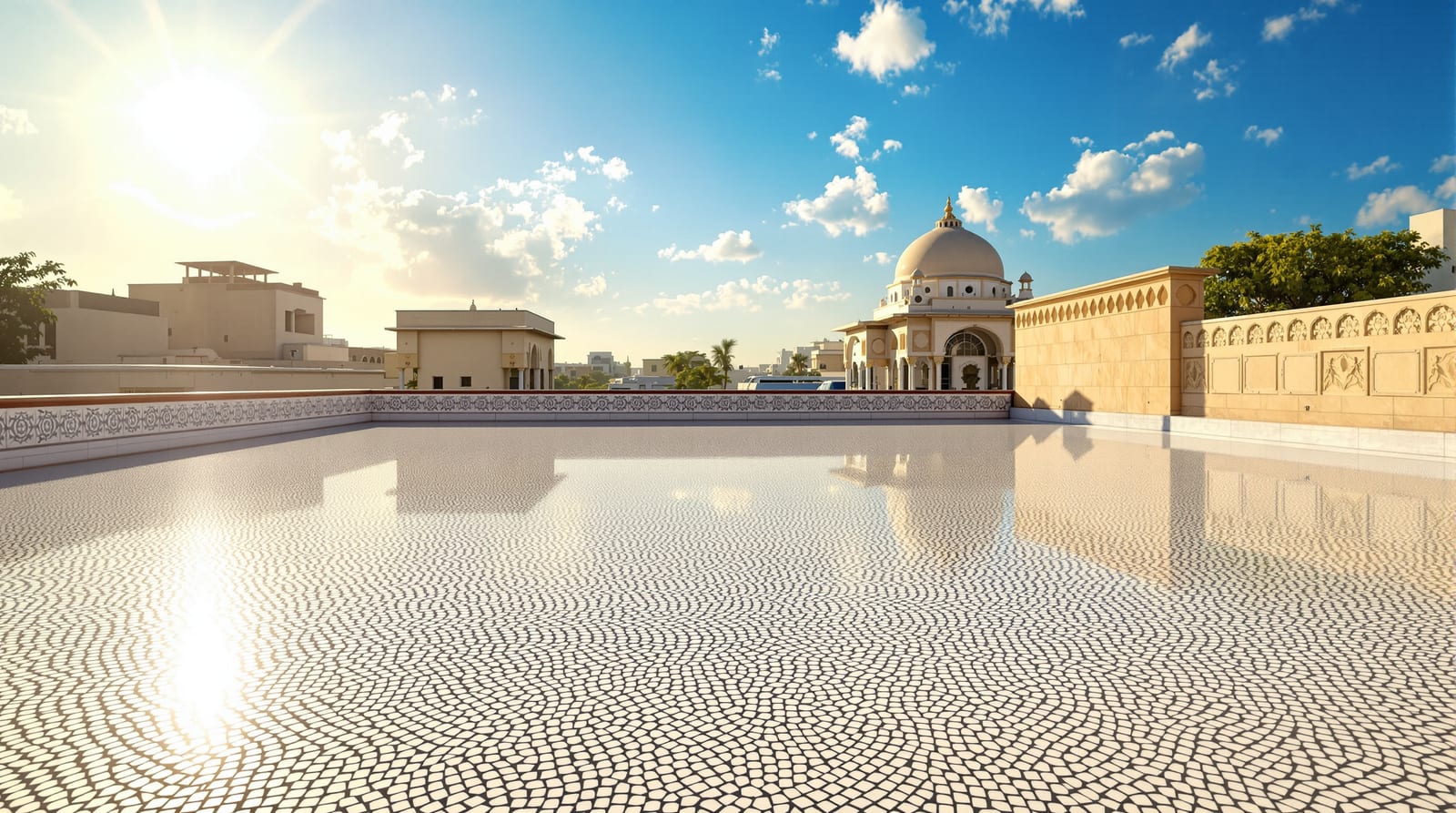
China Mosaic Flooring in India: The Classic Cool White Terrace Finish
Why broken white china pieces set in cement remain India's cheapest, coolest, most waterproof terrace topping — costs, build-up and how it is laid.
Walk onto almost any older Indian rooftop and you will find it: a hard, gleaming white surface made of thousands of broken china pieces locked into cement. This is china mosaic, the most quietly successful terrace finish in the country. It is cheap, it is waterproof, and on a 42-degree afternoon it is noticeably cooler underfoot than the bare grey slab next door. This guide explains what china mosaic actually is, why it became the default Indian terrace topping, how it is laid over waterproofing, what it costs in 2026, and how it compares with the new generation of cool-roof tiles.
What china mosaic flooring is
China mosaic is an in-situ flooring finish made by breaking up white glazed ceramic pieces (the "china") and setting them by hand into a bed of cement mortar over a prepared, waterproofed slab. The pieces are usually rejects, off-cuts and broken stock from glazed-tile and crockery factories, which is why the finish is so inexpensive. Once the pieces are pressed in and levelled, the joints are filled (grouted) with cement slurry, and the whole surface is cleaned and rubbed to a tight, semi-polished plane.
The classic colour is white or off-white, because white reflects sunlight and keeps the roof cool. You will also see pale blue, green and multi-colour versions where broken coloured glazed tiles are mixed in, sometimes in patterns or borders, but the heat-reflective white remains the workhorse. Because it is laid in place rather than as ready-made tiles, china mosaic forms a continuous, joint-free skin that follows every slope, parapet upturn and drain mouth — a big reason it performs so well on terraces.
Why it became India's default terrace topping
A handful of properties came together to make china mosaic the standard rooftop finish across India:
- It is cheap. Made from broken tile waste and ordinary cement, china mosaic is among the lowest-cost finishes you can put on a roof — typically Rs 40-90 per sq ft laid.
- It is waterproof, or close to it. Laid over a proper waterproofing layer, the dense cement-and-china skin sheds monsoon water and resists the standing water that destroys bare slabs.
- It reflects heat. A white china surface bounces a large share of solar radiation back to the sky, so the slab beneath stays cooler and the top-floor rooms below feel less of the afternoon heat. This is the original Indian "cool roof."
- It is durable. Glazed china is hard and weatherproof. A well-laid china mosaic terrace routinely lasts 15-25 years of sun, rain and foot traffic.
- It is anti-skid. The slight unevenness between pieces and joints gives grip, so wet monsoon terraces are safer than a smooth polished slab.
For decades, before reflective paints and engineered cool-roof tiles arrived, china mosaic was simply how you finished a roof in India. It is still specified daily by masons and contractors from Gujarat to Tamil Nadu.
The build-up: what sits under the china
China mosaic is only as good as the layers beneath it. A terrace is a waterproofing system, and the mosaic is its protective wearing coat. A typical sequence, slab upward:
1. RCC roof slab, cleaned and with all cracks and honeycombs repaired.
2. Waterproofing layer — most commonly brickbat coba (broken-brick lime/cement concrete that also builds the slope), or a membrane / chemical waterproofing coat. This is the layer that actually keeps water out.
3. Slope (gradient) — built into the coba or screed so water runs to the drains, never ponds. A fall of about 1 in 80 to 1 in 100 (roughly 12-15 mm per metre) is usual.
4. Cement mortar bedding in which the china pieces are set.
5. China mosaic — the broken glazed pieces, grouted and finished.
The mosaic protects the waterproofing from UV, foot traffic and thermal cracking, while the waterproofing keeps the building dry. For how the waterproofing and slope layers are detailed, see our guides on heat-reflective terrace flooring india and terrace-flooring-india.
How china mosaic is laid
The work is hand craft, done by terrace masons and helpers. A typical sequence:
1. Surface prep. The slab is cleaned, repaired, and the waterproofing / brickbat coba is laid and cured to the correct slope toward the drains. Ponding is checked with water before tiling.
2. Breaking the china. Glazed white tiles or china stock are broken into roughly palm-sized irregular pieces. Sharp shards are trimmed.
3. Setting the bed. A cement mortar bed (around 1:3 to 1:4 cement:sand) is spread over the prepared surface in workable patches.
4. Pressing the pieces. Workers press the china pieces glazed-side up into the wet bed, hand-tight with narrow joints, tapping them level so the surface stays in plane and on slope. Upturns at parapets and around the drain mouth are wrapped continuously.
5. Grouting. After initial set, cement slurry (often white or grey, sometimes with a little waterproofing compound) is flooded into the joints to fill every gap, then the surface is squeegeed and the excess wiped off.
6. Curing and rubbing. The terrace is water-cured for several days. Once hard, the surface is rubbed and cleaned so the china reads bright and the joints are tight and flush.
Skill matters. A good crew keeps joints narrow and the slope true, which is what makes the difference between a terrace that stays dry for two decades and one that ponds and leaks. For the bedding and screed fundamentals beneath, see floor-screed-and-mortar-bed-india.
The cooling benefit — India's original cool roof
The single most valued property of white china mosaic is heat reflection. A bright white glazed surface has high solar reflectance: it sends a large fraction of incoming sunlight straight back to the sky instead of absorbing it as heat. Less heat enters the slab, so the slab runs cooler, and the top-floor ceiling below stays cooler too. In peak summer this can mean a meaningfully lower indoor temperature and less load on fans and air-conditioners.
This is exactly the logic behind modern "cool roof" policy — and china mosaic delivered it decades before the term existed. Keep the surface clean: a white roof only reflects well while it is white, so a wash before each summer restores performance. For a fuller treatment of reflective terraces and how they cut indoor heat, read heat-reflective-terrace-flooring-india.
Costs in 2026 (indicative, varies by city/vendor)
China mosaic is one of the cheapest finishes you can put on a roof. Rates below are the finish only and are indicative, varying by city, vendor, china quality and access; add about 18% GST and the cost of the waterproofing / coba layer beneath, which is a separate (and important) line item.
| Finish / option | Indicative Rs / sq ft | Notes | Best use |
|---|---|---|---|
| China mosaic (white, standard) | 40-90 | Includes bedding, china, grout, finishing; excludes waterproofing below | Terraces, roofs |
| Coloured / patterned china mosaic | 70-130 | Coloured china, borders, motifs; more skilled labour | Courtyards, feature terraces |
| Brickbat coba waterproofing (layer below) | 70-180 | Separate system that builds slope and keeps water out | Under any terrace finish |
| Modern reflective cool-roof tiles | 60-150 | Precast white/light tiles; faster, modular, replaceable | Terraces wanting a tidy modular look |
| Reflective / "cool roof" paint | 25-70 | Cheapest, but a coating only — re-coat every few years | Quick reflectivity upgrade |
Because the china pieces are essentially recycled factory waste, the material cost is low and most of the spend is labour. For a tailored estimate of any floor by area and rate, use the flooring-cost-calculator, and see flooring-cost-per-square-foot-india for benchmarks across materials.
Where it suits — and where it does not
China mosaic is at its best on horizontal, sun-exposed, occasionally-walked surfaces:
- Terraces and roofs — its home ground: cool, waterproof, durable, anti-skid.
- Open parking decks and utility roofs — tough, cheap, takes weather.
- Courtyards and open-to-sky wells — sometimes used for the same cool, washable, traditional look.
- Steps and parapet upturns on terraces, wrapped continuously with the field.
It is less ideal for formal indoor living spaces, where flatter, more refined finishes are usually wanted — for those, compare living-room-flooring-india and the broader flooring-materials-explained-india. The irregular, slightly raised surface that gives anti-skid grip outdoors reads as rustic indoors. China mosaic also needs a sound waterproofing layer beneath; on its own it is a wearing coat, not a waterproofing membrane.
How it compares with other terrace finishes
| Approach | Reflectivity | Waterproofing role | Cost | Look | Repair |
|---|---|---|---|---|---|
| White china mosaic | High (clean white) | Protective coat over waterproofing | Low | Traditional, hand-laid | Patch in situ by mason |
| Cool-roof / reflective tiles | High | Tiles over waterproofing | Low-medium | Tidy, modular | Lift and swap a tile |
| Reflective paint / coating | High when fresh | None (coating only) | Lowest | Flat, painted | Re-coat periodically |
| Bare cement / IPS terrace | Low | Needs waterproofing | Low | Plain grey | Re-screed / re-coat |
| Pressed clay terrace tiles | Medium | Tiles over waterproofing | Medium | Warm, traditional | Replace tiles |
Modern precast cool-roof tiles give you similar reflectivity in a neater, modular package that is easy to lift and replace, and many homeowners now prefer them for a clean look. China mosaic wins on lowest cost, a continuous joint-free skin that hugs every slope and upturn, and a traditional finish that local masons everywhere know how to lay and repair. For the precast modular family of cement-and-marble finishes, see terrazzo-tiles-india; for the traditional in-situ marble-chip cousin, see mosaic-flooring-india; and for the broader map of alternative and specialty floors, start at the specialty-flooring-guide-india pillar. Outdoor exposed-aggregate is another anti-skid option for decks and paths — see exposed-aggregate-flooring-india.
Maintenance
China mosaic is low-maintenance but not no-maintenance:
- Wash before summer. A white roof only reflects well while it is clean. Scrub off dust, algae and monsoon grime once or twice a year, ideally before peak summer.
- Watch the joints. Over years the cement grout can craze or loosen in spots. Re-grout small areas before water finds its way through to the waterproofing.
- Clear the drains and slope. Keep drain mouths and the fall toward them clear so water never ponds; standing water is the enemy of any terrace.
- Patch promptly. Loose or popped china pieces are easily re-set by a mason in situ — fix them early to keep the skin continuous.
- Re-do the waterproofing on schedule. If leaks appear at the ceiling below, the issue is usually the waterproofing layer, not the mosaic; plan a periodic waterproofing overhaul. See floor-resealing-guide-india for sealing principles and floor-cleaning-guide-india for routine care.
Frequently asked questions
Is china mosaic flooring waterproof on its own?
Not fully. The dense china-and-cement skin sheds water well and protects the layers below, but the real waterproofing is the membrane or brickbat-coba layer beneath it. China mosaic is the wearing and reflective coat; always lay it over a proper waterproofing system with slope to the drains.
How much does china mosaic flooring cost in India?
As a rough 2026 guide it runs about Rs 40-90 per sq ft for standard white work, the finish only, plus around 18% GST. Coloured or patterned versions cost more for the extra skilled labour. Budget separately for the waterproofing / coba layer beneath, which can be Rs 70-180 per sq ft. Rates are indicative and vary by city and vendor.
Does white china mosaic really keep the house cooler?
Yes. A clean white china surface reflects a large share of sunlight back to the sky, so the slab and the top-floor rooms below stay cooler in summer. It is India's original cool-roof finish. Keep it clean, because reflectivity drops as the surface dulls.
How long does a china mosaic terrace last?
A well-laid china mosaic terrace commonly lasts 15-25 years, since glazed china is hard and weatherproof. Lifespan depends most on the waterproofing below and on keeping joints sound and drains clear. Periodic re-grouting and a waterproofing overhaul extend it further.
China mosaic or modern cool-roof tiles — which is better?
Both reflect heat well. China mosaic is cheaper, forms a continuous joint-free skin that wraps slopes and upturns, and any local mason can lay or patch it. Cool-roof tiles look tidier and individual tiles lift out for easy replacement. Choose china mosaic for lowest cost and traditional terraces; choose cool-roof tiles for a neater, modular finish.
Export this guide
Related Guides — Deep-dive reading
Terrace Flooring in India: Best Heat-Reflective, Waterproof Rooftop Options (2026)
An Indian terrace takes full sun, heavy monsoon and daily thermal expansion, so the floor is the second line of defence over a sound waterproofing layer and slope: cool-roof china mosaic, heat-reflective and anti-skid vitrified pavers, Kota and Tandur, deck and WPC tiles, pedestal pavers and artificial grass, with ₹/sq ft, expansion joints and the waterproofing-first rule.
Flooring & SurfacesThe Cool Roof Guide
The reflective roof that bounces the sun's heat back to the sky — one of the cheapest, highest-impact upgrades for a hot Indian home. What makes a roof cool (solar reflectance and thermal emittance, combined as SRI), the options from white paint to china mosaic, the temperature drops you can expect, the fast payback, and how a cool roof fits alongside insulation and green roofs. Plain language, India-grounded.
RoofingEpoxy Grout vs Cement Grout for Tiles in India: Which to Specify (2026)
A plain-English guide to tile grouts for Indian homes: what grout does, how cementitious grout compares with epoxy grout on cost, stain and water resistance, hygiene and durability, and exactly where each one belongs - kitchens, bathrooms, pools, dry rooms and more.
Building MaterialsRelated Tools — Try Free
Monsoon-Readiness Checklist
Pre-rain home audit across 9 categories — terrace, drains, waterproofing, electrical, HVAC, pest, vehicles, documents.
Seasonal AuditFlooring Cost Calculator
Estimate the all-in cost of a floor — material, laying, wastage, skirting and GST — by area and material.
Flooring CalculatorMaterial Schedule Generator
Generate a room-wise finish schedule — walls, floors, ceilings, trim, and joinery by location.
Material Schedule