
How to Choose Flooring for Indian Weather
Climate-first flooring decisions for hot-dry, humid-coastal, composite, monsoon-wet and cold Indian homes
Flooring is the one finish in an Indian home that is judged by the climate before it is judged by the eye. A tile that performs beautifully in a dry Pune flat will sweat and bead all monsoon in a Mumbai ground-floor; a hand-finished oak engineered plank that is the pride of a Gurgaon bedroom will cup and gap within two seasons in a coastal Mangalore one. The single biggest source of flooring regret in India is not material quality — it is choosing the right material for the wrong climate.
Climate is what stresses a floor: capillary moisture rising through ground-floor slabs in monsoon-wet zones, thermal expansion and contraction on hot-dry summer afternoons, condensation building under engineered wood in cold Himalayan winters, salt-laden air abrading polished surfaces on the coast. Every flooring family has a climate where it is at its best — and one or two where it should never be specified at any price.
This guide maps the five working climate zones of India to the flooring families that survive in each, with real ₹/sqft rates, anti-skid R-ratings, life expectancy and a by-zone plan inside a typical 2 BHK. It is a deep-dive companion to our complete guide to plywood grades in India, and pairs naturally with the flooring finishes specification and the best materials for moisture-prone homes guides.
The five climates that decide the brief
India is officially read as five climate zones in NBC 2016 Part 11: hot-dry, warm-humid, composite, cold, and the (often-overlooked) monsoon-wet pocket of the west coast. Each one stresses flooring in a specific way, and the right material is the one that absorbs that specific stress without complaint.
Hot-dry (Rajasthan, Gujarat, parts of Madhya Pradesh) stresses flooring with thermal expansion-contraction (a 25 °C swing in a day is normal), abrasive dust, and an intense need for cool-underfoot surfaces in summer. Warm-humid (Kerala, Tamil Nadu coast, Goa, the entire eastern coast) brings 75–90% relative humidity year-round, salt-air corrosion, and the silent enemy of capillary moisture rising through ground-floor slabs. Composite (Bengaluru, Hyderabad, much of the Deccan) swings between dry summer and wet monsoon, asking the floor to be an all-rounder. Monsoon-wet (Mumbai, Konkan, Mangalore, Goa interior) is its own beast — 2,500 to 3,500 mm of annual rain, basement and ground-floor flooding events, and shutters that swell every July. Cold (Shimla, Srinagar, Gangtok, Manali) brings sub-zero nights, condensation under impermeable floors, and the universal preference for a warm, quiet surface underfoot.
The fastest way to get flooring wrong in India is to import a Pinterest reference photographed in a Milan studio into a Mangalore ground-floor flat. The climate the photo was taken in is not your climate.
The six flooring families that matter in India
There are dozens of flooring options on the market, but six families do 95% of the work in Indian homes. Each has a climate where it is the right answer, a climate where it is acceptable, and at least one climate where it should be refused.
| Family | ₹ / sqft (laid) | Life | Wet CoF | Thermal feel | Best climate |
|---|---|---|---|---|---|
| Vitrified tile (IS 15622) | 65–180 | 15–25 yr | R9–R10 | Neutral | All zones (default) |
| Porcelain | 140–300 | 20–30 yr | R10–R11 | Neutral | Humid, monsoon |
| Granite | 140–350 | 40+ yr | R9 polished | Cool | Hot-dry, composite |
| Marble | 180–600 | 25–40 yr | R9 only | Cool | Hot-dry, non-utility only |
| Engineered wood | 250–650 | 15–25 yr | Not wet-rated | Warm | Cold, dry composite |
| SPC vinyl plank | 110–250 | 10–15 yr | R10 | Warm | Coastal, monsoon, cold |
| Kota / Jaisalmer | 85–180 | 25+ yr | R10 honed | Cool | Hot-dry, composite |
Vitrified (IS 15622) is the universal Indian default for good reason: it is dimensionally stable across humidity swings, oil and stain resistant, available from 65 to 180 ₹/sqft, and runs in formats from 600×600 up to 1200×2400. Its weakness is the polished glossy version in a kitchen — it is dangerously slippery wet, and oil masks the slip until the moment of the fall.
Porcelain is vitrified taken to a denser, harder, less-than-0.5%-absorption extreme. It is the right answer for every bathroom, every utility floor and every balcony in the country, and the right answer for the whole flat on a coastal ground floor where capillary rise will defeat anything more permeable.
Granite is the most under-rated residential floor in India. It will outlast the building, polishes back to new every decade for a few thousand rupees, and is the only floor that genuinely shrugs at a dropped 6 kg pressure cooker. It belongs in entrance lobbies, foyers, kitchens and any high-traffic zone in a hot-dry or composite climate.
Marble is a non-utility material — strikingly beautiful in living and master bedrooms in hot-dry climates, but a poor choice anywhere acidic kitchen spills, coastal salt air or monsoon-wet cleaning is part of daily life. Specify only Makrana, Banswara or imported Italian; reject the "sasta marble" that is actually low-grade dolomitic limestone.
Engineered wood is a tightly defined category: a 12–18 mm multi-ply substrate with a 2–4 mm hardwood wear layer (oak, teak, walnut). The substrate prevents the cupping and gapping that solid wood suffers in Indian humidity swings. It is the right answer for cold-climate bedrooms and dry-composite master bedrooms, and the wrong answer on any ground floor in a coastal or monsoon zone.
SPC vinyl plank is the genuinely useful new entrant. A stone-polymer composite core gives it dimensional stability that LVT and laminate never had, it floats over existing tile in a retrofit, and it is fully waterproof at the plank level. It is the right answer for a Mumbai ground-floor retrofit, a Mangalore bedroom and a Shimla guest room where engineered wood would risk condensation issues.
Kota and Jaisalmer stone belong in a separate sentence. They are the indigenous, low-embodied-energy, cool-underfoot solution for hot-dry India and have been since the 16th century. A honed Kota finish is naturally R10 wet, ages with a beautiful patina, and costs less per square foot than half the cheap vitrified tiles being sold today.
How each climate stresses flooring
| Climate | Primary stress | Secondary | What fails first |
|---|---|---|---|
| Hot-dry | Thermal expansion 12–18 °C diurnal | Dust abrasion | Large slabs without movement joints |
| Warm-humid | 80%+ RH year-round | Salt-air corrosion | Engineered wood at grade |
| Composite | Dry-wet swing | Pollen, dust | Polished marble in monsoon |
| Monsoon-wet | 2,500+ mm rain, basement flood | Capillary rise | Solid wood, MDF subfloors |
| Cold | Condensation under floor | Frost movement | Glued ceramic without expansion |
The two failures Indian homeowners regret most are not actually material failures — they are climate mismatches. The first is solid wood or budget engineered wood on a coastal or monsoon ground floor: the planks cup, gap and finally lift along the long edges by year three. The second is glossy vitrified tile in a kitchen: it is the right product, in the wrong finish, and it is statistically the most common floor-related slip injury in Indian flats.
Specify the floor to the climate first, the room second, and the eye last. The order matters — get it wrong and you replace the floor in seven years instead of twenty-five.
Anti-skid and the R-rating that bathrooms actually need
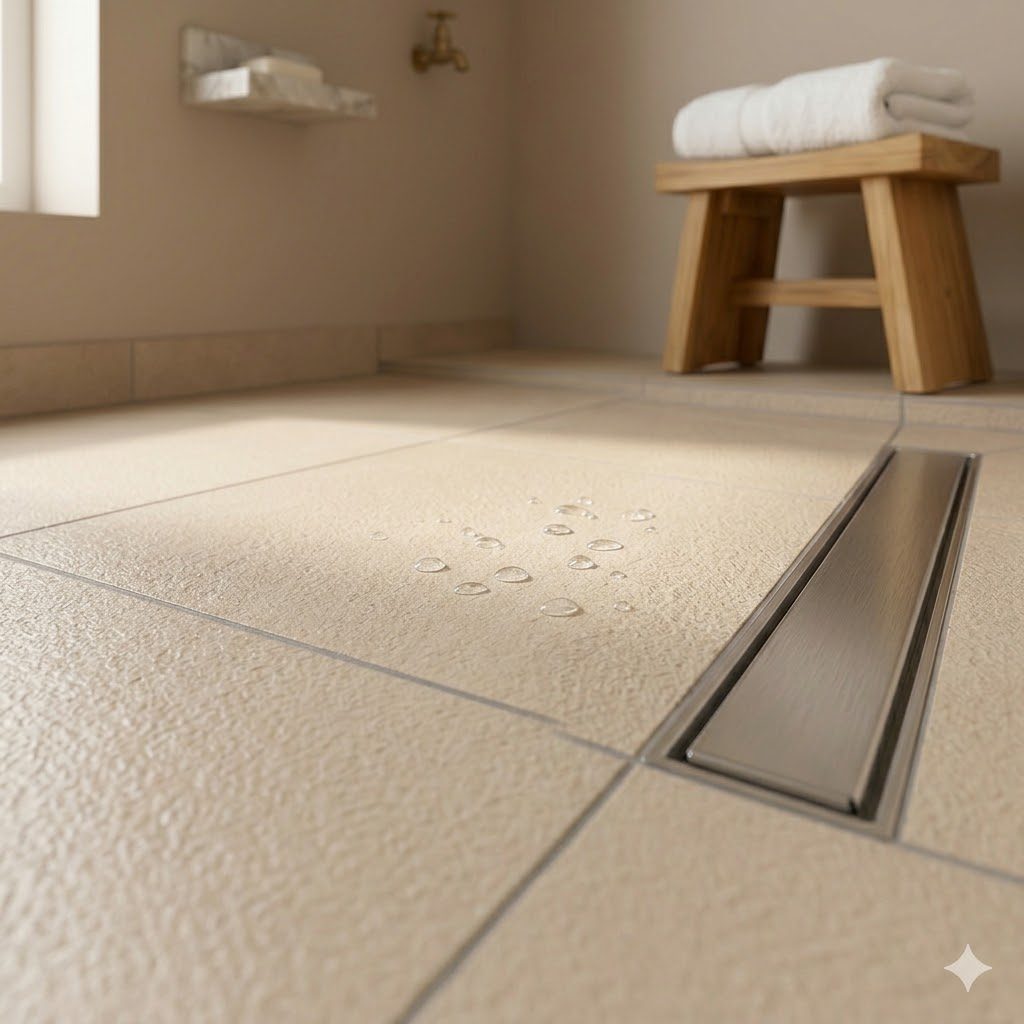
The DIN 51130 R-rating (R9 to R13) measures the coefficient of friction of a wet floor under a controlled oil-and-water test. R9 is acceptable for dry interior areas. R10 is the minimum for kitchens. R11 is the minimum for bathrooms, utilities and balconies. Anything higher is industrial.
The Indian-market shortcut is to look for the words "anti-skid" in the catalogue and trust them. Don't. Ask the seller for the DIN 51130 rating in writing, or for the catalogue page that prints it. The difference between an R9 polished bathroom tile and an R11 textured one is the difference between an elderly relative breaking a hip and not breaking a hip.
By-zone flooring plan inside a 2 BHK
Within a single flat, no one flooring choice is right for every room. The right plan picks the family by zone — and that plan also changes by climate.
In a dry-composite climate (Bengaluru, Hyderabad, Pune) a working 2 BHK plan is: large-format vitrified (800×1600 or 600×1200) in the living and dining for fewer grout lines, engineered oak in the master bedroom for warmth, matte vitrified in the kitchen with a R10 anti-skid surface, porcelain R11 in both bathrooms with a 1:80 fall to drain, and an outdoor-rated porcelain in the balcony.
In a monsoon-wet or coastal climate (Mumbai ground-floor, Mangalore, Kochi) the same flat changes: porcelain or SPC plank in the living and bedrooms (no engineered wood at grade), porcelain R11 in the kitchen and bathrooms, and the balcony specified at R11+ outdoor-rated. The capillary-rise risk on a ground floor in Mumbai is so high that the entire floor is typically taken to porcelain with a separate damp-proof membrane below the screed.
In a hot-dry climate (Jaipur, Ahmedabad) the brief flips: kota or Jaisalmer in the living and dining for the cool-underfoot effect, marble or vitrified in bedrooms, granite in the kitchen and foyer for impact resistance, and porcelain R11 in bathrooms. The flat literally feels 3–4 °C cooler when the floor itself is helping.
In a cold climate (Shimla, Srinagar) the brief flips again: engineered wood almost everywhere except the bathrooms, where SPC or porcelain R11 is the answer. The warmth-underfoot, the acoustic damping and the thermal break that wood gives are part of what makes the home liveable.
The fix, in order
1. Identify your climate zone before the showroom visit. Read NBC 2016 Part 11 or use the material decision framework to lock the zone first.
2. Lock the family by zone within the flat — never one floor for every room.
3. Demand the R-rating in writing for kitchen, bathroom, utility and balcony tiles. R10 minimum for kitchen, R11 minimum for bathroom and balcony.
4. Detail movement joints every 6 m and at every doorway in hot-dry zones; specify a damp-proof membrane below screed on every coastal or monsoon ground floor.
5. Use the material compare tool to put two shortlisted options side-by-side on cost, life and CoF before signing the BOQ.
Prevent it / Plan it: Decide the family with the material decision framework, shortlist with material compare, and study the flooring finishes specification guide, best materials for moisture-prone homes and cross-ventilation for Indian homes before locking the order.
References
- Bureau of Indian Standards (2017) IS 15622: Pressed Ceramic Tiles — Specification. New Delhi: BIS.
- Bureau of Indian Standards (2016) National Building Code of India 2016, Part 11: Approach to Sustainability. New Delhi: BIS.
- Deutsches Institut für Normung (2014) DIN 51130: Testing of Floor Coverings — Determination of the Anti-Slip Property — Workrooms and Fields of Activities with Slip Hazard. Berlin: DIN.
- Krishan, A., Baker, N., Yannas, S. and Szokolay, S. V. (2001) Climate Responsive Architecture: A Design Handbook for Energy Efficient Buildings. New Delhi: Tata McGraw-Hill.
- Ching, F. D. K. (2020) Building Construction Illustrated. 6th edn. Hoboken, NJ: John Wiley & Sons.
Part of the Studio Matrx Materials & Finishes series.
Export this guide
Related Guides — Deep-dive reading
Coastal Flooring India: Best Floors for Salt Air, Humidity and Monsoon Damp in Mumbai, Goa, Chennai, Kochi and Vizag
What to choose and what to avoid for coastal and high-humidity Indian homes: why solid wood warps and carbon-steel fixings rust, why vitrified and porcelain tiles, anti-skid natural stone and SPC win, plus matte finishes for wet grip, moisture barriers, ventilation and mould-proof grout.
Flooring & SurfacesFlooring & Finishes Specification for Indian Architects
Performance Criteria, IS Codes, and Detailing for Residential Floors and Wall Finishes
Materials & FinishesAnti Slip Flooring for Bathroom and Wet Areas in India: R-Ratings, Finishes and Genuinely Safe Tile Choices
How to choose genuinely safe flooring for bathrooms, kitchens, balconies, pools, entrances and elderly- or child-friendly homes — the R-rating system, finishes that grip wet feet, anti-skid natural stone, slope to drains and the tiles to avoid.
Flooring & SurfacesRelated Tools — Try Free
Cross-Ventilation Analyzer
Estimate airflow and air changes per hour (ACH) from room size, window areas, layout, and local wind — with NBC 2016 Part 8 compliance check.
Ventilation CalculatorFlooring Cost Calculator
Estimate the all-in cost of a floor — material, laying, wastage, skirting and GST — by area and material.
Flooring CalculatorFull-Room BOQ — Living, Bedroom, Kitchen, Bath
Room-wise BOQ across living, bedrooms, kitchen, utility, and bathrooms with line-item pricing.
Full-Room BOQ