
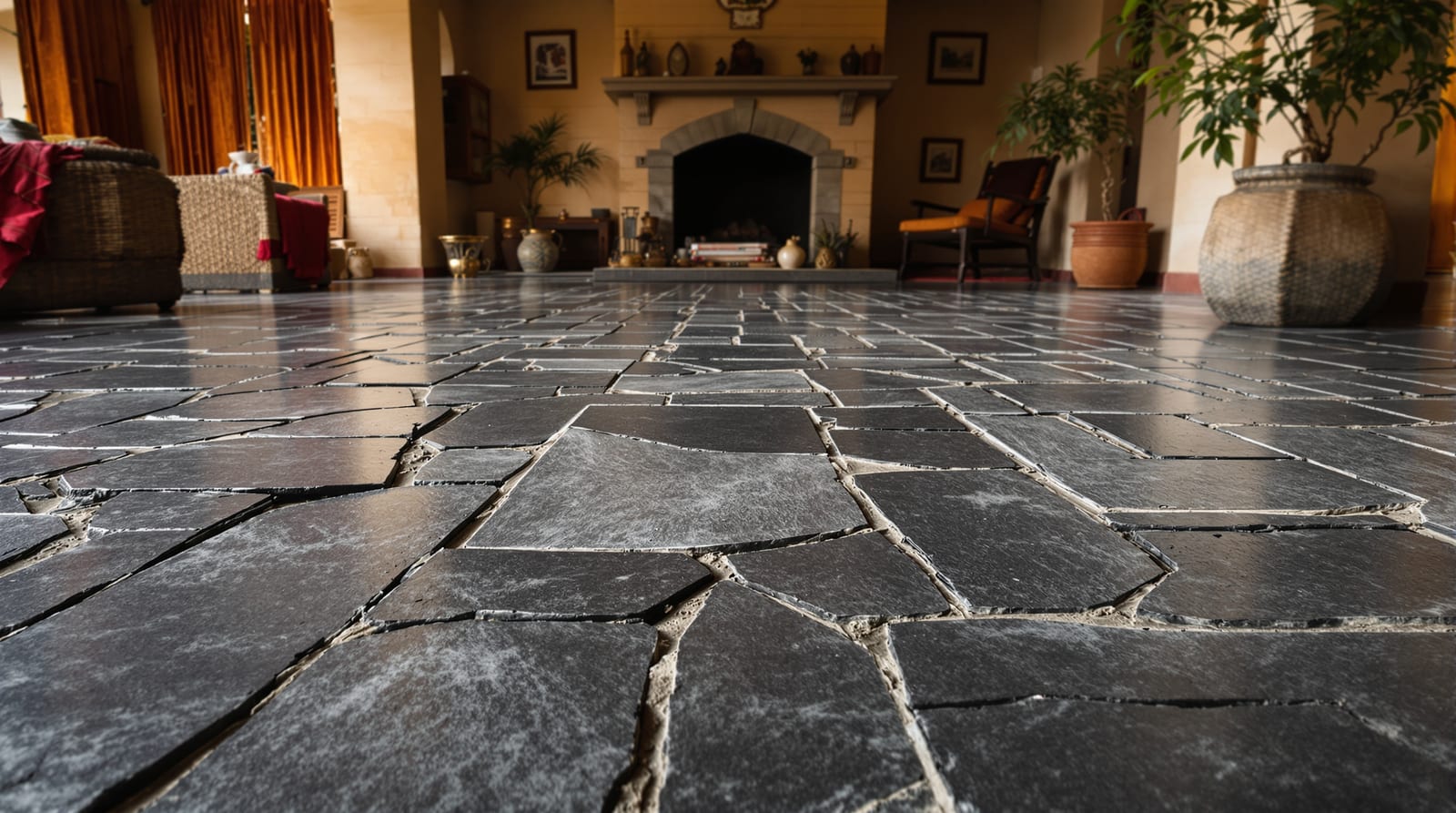
Slate Flooring in India: Riven Stone, Colours, Cost & Sealing Guide
Indian slate is a layered, naturally anti-skid metamorphic stone for rustic interiors, courtyards, bathrooms and feature walls — here is how to choose, finish, seal and budget it.
Slate is the most honest stone you can put underfoot. It is a metamorphic rock that formed in flat layers under pressure, so it splits cleanly into thin sheets with a naturally rippled, slightly uneven face — the "riven" or natural-cleft surface that grips bare wet feet better than almost any other floor. India quarries some of the world's best slate in Kund and Markino in Rajasthan, in Andhra Pradesh and in Himachal Pradesh, in colours from cool grey and charcoal black to green, rustic multicolour and warm copper-rust. At roughly ₹50–150 per sq ft for the stone, it is one of the most characterful natural floors a home can have — provided you respect its one demand, which is sealing.
This guide covers how slate is split and finished, what each colour looks like, where it belongs in an Indian home, what it costs, and how to keep it good for decades.
What slate is — and why it splits in layers
Slate begins as shale (compacted clay and silt) that heat and pressure recrystallise into a dense, fine-grained metamorphic stone. The defining property is "slaty cleavage": the minerals align into parallel planes, so the stone breaks into flat sheets. Quarry workers and processors exploit this by splitting blocks along the natural plane — which is exactly how you get a thin floor tile with a textured, layered face that needs no machine to make it grippy.
That same layered structure explains slate's quirks. It is moderately porous and will absorb water, oil and stains if left unsealed. Cheaper or weathered slate can occasionally "spall" — flake a thin top layer — if it was quarried from a softer seam or laid without sealing in a high-traffic wet zone. Good, dense Indian slate from a reputable yard, properly sealed, does not do this. When you buy, run your thumb across the back: well-bonded slate feels solid, not papery or crumbly at the edges.
Colours of Indian slate
Slate's colour comes from its mineral content and oxidation, and India's quarries cover a wide palette. Greys and blacks read modern and architectural; greens and rusts read earthy and rustic; multicolour is the most "alive" but the busiest.
| Colour | Typical source | Character | Best for |
|---|---|---|---|
| Grey / silver-grey | Kund (Rajasthan), Himachal | Calm, neutral, contemporary | Living rooms, modern interiors, feature walls |
| Black / charcoal | Markino, Andhra | Dramatic, smart, hides dirt | Bathrooms, accent floors, urban interiors |
| Green / sea-green | Himachal, Rajasthan | Earthy, soft, organic | Rustic homes, courtyards, garden rooms |
| Rustic multicolour | Rajasthan (Kund/Markino) | Mottled rust-gold-grey, lively | Verandahs, outdoor paths, farmhouse floors |
| Copper / autumn | Rajasthan | Warm rust-and-bronze tones | Feature walls, fireplaces, accent zones |
Because slate is natural, expect tile-to-tile variation — that variation is the point, not a defect. Order from one batch, dry-lay a few square metres before fixing, and blend tiles across boxes so no single patch looks off.
Finishes: natural cleft, calibrated and honed
Slate reaches your floor in one of three broad surface treatments, and the choice drives both look and slip-safety.
| Finish | Surface | Slip (wet) | Look | Best use |
|---|---|---|---|---|
| Natural cleft (riven) | Naturally split, textured, undulating | Excellent — naturally anti-skid | Rugged, rustic, characterful | Bathrooms, courtyards, outdoors, pool decks |
| Calibrated | Cleft face, but back ground flat to even thickness | Excellent | Same riven face, far easier to lay | Indoor floors where flat laying matters |
| Honed / sanded | Mechanically smoothed to a matte even face | Moderate — can be slick when wet | Refined, contemporary | Dry interiors, feature walls, low-traffic |
A note worth its own line: natural-cleft slate varies in thickness across a single tile, which makes the mason work harder and uses more adhesive in a thick mortar bed. "Calibrated" slate keeps the beautiful cleft top but grinds the underside to a consistent thickness, so it lays faster and flatter with a thin-bed adhesive — for most indoor floors, calibrated is the practical sweet spot. Reserve fully natural, uncalibrated cleft for outdoor and courtyard work where a slightly uneven surface is welcome.
The riven cleft surface is genuinely one of slate's superpowers in the Indian context. In bathrooms, around pools, on monsoon-wet verandahs and on outdoor steps, that micro-texture sheds water and grips the foot — it earns high slip ratings (broadly DIN 51130 R11–R13 territory in cleft form) without any added treatment. For more on slip ratings and treatments, see our guides on anti-slip flooring for wet areas in India and anti-skid floor treatment in India.
Where slate suits an Indian home
Slate is a specialist, not an all-rounder. It shines exactly where smoother stones struggle.
- Bathrooms and wet zones. The cleft surface is naturally non-slip and the dark colours hide soap film and hard-water marks. Seal well and slope to the drain.
- Courtyards, verandahs and outdoor steps. Slate handles sun, rain and foot traffic, and the riven face stays grippy in the monsoon. It is a natural partner to the choices in our outdoor flooring guide for India.
- Feature walls and floor-to-wall continuity. Running the same slate up a wall behind a basin, fireplace or TV unit is one of its most striking uses — the layered texture catches light beautifully.
- Rustic, farmhouse and earthy interiors. Multicolour and green slate suit homes that want warmth and grain rather than gloss.
- Kitchens (with care). Durable and heat-tolerant, but seal thoroughly against oil and acid spills.
Where slate is a poor fit: large glossy formal living rooms (honed marble or vitrified tile suits better — compare in our marble flooring and vitrified tile flooring guides), and anywhere a perfectly flat, uniform surface is wanted. If you love stone but want a cooler, flatter matte floor, Indian limestone is the closest cousin — see our limestone flooring in India guide — and for warm sandy outdoor paving, sandstone flooring in India.
Cost in India (2026, indicative)
Slate is mid-range stone. Prices are indicative and vary by city, colour, finish and vendor; add 18% GST, and laying is extra. Below is a working benchmark.
| Item | Rate (₹ per sq ft) | Notes |
|---|---|---|
| Grey / multicolour slate tile (cleft) | 50–100 | Common Rajasthan stock |
| Black / green / select slate | 90–150 | Premium colours, calibrated |
| Honed / sanded slate | 100–160 | Extra processing |
| Laying (thin-bed adhesive, calibrated) | 35–70 | Labour + adhesive |
| Laying (mortar bed, natural cleft) | 50–90 | More skill, thicker bed |
| Sealing (penetrating sealer, materials) | 8–20 | Re-applied periodically |
So a calibrated grey slate floor laid indoors typically lands around ₹120–200 per sq ft installed before sealing — comparable to mid Kota or sandstone, and well below marble or imported travertine. To size a job, use the natural stone slab calculator, and to estimate a re-seal, the floor sealer calculator. For the bigger picture on rates, see our flooring cost per square foot in India guide.
Sealing: the non-negotiable step
This is where slate floors are won or lost. Slate is porous: unsealed, it drinks up water, oil, wine, turmeric and acidic spills, leaving permanent marks, and in wet zones it can grow a thin biofilm. Sealing closes the surface and is mandatory, not optional.
Use a penetrating (impregnating) sealer that soaks in and leaves the natural matte cleft texture, rather than a glossy topical film that can peel and turn the riven surface slick. For a deeper, slightly enriched colour, a colour-enhancing penetrating sealer brings out slate's greens and rusts beautifully. Seal once before grouting (to stop grout haze sticking to the textured face), again after, and then re-apply every one to three years depending on traffic and wet exposure — outdoor and bathroom slate needs it most often. Our floor resealing guide for India walks through the full re-seal routine.
For grout, a darker grout hides dirt on textured slate far better than white. And because slate is split natural stone, it falls under the same buying logic as other natural stones — thickness consistency, batch matching and finish — covered in our natural stone standards in India guide.
How riven slate splits — an inline look
The diagram below shows why cleft slate grips: the stone splits along its mineral layers into a thin tile whose top face stays naturally rippled and textured, while calibrated slate has that same face but a ground-flat back.
Pros and cons at a glance
| Pros | Cons |
|---|---|
| Naturally anti-skid riven surface — superb wet/outdoor | Porous: must be sealed and re-sealed |
| Affordable for natural stone (₹50–150/sq ft) | Cleft surface is uneven — harder to clean, dust catches |
| Wide Indian colour range, lots of character | Natural-cleft varies in thickness — slower to lay |
| Hard, durable, sun- and rain-tolerant | Softer seams can spall if poor quality or unsealed |
| Stunning floor-to-wall feature continuity | Honed slate can be slippery when wet |
| Indian-quarried — low transport cost vs imports | Dark colours show dust; cold underfoot in winter |
Care and everyday maintenance
Slate is low-fuss once sealed. Sweep or dry-mop the textured surface regularly — the riven face traps fine dust, so a soft brush helps. Clean with a pH-neutral stone cleaner; never use acidic cleaners, vinegar or harsh abrasives, which etch and strip sealer. Wipe spills promptly, especially oil and turmeric. Re-seal when water stops beading on the surface (drop-test a few spots). A simple maintenance rhythm is covered in our floor cleaning guide for India and the floor resealing guide for India.
Frequently asked questions
Is slate flooring slippery when wet?
Natural-cleft (riven) slate is one of the least slippery floors you can lay — its rippled, textured surface grips wet feet, which is why it suits bathrooms, courtyards and pool decks. Honed (smoothed) slate is the exception; it can be slick when wet, so reserve honed slate for dry interiors and feature walls.
Does slate flooring really need sealing?
Yes — sealing is essential, not optional. Slate is porous and will absorb water, oil and acidic spills, staining permanently and, in wet zones, growing biofilm. Use a penetrating sealer, seal before and after grouting, and re-apply every one to three years depending on traffic and wet exposure.
How much does slate flooring cost in India?
The stone typically runs ₹50–150 per sq ft depending on colour and finish, with premium black, green and calibrated slate at the upper end. Laying adds roughly ₹35–90 per sq ft, plus sealing and 18% GST — so installed, calibrated grey slate often lands around ₹120–200 per sq ft. Rates are indicative and vary by city and vendor.
What is the difference between natural-cleft and calibrated slate?
Natural-cleft slate is split straight from the block, so both faces are textured and the tile varies in thickness — beautiful but slower to lay in a thick mortar bed. Calibrated slate keeps the riven top face but grinds the back flat to a uniform thickness, so it lays fast and flat with thin-bed adhesive — the practical choice for most indoor floors.
Where is Indian slate quarried?
The best-known sources are Kund and Markino in Rajasthan (grey, black and rustic multicolour), Andhra Pradesh (black and grey), and Himachal Pradesh (green and grey). Buying Indian slate keeps transport cost low compared with imported stone and gives you a wide, characterful colour palette.
Export this guide
Related Guides — Deep-dive reading
Limestone Flooring India: Honed Matte Stone, Colours, Cost and Care
The soft sedimentary stone family — beige, grey, blue and cream limestone with an elegant honed matte look, cool underfoot — plus its porosity, sealing needs, ₹/sq ft cost and where it suits Indian homes.
Flooring & SurfacesBrick Flooring India: Clay and Terracotta Brick Pavers for Warm Rustic Interiors and Durable Exteriors — Types, Patterns and Cost
The earthy farmhouse, heritage and courtyard look — clay and terracotta brick pavers laid flat for warm rustic interiors and tough, breathable exteriors — their types, laying patterns, ₹/sq ft cost, sealing and care, and exactly where brick flooring suits in an Indian home.
Flooring & SurfacesAnti Slip Flooring for Bathroom and Wet Areas in India: R-Ratings, Finishes and Genuinely Safe Tile Choices
How to choose genuinely safe flooring for bathrooms, kitchens, balconies, pools, entrances and elderly- or child-friendly homes — the R-rating system, finishes that grip wet feet, anti-skid natural stone, slope to drains and the tiles to avoid.
Flooring & SurfacesRelated Tools — Try Free
Flooring Cost Calculator
Estimate the all-in cost of a floor — material, laying, wastage, skirting and GST — by area and material.
Flooring CalculatorFloor Sealer Calculator
Estimate stone and grout sealer in litres, bottles and cost by area, surface porosity and coats.
Flooring CalculatorHome Building & Interior Cost Calculator — 20 Cities
Construction + interior costs for 20 Indian cities across kitchen, wardrobes, flooring, painting, ceiling.
Cost Calculator