
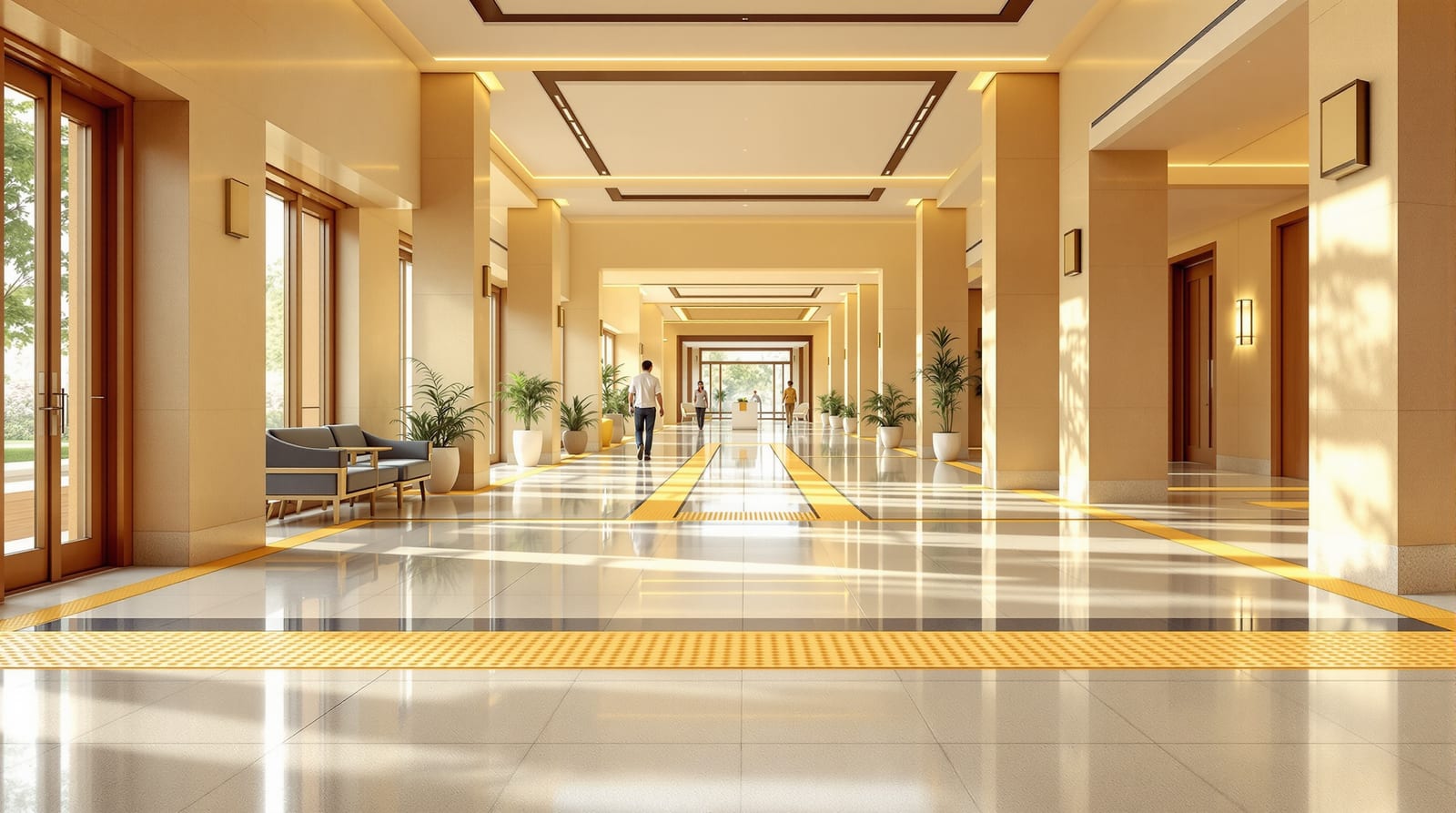
Accessible Flooring Standards in India: Age-Friendly & Barrier-Free Floors (RPwD, NBC, Harmonised Guidelines)
How to specify slip-resistant, level, glare-free and tactile flooring that meets India's accessibility law and codes for homes with elders or disabled users and for public buildings.
A floor that is invisible to a healthy adult can be a daily hazard to an 80-year-old, a wheelchair user, or someone with low vision. India now treats this as a legal duty, not a courtesy: the Rights of Persons with Disabilities (RPwD) Act 2016 makes accessibility mandatory, and the 2021 Harmonised Guidelines and Standards for Universal Accessibility, read with the National Building Code (NBC) 2016, tell you exactly what a floor must do. This guide turns those rules into specifiable flooring decisions for homes with elders or disabled members and for any public building.
Why flooring sits at the centre of accessibility
Most accessibility failures are floor failures. A slippery vitrified tile near a bathroom, a 25 mm marble threshold strip, a glossy mirror-polished hall that disorients a low-vision user, a thick rug that a wheelchair cannot cross, or a step with no contrast edge — each is a flooring choice that quietly excludes someone. Get the floor right and most of the building becomes usable.
Four floor properties carry the load: slip resistance, levelness (no abrupt changes and minimal thresholds), surface firmness and evenness, and visual legibility (glare, colour and contrast, tactile cues). India's framework addresses all four. Note that accessibility law applies in full to public buildings; for private homes it is voluntary, but the same standards are exactly what you want when planning to age in place.
The Indian legal and code framework
The RPwD Act 2016 mandates barrier-free access to the built environment. The operative technical document is the Harmonised Guidelines and Standards for Universal Accessibility in India 2021 (issued by the Ministry of Housing and Urban Affairs / CPWD), which superseded the 2016 harmonised guidelines and is the reference most municipal sanctioning authorities now cite. NBC 2016 Part 3 carries parallel accessibility provisions, and several states fold these into their building bye-laws and occupancy certificate checks.
| Code / instrument | What it covers | Core flooring requirement |
|---|---|---|
| RPwD Act 2016 | Legal mandate for barrier-free built environment | Public buildings must be accessible; non-compliance is an offence |
| Harmonised Guidelines 2021 | Detailed universal-design standards | Slip-resistant, firm, even floors; thresholds, ramps, tactile indicators, contrast |
| NBC 2016 Part 3 | Building accessibility provisions | Anti-slip floor finishes, level changes ramped, signage and tactile guidance |
| IS 15622 / IS 13630 | Tile classification + slip/abrasion test methods | Specify and verify the slip and wear class you claim |
| DIN 51130 / 51097 | Ramp-test (R9-R13) and barefoot (A/B/C) slip ratings | Practical bench you ask vendors for in writing |
Because India lacks a single mandatory floor-friction number, the standard practice is to specify an internationally recognised slip rating (R-value or barefoot A/B/C, or a wet pendulum PTV) in the tender, and demand the manufacturer's test certificate.
Slip resistance: specify it, do not assume it
Slip resistance is the single most important accessible-flooring property because falls are the leading injury for elders. The German DIN 51130 ramp test gives an R-rating for shod feet and DIN 51097 gives a barefoot A/B/C class for wet barefoot areas (bathrooms, pool decks). Higher is grippier.
| Area | Minimum slip class (shod) | Barefoot class | Practical flooring choice |
|---|---|---|---|
| Living room, bedroom (dry) | R9-R10 | - | Matte vitrified, anti-skid ceramic, wood, LVT |
| Kitchen, dining | R10 | - | Matte/textured vitrified or anti-skid ceramic |
| Bathroom, wet area | R10-R11 | B (or C for showers/ramps) | Anti-skid ceramic, textured stone, small-format tile |
| Entrance lobby, corridor (footwear, may be wet) | R10-R11 | - | Matte rectified vitrified or textured stone |
| Outdoor path, ramp, pool surround | R11-R12 | C | Textured granite, riven stone, anti-skid outdoor tile |
Avoid mirror-polished marble and high-gloss PGVT in circulation routes used by elders — they are both slippery when wet and a glare hazard. For deeper specification logic see the Studio Matrx guides on anti-slip flooring standards and anti-slip flooring for wet areas, and treat bathroom flooring as the highest-risk room in the house.
Level, flush thresholds and no abrupt changes
A wheelchair, walker or shuffling foot needs the floor plane to stay continuous. The Harmonised Guidelines set tight limits on level changes.
- Thresholds at doorways: maximum 12 mm. Anything up to 6 mm can be square-edged; 6-12 mm must be bevelled (chamfered) so a wheel rolls over it. Above 12 mm you must ramp it.
- No abrupt level changes within a floor. Differences greater than the threshold limit must be resolved by a ramp, not a step, on accessible routes.
- Bathroom drainage without a kerb. Use a gentle floor slope (about 1:50 to 1:80) toward a linear/floor drain instead of a raised lip, so the bathroom floor stays flush with the room — a "level access" or curbless shower. This is far more elder-safe than the common 100 mm sunken-floor lip.
The diagram below contrasts a hazardous raised threshold with a compliant bevelled flush one.
When two finishes meet (tile to wood, tile to stone), use a flat transition profile, not a domed brass strip that adds a bump. Specify calibrated, well-laid tiles to avoid lippage between tiles — a 2-3 mm raised tile edge is itself a trip and a wheel-catch. The tile levelling and spacers guide explains how to keep the plane true.
Firm, even, non-glare surfaces
A floor must be firm and even so a wheel rolls and a cane lands predictably.
- Avoid thick, soft or loose floor coverings on accessible routes. Deep-pile carpet, thick rugs and loose mats sink under a wheel and snag a toe. If carpet is used, specify low, dense, firm-backed carpet securely fixed; pile generally under ~13 mm. Loose rugs are a fall hazard for elders — remove them or fix them down with a full anti-slip underlay.
- Choose matte, non-glare finishes. High-gloss floors reflect light into a sheet of glare that low-vision users read as water or a hole, and they look slippery and disorienting. Matte vitrified, honed (not mirror-polished) stone, and textured tiles are preferred. This complements the slip logic — matte and slip-resistant usually go together.
- Keep surfaces even and well-maintained. Cracked tiles, popped tiles, hollow/drummy areas and worn patches all become hazards; the cracked tile replacement and flooring installation mistakes guides cover prevention and repair.
Tactile flooring: guiding and warning indicators
Tactile Ground Surface Indicators (TGSI) are detectable underfoot and by a long cane, and are mandatory in public buildings under the Harmonised Guidelines. There are two distinct patterns — do not mix them up.
| Tactile type | Pattern | Meaning | Where used |
|---|---|---|---|
| Guiding (directional) | Parallel bars / ribs in the direction of travel | "Walk this way" | Along a safe travel path across lobbies, concourses, platforms |
| Warning (attention / hazard) | Truncated domes / blisters | "Stop, hazard ahead" | Top and bottom of stairs and ramps, edges of platforms, before crossings, at doors |
The Harmonised Guidelines call for a continuous tactile path from entrance to key destinations (reception, lift, accessible toilet), with warning blocks at all hazards. Tactiles should contrast in colour and tone with the surrounding floor so partially sighted users see them too. Use durable embedded tiles (vitrified or natural stone tactiles, or stainless/cast studs) rather than glued-on plastic that lifts. The schematic below shows both patterns at a stair head.
Colour, contrast and visual legibility for low vision
Low-vision users navigate by tonal contrast, not fine detail.
- Contrast every step nosing and level change. Each stair tread edge needs a contrasting nosing band (commonly 50-65 mm) with a light-reflectance-value (LRV) difference of roughly 30 points from the tread, so the step reads as a distinct line. The same applies to any change of level or ramp edge.
- Avoid busy, high-contrast floor patterns. Strong chequerboards, bold geometric tiles or busy terrazzo can read as steps or holes and cause hesitation or stumbles. Keep field flooring quiet and reserve contrast for where it carries meaning (edges, tactiles, doorways).
- Mark glass and door zones at the floor. Where a path meets a glazed wall or door, a contrasting floor band warns of the threshold.
Ramps: the floor that resolves level changes
Where a level change exceeds the threshold limit, a ramp replaces the step. The Harmonised Guidelines specify a maximum slope of 1:12 (steeper short ramps are discouraged; 1:15 to 1:20 is gentler and preferred for longer runs and elders), a minimum clear width of about 1200 mm, level landings at top, bottom and every change of direction, handrails on both sides, and slip-resistant ramp flooring (R11-R12 / barefoot C) because a ramp concentrates slip risk. Add a contrasting warning tactile at the top and bottom and a 75-100 mm raised kerb edge so a wheel does not run off the side.
| Ramp element | Accessible requirement |
|---|---|
| Slope | 1:12 maximum; 1:15-1:20 preferred for long runs |
| Clear width | About 1200 mm minimum |
| Surface | Slip-resistant R11-R12, matte, even |
| Landings | Level rest landing top, bottom and at turns |
| Edges | 75-100 mm kerb both sides; contrasting nosing |
| Tactile | Warning blocks at top and bottom |
For outdoor ramps and paths, cross-reference durable textured stone or granite as in the broader flooring standards in India and NBC flooring requirements guides.
A specification checklist you can hand to a vendor
When you specify accessible flooring, write these into the BOQ and demand evidence:
- Slip rating per area (R-value and/or barefoot class), with the manufacturer's DIN test certificate.
- Matte / honed finish only on circulation and wet routes; no mirror polish.
- Thresholds documented at or below 12 mm, bevelled if over 6 mm; curbless wet rooms with sloped drainage.
- Calibrated tiles, zero-lippage laying, flat transition profiles between finishes.
- Firm, even covering; no loose rugs; fixed low-pile carpet only if unavoidable.
- TGSI: guiding and warning tactiles in contrasting colour, durable embedded type, at all hazards on the accessible route (public buildings).
- Step nosings and level changes contrast-marked (LRV difference about 30).
- Ramps where level change exceeds the threshold, at 1:12 or gentler with slip-resistant surface, kerbs, landings and handrails.
Cross-check the slip and quality numbers against anti-slip flooring standards, anti-slip flooring for wet areas and bathroom flooring, and the regulatory backbone against NBC flooring requirements and flooring standards in India.
Frequently asked questions
Is accessible flooring legally required in an Indian home?
For private homes, no — the RPwD Act 2016 mandates accessibility in public buildings and services, not private residences. But if your home has an elderly or disabled member, or you are designing to age in place, the same Harmonised Guidelines 2021 and NBC standards are exactly the right specification to follow voluntarily. They are inexpensive at the design stage and very costly to retrofit after a fall.
What is the maximum threshold height for wheelchair access?
The Harmonised Guidelines cap doorway thresholds at 12 mm. Up to 6 mm can be square-edged; between 6 and 12 mm the threshold must be bevelled (chamfered) so a wheel rolls over it. Anything higher than 12 mm must be resolved with a ramp, not left as a step.
Which flooring is best for elderly people in India?
Matte-finish vitrified tiles or honed natural stone with an R10-R11 slip rating in dry rooms, and anti-skid ceramic with a barefoot B-C rating in bathrooms. Keep the floor level and flush, avoid loose rugs and high gloss, and use curbless sloped bathroom drainage. Wood and LVT are also good — warm, firm and non-glare.
What is the difference between guiding and warning tactile tiles?
Guiding (directional) tactiles have parallel bars running in the direction of travel and mean "walk this way" along a safe path. Warning (attention) tactiles have truncated domes or blisters and mean "stop, hazard ahead" — they go at the top and bottom of stairs and ramps and before crossings. Both must contrast in colour with the surrounding floor.
Are glossy floors a real accessibility problem?
Yes. High-gloss and mirror-polished floors create a sheet of glare that low-vision users often misread as water or a hole, causing hesitation and falls, and they are usually more slippery when wet. For accessible and age-friendly spaces, specify matte or honed finishes, which are simultaneously safer underfoot and easier to read visually.
Export this guide
Related Guides — Deep-dive reading
Anti Slip Flooring for Bathroom and Wet Areas in India: R-Ratings, Finishes and Genuinely Safe Tile Choices
How to choose genuinely safe flooring for bathrooms, kitchens, balconies, pools, entrances and elderly- or child-friendly homes — the R-rating system, finishes that grip wet feet, anti-skid natural stone, slope to drains and the tiles to avoid.
Flooring & SurfacesBarrier Free Shower India: Curbless Zero-Threshold Roll-In Showers (2026)
The curbless, zero-threshold shower with no kerb to step or wheel over: the recessed slab and linear drain that contain water without a lip, whole-wet-area waterproofing, fold-down seat and grab bars, wheelchair transfer and turning space, anti-slip floors, aging-in-place logic and real rupee costs — planned before the slab is cast.
BathroomsDesigning Adaptable & Universal-Design Homes
Accessibility, Aging-in-Place, and the Multi-Stage Family — Code, Anthropometrics, and Plan-Stage Discipline for Indian Residential Architects
Room PlanningRelated Tools — Try Free
Full-Room BOQ — Living, Bedroom, Kitchen, Bath
Room-wise BOQ across living, bedrooms, kitchen, utility, and bathrooms with line-item pricing.
Full-Room BOQAccessibility Compliance Calculator
Check a planned lift against the CPWD and RPwD accessible-lift benchmarks for a score.
Lift CheckerAccessible Door Checker
Check a door against wheelchair-accessibility guidance — clear width, threshold, handle and closer force per RPwD 2021.
Compliance Tool