
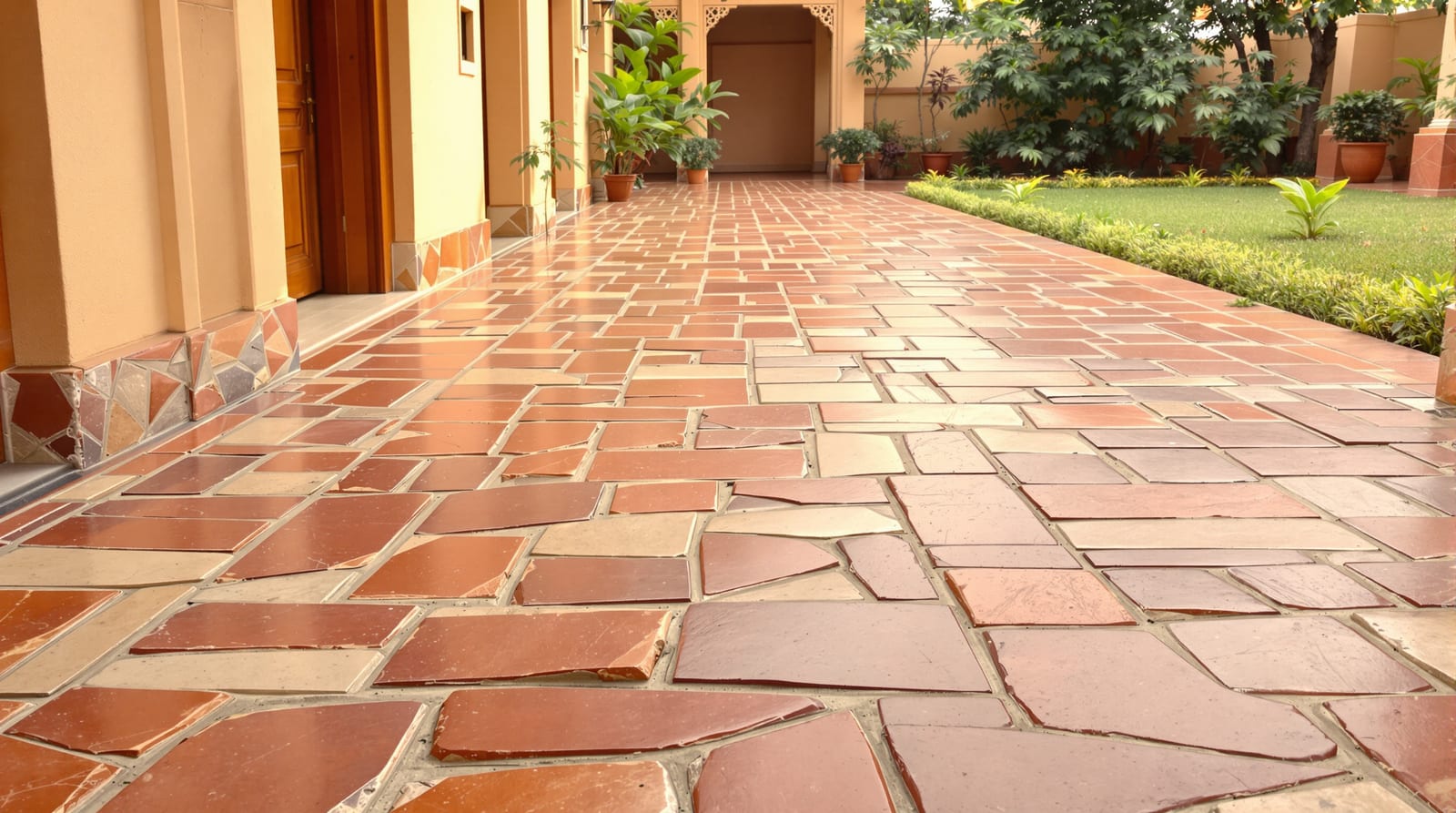
Sandstone Flooring in India: Types, Colours, Prices & Where to Use It (2026)
India's natural stone for courtyards, driveways, patios and rustic interiors — Jodhpur red, Dholpur beige, Agra red, Kandla grey, Rainbow and Teakwood by source, with finishes, prices per square foot, IS 3622 and how to seal and care for it.
Sandstone is the stone India reaches for when a floor has to live outdoors. It is warm underfoot, naturally non-slip in its riven and sandblasted finishes, weathers gracefully over decades, and costs a fraction of granite or marble. The catch is porosity: sandstone is a sedimentary stone that drinks water, so it must be sealed and resealed to stay stain-free. Get that one habit right and a Jodhpur-red courtyard or a Kandla-grey driveway will outlast the house. This guide covers the Indian sandstone varieties by source and colour, what each costs per square foot, the finishes, IS 3622, and exactly how to seal and care for it.
What sandstone is, and why it suits outdoors
Sandstone is formed from compacted layers of sand grains — mostly quartz — bound by natural cements over geological time. Those layers are why a split (riven) sandstone surface has its characteristic gently rippled, naturally grippy texture, and why the stone splits cleanly along its bedding plane. The same layered structure makes it more porous than igneous granite or metamorphic marble: water absorption for sandstone typically runs about 1 to 6 percent, against roughly 0.1 to 0.5 percent for granite. Higher porosity means it stains and harbours moss more readily if left raw — but it also means a softer, cooler, less glaring surface that does not turn into a skating rink when wet.
That combination is precisely why sandstone is the default Indian choice for courtyards, driveways, patios, garden paths, temple plinths and rustic verandahs. It handles sun, rain and frost (in the northern plains and hills) without spalling, the colour reads as earthy and timeless rather than shiny, and the riven finish gives natural slip resistance that polished stone cannot. For a fuller picture of how sandstone sits against tiles and concrete outdoors, read the outdoor flooring guide for India; for the wet-area logic it shares with terraces, see terrace flooring in India.
Indian sandstone varieties by source and colour
India is one of the world's largest sandstone exporters, and almost all of it comes from a belt across Rajasthan, eastern Rajasthan into Madhya Pradesh, and Uttar Pradesh. Each quarry region has its own colour and character, and the trade names you will hear at a dealer are essentially place names. Buying close to the source — most of it is processed around Kota, Jodhpur, Dholpur and the Bansi Paharpur belt — keeps transport off your per-square-foot price, because sandstone is heavy and freight to a far metro can add a meaningful amount.
| Variety / trade name | Source (region) | Colour & character | Indicative ₹/sq ft (material) | Best uses |
|---|---|---|---|---|
| Jodhpur Red / Pink | Jodhpur, Rajasthan | Deep red to soft pink, fine even grain, very hard | 45 to 90 | Courtyards, facades, plinths, heritage-look interiors |
| Dholpur Beige / Cream | Dholpur, Rajasthan | Pale beige to cream, smooth, light-reflecting | 45 to 95 | Patios, verandahs, light courtyards, cladding |
| Agra Red | Agra belt, Uttar Pradesh | Rich brick-red, classic Mughal stone | 40 to 85 | Driveways, garden paths, rustic flooring |
| Kandla Grey | Kota / Nagaur belt, Rajasthan | Cool grey with subtle banding, dense | 55 to 110 | Driveways, patios, contemporary outdoor floors |
| Kandla / Mint Buff | Rajasthan | Soft yellow-buff, warm neutral | 50 to 100 | Patios, pool surrounds, garden paving |
| Rainbow (Teakwood / Camel) | Bansi Paharpur, Rajasthan | Multicolour streaks — gold, rust, grey, brown | 60 to 130 | Feature patios, accent walls, rustic floors |
| Teakwood (Yellow Teak) | Rajasthan | Wood-grain banding, yellow-brown | 60 to 125 | Patios, cladding, statement courtyards |
| Mint / Mint Fossil | Rajasthan | Greenish-grey, fine fossil markings | 55 to 110 | Patios, garden paths, contemporary outdoor |
| Modak / Lalitpur Pink | Madhya Pradesh / UP | Earthy pink-buff, very durable | 45 to 95 | Driveways, heavy-traffic paving, plinths |
Prices are indicative and vary by city, vendor, finish, calibre and lot — calibrated and hand-cut "cobble" or random-pattern stone costs more than plain tiles, and seconds cost less but should be avoided for main floors. Note the close cousins worth knowing: Jaisalmer's golden yellow stone is technically a limestone often sold alongside sandstone, covered in Jaisalmer stone in India; and the grey-brown limestone workhorse Kota stone, which many people compare to sandstone for outdoor paving, has its own Kota stone flooring guide.
The look: how layered, riven sandstone reads
The single most distinctive thing about sandstone is its bedding — the visible layers laid down as sediment. When a slab is split along that plane rather than sawn, you get a naturally textured, faintly rippled face that scatters light and grips a shoe. The diagram below shows what is happening inside the stone and why the riven finish behaves the way it does outdoors.
Properties — what sandstone does well, and its one weakness
Sandstone's strengths are weathering and grip. It takes sun, monsoon and northern frost without the spalling that catches out cheaper materials, and a riven or sandblasted face is non-slip by nature — no anti-skid treatment needed for most outdoor uses. It is cooler underfoot than dark granite in the sun, ages into a soft patina rather than looking dated, and is genuinely repairable: a damaged piece can be lifted and replaced without an obvious patch, because natural colour variation hides the join.
The one real weakness is porosity. Raw sandstone absorbs water, oil, tea, wine and the tannins in fallen leaves; left unsealed in a damp spot it grows moss and algae and can show dark patches. This is not a reason to avoid it — it is a reason to seal it. A breathable, penetrating impregnating sealer (a solvent- or water-based siloxane/silane type, not a surface film) soaks in, lets the stone breathe, and dramatically cuts water and stain uptake while keeping the natural matte look. Re-application every couple of years outdoors is normal maintenance, the same discipline laid out in the floor resealing guide for India.
| Property | Sandstone behaviour | Practical takeaway |
|---|---|---|
| Water absorption | Moderate to high (about 1 to 6 percent) | Seal before/after laying; reseal outdoors every 1 to 3 years |
| Slip resistance | Excellent in riven & sandblasted finishes | Ideal for wet courtyards, pool edges, driveways |
| Weathering / frost | Very good — withstands sun, rain, frost | Suits open courtyards, terraces, hill-station patios |
| Heat underfoot | Cooler than dark granite, esp. lighter shades | Choose beige/buff for sun-baked patios |
| Hardness / wear | Softer than granite; fine-grained reds are quite hard | Fine for homes & gardens; not for heavy industrial loads |
| Staining (unsealed) | Vulnerable to oil, tannins, algae | Sealing converts the weakness into a non-issue |
For how these traits sit alongside marble, granite and the formal test parameters, the natural stone standards in India guide puts sandstone's numbers next to the others.
Finishes — natural, honed and sandblasted
Finish decides both the look and the safety of a sandstone floor, and you should pick it by where the stone is going.
Natural / riven (split-face) is the most common outdoor finish: the stone is split along its bedding to leave a textured, slightly uneven, very grippy surface. It is the safest choice for driveways, courtyards and pool surrounds. Hand-cut (hand-cut edges) versions give a rustic, slightly irregular tile.
Honed gives a smooth, flat, matte face with no shine — sawn and then ground. It reads more refined and is the right pick for rustic interiors, covered verandahs and low-traffic indoor floors where you want comfort underfoot. It is smoother than riven, so keep honed sandstone out of always-wet zones unless you add grip.
Sandblasted (or shot-blasted) deliberately roughens a sawn face with abrasive grit, giving a uniform, fine-textured, anti-slip surface that is more even than riven but still grippy — excellent for ramps, steps and contemporary patios. Other finishes you may see include flamed (heat-textured, very grippy) and tumbled (softened edges for an aged, cobbled look).
| Finish | Texture & look | Slip safety | Best for |
|---|---|---|---|
| Natural / riven (split) | Textured, rippled, rustic | Excellent | Courtyards, driveways, pool surrounds, garden paths |
| Honed | Smooth matte, refined | Moderate (slippery wet) | Rustic interiors, covered verandahs, low-traffic rooms |
| Sandblasted / shot-blast | Uniform fine grit, even | Very good | Steps, ramps, contemporary patios |
| Flamed | Coarse, rugged | Excellent | Heavy-use paving, steep ramps |
| Tumbled | Soft, aged, rounded edges | Good | Cobbled paths, heritage-look courtyards |
IS 3622 and the standard to quote
Indian sandstone for building and flooring is covered by IS 3622, the Bureau of Indian Standards specification for sandstone (block, slab and tile), which sets out classification, dimensions, finish and the durability and strength limits the stone should meet. Because sandstone is more porous than granite or marble, IS 3622 permits a higher water absorption than those stones — the point is that the stone is sound, sufficiently strong and within its declared absorption, not that it is impervious. The companion test method, IS 1124, defines how water absorption, apparent specific gravity and porosity are actually measured, and IS 1121 covers the strength tests.
There is no mandatory ISI mark on sandstone slabs — natural stone is not under a Quality Control Order — so the way you use the standard is to quote it in your purchase order and inspect the stone yourself. Write something like "sandstone to IS 3622, water absorption to IS 1124 within the declared limit, calibrated thickness 22 mm, riven finish," then sight along the slabs in daylight for cracks, soft patches, sand pockets and colour scatter, and do a ring/tap test (a dull thud can mean a hidden crack). The broader inspection routine is in natural stone standards in India.
Cost, transport and where to buy
The per-square-foot figures in the variety table are material only. To budget the real number, add laying, a bedding mortar bed, jointing, sealing and transport. Outdoor sandstone is usually laid on a mortar bed (not thin-set adhesive), so laying labour runs roughly ₹30 to 60 per square foot in metros and ₹20 to 40 in tier-2 cities, plus sand and cement. Sealer adds a few rupees per square foot per coat. The biggest swing is freight: sandstone is dense and heavy, so a load shipped from the Rajasthan quarry belt to Mumbai, Bangalore or Kolkata can add noticeably to the landed cost — which is why buying close to source (the Kota, Jodhpur, Dholpur and Bansi Paharpur belts, and stone markets in Jaipur) is cheaper for northern and western projects than for far-southern ones.
When you buy, compare the all-in rate — material plus laying plus mortar plus sealing plus GST plus transport and loading — not just the slab price. Natural stone slabs and tiles attract 18 percent GST; insist on a GST invoice for input credit and genuineness, and an e-way bill for the transport leg. Buy one lot and one calibre with 5 to 10 percent spare so future repairs match, and avoid "seconds" for the main floor.
Frequently asked questions
Does sandstone flooring need to be sealed?
Yes. Sandstone is porous and absorbs water, oil and stains, so a penetrating (impregnating) sealer is essentially mandatory rather than optional. Seal it after laying and reseal outdoors roughly every one to three years depending on traffic and weather. Use a breathable siloxane/silane impregnator, not a glossy surface film, so the stone keeps its natural matte look and can still breathe.
Which sandstone is best for a driveway?
Choose a dense, harder variety in a riven or sandblasted finish for grip and load: Kandla grey, Agra red, Jodhpur red and Modak all perform well for driveways. Lay it on a proper mortar or compacted base, keep joints tight, and seal it. The textured finish gives natural slip resistance for cars and feet in the monsoon.
Is sandstone good for indoor floors?
Yes, in the right rooms. Honed sandstone gives a warm, rustic, matte interior floor that suits living rooms, courtyards-turned-rooms and heritage-style homes. It is softer than granite, so it suits low-to-moderate traffic, and it should still be sealed against spills. For high-traffic kitchens or wet bathrooms, denser stone or vitrified tile is usually the easier choice.
How does sandstone compare with Kota stone for outdoor use?
Both are budget-friendly Indian natural stones for outdoors. Sandstone offers warm earthy colours (red, beige, grey, multicolour) and a naturally grippy riven texture; Kota stone is a grey-green/brown limestone that is very hard and can take a polish but is cooler in colour. Sandstone wins on warmth and rustic looks; Kota wins on hardness and price for plain workhorse paving. See the Kota stone flooring guide to compare directly.
What does sandstone flooring cost installed in India in 2026?
Material runs roughly ₹40 to 130 per square foot depending on variety, finish and calibre, with Rainbow, Teakwood and Kandla grey at the top and Agra red and Dholpur at the value end. Add laying (about ₹20 to 60 per square foot by city), mortar, sealing and transport, plus 18 percent GST, for the all-in installed figure. Always get a written, GST-inclusive quote that lists every line.
Export this guide
Related Guides — Deep-dive reading
Slate Flooring in India: Riven Stone, Colours, Cost & Sealing Guide
Indian slate is a layered, naturally anti-skid metamorphic stone for rustic interiors, courtyards, bathrooms and feature walls — here is how to choose, finish, seal and budget it.
Flooring & SurfacesLimestone Flooring India: Honed Matte Stone, Colours, Cost and Care
The soft sedimentary stone family — beige, grey, blue and cream limestone with an elegant honed matte look, cool underfoot — plus its porosity, sealing needs, ₹/sq ft cost and where it suits Indian homes.
Flooring & SurfacesFloor Sealing and Resealing Guide India: How to Seal Marble, Granite, Kota, Sandstone, Terrazzo and Cement Grout
Why porous natural stone and cement grout floors need sealing, the simple water-drop test to check if resealing is due, penetrating versus topical sealers, how to clean-dry-coat-buff, how often to reseal, and what you should never seal.
Flooring & SurfacesRelated Tools — Try Free
Flooring Cost Calculator
Estimate the all-in cost of a floor — material, laying, wastage, skirting and GST — by area and material.
Flooring CalculatorHome Building & Interior Cost Calculator — 20 Cities
Construction + interior costs for 20 Indian cities across kitchen, wardrobes, flooring, painting, ceiling.
Cost CalculatorMaterial Compare — Side by Side
Compare materials side-by-side: granite vs quartz vs marble, laminate vs acrylic vs PU, and more.
Comparison