
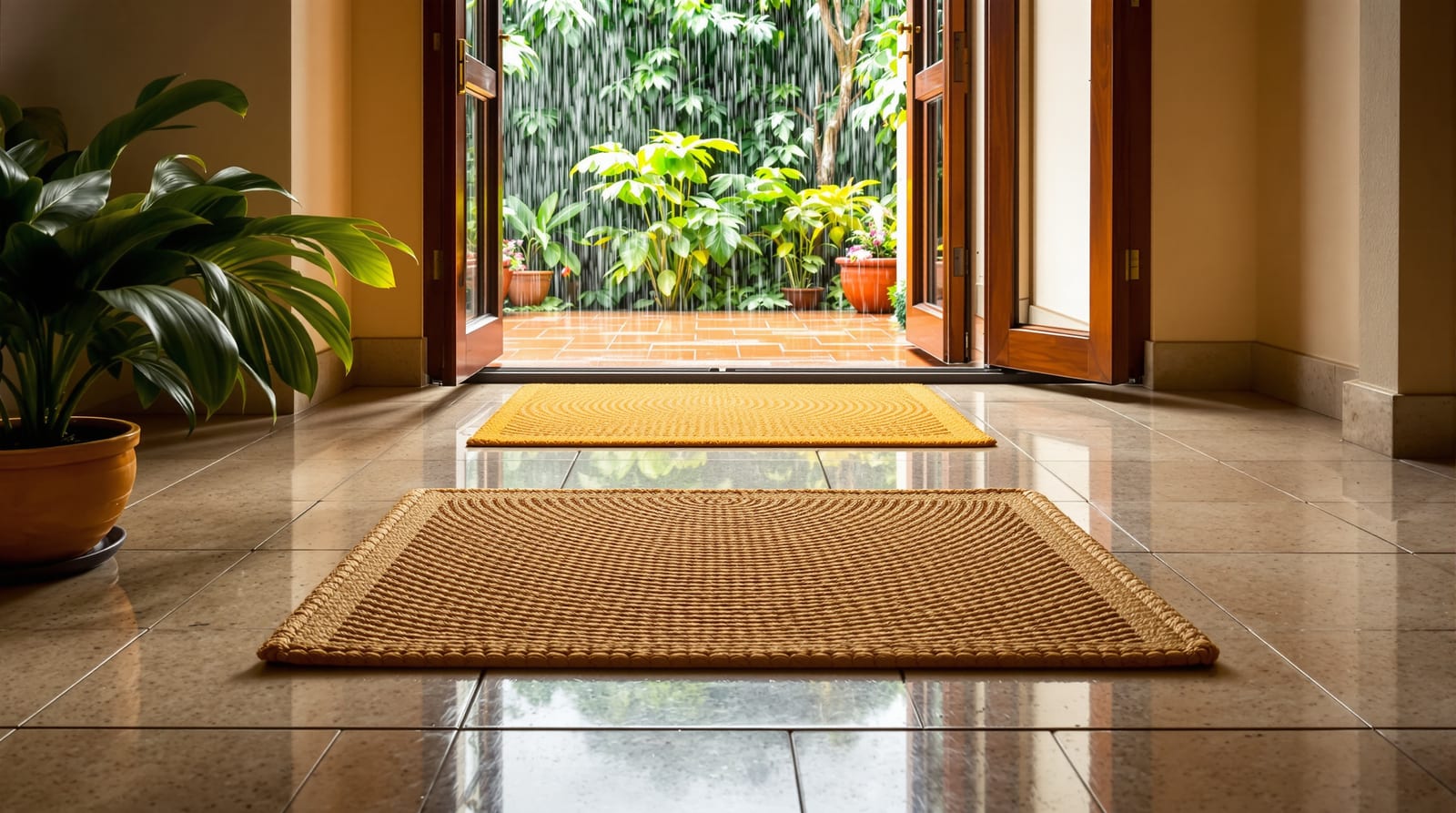
Monsoon Flooring in India: Slip-Safe, Quick-Dry Floors That Survive the Rains
How to choose and protect floors that stay safe and dry through the Indian monsoon — anti-skid entries, low-absorption surfaces, drainage and mould control.
For roughly four months a year, a large part of India lives with water tracked indoors on every shoe, umbrella and pet paw. The flooring that looks beautiful in a dry showroom can turn into a skating rink the moment it gets wet — and wet entrances are one of the most common spots for serious falls in Indian homes, especially for older relatives and toddlers. A monsoon-ready floor is not a single product; it is a set of choices about grip, water absorption, drainage and material that, taken together, keep your home safe and dry from June to September.
This guide walks you through what actually changes when the rains arrive, zone by zone, and what to specify or retrofit so your floors survive wet feet, swelling, standing water and stubborn mould in the grout.
Why the monsoon is a flooring problem, not just a cleaning problem
Three things happen when humidity spikes and water keeps coming indoors. First, smooth floors lose grip — a polished marble or glazed tile that is perfectly safe dry can drop well below safe friction levels when a film of water sits on it. Second, water-absorbing materials swell or rot — laminate cores puff up at the edges, solid wood cups, and cement grout soaks up moisture and grows mould. Third, water that cannot drain stays put, so utility areas, balconies and bathrooms need a deliberate slope and waterproofing or you get pooling, seepage into the slab below, and that persistent damp smell.
The fix is to match each zone to its real monsoon risk. The single most important upgrade for safety is grip at the points where wet feet first touch the floor: the main door, balcony thresholds, the path from the gate, and bathroom and utility entries.
The monsoon-readiness checklist (zone, risk, fix)
Use this table as your room-by-room audit. Walk your home with it before the rains and fix the high-risk zones first.
| Zone | Main monsoon risk | What to do |
|---|---|---|
| Main entrance / foyer | Slip on wet tracked-in water; mud and grit | Anti-skid matte tile (R10-R11), large coir or rubber-backed mat inside and out, a "shoe-off" zone, dark/textured grout |
| Porch, gate-to-door path | Slippery when wet; algae growth | Anti-skid outdoor tile or rough natural stone (Kota, cuddapah, leather-finish granite); slope away from door |
| Balcony / utility / wash area | Standing water; slip; seepage to room | Matte anti-skid vitrified or rough stone, slope ~1:80-1:100 to a drain, waterproofing membrane, threshold lip to room |
| Bathroom | Highest fall risk when wet; mould | Small-format anti-skid tile, slope to floor trap, anti-skid retro-treatment on existing smooth tile, epoxy grout |
| Kitchen | Wet spills + grease = very slippery | Matte vitrified/porcelain, epoxy grout, mat at sink |
| Living / bedrooms (upper floors) | Humidity, not water | Vitrified, tile or engineered wood with DPM; keep dry |
| Ground floor in flood-prone area | Flooding swells laminate/wood | Vitrified/porcelain or stone only — never laminate or solid wood at grade |
| Staircase | Slip on wet treads | Anti-skid nosing strips, matte treads, never polished stone on stairs |
| Terrace / roof | Pooling + heat + waterproofing failure | Heat-reflective china-mosaic or SRI tile over waterproofing, slope 1:100 to outlets |
Grip first: anti-skid where wet feet land
Slip resistance is measured on the German DIN 51130 R-scale (R9 to R13) and the barefoot wet-area scale (A/B/C). For dry indoor areas R9 is fine, but anywhere water arrives you want R10 or R11, and bathrooms benefit from R11 plus a barefoot rating. The National Building Code (NBC) 2016 and the accessibility rules under the RPwD Act 2021 both push for anti-slip floors and level, low thresholds (a doorway step-up of no more than about 12 mm) — good guidance for every home, not just public buildings.
Two practical moves matter most:
- Specify matte and textured finishes at entries. Glossy PGVT and polished marble look stunning but are the worst choice for a wet foyer. A matte, structured or "sugar-finish" vitrified tile, or a naturally rough stone like leather-finished granite or Kota, keeps grip when wet. Studio Matrx's guide on vitrified tile flooring in India explains the finish options; for the entry specifically, lean matte.
- Retro-treat what you already have. If your foyer or bathroom is already laid in smooth tile, you do not have to re-tile. An acid-etch anti-skid floor treatment (₹15-40 per sq ft, indicative and varies by city/vendor) micro-textures the surface and raises its wet R-rating. See the dedicated guides on anti-skid floor treatment in India and anti-slip flooring for wet areas in India for products and process.
Add mats with purpose: a coarse coir or rubber doormat outside to knock off grit, and a large rubber-backed absorbent mat inside the door to catch the water that still comes through. The combination of mat plus anti-skid tile is far safer than either alone.
Quick-dry, low-absorption surfaces
The faster a floor sheds water and the less it soaks up, the safer and healthier it stays. Water absorption is the key spec here.
| Material | Water absorption | Monsoon verdict |
|---|---|---|
| Vitrified / porcelain (IS 15622) | Under 0.5% | Excellent — near-zero absorption, quick-dry, choose matte/anti-skid |
| Glazed ceramic | ~3-10% | Good for walls/dry rooms; pick matte anti-skid for floors |
| Granite (sealed) | Very low | Excellent; use leather/flamed finish for grip |
| Marble | Low but porous; etches | Use only in dry zones; reseal; never at wet entries |
| Kota / cuddapah stone | Low-moderate | Good rough-finish entry/balcony stone; seal it |
| Epoxy floor | Non-absorbent, seamless | Excellent for utility/wash; no grout lines to mould |
| Laminate | High at core edges | Avoid on ground floors and any wet/flood-prone zone — swells |
| Solid wood | Absorbs; cups in humidity | Avoid in coastal/humid and ground-floor wet zones |
The headline: vitrified and porcelain tiles, with low water absorption under 0.5% per IS 15622, are the monsoon workhorse — they dry fast, do not stain from puddles and resist humidity. Pair them with a matte anti-skid finish at entries and you get both safety and easy drying.
The drainage diagram: water in, water out
A monsoon-ready wet zone is really a tiny water-management system: water enters at the entry, the floor is sloped so it runs to a drain, and a waterproofing membrane under the tile protects the slab from anything that seeps through. The diagram below shows the principle.
Three rules make this work in practice: give wet floors a slope of about 1:80 to 1:100 toward the drain (a fall of roughly 10-12 mm per metre), lay a waterproofing membrane under the screed per IS 2645 practice, and keep a small threshold lip so water cannot run from the balcony or wash area into the living rooms. Studio Matrx's balcony flooring guide for India covers the slope-and-membrane detail for balconies specifically.
Material choices by zone
- Entrance and foyer: matte anti-skid vitrified tile, or rough natural stone, with dark or textured grout that hides the mud. Add the mat duo. This is the one zone where you should never compromise on grip.
- Balcony and utility/wash: anti-skid vitrified or rough Kota/cuddapah, sloped to a drain, waterproofed. Epoxy is excellent here because it is seamless with no grout lines to grow mould.
- Bathroom: small-format anti-skid tile (smaller tiles mean more grout lines, which actually helps grip), epoxy grout, slope to the floor trap.
- Ground floor in flood-prone areas: stick to vitrified, porcelain or stone. Do not lay laminate or solid wood at grade in any area that floods — the cores swell, edges lift and the planks are not salvageable once soaked. Reserve laminate and engineered wood for dry upper floors, always over a 200-micron damp-proof membrane.
- Terrace and roof: heat-reflective china-mosaic, broken-china or high-SRI tiles over waterproofing with a 1:100 slope to outlets — this both sheds monsoon water and cuts summer heat. See the heat-reflective terrace flooring and outdoor flooring guides for India.
Beating mould and mud
Two monsoon nuisances are about grout and dirt, not slipping.
Mould in grout. Cement grout is porous; in a humid, rarely-dry bathroom it soaks up moisture and grows black mould. Three fixes, in order of permanence: seal the cement grout, regularly clean and use a grout whitener (see the grout cleaning and whitening guide for India), or — best of all — specify epoxy grout in kitchens and bathrooms, which is non-porous and effectively mould-proof. For floor stains and the damp marks that appear in the rains, the floor stain removal guide for India has product-specific steps.
Mud and grit management. The grime that comes in on shoes is abrasive and slippery. A proper entry sequence — outdoor scraper mat, a shoe-off zone, an indoor absorbent mat — keeps most of it out. Daily damp mopping with a mild pH-neutral cleaner finishes the job; avoid acidic cleaners on marble and on cement grout.
Sealing stone. Porous stones — marble, Kota, cuddapah, lighter granites — should be sealed before and topped up during the monsoon so they do not drink up water and stain. The floor resealing guide for India explains intervals and products.
Match the floor to your climate, not just the season
Monsoon-readiness overlaps with your broader climate. Coastal and high-humidity homes face salt air and warping risk on top of rain; check the flooring for coastal and humid homes guide and the flooring for high-humidity homes guide for those specifics. If you are choosing flooring from scratch and want it filtered by your climate zone, the Studio Matrx flooring climate selector tool narrows the options for you.
Frequently asked questions
Which flooring is best for the monsoon in India?
Matte, anti-skid vitrified or porcelain tile is the best all-round monsoon floor: its water absorption is under 0.5 percent, so it dries fast and resists humidity, and a matte or structured finish keeps grip when wet. At entrances pair it with mats; in wet zones add slope and waterproofing. Rough natural stone like leather-finish granite or Kota also works well outdoors.
Can I put laminate flooring on a ground floor that floods?
No. Laminate has a fibreboard core that swells and lifts at the edges when soaked, and the planks cannot be dried out or refinished. On any ground floor that is prone to flooding, use vitrified, porcelain or stone instead, and keep laminate and engineered wood for dry upper floors over a 200-micron damp-proof membrane.
How do I make my existing smooth tiles less slippery in the rain?
Apply an anti-skid floor treatment — an acid-etch solution that micro-textures the surface and raises its wet slip rating — typically ₹15-40 per sq ft (indicative, varies by city and vendor). It avoids re-tiling. Combine it with absorbent mats at entries. See the anti-skid floor treatment and anti-slip flooring for wet areas guides.
What slope should a wet-area or balcony floor have?
Aim for a fall of about 1:80 to 1:100 toward the drain — roughly 10 to 12 mm of fall per metre — so water runs to the floor trap instead of pooling. Lay a waterproofing membrane under the screed and keep a small threshold lip so water cannot run into adjoining rooms.
How do I stop black mould in my bathroom grout during the monsoon?
Cement grout is porous and grows mould in humid, rarely-dry rooms. Seal it and use a grout whitener for upkeep, or replace it with epoxy grout, which is non-porous and effectively mould-proof. Keep the bathroom ventilated and squeegee the floor dry after use to cut standing moisture.
Export this guide
Related Guides — Deep-dive reading
Anti Slip Flooring for Bathroom and Wet Areas in India: R-Ratings, Finishes and Genuinely Safe Tile Choices
How to choose genuinely safe flooring for bathrooms, kitchens, balconies, pools, entrances and elderly- or child-friendly homes — the R-rating system, finishes that grip wet feet, anti-skid natural stone, slope to drains and the tiles to avoid.
Flooring & SurfacesAnti Skid Floor Treatment India: Make Slippery Tiles Safe Without Replacing Them, R-Ratings, Acid-Etch and Anti-Slip Coatings
How to make slippery polished floors safe in Indian homes: where slips happen, what R-ratings and the wet pendulum test mean, how anti-slip acid-etch treatment raises grip on existing tiles at ₹15-40 per sq ft, plus coatings, mats, strips, choosing anti-skid tiles upfront and accessibility rules.
Flooring & SurfacesCoastal Flooring India: Best Floors for Salt Air, Humidity and Monsoon Damp in Mumbai, Goa, Chennai, Kochi and Vizag
What to choose and what to avoid for coastal and high-humidity Indian homes: why solid wood warps and carbon-steel fixings rust, why vitrified and porcelain tiles, anti-skid natural stone and SPC win, plus matte finishes for wet grip, moisture barriers, ventilation and mould-proof grout.
Flooring & SurfacesRelated Tools — Try Free
Monsoon-Readiness Checklist
Pre-rain home audit across 9 categories — terrace, drains, waterproofing, electrical, HVAC, pest, vehicles, documents.
Seasonal AuditFlooring Material Selector
Get the best flooring material for your room, budget and climate, with anti-slip checks for wet areas.
Flooring ToolFull-Room BOQ — Living, Bedroom, Kitchen, Bath
Room-wise BOQ across living, bedrooms, kitchen, utility, and bathrooms with line-item pricing.
Full-Room BOQ