
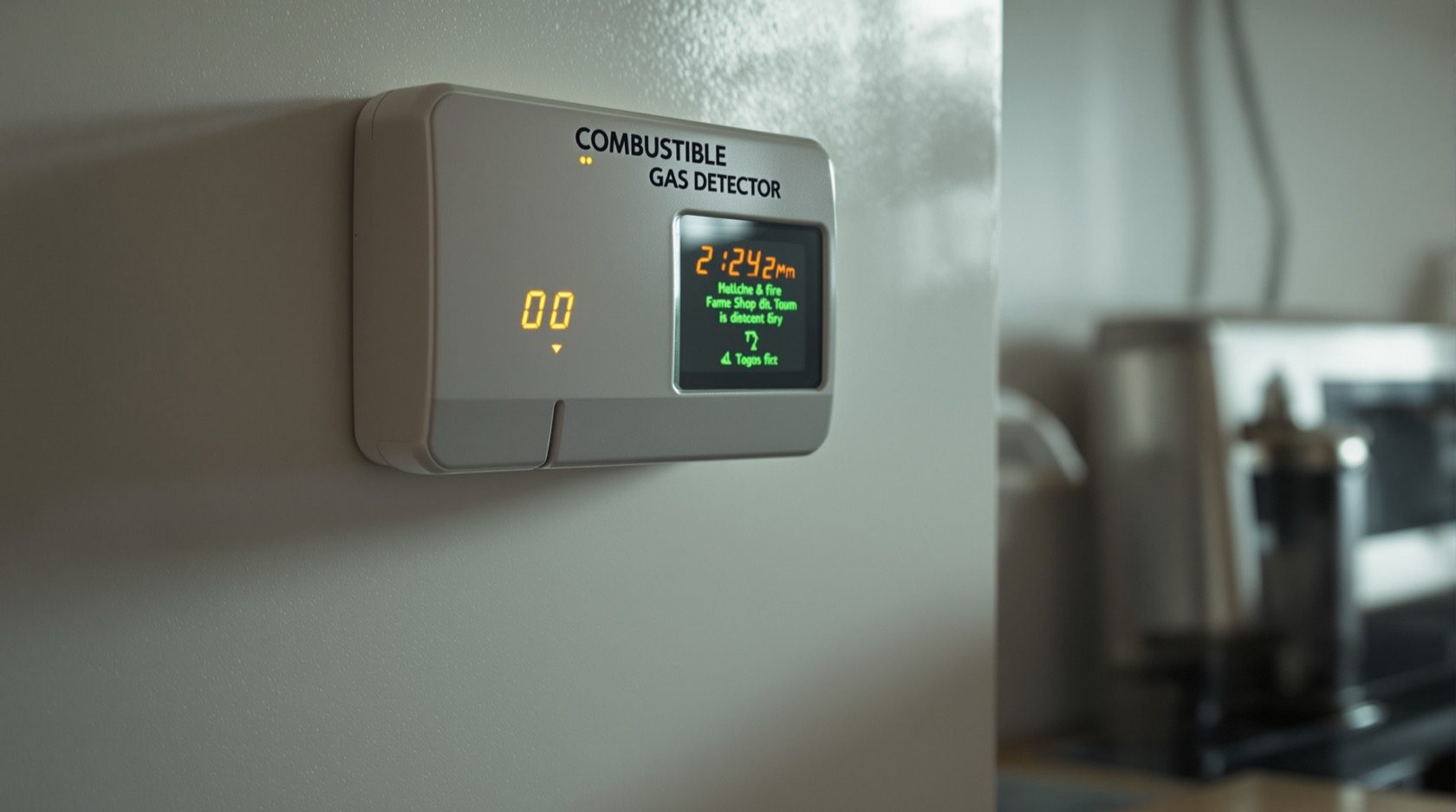
Gas Detectors in India (2026): Combustible-Gas Sensing, LPG vs PNG & the Mounting-Height Rule
How combustible-gas detectors sense a leak before it can explode, why gas density decides whether you mount the unit LOW for LPG or HIGH for PNG, and how to place, test and maintain one.
A gas detectors installation does one job that no human sense can be trusted to do reliably: it watches, continuously, for combustible gas escaping into a room and sounds an alarm while the concentration is still far too low to explode. Cooking gas is deliberately scented so you can smell a big leak, but a small steady leak overnight, a leak while nobody is home, or a leak that starts while everyone is asleep is exactly the situation a nose cannot catch in time. A fixed gas detector fills that gap. This is the umbrella guide to combustible-gas detection for Indian homes and buildings — how the sensor works, and the one placement rule that people get wrong so often it makes the whole device useless.
This guide sits in Studio Matrx's fire-safety library, under the complete guide to fire safety in India. It is the category-and-engineering companion to the consumer-device guide, LPG leak detectors, which walks a homeowner through buying and fitting one specific unit. Here we stay broader: the whole family of combustible-gas sensors, what the alarm threshold means, and how the same physics changes the answer for LPG versus piped gas.
Scope and safety — read this first. A standalone plug-in or battery gas detector for a home kitchen is something you CAN buy and fit yourself, and this guide helps you choose and place it correctly. But a gas detector is NOT a carbon-monoxide alarm and NOT a smoke alarm — three different devices for three different dangers, covered below. For a shop, restaurant, boiler room or any commercial or institutional building, a gas-detection system tied to an auto shut-off valve and the premises Fire NOC is designed and installed by licensed professionals under IS 2189:2026 and the State Fire Services — not a retail purchase. This is educational guidance, not legal advice. And one rule overrides everything: if you can smell a strong leak, do NOT touch any switch — open up, shut the gas off, get everyone out, and call the gas helpline and 101 or 112 from outside.
What a combustible-gas detector actually senses
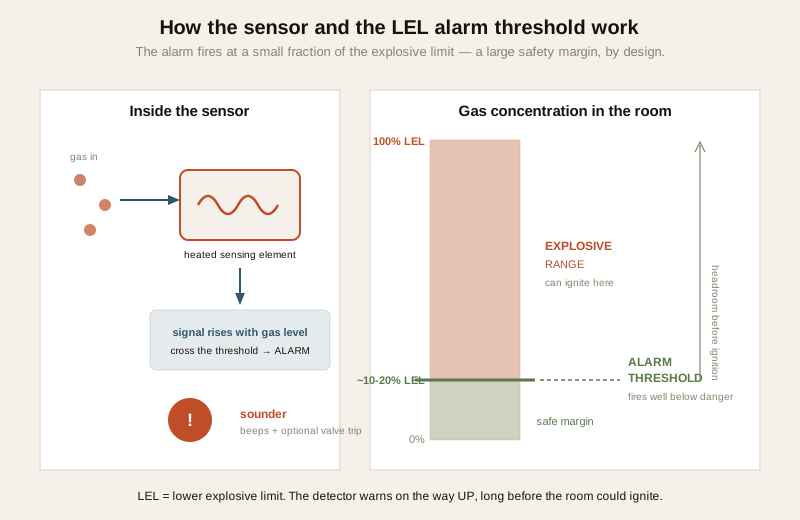
A gas detector does not "smell" gas the way you do. It carries a small sensing element that reacts to the presence of a flammable gas and turns that reaction into an electrical signal. When the signal crosses a set threshold, the alarm sounds. The three sensor technologies you will meet are worth knowing, because they behave differently.
| Sensor type | How it works | Best suited to | Trade-off |
|---|---|---|---|
| Catalytic bead (pellistor) | A tiny heated bead burns the gas on its surface; the heat it releases changes the bead's resistance | LPG, methane and most hydrocarbons at ordinary levels | Needs oxygen to work; can be poisoned by silicones; the workhorse of fixed detectors |
| Semiconductor (MOS / metal-oxide) | Gas adsorbing on a heated metal-oxide film changes its electrical conductivity | Low-cost home LPG and PNG alarms | Sensitive but less selective; more prone to nuisance response to fumes |
| Infrared (IR / NDIR) optical | Gas molecules absorb a specific infrared wavelength; the detector measures how much light is lost | Methane and hydrocarbons; harsh or oxygen-poor settings | Cannot detect hydrogen; costlier; used in industrial and commercial systems |
For a home, the sensor type matters less than placement and upkeep — an inexpensive semiconductor kitchen alarm, correctly mounted and tested, saves lives. For a commercial kitchen, boiler room or plant room, the sensor is specified by the fire-safety engineer, usually catalytic or IR for reliability.
LEL — why the alarm fires long before an explosion
Every flammable gas has a lower explosive limit (LEL) — the minimum concentration in air at which it can ignite. Below the LEL the mixture is too "lean" to catch; above the upper explosive limit it is too "rich". A gas detector is deliberately set to alarm at a small fraction of the LEL — commonly around a tenth to a fifth of it — so it warns you while the room is nowhere near the danger concentration. In other words, the detector gives you a large safety margin: by the time it sounds, there is still a great deal of headroom before the atmosphere could ignite. That margin is the entire point. It is why a gas detector is a prevention device, not a last-second alarm — it is meant to catch the slow leak on its way up, long before it becomes dangerous.
The rule everyone gets wrong: gas density sets the mounting height
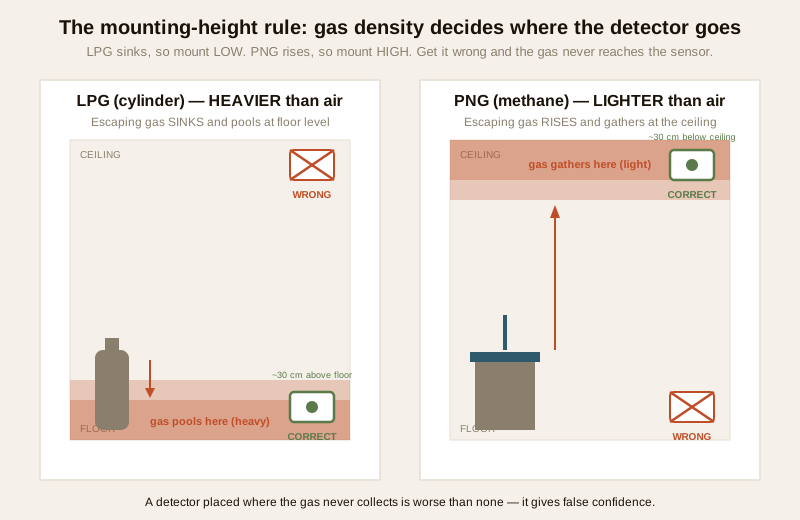
This is the single most important idea in the guide, and it is the reason so many gas detectors in Indian homes are fitted in the wrong place and would never catch a leak. Where a gas collects when it escapes depends on whether it is heavier or lighter than air — and that decides how high on the wall the detector must go.
- LPG (cooking-gas cylinders — propane and butane) is HEAVIER than air. When it leaks, it sinks and pools at floor level like an invisible liquid, filling the room from the bottom up. A detector for LPG must be mounted LOW — near the floor, typically within about 30 cm of the floor, so it meets the gas where it actually collects.
- PNG / piped natural gas (methane) is LIGHTER than air. When it leaks, it rises and gathers under the ceiling. A detector for PNG must be mounted HIGH — near the ceiling, typically within about 30 cm of the ceiling.
Get this backwards — an LPG detector near the ceiling, or a PNG detector near the floor — and the gas will fill the room to a dangerous level without ever reaching the sensor. The device is not faulty; it has simply been placed where the gas never goes. A detector in the wrong position is worse than no detector, because it gives false confidence.
| Gas | Heavier or lighter than air | Where it collects | Mount the detector | Typical setting |
|---|---|---|---|---|
| LPG (propane / butane, cylinders) | Heavier | Sinks to the floor | LOW — about 30 cm above floor | Home cylinder kitchens, most Indian homes |
| PNG (methane, piped gas) | Lighter | Rises to the ceiling | HIGH — about 30 cm below ceiling | Piped-gas kitchens in metros |
If your building runs both — a cylinder as backup and a PNG line — treat them as two problems, or use a dual-fuel detector rated for both and follow its manufacturer's height instruction for the specific gas. Never assume one unit at one height covers both.
Where to place it, in the room
Height is the big rule; horizontal position matters too.
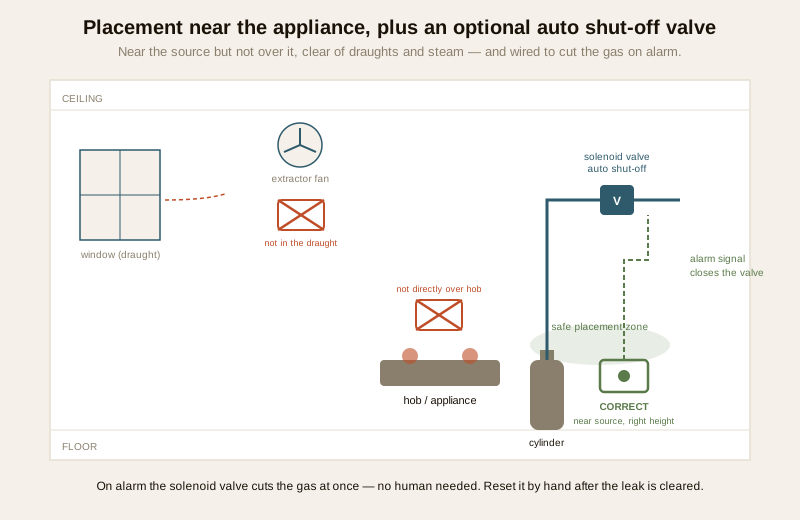
- Near the source, but not directly on top of it. Fit the detector on the wall a short distance from the appliance or cylinder — near enough to catch an escaping plume quickly, but not immediately above a burner where cooking heat, steam and combustion by-products would nuisance-trip it or shorten its life.
- Away from windows, doors and extractor fans. A draught blows escaping gas away from the sensor and delays the alarm. Keep it out of the direct path of a window, a chimney intake or a ceiling fan.
- Away from steam and spray. Not directly over the sink, kettle or hob where humidity and grease coat the sensor.
- Accessible for testing. You must be able to reach it to press the test button and, eventually, to clean and replace it — so do not bury it behind a cabinet.
Auto shut-off: turning detection into action
A detector that only beeps depends on someone being there to act. For higher-risk or unattended installations, the detector can be wired to an automatic solenoid shut-off valve on the gas line. When the sensor alarms, the valve closes and cuts the gas supply at once — no human needed. This is standard in commercial kitchens, boiler rooms and plant rooms, and is increasingly offered for homes with piped gas.
- Home PNG: an auto shut-off valve on the piped-gas line, closing on a detector alarm (and often on a seismic trip), is a genuine upgrade for a family that travels or sleeps with the gas line live.
- Commercial and institutional: an interlocked detection-and-shutoff system, often with multiple sensors zoned across the space and tied to ventilation and the fire panel, is part of the designed system under IS 2189:2026 and the Fire NOC — not a plug-in gadget.
- Reset by hand, deliberately. A well-designed shut-off valve does not silently reopen; someone must reset it after the leak is found and cleared, which is exactly what you want.
Commercial kitchens, boiler rooms and plant rooms
A shop or restaurant kitchen, a hotel or hospital boiler room, a society community kitchen or a gas-fired plant room is a different problem from a home. There is more gas, more pipework, often multiple appliances, and frequently no one watching. The answer there is a fixed, professionally designed gas-detection system: multiple sensors placed at the correct height for the gas in use, zoned so the panel shows where the leak is, interlocked to an auto shut-off valve and to the ventilation, and tied into the building's fire-detection and alarm system under IS 2189:2026 and the premises Fire NOC. If you run or manage such a space, the office fire-safety guide, the hotel and hospital guides and the commercial-buildings security guide set the wider compliance picture, and the basement fire-safety guide covers the special danger of heavier-than-air gas collecting below ground.
Not a CO alarm, not a smoke alarm — three different devices
This confuses people constantly, and the confusion kills, so be precise:
| Device | Detects | The danger | Where in this library |
|---|---|---|---|
| Combustible-gas detector (this guide) | LPG / PNG leaking before it burns | Explosion / fire from a gas leak | This page + LPG leak detectors |
| Carbon-monoxide (CO) detector | CO — a colourless, ODOURLESS toxic gas from incomplete combustion | Silent poisoning (generators, geysers, gas heaters, an attached garage) | Carbon-monoxide detectors |
| Smoke detector | Smoke particles from a fire that has started | An actual fire, so you can escape | Smoke detectors |
A combustible-gas detector watches for unburned fuel before ignition. A CO detector watches for a toxic by-product of burning and is placed per its own rules (CO mixes fairly evenly with air, so it is not a floor-or-ceiling question). A smoke detector watches for a fire already underway. Owning one does not cover the others — a full home ideally has all three, plus a heat detector where smoke would false-trip, while flame detectors are a specialised industrial device. The fire-detector selector helps you work out which you need in which room.
How to place it, test it and keep it working
A gas detector is only protection if it is alive on the day it is needed. The good news is that upkeep is a two-minute monthly habit.
- Fit it at the correct height for your gas (LOW for LPG, HIGH for PNG), near but not over the source, clear of draughts and steam, and reachable.
- Test it monthly. Press the test button — it checks the electronics and sounder, not the sensor's gas response, but it confirms the unit is powered and audible. Some units also allow a controlled bump test with a test-gas aerosol, which checks the sensor actually responds; in commercial systems this is done on a schedule.
- Power it reliably. Mains power in India cuts often, so choose a unit with battery backup, or a battery unit whose low-battery chirp you never ignore. A dead battery is a dead detector.
- Keep it clean. Wipe dust and grease off the vents gently; a clogged sensor is a slow sensor. Do not paint over it or spray cleaners or insecticide near it.
- Respect the sensor's life. Gas sensors age and drift — most home units are rated to be replaced every few years (typically around five, per the manufacturer), and commercial sensors are calibrated on a schedule and replaced at end of life. Note the replacement date when you fit it.
Never disable it — pick the right type and place instead
If a detector nuisance-trips, the answer is NEVER to unplug it, pull its battery, or bag it — that is how families die, because the disabled detector is still on the wall giving false comfort. A gas detector rarely nuisance-trips if it is the right unit placed correctly and kept clear of cooking steam and aerosol sprays. If yours trips without a real leak, move it away from the fan or the kettle, clean it, or replace an aged sensor — but leave it working. A disabled detector is a dead detector.
When to route it to a professional / when it is a statutory system. A single standalone home gas alarm is yours to buy, fit and maintain. But the moment you are dealing with a commercial or institutional building, a boiler or plant room, a multi-sensor zoned system, or any detector interlocked to an auto shut-off valve or the building's fire panel, you are into a designed automatic detection-and-alarm system under IS 2189:2026 and NBC Part 4 (via SP 7:2026). That must be specified, installed, certified and maintained by a licensed fire-alarm contractor and cleared by the State Fire Services as part of the Fire NOC — never DIY. Any change to the gas installation itself — a new pipe run, a PNG connection, moving a meter — belongs to your authorised distributor's fitter under the Gas Cylinder Rules / PESO framework.
For the whole-house picture — smoke alarms, an escape plan and the fire classes — start with the home fire-safety guide; for a flat, the apartment fire-safety guide covers the shared-building risks; the kitchen fire-safety guide covers the gas-and-oil habits at the counter; and the home fire-safety scorecard turns all of it into a ten-minute self-check.
Key takeaways
- A combustible-gas detector catches a leak before it can explode, alarming at a small fraction of the lower explosive limit (LEL) so you get a large safety margin — it is a prevention device, not a last-second alarm.
- Gas density sets the mounting height, and getting it wrong makes the device useless: LPG is heavier than air, so mount the detector LOW near the floor; PNG (methane) is lighter than air, so mount it HIGH near the ceiling.
- Place it near — not directly above — the appliance or cylinder, clear of draughts, windows, fans and steam, and reachable so you can test and replace it.
- For higher-risk or unattended installs, wire it to an automatic solenoid shut-off valve that cuts the gas on alarm; in commercial kitchens, boiler rooms and plant rooms this is part of a professionally designed, zoned system.
- It is not a CO alarm and not a smoke alarm — three different devices for three dangers; test it monthly, keep it powered and clean, replace the sensor at end of life, and NEVER disable it.
References
- IS 2189 : 2026 — Selection, Installation and Maintenance of Automatic Fire Detection and Alarm System, Code of Practice, Bureau of Indian Standards — the core code governing designed automatic detection-and-alarm systems, including gas detection interlocked to a building's fire system. Verify the current edition via the BIS catalogue: https://www.services.bis.gov.in/
- National Building Code of India, SP 7 : 2026 (the NBC), Part 4 "Fire and Life Safety" — the fire and life-safety framework for buildings; the older SP 7 : 2016 edition is withdrawn but still widely quoted. Verify via the BIS catalogue: https://www.services.bis.gov.in/
- The Gas Cylinder Rules and the PESO (Petroleum and Explosives Safety Organisation) framework governing LPG, plus your authorised LPG/PNG distributor's safety guidance — the basis for gas-installation and leak-response rules. The applicable BIS/IEC component standard for a combustible-gas detector should be confirmed as the current edition via the BIS catalogue before relying on it.
- Manufacturer datasheets and installation manuals for your specific detector, and the relevant State Fire Services Act and Rules and Model Building Bye-Laws (MoHUA) — these set the correct mounting height, sensor life and calibration schedule, and when a designed gas-detection system and a Fire NOC are legally required.
This is an educational overview, not legal advice, and not a substitute for a licensed fire-safety professional or your authorised gas distributor. A designed gas-detection system, an auto shut-off interlock, the Fire NOC and any change to a gas installation are qualified professional tasks — engage licensed professionals and the State Fire Services, and verify any standard's current status and the correct mounting height for your specific detector via the manufacturer and the BIS catalogue before relying on it.
Export this guide
Related Guides — Deep-dive reading
LPG Leak Detectors in India (2026): The Kitchen Gas Alarm Every Home Should Fit
Almost every Indian home cooks on LPG or PNG, and a leak pools invisibly until one spark ignites it. Here is the cheap kitchen gas alarm to fit, and the one placement rule that decides whether it works.
SecuritySmoke Detectors in India (2026): Photoelectric vs Ionisation, Placement & Testing
The single most important fire-safety device every Indian home should own - how smoke detection works, which type to buy, exactly where to fit it, and how to keep it alive for a decade.
SecurityCarbon Monoxide Detectors in India (2026): The Silent Killer You Cannot Smell
Carbon monoxide is a colourless, odourless gas from generators, gas geysers and indoor braziers that kills Indians every winter. Here is why a CO alarm is a separate device, and how to choose, place and respond to one.
SecurityRelated Tools — Try Free
Fire Detector Selector
Smoke, heat, CO, gas or flame? Pick a space and its fuels and hazards and get the right detector type(s) to consider — with the one placement rule that matters most for each, including the LPG-low vs PNG-high gas rule.
Detector SelectorCross-Ventilation Analyzer
Estimate airflow and air changes per hour (ACH) from room size, window areas, layout, and local wind — with NBC 2016 Part 8 compliance check.
Ventilation CalculatorAccess-Control Schedule Generator
Build the time schedules that decide when each access group can enter — an editable list for your integrator.
Time Schedules