
Wireless Fire Alarm Systems in India (2026): Radio Detectors for Retrofit, Heritage & Occupied Buildings
The radio-linked fire-alarm system for buildings where running cable is disruptive, costly or impossible - how supervised wireless works, when it earns its keep against wired, and how to specify it to IS 2189 : 2026.
Some buildings fight a wired fire-alarm system every step of the way. A working office where you cannot shut floors for weeks of cable-chasing. A heritage or listed structure where you are not allowed to cut a channel into a lime-plastered wall. A marble-clad lobby, a stone temple hall, a panelled hotel suite where a surface conduit would be an aesthetic wound. A temporary site, or a building expanding in phases where today's cabling design is obsolete by next quarter. For all of these, wireless fire alarm systems are the answer: the detectors, manual call points and sounders talk to the control panel over supervised two-way radio, so a full statutory system goes in with almost no cabling to the field devices - fast, clean, and reversible.
This is the wireless-systems chapter of Studio Matrx's fire-safety library, sitting under the complete guide to fire safety in India. It is the third of three system-architecture guides: read it alongside the addressable fire-alarm systems guide and the conventional fire-alarm systems guide, because wireless is not a fourth kind of detection - it is a way of connecting the same detectors, call points and panel without cable.
Scope and safety - read this first. A wireless fire-alarm system is still a statutory, engineered fire-detection installation, not a consumer gadget. It is designed, installed, commissioned and certified by a licensed fire-alarm contractor to IS 2189 : 2026 and the National Building Code (via SP 7 : 2026, Part 4 Fire and Life Safety), and it is tied to the building's Fire NOC under your State Fire Services Act and Rules. "Wireless" removes the cable, not the compliance. This guide helps an owner, committee, facility manager or consultant understand and specify the system and hold the contractor accountable - it is educational guidance, not legal advice and not a design document. And the golden operating rule stands: when the alarm sounds, get everyone out and call the fire brigade on 101 or 112.
What a wireless fire-alarm system actually is
Strip away the marketing and a wireless fire alarm system is a normal automatic fire detection and alarm system in which the wired detection loop is replaced by radio links. Each field device - a smoke detector, a heat detector, a manual call point, a sounder or a sounder-strobe - carries a low-power radio and a multi-year battery, and it communicates with the fire-alarm control panel (or with a wireless expander connected to the panel) over a dedicated, supervised radio channel. The panel still does everything it does in a wired system: it names the device or zone in alarm, drives the sounders, runs any cause-and-effect, and shows fire, fault and disable states.
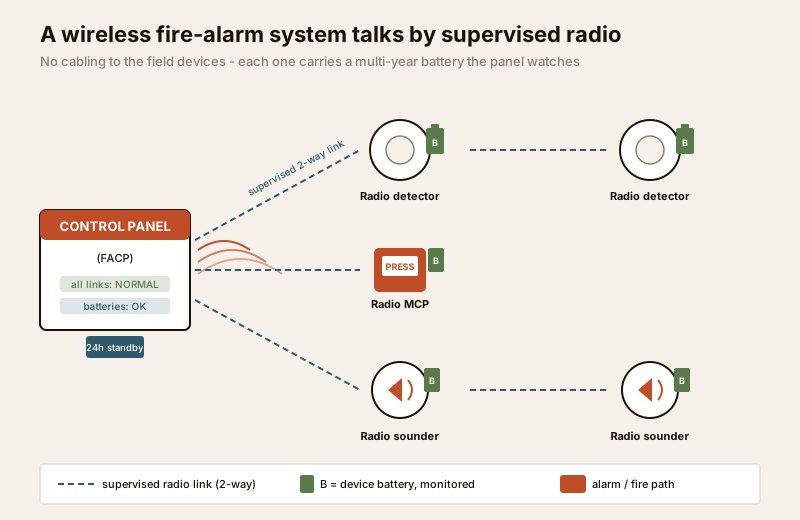
The two properties that separate a real fire-grade wireless system from a consumer alarm are worth stating plainly, because they are the whole point:
- It is supervised. The panel continually polls every device and expects a reply. If a device stops answering - because it failed, was removed, or lost its radio path - the panel raises a fault, so a missing device becomes visible instead of a silent hole in coverage. A consumer alarm that simply stops working tells no one.
- It is two-way. Devices report their status back to the panel, and the panel can command devices (for example, to sound). This is what lets the panel monitor each device's signal strength and battery and warn you long before either fails.
The hybrid: wireless where it is hard, wired where it is easy
The most common real-world design is not pure wireless at all - it is a hybrid. You run a conventional or addressable wired backbone through the parts of the building where cabling is straightforward (risers, new areas, plant rooms), and you use a wireless expander to reach the pockets where cable is disruptive or forbidden - the heritage wing, the marble atrium, the occupied floor that cannot be shut. This gives you the low lifetime upkeep of wire where it is cheap to run, and the clean, fast install of radio only where you actually need it. For any sizeable building, ask your contractor to price a hybrid alongside the pure-wireless option.
When wireless earns its keep - and when wired is better
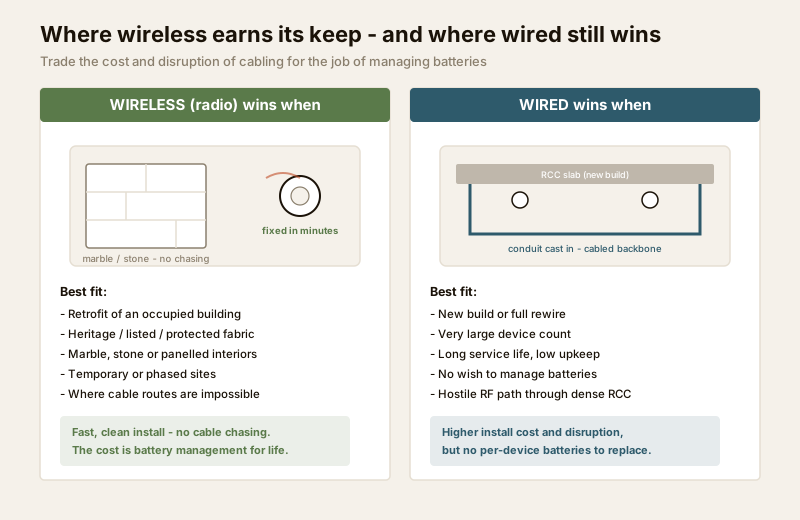
Wireless is not "better" or "worse" than wired; it trades one set of costs for another. You give up cable-chasing and gain speed and reversibility, and in exchange you take on battery management for the life of the system. Choosing well means being honest about which of those costs your building can actually bear.
| Decision factor | Wireless (radio) is the better fit | Wired is the better fit |
|---|---|---|
| Building status | Occupied, must stay open during works | Empty, or new build under construction |
| Fabric | Heritage, listed, marble, stone, panelled - no chasing allowed | Ordinary walls where conduit is acceptable |
| Timeline | Fast, needs to be live in days | Programme allows first-fix cabling |
| Permanence | Temporary site, or phased / changing layout | Permanent, stable final layout |
| Device count | Small to medium; batteries stay manageable | Very large; a battery per device becomes a burden |
| Lifetime upkeep | You accept planned battery replacement | You want minimal ongoing device upkeep |
| RF environment | Radio path proven by survey | Very dense RCC / metal that defeats radio |
| Up-front cost | Higher device cost, far lower install cost and disruption | Lower device cost, higher install cost and disruption |
The short version: wireless earns its keep wherever the cost or disruption of cabling is high - retrofit into a running building, heritage and protected interiors, marble and stone finishes, temporary and phased works. Wired usually wins for a new build where the cable goes in before the finishes, for very large systems where hundreds of device batteries become a maintenance headache, and wherever an RF survey shows the radio path cannot be made reliable.
The Indian reality that shapes the choice
Two India-specific facts push in opposite directions. First, our buildings are overwhelmingly dense reinforced-concrete (RCC) with thick masonry, and that fabric attenuates radio - a signal that sails through a plasterboard office in Europe may struggle through three RCC walls and a lift core here, which makes the RF survey non-negotiable. Second, retrofit is the dominant Indian case: enormous numbers of occupied apartment towers, offices, hospitals, hotels and older commercial buildings need a fire-alarm system fitted into a live, finished, tenanted structure where you simply cannot chase cable through every corridor. That is exactly the situation wireless was made for - see how it plays out in the apartment fire-safety guide, the office fire-safety guide and the hospital fire-safety guide.
The trade-off you are actually signing up for: batteries and supervision
The single thing that makes or breaks a wireless system is how it handles power. Every field device runs on a battery - typically a long-life lithium cell rated for several years of normal operation - and the entire integrity of the system depends on those batteries being alive. A wired detector draws its power from the loop and effectively never runs out; a wireless detector does not have that luxury. This is not a reason to avoid wireless - it is a reason to insist on a properly supervised system and a maintenance contract that treats batteries as a scheduled, planned replacement, not a surprise.
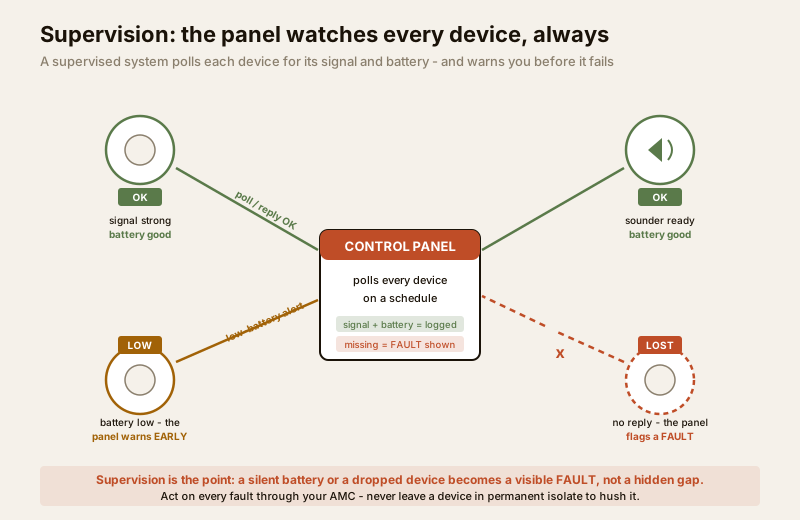
Here is what a compliant supervised system does about it, and why it means a wireless system is safe to rely on:
- The panel watches every battery. Because the link is two-way, each device reports its battery state, and the panel raises a distinct low-battery warning well ahead of actual failure - typically giving weeks of notice so the cell can be replaced on a planned visit. A battery does not simply die unnoticed.
- The panel watches every link. The panel polls each device and expects a reply. A device that drops off the radio - removed, failed or blocked - is flagged as a fault, naming the device, so coverage gaps cannot hide.
- Redundant paths. Good systems mesh or provide alternate radio routes so a single blocked path does not orphan a device; the survey and the system design build this in.
The honest trade-off table:
| Wireless system | Wired system | |
|---|---|---|
| Install disruption | Very low - no chasing, occupants stay in | High - cable routes, cutting, making good |
| Speed to commission | Days | Weeks, following the cabling programme |
| Field-device power | Battery per device (multi-year, supervised) | Powered from the loop - effectively unlimited |
| Ongoing upkeep | Planned battery replacement across all devices | Minimal device power upkeep |
| Failure visibility | Supervised - low battery and lost link both show as faults | Supervised via loop monitoring |
| Reversibility | High - devices lift off, ideal for heritage | Low - cabling is embedded |
| Best economics | Retrofit, heritage, phased, small-to-medium | New build, very large, permanent |
Specify it right: the RF survey and a compliant, supervised system
Two things separate a wireless system you can trust from one that will fail its Fire NOC inspection - or worse, fail silently in a fire.
Insist on an RF (radio) site survey
Before a wireless system is quoted, the contractor should perform a radio survey of the actual building: placing test transmitters where devices will go and measuring signal strength and margin back to the panel or expander through the real walls, slabs, lift cores and metalwork. This is where Indian RCC density matters - the survey proves whether the radio path has enough margin to stay reliable, and it dictates where expanders or repeaters are needed. A wireless quote produced without a site survey is a red flag; radio behaviour cannot be assumed from a floor plan.
Insist on a fire-grade, supervised, standards-compliant system
A building fire-alarm system must be a properly supervised, fire-grade product - not a repurposed consumer or smart-home alarm. Specify a system installed to IS 2189 : 2026 (the Indian code of practice for selection, installation and maintenance of automatic fire detection and alarm systems) and, for the wireless components specifically, an applicable BIS or EN wireless fire standard - verify the exact current designation with your contractor and the BIS catalogue. The wireless components should be a listed, supervised, fire-rated system with published battery life and supervision behaviour; do not accept device-level specification numbers unless the contractor can evidence them against the current standard. Where a claim about a component grade or a standard number cannot be verified, treat it as unverified and require the contractor to substantiate it.
The manual call points, panel and zoning all work exactly as in a wired system - the radio only changes how they connect. For those elements read the companion manual call points guide, the fire-alarm panels guide and the fire-alarm zoning guide, and use the fire-alarm system selector to frame the architecture choice before you brief a contractor.
Living with a wireless system: never hush a fault into silence
A wireless system rewards good maintenance and punishes neglect faster than a wired one, because it depends on live batteries. The deadly failure mode is universal to all fire-alarm systems but especially tempting here: a device nuisance-trips or throws a persistent low-battery fault, and someone puts it in permanent isolate or disable to stop the noise. A device left permanently isolated is no device at all - the coverage it was installed to provide is simply gone, and no one will know until the day it was needed. The correct response to any fault is never to silence it forever; it is to log it and route it to your maintenance contractor to fix at source - replace the battery, relocate a device, or resolve the radio path.
That is why a wireless system, more than any other, needs a proper AMC (annual maintenance contract) with scheduled battery replacement and periodic testing built in, and a log book at the panel recording every fault and its resolution. Keep the standby battery in the panel itself healthy too - like any fire-alarm control panel it must ride through India's routine power cuts on battery standby (the code intent is typically around 24 hours of standby plus a sounding period). Detailed testing and maintenance regimes, voice-evacuation and emergency communications are a topic in their own right and are covered separately in the fire-safety library.
When the law requires a professional - and never leave it disabled. A wireless fire-alarm system is a statutory installation exactly like its wired siblings: it must be designed, installed, commissioned and certified by a licensed fire-alarm contractor to IS 2189 : 2026 and the NBC (via SP 7 : 2026, Part 4), and it is tied to your Fire NOC under the State Fire Services Act and Rules. "Wireless" is a wiring choice, not a compliance shortcut, and it is never a DIY consumer purchase for a building. Route the design, the RF survey, the install and the AMC to a qualified fire professional - see the high-rise fire-safety guide and the wider building security systems guide. And whatever the architecture, never leave a device in permanent isolate to stop a fault: a disabled device is a dead device, and the fire it fails to catch does not care why it was silenced.
Key takeaways
- Wireless fire alarm systems link the same detectors, call points and sounders to the panel by supervised two-way radio - they are a way of connecting a statutory system without cabling, not a lesser class of system, and they must still meet IS 2189 : 2026 and carry a Fire NOC.
- Wireless earns its keep wherever cabling is disruptive, costly or impossible - retrofit into occupied buildings, heritage and listed fabric, marble and stone interiors, temporary and phased sites - while wired usually wins for new build, very large systems and hostile RF paths; a hybrid combines both.
- The trade-off is battery management - every field device runs on a multi-year battery, but a properly supervised system watches each device's signal and battery and warns you early, turning a silent failure into a visible fault.
- Insist on an RF site survey and a fire-grade, supervised, standards-compliant system - Indian dense RCC attenuates radio, so the path must be proven in the real building, and the wireless components must meet the applicable BIS or EN wireless fire standard, verified - never a consumer alarm.
- Never hush a fault into permanent isolate - a disabled device is a dead device; keep an AMC with scheduled battery replacement, a panel log book, and healthy standby battery so the system survives India's power cuts.
References
- IS 2189 : 2026, Bureau of Indian Standards - Selection, Installation and Maintenance of Automatic Fire Detection and Alarm System, Code of Practice. The core Indian code for building fire-detection systems including wireless architectures; the applicable BIS or EN wireless fire-detection component standard should be confirmed against the current catalogue. Verify the current edition via the BIS catalogue: https://www.services.bis.gov.in/
- National Building Code of India, SP 7 : 2026 (the NBC), Part 4 "Fire and Life Safety" - the framework requiring automatic fire detection and alarm systems in buildings by occupancy and height; the older SP 7 : 2016 edition is withdrawn but still widely quoted. Verify the current edition via the BIS catalogue: https://www.services.bis.gov.in/
- The relevant State Fire Services Act and Rules and the Model Building Bye-Laws (MoHUA) - these set when a Fire NOC and a certified building fire-detection and alarm system are legally required for a given premises, and govern who may design, install and certify it.
- Manufacturer datasheets and the radio-site-survey report for the specific wireless system proposed - the authority for its supervision behaviour, published battery life, signal margins and the wireless standard it is listed to; always require the survey and the listing evidence before accepting a wireless quote.
This is an educational overview, not legal advice, and not a substitute for a licensed fire-alarm contractor or fire-safety consultant. A building wireless fire-alarm system, its RF survey, its commissioning, the Fire NOC and any statutory installation are qualified professional tasks - engage licensed fire professionals and the State Fire Services, and verify any standard's current status via the BIS catalogue before relying on it.
Export this guide
Related Guides — Deep-dive reading
Addressable Fire Alarm Systems in India (2026): Loops, Exact Location & When You Need One
The system for larger, complex buildings where you must know exactly which device triggered - how the loop and unique device addresses work, when the Fire NOC demands one, and how to specify it well.
SecurityHow to Choose a Fire Alarm in India (2026): A Life-Safety, Code-Governed Buying Guide
A fire alarm is not shopped on price or looks. It is specified to the National Building Code and the local fire officer, built from listed and certified parts, and installed by a licensed contractor. This guide shows a homeowner, manager or architect how to choose and verify one correctly.
SecurityFire Alarm Panels in India (2026): The FACP, Battery Standby & Reading Fault vs Fire
The Fire Alarm Control Panel is the brain of a building's fire system - what it watches, what it drives, why it needs battery standby through a power cut, and how to read FIRE vs FAULT vs DISABLE.
SecurityRelated Tools — Try Free
Fire Alarm System Selector
Conventional, addressable or wireless? Answer three questions about your building's size, whether it is a retrofit and how hard cabling is, and get the right fire-alarm architecture to consider — with the non-negotiables. A planning guide, not a system design.
Alarm SystemAcoustic Privacy (STC) Visualizer
Indian healthcare acoustic visualizer — compare wall assemblies and noise sources, see received SPL after STC attenuation, and check FGI 2018 / IS 1950 / NABH speech-privacy compliance with live dual-canvas waveform.
Acoustic ToolContract Studio
AI generates professional architecture service agreements with milestones and scope.
ArchitectAI