
Heat Detectors in India (2026): Fixed-Temperature vs Rate-of-Rise and Where to Use Them
The detector for places where smoke alarms cry wolf - kitchens, garages, boiler and DG rooms, dusty or steamy stores. How heat sensing works, the two trigger types, and why it is a backup, never a bedroom substitute.
Most Indian homes have no fire detector of any kind. When a family finally fits one, they usually reach for a smoke alarm and put it everywhere - including the kitchen, where it shrieks at the first tarka and gets ripped off the ceiling within a week. That is the exact failure this guide exists to prevent. In a greasy, steamy, dusty or fume-filled space, a smoke alarm cries wolf so often that people disable it, and a disabled alarm is a dead alarm. The right device for those places is a different sensor entirely: a heat detector, which ignores smoke, steam and dust and reacts only to the one thing that always means fire - a real, rising temperature.
This is the heat-detector chapter of Studio Matrx's fire-safety library, and it sits under the complete guide to fire safety in India. Read it alongside its sibling on smoke detectors - the two are partners, not rivals, and knowing which room gets which is the whole point.
Scope and safety - read this first. A single standalone heat alarm for a home kitchen or garage is something you can buy and fit yourself, and this guide helps you choose, place, test and maintain it. But a building-wide automatic fire detection and alarm system - the interlinked detectors, the control panel, the sounders wired across a flat block, office, shop, hospital or hotel - is a statutory system under IS 2189:2026 and the National Building Code (SP 7:2026, Part 4), tied to your Fire NOC. That must be designed, installed, certified and maintained by a licensed fire-alarm contractor and cleared by the State Fire Services - never DIY. This is educational guidance, not legal advice. And one rule overrides everything: on any real fire, do not investigate - get everyone out and call the fire brigade on 101 or 112.
What a heat detector is - and what it is not
A heat detector is a ceiling-mounted device that watches the temperature of the air immediately around it and raises the alarm when that temperature does something a fire would cause. It does not "see" smoke, it does not smell gas, and it is completely unbothered by cooking steam, exhaust fumes, dust, humidity or a warm background. That immunity is its entire reason for existing. Where a smoke detector would false-alarm ten times a day, a heat detector sits quiet until there is genuine heat.
The price of that immunity is speed. Smoke travels ahead of heat, so a smoke alarm can warn you while a fire is still smouldering, minutes before it produces enough heat to matter. A heat detector needs the fire to be established enough to actually warm the ceiling. That makes it slower - and that single fact decides where it belongs. A heat detector is a backup for spaces where smoke detection is impractical, not a substitute for smoke alarms in the rooms where people sleep and gather.
| Smoke detector | Heat detector | |
|---|---|---|
| Senses | Smoke particles in the air | A temperature level or a fast temperature rise |
| Speed of warning | Faster - warns during smouldering, before flames | Slower - needs a real, established fire producing heat |
| False alarms from steam, dust, cooking, fumes | Prone to them | Immune - ignores all of it |
| Best home use | Bedrooms, living rooms, hallways, escape routes | Kitchens, garages, boiler/DG rooms, dusty or steamy stores |
| Role | The primary life-safety warning | A backup where smoke alarms cannot work |
How heat detection works: the two trigger types
Every heat detector answers a simple question - "is this too hot, or getting hot too fast?" - and the two ways it can answer give the two classic types. Most good units today do both at once.
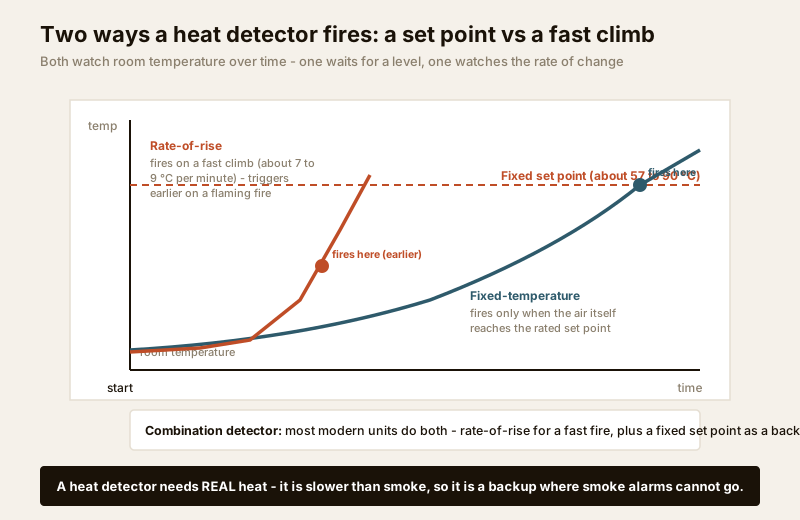
Fixed-temperature: it fires at a set point
A fixed-temperature detector triggers when the air around it actually reaches a preset value - commonly rated somewhere between about 57 and 90 degrees Celsius depending on the model and the room it is meant for. Inside is a heat-sensitive element (a bimetallic strip, a fusible alloy, or a thermistor read by electronics) that changes state at that rated point and closes the alarm circuit. It is simple, robust and hard to fool. Its limitation is that it must wait for the whole air mass to reach the set point, so on a fast-flaming fire it can be relatively late.
Rate-of-rise: it fires on a fast climb
A rate-of-rise detector does not care about the absolute temperature - it watches how quickly the temperature is climbing, and triggers when the rise exceeds a threshold, typically in the order of 7 to 9 degrees Celsius per minute. A flaming fire heats the ceiling fast, so a rate-of-rise element catches it early, often before the air ever reaches a fixed set point. The trade-off is that it must ignore slow, harmless warming - the afternoon sun on a terrace slab, an oven warming a kitchen - so a purely slow-building fire could, in theory, sneak under its rate threshold.
Combination: the sensible default
Because each type covers the other's blind spot, most modern detectors are combination (rate-of-rise plus a fixed-temperature backstop). The rate-of-rise element gives the early catch on a fast fire; the fixed-temperature element guarantees the alarm still sounds on a slow, steady heat build-up that never trips the rate threshold. For nearly every use in this guide, a combination detector is the right choice.
Where to use a heat detector - and where you must not
This is the decision that matters most, so treat it as a map of the home. Heat detectors go where smoke and steam are normal; smoke detectors go where people are.
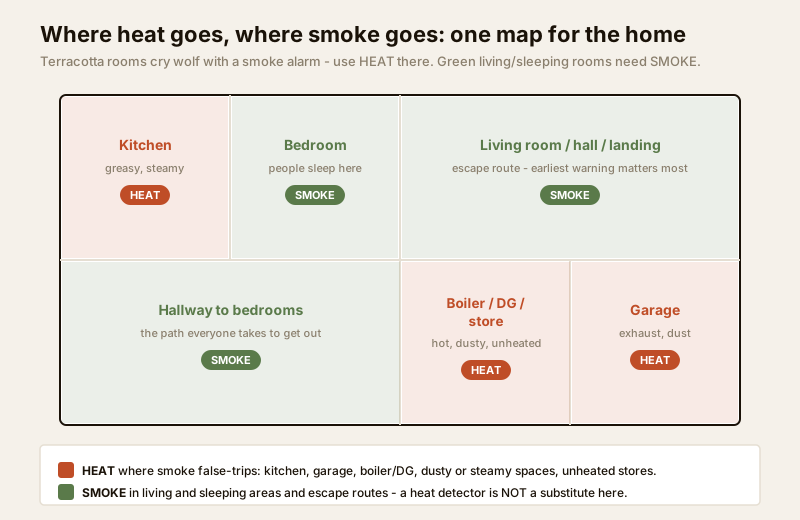
Use a heat detector in:
- The kitchen. Cooking steam, oil vapour and dust would nuisance-trip a smoke alarm constantly. A heat detector rides through all of it and still catches a real kitchen fire. Pair this with the habits and kit in the kitchen fire-safety guide.
- An attached or basement garage. Vehicle exhaust and dust rule out a smoke alarm here; a heat detector suits the space and catches a vehicle or fuel fire. See the basement fire-safety guide for parking-level risks.
- Boiler rooms, DG (generator) rooms, plant and utility rooms. These run hot and dirty; a higher-rated heat detector is the correct sensor.
- Dusty or steamy spaces and unheated stores - a workshop, a laundry, a godown, a loft store - where dust or humidity would defeat a smoke alarm.
Do NOT use a heat detector as a substitute for smoke alarms in:
- Bedrooms and the hallways outside them. People asleep need the earliest possible warning, and only a smoke alarm gives it. A heat detector here would warn far too late.
- Living rooms, halls, landings and escape routes. These are where a warning buys escape time; smoke detection is essential.
The one-line rule: heat where smoke fails, smoke where people are. Never downgrade a bedroom or living area to a heat detector just to avoid nuisance trips - fix nuisance trips by choosing the right smoke-detector type and placement instead.
Placing it right and choosing the right rating
Two things decide whether a heat detector actually works: where you fit it, and what temperature rating you pick for the room.
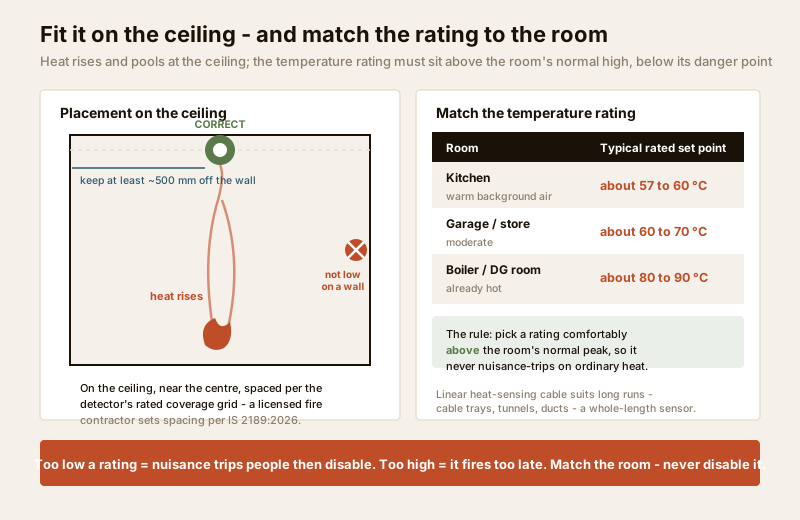
Placement
- On the ceiling, not the wall. Heat rises and collects at the highest point, so the ceiling is where a detector meets the fire's heat soonest. Fit it there, near the centre of the space rather than tucked into a corner.
- Off the walls and out of dead-air corners. Keep it clear of the wall (as a rule of thumb, at least roughly half a metre) and away from the very apex of a pitched ceiling and from corners, where hot air can stagnate and delay the response.
- Spacing to the detector's rated grid. Each detector covers a defined floor area; large rooms need several on a grid. In any building-wide statutory system the exact spacing, coverage and siting are set by the fire-alarm contractor per IS 2189:2026 - not guessed.
- Away from false heat sources - directly above the hob flame, a heater, an oven vent or a spot in direct sun - which could nuisance-trip even a heat detector or, worse, sit in a pocket that never gets the fire's heat.
Choosing the temperature rating
The rating must sit comfortably above the room's normal peak temperature but well below a fire's, so it never trips on ordinary warmth yet fires promptly on a real fire. A kitchen rating is not a boiler-room rating.
| Space | Typical rated set point | Why |
|---|---|---|
| Kitchen, living-adjacent utility | about 57 to 60 degrees Celsius | Warm background, but rarely this hot without a fire |
| Garage, general store, workshop | about 60 to 70 degrees Celsius | Moderate ambient, some solar and machine heat |
| Boiler room, DG room, hot plant room | about 80 to 90 degrees Celsius | Already runs hot; a lower rating would false-trip |
Pick too low a rating for a hot room and it nuisance-trips, people disable it, and you are back to no protection. Pick too high and it fires too late. Matching the rating to the room is the difference between a detector people keep and one they tear down.
Linear heat-sensing cable - for long runs
Point detectors suit rooms; some hazards are lines, not rooms. Linear heat-sensing cable is a continuous heat-sensitive cable that raises the alarm anywhere along its whole length. It is the right tool for cable trays and cable tunnels, conveyor lines, long ducts, car-park bays and tunnels - anywhere the risk runs in a line rather than pooling in a room. In a home this is rare, but it is worth knowing it exists; specifying it is a job for the fire-alarm contractor.
Test it, maintain it - and never disable it
A detector you fit and forget is only half a safeguard. Standalone home heat alarms need the same simple discipline as smoke alarms.
- Test monthly. Press the test button - it checks the electronics and the sounder. Do not use a real flame to test a heat detector.
- Keep it clean. Gently vacuum or wipe dust from the cover so nothing blocks the sensing element.
- Mind the power. Change batteries on schedule in a battery unit (and never leave it flat); in India's frequent power cuts, a mains-powered detector must have battery backup so a cut does not silence it.
- Replace at end of life. Like smoke alarms, heat detectors have a service life - commonly around ten years. Replace the whole unit at the manufacturer's stated end-of-life; the sensing element ages.
- Never disable it - pick the right type instead. If a detector nuisance-trips, the answer is never to remove it, cover it or pull its battery. It is to fix the cause: the correct sensor for the space (heat, not smoke, in a steamy kitchen) and the correct temperature rating for the room. A disabled detector protects no one.
For the whole-house picture - the mix of smoke and heat detection, the escape plan and the fire classes - see the home fire-safety guide; for a society flat, the apartment fire-safety guide; and turn all of it into a ten-minute self-check with the home fire-safety scorecard. If you are unsure which detector each room should have, the fire-detector selector walks you through it.
When the law requires a professional system. A single home alarm is yours to fit. But for any flat block, office, shop, warehouse, hospital, hotel or school, a building-wide automatic fire detection and alarm system is a statutory requirement under IS 2189:2026 and the National Building Code (SP 7:2026, Part 4 Fire and Life Safety), your State Fire Services Act and Rules and the local Model Building Bye-Laws, and it is tied to the premises Fire NOC. The detector types, their ratings, spacing, zoning, the control panel and the sounders must be designed, installed, certified and maintained by a licensed fire-alarm contractor and cleared by the State Fire Services. For the wider compliance picture see the office fire-safety guide and the guidance for a commercial building.
Key takeaways
- A heat detector reacts to real heat, not smoke, so it stays quiet through steam, dust, cooking and fumes - the reason it belongs where a smoke alarm would cry wolf.
- It is slower than a smoke alarm and is therefore a backup for kitchens, garages, boiler and DG rooms, dusty or steamy stores - never a substitute for smoke alarms in bedrooms, living areas and escape routes.
- Two trigger types: fixed-temperature fires at a set point (about 57 to 90 degrees), rate-of-rise fires on a fast climb (about 7 to 9 degrees per minute); a combination unit does both and is the sensible default.
- Match the temperature rating to the room - roughly 57 to 60 degrees for a kitchen, up to 80 to 90 degrees for a hot boiler or DG room - and fit it on the ceiling, off the walls; linear heat-sensing cable covers long runs like cable trays and tunnels.
- Test monthly, keep it clean, back it up against power cuts, replace at about ten years - and never disable it. If it nuisance-trips, fix the type and rating, do not remove the detector.
References
- IS 2189 : 2026, Bureau of Indian Standards - Selection, Installation and Maintenance of Automatic Fire Detection and Alarm Systems, Code of Practice - the core code governing detector selection, placement, ratings, zoning and maintenance for statutory systems in India. Verify the current edition via the BIS catalogue: https://www.services.bis.gov.in/
- National Building Code of India, SP 7 : 2026 (the NBC), Part 4 "Fire and Life Safety" - the fire and life-safety framework that sets when an automatic fire detection and alarm system is required for a given occupancy; the older SP 7 : 2016 edition is withdrawn but still widely quoted. Verify the current edition via the BIS catalogue: https://www.services.bis.gov.in/
- The relevant State Fire Services Act and Rules and the Model Building Bye-Laws (MoHUA) - these set when a Fire NOC and a professionally installed detection and alarm system are legally required for a premises.
- Manufacturer datasheets for the specific heat detector or linear heat-sensing cable - always follow the maker's stated temperature rating, coverage area, mounting and end-of-life for the exact model, as these vary by product.
This is an educational overview, not legal advice, and not a substitute for a licensed fire-safety consultant. A building-wide automatic fire detection and alarm system, its design, its Fire NOC and its certification are qualified professional tasks - engage a licensed fire-alarm contractor and the State Fire Services, and verify any standard's current status via the BIS catalogue before relying on it.
Export this guide
Related Guides — Deep-dive reading
Smoke Detector vs Heat Detector in India (2026): Which Belongs Where
An honest, even-handed head-to-head for Indian homes: what a smoke detector and a heat detector each sense, why the smoke detector is the primary early-warning device, and where a heat detector belongs instead — kitchens, garages and dusty or steamy rooms — because a proper design uses both, chosen to the code and the space.
SecuritySmoke Detectors in India (2026): Photoelectric vs Ionisation, Placement & Testing
The single most important fire-safety device every Indian home should own - how smoke detection works, which type to buy, exactly where to fit it, and how to keep it alive for a decade.
SecurityHow to Choose a Fire Alarm in India (2026): A Life-Safety, Code-Governed Buying Guide
A fire alarm is not shopped on price or looks. It is specified to the National Building Code and the local fire officer, built from listed and certified parts, and installed by a licensed contractor. This guide shows a homeowner, manager or architect how to choose and verify one correctly.
SecurityRelated Tools — Try Free
Fire Detector Selector
Smoke, heat, CO, gas or flame? Pick a space and its fuels and hazards and get the right detector type(s) to consider — with the one placement rule that matters most for each, including the LPG-low vs PNG-high gas rule.
Detector SelectorAccess-Control Battery-Backup Calculator
Size the standby battery so an access system keeps running through a power cut, with an egress life-safety note.
Battery BackupBurglar Alarm System Selector
Answer a few questions about your property, cabling, coverage, monitoring and power and get the right burglar alarm — wired / wireless / hybrid, self or professionally monitored — with the design non-negotiables.
Alarm Selector