
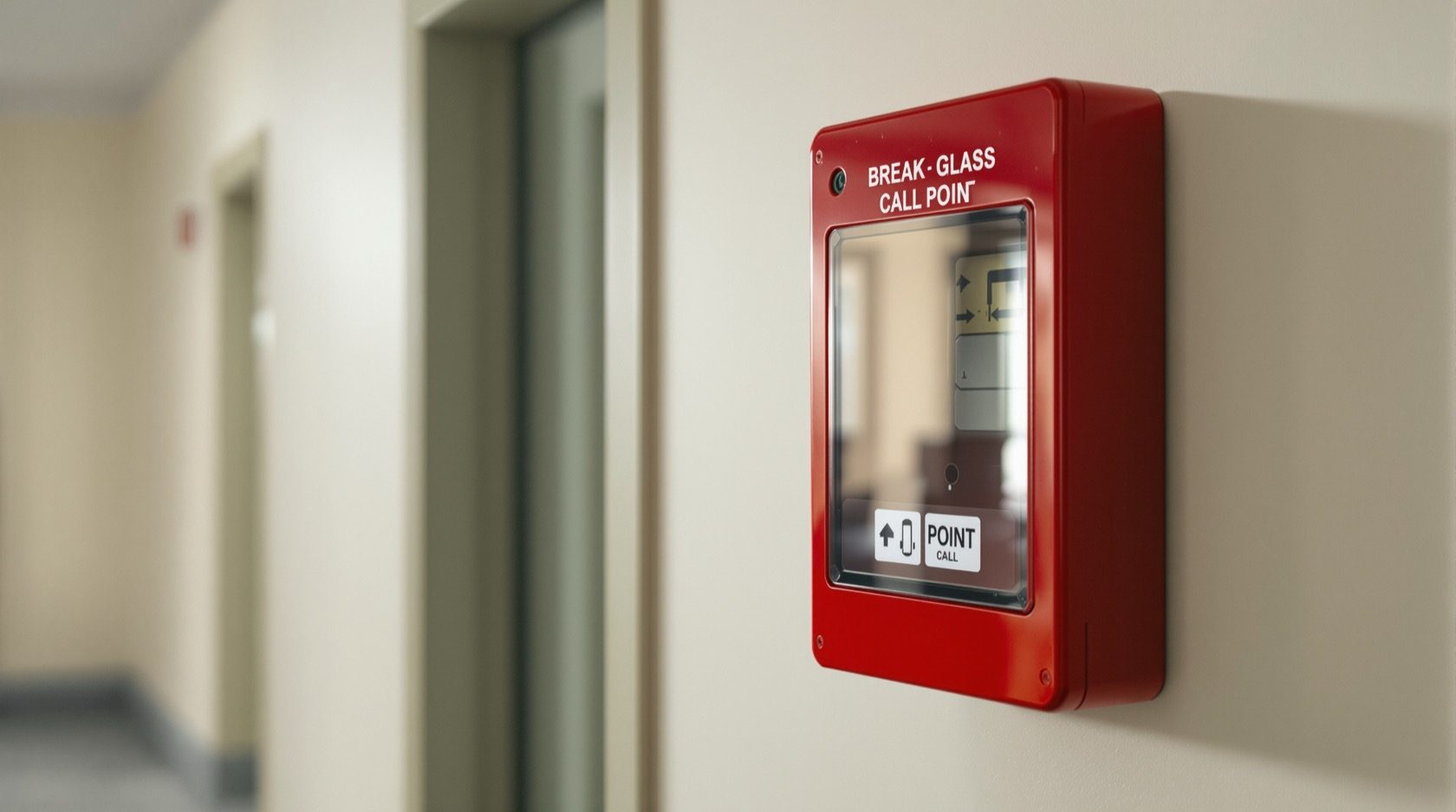
Manual Call Points in India (2026): Break-Glass Alarm Stations, Siting & Standards
The human-operated way to raise the fire alarm - how the break-glass call point works, exactly where IS 2189:2026 wants it sited, which type to specify, and why it must never be disabled.
Automatic detectors are patient machines that wait for smoke or heat to reach the ceiling. A person is faster. Someone who walks into a store-room and sees flames licking a stack of cartons, or smells burning insulation in a riser, knows there is a fire seconds - sometimes minutes - before any detector on the ceiling will confirm it. The device that lets that person turn what they have seen into a building-wide alarm, immediately, is the manual call points station: the red "break-glass" box on the wall by every exit. It is the human hand on the fire alarm, and in a real fire it is very often the first input the panel ever receives.
This is the manual-call-point chapter of Studio Matrx's fire-safety library, sitting under the complete guide to fire safety in India. It is written for the facility manager, RWA committee, builder and shop or office owner who must specify a system, hold a contractor to it, and keep it working. Call points are one part of the wider alarm system - the addressable and conventional architectures decide how each call point reports, the control panel receives it, and zoning tells responders where it came from. Here we stay on the wall by the door.
Scope and safety - read this first. A building fire-alarm system, including its manual call points, is a statutory, engineered installation designed, installed, wired, commissioned and certified by a licensed fire-alarm contractor to IS 2189 : 2026 and the National Building Code (via SP 7 : 2026, Part 4), and tied to the premises Fire NOC under your State Fire Services Act and Rules. This guide helps you understand, specify and maintain call points and hold your contractor accountable - it is educational guidance, not legal advice, and not a licence to install or re-wire anything yourself. And one rule overrides all of it: if you see fire, operate the nearest call point, get everyone out, and call the fire brigade on 101 or 112 - do not investigate.
What a manual call point is, and why it matters
A manual call point (MCP), also called a manual pull station or simply a break-glass, is a wall-mounted device with a single job: when a person operates it, it sends a fire signal to the fire alarm control panel, which then raises the alarm across the building. It is the manual counterpart to an automatic detector, and it earns its place for one blunt reason - a human present at the start of a fire is the fastest, most reliable detector in the building.
Consider how a fire is usually discovered. A staff member smells smoke, sees a flicker under a door, or watches an overloaded board start to arc. Automatic detection has not triggered yet because the smoke has not risen to a ceiling sensor, or the fire is behind a partition. Those first seconds are the most valuable in the whole event, because a fire caught small is a fire that can be walked away from. The call point lets the person who has that knowledge act on it at once, without hunting for a phone or a person to tell. That is why call points are mandatory alongside automatic detection in essentially every non-domestic building - the two systems cover each other's blind spots.
The call point also starts the evacuation, not just the detection. In a phased or cause-and-effect building the panel may do a great deal when a call point is operated - sound the zoned sounders, release magnetic door holders, recall lifts, start stair pressurization - but from the occupant's point of view the important thing is simpler: pressing that box is the signal that tells everyone in earshot to leave. It converts one person's knowledge into a whole building's head start.
Where call points go - siting per IS 2189
Siting is what separates a compliant, useful call-point layout from a box of red plastic that nobody can find. IS 2189 : 2026 and NBC Part 4 drive the principles below; the exact figures for your building are fixed by your licensed fire-alarm designer against the current code, so treat the numbers here as the design intent to check against, not as values to self-apply.
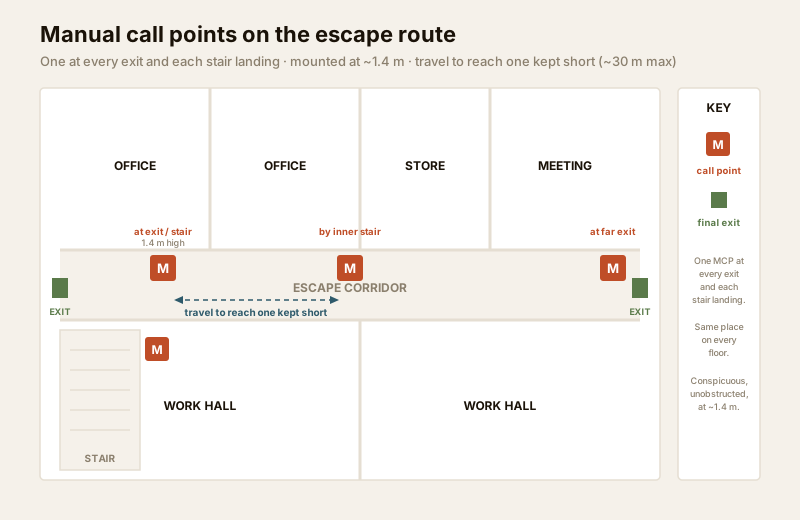
The governing idea is that a call point must always be close at hand on the way out. The layout follows the escape route, so that a person moving toward an exit passes a call point without going out of their way.
- At every final exit from the building, and at exits from each storey onto a protected stair. The point where people are already leaving is exactly where the alarm should be raisable.
- At each floor's stair landing / lobby, so that anyone entering the escape stair can raise the alarm as they go, and so every floor has its own call point regardless of what else is on it.
- So that travel distance to reach a call point stays short. The design intent is that no one has to travel far - commonly taken as on the order of 30 m maximum to the nearest call point, with one always near an exit. Your designer sets the compliant figure for the occupancy; the point is that call points are frequent enough that one is always close.
- Along the escape route in long corridors, adding intermediate call points where a run between exits would otherwise leave a gap.
Beyond location on plan, four mounting rules matter on every unit:
| Siting rule | What good looks like | Why it matters |
|---|---|---|
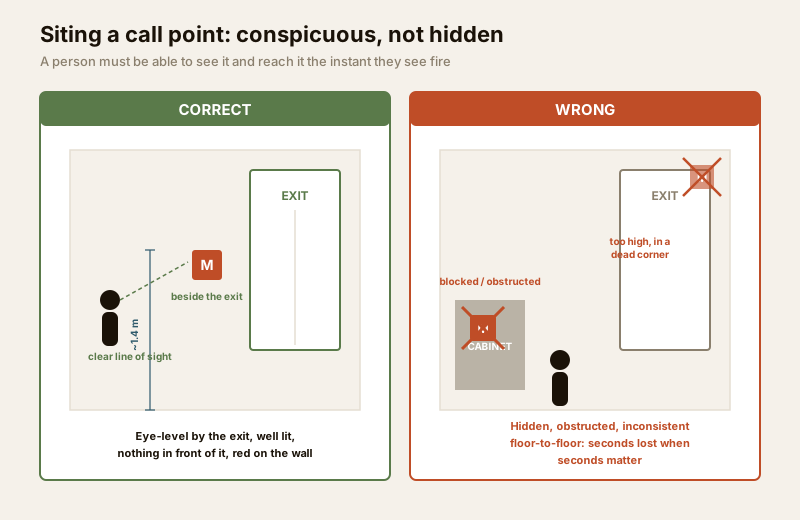
| Mounting height | Roughly 1.4 m above finished floor to the operating element (confirm the current IS 2189:2026 figure) | Reachable by most adults and children, and consistent so people expect it there |
| Conspicuous | Red, well lit, at eye-to-hand level, on the open wall by the door | A call point you cannot see in an emergency may as well not exist |
| Unobstructed | Nothing parked, stacked or hung in front of it; clear approach | Furniture and cabinets creep in front of call points over the years - audit for this |
| Consistent floor-to-floor | Same relative position on every storey | In smoke, people find the call point by muscle memory, not by reading signs |
Get these right and the layout does its job invisibly. Get them wrong - a call point hidden behind a cupboard, mounted shoulder-high in a dark corner, or in a different spot on every floor - and you have installed a device that fails at the one moment it is needed. For how this ties into the building-wide picture by occupancy, see the office, school, apartment and high-rise fire-safety guides.
Types of manual call point
Not all call points are the same box. Choosing the right variant for each location is part of specifying the system well.
Break-glass versus push-and-reset element
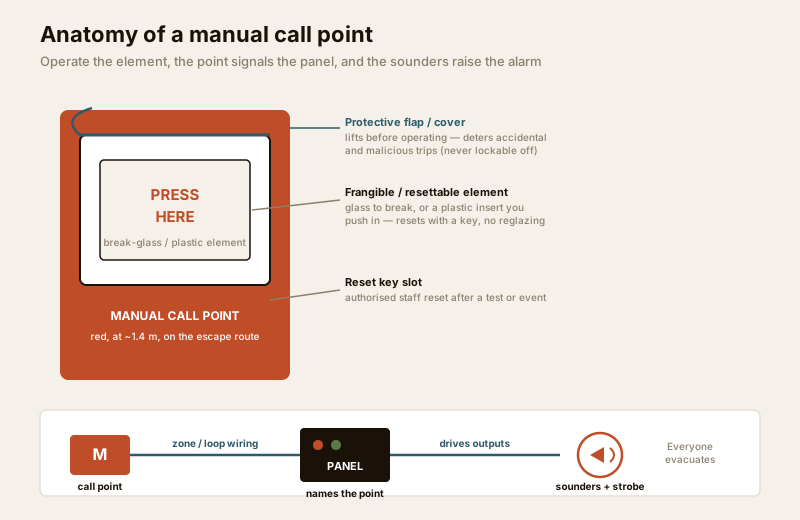
The classic call point uses a small frangible glass element: you break the glass, a switch closes, and the alarm sounds. It is unambiguous and tamper-evident - broken glass tells you it was operated - but it needs a replacement element after every operation and test, and broken glass is a minor hazard.
Most modern call points instead use a resettable plastic element: a spring-loaded plastic insert you push in firmly (it gives the same positive "operate" action and often shows a changed indicator), which is then reset with a key rather than reglazed. This makes routine testing far cheaper and cleaner, which in turn makes it more likely the building actually tests them. For a new specification, resettable-element call points are usually the sensible default; keep a small stock of spare glass elements if any break-glass units remain.
Weatherproof and hazardous-area variants
For outdoor locations - external escape stairs, plant yards, fuel or godown areas exposed to the weather - specify a weatherproof (IP-rated) call point with a sealed enclosure, so rain and dust do not corrode the switch or cause faults. Where an area is classified for flammable atmospheres, an intrinsically-safe or flameproof-rated call point to the applicable BIS/EN standard is required; that is a specialist call your designer makes.
Protective flaps and covers - the right way
A hinged transparent protective flap (a lift-up cover) over the element is a widely-specified accessory. Its purpose is to add one deliberate action - lift the flap, then operate - which sharply reduces accidental knocks and casual malicious activation, a real problem in schools, hostels and busy public areas where nuisance operation drives false alarms. Some flaps include a local sounder that chirps when lifted, drawing attention to whoever is operating it.
The flap is legitimate and useful. But there is a hard line: a protective flap or cover must never be a lock that can hold the call point in a disabled or unusable state. A call point has to work the instant a person operates it. A cover that deters idle fingers is good practice; anything that stops a genuine user raising the alarm - a padlock, a screwed-shut box, a unit left "isolated" at the panel - is a defeated life-safety device, and that is covered in the warning below.
| Type / feature | Best used for | Watch-outs |
|---|---|---|
| Break-glass element | Where tamper-evidence is wanted | Needs a spare element after each operation; broken glass |
| Resettable plastic element | Most modern installations; frequent testing | Confirm it gives a positive, unmistakable operate action |
| Weatherproof (IP-rated) | Outdoor stairs, yards, exposed godown areas | Match IP rating to exposure; check seals during service |
| Protective flap / cover | High-traffic, school, hostel, public areas prone to malicious trips | Reduces false alarms - but must NEVER lock the point off |
| Addressable vs conventional | Addressable names the exact point; conventional shows the zone | Set by the system architecture you choose |
Whether a call point reports its exact identity or just its zone depends on the system architecture: on an addressable loop the panel names the precise call point that was operated, which is invaluable in a large building; on a conventional system the panel shows the zone and staff confirm which point. A wireless call point suits retrofit and heritage buildings where running cable to every exit is disruptive.
Testing, log books and the never-disable rule
A call point, like every part of the alarm system, is only protection if it actually works - and the only way to know is to test it and keep the record.
Routine testing of call points is part of the system's periodic maintenance regime under the AMC, carried out by your fire-alarm contractor and logged in the panel log book. The widely-followed practice is to test a different call point at each periodic test, rotating through them so that over a cycle every call point in the building has been operated and confirmed to signal the panel and sound the alarm - rather than testing the same convenient one every time and never exercising the rest. Each test is entered in the log book with the call point identity, the date and the result, and the point is then reset. Detailed testing schedules and the wider commissioning-and-maintenance picture are covered in the alarm-maintenance guidance in this library.
When the law requires a professional - and why you must never leave a call point disabled. The most dangerous thing that happens to real fire-alarm systems in India is not that they are never installed - it is that they are installed for the Fire NOC and then quietly defeated to stop nuisance alarms. A call point that is padlocked, taped over, wired out, or left permanently "isolated" or "disabled" at the panel is not a safer call point - it is no call point, and the fire it fails to raise the alarm on does not care why it was silenced. If call points are being maliciously operated, the correct fixes are protective flaps, better supervision, or an addressable system that names the culprit point - never disablement. Design, installation, wiring, commissioning, certification and any re-configuration of call points and the panel are licensed fire-alarm contractor work, tied to your Fire NOC and IS 2189 : 2026; keep the AMC live, keep the log book current, and never let any part of the system sit in a disabled state. When in doubt, engage a qualified fire-safety consultant - see the commercial-building and apartment security guidance and the wider building security systems guide.
For a broader emergency picture beyond the alarm hardware, the emergency-preparedness guide covers drills and evacuation, and the electrical safety guides cover the wiring faults that start many of the fires a call point is there to raise. To match detection devices to a given risk, use the fire-detector selector; to think through the whole alarm architecture, the fire-alarm system selector; and for a quick premises self-check, the home fire-safety scorecard.
Key takeaways
- A manual call point is the human hand on the fire alarm - it lets a person who sees or smells fire raise the building-wide alarm instantly, often seconds or minutes before any automatic detector would, and it is mandatory alongside detection in non-domestic buildings.
- Site call points on the escape route - at every final exit and each stair landing, at about 1.4 m, conspicuous, unobstructed and in the same position on every floor, so travel to reach one is short and people find it by memory in smoke.
- Specify the right type per location - resettable-element points for cheap frequent testing, weatherproof IP-rated units outdoors, and protective flaps in areas prone to malicious operation.
- A protective flap reduces false alarms but must never lock the point off - a call point has to operate the instant a genuine user needs it; a cover that deters, not one that disables.
- Test call points on rotation and log every test, and never leave one disabled - a padlocked, taped-over or "isolated" call point is no call point; route every fix through the AMC and your licensed fire-alarm contractor.
References
- IS 2189 : 2026, Bureau of Indian Standards - Selection, Installation and Maintenance of Automatic Fire Detection and Alarm System, Code of Practice. The core code governing manual call points, their siting on escape routes, mounting and inclusion in the system. Verify the current edition and any specific figures via the BIS catalogue: https://www.services.bis.gov.in/
- National Building Code of India, SP 7 : 2026 (the NBC), Part 4 "Fire and Life Safety" - the framework requiring manual and automatic fire alarm provision in buildings by occupancy and height; the older SP 7 : 2016 edition is withdrawn but still widely quoted. Verify the current edition via the BIS catalogue: https://www.services.bis.gov.in/
- The relevant State Fire Services Act and Rules and the Model Building Bye-Laws (MoHUA) - these set when a Fire NOC and a certified building fire-alarm system, including call points, are legally required for a given premises.
- Manufacturer datasheets and installation instructions for the specific call point specified - the authority for its element type, IP rating, reset method, flap accessory and addressable or conventional signalling; always follow the unit's own instructions and the designer's drawings.
This is an educational overview, not legal advice, and not a substitute for a licensed fire-safety consultant. Building fire-alarm systems, manual call points, the Fire NOC and any statutory installation, wiring or re-configuration are qualified professional tasks - engage licensed fire professionals and the State Fire Services, and verify any standard's current status and figures via the BIS catalogue before relying on it.
Export this guide
Related Guides — Deep-dive reading
How to Choose a Fire Alarm in India (2026): A Life-Safety, Code-Governed Buying Guide
A fire alarm is not shopped on price or looks. It is specified to the National Building Code and the local fire officer, built from listed and certified parts, and installed by a licensed contractor. This guide shows a homeowner, manager or architect how to choose and verify one correctly.
SecurityFire Alarm Zoning in India (2026): Detection Zones, Search Limits & Phased Evacuation
How dividing a building into detection zones lets responders find the fire fast, drives phased evacuation and cause-and-effect - the IS 2189:2026 principles every owner and committee should understand.
SecurityConventional Fire Alarm Systems in India (2026): Zones, Cost & When They Fit
The simpler, lower-cost fire-alarm architecture for small, simple buildings - how zone wiring works, what the panel can and cannot tell you, and exactly where it fits and where it does not.
SecurityRelated Tools — Try Free
Electrical Safety & Load Audit
Home electrical audit — 10 categories, 65+ checkpoints across earthing, RCCB, MCB, wiring, switchboards, appliance circuits, DG/inverter backup.
Safety AuditContract Studio
AI generates professional architecture service agreements with milestones and scope.
ArchitectAISmoke Detector Quantity Calculator
How many smoke detectors does a floor need? Enter the area, the coverage per detector and the enclosed rooms and stair landings to get the total — the greater of the area count and the per-space minimum. An indicative planning estimate; a fire consultant designs to NBC.
Detector Count