
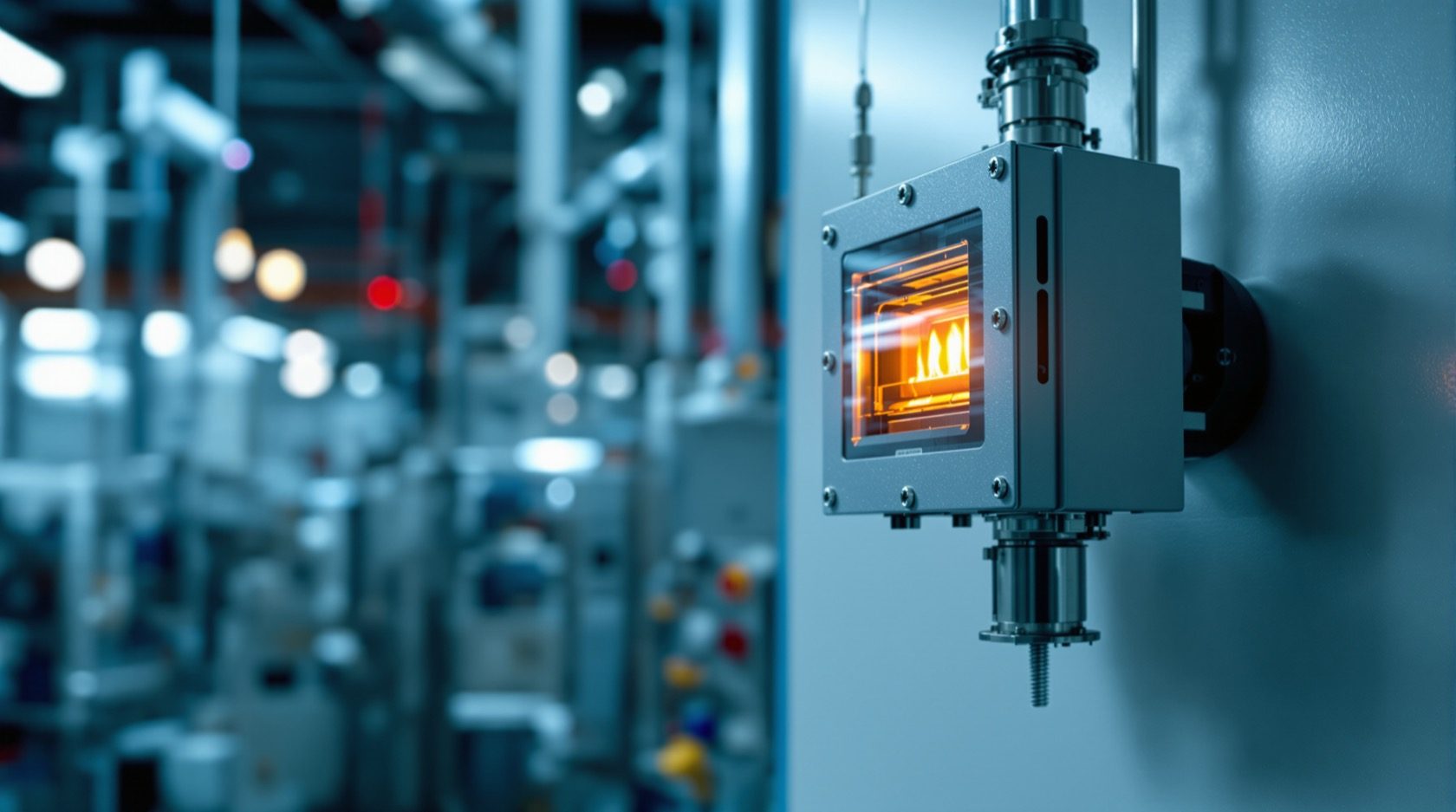
Flame Detectors in India (2026): UV, IR and Where High-Hazard Spaces Need Them
The fast optical detector for spaces where a fire flares in seconds - fuel stores, gensets, boiler and paint areas. How UV, IR and combined sensors see a flame, and why they are a professional, engineered choice.
Most of the detectors in a building watch for the by-products of a fire - the smoke that drifts up to a ceiling sensor, or the heat that slowly builds under one. In a normal room that is exactly right, because a room fire usually smoulders before it flames and there is time for smoke to reach a detector. But there are spaces where that assumption breaks. Put a leaking fuel line, a diesel genset, a solvent vapour or a pool of flammable liquid together with an ignition source and the fire does not smoulder - it flares to full size in a second or two, often with very little early smoke. In those spaces you need a detector that watches for the fire itself, at the speed of light. That is what flame detectors do, and this guide explains where they belong, how UV and IR optical sensing works, and why - unlike a home smoke alarm - a flame detector is an engineered, professionally specified device and never a retail purchase.
This is the high-hazard chapter of Studio Matrx's fire-safety library, and it sits under the complete guide to fire safety in India. It is deliberately the most specialised of the detector guides. If you are protecting a home or an ordinary office, you almost certainly want the smoke detectors guide and the heat detectors guide instead - flame detection is the tool for the industrial and fuel-hazard end of the spectrum, and reading this to fit one in a living room would be a mistake.
Scope and safety - read this first. This guide is written for professionals and facility managers who are scoping protection for a high-hazard space, so that you know what a flame detector is, when it is the right answer, and what to brief your consultant on. It is not a DIY installation manual. A flame-detection system in a fuel store, boiler house or process area is a life-safety and property-protection system that must be designed, installed, commissioned and certified by a licensed fire-alarm contractor and fire consultant, tied into the building's fire-alarm panel and its Fire NOC, under IS 2189 : 2026 and the National Building Code (SP 7 : 2026, Part 4). The detector type, count, mounting and field of view are engineering decisions, not catalogue choices. This is educational guidance, not legal advice or a substitute for a licensed fire-safety professional.
What a flame detector actually senses
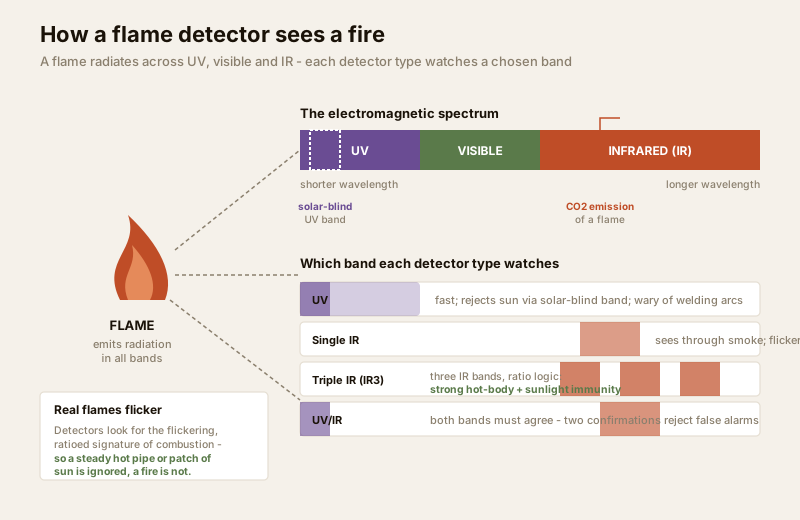
A flame is not just heat and light we can see. When fuel burns it emits electromagnetic radiation across a wide band - some of it ultraviolet (UV), some visible, and a great deal of it infrared (IR). A flame detector is an optical instrument: it looks along a line of sight, watches specific slices of that radiation, and raises an alarm when it sees the characteristic signature of a real flame. Because radiation travels at the speed of light, a flame detector can respond to a fast-developing pool or spray fire in a fraction of a second - far quicker than smoke has to drift to a ceiling or heat has to build up.
The whole design challenge is discrimination: a good flame detector must see a genuine fire fast while rejecting the many things in an industrial space that also emit UV or IR - direct or reflected sunlight, hot machinery and exhausts, welding and grinding arcs, lightning, and switched artificial lighting. A detector that cries wolf gets disabled by frustrated staff, and a disabled detector protects nobody. So the sensor technology is chosen to match both the fuel you expect to burn and the false sources present in that particular space.
The main sensing technologies
Flame detectors are grouped by which part of the spectrum they watch. Each has a niche, and the right choice depends on the expected fuel and the ambient false sources.
| Sensor type | What it watches | Strengths | Watch-outs |
|---|---|---|---|
| UV | Ultraviolet radiation from a flame | Very fast; sensitive to most fires including hydrogen and metals | Can be triggered by welding arcs, lightning and some lamps; UV can be blocked by oil mist, smoke, dust or gas films on the lens |
| Single IR | One infrared band (often the CO2 emission of a hydrocarbon flame) | Sees through smoke better than UV; good for carbon-fuel fires | Prone to false alarm from hot surfaces and modulated blackbody sources unless flicker-checked |
| Dual IR (IR2) | Two IR bands compared against each other | Much better false-source rejection than single IR | Tuned mainly to hydrocarbon fuels |
| Triple IR (IR3) | Three IR bands with ratio logic | Excellent immunity to hot bodies, sunlight and blackbody sources; long range on hydrocarbon fires | Optimised for hydrocarbons; may not suit hydrogen or some non-carbon fuels |
| UV/IR | Combined UV and IR, both must agree | Strong false-alarm rejection by requiring two independent confirmations; fast | Combined cost and complexity; still a professional-specified device |
Two ideas run through the whole table. First, "solar-blind" UV detection uses a UV band that sunlight at ground level does not reach, which is why UV can ignore direct sun. Second, real flames flicker at a few hertz, so good detectors do not just measure brightness - they look for the flickering, ratioed signature of combustion, which is how they separate a fire from a steady hot exhaust pipe or a patch of sunlight. The result is a device that is fast and specific, but only when the type is matched to the space.
Where flame detectors belong - and where they do not
Flame detectors earn their place in exactly the spaces where smoke and heat detection are too slow, obstructed, or unworkable. The common thread is a high-hazard, high-value or fast-flaring risk, usually with a flammable liquid, gas or vapour, and often in a large-volume or outdoor-ish area where smoke would never reach a ceiling detector in time.
| Space | Why flame detection fits |
|---|---|
| Fuel and diesel storage, drum stores | A liquid-fuel fire flares instantly with little early smoke; optical detection is fast enough to matter |
| Genset and DG rooms | Diesel spray and hot surfaces; a fast spray fire needs speed, and IR3 or UV/IR rejects the hot exhaust as a false source |
| Boiler houses and process-heating areas | Open flames and fuel lines in a large, hot, high-bay space |
| Paint booths, solvent and coating areas | Flammable vapour that can flash; very fast fire growth |
| Warehouses storing flammable liquids | High-bay volume where ceiling smoke detection is slow and the stored fuel flares |
| Industrial process and petrochemical areas | Classic flame-detector territory; often ATEX/explosion-proof rated |
| Large atria and high-bay halls (sometimes) | Where ceiling height defeats smoke detection, flame or beam detection may be specified by the consultant |
Just as important is where flame detectors do not belong. A flame detector is line-of-sight and looks for an open flame, so it is poor at catching the slow, smouldering fires that start most fires in ordinary occupancies - an overheating cable in a wall, a cigarette in a sofa, a smouldering mattress. Those emit smoke long before an open flame, which is exactly what a smoke detector is built for. That is why a flame detector is essentially never the right answer for a home, an ordinary office floor, a bedroom or a corridor - there, use smoke detection, and heat detection only where smoke would nuisance-trip. Treat flame detection as a specialist supplement for named hazards inside a wider system, not a general-purpose replacement.
A few adjacent high-hazard rooms deserve a mention because they come up constantly in Indian buildings. A battery room - a large UPS or inverter bank - can develop fast thermal-runaway fires and is sometimes flame-monitored as part of an engineered scheme. A basement plant room or fuel store shares the same fast-flare, smoke-trap problems. And the ignition source behind so many of these fires is electrical, so the detection scheme always sits alongside good electrical fire safety and the wider electrical hub - a flame detector catches the fire, but stopping the fault that started it is a separate, equally important job.
Line of sight: the siting that makes or breaks it
A flame detector is only as good as what it can see. Because it works by looking along a straight line at the radiation a flame emits, three things dominate whether it actually protects the hazard: its field of view, its range, and whether that view is unobstructed.
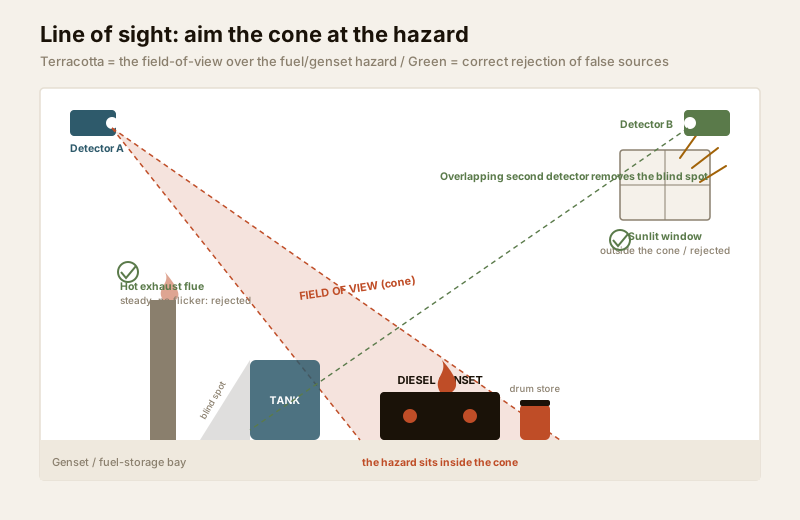
- Field of view (the cone). Every detector sees within a cone - a stated angle, often around 90 to 120 degrees for common devices. The hazard must sit inside that cone. Aim the detector so the most likely fire location - the fuel bund, the genset, the decanting point - falls squarely in the middle of its view, not at the edge where sensitivity falls off.
- Range. Sensitivity falls with distance and with fire size: a detector rated to see a defined test fire at, say, twenty-five metres will see a small fire only much closer. Specify range against the smallest fire you need to catch, not the biggest.
- Clear line of sight. Anything solid between detector and flame is a blind spot - tanks, racking, machinery, a parked forklift, a stack of drums. Overlapping detectors from different angles remove blind spots, which is why high-hazard areas usually get several units cross-covering the same volume.
- Lens contamination. Oil mist, dust, paint overspray and condensation on the window blind the detector. That is why professional units include automatic optical self-test (they periodically verify the lens is clear and the electronics live) and why a maintenance schedule to clean lenses is non-negotiable.
- False-source geometry. Site the detector so that predictable false sources - a west-facing window that catches evening sun, a welding bay, a hot flue - fall outside its cone or are rejected by the sensor type. Getting this geometry right is exactly why placement is an engineered calculation, not a guess.
Choosing the type: fuel and false sources together
There is no single "best" flame detector - only the right one for a given fuel and a given set of false sources. The selection is a matching exercise, and it belongs to the fire consultant, but understanding the logic helps you brief them and read their proposal.
The two questions that drive the choice are: what will burn here (which sets the radiation signature you must detect), and what else in this space emits UV or IR (which sets what you must reject). A hydrogen fire emits strong UV but weak carbon-band IR, so it wants a UV or UV/IR device; a diesel or petrol fire emits strongly in the IR CO2 band, so an IR3 device sees it far off and shrugs off hot surfaces. A space full of arc welding argues against plain UV; a sun-drenched or hot-machinery space argues for IR3 or UV/IR with their strong blackbody rejection.
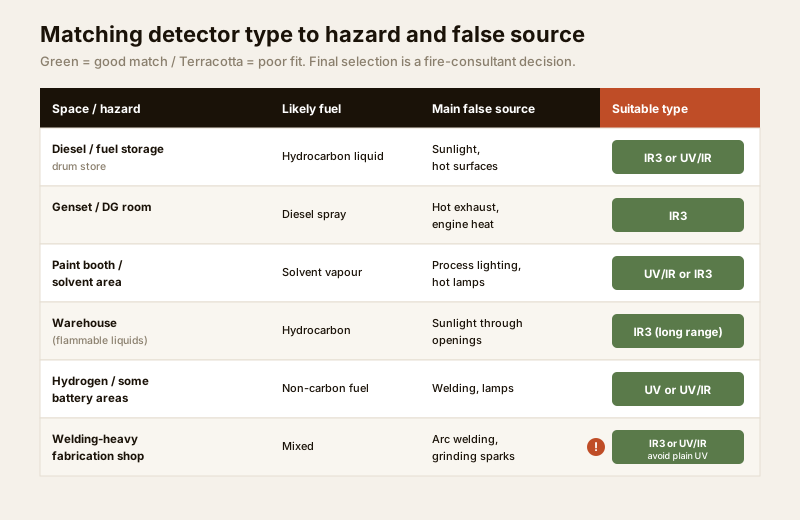
| Space / hazard | Likely fuel | Main false sources | Typical suitable type |
|---|---|---|---|
| Diesel / fuel storage, drum store | Hydrocarbon liquid | Sunlight, hot surfaces | IR3 or UV/IR |
| Genset / DG room | Diesel spray | Hot exhaust, engine heat | IR3 (strong hot-body rejection) |
| Paint booth / solvent area | Solvent vapour | Process lighting, hot lamps | UV/IR or IR3 |
| Warehouse (flammable liquids) | Hydrocarbon | Sunlight through openings | IR3 (long range) |
| Hydrogen / some battery areas | Hydrogen / non-carbon | Welding, lamps | UV or UV/IR |
| Welding-heavy fabrication shop | Mixed | Arc welding, grinding sparks | IR3 or UV/IR (avoid plain UV) |
This table is a starting frame for a conversation with your consultant, not a specification. Real selection also weighs response time targets, the required detection distance to the smallest credible fire, whether an ATEX / explosion-proof rating is needed, how the detector votes into the alarm panel (many high-hazard schemes require two detectors to agree before releasing a suppression system), and the maintenance regime. Those judgements are why IS 2189 : 2026 routes automatic detection design to competent fire professionals.
Testing and maintenance: how a flame detector is kept alive
A flame detector that is dirty, misaligned or unpowered is worse than none, because people believe they are protected. Keeping it working is a professional maintenance task, but managers should know what the regime looks like so they can hold their AMC contractor to it.
- Automatic optical self-test. Quality detectors continuously or periodically check their own optics and electronics and report a fault if the lens is contaminated or a channel fails - so a fault signal on the panel is a call to action, never something to silence.
- Manual functional test. On a schedule, a technician confirms each detector responds using an approved flame-simulator test lamp aimed into its field of view, and confirms the alarm reaches the panel and does what it should downstream.
- Lens cleaning. The window is cleaned to the manufacturer's schedule - more often in dusty, oily or overspray-heavy areas.
- Alignment check. The field of view is re-confirmed, because racking gets moved, a new machine appears in the line of sight, or a detector drifts on its mount.
- Record it. Every test and clean is logged, tied to the AMC and the building's fire-safety records, and available for the Fire NOC renewal.
Never disable it - fix the cause instead. If a detector nuisance-trips, the answer is never to unplug it, tape over the lens or leave it in fault. The answer is to find why - a new false source in its cone, a wrong type for the fuel, a bad aim - and have the consultant re-select or re-site it. A covered or bypassed flame detector is a dead flame detector, and in a fuel or genset space that is a decision that can cost lives.
When you must use a professional and a statutory system. Everything about a flame-detection scheme is professional territory. The decision to use flame detection at all, the choice of UV versus IR versus UV/IR, the number and placement of detectors, their integration into the fire-alarm panel, any interlock to a gas or water-mist suppression release, and the sign-off all belong to a licensed fire-alarm contractor and fire consultant, working to IS 2189 : 2026 and the National Building Code (SP 7 : 2026, Part 4), and cleared by the State Fire Services as part of the building's Fire NOC. For component-level detector specifications, verify the current applicable BIS/IEC flame-detector standard via the BIS catalogue rather than relying on any single quoted number. If you manage a facility with a fuel store, genset, boiler house or process hazard, engage a qualified fire consultant to scope the detection early - retro-fitting it after the layout is fixed is far costlier and often compromised.
Key takeaways
- Flame detectors are optical, line-of-sight sensors that watch for the UV and IR radiation a fire emits, so they respond in a fraction of a second to fast-flaring fires that smoke and heat detection would catch too late.
- They are for high-hazard spaces - fuel and diesel storage, gensets, boiler houses, paint and solvent areas, warehouses of flammable liquids and industrial process areas - and are overkill and wrong for a home or ordinary office, where smoke detection belongs.
- Type is matched to fuel and false sources: UV, single/dual/triple IR (IR3) and UV/IR each suit different fires and reject different nuisance sources like sunlight, hot surfaces and welding arcs; the right choice is a fire-consultant decision.
- Siting is everything: the hazard must sit inside the detector's field-of-view cone and within its range, with a clear line of sight, overlapping units to kill blind spots, and predictable false sources kept out of view.
- Never disable a nuisance-tripping detector - re-select or re-site it; keep lenses clean, self-test faults actioned and every test logged, all under IS 2189 : 2026 and tied to the building's Fire NOC.
References
- IS 2189 : 2026, "Selection, Installation and Maintenance of Automatic Fire Detection and Alarm System - Code of Practice", Bureau of Indian Standards - the core Indian code governing where and how automatic detection, including flame detection, is designed and maintained. Verify the current edition via the BIS catalogue: https://www.services.bis.gov.in/
- National Building Code of India, SP 7 : 2026 (the NBC), Part 4 "Fire and Life Safety" - the fire and life-safety framework that sets when automatic detection and a Fire NOC are required for a given occupancy; the older SP 7 : 2016 edition is withdrawn but still widely quoted. Verify via the BIS catalogue: https://www.services.bis.gov.in/
- The applicable BIS / IEC flame-detector product standard for UV, IR and combined optical flame detectors - verify the current edition and designation via the BIS catalogue before specifying: https://www.services.bis.gov.in/
- The relevant State Fire Services Act and Rules, the Model Building Bye-Laws (MoHUA), and the flame-detector manufacturer's datasheet and installation manual - these set the statutory requirement, the field-of-view and range figures, and the maintenance regime for the specific device chosen.
This is an educational overview, not legal advice, and not a substitute for a licensed fire-safety consultant. Flame-detection design, selection, installation, commissioning and any suppression interlock are qualified professional tasks - engage a licensed fire-alarm contractor and the State Fire Services, and verify any standard's current status via the BIS catalogue before relying on it.
Export this guide
Related Guides — Deep-dive reading
Smoke Detectors in India (2026): Photoelectric vs Ionisation, Placement & Testing
The single most important fire-safety device every Indian home should own - how smoke detection works, which type to buy, exactly where to fit it, and how to keep it alive for a decade.
SecurityHeat Detectors in India (2026): Fixed-Temperature vs Rate-of-Rise and Where to Use Them
The detector for places where smoke alarms cry wolf - kitchens, garages, boiler and DG rooms, dusty or steamy stores. How heat sensing works, the two trigger types, and why it is a backup, never a bedroom substitute.
SecurityHow to Choose a Fire Alarm in India (2026): A Life-Safety, Code-Governed Buying Guide
A fire alarm is not shopped on price or looks. It is specified to the National Building Code and the local fire officer, built from listed and certified parts, and installed by a licensed contractor. This guide shows a homeowner, manager or architect how to choose and verify one correctly.
SecurityRelated Tools — Try Free
CCTV Mounting Height & Angle Calculator
Height, target distance and lens angle to the downward tilt, the blind dead-zone below and where coverage begins and ends.
Height & AngleCross-Ventilation Analyzer
Estimate airflow and air changes per hour (ACH) from room size, window areas, layout, and local wind — with NBC 2016 Part 8 compliance check.
Ventilation CalculatorFire Detector Selector
Smoke, heat, CO, gas or flame? Pick a space and its fuels and hazards and get the right detector type(s) to consider — with the one placement rule that matters most for each, including the LPG-low vs PNG-high gas rule.
Detector Selector