
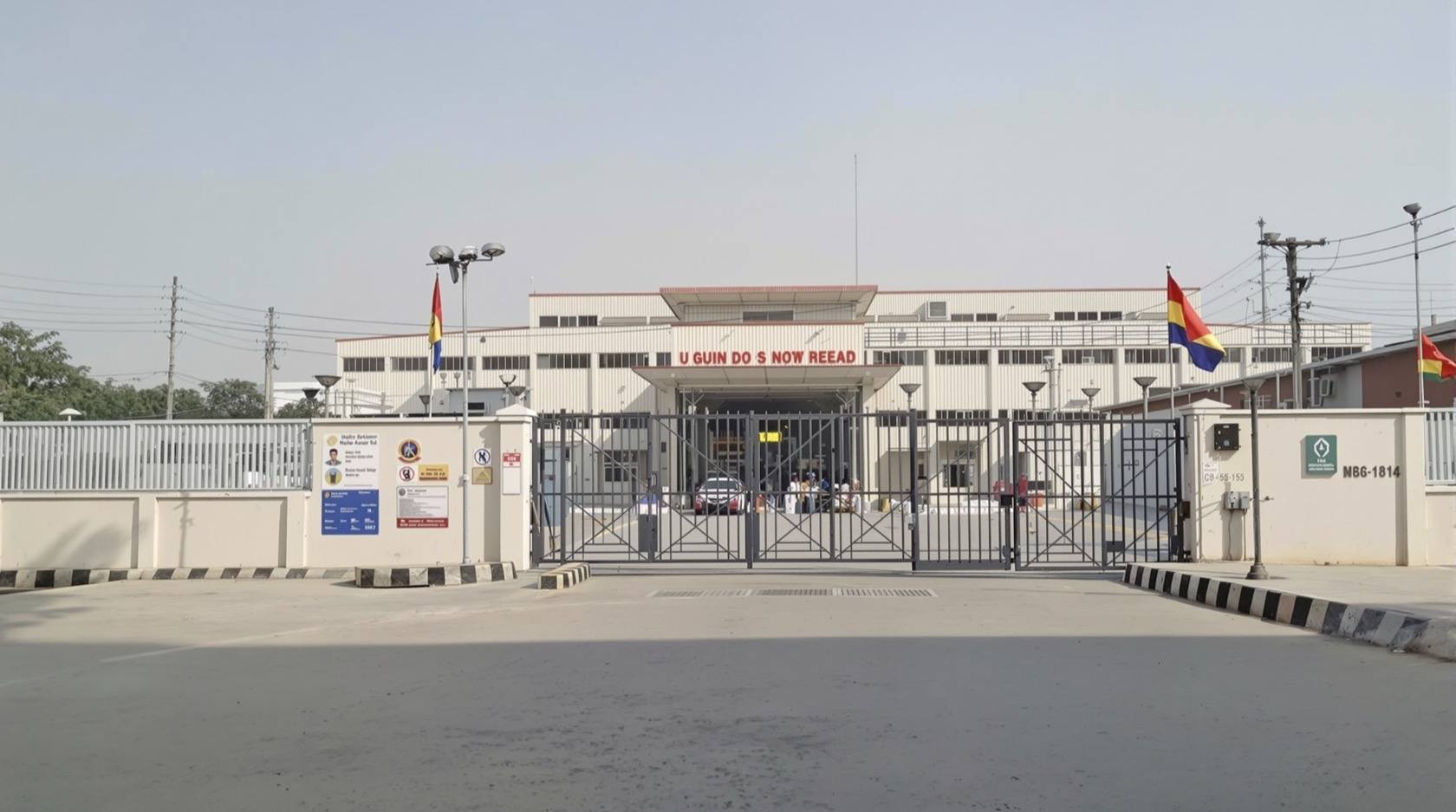
Factory Security in India (2026): A Layered Guide for Manufacturing Plants and MSME Units
How a manufacturing factory, industrial plant or MSME unit protects a large site of machinery, raw materials, finished goods and scrap, controls a shift-based workforce and the movement of material through its gate, hardens its OT and IP, and treats hazardous-process and fire safety as non-negotiable life-safety.
A factory is one of the hardest sites to secure well, because it is so many things at once. A manufacturing plant, an industrial unit or an MSME workshop is a large site holding valuable machinery, raw materials, work-in-progress and finished goods — often with high-value copper, metals and scrap that are a theft target in their own right. It runs on a shift-based workforce flowing in and out, plus a stream of contractors, vendors and vehicles. It carries intellectual property — designs, processes, formulations — worth more than any single machine. It depends on control systems and an IT network that, if stopped, stop production. And it runs hazardous processes where fire, chemical and machine safety are matters of life and death. No single device secures all of that; a factory is protected by layers, each composed for a specific part of the problem.
The two failure modes are opposite and both common. Treat a factory like a warehouse and you protect the stock but ignore the OT network, the IP and the shift-gate through which insiders quietly walk material out. Treat it like a fortress and you choke the very flow of workers and material the plant runs on, and — far worse — you compromise the egress and fire safety on which lives depend. This guide walks the layers in order. For the stock-storage overlap — racking, dispatch and inventory integrity — read it alongside the warehouse security guide; for the shared office, gate and visitor fundamentals, the commercial buildings security guide is the companion.
Scope & safety. This is a planning, decision and coordination guide for factory owners, plant managers, EHS and security heads, architects and their consultants — not an installation manual, and strictly defensive. Safety is the first security duty of a factory: hazardous-process, fire, chemical, machine and worker safety, and clear egress and assembly, are governed by the Factories Act, 1948 and its state rules and by the National Building Code (NBC = SP 7:2026), and take absolute priority over any lock, camera or barrier. CCTV, access and attendance data are personal data under the Digital Personal Data Protection Act, 2023 (DPDP); any deployed guards must come through a PSARA 2005-registered agency; and industrial-process, factory-licensing and environmental obligations apply on top. Verify all standards current and engage a licensed installer, security consultant and safety professional for a site at this scale.
The factory threat profile — six things to protect at once
Before specifying a single camera, name what a factory is actually defending. Six concerns run in parallel, and layering means addressing each deliberately rather than buying a generic "industrial security package":
- The perimeter of a large site — a long boundary and open ground that must be walled, watched and lit, with entry funnelled to one controlled point.
- The workforce and the gate — a shift-based workforce, contractors and vehicles moving in and out, and the movement of raw materials, finished goods and scrap out of the gate, which is where insider pilferage concentrates.
- The assets — machinery, tools, raw materials, finished goods, and the copper, metal and scrap that are a theft target in themselves.
- IP and OT/IT — designs and processes, and the control systems and network that run the plant; a cyber breach can halt production or steal the crown jewels.
- Insider and sabotage risk — the sober reality that a disgruntled worker or an industrial dispute can turn into deliberate harm, handled calmly and by process.
- Life-safety — hazardous processes, fire and machine safety and clear egress, which override every other measure.
A plant that has honestly covered those six is more secure than one that has spent its whole budget on cameras. The rest of this guide takes them layer by layer.
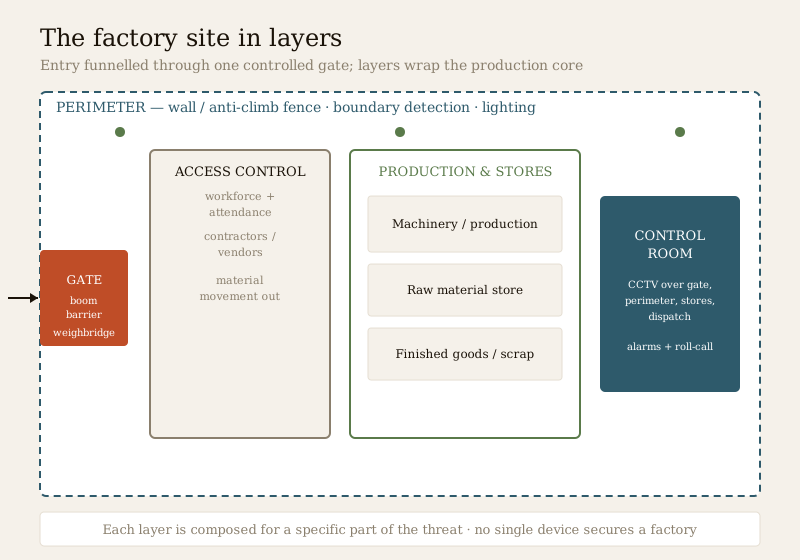
Layer 1 — the perimeter and the single gate
A factory's first layer is the ground it stands on. A large industrial site has a long boundary and often open land around the sheds, and the security principle is the classic one: make the perimeter a real barrier, watch it, light it, and funnel all entry through one controlled point.
- A defined physical boundary — a boundary wall or industrial fencing that actually resists climbing and cutting, not a token line. Anti-climb fencing, topping and a clear zone on the inside all matter over a long run.
- Perimeter detection where the run is long — for a big site, boundary intrusion detection (beam or fence-mounted sensors, or camera analytics) turns a wall someone could quietly scale into a wall that raises an alarm. The perimeter security hub and the perimeter security pillar cover the choices.
- Perimeter and yard lighting — a lit boundary and yard is one of the cheapest, strongest deterrents a factory has, and it makes the cameras usable at night. See the security lighting hub.
- One controlled gate, not many casual ones — the more openings a site has, the weaker each becomes. Funnel people and vehicles through a single (or strictly limited) controlled entry, with the boundary sealed elsewhere.
Right-sizing applies: a small MSME shed does not need a military perimeter, but it does need a real boundary and one controlled way in. A large plant with valuable metal on site needs the full detection-plus-lighting treatment along the run.
Layer 2 — the gate: workforce, attendance and material movement
The gate is where a factory is most exposed and most defended, because everything and everyone passes through it. It carries two jobs that must not be confused: controlling people, and controlling material.
Controlling people. A shift-based workforce, plus contractors and vendors, flows through the gate every day, and the gate must let the right people in efficiently while keeping a clean record.
- Access control and attendance together — worker entry runs on the same credential that marks attendance, so the plant knows who is on site in real time (which is also a life-safety roll-call in an evacuation). The access-control pillar and gate access control cover the mechanisms.
- Contractor and vendor management — contract labour, delivery drivers and service vendors are logged, verified and, where needed, escorted; this is exactly the discipline of visitor access management. Unmanaged contractors are a classic soft entry.
- Vehicle control — trucks and two-wheelers are held and released through a boom barrier at the gate, so no vehicle enters or leaves without passing the check.
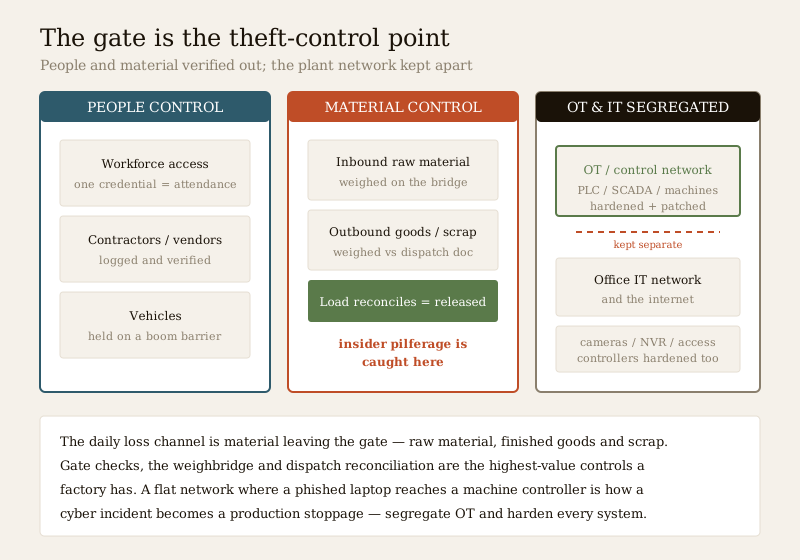
Controlling material — where insider theft actually happens. The theft a factory most underestimates is not a break-in but the quiet, repeated leakage of material out through the gate: raw material, finished goods and, above all, scrap and metal.
- Gate checks on everything leaving — vehicles and, where policy provides, persons are checked on the way out against paperwork. Material does not leave without an authorised dispatch document that matches what is on the vehicle.
- The weighbridge as a control, not just a scale — weighing inbound raw material and outbound finished goods and scrap against documented quantities is one of the strongest anti-pilferage tools a factory has. A load that does not reconcile is caught at the bridge.
- Dispatch integrity — finished-goods dispatch and scrap sales are reconciled against production and stock records, so quantities out match quantities made. Scrap in particular — copper offcuts, metal turnings, rejected castings — has real resale value and is a favourite for internal diversion; treat scrap movement with the same rigour as finished goods.
This material-movement discipline is the single highest-value part of factory security, because it addresses the loss channel that runs every single day. The warehouse security guide goes deeper on dispatch-and-inventory reconciliation for the stock side.
Layer 3 — protecting the assets inside
Past the gate, the plant itself holds the assets: machinery, tooling, raw materials, work-in-progress, finished goods and the ever-present scrap. Asset protection is about zoning and discipline inside the boundary.
- Zone and lock the stores — raw-material and finished-goods stores, the tool crib and any high-value or hazardous material store sit behind controlled access, not open to the whole workforce. Not everyone needs to reach everything.
- Secure the high-theft targets specifically — tools, portable equipment, and copper, brass and metal stock (including scrap) are what walk. Store them securely, mark and record serials on capital equipment, and keep scrap in a defined, controlled area rather than an open heap by the fence.
- Inventory discipline — a stock system that reconciles what came in, what was consumed and what remains is both an operations tool and a theft detector; unexplained shrinkage is a signal, not just a cost. This is the overlap with the warehouse security guide.
- After-hours protection — a factory's highest-risk hours are when a shift ends and the sheds are quiet. An intrusion alarm on stores and key sheds, with realistic alarm monitoring and remote monitoring, protects the plant when nobody is watching.
Layer 4 — IP and the OT/IT network
A factory's most valuable asset is often not on the shop floor at all: it is the intellectual property — product designs, tooling, process parameters, formulations — and the operational-technology (OT) and IT systems that run the plant. Both need protecting, and the cyber layer is where many industrial sites are weakest.
- Protect the IP as information — restrict who can access drawings, process documents and formulations; control removable media and remote copying; and treat design data with the same access discipline as any sensitive record. Physical and information security meet here.
- Segregate OT from IT and the internet — the plant's control systems (PLCs, SCADA, machine controllers — industrial control systems generally) should be on a network segregated from the office IT and, as far as possible, from the internet. A flat network where a phished office laptop can reach a production controller is how a cyber incident becomes a production stoppage.
- Harden and patch, but change carefully — OT/ICS environments need hardening, controlled access and vendor-remote-access discipline, but changes must be planned around production and safety, not pushed blindly. Follow recognised industrial-control-system security practice and your equipment vendors' guidance.
- Secure the security systems themselves — the cameras, NVRs, access controllers and alarm panels are networked devices that must be hardened too; an insecure camera or recorder is a way in, not just a way to watch. The security-system cybersecurity pillar and the cybersecurity hub are the references — a factory cyber breach can stop production or steal IP, so this layer is not optional.
Layer 5 — insider and sabotage risk, handled soberly
A factory has to reckon, calmly and without alarmism, with the reality that harm can come from within — a disgruntled worker, a soured industrial relationship, a dispute that escalates. This is not a reason to treat a workforce as suspects; it is a reason to run sound process.
- Least-privilege access — people can reach the areas, systems and material their role needs, and no more, so a single disaffected individual cannot touch everything.
- Logs and accountability — access, material-movement and system logs mean an incident can be traced and, more importantly, that quiet diversion is likely to be noticed. What is logged is what is deterred.
- A clean joiner-mover-leaver process — credentials, keys and system access are issued on joining and promptly revoked on exit or role change. A departed worker whose card still opens the store is an avoidable exposure.
- Fair process and grievance channels — much sabotage risk is reduced upstream by fair treatment, working grievance mechanisms and good industrial relations. Security supports EHS and HR here; it does not replace them.
Handle this generically and by system, not by profiling. The controls above protect the plant whether or not any individual ever intends harm.
Layer 6 — CCTV over the right zones, never the private ones
Cameras earn their place across a factory — but placement is a discipline, and the privacy line is firm.
Cover, sensibly:
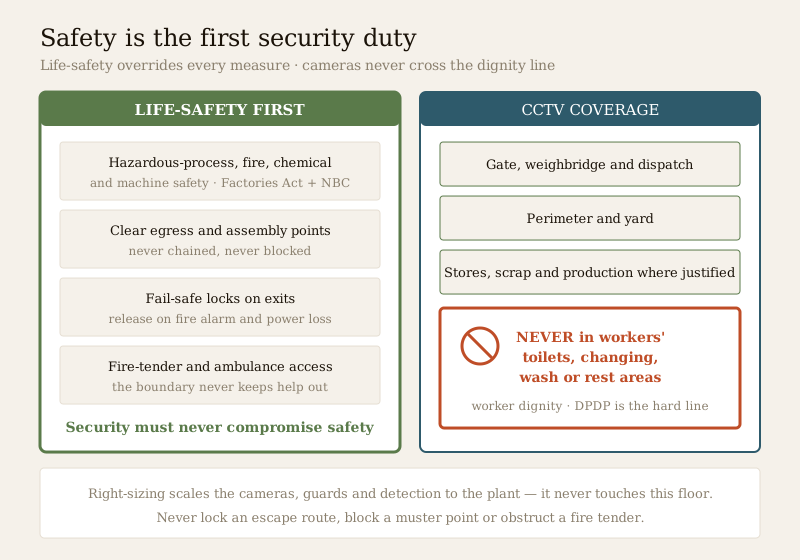
- The gate, weighbridge and dispatch area — where material and people move and where disputes over loads happen.
- The perimeter and yard — supporting the boundary detection and lighting.
- Raw-material and finished-goods stores and the scrap area — the high-theft zones.
- Production where appropriate — for safety, quality and asset protection, where there is a genuine operational reason.
Never place cameras in workers' toilets, changing rooms, wash areas or rest rooms. Recording workers in those spaces violates their dignity and their privacy and is incompatible with the DPDP duty the factory owes them — there is no security or productivity justification that outweighs it. This is the hard line of factory CCTV, and it applies no matter how large the plant.
Beyond placement, the CCTV, access and attendance systems are all personal data under DPDP: display notices that recording and monitoring are in use, restrict who can view footage and records, keep them only as long as needed, and secure the recorders against tampering and remote compromise. The CCTV hub covers placement, coverage and retention in depth.
Safety is the first security duty of a factory
In a factory, safety is not a competing concern to security — it is the most important security duty of all, and it overrides everything above. A plant runs hazardous processes, moving machinery, heat, chemicals and stored energy, and it holds a workforce whose lives depend on getting safety right. No security measure may ever compromise it.
- Hazardous-process, fire, chemical and machine safety come first — machine guarding, chemical handling and storage, fire detection and suppression, and process-hazard controls are governed by the Factories Act, 1948 and its state rules and by NBC (SP 7:2026). Security is layered around these, never at their expense.
- Egress and assembly must never be compromised — every exit, escape route and muster/assembly point stays clear and usable at all times. A gate or door locked against theft that also traps a shift in a fire is a fatal error, not a saving. Electronic locks on exits must fail open on fire alarm and power loss and provide an emergency door release; security locking and fire egress must be designed to be compatible — see fire-egress compatibility.
- Fire-tender and emergency access into the site — the perimeter and gate must let a fire tender and ambulance reach the plant fast; do not design a boundary that keeps help out. See fire-tender access.
- The attendance system is also a roll-call — knowing who is on site, by shift, is a genuine life-safety asset in an evacuation, tying access control to worker safety.
Right-sizing never touches this floor. A plant may reasonably scale its cameras, guards and detection to its size and risk — but it may never lock an escape route, block a muster point or obstruct a fire tender. The fire-safety hub covers the detection, suppression and egress minimums that apply.
Layer 7 — PSARA guards and a security control room
A large plant needs people, and a place from which to run its security. Guarding and a control room tie the layers together.
- PSARA-verified guards — manned guarding at the gate, perimeter patrols and the control room must be supplied through a PSARA 2005-registered agency, with verified, trained personnel. The gate guard in particular is the human check behind the weighbridge and dispatch discipline. See guardhouse design.
- A security control room — for a large factory, a control room consolidates CCTV monitoring, alarm annunciation, access-control oversight and gate coordination, and becomes the incident-response and evacuation-coordination point. It is where the alarm monitoring feeds land and where the shift roll-call matters most in an emergency.
- Procedures, not just kit — patrol routines, gate-check protocols, key control, incident escalation and evacuation drills are what make the hardware effective. A control room without procedures is a room full of screens.
The factory security composition
Pulling it together, a factory composes the shared building blocks in layers, each matched to a specific part of its threat profile:
| Layer | What it protects | Composed measure for a factory | Key rule |
|---|---|---|---|
| Perimeter | The large site boundary and yard | Wall / anti-climb fence; boundary detection over the long run; perimeter and yard lighting | Real barrier, watched and lit; funnel entry to one gate |
| Gate & people | Workforce, contractors, vehicles | Access control tied to attendance; contractor / visitor logging; boom barrier on vehicles | The gate is the record of who is on site — and the roll-call |
| Gate & material | Raw material, finished goods, scrap | Gate checks on all outbound loads; weighbridge reconciliation; dispatch integrity | Insider pilferage is caught at the gate; scrap gets full rigour |
| Assets | Machinery, tools, metal, stock | Zoned and locked stores; secured high-theft items; inventory reconciliation; after-hours alarm | Shrinkage is a signal; copper and scrap are theft targets |
| IP & OT/IT | Designs, processes, control systems | Restricted IP access; OT network segregated from IT and internet; hardened, patched, secured systems | A cyber breach can stop production or steal IP |
| Insider risk | The whole plant | Least privilege; logs; prompt leaver revocation; fair process via HR/EHS | Handle soberly and by system, never by profiling |
| CCTV | Gate, perimeter, stores, dispatch, production | Well-placed cameras with DPDP notice and retention | Never in toilets, changing or rest areas |
| Guards & control room | The coordinated whole | PSARA-verified guards; control room for CCTV, alarms and gate; procedures and drills | Guards through a PSARA-registered agency; procedures make kit work |
| Safety / life-safety | Every worker on site | Hazardous-process, fire, machine safety; clear egress and assembly; fail-safe locks; fire-tender access | Overrides everything; per Factories Act 1948 and NBC (SP 7:2026) |
Two Studio Matrx tools help a plant do this concretely: the site perimeter security assessment checks the boundary, gate and lighting fundamentals a large site depends on, and the home security risk scorecard is a quick structured way to surface where a smaller MSME unit's gaps really are so a limited budget goes to the right layer first.
Key takeaways
- A factory protects six things at once — a large perimeter, a shift workforce and its gate, the assets, IP and OT, insider risk, and life-safety. It is secured by layers, not one device; don't let cameras eat the whole budget.
- The gate is the theft-control point — insider pilferage happens in the daily movement of raw material, finished goods and scrap out of the gate; gate checks, a weighbridge and dispatch reconciliation are the highest-value controls a factory has.
- Scrap and metal are theft targets in themselves — copper, brass and offcuts have real resale value; give scrap movement the same rigour as finished goods.
- Segregate and harden OT — keep the plant's control systems on a network separate from office IT and the internet, and secure the security systems themselves; a cyber breach can stop production or steal IP.
- Handle insider and sabotage risk soberly — least privilege, logs, prompt leaver revocation and fair process via HR and EHS, never by profiling.
- CCTV covers gate, perimeter, stores, dispatch and production where justified — never workers' toilets, changing or rest areas. Worker dignity is the hard line, and DPDP governs the footage, access and attendance data.
- Safety is the first security duty — hazardous-process, fire, chemical and machine safety and clear egress and assembly, per the Factories Act 1948 and NBC (SP 7:2026), override every security measure; never lock an escape route, block a muster point or obstruct a fire tender.
- Use PSARA-verified guards and a control room — a large plant needs trained guarding through a registered agency and a control room with real procedures and drills, not just screens.
Where to go next
- Warehouse security — the stock-storage overlap: racking, dispatch and inventory integrity for a factory's stores.
- Commercial buildings security — the shared office, gate and visitor fundamentals that sit alongside the plant.
- Perimeter security pillar and the perimeter and lighting hubs — the boundary layer for a large site.
- Access-control pillar, gate access control, boom barriers and visitor access management — the gate, attendance and contractor discipline.
- Security-system cybersecurity pillar and the cybersecurity hub — protecting the OT/IT network and the security systems.
- CCTV hub, alarm monitoring and remote monitoring — camera placement and after-hours coverage.
- Fire-safety hub, fire-egress compatibility, emergency door release and fire-tender access — the life-safety layer that overrides all.
- Guardhouse design — the manned gate and control room.
- The building-type security pillar and the building-types sub-hub, plus the main security hub.
References
- The Factories Act, 1948, and the relevant State Factories Rules — the primary law governing worker safety, hazardous processes, machine guarding, fire safety, egress and welfare in a manufacturing factory; safety obligations here take priority over any security measure. Verify the current provisions and your state rules.
- National Building Code of India (SP 7), Bureau of Indian Standards — occupancy classification (industrial), means of egress, exit width, travel distance, assembly and fire-safety provisions governing a factory building. Verify the current edition (SP 7:2026) via the BIS catalogue: https://www.services.bis.gov.in/
- Digital Personal Data Protection Act, 2023 — CCTV footage, access-control records and attendance data are personal data; the factory is the data fiduciary and must protect them, control access, notify monitoring and handle them lawfully.
- Private Security Agencies (Regulation) Act, 2005 (PSARA) — any guard deployed at a factory must be supplied through a PSARA-registered agency; verify licensing before contracting.
- Industrial control system (OT/ICS) security practice — recognised guidance on segregating and hardening operational-technology networks and control systems; apply the principles alongside your equipment vendors' guidance rather than any single product.
- Crime Prevention Through Environmental Design (CPTED) — the named design approach behind natural surveillance, controlled entry, defined zoning and territorial reinforcement across a large site; apply its principles rather than any single product.
This is an educational, layered planning overview for factory owners, plant managers, EHS and security heads and their consultants — not legal advice, an installation manual, or a substitute for factory-licensing, industrial-safety, environmental or data-protection compliance. Worker safety, hazardous-process safety, egress and fire provisions take priority over any security measure; engage a licensed installer, security consultant and safety professional for a site at this scale, deploy guards only through PSARA-registered agencies, and verify any standard's current status via the BIS catalogue before relying on it.
Export this guide
Related Guides — Deep-dive reading
Complete Guide to Security System Cybersecurity in India (2026): Protecting the Systems That Protect You
The cameras, locks, alarms and door phones you install to feel safer are internet-connected computers that can themselves be attacked, and an insecure one is worse than none. This pillar maps the whole attack surface — devices, network, accounts and data, operations — and points to every guide that hardens it.
SecurityWarehouse Security in India (2026): Protecting Stock, Docks and Dispatch
How a godown, distribution centre, 3PL facility or cold-store secures a large-footprint building full of high-value stock with constant vehicle and goods movement — layering perimeter, gate-and-dock control, inventory discipline, after-hours monitoring and fire safety without ever blocking worker egress.
SecurityComplete Guide to Building Type Security in India (2026): Right-Sizing Protection to Homes, Schools, Hospitals, Warehouses and Temples
The same security building blocks — perimeter, gate and access, CCTV, alarms, lighting, fire, guards and cyber — are composed very differently for a villa, a school, a hospital, a warehouse or a temple. This pillar maps the whole library of building-type guides and gives you the framework to tailor security to each kind of building.
SecurityRelated Tools — Try Free
CCTV Camera Coverage & Count Calculator
Estimate how many CCTV cameras you need, the NVR channels, storage in TB for your retention period, and an indicative all-in cost with GST.
CCTV CalculatorHome Security Risk Scorecard
Score your home across six security layers — perimeter, entry points, lighting, detection, alarm and habits — and get a prioritised action plan.
Security ScorecardCCTV Camera Overlap Calculator
The overlap or blind gap between two adjacent cameras, from coverage width and spacing, plus the spacing for a target overlap.
Overlap