
Construction Drawings Masterclass: How to Read Your Home's Working Drawings
The complete homeowner's field guide to the drawing set that builds your house — architectural, structural, plumbing, electrical and HVAC sheets, what each one is for, the symbols and scales that decode them, and how to review them before you pour a single footing.
The folder lands on your dining table with a soft thud — a fat roll of paper, or a stack of A1 sheets, or a PDF the size of a small novel. Your architect calls it the GFC set. The contractor calls it the working drawings. You open the first sheet and it might as well be a flight-deck schematic: a maze of thin lines, tiny numbers, letters in bubbles, hatched squares, and a code in the corner that reads A-101. Somewhere inside this bundle is your home — every wall, every socket, every centimetre of your bathroom slope. And right now you cannot read a word of it.
Here is the reassuring truth. A construction drawing set is not a secret language meant to keep you out. It is an instruction manual, and like any manual it follows rules — rules so consistent that once you learn the grammar of one sheet, the other two hundred fall open. Builders in Coimbatore, Kochi and Kolkata are all reading from the same conventions, most of them codified by the Bureau of Indian Standards decades ago.
This masterclass is the map of the whole territory. Think of it as the index at the front of the manual — it tells you what each chapter is, why it exists, and where to go deep.
A construction drawing set is the complete, scaled, coordinated package of drawings — architectural, structural and services (MEP) — that translates a design into precise instructions for building it, where every line, symbol, dimension and code letter carries a specific, agreed meaning.
This is the pillar guide for our whole Construction Drawings cluster, written first for the homeowner who has just been handed a set and feels lost — and then, layer by layer, for the B.Arch or civil student and the junior site engineer who want the real technical depth. If you only read one guide, read this; it links to all thirteen deep-dives. If you want to start by understanding the difference in how a trained eye reads, jump to how architects read drawings differently than homeowners. If you are about to approve a set before a pour, go straight to the construction drawing review checklist.
A drawing is a promise about a building that does not exist yet. Reading it well is how you keep that promise honest before the concrete sets.
1. What the drawing set actually is
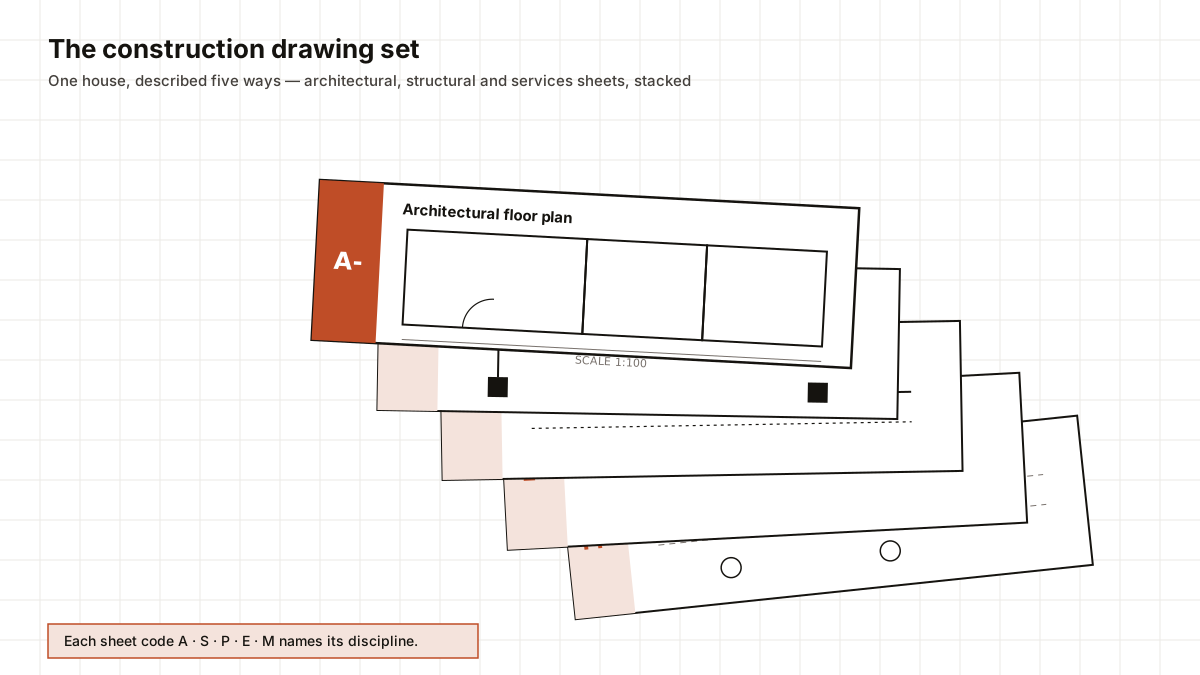
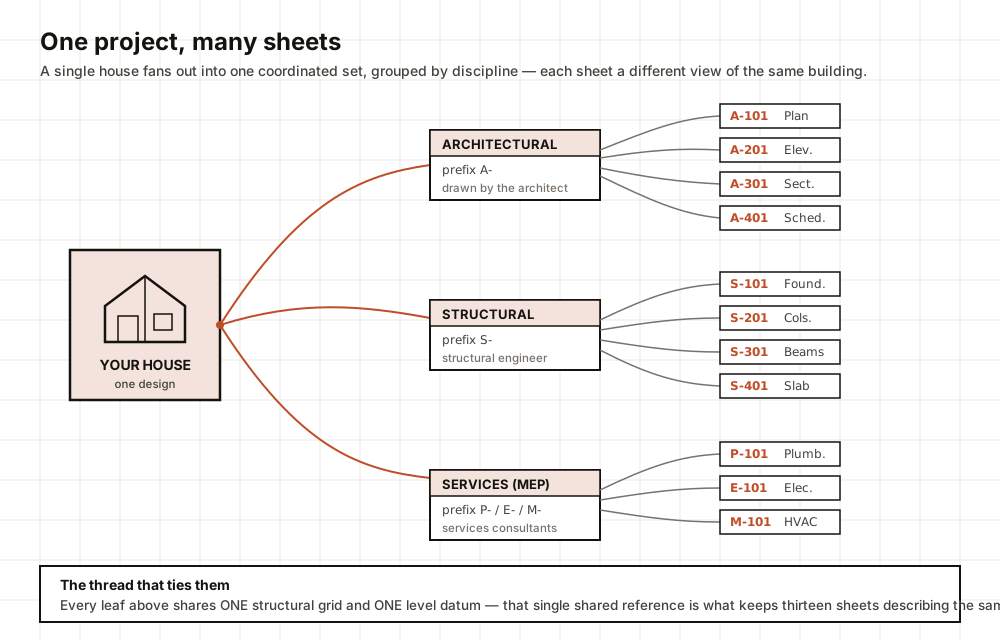
In India a house is rarely built from one drawing. The folder you were handed is a coordinated set produced over weeks by several people who barely sit in the same room: a registered architect, a structural engineer, and one or more services consultants for plumbing, electrical and air-conditioning. Each draws their own sheets, but all of them pin their work to the same grid and the same levels (we will meet those in Section 6) so that the parts fit on site.
The set is usually issued in stages. Early sheets are concept and General Arrangement (the GA — the overall floor plans and elevations). Once the design is frozen, the structural and services drawings are produced and coordinated against the architecture. The final, buildable version is stamped Good for Construction — GFC. Until a sheet says GFC (or your local equivalent), it is not safe to build from.
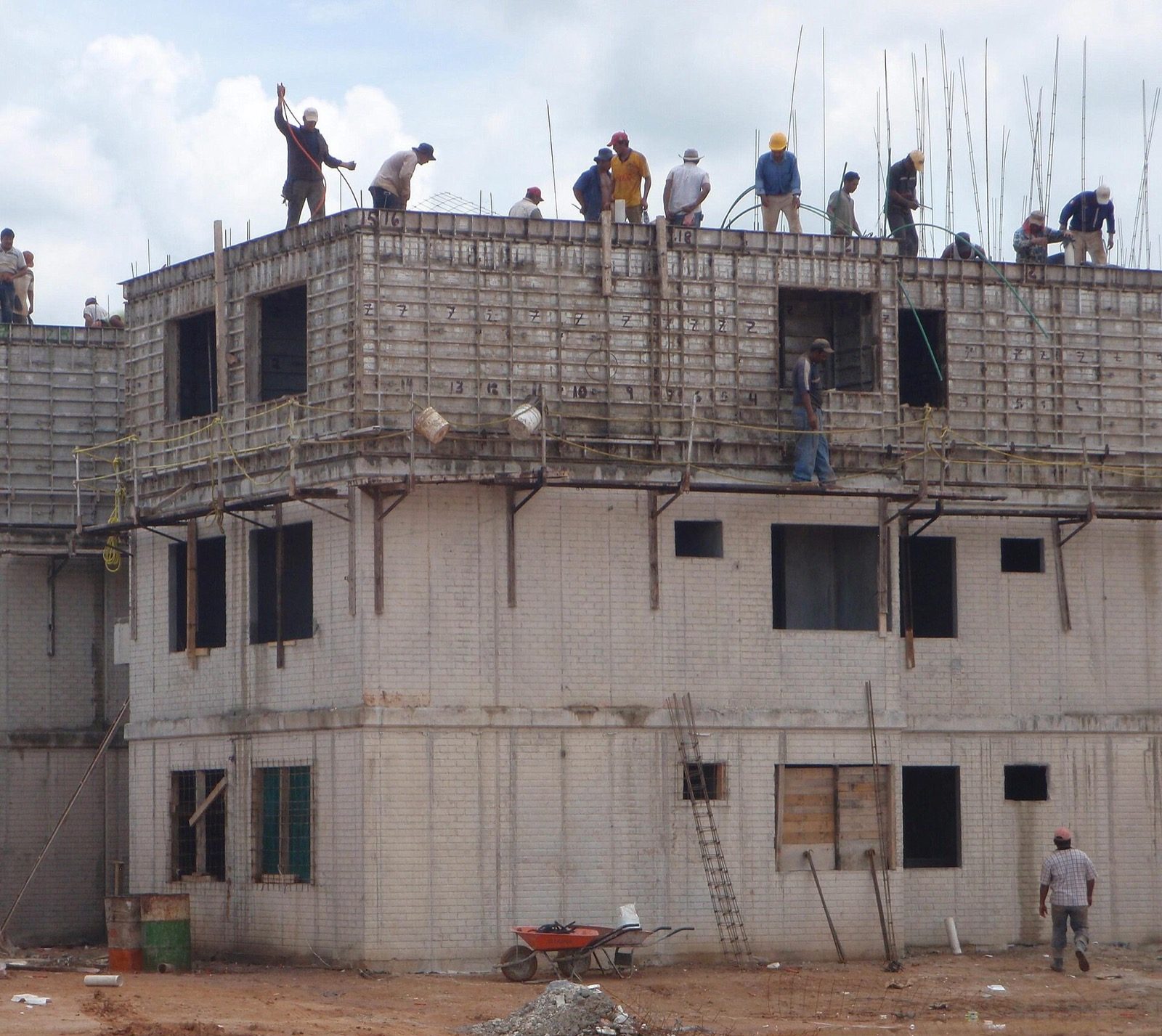
Every line on the sheets above becomes something like this on site. The reinforced-concrete frame in the photograph — walls, slabs and the starter bars waiting for the next floor — is exactly what the structural and GFC sheets describe in plan and section before a single bag of cement is opened.
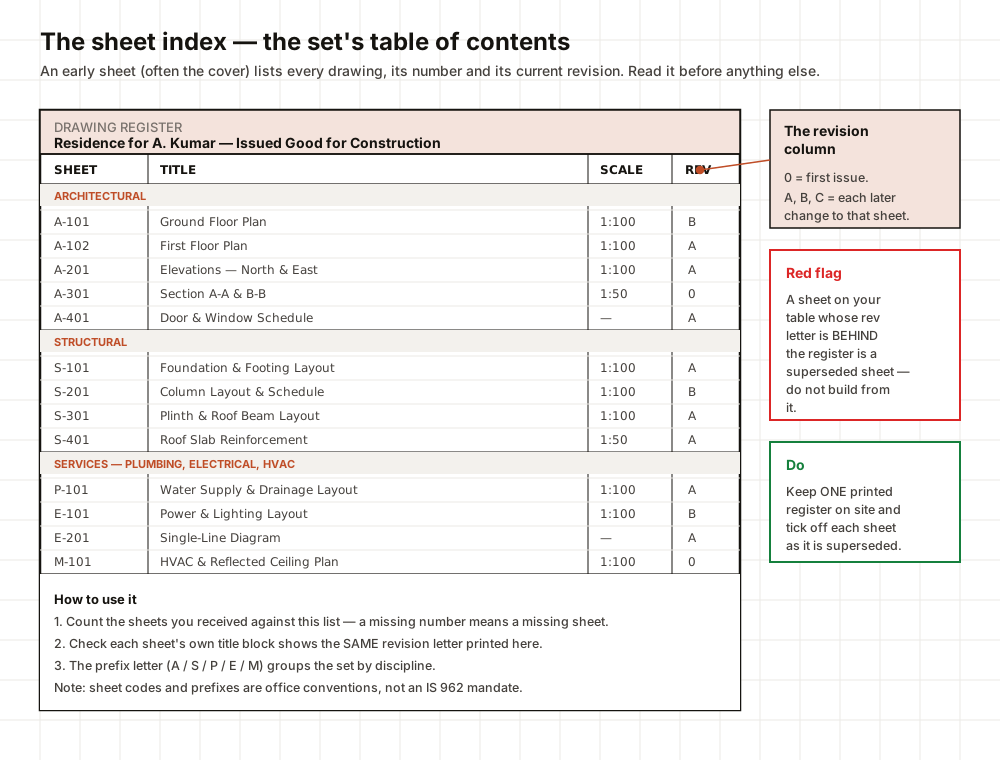
The very first thing to find in any set is its sheet index (also called the drawing register) — usually on the cover sheet. It lists every drawing by number and title, with the current revision against each, so you can check at a glance that you received the whole set and that nothing on your table is an out-of-date version.
A few words you will hear on every Indian site, defined once:
| Term | Plain meaning |
|---|---|
| RCC | Reinforced Cement Concrete — concrete with steel bars inside |
| GA | General Arrangement — the overall floor-plan / elevation sheets |
| GFC | Good for Construction — the approved, buildable version of a sheet |
| MEP | Mechanical, Electrical & Plumbing — the building services |
| Plinth | The base platform of the house, just above ground level |
| c/c | Centre-to-centre — spacing measured between the middles of two things |
| Ø | Diameter — used for bar sizes and pipes (16Ø means 16 mm diameter) |
| FFL / RL | Finished Floor Level / Reduced Level — height references |
For students & site engineers: the conventions for sizes, layout, line-work, lettering, scales and material representation in Indian building drawings are laid out in IS 962 (Code of Practice for Architectural and Building Drawings). It is the quiet rulebook behind almost everything on these sheets — worth reading once in full.
2. The disciplines — and who draws what
The single most useful mental model is to stop seeing one fat folder and start seeing a stack of disciplines, each owned by a different professional. The architectural sheets describe the spaces and finishes; the structural sheets describe the skeleton that holds it up; the MEP sheets describe what flows through it.
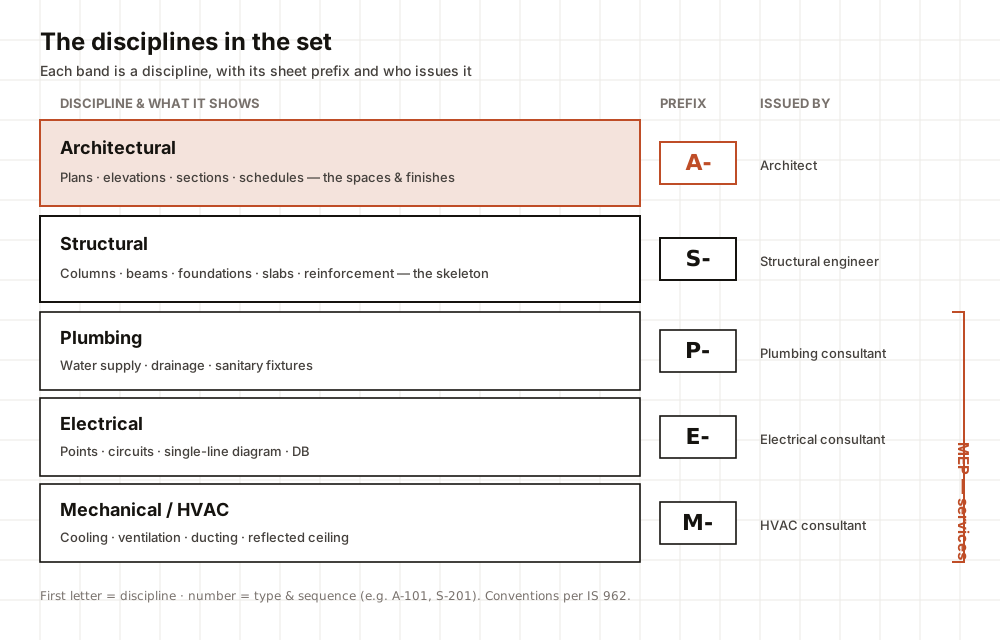
Most offices in India follow a discipline-prefix system borrowed from international practice (notably the AIA / CSI Uniform Drawing System; note that IS 962 itself does not mandate these letters — office conventions vary). The first letter of a sheet number tells you its discipline, the number tells you the type and sequence:
| Prefix | Discipline | Issued by | Deep-dive |
|---|---|---|---|
| A- | Architectural — plans, elevations, sections, schedules | Architect | how architects read drawings |
| S- | Structural — columns, beams, foundations, slabs, reinforcement | Structural engineer | column layout · beams |
| P- | Plumbing — water supply, drainage, sanitary | Plumbing consultant | plumbing drawings |
| E- | Electrical — points, circuits, single-line diagram | Electrical consultant | electrical drawings |
| M- | Mechanical / HVAC — cooling, ventilation, ducting | HVAC consultant | HVAC drawings |
So a sheet marked S-201 is a structural sheet; A-101 is your ground-floor architectural plan. The contractor for one trade can pull just their letter and ignore the rest. The deep-dive on how all the drawings work together shows how these disciplines coordinate around one shared grid — and where they clash.
The reason the folder is so thick is that one design fans out into many sheets. A single house becomes a coordinated family of drawings, grouped by discipline and produced by different professionals — yet every leaf of that fan is pinned to the same grid and the same level datum, which is what keeps them all describing one building.
The structural family in particular
Because structure is where homeowners get most nervous, the cluster breaks it into five guides, in the order the building rises from the ground up:
- Foundation drawings explained — what is under your house: footings, rafts, piles, the plinth beam.
- Understanding column layout drawings — the vertical skeleton and the grid that locks your plan.
- Beam layout drawings explained — the horizontals that carry the floors onto the columns.
- Roof & floor slab drawings explained — the flat planes you live on and under, including sunken slabs for wet areas.
- Reinforcement drawings simplified — the steel hidden inside all of the above, and the notation that describes it.
3. The title block — the sheet's passport
Before you read a single line of the drawing, read the box in the bottom-right corner. The title block is the sheet's passport: it tells you what you are looking at, how big it is on paper, who drew it, who checked it, and — crucially — whether this is the latest version. A homeowner who learns to read only the title block has already avoided the most common and most expensive mistake: building from a superseded sheet.
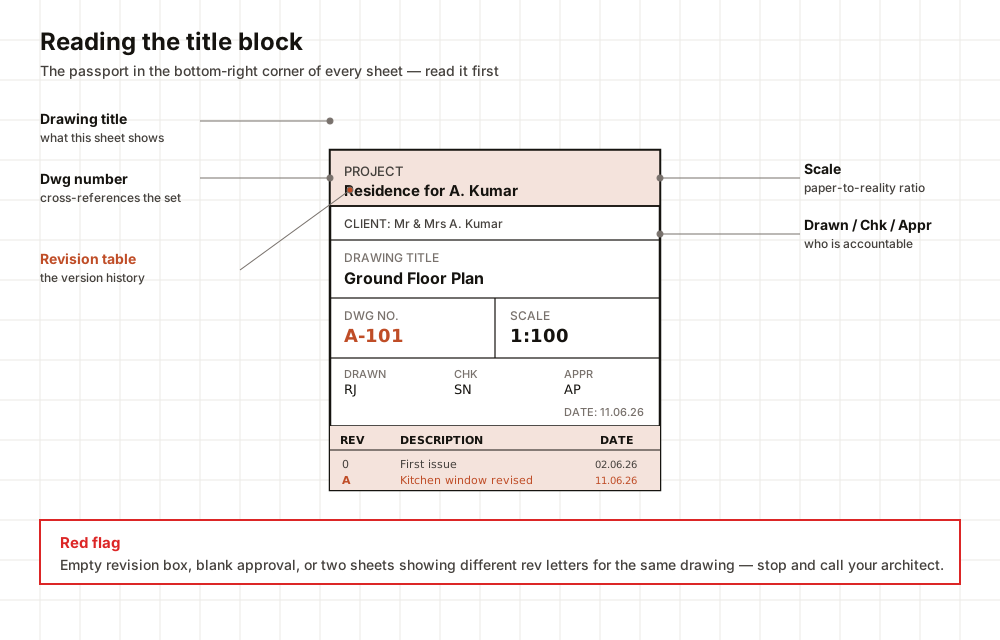
Every title block, whatever the office style, carries the same essential fields:
| Field | What it tells you | Why you care |
|---|---|---|
| Project & client | Whose house, which project | Confirms the sheet is yours, not a reused template |
| Drawing title | What this sheet shows | "Ground Floor Plan", "Footing Layout" |
| Drawing number | The unique sheet code (A-101) | Lets you cross-reference across the set |
| Scale | Paper-to-reality ratio (1:100) | How to measure off it — see scales |
| Date | When it was issued | Pairs with the revision to fix the version |
| Drawn / Checked / Approved | Who is accountable | A blank "Approved" box is a pause sign |
| Revision table | The history of changes (Rev 0, A, B…) | The single most important box on the sheet |
Red flag: if the revision box is empty, the approval line is blank, or two sheets in the same set carry different revision letters for the same drawing, stop and call your architect. Revision control is not bureaucracy — it is the difference between everyone building the same house. The first issue is normally Rev 0 or a dash; each change bumps the letter or number, with a one-line reason and a date.
4. Scale — how a 9-metre wall becomes 18 centimetres
A drawing is the building shrunk by a fixed ratio. At 1:100, one unit on paper equals a hundred in reality, so a 9-metre (9000 mm) wall is drawn 90 mm long. At 1:50 the same wall is 180 mm — twice as long on paper, because you are twice as zoomed in. The bigger the second number, the more zoomed out (and less detailed) the drawing.
Different sheets use different scales because they have different jobs. You do not detail a tap at the same zoom you use to show a whole plot:
| Drawing type | Typical scale | Zoom level |
|---|---|---|
| Site / layout plan | 1:500 to 1:200 | Far out — the whole plot |
| Floor plans | 1:100 (sometimes 1:50) | The standard working view |
| Sections & elevations | 1:50 | Closer — heights and build-up |
| Construction details | 1:20 to 1:5 | Very close — joints, junctions |
| Full-size details | 1:1 | Exactly real size |
The cardinal rule, taught on day one of every site: a written dimension always beats a scaled-off one. Paper stretches, photocopiers shrink, PDFs get resized. If a wall says 3450 in writing, it is 3450 — even if your ruler reads 3400 off the print. The graphic scale bar printed on the sheet survives photocopying because it shrinks with the drawing; the stated ratio does not. The full mechanics, with worked examples, are in understanding drawing scales.
5. Symbols — the alphabet of the set
Once you accept that a drawing is shrunk, the next leap is accepting that it is also abstracted. A door is not drawn as a door; it is a gap in the wall with a quarter-circle arc showing the swing. A WC is a rounded outline. A socket is a small symbol with a tail. These conventions are standardised so that an electrician in Surat reads the same symbol as one in Salem.
You do not need to memorise them all at once. You need a legend — and almost every set prints one, usually on an early sheet or beside each services plan. Our visual glossary, 50 construction drawing symbols every homeowner should know, draws and explains the ones you will actually meet: doors and their swings, windows, ventilators, stairs with their up-arrow, the north point, the section-cut marker, the grid bubble, plumbing fixtures, electrical points, and the material hatches (brick, RCC, stone, earth) that tell you what a wall is made of just from how it is shaded in section.
For students & site engineers: the graphical symbols and conventional representation of materials are themselves governed by IS 962, which is why a brick hatch or an RCC poche looks the same across offices. Learn the standard set early; it makes you fluent in every discipline's sheets at once.
6. The two coordinate systems that locate everything
Here is the idea that makes the whole set click into place. Every element in a building is located by two coordinate systems at once: a grid that fixes its position in plan (where it is on the floor), and a system of levels that fixes its height (how far up it is). Master these two and you can find any element on any sheet.
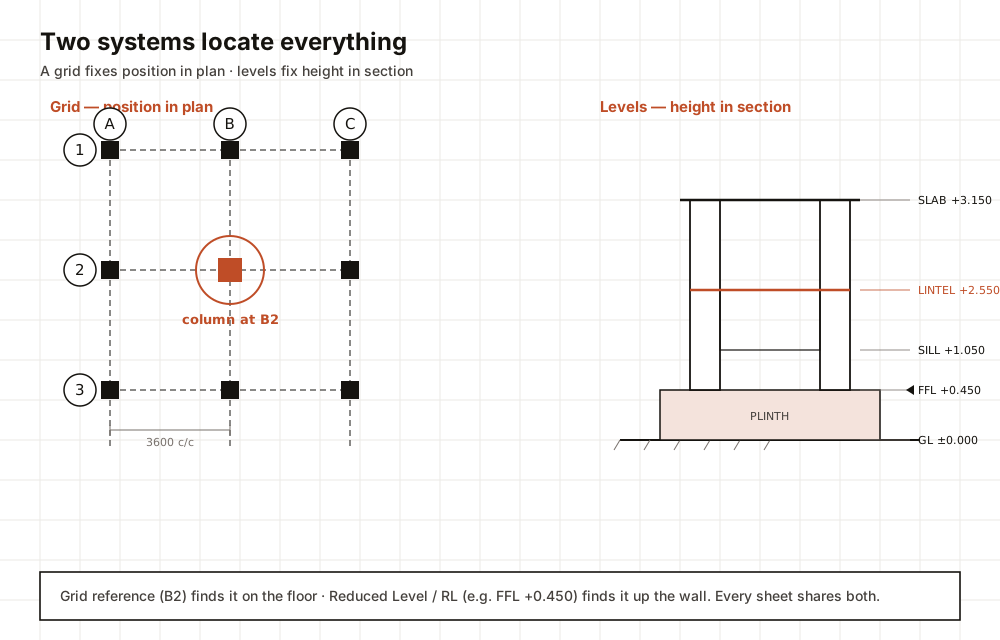
The grid is a set of reference lines, lettered one way (A, B, C across) and numbered the other (1, 2, 3 down), each ending in a circle called a grid bubble. Columns usually sit at the intersections, so a column can be named by its grid reference — the column at B3 is the same column on the architectural plan, the structural plan and the plumbing plan. This shared grid is what lets five different consultants talk about the same point without confusion. The column layout guide reads the grid in detail.
Levels work vertically. The plinth level is the top of the base platform; the Finished Floor Level (FFL) is the surface you walk on after flooring; sill and lintel levels are the bottom and top of window and door openings. Heights are often written as Reduced Levels (RL) — heights relative to a fixed datum on site. A note like "FFL +0.450" means the finished floor is 450 mm above the datum.
For students & site engineers: the grid is the structural backbone and the level datum is the survey backbone; coordination between disciplines is essentially the discipline of keeping every sheet pinned to the same two systems. When a clash happens on site, the first question is almost always "are we on the same grid line and the same RL?"
7. How one room appears across the whole set
The reason a drawing set has so many sheets is that the same room must be described five different ways — as a space, as a structure, and as three kinds of services. The trick to reading the set is to follow one room across the disciplines and watch it transform.
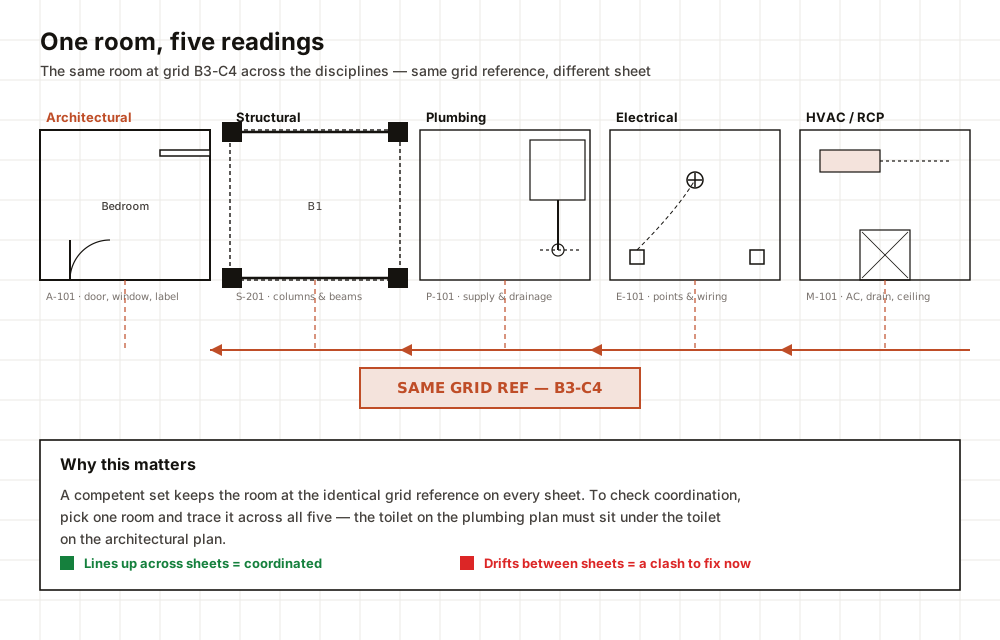
Take your master bedroom at grid B3-C4. On the architectural plan it is a labelled rectangle with a door swing, a window, a wardrobe niche and a dimension string. On the structural plan the room dissolves into the columns at its corners and the beams spanning between them. On the plumbing plan only the attached toilet is busy — supply and drainage lines to the fixtures. On the electrical plan the same room sprouts switches, sockets, a light and a fan point, with dotted wiring runs. On the reflected ceiling / HVAC plan it shows the AC indoor unit, its drain and refrigerant route, and the ceiling fittings.
Same room, same grid reference, five readings. The arrows in the figure are the whole point: a competent set keeps that grid reference identical across every sheet. When it does not — when the toilet on the plumbing plan does not line up with the toilet on the architectural plan — you have found a coordination error before it became a chipped slab. The guide on how all construction drawings work together is the deep-dive on exactly this coordination, including the classic clashes (a beam through a duct, a column in a doorway) and how a single change ripples across the set.
8. The full cluster — your thirteen deep-dives
This pillar is deliberately broad. Each topic below has its own guide that goes to real depth, with its own figures, tables and red-flag call-outs. Here is the complete map:
- How architects read drawings differently than homeowners — the professional's triage order, and how to borrow it.
- Understanding column layout drawings — the grid, column marks (C1, C2), sizes, orientation and the schedule.
- Beam layout drawings explained — beam marks (B1, B2), width x depth, main vs secondary, and why a beam must land on a column.
- Foundation drawings explained — footing types, the footing schedule, safe bearing capacity and the plinth beam.
- Roof & floor slab drawings explained — one-way vs two-way slabs, thickness, levels, sunken slabs.
- Reinforcement drawings simplified — decoding 4-16Ø and 8Ø @ 150 c/c, the bar bending schedule, cover and laps.
- Plumbing drawings explained — supply vs drainage, slopes, traps, vents and wet-area stacking.
- Electrical drawings explained — points, circuits, the single-line diagram, the DB and load.
- HVAC drawings explained — split and ducted systems, the reflected ceiling plan, drains and refrigerant runs.
- How all construction drawings work together — coordination, clashes, the issue sequence and change control.
- 50 construction drawing symbols every homeowner should know — the visual glossary.
- Understanding drawing scales — ratios, the scale bar, and never trusting a scaled dimension over a written one.
- Construction drawing review checklist — the printable, room-by-room and sheet-by-sheet review before the concrete.
9. How to use this masterclass
You do not have to read all fourteen guides before you can act. Read this pillar to build the map. Then, depending on where you are:
- Just handed a set? Start with how architects read drawings, then the symbols glossary and scales.
- About to approve drawings before work begins? Go straight to the review checklist — it is printable and structured for a single sitting.
- Worried about the structure specifically? Read foundation, column, beam, slab and reinforcement in that order.
- Planning kitchens and bathrooms? Pair plumbing with electrical and HVAC.
If you do not yet have a set — if you are still at the idea stage — explore visual concepts for your home with DesignAI, browse ready layouts in our house plans library, or find an architect to produce a proper stamped set. Drawings are only as good as the people who stamp them; this masterclass helps you be the informed client who gets the best out of them. For the bigger picture of the whole journey, see our guide on building a house in India.
Image credits
- Photograph (a multi-storey reinforced-concrete building under construction in its formwork): WTF Formwork http://www.wallties.com — CC BY-SA 3.0, via Wikimedia Commons. Source: https://commons.wikimedia.org/wiki/File:Aluminum_Formwork.JPG
References & Further Reading
Indian standards & manuals
- IS 962 — Code of Practice for Architectural and Building Drawings (sizes, layout, scales, line-work, lettering, dimensioning, graphical symbols and conventional representation of materials).
- National Building Code of India, NBC 2016 (Bureau of Indian Standards) — Part 3 (Development Control Rules & General Building Requirements) and the building-classification framework.
- IS 456 — Plain & Reinforced Concrete, Code of Practice (concrete grades, nominal/clear cover).
- IS 13920 — Ductile Design & Detailing of RC Structures Subjected to Seismic Forces (mandatory detailing in seismic Zones III–V).
- IS 2502 and SP 34 — Bending and fixing of reinforcement bars, and the Handbook on Concrete Reinforcement & Detailing (bar bending schedules).
- IS 732 — Code of Practice for Electrical Wiring Installations; relevant CPHEEO manual and IS 1742 / IS 2064 for plumbing & sanitary practice; NBC 2016 Part 8 / ISHRAE references for HVAC & ventilation.
Books / references
- Francis D. K. Ching, Architectural Graphics — the classic on drawing conventions and reading plans.
- Bureau of Indian Standards, SP 34 (S&T): Handbook on Concrete Reinforcement and Detailing.
- C. M. Sweet / standard Indian textbooks on Building Drawing and Building Construction used in B.Arch and diploma courses.
Companion Studio Matrx guides
- Building a house in India · Modern house design in India
- Facade design for Indian climates · Passive design for India's climate zones
- Architect fee structures in India — who produces and stamps your set, and what it costs.
Author's Note — Amogh N P. I have watched homeowners hold a drawing set the way you hold a letter in a language you half-recognise — anxious, a little ashamed of not understanding. You should never feel that. These sheets were made for you; learning to read them is not an engineer's privilege but your right as the person whose home and money are on the table. Start with the title block, follow one room across the set, and trust the written dimension. The rest is just patience, and I wrote this whole cluster to keep you company through it.
Disclaimer. This guide is an educational overview to help you read and discuss construction drawings; it is not a substitute for a licensed structural engineer, MEP consultant or registered architect. All sizes, covers, slopes, levels, loads and bearing-capacity figures mentioned anywhere in this cluster are indicative and typical only — act exclusively on the stamped, project-specific drawings prepared for your site, and consult the relevant professional before making any construction decision.
Export this guide
Related Guides — Deep-dive reading
How All Construction Drawings Work Together
From one grid to a finished house — how architectural, structural and MEP sheets coordinate, where clashes hide, the order drawings are issued, and how a small change ripples across the whole set.
Construction DrawingsBathroom Planning for New Homes in India: Get It Right Before You Build
The bathroom decisions you cannot undo once the slab is cast — location and stacking, sunken vs non-sunken slabs, waterproofing, and the plumbing, electrical and ventilation you must coordinate with the civil work, stage by stage.
BathroomsHow Architects Read Drawings Differently Than Homeowners
The same sheet, two different readings — what a trained eye notices first, the questions professionals ask of a drawing, and how to start seeing a plan the way your architect does.
Construction DrawingsRelated Tools — Try Free
Cross-Ventilation Analyzer
Estimate airflow and air changes per hour (ACH) from room size, window areas, layout, and local wind — with NBC 2016 Part 8 compliance check.
Ventilation CalculatorMaterial Schedule Generator
Generate a room-wise finish schedule — walls, floors, ceilings, trim, and joinery by location.
Material ScheduleInterior Layout Planner — Printable Graph Grid
Printable graph grid to sketch room layouts to scale before committing to furniture placement.
Layout Tool