
Beam Layout Drawings Explained
How the beams that carry your slabs are drawn — beam marks, sizes, the difference between a beam you can see and one hidden in the slab, and why beams must land on columns.
Picture the roof of a room as a wide, flat tray of concrete — your slab. Now ask the obvious question that almost nobody asks until the drawings arrive: what is holding that tray up at its edges so it does not simply sag and crack in the middle? The answer is a frame of concrete ribs running along the tops of your columns. Those ribs are the beams, and the beam layout drawing is the sheet that tells the contractor exactly where every one of them goes.
If the column layout is the skeleton's legs, the beam layout is its rib cage — the horizontal members that span from leg to leg, catch the floor above, and hand its weight down to the columns. Get this sheet wrong on paper and you get a cracked ceiling, a sagging floor, or a beam ugly-dropping into the middle of your living room. Get it right and you never think about it again.
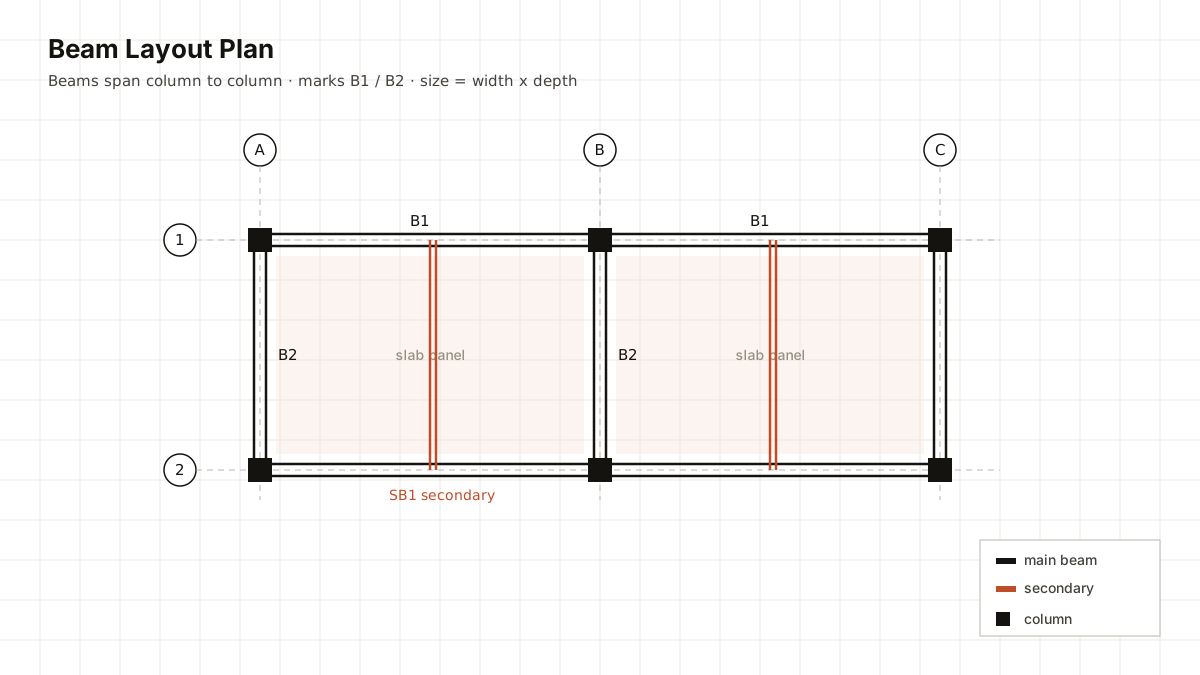
A beam layout drawing is the structural sheet that shows, in plan, every beam of a floor — where it runs, what it is called (its beam mark), and how big it is (width x depth) — so the slab it carries is supported on a clear path of beams down to the columns and into the ground.
This guide is written for the homeowner who has just been handed a beam layout and feels the lines blur together, and then goes one layer deeper for the B.Arch / civil student and the junior site engineer who needs the real conventions. It sits inside our Construction Drawings Masterclass and reads most naturally right after Understanding Column Layout Drawings — because beams land on columns — and just before Roof & Floor Slab Drawings Explained and Reinforcement Drawings Simplified, which show what the slab on top and the steel inside actually look like.
A beam is a promise the slab makes to the column: I will not fall, because there is always a clear line of support beneath me.
1. What a beam actually does
A beam is a horizontal structural member that collects load from the slab (and any wall sitting on it) and carries that load sideways to its supports — the columns — which then take it straight down. In an RCC (reinforced cement concrete) framed house, almost every floor and roof works this way. The slab is the surface; the beams are the lines of support under its edges.
The single most useful idea in the whole sheet is the load path. Weight does not teleport into the ground; it travels along a chain, and every link must exist:
| Step | Element | What it does |
|---|---|---|
| 1 | Slab | The flat plane you stand on; spans between beams |
| 2 | Secondary beam | Picks up slab load mid-panel, hands it to main beams |
| 3 | Main (primary) beam | Spans column to column; collects the load |
| 4 | Column | Carries the collected load vertically down |
| 5 | Footing / foundation | Spreads it into the soil |
If any link in that chain is missing — most commonly a beam with no column under one end — the load has nowhere clean to go, and the structure improvises in ways an engineer never intended. That is the golden rule of this entire sheet: a beam should span between supports, and at a framed-building level those supports are columns (or, for a secondary beam, another beam). We will come back to this in Section 5, because it is the one red flag a homeowner can genuinely catch.
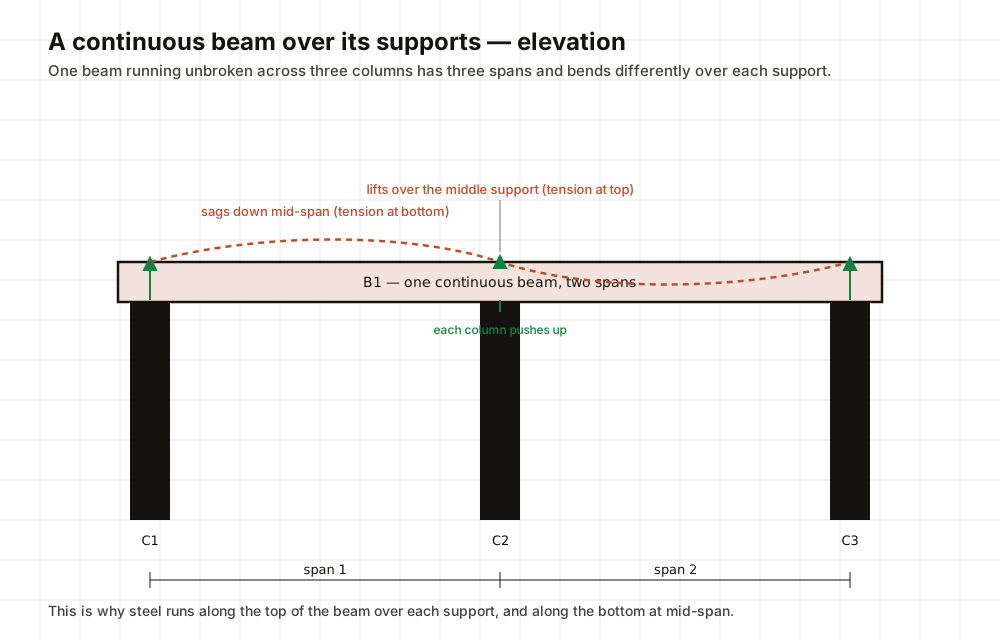
A single beam very often runs across several columns in one continuous pour rather than stopping and restarting at each one. Seen from the side, that continuous beam sags downward between supports and humps slightly upward over the middle columns — which is exactly why, in the reinforcement sheet, you will see steel concentrated along the bottom at mid-span and along the top over the supports. You do not size any of this yourself, but recognising that one drawn beam can be several spans long helps the plan stop looking like a tangle of lines.
For students & site engineers: the load path slab → beam → column → footing is also the design path. The structural engineer sizes each element backwards along it, and IS 456 (the Indian code for plain and reinforced concrete) governs how the beam-column frame is analysed and detailed. The beam layout you are reading is the plan-view summary of that analysis.
2. Reading a beam plan: marks, lines and the grid
Open the sheet and you will see the same lettered-and-numbered grid you met on the column layout (A, B, C across; 1, 2, 3 down). The columns sit as small filled rectangles at the grid intersections. The beams are the lines drawn between them — usually a pair of thin parallel lines (the two faces of the beam) running along the gridlines and sometimes across panels.
Every beam carries a beam mark — a tag that names it. By near-universal Indian (and global) convention the mark is the letter B for Beam followed by a number: B1, B2, B3, and so on. Beams of identical size and reinforcement share a mark, so you will see "B1" repeated many times across the plan; it means "all of these are the same beam type", not "there is only one B1". A plinth-level beam is often marked PB1, PB2 (plinth beam), and a tie beam TB1.
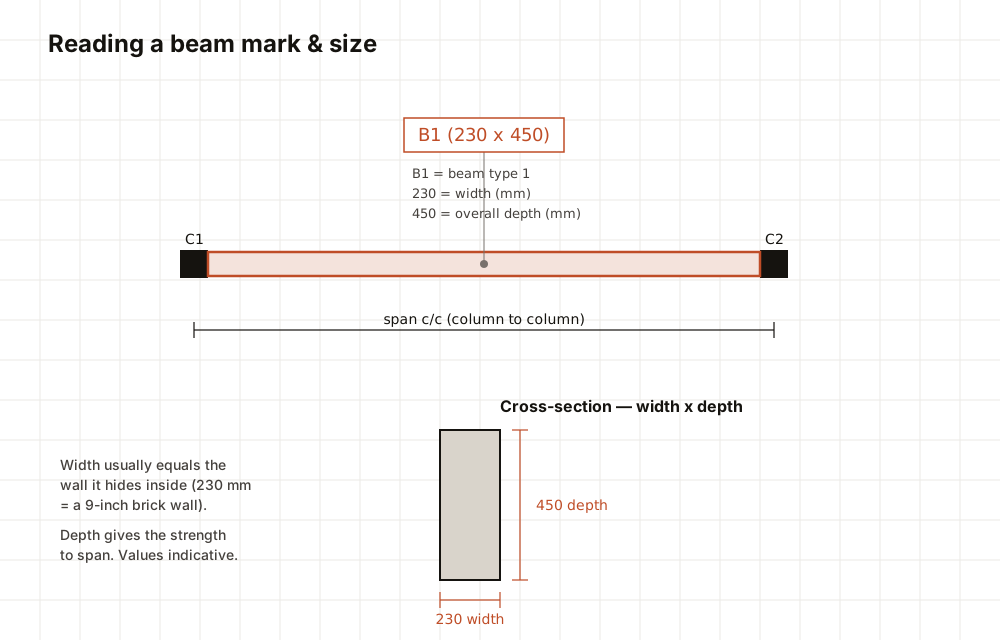
Alongside each mark you will find a size, written almost always as two numbers: width x depth, in millimetres. So "230 x 450" means a beam 230 mm wide and 450 mm deep (overall). The width usually matches the wall it sits under (a 230 mm beam tucks neatly inside a 9-inch brick wall, which is why 230 is so common); the depth is what gives the beam its strength to span. These are indicative typical values — your actual sizes must come from your project's stamped structural drawings, never from a guide.
| You see | It means |
|---|---|
| B1 (230 x 450) | Beam type 1, 230 mm wide, 450 mm overall deep |
| B2 (230 x 600) | A deeper beam — usually a longer span or heavier load |
| PB1 (230 x 300) | Plinth beam type 1 at plinth level |
| c/c dimension between grids | Centre-to-centre span of the beam |
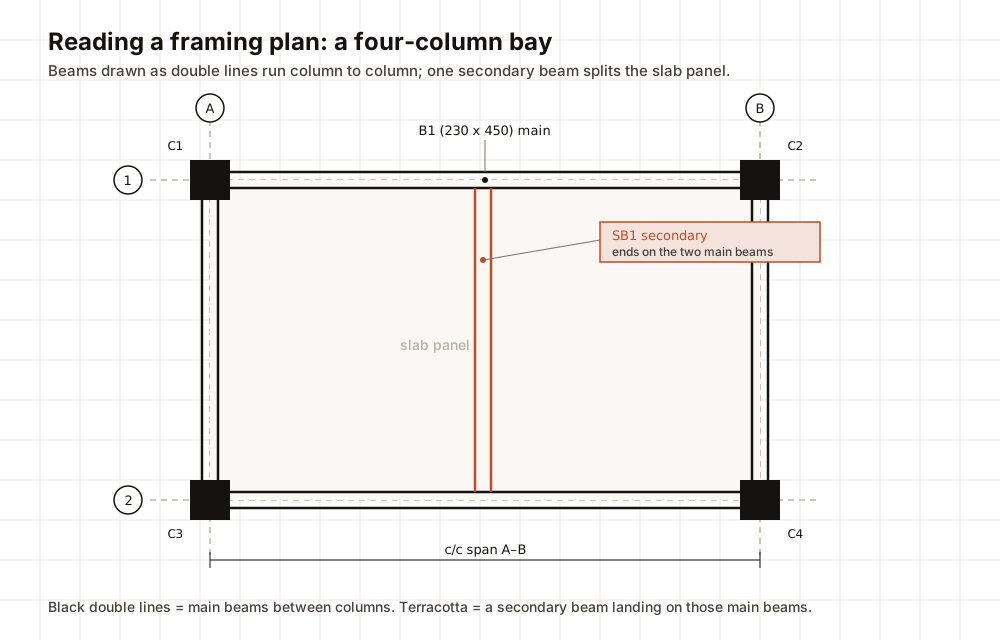
Reading one bay at a time is the trick. Find the four columns at the corners, follow the double lines that join them — those are your main beams — and then notice any extra line crossing the middle of the panel that touches beams rather than columns: that is a secondary beam. Once a single bay reads cleanly, the whole sheet is just that same pattern repeated across the grid.
For students & site engineers: be careful — in reinforcement detailing the tokens B1, B2 and T1, T2 are also used for bar layers (Bottom layer 1, Top layer 1, etc., where direction 1 is the main span). Context disambiguates: on a beam layout plan a tag like B1 next to a member is a beam mark; on a bar schedule or section, B1 over a steel line is a layer. Do not conflate the two notations.
3. Main beams vs secondary beams
Not all beams are equal in the load path. The drawing distinguishes two roles, even if it does not always shout about it.
A main (primary) beam spans directly from column to column. It is the strong member of the frame, and it carries both the slab load that reaches it and the reactions handed up by any secondary beams.
A secondary beam spans not between columns but between two main beams. Its job is to break up a large slab panel so the slab does not have to span a long distance on its own — the secondary beam catches the slab mid-panel and passes that load to the main beams at its ends.
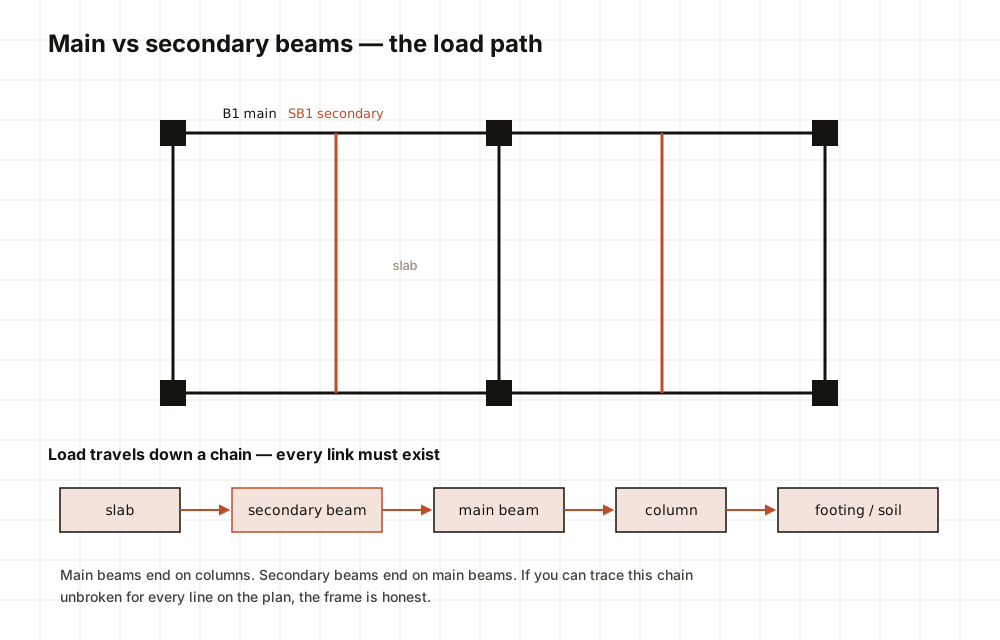
So the full chain, drawn out, is: slab → secondary beam → main beam → column → footing. Every secondary beam must land on main beams; every main beam must land on columns. If you can trace that chain unbroken for each line on the plan, the frame is honest.
| Main / primary beam | Secondary beam | |
|---|---|---|
| Spans between | Column and column | Main beam and main beam |
| Typical depth | Larger | Often equal or smaller |
| Carries | Slab + secondary-beam reactions | Slab load only |
| Lands on | Columns | Other beams |
There is no separate symbol that screams main or secondary on most Indian drawings — you read it from geometry (what its ends touch) and from depth in the beam schedule. That is exactly the kind of reading a trained eye does instinctively, which we unpack in How Architects Read Drawings Differently Than Homeowners.
4. Hidden (concealed) beams vs dropped beams
Here is the distinction that surprises most homeowners. When you stand in a finished room and look up, do you see a beam dropping below the ceiling, or a flat ceiling with nothing visible? The drawing decides this long before the plaster does.
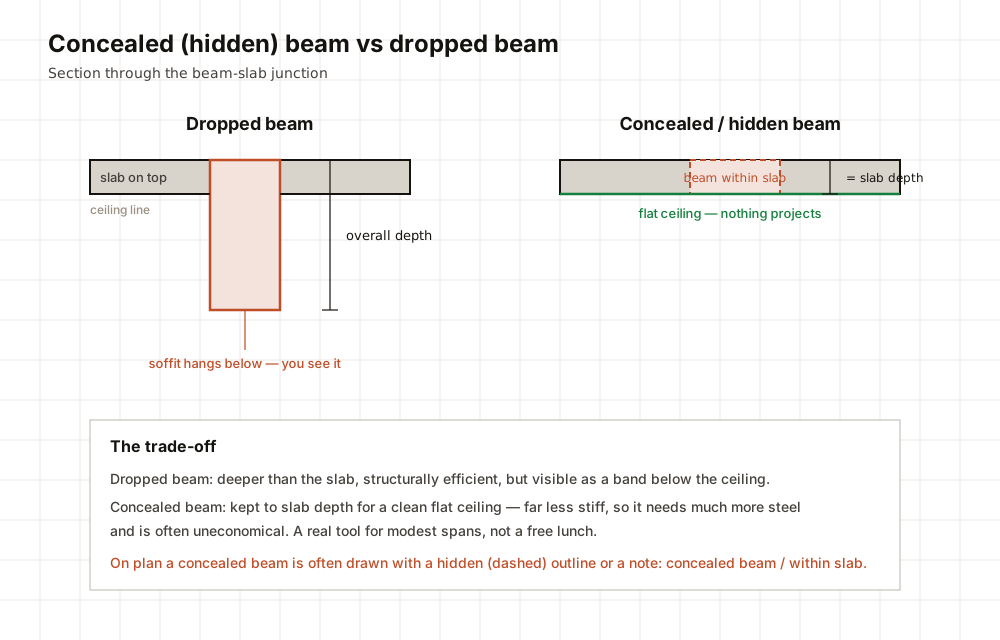
A dropped beam is the normal case: the beam is deeper than the slab, so its underside (its soffit) hangs below the slab. You see it as a band projecting down from the ceiling — often boxed in by a false ceiling later. Because it is deep, it is structurally strong and efficient.
A concealed beam (also called a hidden beam, slab beam or flat beam) is kept to the same depth as the slab itself, so it is buried entirely within the slab thickness and the ceiling below stays perfectly flat. It looks cleaner — but you pay for that appearance.
| Dropped beam | Concealed / hidden beam | |
|---|---|---|
| Depth | Deeper than slab | Equal to slab thickness |
| Visible below ceiling | Yes (a projecting band) | No (flat ceiling) |
| Structural efficiency | High | Much lower — needs more steel |
| Typical use | Standard framing | Where a flat ceiling is wanted, modest spans |
The engineering reality, confirmed across structural references, is blunt: because a concealed beam is shallow, it is far less stiff than a dropped beam of the same width and needs a great deal more steel to do a comparable job — so it is often genuinely uneconomical. It is a real tool for clean ceilings over modest spans, not a free lunch. On the drawing, a concealed beam is frequently shown with a hidden-line (dashed) outline or a note saying "concealed beam / within slab", precisely because you would not otherwise see it on a plan.
A dropped beam earns its keep with depth. A hidden beam buys you a flat ceiling and quietly bills you in steel.
5. The golden rule: beams must land on supports
This is the one check worth slowing down for, because it is where a homeowner can actually spot a problem — or reassure themselves there is none.
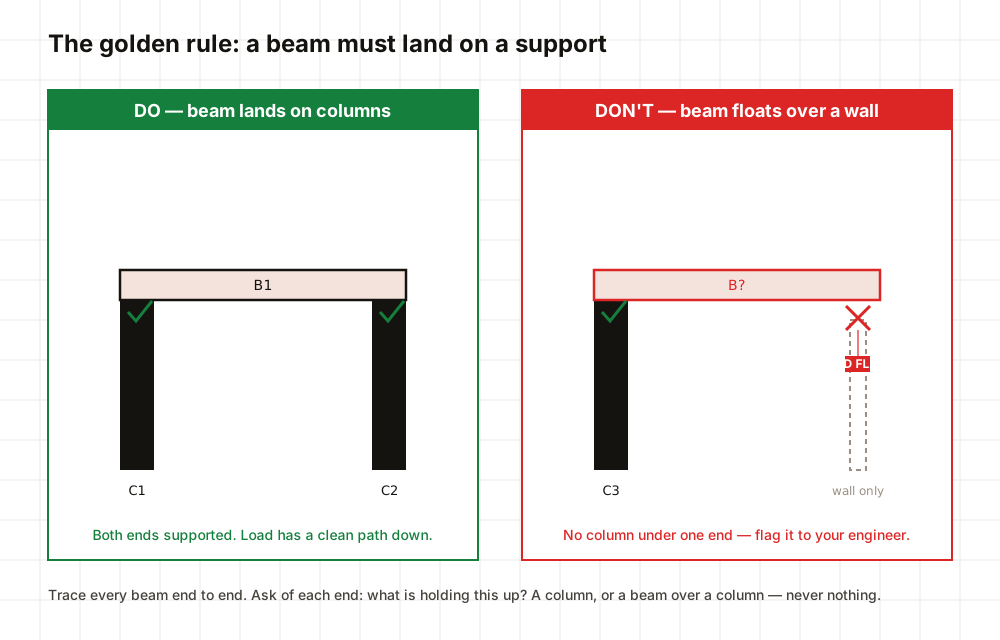
Trace each beam from end to end. At every end, ask: what is holding this up? For a main beam the honest answers are "a column" or "a beam node over a column". For a secondary beam, "a main beam". What you do not want to see is a beam whose end simply stops in space, or sits only on a brick wall with no column beneath, while it is carrying real slab load.
- Do: every main beam runs column to column, ending on a filled column section at both ends.
- Do: every secondary beam ends on a main beam, which itself ends on columns.
- Don't (red flag): a load-carrying beam ending mid-span over nothing, or floating over a partition wall with no column under it.
A beam that does not land on a support has to find another way to shed its load — usually by becoming a long, deep transfer member, or by quietly overloading whatever it does touch. That is expensive to fix and sometimes unsafe. If you see it, do not argue the physics yourself — flag it to your structural engineer and ask them to walk you through how that beam is supported. There is almost always either a column you missed or a deliberate (and designed) transfer arrangement. Catching it on paper costs a phone call; catching it after the pour costs a wall.
6. Plinth beams and tie beams: the beams you never see
Not every beam carries a slab. Two special beams live low in the structure and deserve a mention because they appear on their own layout (often a separate plinth-beam plan).
A plinth beam is an RCC beam cast at plinth level — the line where the superstructure rises above the filled-in ground — running along the tops of the foundation columns to tie them all together. Its jobs, as standard Indian practice and references describe, are to distribute the wall load evenly onto the footings, to tie the columns so they cannot drift apart, to resist differential settlement (one footing sinking more than another), and to give the ground-floor walls a clean, level, moisture-resisting base to start from. You will meet it again in Foundation Drawings Explained.
A tie beam is closely related but its role is more about bracing than carrying wall weight — it links columns to share lateral loads (wind, seismic) and to reduce their effective unsupported length, rather than to support a slab or a heavy wall above. On drawings the two are sometimes used loosely; what matters is reading the mark (PB / TB) and the level note that tells you where in the height of the building it sits.
For students & site engineers: plinth and tie beams are detailed to IS 456, and in seismic zones their continuity, anchorage at junctions and stirrup confinement matter as much as their size — a tie beam that is not properly anchored into its columns is not tying anything.
7. The beam, on the sheet and in the schedule
The beam layout plan rarely tells the whole story by itself. It is read together with a beam schedule — a table that lists each beam mark against its size and, sometimes, a reference to the reinforcement detail. The plan tells you where; the schedule tells you what.
| Reading task | Look on the | Ask |
|---|---|---|
| Where a beam runs | Plan | Which gridlines does it follow? |
| What it is called | Plan (the mark) | B-, PB-, TB-? |
| How big it is | Schedule / plan note | Width x depth in mm |
| What holds its ends | Plan | Column or main beam at each end? |
| Concealed or dropped | Section / note | Within slab, or below ceiling? |
| The steel inside | Reinforcement / detail sheet | (see the reinforcement guide) |
A homeowner does not need to verify steel — that is the engineer's stamped responsibility — but you absolutely can read the where, the what-it-is-called, the how-big, and the does-it-land-on-a-support. Those four readings catch most of the gross errors that a non-specialist can catch at all.
How to use this
Read your beam layout alongside your column layout: put the two sheets side by side and check that the beams on one truly land on the columns on the other. Then trace the load path of each room's slab — slab, secondary beam, main beam, column — and satisfy yourself that the chain is unbroken. Note any concealed-beam call-outs so the flat ceilings you were promised are actually drawn in.
When you are ready to review the whole set with intent, our Construction Drawing Review Checklist turns these checks into a printable, sheet-by-sheet walkthrough, and How All Construction Drawings Work Together shows how the beam plan must agree with the slab, plumbing and electrical sheets above and below it.
If you are still choosing how to build, see Building a House in India for the bigger picture, explore ready structural-and-architectural sets in our house plans library, generate concept layouts with DesignAI, or find an architect and a structural engineer whose stamped drawings you can finally read with confidence.
References & Further Reading
Indian standards & manuals
- IS 456 : 2000 — Plain and Reinforced Concrete, Code of Practice (governs RCC beam-column design and detailing).
- IS 13920 : 2016 — Ductile Design and Detailing of Reinforced Concrete Structures Subjected to Seismic Forces (beam-column joints, confinement).
- IS 962 — Code of Practice for Architectural and Building Drawings (drawing conventions and presentation).
- SP 34 / IS 2502 — Handbook and code on concrete reinforcement and detailing (bar bending, schedules).
- National Building Code of India (NBC) 2016 — overarching building requirements, structural safety provisions.
- Values such as cover, sizes and grades quoted here are indicative of typical Indian practice and must be read from your project's stamped drawings.
Books / references
- Pillai & Menon, Reinforced Concrete Design (Tata McGraw-Hill) — standard Indian text on RCC behaviour and detailing.
- N. Krishna Raju, Advanced Reinforced Concrete Design — beam and frame design depth.
- B. C. Punmia, Reinforced Concrete Structures — widely used Indian reference.
- M. Chakraborti, Estimating, Costing, Specification & Valuation — for reading beam schedules and quantities.
Companion Studio Matrx guides
- Construction Drawings Masterclass — the pillar overview of the whole set.
- Understanding Column Layout Drawings — where beams land.
- Roof & Floor Slab Drawings Explained — the plane beams carry.
- Reinforcement Drawings Simplified — the steel inside the beam.
- Foundation Drawings Explained — plinth beams and footings.
- Construction Drawing Review Checklist — review with intent.
Author's Note. I have stood under more than one freshly struck slab with a worried homeowner, and the question is always the same: "Is it safe?" My honest answer is that safety lives in the load path, and the load path is drawn on this exact sheet long before any concrete is poured. If I can teach you to trace one beam from its slab to the soil and see that the chain is unbroken, I have given you the single most empowering thing a non-engineer can hold over their own home. — Amogh N P
Disclaimer. This article is an educational overview to help you read beam layout drawings; it is not a substitute for a licensed structural engineer or registered architect. Beam sizes, grades, spans and reinforcement are design decisions that must be made and stamped by a qualified professional for your specific soil, loads and site. All numeric values here are indicative and typical; act only on the stamped, project-specific drawings issued for your home.
Export this guide
Related Guides — Deep-dive reading
Compound Wall Piers and Columns in India: Spacing, Reinforcement and Stability (2026)
Why a long, free-standing boundary wall needs intermediate piers or RCC columns to stay up — the physics of overturning in plain terms, thickened masonry piers vs reinforced-concrete columns on footings, indicative spacing that an engineer sets to your height and wind zone, the coping or tie beam that braces the top, and where to break a long run with movement joints.
Compound WallsHow Architects Read Drawings Differently Than Homeowners
The same sheet, two different readings — what a trained eye notices first, the questions professionals ask of a drawing, and how to start seeing a plan the way your architect does.
Construction DrawingsWhat Is Structural Safety in Residential Buildings? A Homeowner's Field Guide
How a house carries its loads safely to the ground — the forces it must resist, who is responsible for safety, the warning signs you can read yourself, and when to call a structural engineer.
Structural SafetyRelated Tools — Try Free
Cross-Ventilation Analyzer
Estimate airflow and air changes per hour (ACH) from room size, window areas, layout, and local wind — with NBC 2016 Part 8 compliance check.
Ventilation CalculatorMaterial Schedule Generator
Generate a room-wise finish schedule — walls, floors, ceilings, trim, and joinery by location.
Material ScheduleBefore vs After — Cost Reality Check
Compare what you expected to pay vs what you actually paid, category by category.
Reality Check