
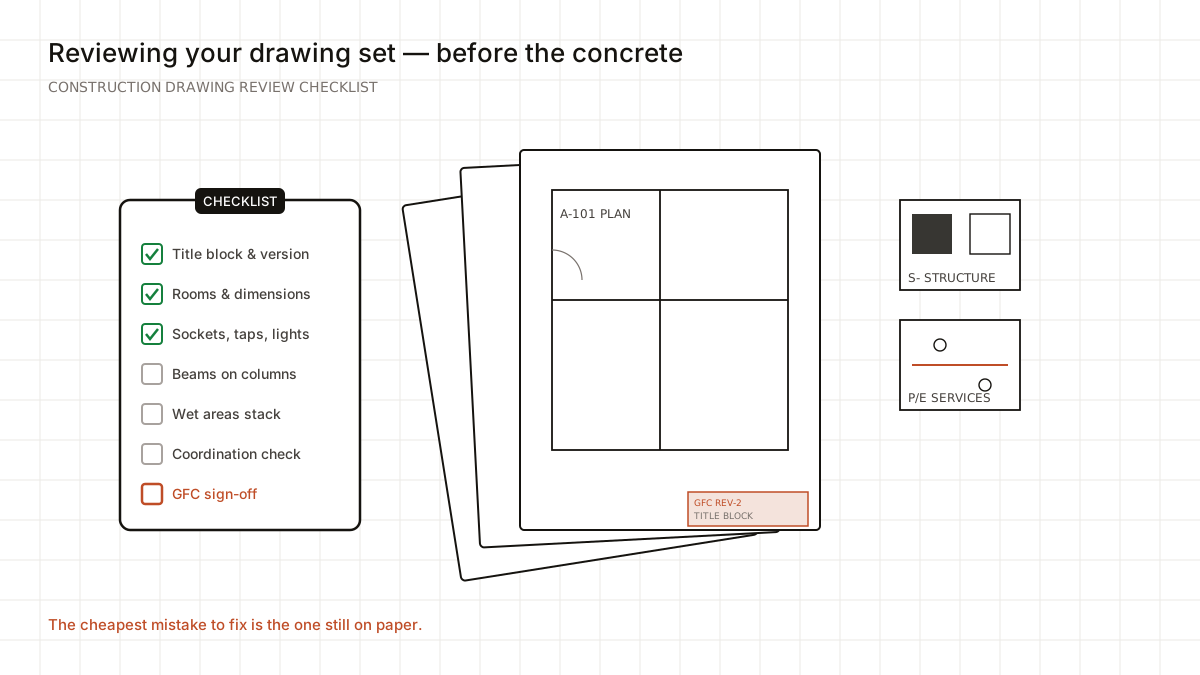
Construction Drawing Review Checklist
Before the concrete — a homeowner's printable, room-by-room and sheet-by-sheet checklist for reviewing your drawing set, the questions to ask, the red flags to catch, and when to call your architect.
A folder lands on your dining table. Inside are forty sheets of paper covered in grey lines, tiny numbers and codes that mean nothing to you yet — C1, FFL, 8Ø @ 150 c/c, REV-2. Your contractor says, cheerfully, "Sir, drawings approved? We start footing Monday." You nod, because what else do you do. And right there, in that nod, lakhs of rupees and months of your life quietly change hands.
Here is the thing nobody tells you: the cheapest mistake to fix is the one still on paper. Moving a wall on a drawing costs a pencil and ten minutes. Moving the same wall after it is built in brick and RCC (reinforced cement concrete — concrete with steel inside) costs demolition, debris, a sulking mason and a fortnight. The drawing review is the last cheap moment you will get.
This guide is that review, turned into a checklist you can actually hold and tick. You do not need an engineering degree. You need a method, a quiet hour, and the willingness to ask "why?" out loud.
A construction drawing review is the systematic, sheet-by-sheet and room-by-room check a homeowner (with their architect) runs on the complete drawing set before any concrete is poured — confirming the drawings are the latest approved version, that they say what you want, and that the disciplines agree with each other.
This is the capstone of the Construction Drawings Masterclass. If a particular sheet still looks like hieroglyphs, this checklist sends you to the right deep-dive — the column layout, the beam layout, the foundation, the plumbing and electrical sheets each get their own walkthrough. Start at the pillar guide if you have not, and keep this page open on site. It is written for the homeowner first, with a deeper layer flagged for B.Arch / civil students and junior site engineers who will run this same review professionally.
You are not checking the engineer's arithmetic. You are checking that the drawings describe the house you want — and that they agree with one another.
1. Why review at all — and what you are (and are not) doing
Your architect and structural engineer have done the design. So why does a homeowner review anything? Because design intent and your lived intent are two different things, and only you hold the second one. The engineer cannot know that you want the geyser switch reachable from outside the bathroom, or that grandmother's room must not share a wall with the lift shaft. The drawing review is where your life meets their lines.

Reviewing the set together, on or near site, is exactly the moment this guide is about — people pointing at the same sheet and asking what it really says before anyone builds from it. There are three jobs in a review, and it helps to keep them separate:
| Your job | What it means | What it is NOT |
|---|---|---|
| Version control | Confirm every sheet is the latest approved (GFC) revision and the old ones are destroyed | Re-designing the structure |
| Intent check | Confirm rooms, sizes, doors, and every tap, socket and light match how you will live | Second-guessing beam sizes |
| Coordination check | Confirm the disciplines agree — the same room is the same on every sheet | Doing the engineer's clash-detection for them |
GFC stands for Good For Construction — the final, stamped, approved set issued for execution. A GFC drawing carries a revision number, a date and an approval stamp, and it overrides every earlier version. Until a sheet is marked GFC, it is a draft, and building from a draft is how a wall ends up in the wrong place.
For students & site engineers: professionally, this review maps to a drawing-issue register and a GFC sign-off protocol. Every sheet entering site is logged with its revision, only GFC prints are displayed at the work face, and superseded prints are physically removed from circulation. The homeowner's "tick the box" is the soft-skin version of formal document control as practised under standard Indian QA/QC workflows aligned to CPWD and the relevant IS codes.
2. The review sequence — six stages, in order
Do not read forty sheets left to right. Triage them in stages, each building on the last. The figure below is the whole review on one page.
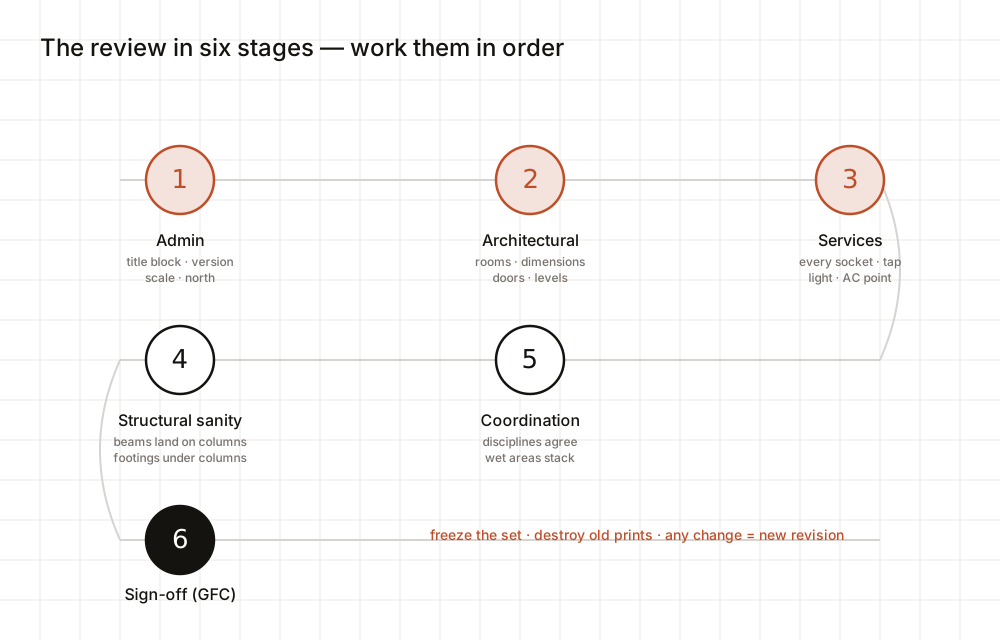
The logic of the order: admin tells you whether the paper is even valid; architectural sets the house everyone else references; services is where you, the homeowner, add the most value; structural and coordination are sanity checks; sign-off freezes the set. Work any stage out of order and you will check the wrong version, or fix a socket on a wall that is about to move.
3. Stage 1 — Admin checks (the title block & version)
Before you read a single wall, read the bottom-right corner. That box — the title block — is the sheet's passport. If it is wrong, nothing above it can be trusted. Spend five minutes here per sheet and you will catch the most expensive mistake of all: building from yesterday's drawing.
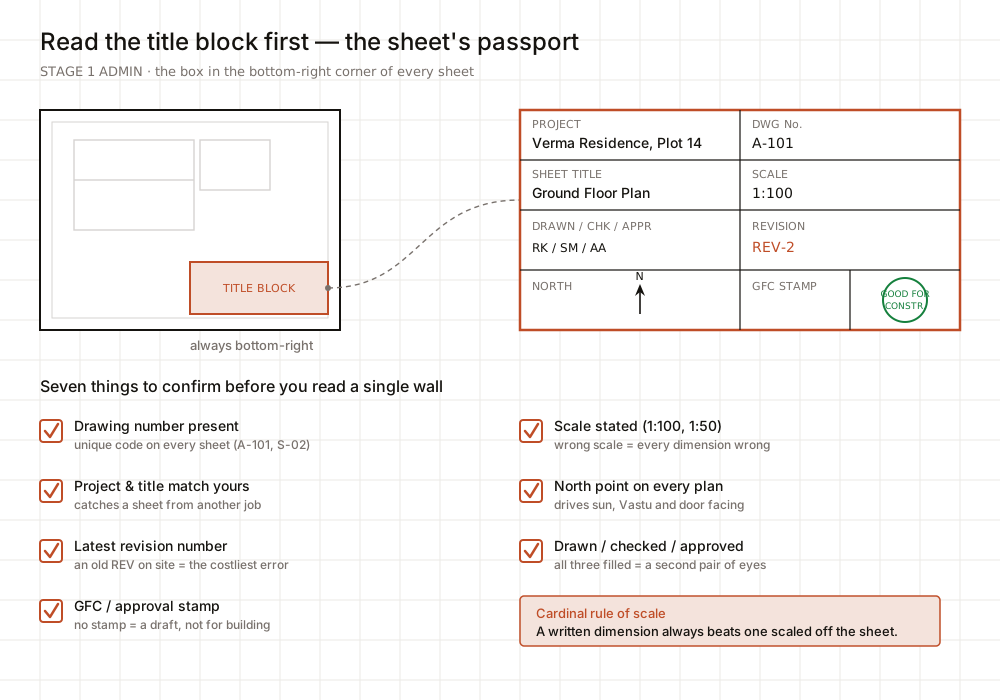
| Checkpoint | What to look for | Why it matters |
|---|---|---|
| Drawing number | A unique code (e.g. A-101, S-02) present on every sheet | A sheet with no number cannot be tracked or referenced |
| Title & project name | The sheet's title and your project/site address match | Catches a drawing from another project slipping in |
| Revision number | The latest REV number, with a dated revision table | An old revision on site is the single most common costly error |
| GFC / approval stamp | "Good For Construction" or the consultant's approval seal | Building from an unstamped draft has no design accountability |
| Scale | A stated ratio (1:100, 1:50) and ideally a scale bar | Wrong scale = every measured dimension is wrong |
| North point | A north arrow on every plan | Orientation drives sun, Vastu and which way a door faces |
| Drawn / checked / approved | Names or initials in all three boxes | An unchecked drawing has had no second pair of eyes |
If you cannot fully decode the title block or the scale ratio, read the companion guides on drawing scales and the symbols every homeowner should know first — then come back. The cardinal rule on scale: a written dimension always beats a scaled-off one. If a wall says 3600 but measures as 3700 with a ruler, trust the written 3600 and flag the mismatch.
4. Stage 2 — Architectural checks (rooms, dimensions, doors, levels)
Now the floor plan. This is the sheet you can read most naturally — it is the house seen from above. Walk it room by room, in your mind, as if touring the finished home. Three things hide here: dimensions that do not add up, doors that fight, and levels that trip.
| Checkpoint | What to look for | Why it matters |
|---|---|---|
| Every room dimensioned | A length and width written on each room; a wall with no dimension | An undimensioned wall gets built to the mason's guess |
| Dimensions add up | Individual room sizes plus walls equal the overall outer dimension | Strings that do not total reveal a drafting error before it is built |
| Door swings | The quarter-circle swing arc does not hit a wall, another door, or block a passage | A door that fouls a swing is a daily annoyance you cannot undo |
| Door & window sizes | A door and window schedule, with sizes matching the plan tags | The mason leaves openings to the schedule; a mismatch is a re-chase |
| Circulation | You can walk every room without squeezing past furniture lines | Tight circulation is invisible on paper until you live it |
| Levels (FFL, sill, lintel) | Finished Floor Level (FFL) marks, sill and lintel heights, steps between areas | A 100 mm step you did not expect at a doorway is a real trip hazard |
| Wet-area floors | Bathroom and balcony floors shown a step or slope down | Wet floors must fall away from dry rooms — water finds the low point |
FFL means Finished Floor Level — the top of your final floor finish (tile, stone), the line your feet actually touch. Drawings also carry SFL (Structural Floor Level, the bare slab top) — the gap between them is your flooring thickness. Mixing the two up is how a door ends up 25 mm too short.
5. Stage 3 — Services walkthrough (every tap, socket, light, AC point)
This is where you, the homeowner, are irreplaceable — and where most regret is born. Nobody but you knows where you will plug in the phone charger, stand to dry your hair, or want a reading light. So do not skim the services sheets. Walk them.
Stand (in your imagination) in the middle of each room, and turn slowly. The walkthrough card below is your script for one room — repeat it for every room.
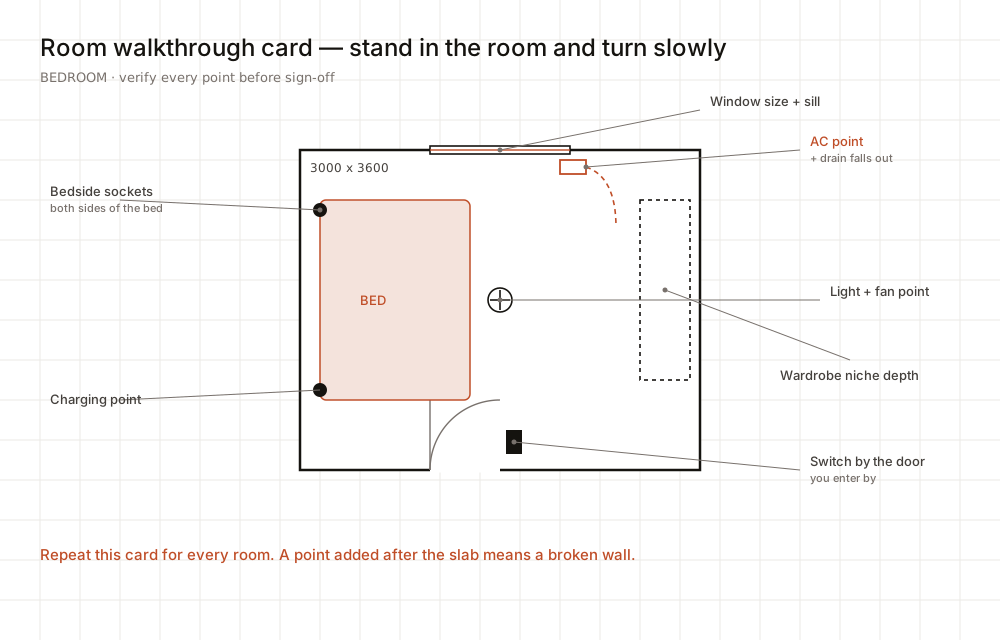
| Checkpoint | What to look for | Why it matters |
|---|---|---|
| Sockets where life happens | Points at the bedside, study, kitchen counter, TV wall, charging spots | A wall chased open later for one socket means broken tiles and paint |
| Switch reach | The switch board beside the door you enter by, geyser switch outside the wet zone | Reaching across a dark room for a switch is a design failure |
| Light & fan points | A ceiling fan point and adequate light points per room; task lights where needed | Adding a point post-slab means surface conduit or a re-chase |
| AC point + drain | An AC indoor-unit position, its power point, and a condensate-drain route that falls outward | An AC with no planned drain leaks down your wall |
| Every tap & outlet | Each WC, washbasin, shower, sink, bib tap, washing-machine and RO point shown | A missing tap is a wall reopened after waterproofing — a serious setback |
| Floor traps & slope | A floor trap (the floor drain) in each wet area, with the floor sloping to it | A bathroom that does not drain to the trap holds standing water |
To read the symbols on these sheets — the squiggle that is a two-way switch, the circle that is a floor trap — keep the electrical drawings and plumbing drawings guides open beside you, plus the symbols glossary. If your home has split or ducted air-conditioning, the HVAC drawings guide explains the refrigerant and drain routes that must be planned now, not later.
For students & site engineers: this stage is also a point-count reconciliation. The electrical point schedule, the DB (distribution board) circuit list and the plan must agree on totals; the plumbing fixture count must match the sanitary schedule. Electrical installations follow IS 732 practice; sanitary and plumbing follow IS 1742 / IS 2064 and the CPHEEO manual conventions. Treat any point on the plan with no entry in the schedule as a query, not an assumption.
6. Stage 4 — Structural sanity checks (no degree required)
You are not redesigning the structure. You are running three common-sense sanity checks that catch genuine, expensive errors — the kind that happen when sheets are drawn in a hurry.
| Checkpoint | What to look for | Why it matters |
|---|---|---|
| A column under every junction | On the column layout, columns (C1, C2…) sit at grid intersections | Columns are the legs of the house; their positions lock your plan |
| Beams land on columns | On the beam layout, each beam (B1, B2…) spans support to support | A beam whose ends rest on nothing — no column or beam at either end — is a query for the engineer; a beam carrying a column above it (a transfer beam) is a deliberate design, not an error |
| Footings under columns | On the foundation plan, a footing (F1, F2…) sits under each column | A column with no footing under it has nothing transferring load to soil |
| Soil test referenced | A soil report / SBC (safe bearing capacity) noted on the foundation sheet | Footing sizes depend on what the soil can carry; no test = a guess |
| Slab levels & sunken areas | On the slab drawing, sunken slabs under bathrooms, slopes to outlets | A bathroom with no sunken slab leaves no room to bury plumbing |
| Steel callouts present | The reinforcement sheets carry bar and stirrup callouts, not blanks | Concrete without specified steel is just heavy, brittle stone |
The one rule a homeowner can police without any training: follow the load downward. Slab rests on beam, beam rests on column or another beam, column rests on footing, footing rests on soil. If a member appears to rest on nothing — a beam whose ends hang in space, a column with no footing — stop and ask. (An engineer can legitimately carry a column on a beam below it — a transfer beam — so "no column directly under this point" is a question to raise, not a verdict to reach.) All RCC values you see (cover, lap, bar sizes, slab thickness, SBC) are indicative and belong to your stamped drawings; never treat a number from any guide as a design value. Ductile detailing of RCC follows IS 13920 and IS 456 governs concrete design — these are the engineer's domain; your job is only to confirm the chain is unbroken on paper.
7. Stage 5 — Coordination checks (do the sheets agree?)
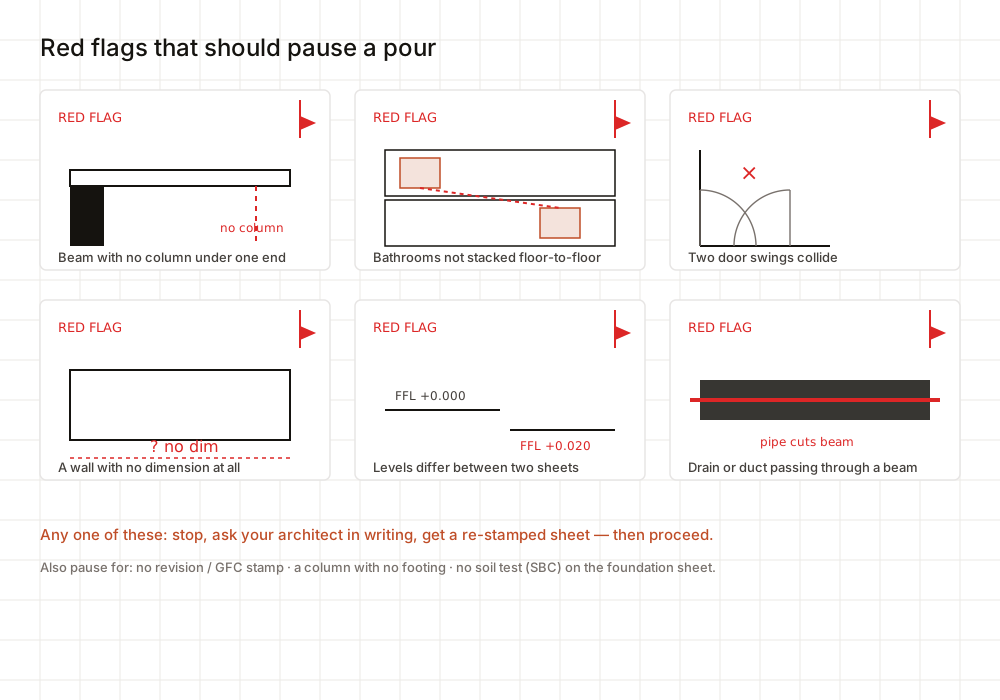
No drawing stands alone. The same room appears on five or six sheets, and they must all describe the same room. Coordination errors — where the architectural plan says one thing and the structural or services plan says another — are the biggest source of on-site rework. The figure collects the classic red flags.
| Checkpoint | What to look for | Why it matters |
|---|---|---|
| Wet areas stack vertically | Bathrooms and kitchens align floor to floor so drains drop straight down | Misaligned wet areas force long horizontal pipe runs and leaks |
| Same room, same size | A bedroom's dimensions match across architectural, structural and services sheets | A 10 mm drift between sheets compounds into a real site clash |
| Levels match across sheets | FFL on the architectural plan equals the slab level logic on the structural plan | Mismatched levels mean a step nobody designed |
| Grid reference consistent | The grid (A-B-C / 1-2-3) is identical on every discipline's sheet | The shared grid is the one truth all sheets pin to |
| No service through structure | No drain, duct or large conduit drawn passing through a beam | Cutting a beam for a pipe weakens it; it must route around |
| Door vs switchboard | The door swing does not cover the switchboard you must reach | A switch behind an open door is a daily small misery |
For the full picture of how the disciplines lock together around one grid, read how all construction drawings work together. If you want to understand why an architect's eye catches these instantly while yours does not — yet — see how architects read drawings differently than homeowners.
8. Red flags that should pause a pour
Some findings are not "note it and continue." They are "stop, call the architect, do not let the mixer start." If you spot any of these, freeze the relevant work until it is answered in writing:
- A sheet with no revision number or no GFC stamp — you may be building from a draft.
- Two sheets showing the same wall in different places — somebody is working off an old version.
- A beam with no support at one or both ends — no column and no other beam picking it up — or a column with no footing — the load chain may be broken (raise it; a transfer beam carrying a column is intentional and not this case).
- Wet areas not stacked between floors, or no sunken slab shown under a bathroom — water has nowhere to go.
- A wall, room or opening with no dimension at all — it will be built to a guess.
- Mismatched levels (FFL/SFL) between the architectural and structural sheets — an undesigned step.
- A door swing fouling another door, a passage, or a switchboard — a daily fault you cannot un-build.
- A drain, duct or conduit drawn through a structural beam — a structural compromise.
- No soil test / SBC referenced on the foundation sheet — the footings are sized on a guess.
- A point on a plan that has no entry in its schedule (electrical or plumbing) — an unconfirmed count.
None of these mean your architect erred — drawings evolve, and catching this is exactly what review is for. They mean: ask, get it corrected, get the corrected sheet re-stamped, and only then proceed.
9. Stage 6 — Sign-off & freezing the set
When every box is ticked and every query is answered on a re-issued, re-stamped sheet, you freeze the set. This is the GFC sign-off, and it has a small discipline of its own:
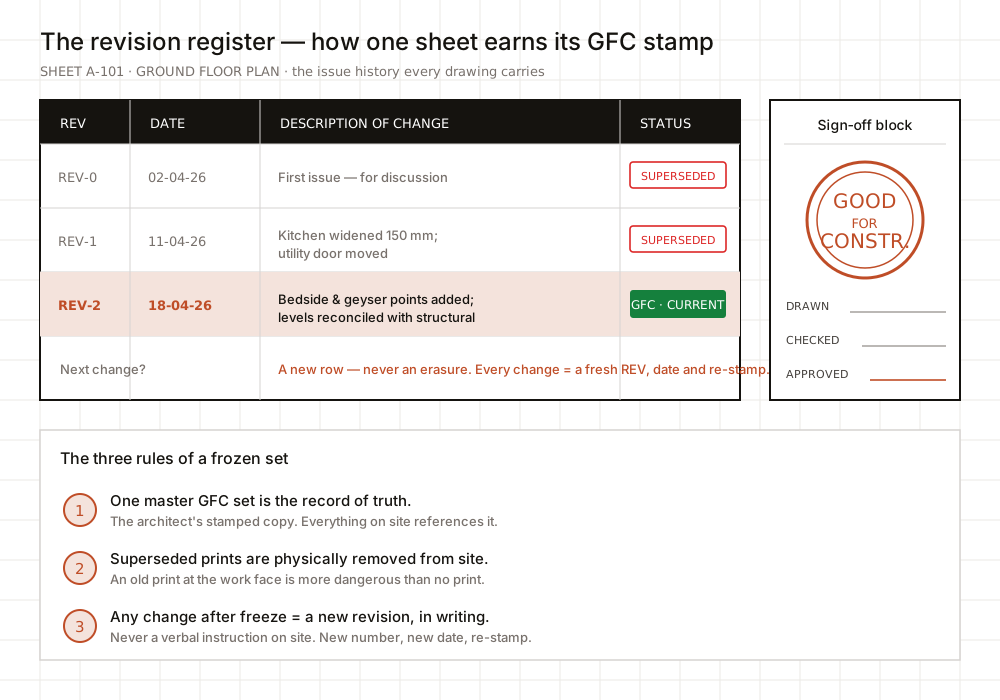
- Confirm every sheet now reads the same latest revision and carries the GFC / approval stamp.
- Destroy or clearly mark superseded prints — old drawings on site cause more damage than no drawings.
- Keep one master GFC set (the architect's stamped copy) as the reference of record.
- Agree, in writing, that any change after this triggers a new revision — a fresh number, date and re-stamp — never a verbal instruction on site.
- Note that a single change ripples: move one wall and the beam under it, the points on it and the ceiling above it all change. Re-review the affected sheets, not just the one you altered.
That last point is the whole reason version control matters. Drawings are a system, not a stack of independent pages.
How to use this
Print this checklist. Sit with your architect for one focused hour per discipline — architectural, then structural, then services — and physically tick each box, room by room. Where a sheet defeats you, open the matching deep-dive: columns, beams, foundations, slabs, reinforcement, plumbing, electrical or HVAC, and the symbols and scales primers. Return to the Construction Drawings Masterclass pillar for the map of the whole set.
If you are still choosing a designer, or want a second set of professional eyes on your drawings before you pour, find an architect through Studio Matrx. Exploring layouts before you commit? Browse ready house plans or shape an idea in DesignAI. The earlier you review, the cheaper every decision is — and a folder on the dining table is the cheapest moment you will ever get.
Image credits
- Photograph (people on a construction site reviewing a large drawing sheet together): U.S. Army Corps of Engineers from USA — Public domain, via Wikimedia Commons. Source: https://commons.wikimedia.org/wiki/File:Chief_of_Engineers_visits_USACE_Afghanistan_Engineer_District-South_construction_sites_(7348887610).jpg
References & Further Reading
Indian standards & manuals (confirm the current edition against your project's stamped set)
- National Building Code of India, NBC 2016 — overarching building practice and documentation.
- IS 962 — Code of practice for architectural and building drawings (drawing practice, title blocks, line types).
- IS 456 — Plain and reinforced concrete, code of practice (RCC design basis).
- IS 13920 — Ductile detailing of RCC structures subjected to seismic forces.
- SP 34 / IS 2502 — Detailing and bar bending of reinforcement.
- IS 732 — Electrical wiring installations, code of practice.
- IS 1742 / IS 2064 — Sanitary and plumbing installations; the CPHEEO Manual on Water Supply & Treatment / Sewerage for plumbing practice.
- ISHRAE guidance and NBC 2016 Part 8 — HVAC and ventilation practice.
Books / references
- Ching, F. D. K. — Architectural Graphics, and Building Construction Illustrated (drawing conventions and assemblies).
- Rangwala, S. C. — Building Construction (standard Indian text).
- Styles & Bichard — Working Drawings Handbook (set structure and coordination).
Companion Studio Matrx guides
- Pillar: Construction Drawings Masterclass
- How architects read drawings differently than homeowners · How all construction drawings work together
- Symbols every homeowner should know · Understanding drawing scales
- Context for building well: Building a house in India · Architect fee structures in India
Author's Note — I have watched a family stand in a finished bathroom and realise the geyser switch was inside the splash zone, because the drawing was approved with a nod and not a walkthrough. It haunted me, because it cost them nothing on paper and a re-chase in reality. This checklist is the hour I wish every homeowner would spend. Take it slowly, ask every "why" out loud, and let the paper carry your second thoughts so the concrete never has to. — Amogh N P
Disclaimer: This is an educational overview to help homeowners and students read and review drawings with confidence. It is not a substitute for a licensed structural engineer, MEP consultant or registered architect, and it does not constitute approval of any design. Act only on stamped, project-specific drawings; all sizes, levels, slopes, loads and code references mentioned here are indicative and must be taken from your own GFC set. When in doubt, pause the work and ask your architect in writing.
Export this guide
Related Guides — Deep-dive reading
How All Construction Drawings Work Together
From one grid to a finished house — how architectural, structural and MEP sheets coordinate, where clashes hide, the order drawings are issued, and how a small change ripples across the whole set.
Construction DrawingsBathroom Planning for New Homes in India: Get It Right Before You Build
The bathroom decisions you cannot undo once the slab is cast — location and stacking, sunken vs non-sunken slabs, waterproofing, and the plumbing, electrical and ventilation you must coordinate with the civil work, stage by stage.
BathroomsConstruction Drawings Masterclass: How to Read Your Home's Working Drawings
The complete homeowner's field guide to the drawing set that builds your house — architectural, structural, plumbing, electrical and HVAC sheets, what each one is for, the symbols and scales that decode them, and how to review them before you pour a single footing.
Construction DrawingsRelated Tools — Try Free
Cross-Ventilation Analyzer
Estimate airflow and air changes per hour (ACH) from room size, window areas, layout, and local wind — with NBC 2016 Part 8 compliance check.
Ventilation CalculatorApartment Furniture Size Chart
Standard furniture dimensions for Indian apartments — sofas, beds, tables, dining, storage.
Reference ChartElectrical Safety & Load Audit
Home electrical audit — 10 categories, 65+ checkpoints across earthing, RCCB, MCB, wiring, switchboards, appliance circuits, DG/inverter backup.
Safety Audit