

BOQ for STPs: What a Bill of Quantities Includes
Every civil, mechanical, electrical and instrumentation line item that belongs in a sewage treatment plant bill of quantities — and how to read one to compare vendor quotes on a like-for-like basis.
When three vendors quote wildly different prices for the "same" 200 KLD sewage treatment plant, the difference is almost never in the technology — it is in what each one quietly left out. One priced a bare tank and a blower; another included the civil works, the piping, the control panel and a year of spares. The document that exposes the difference, and lets you compare like with like, is the Bill of Quantities, or BOQ.
A BOQ is the itemised, quantified spine of an STP tender: every tank, pump, valve, cable and sensor listed with its make, specification, unit and count, priced line by line. Get it right and vendor comparison becomes arithmetic. Get it vague, and you are comparing a Maruti to a Mercedes on sticker price alone.
A good STP BOQ is not a price list — it is a specification with prices attached. If a line does not tell you the make, capacity, material and quantity, it is not a BOQ line; it is a placeholder for a future dispute.
This guide walks through what belongs in an STP bill of quantities, section by section, and how to read one when the quotes land on your desk. For where the plant sits in the bigger picture, start with what a sewage treatment plant is; to fix the capacity every BOQ is built around, use how to size an STP.
Why the BOQ decides your procurement
The BOQ does three jobs at once. It is the scope definition — anything not in it is, by default, extra and chargeable. It is the comparison grid — identical line items across bidders make apples-to-apples evaluation possible. And it becomes the contract measure — payments, variations and the final account are all reconciled against it.
Most STP disputes trace back to a thin BOQ: interconnecting pipework "assumed by client", electrical work "up to panel only", or a disinfection system shown as a lump sum with no dosing rate. A well-structured BOQ closes those gaps before money changes hands. It sits at the heart of STP tender preparation and pairs directly with your technical specifications.
A complete STP BOQ is organised into four disciplines: Civil, Mechanical, Electrical and Instrumentation — often abbreviated C&S, M, E and I&C. Let us take them in turn.
Civil and structural line items
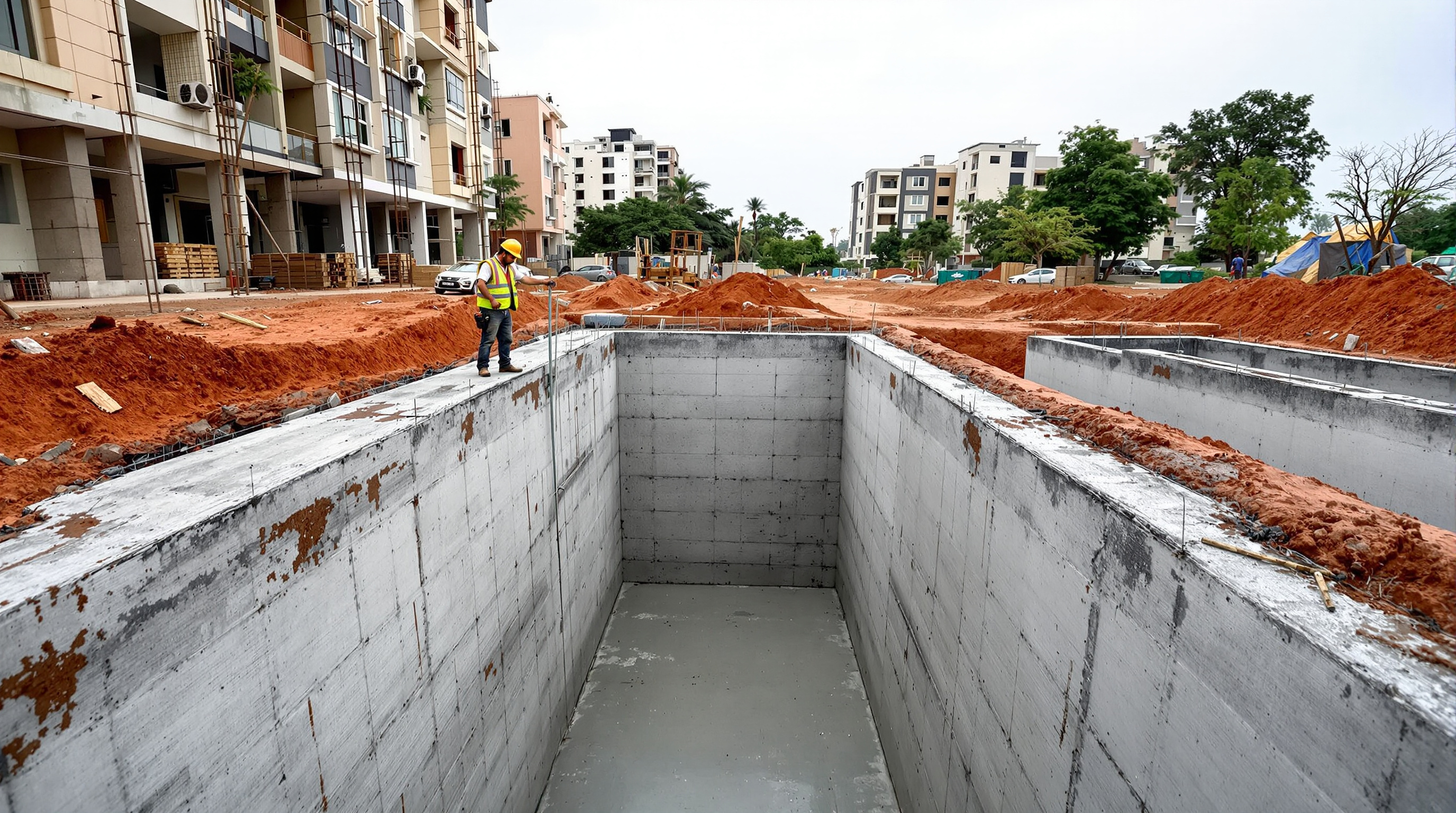
The civil scope is the tankage and everything that holds water or supports the plant. On RCC plants this is often the single largest cost block; on packaged/prefabricated MS or FRP plants it shrinks to a foundation raft and a room.
Typical civil BOQ lines:
- Excavation, shoring and dewatering — measured in cubic metres, critical for basement or below-grade plants.
- RCC tanks — collection/equalisation, anoxic, aeration, clarifier/MBR tank, sludge holding, treated-water tank. Listed per tank with volume, grade of concrete (M25/M30), and waterproofing.
- PCC, raft and plinth for equipment skids, blowers and the filter feed pumps.
- STP room / blower room / DG-panel room — brick or block work, plaster, flooring, doors, ventilation louvres.
- Waterproofing and protective coating — food-grade or acid-resistant lining where specified.
- Handrails, gratings, chequered-plate covers, ladders — the safety steel most cheap quotes omit.
Watch for whether the vendor is supplying the tanks or expects the builder's civil contractor to. This single boundary shifts lakhs of rupees and is the most common cause of a quote looking "cheap".
Mechanical line items
The mechanical section is the working heart of the plant — the equipment that moves, aerates and filters. This is where technology choice (MBBR, SBR or MBR) changes the line items most.
| Line item | What to specify | Common unit |
|---|---|---|
| Raw sewage / transfer pumps | Make, flow (m³/hr), head, kW, duty + standby | No. |
| Air blowers | Type (twin-lobe/screw), capacity (m³/min), kW, duty + standby | No. |
| Fine-bubble diffusers | Make, material (EPDM), quantity, grid layout | No. / set |
| MBBR media or MBR membrane modules | Make, fill %, m² of area, or module count | m³ / No. |
| Tube-deck / clarifier internals | Material, area | set |
| Filter feed pumps, PSF & ACF | Vessel size, media, flow rating | No. |
| Disinfection (chlorine dosing / UV) | Dosing rate or UV dose (mJ/cm²) | set |
| Sludge handling (filter press / decanter / drying beds) | Capacity, make | No. |
| Interconnecting piping & valves | Material (uPVC/CPVC/MSEP/SS304), size schedule | LM / lot |
The line most often fudged is interconnecting piping and valves. A plant is only as good as the pipework tying it together, and a "lot" or "lump sum" here hides both scope and quality. Insist on a pipe schedule with materials and sizes. For pumps, blowers and the logic that runs them, STP pumps and instrumentation goes deeper.
Electrical line items
The electrical scope powers and protects everything mechanical. It runs from the incomer to the last motor, and its completeness decides whether the plant can actually be switched on.
- MCC / PCC panel — the motor control centre, with starters, VFDs (variable frequency drives), MCBs/MCCBs, contactors and metering. Specify IP rating and busbar rating.
- Power and control cabling — armoured cable, sizes and runs in metres, cable trays and glands.
- Earthing and lightning protection — pits, strips, earthing for every motor and the panel.
- Field wiring, junction boxes, local push-button stations at each pump and blower.
- Lighting and small power for the STP room; exhaust fans and ventilation.
- Interface to the building DG / mains — the boundary of supply, always worth pinning down.
VFDs deserve attention: they are a meaningful cost line but cut running bills sharply by trimming blower and pump energy — the single biggest operating expense. See reducing STP electricity consumption for why that trade-off usually pays back.
Instrumentation and controls (I&C)
The smallest section by cost, the largest by consequence for how the plant runs day to day. Under-specify it and you get a plant that works only when someone is standing over it.
- Level sensors / float switches in collection, aeration and treated-water tanks for auto pump control.
- Flow meters (electromagnetic) on inlet and treated-water lines — essential for CPCB compliance and for verifying you got the KLD you paid for.
- pH, DO (dissolved oxygen) and MLSS probes for process control in the aeration tank.
- Online quality analysers — BOD/COD/TSS where regulators require continuous monitoring on larger plants.
- PLC / SCADA / HMI — the programmable controller and screen that automate the sequence and log data.
- Remote monitoring / IoT gateway — increasingly specified so operators and CPCB dashboards can see the plant live.
A note on the newer end of this list: PLC-SCADA automation is mature and worth paying for; remote IoT monitoring is proven and increasingly standard. But treat "AI-based" or "digital twin" line items with a clear eye — some deliver genuine predictive-maintenance value, while others are dashboards with ambitious names. Ask exactly what the software does and what it costs to keep running before you let it inflate the BOQ.
How to use the BOQ to compare quotes

Once you have a common BOQ, evaluation is disciplined:
- Normalise the format. Issue your BOQ template and require vendors to fill it, rather than accepting each vendor's own format. This forces line-by-line comparability.
- Flag every "excluded", "by client" or "lump sum". Total the exclusions — the cheapest base quote often carries the most excluded scope.
- Check makes, not just counts. A blower is a line item; a reputed-make blower with a warranty is a different price. Compare specified brands.
- Separate CAPEX from OPEX. A plant with VFDs and efficient blowers may cost more upfront and far less over five years. Weigh it against the annual operating cost and the AMC.
- Sanity-check the total against a benchmark. Run the design through the STP Cost Estimator and cross-read STP cost per KLD in India; a quote 30% below benchmark is not a bargain, it is a warning.
A structured vendor evaluation matrix turns the completed BOQs into a defensible score, and the comparing STP vendors guide covers the commercial and warranty terms that sit alongside the numbers.
The bottom line
A Bill of Quantities is the one document that makes STP procurement honest. Insist on all four disciplines — civil, mechanical, electrical, instrumentation — with make, specification, material, unit and quantity on every line, and the vague quote that hides its exclusions has nowhere left to hide. Build your own template, make every bidder fill it, and let the arithmetic decide.
Start from the Sewage Treatment Plants guide library to fix your technology and capacity, then price the design with the STP Cost Estimator before you issue the tender — so the number in your head and the numbers in the BOQs are speaking the same language.
Export this guide
Related Guides — Deep-dive reading
Mechanical Installation of STP Equipment: Blowers, Pumps, Diffusers & Pipework Done Right
How the blowers, pumps, diffuser grids, media, screens, tube settlers and pipework of a sewage treatment plant are actually set, aligned, anchored and supported on site — and the pre-commissioning mechanical checks that decide whether the plant runs quietly for years or rattles itself apart in months.
Sewage Treatment PlantsCivil Construction of STPs: What Goes Into Building One
Before a single blower runs, an STP is a piece of civil engineering — excavation, watertight RCC tanks, baffle walls, a plant room and drainage, built in a sequence that decides whether the plant ever works. Here is what that construction actually involves.
Sewage Treatment PlantsAir Blowers & Diffusers in an STP: How Aeration Actually Works
The blowers that push air and the diffusers that turn it into bubbles are the lungs of your sewage treatment plant. Here is how they work, how they are sized, and why they decide most of your electricity bill.
Sewage Treatment PlantsRelated Tools — Try Free
STP Cost Estimator
Estimate the capital cost of a sewage treatment plant by capacity in KLD and technology, with an underground option and instant cost per KLD.
STP CalculatorSTP Technology Comparison Matrix
Compare Extended Aeration, MBBR, SBR, MBR and UASB across six criteria, set your priority, and see the best-fit STP technology instantly.
ComparatorContract-Ready BOQ — With Brand Dropdowns
Build a contract-ready Bill of Quantities with curated brand dropdowns for each line item.
BOQ