
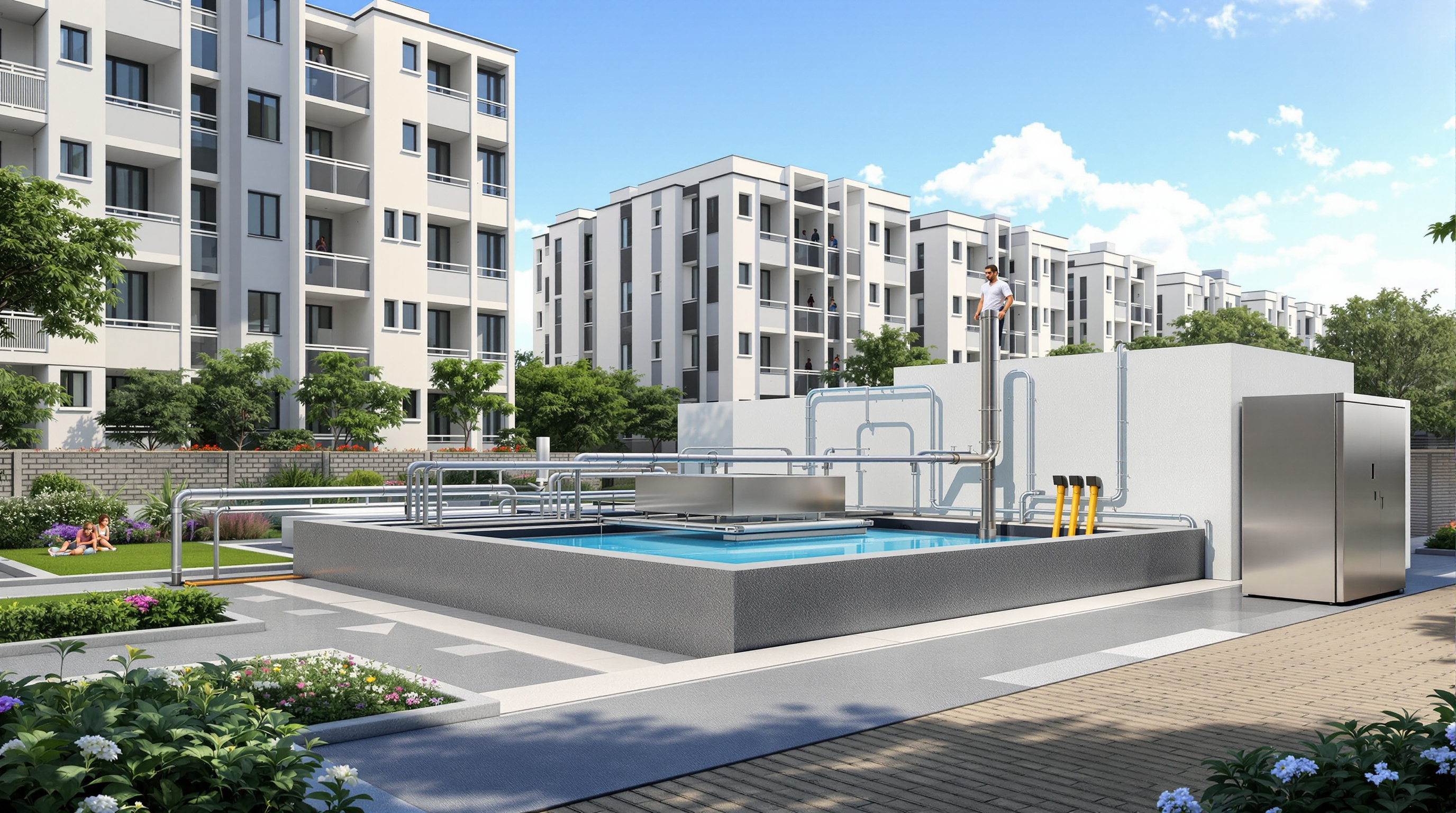
Sequential Batch Reactor (SBR): The Fill-and-Draw STP Explained
How the SBR runs all five treatment phases — fill, react, settle, decant, idle — inside a single PLC-controlled tank, why it saves space and removes nutrients so well, and where its batch rhythm becomes a limitation.
Most sewage treatment plants clean water by moving it through a chain of tanks — aeration here, settling there, each doing one job continuously. The sequential batch reactor does something cleverer. It keeps the water still and changes what happens to it over time. Everything — mixing, aerating, settling, drawing off the clean water — happens in the same tank, one step after another, on a repeating clock. This is why engineers also call it the fill-and-draw process.
If you have read our activated sludge process guide, you already know the biology at the heart of every SBR: billions of bacteria eating the pollution in an oxygen-rich tank. The SBR simply organises that biology around time instead of space — and that single design choice gives it a small footprint, excellent nutrient removal, and no need for a separate clarifier.
A conventional plant separates its jobs by giving each one its own tank. A sequential batch reactor separates them by giving each one its own time-slot in the same tank. Same activated sludge, sequenced by a clock instead of laid out along a pipeline.
What "sequential batch" actually means
Break the name into its two halves and the whole idea falls out:
- Batch — the tank treats a defined volume of sewage at a time, from start to finish, rather than a river of it flowing past. Fill the tank, treat that batch, empty most of it, repeat.
- Sequential — the treatment steps happen in sequence, one after the other in the same vessel, controlled by a timer.
A PLC (programmable logic controller — the small industrial computer that runs the plant) decides when each phase begins and ends. It switches the blowers on and off, opens and closes valves, and drops the decanter. Because the sequence is just software and a few timers, an operator can re-tune the cycle — more aeration, a longer settle — without rebuilding a single tank. That programmability is the SBR's superpower and, as we will see, also its main complication.
Most real installations use two SBR tanks working in tandem: while one is filling, the other is reacting, settling and decanting, so the plant never has to turn incoming sewage away. That pairing is the standard way SBRs handle a continuous 24-hour inflow with a fundamentally batch process.
The five phases of an SBR cycle
One full cycle passes through five phases. On a typical domestic plant a cycle runs about four to six hours, so each tank completes four to six batches a day.
| Phase | What happens in the tank | Blower | Roughly |
|---|---|---|---|
| 1. Fill | Raw (screened) sewage enters the tank, mixing with the sludge left from the last batch. May be aerated, mixed-only, or static depending on the target. | On/off | 25% of cycle |
| 2. React (aerate) | Blowers drive air through the batch. Bacteria devour the dissolved organic waste — this is where BOD and COD are destroyed. | On | 35% of cycle |
| 3. Settle | Everything stops. With no mixing, the fattened microbial flocs sink, leaving clear treated water on top. The tank is now its own clarifier. | Off | 20% of cycle |
| 4. Decant (draw) | A floating decanter skims the clear water off the top and out of the tank — the treated effluent. The settled sludge stays behind. | Off | 15% of cycle |
| 5. Idle | A short waiting phase before the next fill; excess sludge is periodically wasted here. | Off | 5% of cycle |
The elegance is in phase 3 and 4. In a conventional plant you need a whole separate clarifier tank downstream to settle the sludge. In an SBR the same tank becomes a perfectly still settling basin the moment the blowers switch off — no second tank, no pumps moving sludge between vessels, no risk of the settling being disturbed by incoming flow. The decanter then draws only the clarified top layer.
Why the fill and react phases can remove nitrogen and phosphorus
Here is where the SBR quietly outperforms a basic aeration plant. By programming the fill and react phases to alternate between aerated and non-aerated (anoxic) conditions, the same tank can be made to do biological nutrient removal:
- With air, bacteria convert ammonia to nitrate (nitrification) and take up phosphorus.
- Without air (anoxic), a different set of bacteria convert that nitrate to harmless nitrogen gas that bubbles off (denitrification).
Because the PLC controls exactly when air is present, an SBR can create both conditions in one tank simply by sequencing them in time. Achieving the same in a continuous-flow plant needs separate anoxic and aerobic zones plumbed together. This is why SBRs are a favourite where discharge norms cap total nitrogen and phosphorus — and why they suit sensitive catchments like lakes, which is where nutrients do the most damage. If the vocabulary here is new, our wastewater characteristics guide explains BOD, COD, TSS and nutrients in plain terms.
The advantages: why designers choose an SBR
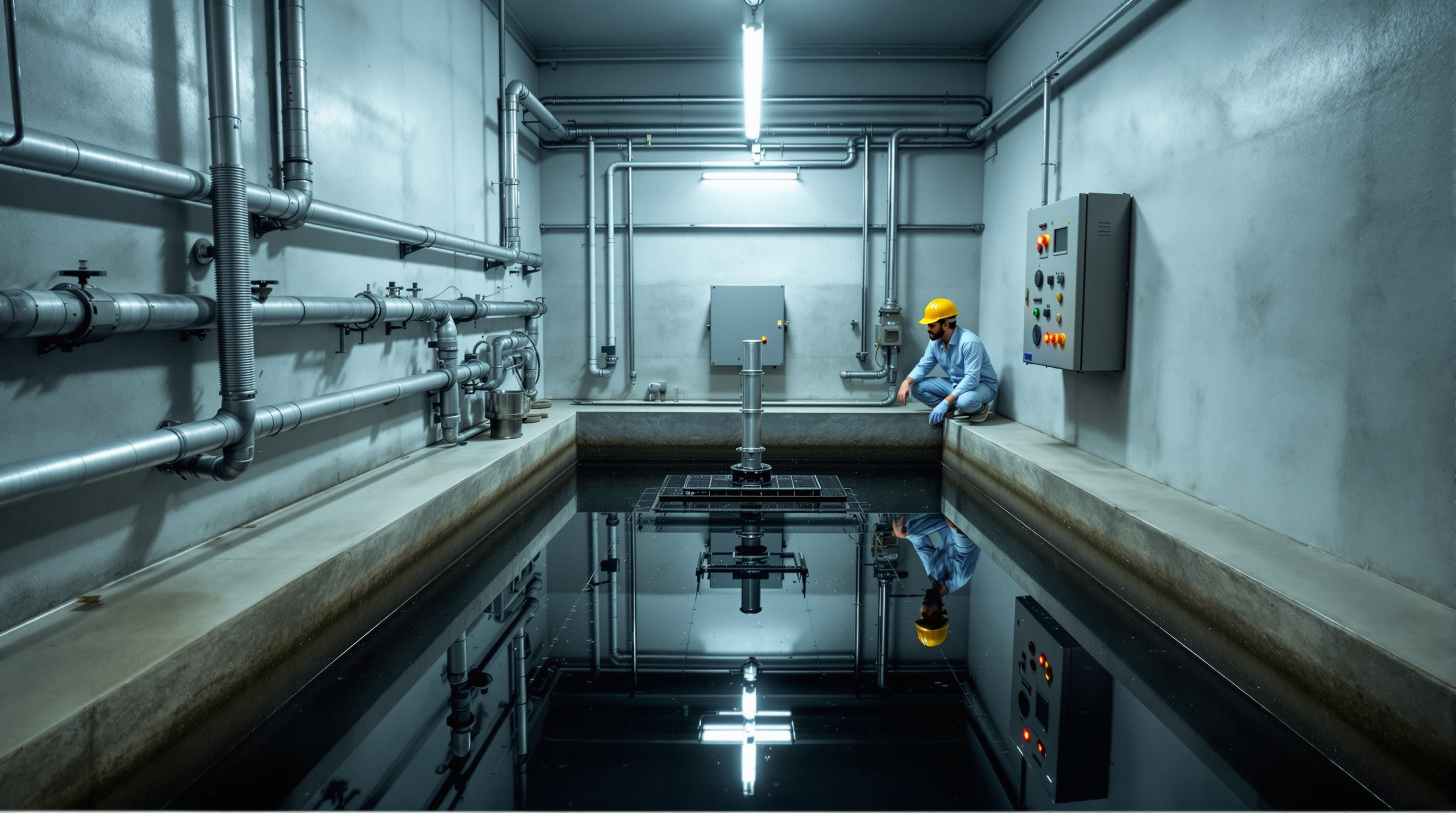
- Small footprint. No separate clarifier, no return-sludge pumping line, no separate anoxic tank. One vessel does the work of three or four. On tight urban plots and basements — the reality of most Indian buildings — that compactness is decisive.
- Excellent nutrient removal. As above, time-sequenced aeration removes nitrogen and phosphorus far better than a plain aeration plant, without extra tanks.
- Superb, quiescent settling. Because settling happens in a completely still tank with zero inflow, the sludge separates cleanly and the effluent is consistently low in suspended solids.
- Operational flexibility. Peak season, low occupancy, a stricter discharge limit — an operator retunes the cycle in software rather than rebuilding hardware. A half-full apartment block can simply run fewer, longer batches.
- Shock-load tolerance. The batch sits contained for hours; a slug of strong sewage is diluted and digested within the batch rather than washing straight through to the outlet.
The limitations: where the batch rhythm bites
No technology is free of trade-offs, and the SBR's are the flip side of its batch nature.
- Batch handling of peak flow. This is the big one. Real sewage arrives continuously and surges at peak hours; the SBR treats it in discrete batches. Bridging the two demands a generously sized equalisation tank upstream to hold incoming flow while a tank is mid-cycle, plus usually two tanks in tandem. Undersize the buffer and a morning peak can overwhelm the cycle.
- Controls complexity. The plant lives or dies by its PLC, valves, level sensors and the decanter mechanism. More moving, automated parts mean more that can fail and a real dependence on the automation working — and being maintained by someone who understands it. A simpler extended aeration plant has far less to go wrong.
- Operator skill. Tuning cycle times to changing load is a genuine skill. Set the phases wrong and you waste energy on over-aeration or let half-treated water out. This is not a "switch it on and forget it" system.
- The decanter is a critical single point. If the decanter jams or floods, the batch cannot be drawn and the cycle stalls. It needs reliable maintenance.
- Intermittent, not continuous, discharge. Effluent leaves in slugs during decant, not as a steady trickle, which the downstream filtration and reuse tank must be sized to absorb.
SBR versus the alternatives
Where does the sequential batch reactor sit against the other biological STP technologies you will meet in this series?
| Technology | Core idea | Separate clarifier? | Nutrient removal | Footprint |
|---|---|---|---|---|
| SBR | One tank, five timed phases | No — settles in the same tank | Very good (time-sequenced) | Small |
| Conventional ASP | Continuous flow through aeration then clarifier | Yes | Basic | Larger |
| MBBR | Microbes grow on moving plastic media | Yes | Moderate | Compact |
| MBR | Aeration + membrane filtration | No — membrane replaces it | Very good | Smallest |
Broadly: an SBR is chosen when you want strong nutrient removal and a small footprint, are comfortable with automation, and have room for a decent equalisation buffer. Where the incoming flow is very peaky and simplicity matters more than nutrient limits, an MBBR or extended-aeration plant may be an easier life. Where footprint and reuse quality trump everything and the budget allows, an MBR wins.
Typical applications in India

The SBR earns its keep wherever nutrient limits are tight or land is scarce:
- Residential townships and large apartment complexes discharging near lakes or into storm drains that feed sensitive waterbodies.
- IT parks, campuses and commercial developments that want a compact plant and reuse-grade water for flushing and cooling towers.
- Municipal and cluster STPs for towns, where the flexibility to handle a growing, variable load is valuable.
- Hotels and resorts with strongly seasonal occupancy, where cycle-tuning absorbs the swing between a full house and a quiet week.
Before any of this, the design starts from one number: how much sewage the building actually produces. Our STP capacity calculator and sewage generation calculator turn an occupancy figure into a design flow in KLD — the input every SBR cycle is then sized around.
The bottom line
A sequential batch reactor is activated sludge, reorganised around time. By running fill, react, settle, decant and idle in sequence inside a single PLC-controlled tank, it folds the clarifier, the anoxic zone and the aeration basin of a conventional plant into one compact vessel — and gets excellent nutrient removal almost for free. The price is a genuine dependence on automation, skilled tuning and a well-sized buffer to reconcile continuous inflow with batch treatment.
For most space-constrained, nutrient-conscious Indian projects, that is a trade worth making. To see how the SBR fits among all the biological options, continue through the Sewage Treatment Plants guide library, or step back to the complete beginner's guide to STPs for the full picture of how these plants clean water.
Export this guide
Related Guides — Deep-dive reading
Biological Culture Management in an STP: The Heart of Good O&M
The microbes in your aeration tank do the actual work of cleaning sewage. Keep them healthy — the right MLSS, food, oxygen and nutrients — and everything else falls into place. Here is how operators manage the living culture, diagnose bulking and foaming, and recover after a crash.
Sewage Treatment PlantsUnderstanding Hydraulic Retention Time (HRT) in STPs: The Complete Guide
What hydraulic retention time really means, how it sets the size of your reactor and the quality of your treated water, typical HRT figures for ASP, MBBR, SBR and UASB, and why HRT and SRT are two different clocks you must not confuse.
Sewage Treatment PlantsMembrane Bioreactor (MBR): The Highest-Quality STP Technology
How a membrane bioreactor swaps the settling clarifier for ultra-fine membranes to produce near-reuse-grade effluent in the smallest possible footprint — the working principle, the superb water quality, the high-MLSS advantage, and the real trade-offs of cost, fouling and power.
Sewage Treatment PlantsRelated Tools — Try Free
Sewage Generation Calculator
Estimate the daily sewage a building generates and its peak flow in KLD from occupancy, LPCD, sewage return factor and peak factor.
STP CalculatorApartment STP Planner
Plan an apartment complex sewage treatment plant from flats and occupancy — get population load, sewage flow, recommended STP capacity in KLD, treatment technology and approximate space.
PlannerSTP Technology Selector
Weight your priorities — footprint, effluent quality, cost, power and simplicity — and get a scored recommendation between Extended Aeration, MBBR, SBR and MBR.
Selector