
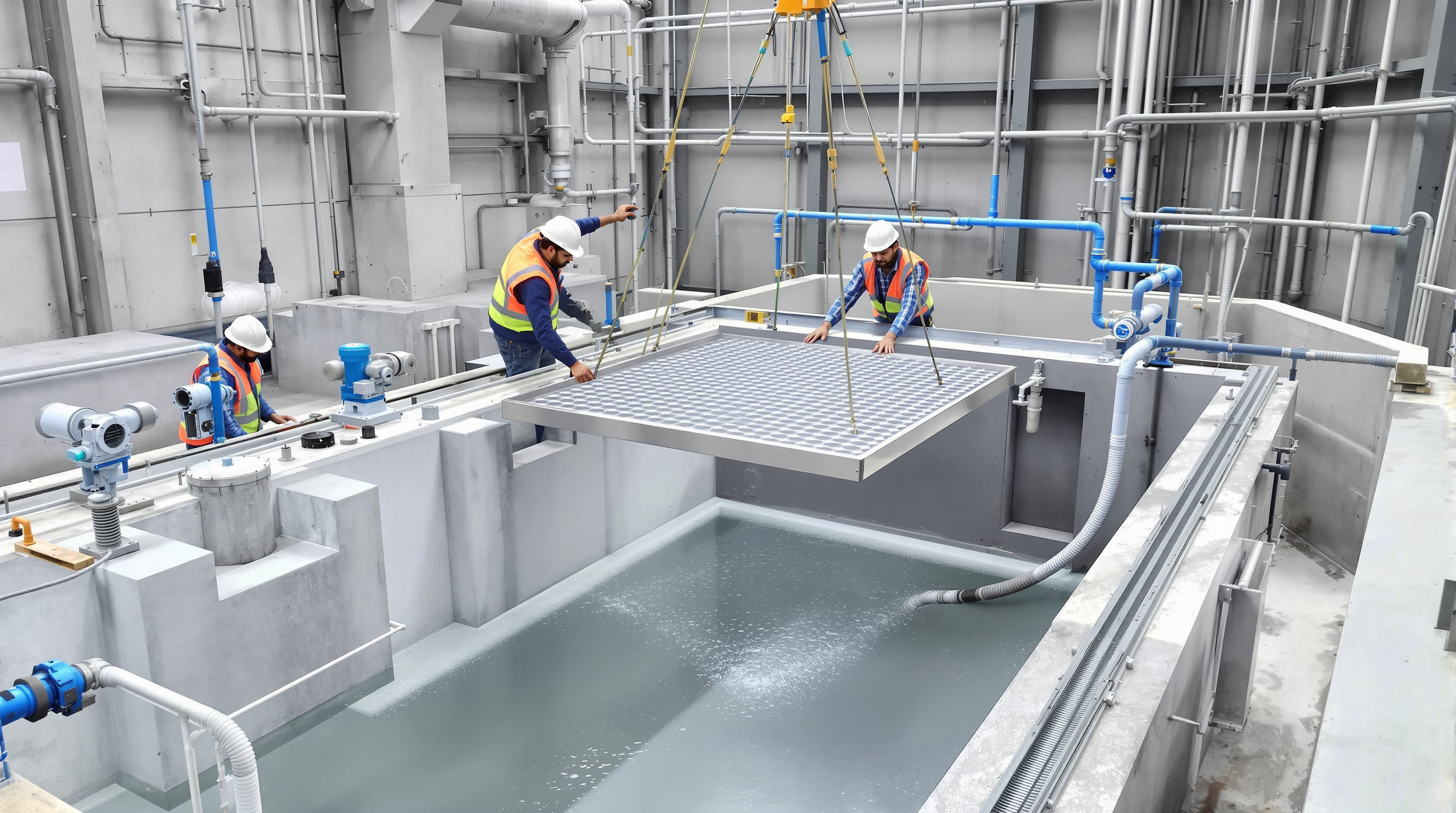
Mechanical Installation of STP Equipment: Blowers, Pumps, Diffusers & Pipework Done Right
How the blowers, pumps, diffuser grids, media, screens, tube settlers and pipework of a sewage treatment plant are actually set, aligned, anchored and supported on site — and the pre-commissioning mechanical checks that decide whether the plant runs quietly for years or rattles itself apart in months.
The civil work is the body of a sewage treatment plant; the mechanical equipment is its muscle and lungs. Once the RCC tanks are built and cured and waterproofed, a very different trade takes over the site: the mechanical erection crew who set the blowers, pumps, screens, diffuser grids, media, tube settlers and the maze of pipework that ties them together. This is where a good design either comes alive or quietly betrays itself. A blower bolted to an out-of-level plinth, a pump coupling a millimetre off, a diffuser lateral that sags — none of it fails on day one. It fails six months later, at 2 a.m., after warranty arguments have already started.
This guide walks through the mechanical installation stp crews do on site, in the order they do it: setting and levelling equipment, aligning rotating machinery, anchoring, supporting pipework, and the pre-commissioning checks that must pass before a single litre of sewage is let in.
Civil tolerances are measured in centimetres; mechanical tolerances are measured in tenths of a millimetre. The most common site failure is a fitter treating a pump like a piece of furniture instead of a piece of precision machinery.
Before anything is lifted: the readiness checks
No equipment should be set until the space is genuinely ready. Rushing this is how plants end up with plinths chipped open again a week later.
- Foundations and plinths cured and level. Every equipment plinth should be checked with a spirit level or laser across two axes. A blower or pump plinth out of level forces the baseplate to twist when bolted down — the machine is stressed before it has run for a second.
- Anchor-bolt pockets or chemical-anchor positions verified against the vendor's General Arrangement (GA) drawing. Bolt centres are unforgiving; a 10 mm error means the baseplate holes will not line up.
- Tanks cleaned, tested and dry. Aeration and clarifier tanks must pass a hydrostatic leak test on the civil side before diffusers or tube settlers go in — you do not want to drain a full tank to fix a crack after the internals are installed.
- Delivery inspection. Match every skid, motor and panel against the packing list and nameplate. Confirm blower CFM and head, pump duty point, and motor kW against the approved STP design before it is craned into a basement it may never easily leave.
Blowers: the heart of the aeration system
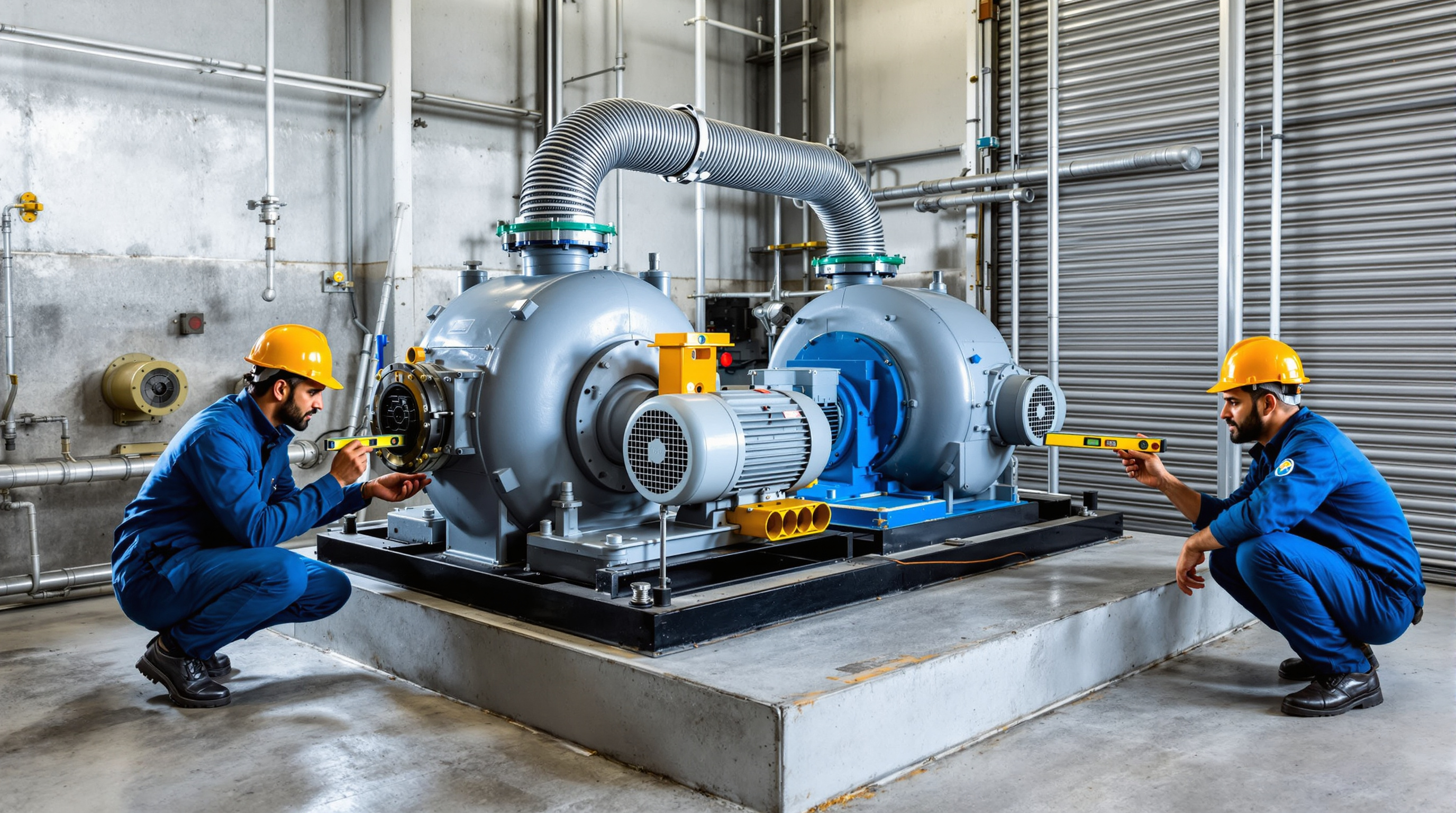
Blowers — usually twin-lobe roots or screw type for aeration tanks — are the most vibration-sensitive machines in the plant, and the ones most often installed badly.
1. Set on anti-vibration mounts. Blowers are almost always supplied on a common baseplate with the motor, sitting on rubber or spring anti-vibration (AV) pads. The baseplate must sit fully level; use shim plates under the AV mounts, not slivers of packing, to true it up.
2. Belt or coupling alignment. For belt-driven blowers, motor and blower pulleys must be co-planar — a straightedge across both pulley faces should touch all four rims. Belt tension follows the vendor's deflection figure; over-tightening wrecks bearings.
3. Anchor without stress. Tighten foundation bolts in a diagonal cross pattern, checking level after each is snugged so the baseplate is not warped as it is drawn down.
4. Flexible connection at the discharge. The pipe leaving a blower must include a flexible bellows or braided connector so pipe loads and thermal growth never transmit into the blower casing. Rigidly welding a blower into hard pipe is a classic, expensive mistake.
5. Suction filter and silencer fitted and clean, discharge non-return valve and pressure-relief valve oriented per the P&ID.
Pumps: alignment is everything
STPs are full of pumps — raw sewage, transfer, filter feed, sludge, and more. Submersible pumps sit on a guide-rail and auto-coupling pedestal that must be plumb so the pump seats squarely on its discharge bend. Dry-mounted (monobloc or end-suction) pumps demand real alignment discipline:
- Coupling alignment between motor and pump shaft, checked with a dial gauge or laser tool for both angular and parallel offset, corrected with shims under the feet. "Eyeballing" a coupling guarantees premature seal and bearing failure.
- No pipe strain. Suction and delivery pipes must arrive at the pump flanges on their own supports, so the pump carries zero pipe weight. Disconnect a flange after alignment; if the pipe springs away, the pipe is fighting the pump — re-support it.
- Flooded suction and eccentric reducers on the suction side (flat-side up) to stop air pockets that cause cavitation and airlock.
Screens, diffusers, media and tube settlers
Bar and fine screens at the inlet are set at the design angle (typically 60–75°) in the screen channel, firmly grouted, with the screenings platform clear and drained back to the channel.
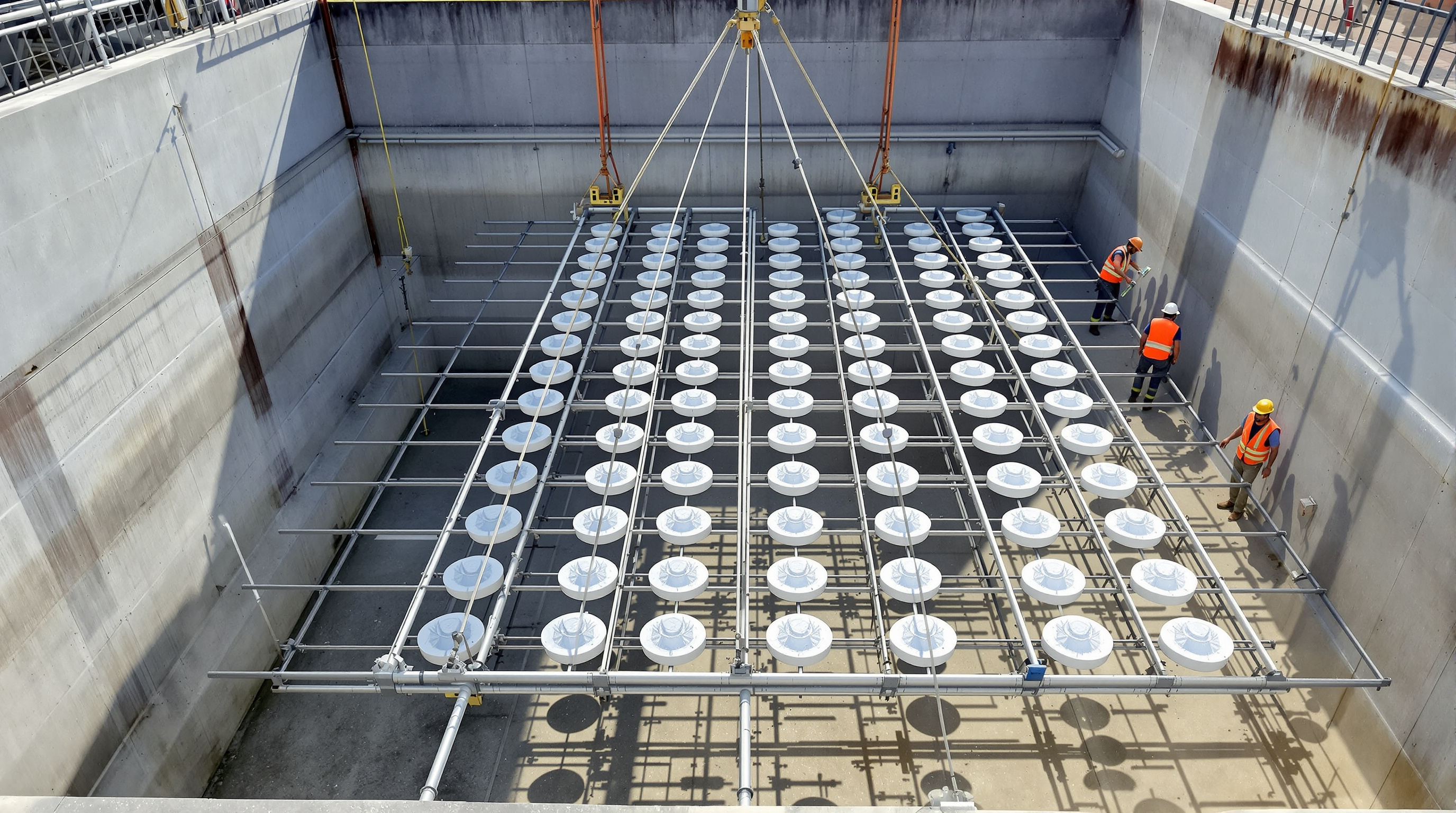
Diffuser grids are the lungs of the aeration tank and the most level-critical internal of all. Fine-bubble membrane diffusers on their air-distribution laterals must be installed dead level across the whole grid — if one lateral sits lower, air takes the path of least resistance and that zone hogs the airflow while the rest goes anaerobic. Level each lateral with a water level or laser, anchor the grid to the tank floor with the vendor's SS supports, and pressure-test the air header for leaks before the tank is filled — a leaking joint underwater is almost impossible to find later.
MBBR media for a moving bed reactor is loaded only after the retention sieves are fitted and checked, and the fill fraction is measured by volume — never dumped in by the bag. Overfilling starves circulation.
Tube settlers in the clarifier sit on a support frame at the design angle (usually 60°); modules must be laid square, fully supported, and weighted or clipped so they cannot float free when the tank fills.
| Equipment | Critical setting tolerance | Most common site error |
|---|---|---|
| Blower baseplate | Level across both axes; AV mounts true | Shimming with random packing, no flexible connector |
| Dry-mounted pump | Coupling align within vendor limit | Pipe weight taken on pump flange |
| Diffuser grid | Whole grid dead level | One lateral low → uneven aeration |
| MBBR media | Fill by measured volume | Overfilling, poor circulation |
| Tube settlers | Correct angle, square, restrained | Modules float or sag |
Pipework and supports: the connective tissue
Pipework is where sloppy installation hides, because it looks finished even when it is wrong. Hold to a few rules:
- Support at the code spacing. Follow IS-directed support intervals for the pipe material and size — closer for uPVC/HDPE than for MS, and closer still on horizontal runs carrying liquid. Sagging plastic pipe holds solids, throttles flow and eventually cracks at the fitting.
- Supports take the load, flanges do not. Every valve, strainer and long run needs its own bracket or hanger so equipment nozzles never carry pipe weight.
- Slope gravity lines continuously toward their destination — no bellies where solids settle and block.
- Isolation and non-return valves placed so any pump or blower can be removed without draining the system, and unions/flanges at every piece of equipment for maintenance access.
- Colour-code and label lines (raw sewage, air, treated water, sludge, chemical dosing) per the treated-water reuse plumbing and dosing scheme, so operators are not guessing later.
Pre-commissioning mechanical checks
Before the plant is handed to the electrical and instrumentation teams for wet commissioning, the mechanical scope must pass its own sign-off:
- Rotation check — bump every motor to confirm correct direction before it is coupled or the pump is primed.
- Manual rotation of pump and blower shafts by hand — they should turn freely, no rubbing or binding.
- Fastener audit — every foundation and flange bolt torqued and marked.
- Hydro-test of pipework and air-test of the aeration header, logged.
- Alignment records for all couplings, filed for the handover dossier.
- Free rotation of valves and correct fail position confirmed.
Clearing this checklist is what lets the commissioning and trial-run phases proceed without chasing mechanical ghosts.
The bottom line
Mechanical installation is the trade that turns a set of concrete tanks into a working machine. Get the plinths level, the couplings aligned, the diffuser grid dead flat, the media measured, the tube settlers restrained and the pipework properly supported and sloped — and the plant runs quiet, efficient and long-lived. Cut corners here and no amount of clever process design will save it.
For the wider picture, start at the Sewage Treatment Plants guide hub or revisit how an STP works. And if you are still sizing the equipment this crew will install, the STP Capacity Calculator turns your building's occupancy into the treatment capacity — and the blower and pump duty points — every installation begins from.
Export this guide
Related Guides — Deep-dive reading
Air Blowers & Diffusers in an STP: How Aeration Actually Works
The blowers that push air and the diffusers that turn it into bubbles are the lungs of your sewage treatment plant. Here is how they work, how they are sized, and why they decide most of your electricity bill.
Sewage Treatment PlantsAnnual STP Maintenance & Overhaul: The Complete Yearly Shutdown Checklist
Once a year your STP needs a full stop, a drain-down, and an honest look at everything the daily rounds never reach — tanks, blowers, membranes, instruments, concrete and the AMC. Here is the complete annual overhaul, in the right order.
Sewage Treatment PlantsCivil Construction of STPs: What Goes Into Building One
Before a single blower runs, an STP is a piece of civil engineering — excavation, watertight RCC tanks, baffle walls, a plant room and drainage, built in a sequence that decides whether the plant ever works. Here is what that construction actually involves.
Sewage Treatment PlantsRelated Tools — Try Free
STP Installation Checklist
An interactive checklist that walks you through every civil, mechanical, electrical/I&C and pre-commissioning task of a sewage treatment plant install, with a live readiness score and per-section progress charts.
ChecklistMonsoon-Readiness Checklist
Pre-rain home audit across 9 categories — terrace, drains, waterproofing, electrical, HVAC, pest, vehicles, documents.
Seasonal AuditRainwater Tank Sizer
How big should your rainwater tank be? Computes annual harvest, recommended tank capacity in litres, water-bill savings, and payback — for 10 Indian cities.
RWH Calculator