
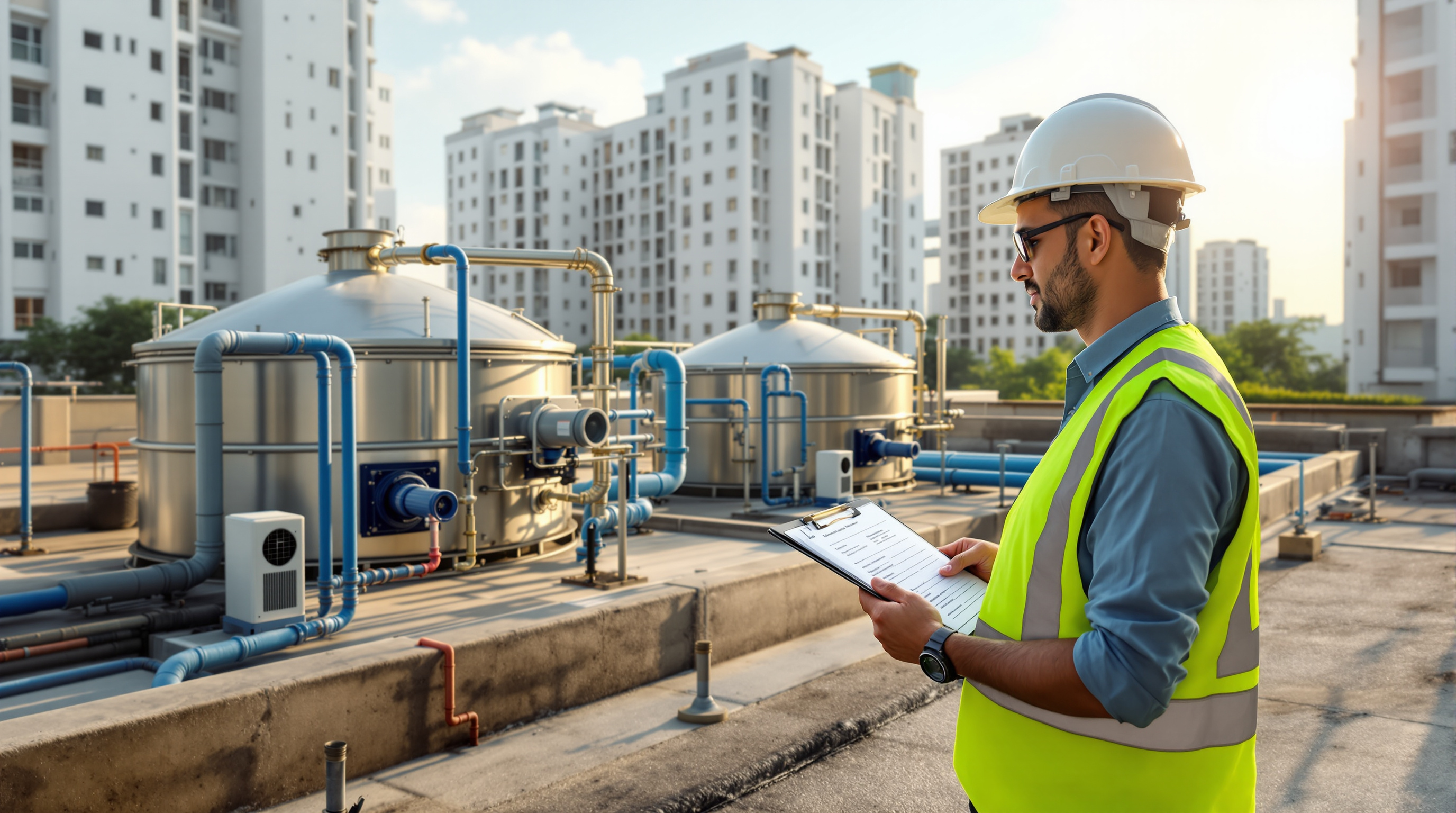
How to Size an STP: A Step-by-Step Method (With Worked Example)
The complete sizing methodology for a domestic sewage treatment plant — from headcount and LPCD to sewage generation, peak flow and tank-by-tank volumes — worked end to end with an Indian apartment example.
Ask three consultants to size the same STP and you may get three different capacities. Not because the maths is hard — it is arithmetic a student could do — but because sizing an STP is a chain of assumptions, and a small change early on ripples all the way to the tank dimensions and the tanker of concrete you pour. Get the population wrong, or pick the wrong LPCD, and every number downstream is wrong with it.
This guide lays the chain out one link at a time. By the end you will be able to take a building — its flats, its beds, its seats — and turn it into a treatment capacity in KLD and a set of tank volumes you can hand to a fabricator. We work a full apartment example alongside the theory so every formula lands on a real number.
Sizing an STP is not about one clever equation. It is about making each assumption honestly — population, LPCD, peak factor, retention time — because the plant is only ever as right as its weakest guess.
Step 1 — Estimate the design population
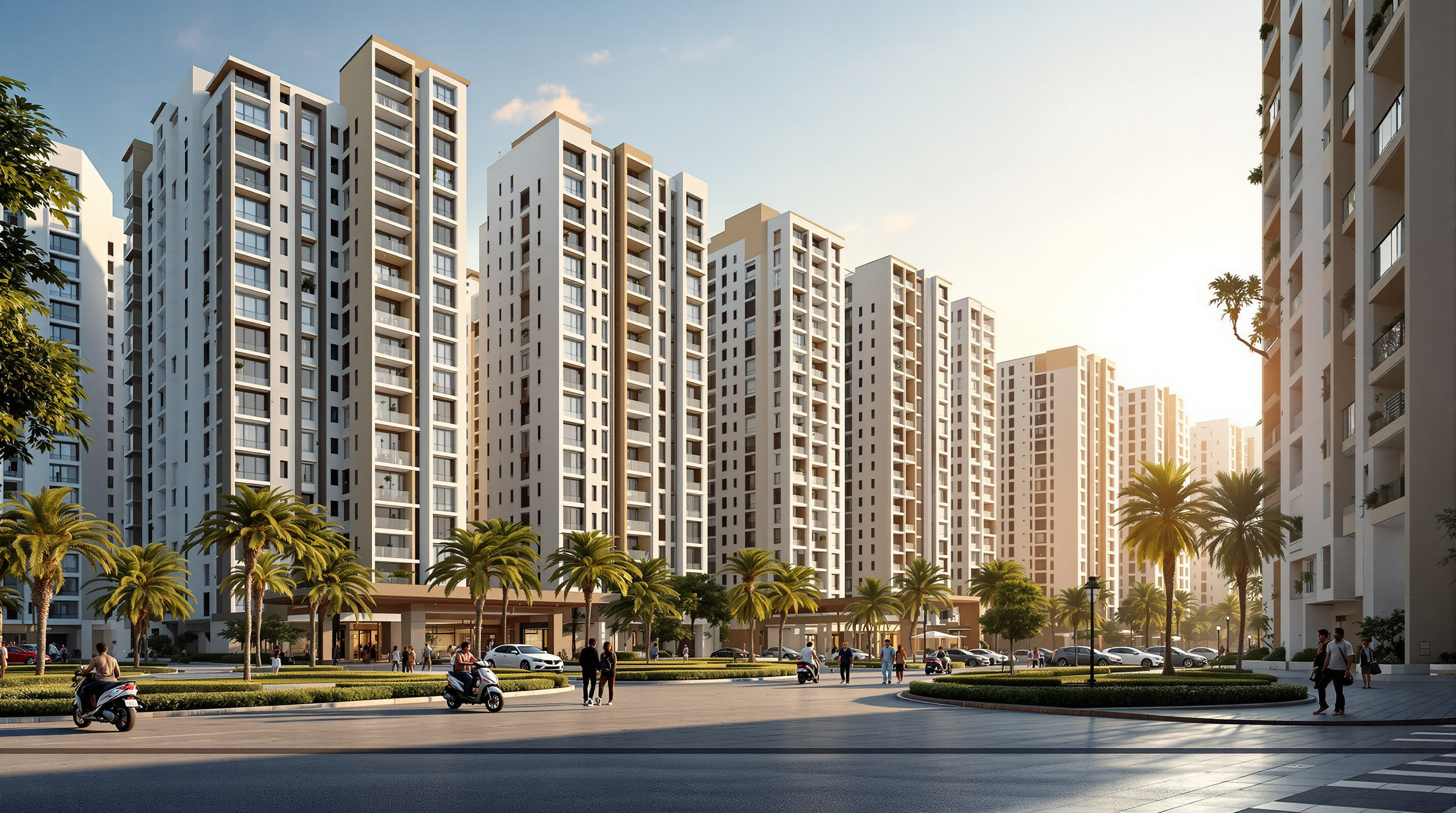
Everything starts with how many people the building serves on a design day. For a residential project you do not count residents directly; you count the fixtures the authority assumes will be occupied. The common convention in Indian practice is a fixed occupancy per dwelling based on bedroom count.
| Occupancy type | Typical design basis |
|---|---|
| Residential (per 1/2/3 BHK) | ~2 / 3 / 4.5 persons per flat, or a flat 4–5 per unit |
| Office / IT park | Per built-up area or per seat |
| Hotel | 2 persons per room + banquet/restaurant covers |
| Hospital | Per bed + outpatient + staff |
| School / college | Per student + staff, day-use only |
The number you want is the design population — the realistic peak the plant must handle, not the average. For a mixed-use development, add each block's population separately; a hotel's laundry-heavy load behaves nothing like an office's nine-to-five one. Our water consumption estimation guide goes deeper on choosing the right occupancy basis for each building type.
Worked example. Take a residential complex of 200 flats — a mix averaging 4 persons per flat. Design population = 200 × 4 = 800 persons.
Step 2 — Apply LPCD to get water demand
LPCD — litres per capita per day — is the water each person is assumed to consume in a day. For fully plumbed urban housing, Indian design commonly uses 135 LPCD for domestic supply, sometimes 150 LPCD where flushing is on the same source. Commercial and institutional buildings use lower figures because people are present for fewer hours.
Water demand (LPD) = Design population × LPCD
For our example at 135 LPCD:
- 800 persons × 135 LPCD = 108,000 litres/day of water supplied.
Pick the LPCD deliberately. Using 135 where the local norm expects 150 quietly undersizes the whole plant by 10%.
Step 3 — Convert water demand to sewage generation
Not all the water supplied becomes sewage — some is lost to gardens, cooling, evaporation and drinking. The standard planning assumption is that 80% of water supplied returns as sewage. This is the single most important conversion in the whole exercise.
Sewage generation = Water demand × 0.80
For our building:
- 108,000 LPD × 0.80 = 86,400 litres/day ≈ 86.4 KLD of raw sewage.
The sewage generation calculation guide explains when to move the 80% factor up or down — a zero-garden high-rise returns more; a campus with heavy irrigation returns less. You can run both this step and the last one instantly with the Sewage Generation Calculator.
Step 4 — Set the design capacity and margin
Now round up and add headroom. Nobody builds an 86.4 KLD plant — you build a standard size above it. Add a design margin of 10–20% for future occupancy, festival peaks and the reality that flats fill up over years.
- 86.4 KLD × 1.15 ≈ 99.4 KLD → round to a 100 KLD plant.
That clean 100 KLD is the plant's rated capacity — the headline number quoted to the pollution board, the fabricator and the buyer. The STP Capacity Calculator does Steps 1–4 in one pass and is the fastest way to sanity-check a consultant's number.
Step 5 — Fix the peak factor
The 100 KLD is a daily figure, but sewage does not arrive evenly. Everyone showers before work and washes up after dinner, so the flow spikes. The peak factor converts average flow into the peak hourly flow the hydraulics — pumps, pipes, channels — must survive.
For a plant this size a peak factor of about 2.5–3.0 is typical (smaller populations swing harder; large ones average out). This peak flow sizes the hydraulic elements. The biological tanks, by contrast, are sized on the average flow because the equalisation tank absorbs the swing — which is exactly why that tank exists. Our peak flow design guide details how peak factor scales with population.
Step 6 — Size each treatment unit
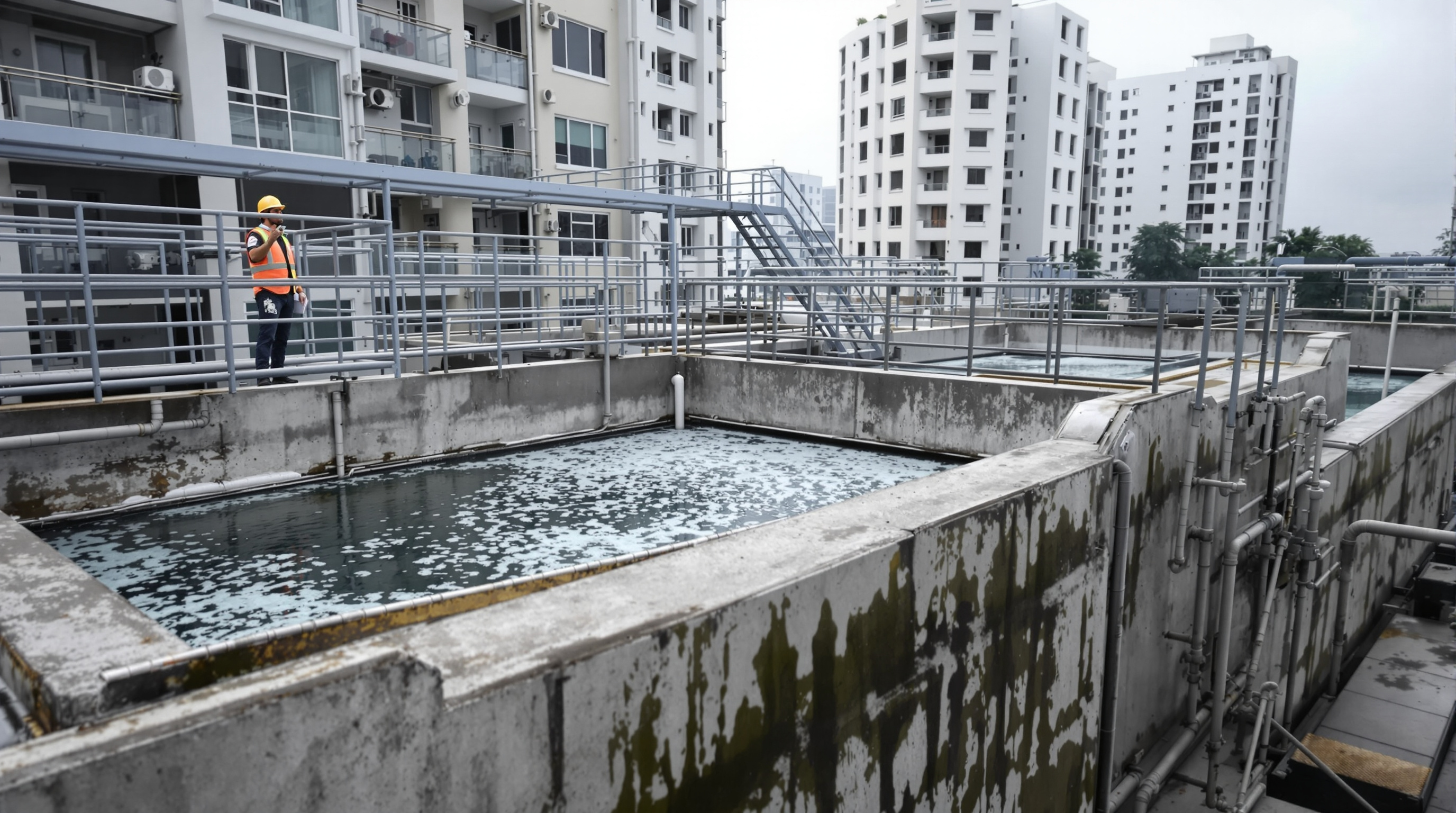
With average flow (100 KLD ≈ 4.17 m³/hr) and peak flow in hand, size the tanks. Each unit is governed by a retention time (how long water sits in it) or a loading rate (how much flow or pollutant each square metre or cubic metre handles). The numbers below are conventional starting points for a domestic ASP/MBBR plant — always confirm against your process vendor.
Equalisation tank. Sized to hold several hours of flow and flatten the daily peak. A common basis is 8–12 hours of average flow.
- 100 KLD × (8/24) ≈ 33 m³ (at 8 hours).
Aeration tank. The biological heart, sized on hydraulic retention time (HRT), typically 6–8 hours for a conventional activated sludge process (MBBR runs shorter, extended aeration longer).
- 100 KLD × (8/24) ≈ 33 m³ at 8 hours HRT.
You can test any tank volume against flow with the Hydraulic Retention Time Calculator, and cross-check the food-to-microorganism balance using the Organic Loading Calculator. The understanding hydraulic retention time and aeration design principles guides unpack why HRT and oxygen demand drive this tank's size.
Secondary clarifier. Sized on surface overflow rate (SOR) — the flow per unit of plan area, commonly around 20–30 m³/m²/day for domestic sewage. Lower SOR means a bigger, calmer tank and cleaner settling.
- 100 m³/day ÷ 24 (m³/m²/day) ≈ 4.2 m² surface area, then set depth (typically 3–3.5 m) for volume.
The clarifier guide covers weir loading and depth so the settled sludge does not float back up.
Sludge handling. Finally, estimate the solids the plant will produce so you size thickening and drying beds — roughly 0.5–0.8 kg of dry sludge per kg of BOD removed. The sludge generation estimation guide and the Sludge Generation Calculator turn your BOD load into a daily sludge figure.
Step 7 — Add margin and sanity-check
Before you freeze the design, walk back up the chain and pressure-test it:
- Does the population reflect full occupancy, not today's half-sold building?
- Is the LPCD the one your SPCB expects for this building class?
- Is 80% right for this site's garden and cooling loads?
- Do the tank volumes agree with two methods — retention time and loading rate?
- Is there 10–20% headroom so the plant is not running at 100% on day one?
A plant sized with honest margins runs quietly for decades; one sized to the bone smells, trips its discharge norms, and gets rebuilt. When numbers look off, the error is almost always an early assumption, not the final arithmetic.
Putting it together
Here is the whole chain for our 200-flat example on one line:
| Step | Calculation | Result |
|---|---|---|
| Population | 200 flats × 4 | 800 persons |
| Water demand | 800 × 135 LPCD | 108,000 LPD |
| Sewage (80%) | 108,000 × 0.80 | 86,400 LPD |
| + Margin (15%) | 86.4 × 1.15 | ≈ 99 KLD |
| Rated capacity | round up | 100 KLD |
From that 100 KLD, retention times and loading rates give every tank its volume. That is the entire method — a disciplined walk from people to KLD to steel and concrete.
One caution: domestic vs industrial
This method sizes a domestic STP — the everyday sewage of homes, offices, hotels and institutions. If your building is really an industrial process — a dyeing unit, a dairy, a pharma plant — the load is not people-driven at all, and an LPCD-and-population approach will badly mis-size it. Those streams need an ETP, sized on process flow and pollutant load, not headcount. The STPs vs ETPs guide draws the line clearly.
For the wider picture — what these tanks actually do and how the stages connect — continue through the Sewage Treatment Plants guide library, and start every real project by running your headcount through the STP Capacity Calculator.
Export this guide
Related Guides — Deep-dive reading
Water Consumption Estimation for Buildings: LPCD Norms, Occupancy & End-Use Breakdown
How to estimate a building's daily water demand from its occupancy and NBC per-capita norms, break it down by end use, and turn that number into the foundation for sizing water supply, storage and sewage systems.
Sewage Treatment PlantsSludge Generation Estimation in STPs: How Much Sludge Will Your Plant Produce?
Every STP that cleans water also makes sludge — and the biosolids you forget to plan for become the operating headache you cannot ignore. Here is how to estimate sludge generation, understand the yield concept, and size dewatering before you build.
Sewage Treatment PlantsUnderstanding Hydraulic Retention Time (HRT) in STPs: The Complete Guide
What hydraulic retention time really means, how it sets the size of your reactor and the quality of your treated water, typical HRT figures for ASP, MBBR, SBR and UASB, and why HRT and SRT are two different clocks you must not confuse.
Sewage Treatment PlantsRelated Tools — Try Free
Sewage Generation Calculator
Estimate the daily sewage a building generates and its peak flow in KLD from occupancy, LPCD, sewage return factor and peak factor.
STP CalculatorDaily Water Consumption Calculator
Estimate a building's total daily water consumption in KLD from occupancy and LPCD, with the end-use split across bathing, flushing, washing, kitchen and drinking.
Water CalculatorRainwater Tank Sizer
How big should your rainwater tank be? Computes annual harvest, recommended tank capacity in litres, water-bill savings, and payback — for 10 Indian cities.
RWH Calculator