
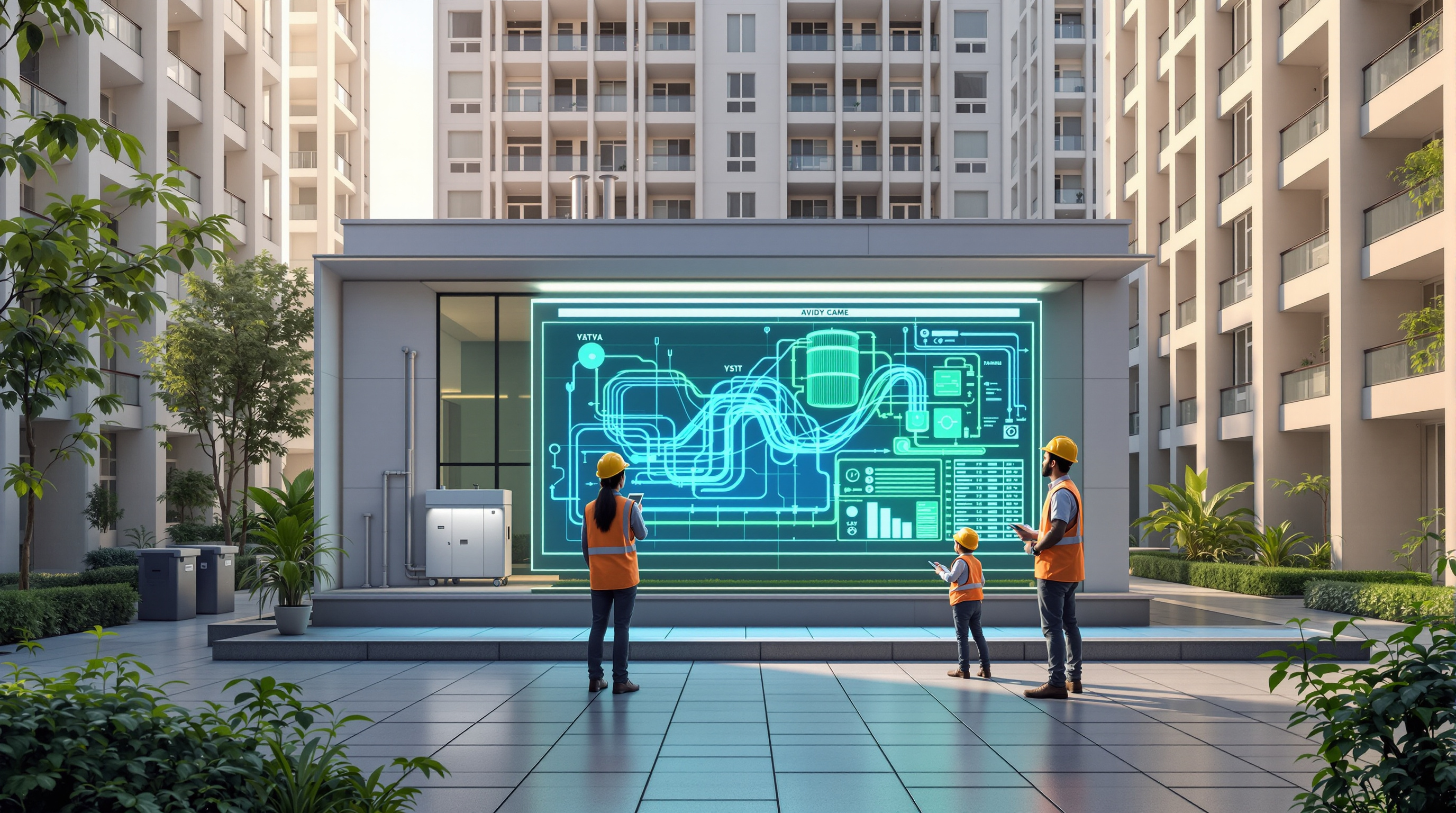
Digital Twins for STPs: A Live Simulation of Your Sewage Treatment Plant
What a digital twin of an STP actually is, how a live virtual model helps you operate, optimise and train without risk, and an honest read on where the technology stands for building-scale plants in India.
Every sewage treatment plant already produces a second, invisible output alongside clean water: data. Dissolved-oxygen readings, blower currents, flow rates, pump run-hours, sludge levels — a modern plant generates thousands of numbers a day. For most buildings that data is glanced at, logged in a register, and forgotten. A digital twin is what happens when you stop wasting it — when you feed it into a live virtual copy of your plant that runs alongside the real one, mirrors its behaviour, and lets you ask "what if?" without touching a single valve.
The phrase gets thrown around loosely, so this guide is deliberately plain about what a digital twin of an STP actually is, what it genuinely does for operation, optimisation and training, and — just as importantly — where the technology honestly stands for a 200 or 500 KLD building-scale plant in India today. Some of what you will read below is proven and running; some is still maturing. We will be clear about which is which.
A digital twin is not a dashboard. A dashboard tells you what your plant is doing. A digital twin tells you what your plant would do — under a load spike, a blower failure, or a new setpoint — before it happens.
What a digital twin actually is
A digital twin has three parts, and all three must be present. Drop any one and you have something less.
- The virtual model. A software replica of your STP — its tanks, its biology, its pumps and blowers — built on the same process equations engineers use to design the plant (activated-sludge kinetics, mass balances, aeration transfer). This is the "twin".
- The live data link. A stream of real sensor readings from the physical plant, flowing continuously into the model so it reflects this plant on this day, not a textbook average. This is what separates a twin from an ordinary simulation.
- The feedback loop. The ability to run scenarios in the model and push insights — or in advanced systems, control setpoints — back to the plant. This is what makes it useful rather than decorative.
Put simply: a simulation is a model you build once. A digital twin is a model that stays synchronised with reality and grows more accurate the longer it runs. It sits one layer above the IoT sensor network that feeds it and the SCADA and instrumentation that already exist on most plants.
What a live simulation lets you do
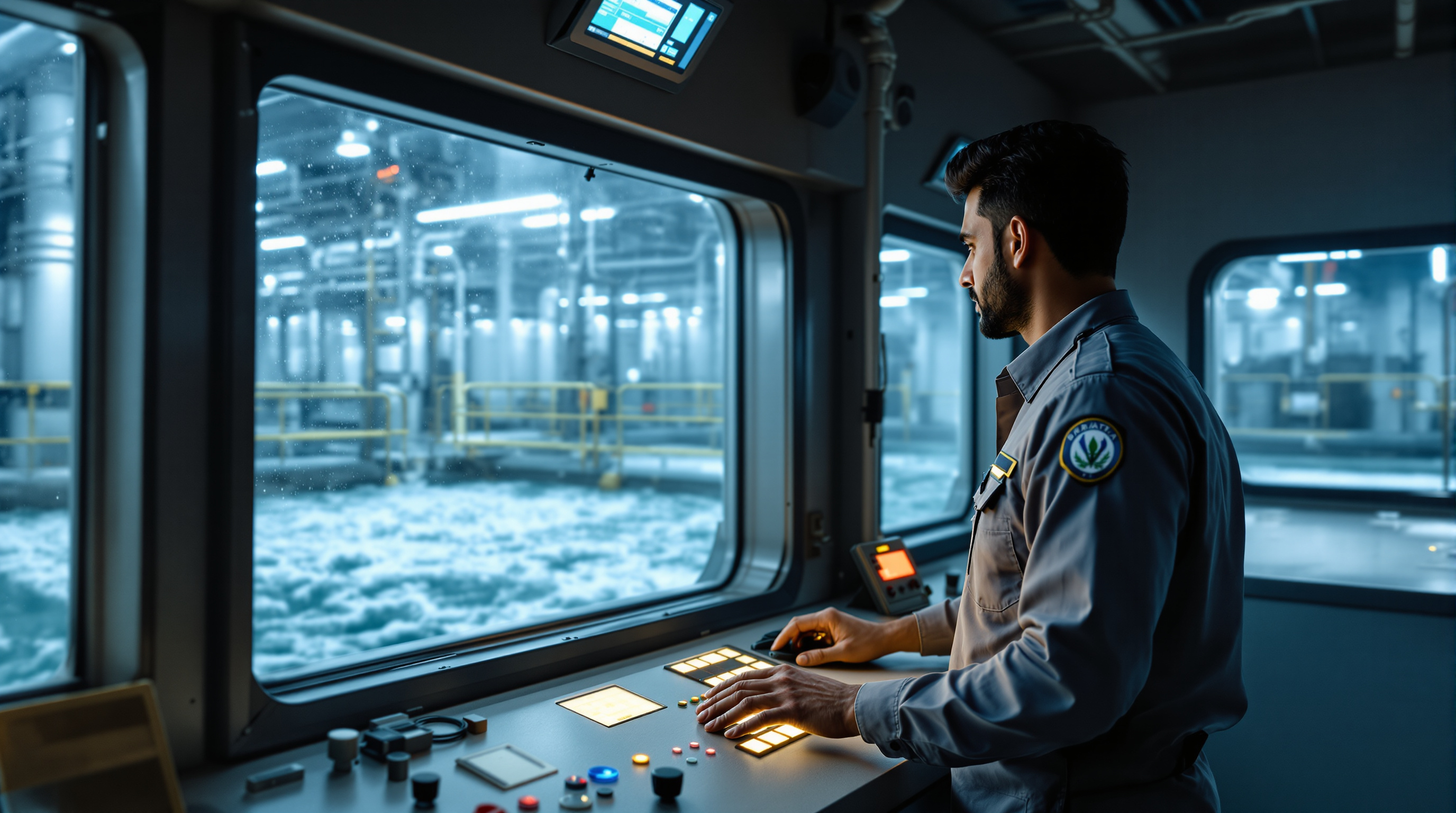
The value of a twin shows up in three distinct jobs. Each is worth understanding on its own.
1. Operation — see the plant you cannot see
Inside an aeration tank, the biology is invisible. You cannot watch the microbes struggle when a hostel's Sunday-morning load doubles the flow. A twin infers the hidden state — estimated BOD load, oxygen deficit, the risk of an upset — from the sensors you do have, and surfaces it as a live picture. An operator who can see that a shock load is arriving can raise aeration an hour early instead of discovering the problem when the effluent turns cloudy.
2. Optimisation — spend less energy on the same result
Aeration is the single largest energy cost in an STP — often 50–60% of the power bill. Most plants run blowers harder than they need to, "just to be safe". A twin lets you test a lower dissolved-oxygen setpoint or a smarter blower schedule in software first, confirm the treated water still meets CPCB norms, and only then apply it to the real plant. This is where twins pay for themselves fastest, and it dovetails directly with the tactics in reducing STP electricity consumption.
3. Training — practise the emergency before it happens
An operator learns to handle a clarifier bulking event or a blower trip by living through one — usually badly, the first time. A twin becomes a flight simulator: trainees can crash the virtual plant, watch the effluent breach limits, and recover it, with zero risk to compliance or the receiving drain. For an apartment association that loses its trained operator every couple of years, that repeatable, consequence-free training is quietly one of the biggest wins.
Twin vs. dashboard vs. simulation
These three are constantly confused. The differences are practical, not academic.
| Capability | Basic dashboard | Offline simulation | Digital twin |
|---|---|---|---|
| Shows live sensor readings | Yes | No | Yes |
| Models the biology & hydraulics | No | Yes | Yes |
| Stays synced to your plant daily | No | No | Yes |
| Answers "what if I change X?" | No | Yes (generic) | Yes (this plant) |
| Predicts an upset before it happens | No | No | Yes |
| Supports risk-free operator training | No | Partly | Yes |
The takeaway: a dashboard reports the past, a simulation explores a hypothetical, and a twin connects the two into a live, plant-specific forecast.
Where the technology honestly stands
Here is the candid part. Digital twins are mature in oil, gas and large municipal water utilities — plants of tens or hundreds of MLD, with dedicated instrumentation budgets and process engineers on staff. At the building scale — the 50 to 1,000 KLD plants this guide series is about — the technology is real but still early.
What is genuinely working today:
- Live monitoring twins that mirror the plant and flag anomalies. This layer is proven and increasingly affordable, riding on predictive-maintenance platforms already sold in India.
- Energy-optimisation advisories that recommend aeration setpoints. Real, but they need a few months of clean data to calibrate.
What to treat with healthy scepticism:
- Fully autonomous "self-driving" STPs that close the control loop without a human. Demonstrated in pilots, not something to specify for a residential plant yet.
- Twins sold with no sensor plan. A twin is only as good as its data. If a vendor promises a digital twin but your plant has three sensors and a flow meter, you are buying a screensaver. Get the instrumentation right first.
The honest sequence for most buildings is: reliable sensors and IoT monitoring first, then analytics and predictive maintenance, and only then a true twin. Skipping to the twin is the classic mistake covered in common mistakes when buying an STP.
Is a twin worth it for your plant?
A rough rule of thumb. The economics favour a digital twin when several of these are true:
- The plant is large (roughly 300 KLD and above), so energy savings are meaningful in rupees.
- It runs variable loads — a hotel, hospital, IT park or mixed-use campus — where a static setting is never optimal.
- Compliance stakes are high, with continuous online monitoring already mandated or installed.
- The site has decent instrumentation or a budget to add it.
- Operator turnover makes repeatable training valuable.
A small, steady 50 KLD apartment plant with a good operator rarely needs a twin yet — solid monitoring is enough. Before committing, model the running-cost picture with the STP annual operating cost guide and quantify the aeration-energy prize with the carbon savings calculator; if the numbers are small, the twin can wait.
The bottom line
A digital twin of an STP is a live, sensor-fed virtual copy of your plant that lets you see the invisible biology, test changes safely, and train without risk. Its clearest wins today are energy optimisation and operator training on larger, variable-load plants — and its foundation is good instrumentation, not clever software. Treat the fully autonomous plant as tomorrow's promise, not today's purchase.
For where this fits in the bigger picture of connected, low-carbon water systems, continue with smart water infrastructure and AI in STP operations, or step back to the full Sewage Treatment Plants guide library to build the fundamentals a twin ultimately runs on.
Export this guide
Related Guides — Deep-dive reading
AI in STP Operations: What Actually Works Today (and What Doesn't)
A practical, honest look at how AI and machine learning are used to run sewage treatment plants — optimising aeration and energy, predicting effluent quality, catching faults early, and easing operator dependence — with a clear-eyed view of what is mature and what is still marketing.
Sewage Treatment PlantsIoT Monitoring for STPs: Real-Time Sensors, Dashboards & OCEMS Compliance
How IoT sensors, connectivity and dashboards turn a blind, manually-logged sewage plant into a plant you can watch, alarm and prove compliant in real time — what to install, what it costs, and where the technology is genuinely ready.
Sewage Treatment PlantsRemote STP Monitoring & Operation: Running Sewage Plants from a Control Room
How cloud SCADA, remote-operations centres and managed-service O&M let a small building get expert STP operation without a full-time expert on site — what works today, what is still maturing, and what it costs.
Sewage Treatment PlantsRelated Tools — Try Free
Apartment STP Planner
Plan an apartment complex sewage treatment plant from flats and occupancy — get population load, sewage flow, recommended STP capacity in KLD, treatment technology and approximate space.
PlannerSTP Compliance Checklist Tool
Interactive self-audit that ticks off STP consents, discharge norms, reuse metering, online monitoring and O&M records to give a live compliance readiness score.
ChecklistApartment Video Door System Planner
Enter flats, entrances, floors and guard desk for a first-pass building intercom plan — door stations, indoor monitors, guard station, the right architecture and an indicative cost band.
Building Planner