
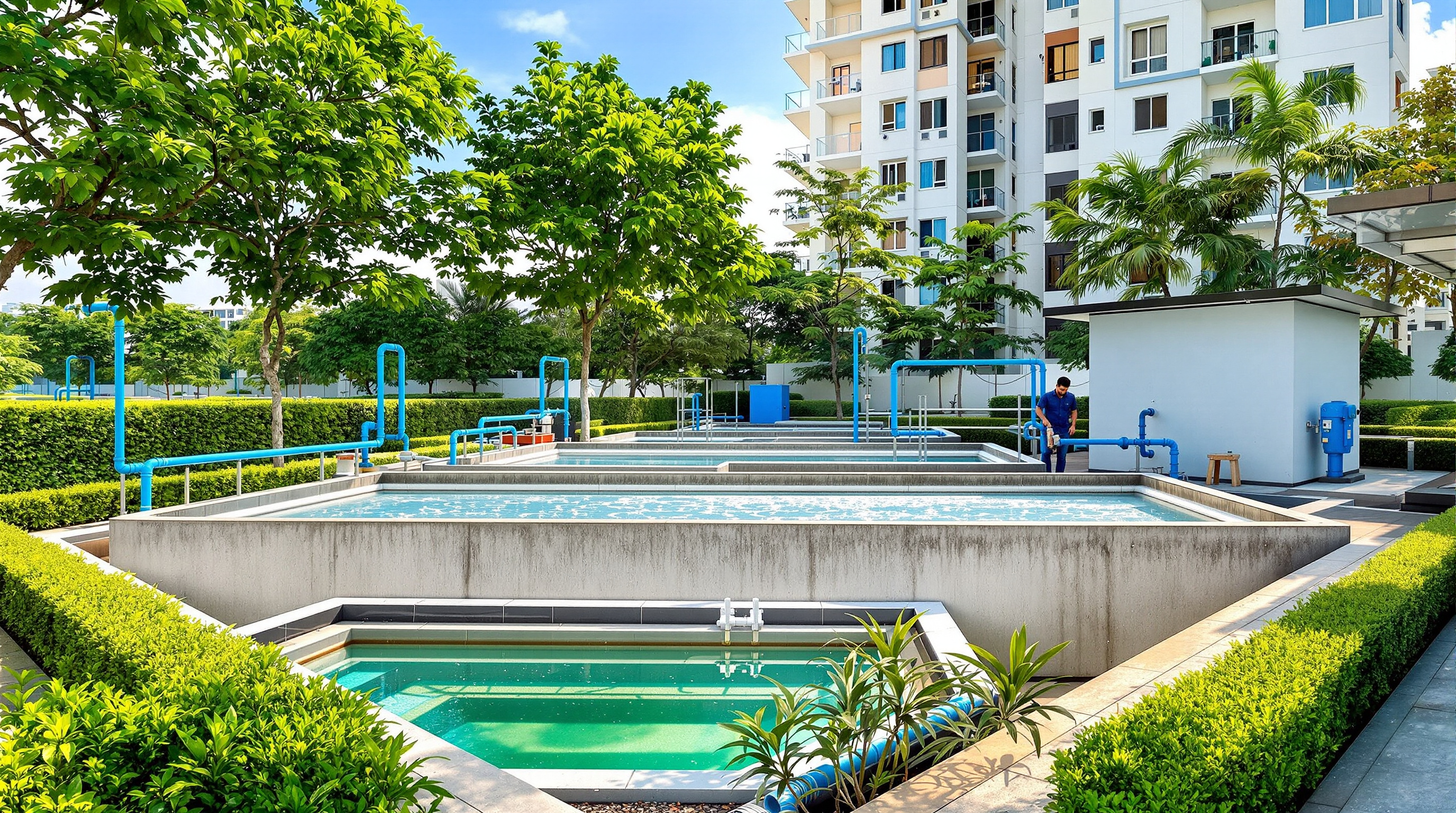
What is a Sewage Treatment Plant (STP)? The Complete Beginner's Guide
What an STP actually is, why modern Indian buildings are required to have one, and how it turns dirty water clean — explained in plain language, stage by stage, with no engineering background assumed.
Every building that has people in it produces sewage — the used water from toilets, kitchens, bathrooms and washing. For most of the last century that problem was somebody else's: it flowed into a municipal sewer and disappeared. Today, across India's cities, that is no longer allowed. A new apartment complex, hotel, hospital or IT park is increasingly required to clean its own wastewater, on its own land, before a drop of it leaves the site. The machine that does this is the Sewage Treatment Plant, or STP.
This guide is the plain-language starting point. No chemistry degree, no jargon you have not met before — just what an STP is, why your building probably needs one, and how it quietly turns foul water into water clean enough to flush toilets, water gardens and recharge the ground.
An STP does in a few hours, inside a compact tank, what a healthy river does over many kilometres: it uses billions of microbes to eat the waste in water until the water is clean again.
What "STP" actually means
STP stands for Sewage Treatment Plant. It is an engineered system — a set of tanks, pumps, blowers and filters — that receives the raw sewage from a building or community and treats it in stages until the water meets a legal quality standard. The treated water (called effluent) is then reused on site or discharged safely; the solid waste left behind (called sludge) is dried and removed.
Two ideas separate an STP from the old ways of dealing with sewage:
- It treats, it does not just store. A septic tank mostly holds sewage and lets solids settle; an STP actively cleans the water to a defined standard so it can be reused.
- It is decentralised. Instead of piping everything to a distant municipal plant, the treatment happens where the sewage is produced — in the basement or a corner of the plot. This is why STPs are the backbone of what engineers call decentralised wastewater treatment.
If you want to see how big a plant your own building would need, the STP Capacity Calculator turns a headcount into a treatment capacity in litres per day in about a minute.
Why every modern building needs one
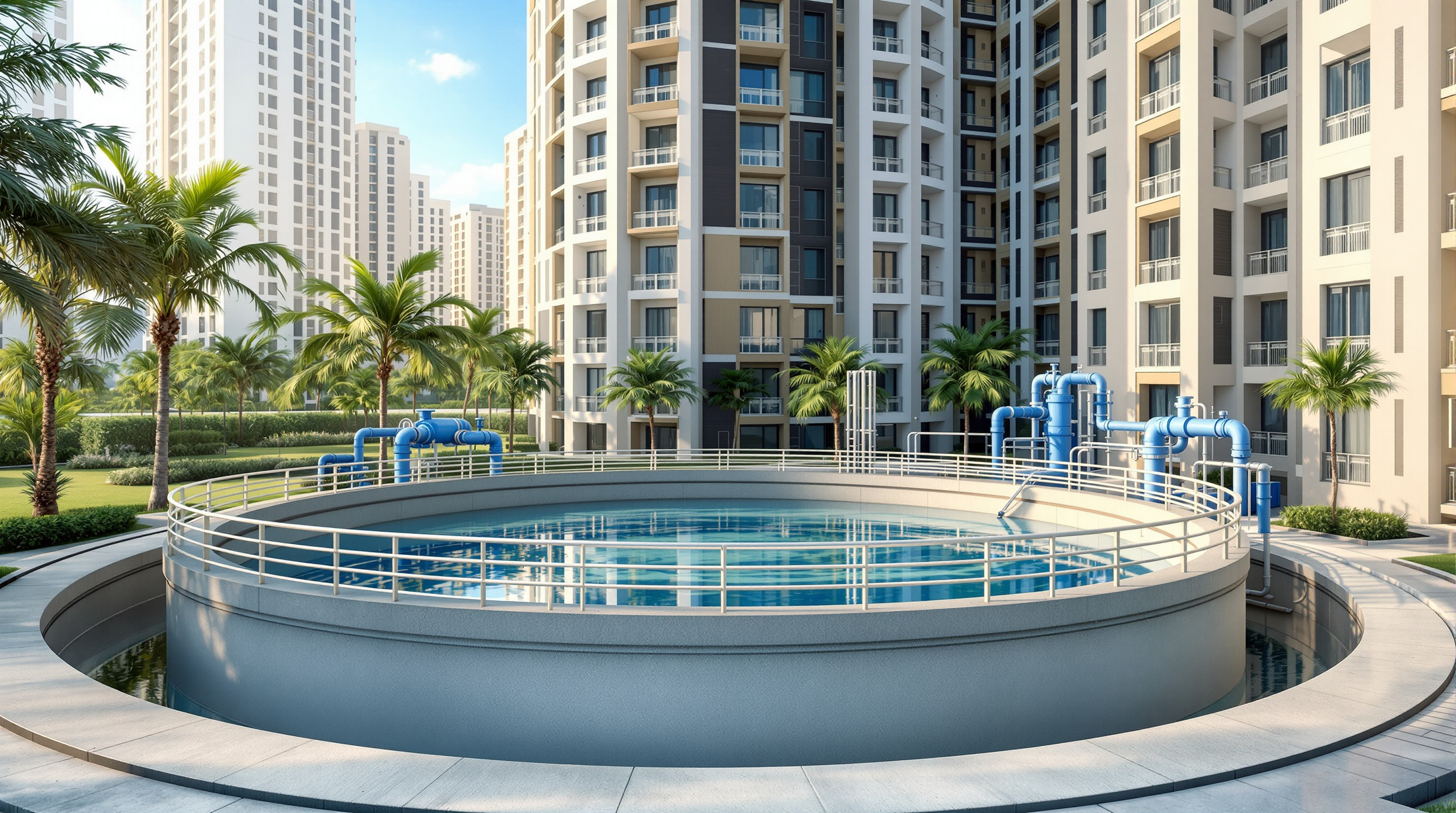
Three forces have made the STP a standard fixture rather than a luxury.
1. Regulation. India's pollution-control authorities now require on-site sewage treatment for most medium and large developments. Apartment projects above a certain size, and virtually all commercial and institutional buildings, must install an STP and prove the treated water meets discharge norms to receive their occupancy and operating approvals. Building an STP is no longer optional paperwork — it is a condition of being allowed to open the doors.
2. Water scarcity. Indian cities are running short of water, and freshwater is expensive and rationed. An STP typically recovers 80–85% of the water a building consumes, turning yesterday's sewage into today's flushing, gardening and cooling-tower water. For a large complex that can mean lakhs of litres saved every month — water you do not have to buy in from tankers.
3. Environment and public health. Untreated sewage poured into drains, lakes and groundwater is the single biggest source of water pollution in urban India. Treating it at source protects the waterbodies downstream and the health of everyone who depends on them.
The result: for a builder or an apartment association, an STP is simultaneously a legal requirement, a running-cost saving, and an environmental responsibility.
What is actually in sewage?
To understand how an STP works, it helps to know what it is fighting. Domestic sewage is more than 99% water — but the fraction that is not water is what makes it dangerous:
- Organic matter — food, faeces, soap, oils. This is what rots, smells and consumes oxygen from water, killing fish and life downstream.
- Suspended solids — the fine particles that make sewage cloudy.
- Nutrients — nitrogen and phosphorus that, if released, trigger algae blooms that choke lakes.
- Pathogens — bacteria and viruses that cause disease.
Engineers measure the strength of sewage with a few key numbers you will meet again and again:
| Parameter | What it measures | Why it matters |
|---|---|---|
| BOD (Biochemical Oxygen Demand) | How much oxygen microbes need to eat the organic waste | The headline strength of the sewage — high BOD means highly polluting |
| COD (Chemical Oxygen Demand) | Total oxygen needed to break down all matter, chemically | Always higher than BOD; flags industrial or hard-to-digest waste |
| TSS (Total Suspended Solids) | The weight of solid particles floating in the water | Decides how cloudy the water is and how much settles out |
| pH | How acidic or alkaline the water is | Microbes only thrive in a narrow, near-neutral band |
The whole job of an STP is to drive BOD, COD and TSS down to safe levels — from raw sewage that might have a BOD of 250–350 to treated water below 10 — while keeping pH comfortable for the microbes doing the work.
How an STP works: the four stages
Almost every STP, whatever its brand or technology, follows the same four-stage journey. Think of it as a relay race that hands the water from one process to the next, cleaner each time.
Stage 1 — Preliminary treatment (catch the junk)
The incoming sewage first passes through a bar screen that catches rags, plastics and large solids, and an oil and grease trap that skims floating fats from kitchens. Then it collects in an equalisation tank — a buffer that smooths out the surges (everyone showers at 7 a.m.) into a steady, even flow the rest of the plant can handle calmly. Nothing is "treated" yet; this stage simply protects the machinery downstream.
Stage 2 — Primary treatment (let solids settle)
The evened-out sewage sits in a tank where gravity does the first real cleaning: heavy solids sink to the bottom as sludge and light material floats to the top to be skimmed. Not every compact STP has a distinct primary stage, but where it exists it removes a large share of the suspended solids before the biological heart of the plant.
Stage 3 — Secondary treatment (the microbes eat)
This is where the magic happens and where most of the pollution is destroyed. The sewage is moved into an aeration tank where air blowers pump oxygen through the water. That oxygen feeds a vast living population of bacteria — the "biological culture" — which devours the dissolved organic waste as food, exactly as microbes do in a healthy river, only far faster and in a controlled tank. The water then flows to a clarifier, a quiet settling tank where the now-fattened microbes clump together and sink, leaving clear water on top. This oxygen-and-microbes principle is the basis of most STP technologies — from the classic Activated Sludge Process to modern MBBR and MBR systems.
Stage 4 — Tertiary treatment (polish and disinfect)
The clear water from secondary treatment is good, but not yet reuse-grade. In the final stage it passes through filters — a pressure sand filter and an activated carbon filter — to remove the last fine particles and any lingering colour or odour. Finally it is disinfected, usually with chlorine or ultraviolet (UV) light, to kill remaining bacteria. What comes out is clear, odourless, safe water ready to be reused.
Meanwhile the sludge collected along the way is thickened, de-watered on drying beds, and periodically carted away — the one genuine "waste" the plant produces.
Where the clean water goes
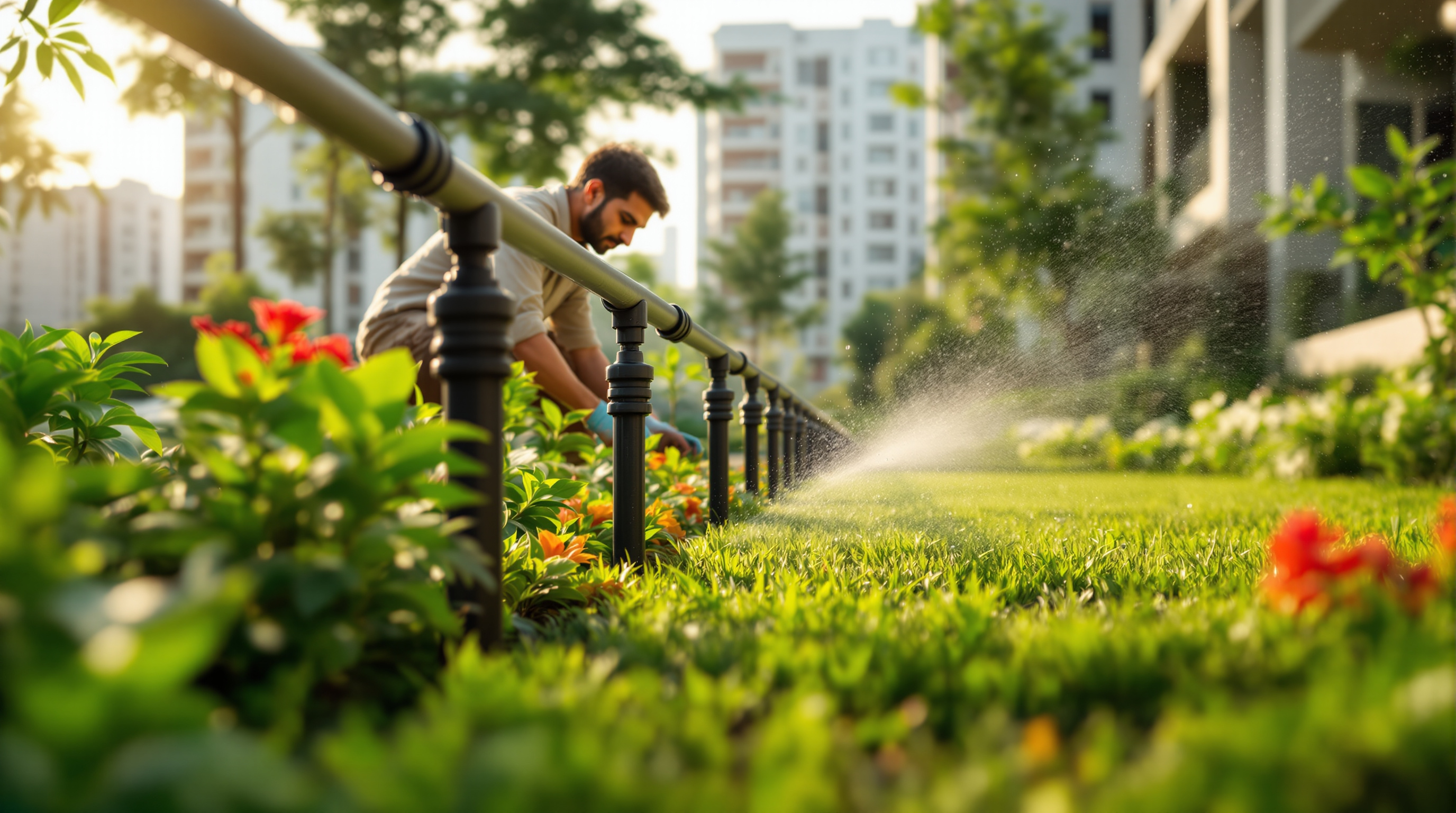
The point of all this effort is that the treated water is a resource, not a problem. In a typical Indian building it is reused for:
- Toilet flushing — piped back up in a separate line, the single biggest reuse.
- Landscape and garden irrigation.
- Cooling towers in air-conditioned commercial buildings.
- Washing of common areas, driveways and vehicles.
- Groundwater recharge, topping up the aquifer under the site.
Only the surplus that cannot be reused is discharged — and by law it must meet the treated-water quality standards before it is.
STP, ETP, septic tank — what's the difference?
Three terms get muddled constantly:
- A septic tank is a passive underground tank for a single house — it settles and partially digests sewage but does not clean the water to a reusable standard. It is the low-tech ancestor of the STP.
- An STP treats domestic/municipal sewage — the everyday wastewater of homes, offices and institutions — to a reusable standard.
- An ETP (Effluent Treatment Plant) treats industrial effluent, which carries chemicals, dyes or heavy metals that domestic STPs are not built for.
A hospital or hotel needs an STP; a textile dyeing unit needs an ETP; a village home might still rely on a septic tank. Knowing which one your project needs is the first design decision, and one this guide series will walk through in detail.
The bottom line
A sewage treatment plant is, at heart, a simple idea executed with care: collect the dirty water, feed its pollution to hungry microbes in an oxygen-rich tank, settle out the solids, filter and disinfect what remains, and reuse the clean water. It is now a standard, required part of any serious building in India — a piece of infrastructure that saves water, satisfies the law, and keeps the country's rivers and lakes alive.
From here, two natural next steps. To understand the biology and machinery in more depth, continue through the Sewage Treatment Plants guide library. And to see how large a plant your building would actually need, spend a minute with the STP Capacity Calculator — it converts your occupancy into a treatment capacity in litres per day, the number every STP design starts from.
Export this guide
Related Guides — Deep-dive reading
Wastewater Characteristics Explained: BOD, COD, TSS and pH
The four numbers that tell you how dirty sewage is and how well your STP is cleaning it — BOD, COD, TSS and pH — explained in plain language, with typical raw-sewage values, treated-water targets, and why each one matters.
Sewage Treatment PlantsHow Does an STP Work? A Step-by-Step Explanation
Follow a single drop of sewage from the building drain to reusable water — through screening, settling, the living microbial heart of the plant, and final polishing — with every stage explained in plain language and no engineering background assumed.
Sewage Treatment PlantsThe Sewage Treatment Process Flow, Explained: Every Stage From Inlet to Reuse
Follow a drop of sewage through a typical STP — inlet, screening, aeration, clarifier, filtration, disinfection and reuse — as one connected flow, with a block diagram and a unit-by-unit table, in plain language.
Sewage Treatment PlantsRelated Tools — Try Free
Apartment STP Planner
Plan an apartment complex sewage treatment plant from flats and occupancy — get population load, sewage flow, recommended STP capacity in KLD, treatment technology and approximate space.
PlannerIndustrial Wastewater Treatment Planner
Pick your dominant industrial wastewater and daily flow to see whether you need an STP or ETP, a 1–5 treatment complexity rating, and how rough capex scales.
PlannerApartment Video Door System Planner
Enter flats, entrances, floors and guard desk for a first-pass building intercom plan — door stations, indoor monitors, guard station, the right architecture and an indicative cost band.
Building Planner