

IoT Monitoring for STPs: Real-Time Sensors, Dashboards & OCEMS Compliance
How IoT sensors, connectivity and dashboards turn a blind, manually-logged sewage plant into a plant you can watch, alarm and prove compliant in real time — what to install, what it costs, and where the technology is genuinely ready.
Most sewage treatment plants in India are run blind. An operator dips a bottle, walks a sample to a corner lab, writes a number in a register once a shift, and hopes the plant behaved the other twenty-three hours. When something goes wrong — a blower trips at 2 a.m., the dissolved oxygen crashes, the biology dies — nobody knows until the water turns grey and the smell reaches the flats above. By then the recovery takes days.
IoT STP monitoring replaces that hope with data. It puts electronic sensors on the handful of parameters that actually decide whether the plant is working, streams their readings continuously to a dashboard, and raises an alarm on your phone the moment a number strays out of band. It is the difference between finding out about a failure from a complaint and finding out from a text message an hour before it becomes a failure at all.
A plant you cannot see is a plant you cannot run. IoT monitoring does not treat the sewage — the biology still does that — but it turns an invisible black box into a live, alarming, provable process.
What "IoT monitoring" actually adds
Every STP already has some instruments: a flow meter for the compliance record, float switches in the sump, a run-hour meter on the blower. IoT monitoring is the layer that (1) adds sensors where there were none, (2) connects them so readings leave the plant room, and (3) makes those readings visible, logged and alarmed. Three building blocks:
- Sensors — probes that measure the process in real time instead of once a shift.
- A gateway and connectivity — a small edge controller (a PLC or IoT gateway) that collects sensor signals and pushes them over 4G, LoRaWAN or the building LAN to the cloud.
- A dashboard and alert engine — the screen and rules that turn raw numbers into gauges, trend charts, and "DO below 1.5 mg/L for 10 minutes → call the operator" alarms.
None of this is exotic anymore. It is the same low-cost sensor-and-cloud stack that already runs in factories and smart buildings, pointed at the STP. It sits squarely inside the broader shift towards smart water infrastructure, and it is the essential first step before any of the higher-tech promises — predictive maintenance, AI-assisted operation or digital twins — can mean anything. You cannot predict from data you never collected.
The sensors that earn their place
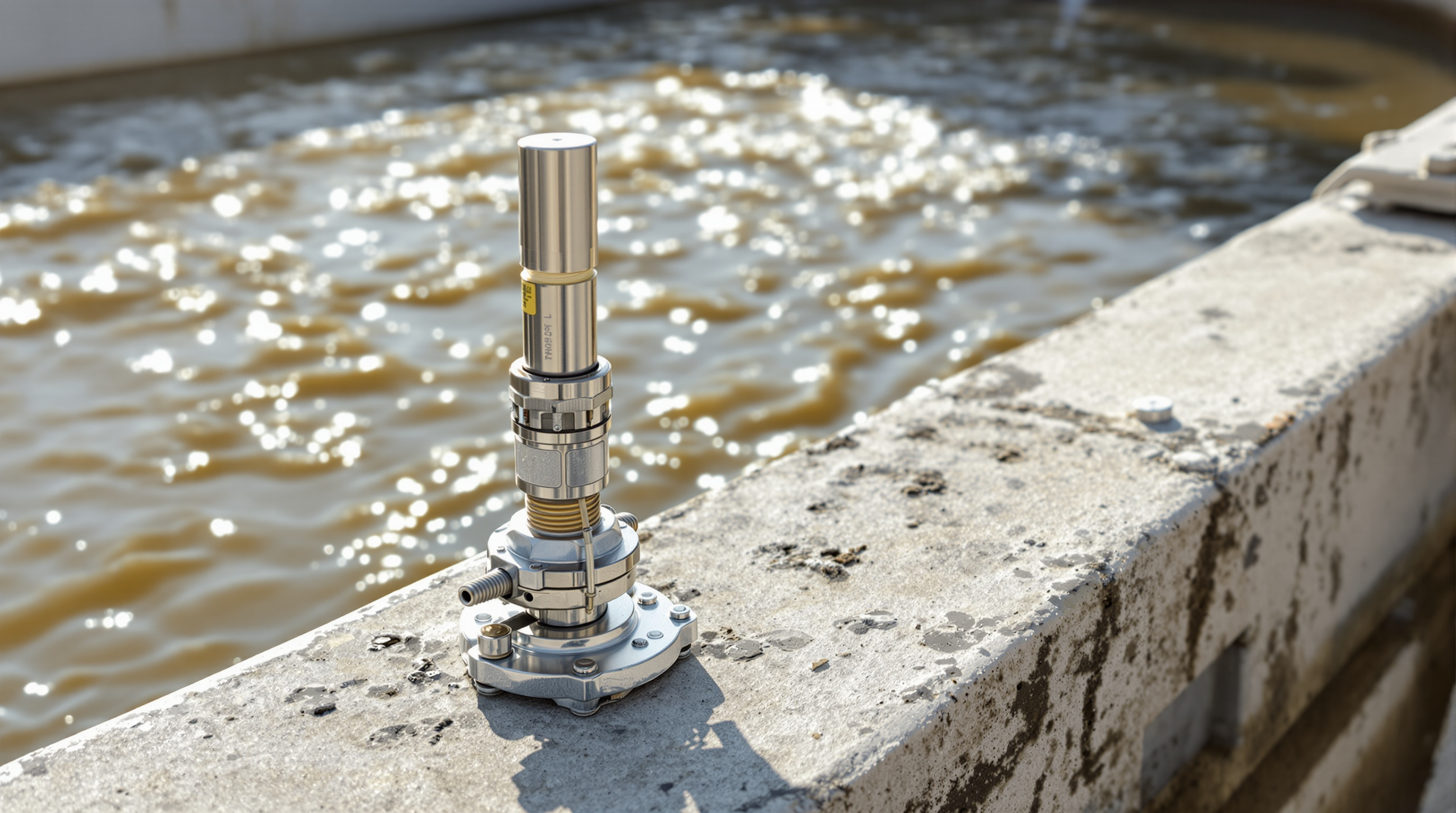
You do not need to instrument everything. A well-chosen handful of sensors covers the failure modes that cause almost every STP crisis. These are the four families worth the money.
| Sensor | Measures | Why it matters | Typical alarm trigger |
|---|---|---|---|
| Dissolved Oxygen (DO) | Oxygen in the aeration tank | The single best live indicator of biological health; low DO kills the culture, high DO wastes power | DO drifts outside ~1.5–3.5 mg/L |
| Flow meter | Inflow / treated-water flow | Confirms hydraulic load, feeds the compliance log, catches surges and dry pumps | Flow far above design, or zero when it shouldn't be |
| Level sensor | Sump / tank levels | Prevents overflow and dry-running of pumps; smooths equalisation | High-high or low-low level |
| Energy meter | Blower / pump power | Aeration is ~60% of the bill; a creeping kWh trend flags fouling or failure | Power spike or abnormal daily kWh |
Beyond these four, larger or regulated plants add pH, turbidity, TSS and MLSS probes, and — where the law requires it — a continuous effluent-quality analyser measuring BOD (as a surrogate), COD, ammonia and TSS. If the four core parameters (DO, flow, level, energy) are unfamiliar, the STP pumps and instrumentation guide explains where each one physically sits in the process train.
The energy meter deserves a special mention because it pays for itself twice: once by catching failures, and once by exposing waste. Watching aeration power against DO in real time is how plants trim the 20–30% of electricity that over-aeration quietly burns — the core move in reducing STP electricity consumption.
Dashboards and remote alerts

Sensors are worthless if the data dies in a basement PLC. The value is in getting it out. A modern setup gives you:
- A live dashboard — gauges and trend charts on any browser or phone, showing every plant at a glance. An RWA managing three towers, or a facilities firm running forty client STPs, sees them all on one screen.
- Threshold and rate-of-change alarms — not just "DO is low" but "DO has been falling for 20 minutes," which catches a dying blower before the crash.
- Escalation — an unacknowledged alarm climbs from operator to supervisor to manager, so a 2 a.m. failure is not left for the morning.
- An automatic, tamper-evident log — every reading timestamped and stored, which quietly solves the compliance-record problem and kills the fiction of the hand-written register filled in at month-end.
For an RWA or owner, that last point changes the relationship with the AMC vendor. When you can see run-hours, DO and energy yourself, "the plant is fine" becomes a checkable claim rather than a monthly assurance — which is exactly the leverage the STP AMC selection guide argues you should hold.
The OCEMS compliance link
For medium and large plants, IoT monitoring is not just good practice — a version of it is the law. The CPCB and state pollution control boards mandate an Online Continuous Emissions/Effluent Monitoring System (OCEMS) for many categories of STPs and ETPs above a size threshold. OCEMS is IoT monitoring with a regulator on the other end: prescribed effluent analysers (typically pH, TSS/turbidity, COD or BOD surrogate, and flow) stream data directly and continuously to the CPCB/SPCB server.
A few things to understand before you treat OCEMS as a box to tick:
- It is a subset, not the whole system. OCEMS covers only the regulator's parameters at the final outlet. Your operational sensors — DO, level, energy — are for running the plant, and you install those for yourself, not for the board.
- Applicability depends on category and capacity, and the thresholds and approved-instrument lists are revised periodically. Confirm the current requirement for your project's size and category with your consultant rather than assuming — the specifics sit inside the wider STP regulations in India.
- Calibration and uptime are audited. A drifting or offline analyser is itself a compliance failure, so OCEMS makes disciplined sensor maintenance non-optional.
The practical takeaway: if your plant is large enough to need OCEMS anyway, extend it with the cheap operational sensors and get a plant you can actually run, not just report on.
What it costs, and where to be honest
Sensors and gateways have fallen dramatically in price. A useful operational package — DO, flow, level, an energy meter, a gateway and a year of cloud dashboard — is a modest capital add on top of a plant, often a low single-digit percentage of the STP's cost, and it is straightforward to retrofit to an existing plant. OCEMS-grade certified effluent analysers cost considerably more, because the instruments are prescribed and must be calibrated to standard. You can sketch both the plant and the monitoring layer into your budget with the STP cost estimator and fold the sensor upkeep into your AMC cost calculator.
Be honest about two things. First, sensors need maintenance — a DO or pH probe fouls, drifts and needs cleaning and recalibration on a schedule; an uncalibrated sensor is worse than none because it lies with authority. Second, monitoring is not automation. IoT tells you the DO is low; it does not, by itself, fix it. The genuinely mature, proven layer today is exactly this: sensing, dashboards and alerts. The layers above it — closed-loop automatic control, AI optimisation, digital twins — are real and advancing, but they are only as trustworthy as the sensor data underneath, and they are still maturing in Indian field conditions. Build the monitoring foundation well and it pays for itself in avoided crashes and lower energy long before any of the fancier promises arrive.
Start where the return is certain. Instrument DO, flow, level and energy; put them on a dashboard with phone alerts; log everything automatically. From there, the rest of the Sewage Treatment Plants guide library — and the tools that turn these numbers into decisions — build on a plant you can finally see.
Export this guide
Related Guides — Deep-dive reading
Smart Sensors in STPs: Online DO, Ammonia, Turbidity, Flow & TSS for Automated Control
How online DO, ammonia, turbidity, flow and TSS sensors turn a sewage treatment plant from a hand-tuned machine into a self-regulating one — cutting energy, catching upsets early, and proving compliance in real time.
Sewage Treatment PlantsSmart Water Infrastructure & the Modern STP: A Practical Guide
How sensors, smart metering and automated control are turning the sewage treatment plant from a noisy basement box into a data-driven asset — and what that actually means for developers, owners and RWAs in India today.
Sewage Treatment PlantsAI in STP Operations: What Actually Works Today (and What Doesn't)
A practical, honest look at how AI and machine learning are used to run sewage treatment plants — optimising aeration and energy, predicting effluent quality, catching faults early, and easing operator dependence — with a clear-eyed view of what is mature and what is still marketing.
Sewage Treatment PlantsRelated Tools — Try Free
Healing View Impact Calculator
Evidence-Based Design dashboard quantifying the recovery impact of nature view + daylight factor on analgesic use, length of stay, and HCAHPS patient-experience uplift. Calibrated against Ulrich 1984 (Science), Park & Mattson 2008, and the CHD EBD evidence base.
EBD CalculatorSTP Compliance Checklist Tool
Interactive self-audit that ticks off STP consents, discharge norms, reuse metering, online monitoring and O&M records to give a live compliance readiness score.
ChecklistRainwater Tank Sizer
How big should your rainwater tank be? Computes annual harvest, recommended tank capacity in litres, water-bill savings, and payback — for 10 Indian cities.
RWH Calculator