

Air Blowers & Diffusers in an STP: How Aeration Actually Works
The blowers that push air and the diffusers that turn it into bubbles are the lungs of your sewage treatment plant. Here is how they work, how they are sized, and why they decide most of your electricity bill.
Walk up to a running sewage treatment plant and the first thing you notice is the sound — a steady mechanical hum from a room full of what look like small engines, and next to it a tank of brown water boiling as if it were on a stove. That "boiling" is not heat. It is air. And the humming machines are the reason the whole plant is alive.
The microbes that actually clean your sewage need oxygen to breathe, exactly as you do. In the aeration tank they eat the dissolved organic waste — the BOD — and burn it with oxygen. No oxygen, no microbes; no microbes, no treatment. Supplying that oxygen, reliably and around the clock, is the single job of the STP's aeration system: the air blowers that push the air and the diffusers that dissolve it into the water.
Aeration is the lungs of an STP. It is also, typically, 50 to 70% of the plant's entire electricity bill. Get the blowers and diffusers right and everything downstream gets easier; get them wrong and no amount of chemistry will save the water quality.
What the aeration system does
Secondary treatment — the biological heart of almost every STP, whether it runs the classic Activated Sludge Process, MBBR or SBR — depends on keeping a huge population of bacteria fed, mixed and breathing. The aeration system delivers three things at once:
- Oxygen for the microbes to respire and oxidise the incoming waste.
- Mixing so the sludge and the sewage stay in constant contact and nothing settles where it shouldn't.
- Turbulence that keeps the biomass suspended as an even "mixed liquor" rather than a stagnant sludge blanket.
Two pieces of equipment achieve all three. The blower is the source of pressurised air. The diffuser is the delivery device at the bottom of the tank that breaks that air into bubbles. The finer the bubbles and the deeper they are released, the more oxygen actually dissolves — and that efficiency is where most of the money is won or lost.
Air blowers: the source of the air
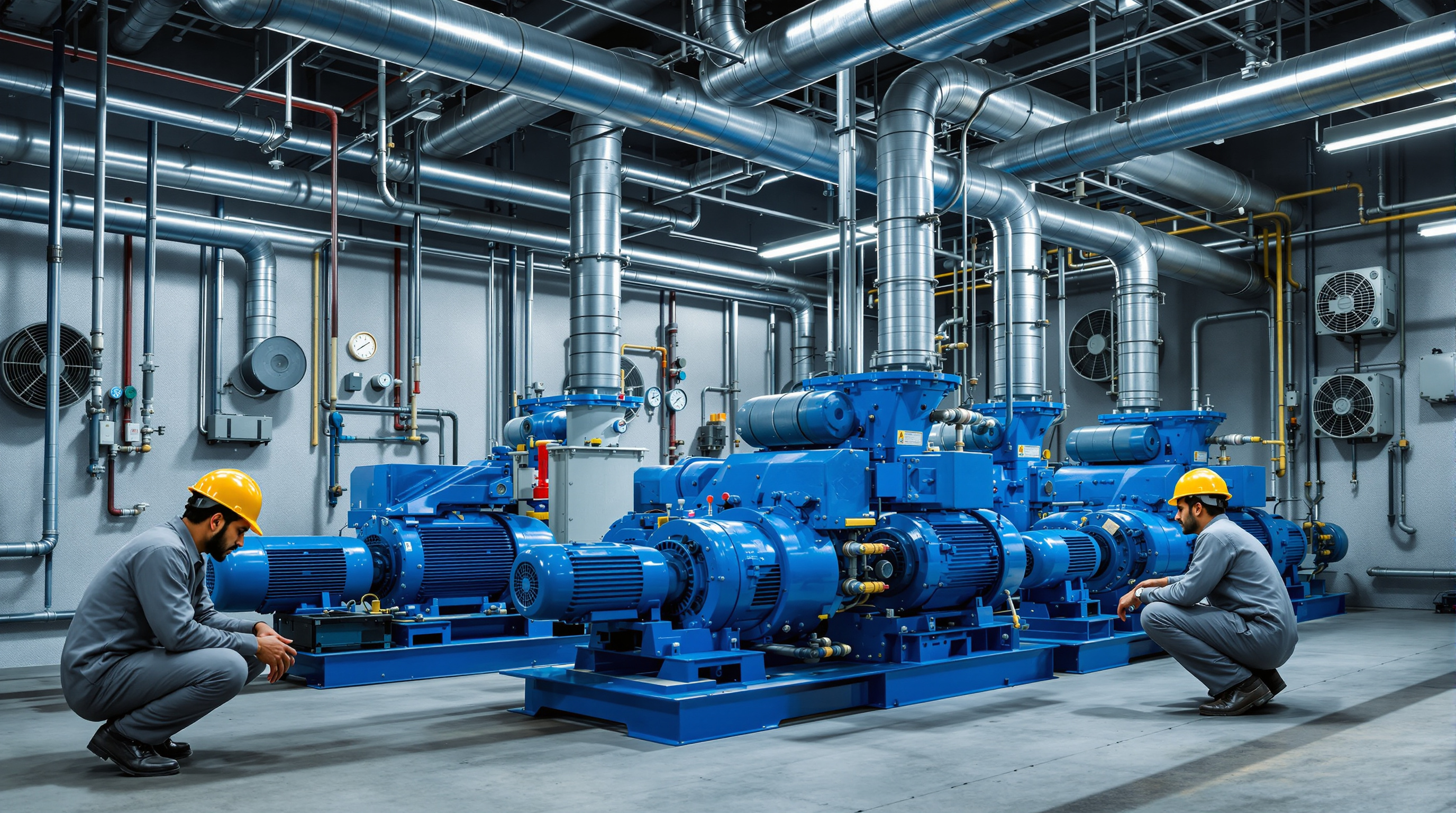
A blower is essentially a heavy-duty air pump. It draws in ambient air and pushes it, under modest pressure, down a header pipe and into the diffuser grid submerged in the tank. In Indian STPs you will meet a few common types.
| Blower type | How it works | Best suited to | Notes |
|---|---|---|---|
| Roots / twin-lobe | Two rotating lobes trap and push fixed pockets of air | Most small and medium STPs (residential, commercial) | Rugged, cheap, easy to service; noisier, less efficient |
| Tri-lobe | Three-lobe version of the roots blower | Medium STPs wanting less pulsation | Smoother, quieter, slightly more efficient |
| Screw / rotary screw | Meshing screws compress air progressively | Larger STPs, high air demand | More energy-efficient at scale; higher capital cost |
| Turbo / centrifugal | High-speed impeller | Very large plants | Excellent efficiency, premium price |
For a typical apartment complex or IT park STP, the workhorse is the twin-lobe (roots) blower — a positive-displacement machine that delivers a steady, predictable air volume against the back-pressure of the water column. It is forgiving, widely stocked, and any local technician can maintain it. Larger campuses and sewage-heavy loads increasingly move to screw blowers for the running-cost saving, since at scale the electricity difference dwarfs the higher purchase price.
Why standby is non-negotiable
Here is the rule that separates a properly designed plant from a troubled one: blowers are always installed in duty-plus-standby. If your air demand needs two blowers running, you install three. The moment a running blower trips or goes in for service, the standby takes over and the microbes never lose their air.
Why so strict? Because the biological culture is a living thing. Starve it of oxygen for even a few hours and it begins to die and go septic — the tank turns black, smells foul, and recovering it can take days or weeks. A spare blower is far cheaper than a crashed biology. Good operators also alternate the duty and standby units week to week so the machines wear evenly. You will find blowers listed alongside the other critical rotating equipment in the STP pumps and instrumentation guide.
Diffusers: turning air into oxygen
Air blown into water does nothing on its own — what matters is how much of that air's oxygen actually dissolves into the liquid. That is the diffuser's job, and the key idea is bubble size. Small bubbles have far more surface area for a given volume of air, and they rise more slowly, so they spend longer in contact with the water. Both effects mean more oxygen transferred per rupee of electricity.
- Fine-bubble diffusers produce bubbles a few millimetres across, usually through a flexible EPDM membrane perforated with tiny slits, mounted as discs or tubes on a grid across the tank floor. They deliver the highest oxygen-transfer efficiency and are the default for energy-conscious STPs.
- Coarse-bubble diffusers release larger bubbles through simple openings. They transfer less oxygen per unit of air but are cheap, hard to clog, and excellent for pure mixing duty — so they are common in equalization tanks, sludge holding tanks and channels where you want agitation, not fine aeration.
The efficiency number engineers quote is SOTE — Standard Oxygen Transfer Efficiency — the percentage of the oxygen in the supplied air that actually dissolves into clean water, per metre of submergence. Fine-bubble membrane diffusers might reach roughly 5–7% per metre of depth, several times better than coarse bubbles. That is why a deeper tank with fine-bubble diffusers uses dramatically less power than a shallow tank with coarse ones to deliver the same oxygen.
Sizing, directionally
You do not need to run the full calculation to grasp what drives blower and diffuser size — it comes down to how much oxygen the biology needs, which follows the pollution load.
1. Start with the load. The daily flow (in KLD) and the incoming BOD together set how many kilograms of oxygen per day the microbes must consume. Bigger building, stronger sewage, more oxygen. Size the plant's flow first with the STP Capacity Calculator, and estimate the incoming flow itself with the Sewage Generation Calculator.
2. Convert oxygen demand to air. Because only a fraction of the air's oxygen dissolves (that SOTE figure), you need many times more air than raw oxygen. This fixes the blower's air volume, usually quoted in cubic metres per hour or per minute.
3. Add the pressure. The blower must overcome the depth of water above the diffusers plus pipe losses. A tank 3–4 m deep needs a blower rated for that back-pressure — the deeper the tank, the better the oxygen transfer, but the harder the blower has to push.
4. Lay out the diffusers. Enough diffuser discs are spread evenly across the floor to release that air as fine bubbles without over- or under-loading any single unit, and to keep the whole tank mixed with no dead corners.
Treat any numbers here as directional. Real sizing accounts for temperature, altitude, the specific process, peak factors and a safety margin — work for the STP designer, not a rule of thumb.
Common problems and O&M
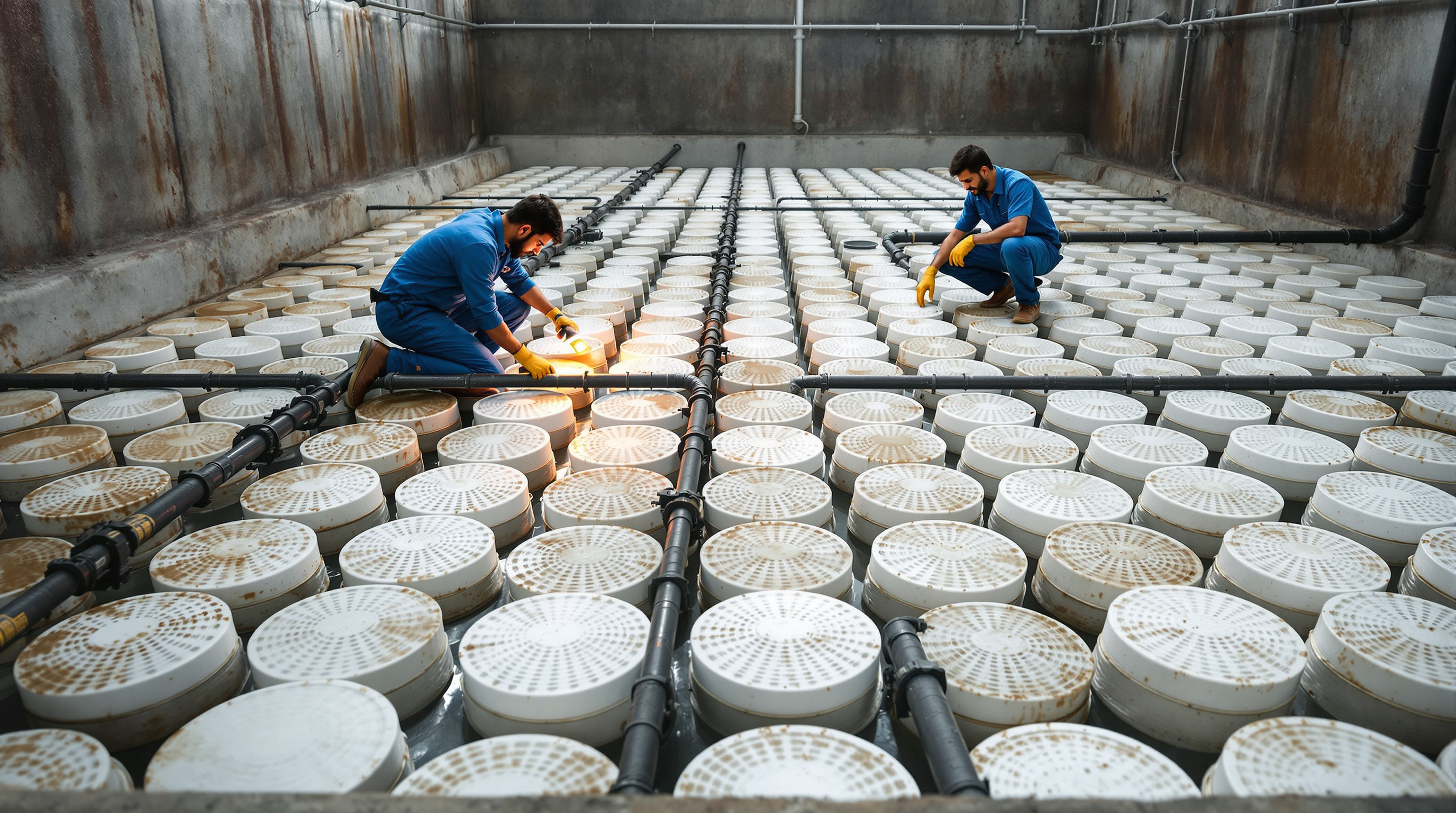
Aeration equipment is mechanically simple but unforgiving of neglect. The recurring issues:
- Clogged or fouled diffusers. Over months, fine-bubble membranes can scale up or clog, coarsening the bubbles and dropping oxygen transfer. Symptoms: the tank aerates unevenly, DO falls, the power bill climbs for no obvious reason. Periodic air-bumping or acid cleaning, and eventual membrane replacement every few years, is normal maintenance.
- Blower air filter choking. A dirty intake filter starves the blower and overworks the motor. Cleaning or replacing filters on schedule is the cheapest maintenance win in the plant.
- Belt, oil and bearing wear. Roots blowers have drive belts and oil-lubricated gears that need routine checks; ignored, they seize.
- Overheating and noise. Blowers run hot; the blower room needs real ventilation. Rising noise or vibration is an early warning of bearing failure — investigate, don't ignore.
- No standby, or standby never tested. A spare blower that has never been run is not a spare. Alternate duty weekly and confirm auto-changeover works.
- Low dissolved oxygen (DO). If a DO meter reads persistently below ~1.5–2 mg/L in the aeration tank, the biology is short of air — check blower output, diffuser condition and whether the load has outgrown the design.
A simple discipline covers most of it: log the DO and the blower running hours daily, keep the air filters clean, alternate the duty blower, and inspect the diffuser grid whenever the tank is drained.
Where it sits in the plant
The aeration system lives at the biological core of the treatment process flow — after the sewage has been screened, degritted and equalised, and before it moves on to the clarifier to settle. Blowers and diffusers do not remove a single solid by themselves; what they do is keep alive the microscopic workforce that removes almost everything. They are the lungs, and like lungs, they matter most when you stop noticing them.
To see how aeration fits the full journey from toilet to reusable water, start with What is a Sewage Treatment Plant, and browse the rest of the equipment and process guides in the Sewage Treatment Plants library.
Export this guide
Related Guides — Deep-dive reading
Aeration Design Principles for STPs: Oxygen Demand, Diffusers & Blower Sizing
How engineers actually size the aeration system at the heart of a sewage treatment plant — from oxygen demand and alpha/beta factors to SOTE, fine versus coarse bubble diffusers, blower selection and the energy bill that follows for decades.
Sewage Treatment PlantsDiffuser Cleaning & Maintenance in STPs: Keeping Oxygen Transfer Efficient
Why fine-bubble diffusers foul, how to read the warning signs of uneven bubbling and rising back-pressure, and the acid-wash, air-bumping and replacement routines that keep your aeration tank transferring oxygen the way it was designed to.
Sewage Treatment PlantsAeration Tank: The Biological Heart of an STP
The tank where blowers push oxygen into billions of microbes that eat the sewage's organic load — how it works, what DO, MLSS, F/M and HRT mean, and why it quietly runs up the biggest electricity bill in the plant.
Sewage Treatment PlantsRelated Tools — Try Free
Apartment STP Planner
Plan an apartment complex sewage treatment plant from flats and occupancy — get population load, sewage flow, recommended STP capacity in KLD, treatment technology and approximate space.
PlannerSewage Generation Calculator
Estimate the daily sewage a building generates and its peak flow in KLD from occupancy, LPCD, sewage return factor and peak factor.
STP CalculatorSTP Capacity Calculator
Size a sewage treatment plant in KLD from your building's occupancy — water demand, sewage generated and recommended STP capacity.
STP Calculator