
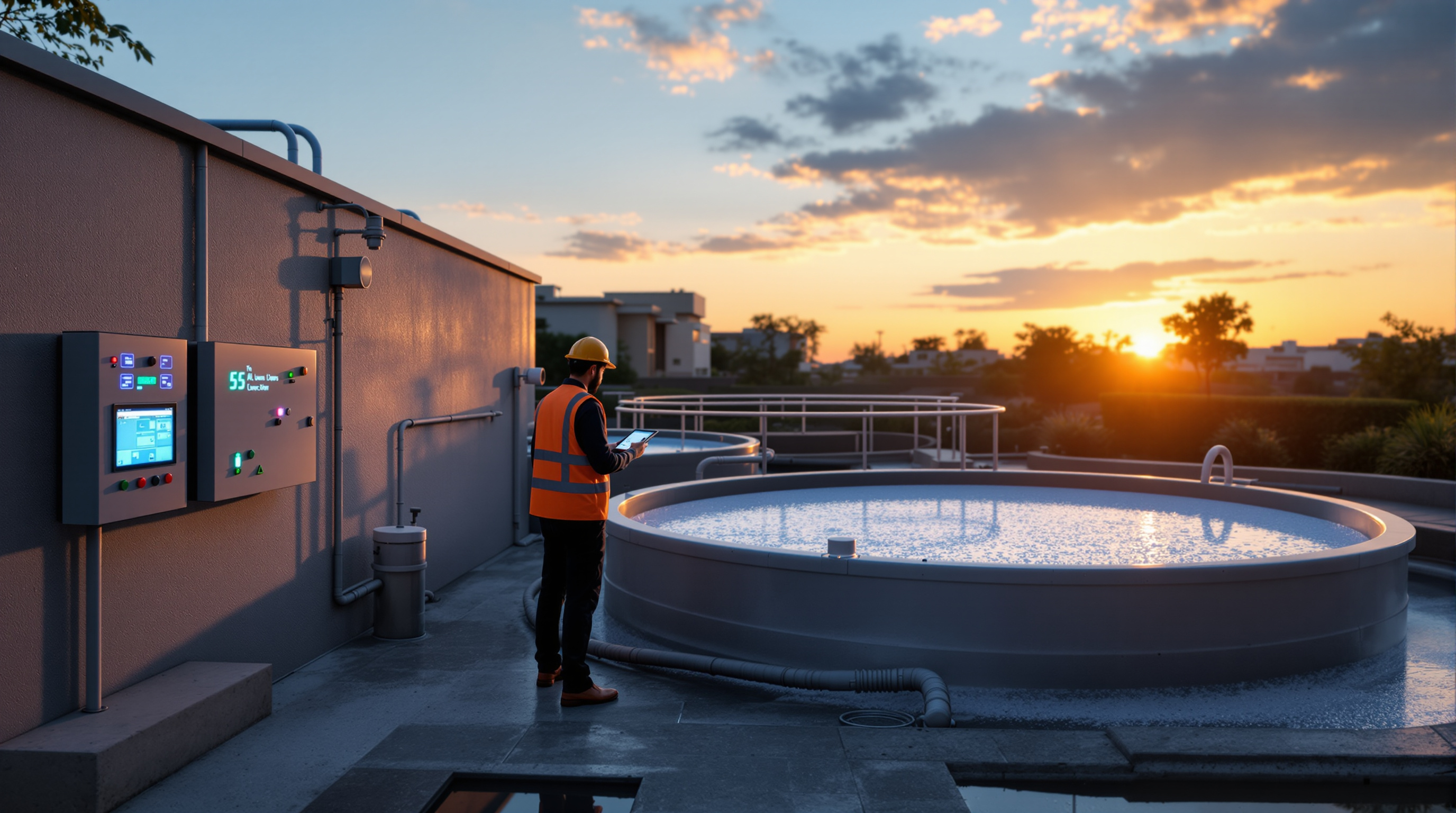
AI in STP Operations: What Actually Works Today (and What Doesn't)
A practical, honest look at how AI and machine learning are used to run sewage treatment plants — optimising aeration and energy, predicting effluent quality, catching faults early, and easing operator dependence — with a clear-eyed view of what is mature and what is still marketing.
Every sewage treatment plant is, underneath the concrete and blowers, a living system that never sits still. The inflow surges at 7 a.m. and again at night. The strength of the sewage drifts with the season, the crowd, the festival weekend. The microbes that do the actual cleaning respond to all of it — sometimes hours later. For decades, the job of holding this moving system inside its permit limits has fallen to one or two operators reading dials and trusting their gut. Artificial intelligence is now being offered as a second, tireless brain for that job.
The pitch is seductive and the marketing is loud, so it is worth being precise. This guide walks through where AI and machine learning genuinely help an STP run — and where the claims outrun the reality. If you are an owner, RWA, or consultant deciding whether "AI-enabled" is worth paying for, this is the honest version.
AI does not clean water. Microbes clean water. What AI can do is watch the plant more closely than any human can, and nudge the blowers, pumps and dosing so those microbes work at their best — cheaper, steadier, and with fewer surprises.
What "AI in STP operations" actually means
Strip away the branding and almost every "AI STP" today is doing one of four concrete things:
- Optimising aeration and energy — deciding how hard the blowers should run, minute by minute.
- Predicting effluent quality — estimating BOD, COD or ammonia before the lab result arrives.
- Anomaly and fault detection — spotting that something is drifting wrong before it becomes a violation.
- Reducing operator dependence — turning tribal knowledge into software that guides a junior operator or runs the plant semi-autonomously at night.
None of this replaces the biology or the four-stage treatment process (if that is unfamiliar, start with how an STP works). AI sits on top of a conventional plant — MBBR, SBR, MBR or extended aeration — reading its sensors and adjusting its controls.
Where AI earns its keep today
1. Aeration optimisation — the real prize
Aeration is where the money is. Blowers pumping air into the aeration tank typically consume 45–60% of an STP's total electricity, and most plants over-aerate massively — running blowers flat-out to be "safe" regardless of actual demand. This is the single most proven application of AI in STP operations.
The mechanism is simple. A dissolved-oxygen (DO) sensor, and increasingly an ammonia sensor, feed a control model that predicts how much oxygen the biology needs right now and throttles the blower (via a VFD) to match — no more, no less. The smarter versions use model-predictive control: they forecast the incoming load from the time of day and recent inflow, and pre-adjust before the surge hits rather than chasing it afterwards.
Done well, this trims aeration energy by a meaningful margin without letting DO crash. It pairs naturally with the fundamentals in reducing STP electricity consumption, and the savings are real enough to model against your running cost with the AMC and operating-cost estimator.
2. Soft-sensing effluent quality
Lab tests for BOD take five days; even COD takes hours. That means an operator is always steering by a rear-view mirror. Machine-learning soft sensors close that gap: trained on months of a plant's own data, they estimate effluent BOD/COD/ammonia in near-real-time from cheap, fast measurements — DO, turbidity, pH, ORP, flow, temperature.
The value is early warning, not laboratory replacement. A soft sensor that flags "your outlet BOD is trending toward 25 mg/L" gives the operator a day to react before a CPCB sample catches it. Be clear-eyed though: these models need a lot of good historical data, they drift as the plant ages, and they must be re-trained. They inform decisions; they do not sign your compliance report.
3. Anomaly detection
This is where AI is quietly most useful and least oversold. An anomaly-detection model learns the plant's normal rhythm and raises a flag when readings depart from it — a blower drawing more current than usual, DO not recovering after a cycle, a pump short-cycling, foam building where it shouldn't. It catches the early signature of problems that a checklist misses between rounds. Many issues in common STP troubleshooting — bulking sludge, blower failure, dosing faults — announce themselves in sensor data hours before they are visible in the tank.
4. Predictive maintenance and lighter operator load
Feed the same sensor streams a maintenance model and it starts predicting equipment failure: bearing wear in a blower from vibration and current signatures, a membrane approaching a clean, a diffuser losing efficiency. This shades into the dedicated field of predictive maintenance for STPs and rides on the same instrumentation covered in STP pumps and instrumentation. The compounding benefit across all four applications is reduced operator dependence — the plant tolerates a less-experienced operator, or a smaller team, because the software holds the institutional knowledge and watches overnight.
How mature is each application, honestly?
Not all of this is equally ready. Here is a plain scorecard for the Indian context:
| Application | What it does | Maturity | Honest caveat |
|---|---|---|---|
| Aeration/DO control | Throttles blowers to real oxygen demand | Proven, deployable now | Needs reliable DO sensors, VFD blowers, disciplined calibration |
| Anomaly detection | Flags abnormal behaviour early | Solid, practical | Some false alarms; needs a few months of baseline data |
| Effluent soft-sensing | Predicts BOD/COD/ammonia | Promising, plant-specific | Model drift; must be retrained; not a legal substitute for lab tests |
| Predictive maintenance | Forecasts equipment failure | Emerging | Works best on blowers/pumps with vibration data; sparse on small STPs |
| Fully autonomous "AI STP" | Runs itself, no operator | Marketing, mostly | No compact Indian STP genuinely runs unmanned; treat the claim with suspicion |
The pattern is consistent: the closer a claim is to "runs itself with no operator," the more scepticism it deserves. A plant that emails you when it's about to breach a limit is real and available. A plant that needs nobody is not.
The unglamorous prerequisites
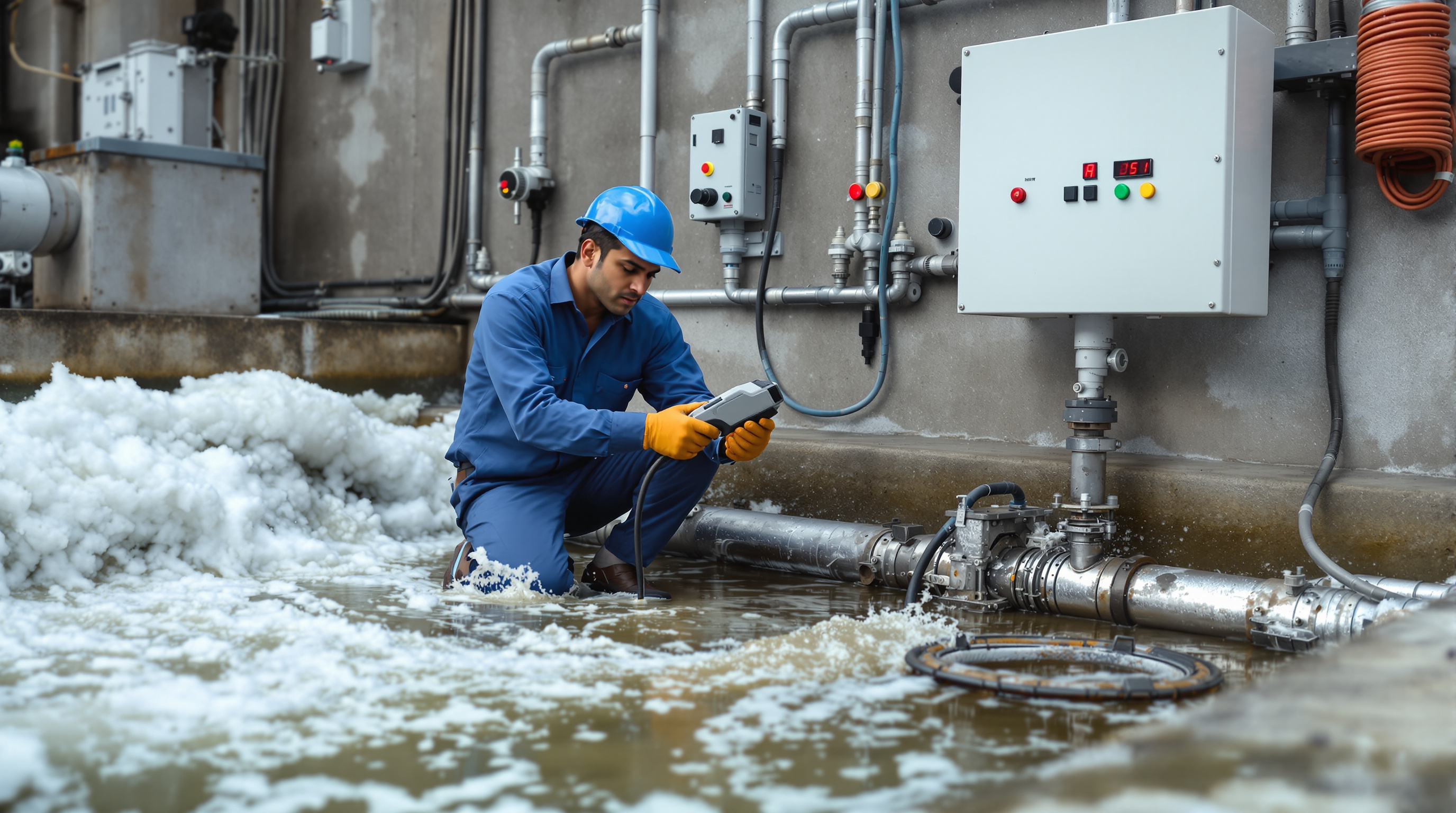
AI is only as good as what it can see and touch. Before any of this delivers value, a plant needs:
- Working, calibrated instrumentation — DO, flow, pH, level, turbidity sensors that are actually maintained. Garbage in, garbage out is brutally literal here.
- Controllable equipment — VFD blowers and automated valves/pumps, so software can act, not just observe. A model that recommends changes an operator must dial in by hand rarely survives contact with a busy plant.
- Reliable data logging — the IoT monitoring layer that captures and stores readings continuously. AI is the analytics tier on top of IoT; without the IoT foundation there is nothing to learn from.
- Months of history — every model needs to learn this plant. There is no useful pre-trained STP brain you can drop in on day one.
This is also why AI and digital twins are often discussed together: a calibrated digital twin of the STP gives models a simulator to test control strategies against before touching the real tanks.
What it means for owners and consultants
If you are specifying or buying, keep three things in front of you. First, demand outcomes, not adjectives — ask a vendor to quantify aeration energy saved and to name which of the four applications they actually deliver, on a comparable Indian plant. Second, budget for the boring layer — sensors, VFDs and their calibration and AMC are the real cost, and they must be maintained or the intelligence goes blind. Third, let AI reduce operator dependence, never eliminate the operator — CPCB compliance still rests on a competent human and real lab data.
Used this way, AI in STP operations is not hype: it is a genuine tool for cutting the energy bill, catching faults early, and running a steadier plant. It simply belongs in the "smart controls" box, not the "magic" box. To see where it fits in the wider shift toward instrumented, lower-carbon water systems, continue through the Sewage Treatment Plants guide library.
Export this guide
Related Guides — Deep-dive reading
Smart Sensors in STPs: Online DO, Ammonia, Turbidity, Flow & TSS for Automated Control
How online DO, ammonia, turbidity, flow and TSS sensors turn a sewage treatment plant from a hand-tuned machine into a self-regulating one — cutting energy, catching upsets early, and proving compliance in real time.
Sewage Treatment PlantsIoT Monitoring for STPs: Real-Time Sensors, Dashboards & OCEMS Compliance
How IoT sensors, connectivity and dashboards turn a blind, manually-logged sewage plant into a plant you can watch, alarm and prove compliant in real time — what to install, what it costs, and where the technology is genuinely ready.
Sewage Treatment PlantsDigital Twins for STPs: A Live Simulation of Your Sewage Treatment Plant
What a digital twin of an STP actually is, how a live virtual model helps you operate, optimise and train without risk, and an honest read on where the technology stands for building-scale plants in India.
Sewage Treatment PlantsRelated Tools — Try Free
STP Compliance Checklist Tool
Interactive self-audit that ticks off STP consents, discharge norms, reuse metering, online monitoring and O&M records to give a live compliance readiness score.
ChecklistBefore vs After — Cost Reality Check
Compare what you expected to pay vs what you actually paid, category by category.
Reality CheckSecurity System Cost Estimator
Estimate the all-in capex with GST, annual running cost and 5-year total cost of ownership of a home or building security system.
Cost Estimator