

Comparing STP Vendors: How to Evaluate Suppliers Fairly
A practical framework for developers, owners, RWAs and consultants to compare sewage treatment plant vendors on track record, technology, guarantees, after-sales support and truly apples-to-apples quotes — instead of just picking the lowest number.
An STP is one of the few pieces of a building you buy once and then live with for fifteen years. The pump you chose, the technology the vendor recommended, the fine print in the guarantee, the phone number you call at 11 p.m. when the blower trips — all of it is decided at the procurement stage, long before the first drop of sewage arrives. And yet most STP purchases are settled the same lazy way: three quotes are lined up in a spreadsheet, the lowest number is circled, and the order is placed.
That is how a building ends up with an under-sized, non-compliant plant that no one will service and no one will own. Comparing STP vendors well is not about finding the cheapest supplier — it is about finding the one whose plant will still be meeting discharge norms, quietly, in year ten. This guide gives you a fair, repeatable way to do that.
The cheapest quote and the cheapest plant are almost never the same thing. Price is what you pay on day one; cost is what you pay across fifteen years of power, chemicals, sludge disposal, repairs and the tanker water you buy when the plant is down.
Five things you are actually comparing
Strip away the brochures and every STP vendor decision comes down to five dimensions. Score each vendor on all five — not just the last one.
- Track record — have they built and, crucially, run plants like yours?
- Technology — is the process they propose right for your load, space and reuse goals?
- Guarantees — what performance and equipment do they actually stand behind, in writing?
- After-sales and AMC — who keeps it running once the cheque clears, and at what cost?
- The quote — is it a like-for-like comparison, or are you comparing a full plant against a half one?
A structured vendor evaluation matrix that weights these and forces a score per vendor is worth more than any single glossy proposal. Let us take them one at a time.
1. Track record: ask to see running plants, not photos
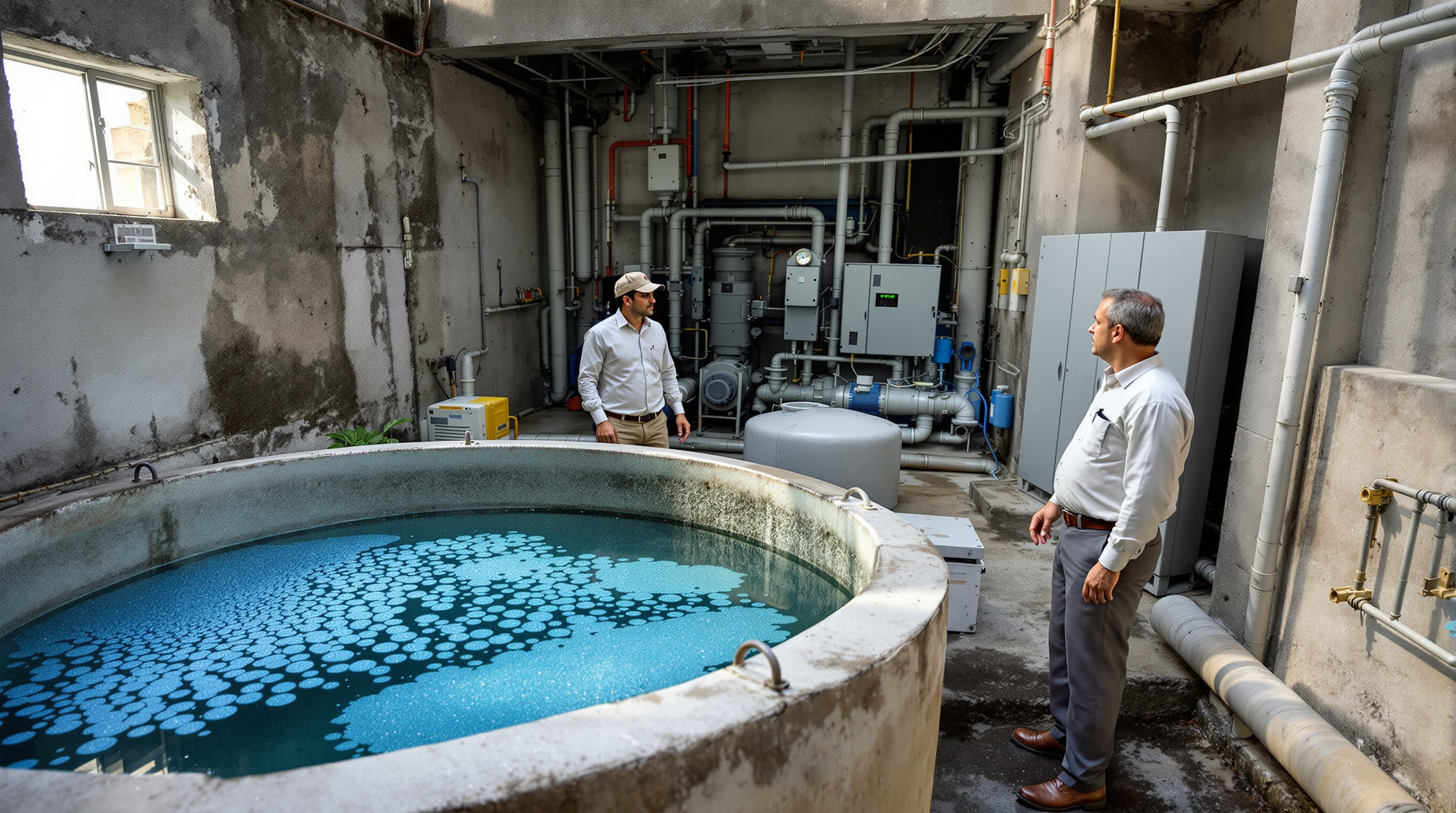
Anyone can fabricate tanks. The real question is whether the vendor's plants are still hitting their numbers years later. Photographs of shiny new installations tell you nothing — a plant looks identical on commissioning day whether it will last two years or twenty.
What to actually ask for:
- A reference list of plants of similar size and type (an apartment complex, not a factory) commissioned three to five years ago — old enough to have been tested by time.
- Permission to visit one unannounced, ideally with your consultant, and to talk to the facility manager or RWA who lives with it.
- CPCB / State Pollution Control Board compliance history — have their plants passed the online monitoring and periodic testing that regulators now demand? A vendor whose plants routinely fail STP regulations is a liability you inherit.
- Financial stability. A ten-year performance guarantee is worthless from a company that will not exist in ten years.
Weight experience with your building type heavily. A vendor who has delivered fifty residential STPs in your city knows the local water quality, the labour, and the SPCB inspector better than a large firm doing its first apartment job.
2. Technology: right-sized, not just fashionable
Vendors have favourite technologies — usually the ones they make the most margin on — and they will steer you toward them. Your job is to check the process actually fits your building, not their order book. The main choices in Indian buildings are MBBR, SBR and MBR, each with a different footprint, power draw and cost curve.
| Consideration | Question to put to the vendor |
|---|---|
| Footprint | Does the proposed process fit the space we have, with room to service it? |
| Power | What is the connected load and expected daily kWh? (Aeration dominates the bill.) |
| Reuse quality | Does the output meet the standard we need — flushing, gardening, or cooling towers? |
| Operator skill | Can a normal facility team run it, or does it need a specialist? |
| Sludge | How much sludge does it generate, and who disposes of it? |
Be honest, too, about the emerging layer. IoT dashboards, AI-driven operations and digital twins are genuinely useful for monitoring — remote alarms, energy trending, early warning of a failing blower. They are real and worth having. But they are maturing, not magic: a smart dashboard on a badly-sized biological process just gives you a prettier view of a plant that still fails. Treat digital features as a bonus on top of sound engineering, never as a substitute for it. Use a neutral STP technology selector to sanity-check what the vendor proposes against your own inputs.
3. Guarantees: read what they will actually put in writing
"Guaranteed" is the most abused word in an STP proposal. Pin down exactly what is covered, for how long, and what voids it. A useful warranty checklist helps, but at minimum separate three distinct promises:
- Performance guarantee — the treated water will meet specified BOD, COD, TSS and other parameters at the design load. Get the numbers and the test method in the contract, not the covering letter.
- Equipment warranty — pumps, blowers, membranes, panels, each with its own period. Membranes in particular have a defined life; know it.
- Commissioning and stabilisation — who runs the plant during the tricky first few weeks while the biological culture establishes, and who pays if it does not stabilise?
The clause that matters most is the one nobody reads: what voids the guarantee. If a single power fluctuation, a slightly higher inflow, or using anyone but the vendor's own operator cancels the whole thing, the guarantee is decorative.
4. After-sales and AMC: the fifteen-year relationship

This is where the lowest bidder usually loses. An STP is not a purchase, it is a marriage — and the AMC is the marriage. A plant with no serious service behind it silently drifts out of compliance within a year or two.
Compare vendors on the things that decide whether the plant keeps running:
- Local service presence — a team in your city, not a promise to fly someone in from another state.
- Response time in writing — how fast for a breakdown versus routine visits.
- AMC scope and price for years two to five, not just the free first year. A generous warranty followed by an extortionate AMC is a trap. Model it with an AMC cost calculator.
- Spares and consumables — availability and price of membranes, diffusers, media, and whether you are locked into the vendor's proprietary parts.
A good AMC selection guide walks through the contract clauses in depth; the headline is simple — judge the after-sales offer as harshly as the capital quote, because you will pay it every single year.
5. The quote: make it apples-to-apples
Two quotes are almost never comparable as written, because vendors quietly leave things out to look cheaper. Before you compare a single rupee, normalise every quote to the same scope. The usual missing items:
- Civil works and tank construction (in scope or yours to arrange?)
- Treated-water plumbing, dual-line reuse, and pumps to the terrace
- Electrical panel, cabling, and the connected load's impact on your sanctioned supply
- Instrumentation and any mandated online monitoring
- The all-important operating cost — power, chemicals, sludge disposal, manpower
A plant that is cheaper to build can easily be dearer to run. Convert each bid into a rupees-per-KLD capital figure and an estimated monthly running cost so you compare lifetime cost, not sticker price. The STP cost estimator and the guides on cost per KLD and annual operating cost give you the benchmarks to spot a quote that is suspiciously low — which usually means something essential has been left out.
A simple scoring approach
Do not average five scores into one and call it a decision. Weight them for your situation — an RWA taking over an existing plant should weight after-sales far above capital price; a developer building to sell may weight compliance and handover documents highest.
| Dimension | Suggested weight | Cheapest bid often scores |
|---|---|---|
| Track record & compliance | 25% | Poorly |
| Technology fit | 20% | Middling |
| Guarantees | 15% | Poorly |
| After-sales / AMC | 25% | Worst |
| Normalised lifetime cost | 15% | Best on day one only |
Notice where the lowest bidder wins: one column, on one day. The right questions before buying and a clean tender preparation process force every vendor onto the same scorecard so their numbers can finally be compared honestly.
The bottom line
Comparing STP vendors fairly means refusing to let a single number — the capital quote — stand in for a fifteen-year decision. Score every vendor on track record you have verified, technology that fits your building, guarantees they will sign, after-sales you can actually reach, and quotes normalised to identical scope. Do that and the right supplier usually stands out clearly, and it is rarely the cheapest one.
From here, build your scorecard with the vendor evaluation matrix guide, and browse the full Sewage Treatment Plants guide library for the technology, cost and compliance detail behind each column.
Export this guide
Related Guides — Deep-dive reading
STP Vendor Evaluation Matrix: A Weighted Scoring System to Pick the Right Supplier
How to turn a pile of STP quotations into a defensible decision — the criteria that actually matter, how to weight them for your project, and how to score vendors on a single comparable scale instead of chasing the lowest price.
Sewage Treatment PlantsAnnual STP Maintenance & Overhaul: The Complete Yearly Shutdown Checklist
Once a year your STP needs a full stop, a drain-down, and an honest look at everything the daily rounds never reach — tanks, blowers, membranes, instruments, concrete and the AMC. Here is the complete annual overhaul, in the right order.
Sewage Treatment PlantsSTP Warranty Checklist: What Should Actually Be Covered (India Guide)
Equipment, civil works, the performance guarantee, membrane and media life, defect liability and the exclusions vendors quietly slip in — a plain-language checklist so your STP warranty protects you, not the supplier.
Sewage Treatment PlantsRelated Tools — Try Free
STP Compliance Checklist Tool
Interactive self-audit that ticks off STP consents, discharge norms, reuse metering, online monitoring and O&M records to give a live compliance readiness score.
ChecklistSTP Technology Selector
Weight your priorities — footprint, effluent quality, cost, power and simplicity — and get a scored recommendation between Extended Aeration, MBBR, SBR and MBR.
SelectorInterior Contract Clause Checklist
16 sections and 98 checkboxes covering scope, BOQ, milestones, penalties, warranty, and disputes.
Contract Checklist