
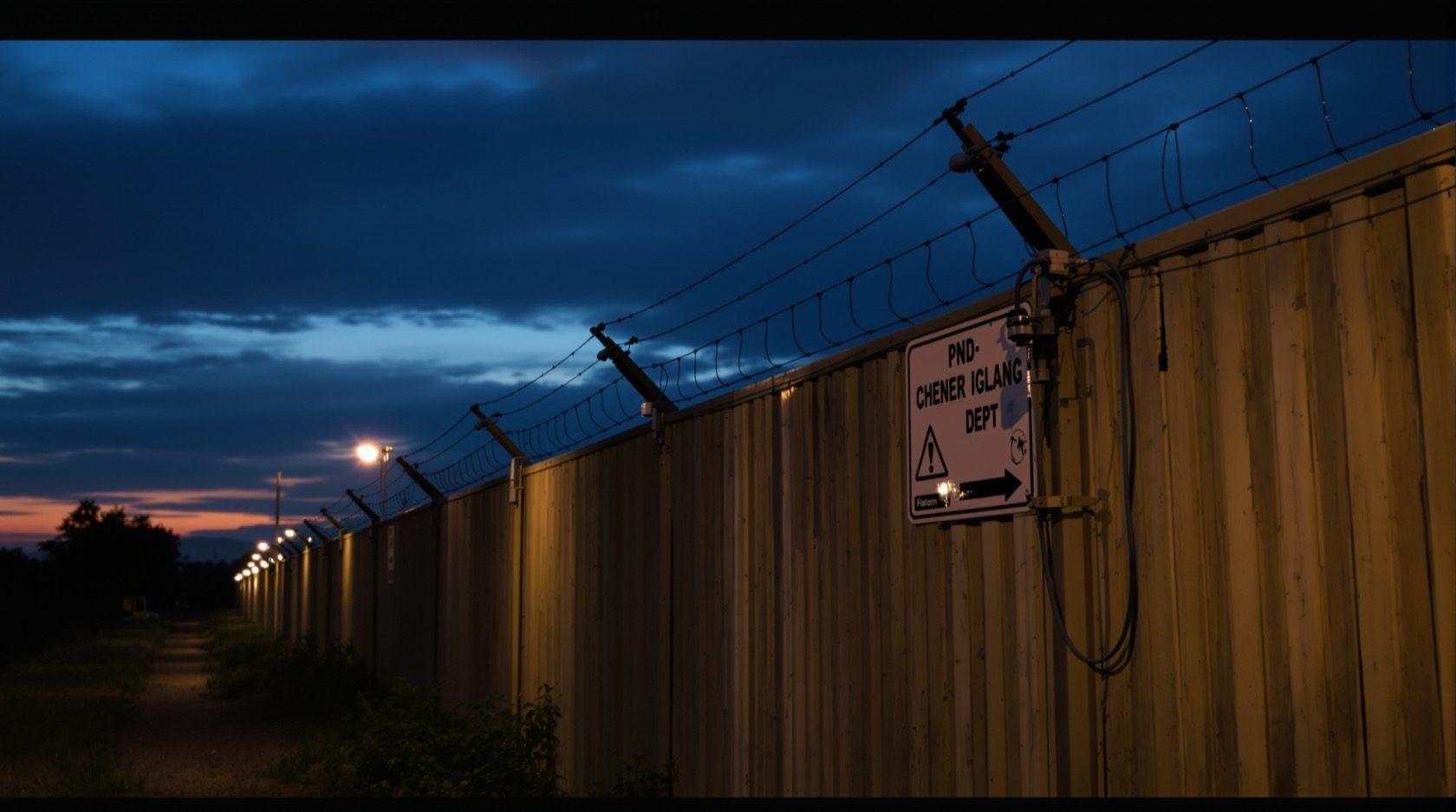
Fence Intrusion Detection in India (2026): Sensing an Attack on the Boundary
How fence-mounted sensors — vibration cable, taut-wire, microphonic and fibre-optic — detect someone climbing, cutting or lifting a boundary fence, how to zone a long perimeter, and how to design out the outdoor false alarms.
A motion sensor guards a room; a door contact guards a door. But a factory, a farmhouse, a campus or a gated community is defended first at its edge — a long run of compound wall or fencing, often hundreds of metres, that an intruder must cross before reaching anything worth protecting. Fence intrusion detection is the technology that turns that boundary itself into a sensor: devices mounted on the fence or wall that detect someone climbing over it, cutting through it, or lifting it to crawl under. It is the outermost layer of a well-designed scheme, buying the seconds of warning that let a guard look, a camera confirm, and a siren sound while the intruder is still at the fence line rather than at the door.
This guide sits inside the Studio Matrx Burglar & Intrusion Alarm hub and extends the perimeter alarm systems overview. Where beam sensors watch an open line across a gap, fence detection watches the physical barrier — the two are complementary layers, not rivals. The focus here is helping an owner, architect or facilities team understand how each fence technology senses an attack, how to divide a long boundary into zones, and how to design out the outdoor false alarms that make a badly specified system worse than none. Designing and installing a large energised or multi-zone perimeter is a licensed job, and this guide keeps to plan-and-decide.
Scope & safety. This is an educational overview to help you specify and place a perimeter detection system and hold an installer to account — not a DIY manual. A boundary system of any size means outdoor mains cabling, work at height along the fence line, and (for electric fences) energised conductors that are safety-regulated: all of this is a licensed electrician's and specialist installer's work — see the electrical hub. Energised perimeter fences are legally controlled in India, require correct earthing and mandatory warning signage, and must never be improvised. Detectors that also record or view touch privacy law — footage and monitoring data are personal data under the Digital Personal Data Protection Act, 2023. This is educational guidance, not legal or electrical advice.
Where fence detection fits
Fence detection is worth its cost when the perimeter is long, the ground between the boundary and the building is open, and a barrier already exists (or is planned) to carry the sensors. That describes a lot of Indian sites:
- Factories, warehouses and industrial plots with a boundary wall or chain-link fence around stockyards and plant.
- Farmhouses and large plots where the house sits well inside a big walled compound.
- Campuses, institutions and gated communities with a continuous perimeter wall and a guard establishment already in place.
- Substations, godowns and yards storing valuable or hazardous material.
For a small home on a short boundary, fence detection is usually overkill — door and window sensors plus a couple of well-placed detectors do more for the money. Fence detection earns its place when the perimeter is the first meaningful barrier and there is a guard or monitored panel to respond. Before specifying anything, walk the boundary as a perimeter vulnerability assessment: where is the fence low, where do trees overhang, where does a drain or slope let someone under? The survey decides which technology and how many zones you actually need.
The four main technologies, at a glance
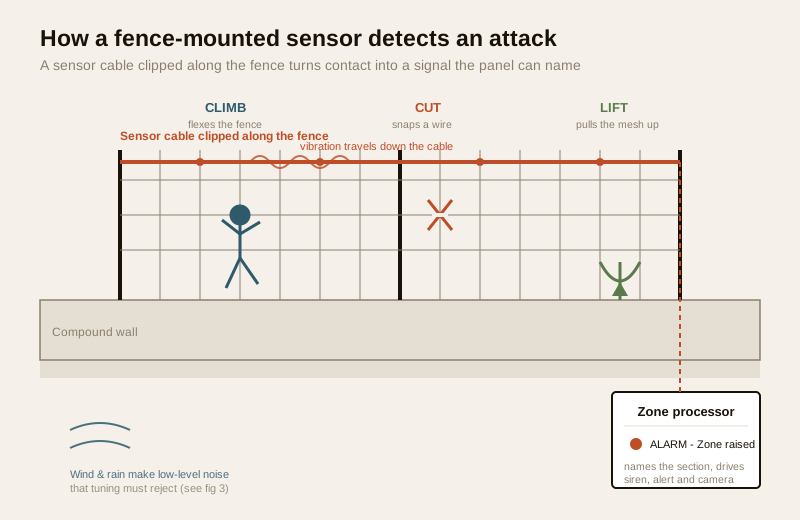
There is no single "fence sensor". A handful of distinct technologies each sense a different physical signature of an attack. Understanding what each responds to is the key to choosing well and to knowing what will false-alarm it.
| Technology | What it senses | Best suited to | Watch-outs |
|---|---|---|---|
| Vibration / accelerometer sensor cable | The shake and flex of the fence being climbed, shaken or cut, picked up by sensors along a cable clipped to the fence | Chain-link and weldmesh fences on factories, yards, campuses | Needs a fence rigid enough to transmit vibration; wind and loose panels raise false alarms |
| Taut-wire system | A change in tension when tensioned wires are spread apart, pushed, cut or climbed | High-security walls and fences where a physical deterrent plus detection is wanted | Higher install cost; needs proper tensioning and periodic adjustment |
| Microphonic / fibre-optic sensor cable | The sound and micro-strain of an attack travelling along the length of a special cable | Long runs; fibre suits very long perimeters and electrically noisy or lightning-prone sites | Sensitivity mapping along the run needs a skilled commissioning; premium cost |
| Electric / pulse fence with monitoring | A break or short in an energised wire array, plus a deterrent shock, reported to a panel | High-risk industrial and utility perimeters where deterrence is wanted alongside detection | Safety-regulated: licensed install, correct earthing and mandatory warning signage are non-negotiable |
A few honest notes on choosing between them:
- Vibration sensor cable is the workhorse for typical Indian factory and campus fences — relatively economical, well understood by local installers, and effective on a decent chain-link or weldmesh fence. Its weakness is a flimsy or rattly fence, so the fence itself must be sound first.
- Taut-wire doubles as a physical barrier: the tensioned wires are hard to climb as well as instrumented, which is why it appears on higher-security sites. It costs more and needs maintenance to stay in tune.
- Microphonic and fibre-optic cables shine on very long perimeters and can pinpoint the location of an attack along the run. Fibre is immune to electrical interference and lightning-induced surge, which matters on exposed rural and industrial sites. It is a premium, professionally commissioned choice.
- Electric / pulse fences add active deterrence — a safe, regulated pulse — on top of detection, and report a cut or climb to the panel. Because they are energised, they are the most heavily regulated: in India they must be installed by qualified people, earthed correctly, and carry the mandatory yellow-and-black warning signs at intervals along the fence. Treat legality and signage as design requirements from day one, not an afterthought.
Whichever you choose, the sensor is only half the system. It reports to a zone processor or alarm panel, which in turn drives sirens, notifies a guard or owner over GSM/app, and — in the best designs — pulls up the right camera. Most Indian perimeter systems are self-monitored this way (siren plus alert to a guard or owner), because professional central-station monitoring with police auto-response is still limited here; see the complete burglar alarm guide for how monitoring options compare.
Zoning: knowing which section was hit
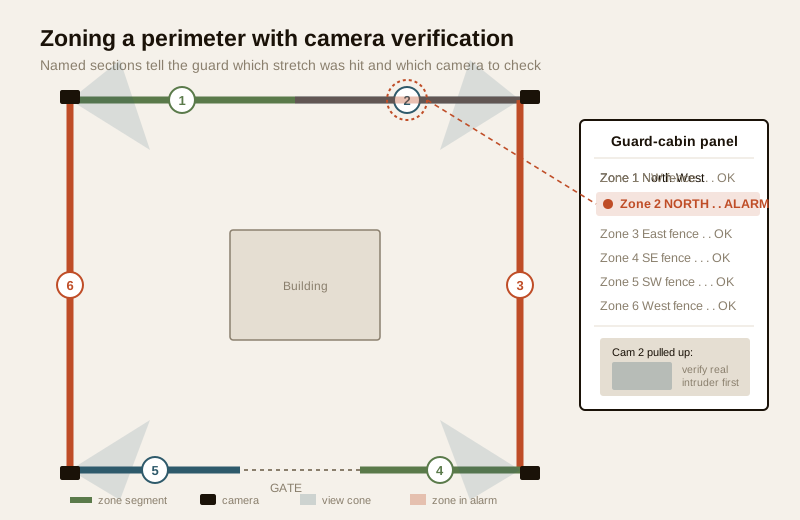
A single alarm that says "the perimeter was disturbed" is nearly useless on a 600-metre boundary — a guard cannot search the whole fence line before the intruder is gone. The design that makes fence detection actually work is zoning: dividing the perimeter into named sections so the panel reports "Zone 4, north fence, behind the transformer yard" rather than a bare buzzer.
Good zoning does three things at once:
1. Directs the response. The guard, or the owner on the app, goes straight to the section that triggered.
2. Enables camera verification. Each zone maps to a camera (or PTZ preset) that swings to that stretch of fence, so a human can confirm a real intruder versus a stray dog before rousing anyone or calling police. This is the single most powerful false-alarm defence — see CCTV intrusion and zone detection.
3. Localises tuning and faults. Sensitivity can be set per zone (the windy corner and the sheltered wall need different settings), and a faulty run is isolated to one zone instead of blinding the whole boundary.
A workable rule of thumb is a zone every 50–100 metres, shorter where the risk is higher (near a gate, a blind corner, or the valuables) and where a camera can usefully cover the stretch. The zone length is a balance: shorter zones pinpoint better but cost more processing channels and cameras.
The honest problem: outdoor false alarms
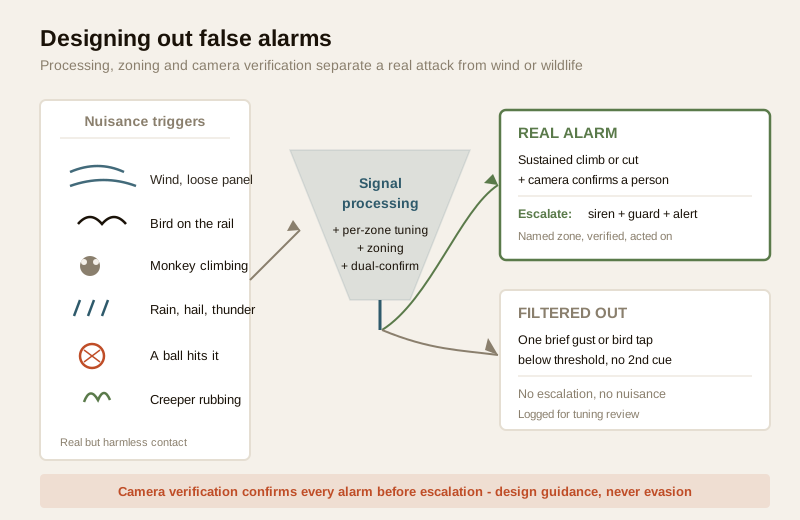
Every outdoor perimeter sensor faces the same hard truth — the boundary is exposed to the weather and the wildlife, and both can look, to a sensor, a lot like an intruder. Pretending otherwise sells a system that will be switched off within a month because it cries wolf. Good design does not hide the problem; it engineers it down. In Indian conditions the usual nuisance triggers are:
- Wind shaking the fence, banging a loose panel or a gate.
- Heavy rain, hail and thunder drumming on the fence and cabling.
- Animals — stray dogs, cattle, birds landing on the top rail, and monkeys, who will happily climb and shake a fence for fun.
- Debris and impact — a branch falling, a football or cricket ball hitting the fence, a plastic sheet blown against it.
- Vegetation — a creeper or overhanging branch rubbing the fence in the breeze, and grass touching the lower cable.
None of these is a reason to skip fence detection; each is a reason to design it properly. The mitigations stack together:
| Nuisance source | Design response (never an excuse to under-protect) |
|---|---|
| Wind & loose fence | Tension and tidy the fence first; set per-zone sensitivity; use signal-processing that counts sustained/repeated hits, not one gust |
| Rain, hail, thunder | Weather-compensated processing; verify with a camera before escalating; brief the guard that monsoon nights need eyes-on, not auto-dispatch |
| Animals, birds, monkeys | Tune out small brief taps; clear the top rail of perches; camera verification to confirm two-legged versus four-legged |
| Vegetation & debris | Keep a cleared strip both sides of the fence; trim creepers and branches; route the cable clear of grass |
| Single-cause noise generally | Dual-confirm — require the fence sensor plus a second cue (a beam break or a camera analytic in the same zone) before a full alarm |
The two most valuable tools in that list are camera verification and per-zone sensitivity tuning. Camera verification means an alarm is confirmed by a human (or a reliable video analytic) looking at the exact stretch of fence before anyone escalates — turning a nuisance-prone sensor into a reliable trigger. Per-zone tuning accepts that the corner facing the open field, the wall behind the trees, and the gate all live in different micro-conditions and must be set individually. Commissioning a perimeter is not a one-visit job; it is walk-tested, tuned over several days and weather conditions, and revisited after the first monsoon.
Weatherproofing, power and cabling
A perimeter system lives outdoors year-round, so the boring engineering decides whether it survives its second monsoon:
- Ingress protection. Field enclosures, junction boxes and sensor terminations should be properly weather-rated and sealed; a taped joint that survived one monsoon rarely survives two. Specify gland-sealed outdoor boxes, not indoor ones pressed into service.
- Power and backup. Perimeter electronics need reliable power with battery backup, because a power cut is exactly when a system must keep watching. Solar-plus-battery is common on farmhouse and remote-plot boundaries where running mains to every corner is impractical; on factory sites a UPS-backed feed from the plant supply is usual. Size the backup for realistic Indian load-shedding, not a token hour.
- Surge and earthing. Long outdoor cable runs act as lightning antennas. Proper earthing and surge protection at the panel and field boxes protect the electronics — fibre-optic sensing is inherently immune to this, one reason it suits exposed rural sites.
- Cable protection. Route sensor and power cabling in conduit or armoured cable, clear of rodents and clear of the ground where damp and grass sit. Keep a cleared strip along the fence so vegetation neither triggers the sensor nor hides a cut cable.
All of this outdoor, at-height and mains-connected work is licensed-professional territory. The owner's job is to specify it correctly and insist on it in the contract; see the electrical hub for who does what.
Layering: fence detection is one line, not the whole defence
Fence detection is powerful precisely because it is the outer line — but it should never be the only line. A layered scheme degrades gracefully: if wind defeats a zone one night, the layers behind still hold. A sound perimeter design combines the fence sensor with an inner detection line and building-level sensors:
- Fence line — vibration/taut-wire/fibre catches contact with the boundary itself.
- Open-space line — beam sensors or outdoor detectors across the yard between fence and building.
- Building shell — door, window and motion sensors as the last line.
- Verification and record — CCTV with zone detection tied to the same zones.
For how these stack on a real site, see the layered security design guide and, for community boundaries specifically, the gated communities security guide. To sanity-check what your site actually needs before you shop, run the burglar alarm system selector.
When to bring in a professional. You can and should do the thinking — walk the perimeter, decide the zones, set the response plan, and read the false-alarm honesty above. Hand the rest to specialists: the fence-sensor survey and sensitivity commissioning, all outdoor and at-height cabling, the mains and UPS/solar power, surge protection and earthing, and — absolutely — any energised electric fence, which is safety-regulated and must be installed, earthed and signed by qualified people. Insist on a walk-test acceptance across different weather, a per-zone tuning record, a written map of zones to cameras, and a post-monsoon revisit. A perimeter system that is never tuned is a siren that everyone learns to ignore.
Key takeaways
- Fence intrusion detection turns the boundary itself into a sensor — catching a climb, a cut or a lift at the fence line, the outermost useful layer for factories, farmhouses, campuses and gated communities on a long perimeter.
- Four main technologies sense different signatures: vibration/accelerometer cable (the workhorse), taut-wire (barrier plus detection), microphonic/fibre-optic (long runs, pinpointing, interference-immune) and monitored electric/pulse fence (deterrence plus detection, but safety-regulated with mandatory earthing and signage).
- Zoning is what makes it work — divide the perimeter into named 50–100 m sections so the panel says which stretch was hit, directs the guard, and pulls up the matching camera.
- Outdoor false alarms are real and must be engineered down, never ignored — wind, rain, monkeys, birds and a stray football are answered with per-zone sensitivity tuning, a cleared fence strip, dual-confirm and, above all, camera verification before any escalation.
- The install is a licensed job — weather-rated enclosures, battery/solar backup for power cuts, surge protection and earthing, and specialist commissioning; energised fences especially are legally controlled and never a DIY task.
References
- Manufacturer specifications — verify the sensing method, zone length limits, environmental/IP rating, operating temperature range and false-alarm mitigation features of any fence sensor, taut-wire or fibre system on the maker's own datasheet before specifying.
- Digital Personal Data Protection Act, 2023 — perimeter CCTV and monitoring data are personal data; restrict who may view recordings and monitoring logs, and set data-handling terms with any monitoring vendor in writing.
- National Building Code of India (SP 7) and relevant Bureau of Indian Standards codes for outdoor electrical installation, earthing and surge protection, plus applicable state rules and mandatory warning signage for any energised (electric) fence; verify the current edition via the BIS catalogue: https://www.services.bis.gov.in/
- Local municipal and estate bye-laws — confirm boundary height, energised-fence permissions and signage obligations with local authorities before installing any perimeter fence system.
This is an educational overview, not legal or electrical advice. Perimeter design, outdoor and at-height cabling, mains power and any energised electric fence are qualified professional tasks — engage licensed installers and electricians, comply with energised-fence regulations and signage, and verify any standard's current status via the BIS catalogue before relying on it.
Export this guide
Related Guides — Deep-dive reading
Boundary Intrusion Detection in India (2026): Choosing & Layering Perimeter Sensors
The umbrella guide to the perimeter intrusion-detection family — beam, fence-mounted, buried, microwave, outdoor PIR and video analytics — and how to match each to the boundary, reject false alarms, and layer two technologies you verify on camera.
SecurityBeam Sensors in India (2026): Active-Infrared Perimeter Detection for Gates, Walls and Farmhouse Boundaries
How active-infrared beam sensors work, where they earn their place on Indian plots, single-beam versus multi-beam towers, and how to tame the outdoor false-alarm problem with sound design.
SecurityFence Vibration Sensors in India (2026): Detecting a Cut or Climb on the Fence Itself
How fence-mounted vibration, sensor-cable, fibre-optic and taut-wire detection turns an ordinary boundary fence into a detecting fence that flags a cut, climb or forcing attempt while the intruder is still on the line.
SecurityRelated Tools — Try Free
Burglar Alarm System Selector
Answer a few questions about your property, cabling, coverage, monitoring and power and get the right burglar alarm — wired / wireless / hybrid, self or professionally monitored — with the design non-negotiables.
Alarm SelectorSecurity Backup Power Calculator
Size a UPS/inverter and battery to keep CCTV, NVR, router and alarm running through a power cut — load, Ah, VA and cost.
Backup PowerCCTV Cable-Length Calculator
Total cable to buy for a CCTV job and a warning when a run exceeds the cable's maximum length.
Cable Length