
Perimeter Beam Sensors in India (2026): Invisible Trip-Lines Along the Boundary
How stacked active-infrared and laser photo-beams strung between towers along a wall, gap or long straight run raise the alarm the moment someone crosses the boundary — and how to place them so fog, birds and foliage do not.
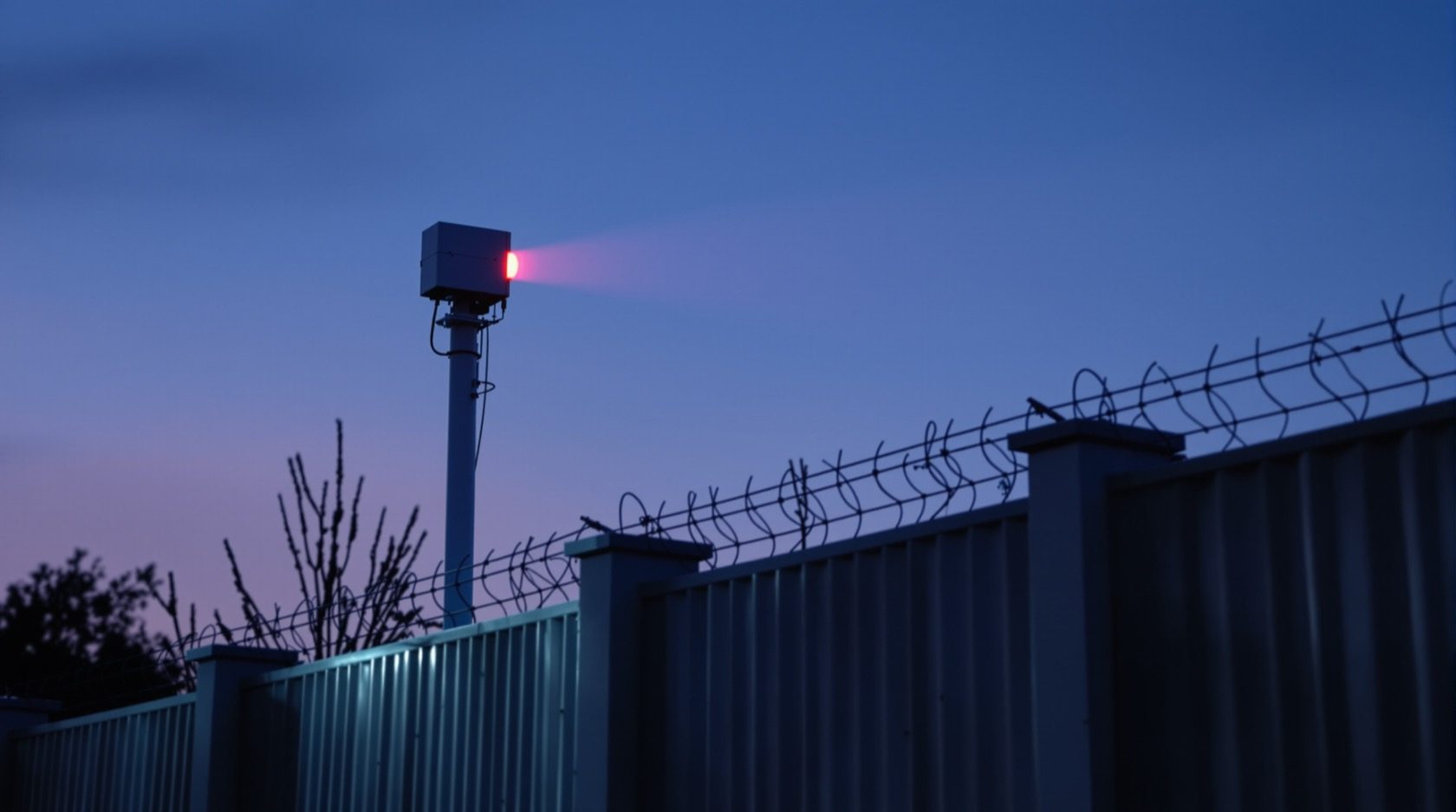
A compound wall only delays an intruder — it does nothing to tell you they are there. Perimeter beam sensors turn that silent wall into a trip-line: a transmitter projects one or more invisible beams to a matched receiver mounted some distance away along the boundary, and the instant a body blocks the light path the receiver drops the signal and raises an alarm. It is the outdoor, boundary-scale application of the active-infrared and laser photo-beam detection that Studio Matrx covers mechanically in the beam sensors guide — this page is about deploying that beam along a real Indian perimeter: over a wall-top, across a gap, or down a long straight run, and doing it so the beam fires on people and stays quiet for fog, birds and a growing creeper.
Scope, honesty & safety. This guide helps you plan, specify and place a perimeter beam line — how detection works and where to site it, never how to defeat one. Hold onto two realities. First, a broken beam is only a signal: it means "something crossed the line," not "an intruder is here." It is worthless unless a human or monitoring station verifies it (almost always by pulling up CCTV) and responds — an unmonitored beam that trips into an empty control room saves no one. Second, everything here — mains power to the towers, mounting at height, precise optical alignment — is licensed-professional and specialist installer work. This is educational planning guidance, not legal advice.
Why a beam line, and where it belongs on the boundary
A perimeter beam is a volumetric line detector: it does not watch an area like a motion sensor or a fence run like a vibration cable — it watches one precise, straight, invisible plane between two points. That makes it excellent at exactly the places a boundary offers a clean, unobstructed shot:
- Along a long straight wall or fence run. A single tower pair can span tens of metres of dead-straight boundary, catching anyone who crosses the plane above the wall — far cheaper per metre than covering the same run with cameras or motion zones.
- Across a gap. A gateway, a service opening, a culvert, the break between two buildings, the strip between a gate and a guardhouse — anywhere the physical barrier stops but the boundary continues, a beam closes the gap.
- Over a wall-top. Mounted so the stacked beams sit just above the coping, the line watches the exact plane an intruder must cross to come over — the compound wall becomes the mounting structure and the beam becomes its early-warning tripwire.
Where a boundary is curved, cluttered, or full of gates and planting that break line-of-sight, a beam struggles — that is where fence vibration sensors reading the fence itself, or perimeter CCTV with video analytics, fit better. Beams reward long, straight, clear runs; they punish clutter. The boundary intrusion detection guide is the umbrella that helps you match technology to each stretch of your line, and the perimeter alarm systems guide covers the panel, siren and monitoring behind it all.
Single beam versus multi-beam towers
This is the decision that most shapes how a perimeter beam behaves, so it deserves care even though the mechanics are covered in the beam sensors guide. Outdoors, on a boundary, the difference is decisive.
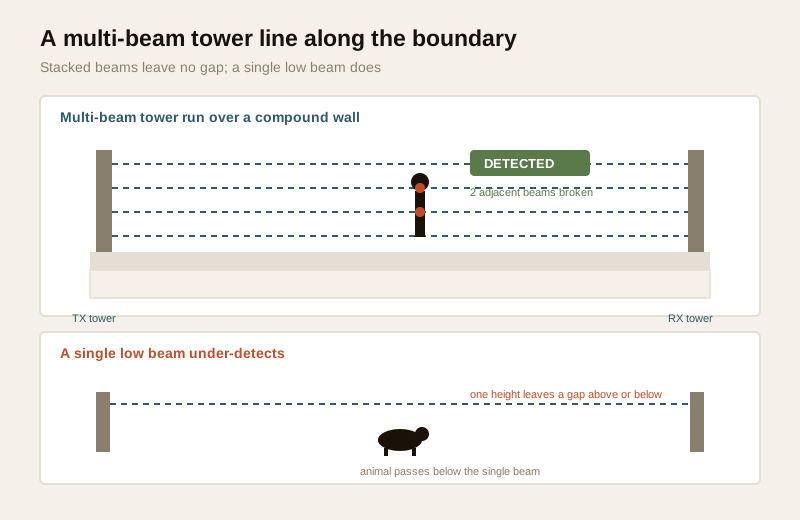
A single beam is one horizontal light path. It is cheap and simple, but on a perimeter it has two honest weaknesses: a small animal, a bird or blowing rubbish crossing it reads exactly like a person (a nuisance trip), and set at any single height it leaves an obvious problem — set it low and it trips on cats and dogs; set it high and someone can pass beneath it. One line cannot be both.
A multi-beam tower stacks several beams vertically in two slim posts (a transmitter tower facing a receiver tower), turning the single line into an invisible wall of stacked beams from near ground to head height. This fixes both weaknesses at once:
- Fewer nuisance trips. Better towers can be set to alarm only when two adjacent beams are broken together (an "AND" logic). A pigeon or a rat crosses one beam, not two stacked ones, so it is ignored; a person's body breaks several at once and trips cleanly. More beams, well configured, means fewer false alarms from small wildlife.
- Harder to pass. With beams from low to high, there is no gap to crawl under or step over — the whole vertical plane is watched. The taller the tower and the more beams, the more completely the crossing plane is covered.
The trade-off is cost, alignment effort (more beams to align) and physical footprint (two towers). As a planning rule of thumb, describe the choice like this to a client:
| Configuration | Watches | Best for | Honest limitation |
|---|---|---|---|
| Single beam | One horizontal line | A narrow gap, a doorway, a short low-risk run, budget sites | Trips on birds/animals; one height leaves a gap above or below |
| Twin / dual beam | Two lines, both must break | Gateways, medium runs where nuisance trips matter | Still limited vertical coverage; two heights only |
| Multi-beam tower (4+) | A stacked vertical wall of beams | Long walls, wall-tops, campus and factory boundaries, higher-risk sites | Higher cost, more alignment, two-post footprint |
There is rarely a reason to run a single beam along a real security boundary — the multi-beam tower is the perimeter workhorse. Reserve single beams for short, controlled gaps where a body is the only thing that could ever cross.
Beam-over-wall versus free-standing tower lines
Two ways to deploy the towers on an Indian plot, each with a place:
- Beam-over-wall. The towers (or beam heads) mount on the existing compound wall so the stacked beams run just above the coping. The wall does the physical delaying and the beam does the detecting of anyone crossing it. This suits the common Indian villa or factory that already has a solid boundary wall — you are adding detection to an existing barrier rather than building a new line. Pair it with anti-climb measures so the wall resists as the beam warns.
- Free-standing tower line. Self-supporting towers set on their own posts or plinths, used where there is no wall to mount on — across open farm boundaries, along a plot edge, or as a detection line set back inside the boundary. These reach greater heights (towers of a metre to a couple of metres are common) and create a pure detection plane independent of any barrier.
Range and alignment: the make-or-break of an outdoor beam
Two engineering realities decide whether a perimeter beam works for years or false-alarms weekly.
Range. Manufacturers quote a maximum outdoor range for each model — and this is where honesty matters. Datasheet ranges are typically stated for clear conditions, and Indian outdoor reality (monsoon fog, dust, haze) attenuates the beam, so the working perimeter range is a fraction of the headline figure. Reputable outdoor beams publish a much shorter rated outdoor distance precisely to keep a fog margin. Never span a run to the datasheet maximum; specify a model whose rated outdoor range comfortably exceeds your actual run, so bad weather eats into margin rather than into detection. Confirm the rated outdoor range on the maker's own datasheet against the applicable BIS/IEC detector standard (verify), never on a marketing number.
Alignment. A beam is a pencil of light aimed at a small receiver window tens of metres away. If the towers shift — a post settling, thermal movement, a knock, wind flex on a tall free-standing tower — the beam drifts off the receiver and the system either dies or false-alarms. Good alignment is a specialist install task using the unit's own alignment aids (signal-strength meters, sighting scopes), on rigid mountings that will not move, with a re-check after the first monsoon and each service. A mis-aligned beam is a false-alarm machine — this is the single most common reason a perimeter beam gets switched off in India, and it is entirely an install-quality problem, not a reason to avoid the technology.
The outdoor false-alarm reality
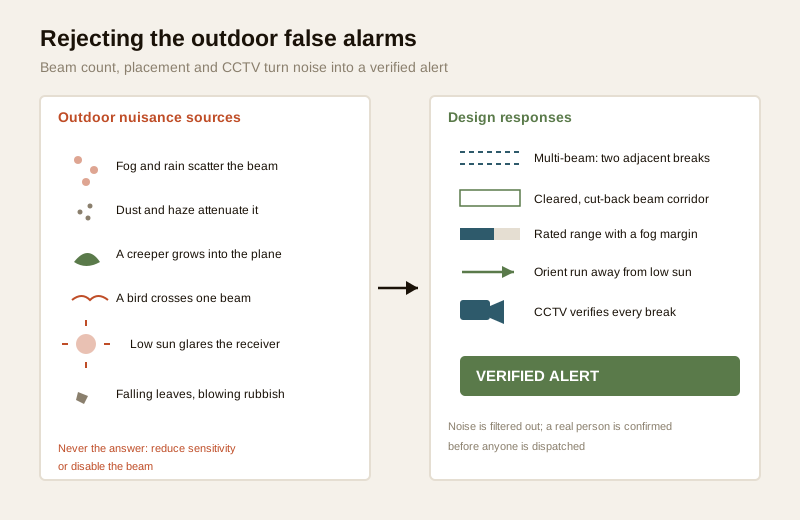
Indoors, a beam lives in still, clean air. On a boundary it lives in weather and wildlife, and every perimeter beam owner learns the same lesson: the outdoors is a noisy place, and a beam that cries wolf gets switched off. The defensive answer is never "make it less sensitive" or disable it — it is to choose the right configuration, place it well, and verify every break with a camera before anyone is dispatched. The honest nuisance sources on an Indian perimeter:
| False-alarm source | Why it trips a beam | Design response (never "reduce sensitivity") |
|---|---|---|
| Fog, heavy rain, monsoon | Water droplets scatter and attenuate the infrared, weakening the received signal | Specify a model with rated outdoor range well above the run; keep a fog margin; use fog-tolerant designs; verify with CCTV before dispatch |
| Dust, haze, smoke | Airborne particles attenuate the beam like light fog | Same margin approach; clean tower windows on a maintenance schedule |
| Foliage growth | A creeper or branch grows into the beam plane over a season and blocks it | Keep the beam corridor cleared; survey the run after monsoon growth; site towers clear of planting |
| Birds and small animals | A bird landing, or an animal crossing a single low beam, reads like a body | Use multi-beam towers with adjacent-beam AND logic so one broken beam is ignored |
| Sun glare / low sun | Direct low sun into the receiver can swamp the sensor | Orient the run so the receiver never faces low morning/evening sun; shade the head |
| Falling leaves, blowing rubbish | Debris crossing a single beam | Multi-beam AND logic; site clear of dumping and litter-catching corners |
The through-line: beam count, height and orientation are the design levers, and CCTV verification is the safety net. A single low beam facing the sunrise through the monsoon is a nuisance generator; a well-oriented multi-beam tower with a fog margin, cross-checked by a camera, is a dependable perimeter tripwire. None of this is about weakening detection — it is about making the beam better at telling a person from a pigeon.
Detect, verify, respond: the chain that makes a beam worth anything
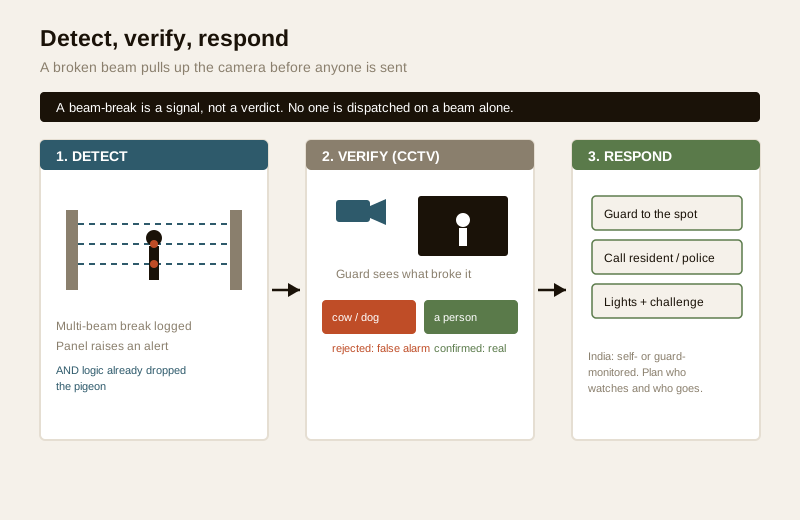
A perimeter beam is a detector, not a decider. On its own it produces one bit of information — the beam is broken — and that bit is meaningless until a human interprets it. The whole value of a perimeter beam lives in a three-link chain, and if any link is missing the beam is theatre:
1. Detect. The beam breaks; the panel logs the zone and the time and raises an alert (siren, app, control-room annunciator). Multi-beam AND logic here has already filtered out the pigeon.
2. Verify. The alarm automatically pulls up the perimeter CCTV camera covering that beam zone so a guard, owner or monitoring operator can see what broke the beam — a person climbing, or a cow leaning on the wall. This is the single best cure for false-alarm fatigue: no one is dispatched on a beam-break alone. For camera coverage that lines up with each beam zone, see CCTV camera placement and outdoor CCTV.
3. Respond. If verification confirms a genuine intruder, the response follows — guard to the spot, call to the resident or police, lights and voice challenge. In India this is overwhelmingly self- or guard-monitored (there is no automatic police dispatch to rely on), so plan who actually watches and who actually goes, and put any professional monitoring contract in writing.
Design the beam so a break in each zone maps to a specific camera view, so verification takes seconds not minutes. A beam without this chain is worse than nothing: it either gets ignored (alarm fatigue) or it sends a guard chasing a stray dog at 2 a.m. until everyone stops responding.
Where beams fit, and where they do not
Beams are one instrument in the perimeter ensemble, and specifying them well means being honest about their limits.
- Beams excel on long straight walls and fences, across clean gaps, and over wall-tops — anywhere there is an unobstructed line-of-sight run and you want a precise, low-cost-per-metre tripwire. They give a clean detection plane and, as multi-beam towers, strong nuisance rejection.
- Fence-mounted detection fits better where the boundary is a fence you can instrument directly, or where the line curves and bends — fence vibration sensors read the shake, cut and climb of the fence itself and do not need a straight optical shot.
- Video analytics fits better where you need to see as well as detect, or where the geometry is complex — perimeter CCTV with line-crossing and intrusion-zone rules, and for range and darkness, thermal cameras. Beams and cameras are partners, not rivals: the beam detects, the camera verifies.
- Gate and access points need their own treatment — gate security and boom barriers handle the way people are meant to come in, while the beam watches the ways they are not.
Most real perimeters are a mix: multi-beam towers on the long straight walls, fence sensors on the curved or fenced stretches, cameras verifying every zone, all reporting to one panel. Assess your own boundary with the site perimeter security assessment and the home security risk scorecard, and see how it fits a whole property in the perimeter security pillar and the security sub-hub.
False alarms, neighbourliness & when to bring in a professional. You can plan the layout — which runs get beams, single versus multi-beam, beam-over-wall versus free-standing — and you can decide how each beam zone maps to a camera for verification. Hand the rest to specialists: mounting towers and any mains power (a licensed electrician — see the electrical hub); precise optical alignment on rigid mountings with a post-monsoon re-check; and a site survey of run lengths, sun orientation, planting and fog exposure before you buy. Two neighbourly notes: any camera that verifies a beam and overlooks a public road or a neighbour's property brings the DPDP Act 2023 privacy duties, so aim and mask views; and a beam with no one to verify or respond is just a boundary-side annoyance — decide the monitoring and response plan before the hardware. For a society or campus, treat the perimeter as a shared project with a written spec and a maintenance schedule.
Key takeaways
- A perimeter beam sensor is an invisible trip-line, not a barrier — a transmitter and receiver project a beam across a boundary run, gap or wall-top, and breaking it raises an alarm; the wall delays, the beam detects. The mechanics live in the beam sensors guide; this is the outdoor boundary application.
- Multi-beam towers are the perimeter workhorse. A stacked vertical wall of beams with adjacent-beam AND logic rejects birds and small animals a single beam trips on, and leaves no gap to crawl under or step over — reserve single beams for short controlled gaps.
- Range and alignment make or break it. Never span to the datasheet maximum; specify a rated outdoor range with a fog margin, and align on rigid mountings with a post-monsoon re-check, because a mis-aligned beam is the number-one reason perimeter beams get switched off.
- The outdoors is noisy — fog, rain, dust, foliage growth, birds and sun glare all attenuate or cross a beam. Answer with beam count, height and orientation plus CCTV verification, never by weakening detection or disabling the beam.
- Detect, verify, respond is the whole point. A broken beam must pull up the covering perimeter CCTV so a human confirms a person before anyone is dispatched; India is self- or guard-monitored, so plan who watches and who goes — an unverified, unanswered beam saves no one.
References
- The applicable BIS / IEC / EN intrusion-detection and active-infrared/photoelectric detector standard — verify the current designation, rated outdoor detection range, environmental (fog/temperature) classification and IP housing rating on the manufacturer's datasheet and against the standard before specifying; check the current edition via the BIS catalogue: https://www.services.bis.gov.in/
- Digital Personal Data Protection Act, 2023 — any CCTV that verifies a beam and overlooks a public road, neighbouring property or shared area captures personal data; aim, mask and store footage responsibly and agree any monitoring/response and data-handling terms in writing with a reputable provider.
- National Building Code of India (SP 7), Bureau of Indian Standards, and local municipal bye-laws for the electrical, mounting and boundary aspects of an outdoor install, plus any local light-nuisance considerations where beam zones are paired with security lighting; verify the current edition via the BIS catalogue: https://www.services.bis.gov.in/
This is educational planning guidance, not legal advice. It is strictly about detecting an intruder at the boundary, never about defeating detection. Mounting at height, mains-connected power, and optical beam alignment are qualified professional tasks — engage licensed electricians and specialist installers, and verify any standard's current status via the BIS catalogue before relying on it.
Export this guide
Related Guides — Deep-dive reading
Beam Sensors in India (2026): Active-Infrared Perimeter Detection for Gates, Walls and Farmhouse Boundaries
How active-infrared beam sensors work, where they earn their place on Indian plots, single-beam versus multi-beam towers, and how to tame the outdoor false-alarm problem with sound design.
SecurityPerimeter CCTV in India (2026): Watching the Boundary and Verifying the Alarm
How cameras earn their place on the perimeter — watching along the fence and wall line, and letting a human confirm a real intruder before response — designed for Indian darkness, weather and neighbour privacy.
SecurityPerimeter Alarm Systems in India (2026): Detect an Intruder at the Boundary
How an outer detection layer — outdoor motion sensors, beam barriers, fence and wall-top sensors and gate contacts — warns you the moment someone crosses your compound wall, and how to design it for Indian weather without endless false alarms.
SecurityRelated Tools — Try Free
Home Security Risk Scorecard
Score your home across six security layers — perimeter, entry points, lighting, detection, alarm and habits — and get a prioritised action plan.
Security ScorecardCCTV Camera Coverage & Count Calculator
Estimate how many CCTV cameras you need, the NVR channels, storage in TB for your retention period, and an indicative all-in cost with GST.
CCTV CalculatorAccess-Control Schedule Generator
Build the time schedules that decide when each access group can enter — an editable list for your integrator.
Time Schedules