
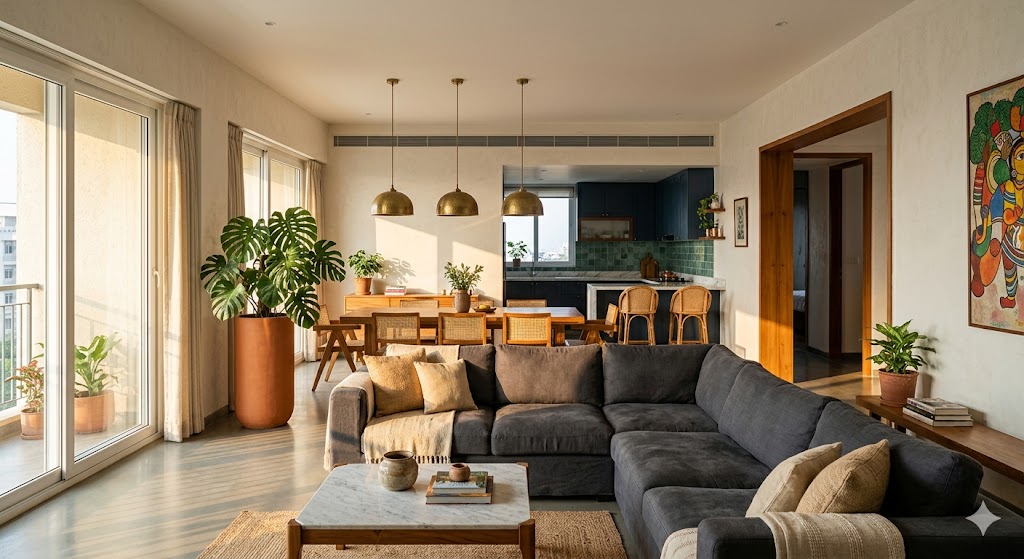
3BHK House Design — Complete Guide for India
Layouts, Bedroom Hierarchy, Living-Dining-Kitchen Configurations, Bath Counts, Vastu, Costs & Checklist
The 3BHK is India's middle-class default. It is the format the salaried professional aspires to after the starter 2BHK, the format builders advertise as the "family home", and the format that absorbs a household through the highest-pressure years of family life — children growing through schooling, aged parents needing room, work-from-home transforming into a fixture, hobbies needing dedicated space, and guests visiting from out of town. A well-designed 3BHK serves a family for fifteen to twenty-five years; a poorly designed one becomes a renovation argument by year seven.
This guide is for the homeowner — buyer, builder, or self-builder — about to commit to a 3BHK. It covers the four canonical layouts (apartment, independent house, wide-frontage, duplex), the bedroom hierarchy that separates a well-designed 3BHK from an undifferentiated one, the four living-dining-kitchen configurations and which matches your household, the bath-count decision tree (2 vs 2+powder vs 3+powder), the Vastu reference layout that 65% of buyers will validate against, the should-you-even-buy-3BHK decision matrix, working dimensions for every room, 2026 costing bands across three tiers and six cities, six common mistakes, and the pre-construction checklist that catches them.
A 3BHK is not three bedrooms of similar size — it is a hierarchy of three rooms, each with a distinct role in the household's emotional and spatial logic.
Should You Even Buy / Build a 3BHK?
Before any layout decision, the threshold question: is a 3BHK the right format for your household at all? The honest analysis:
| Household Profile | 2BHK | 3BHK | 4BHK |
|---|---|---|---|
| Single / couple, no kids | ✓ Right | ↑ Wasteful | ✗ Overscale |
| Couple + 1 child | ✓ Right | ↑ Generous | ✗ Wasteful |
| Couple + 2 children | ↓ Cramped | ✓ Right | ↑ Generous |
| Couple + parent + 1 child | ↓ Tight | ✓ Right | ✓ Comfortable |
| Joint family (5-6 persons) | ✗ Inadequate | ↓ Tight | ✓ Right |
| Work-from-home + family | ↓ Tight | ✓ Right (3rd BR = study) | ✓ Comfortable |
| Frequent overnight guests | ↓ Tight | ✓ Right (3rd BR = guest) | ✓ Comfortable |
The honest 3BHK signal is a household that has — or expects within 5 years — at least one of: (a) two or more children, (b) a permanent third resident (parent / sibling), (c) a dedicated work-from-home requirement that cannot share a bedroom, or (d) regular guest visits that justify a permanent guest room. Without any of these, a generously-sized 2BHK is usually a better investment per usable rupee than an entry-level 3BHK.
Four Typical 3BHK Layouts
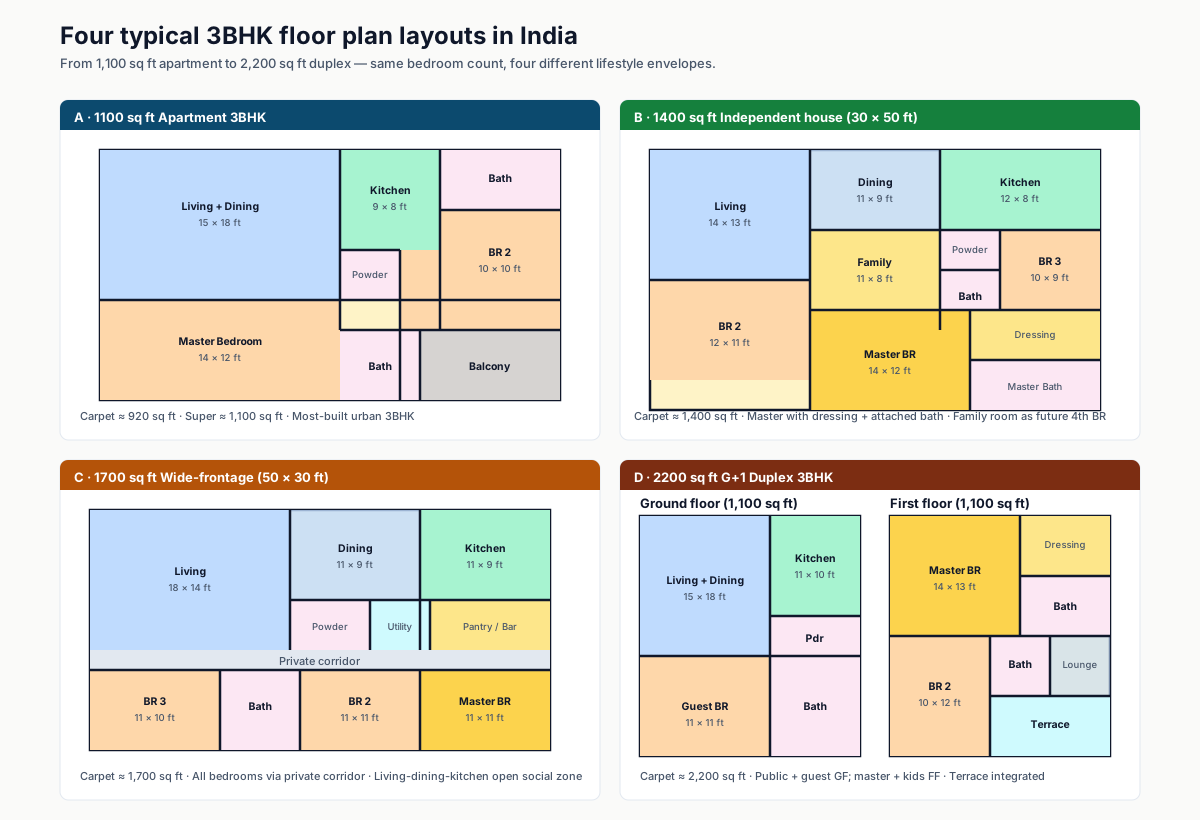
Indian 3BHK construction clusters into four canonical layouts. The figure above draws all four at the same scale.
Layout A — 1,100 sq ft Apartment 3BHK
The most-built urban 3BHK. Combined living-dining (15 × 18 ft), single kitchen (9 × 8 ft), three bedrooms — master with attached bath, BR2 and BR3 sharing a common bath, with a powder room near the entry. Balcony off the living.
Carpet ≈ 920 sq ft. Super ≈ 1,100 sq ft. Suits a family of 3-4 with one frequent guest. The default Tier-1 apartment 3BHK.
Layout B — 1,400 sq ft Independent House 3BHK (30 × 50 ft)
The independent-house equivalent. Separate living, dining, and family / study room — the fourth functional space that elevates the format beyond apartment 3BHK. Master with attached bath and dressing, BR2 and BR3 sharing a common bath, plus a powder room. The family room often doubles as a study and can be converted into a fourth bedroom later.
Carpet ≈ 1,400 sq ft. Suits a family of 4-5 with work-from-home needs. Allows G+1 expansion.
Layout C — 1,700 sq ft Wide-Frontage 3BHK (50 × 30 ft)
The 50 × 30 ft plot — wider than deep — produces the best 3BHK plan in the Indian repertoire. Public zone (living, dining, kitchen) takes the front half; a private corridor separates it from the bedroom zone running across the rear. All three bedrooms access via the corridor, master gets the corner with attached bath, BR2 and BR3 share a common bath between them.
Carpet ≈ 1,700 sq ft. Suits a family of 5-6 with multi-generational composition. Every habitable room gets two external walls.
Layout D — 2,200 sq ft G+1 Duplex 3BHK
The premium end. Ground floor holds public functions plus a guest bedroom with attached bath; first floor holds the master suite with dressing and bath plus two secondary bedrooms (children's), a family lounge, and a roof terrace. Single staircase connecting them.
Carpet ≈ 2,200 sq ft. Suits a joint family or family of 5-7. Common in 30 × 40 ft plot development under FAR 1.75.
Bedroom Hierarchy — Three Rooms, Three Roles
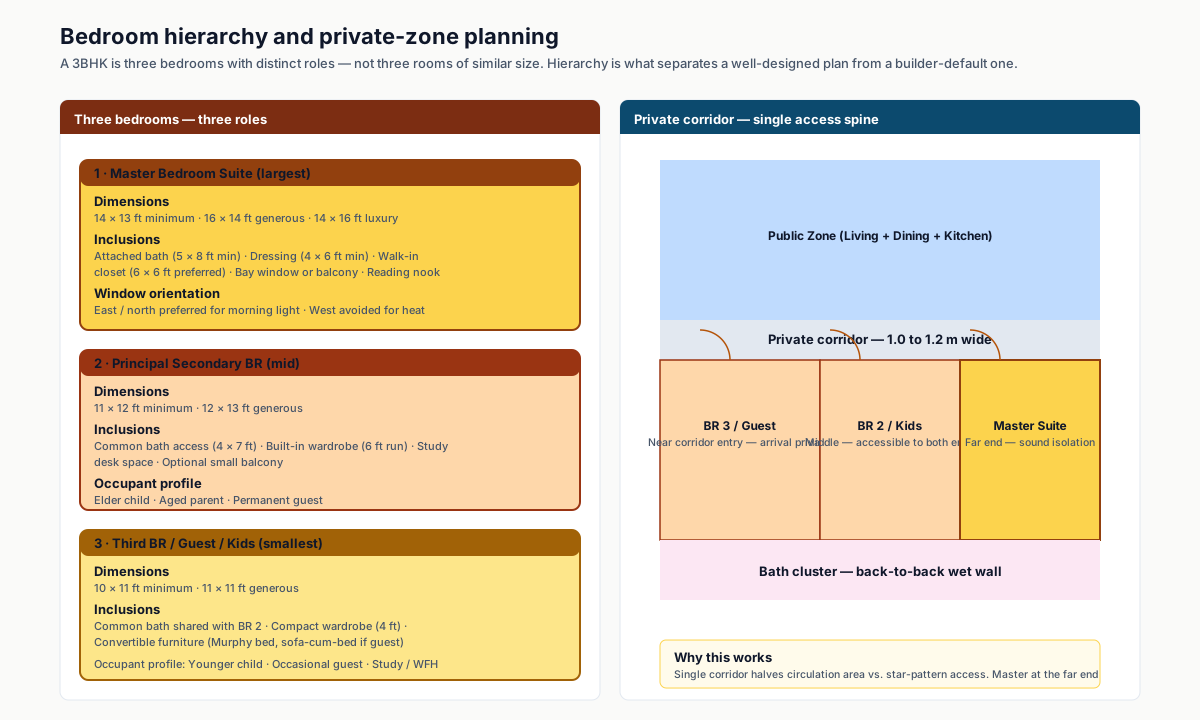
A well-designed 3BHK treats its three bedrooms as a hierarchy of three distinct rooms with distinct roles, not three rectangles of similar size. The figure above documents the hierarchy.
Bedroom 1 — Master Suite (Largest)
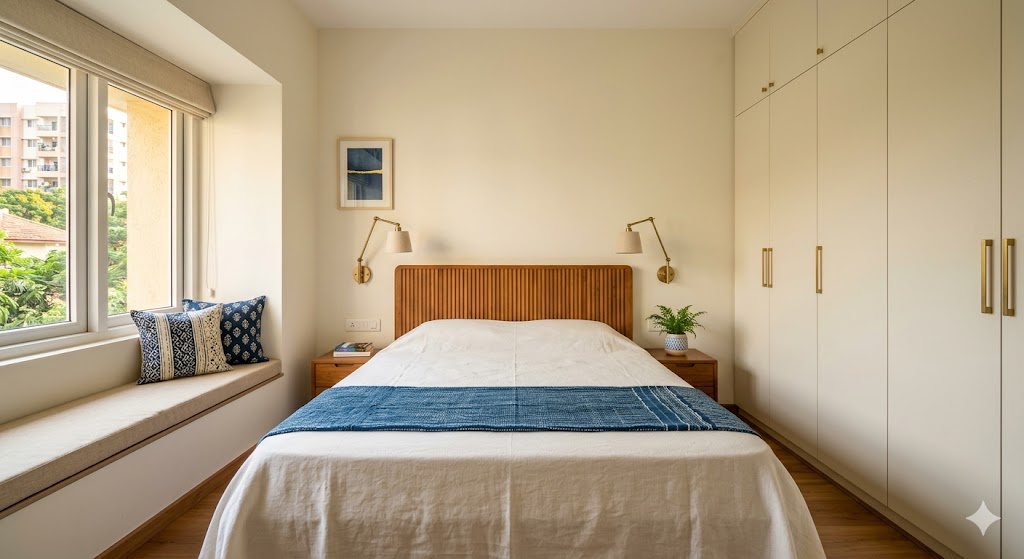
The household's primary sleep + dressing + private retreat space. The discipline:
| Element | Minimum | Generous | Luxury |
|---|---|---|---|
| Bedroom floor area | 14 × 13 ft (180 sq ft) | 16 × 14 ft (225 sq ft) | 14 × 16 ft (225+) |
| Attached bath | 5 × 8 ft | 7 × 9 ft | 8 × 12 ft |
| Dressing / closet | 4 × 6 ft | 6 × 8 ft (walk-in) | 8 × 10 ft (walk-in + island) |
| Window orientation | East / north | East + north | E + N + private balcony |
The master should have at least two external walls for cross-ventilation, an east-facing window for morning light (avoiding west for heat), and a direct sightline from bed to window for waking ergonomics. The dressing should be inside the suite — accessible without crossing the bedroom proper — to allow one partner to dress without disturbing the other.
Bedroom 2 — Principal Secondary
The household's principal secondary sleep space. Typical occupant: an elder child entering adolescence, an aged parent who needs proximity to the master, or a permanent guest.
- Floor area: 11 × 12 ft (132 sq ft) minimum
- Bath access: Common bath shared with BR3 — never inside BR2
- Wardrobe: 6-foot built-in wardrobe run minimum
- Study desk space: 4 × 2 ft minimum at the window
- Optional small balcony if the layout permits
Bedroom 3 — Third / Guest / Kids' (Smallest)
The household's most-flexible room. Typical occupants by life stage: younger child (until 11-13), occasional guest, work-from-home study (during peak WFH years), nursery if family grows.
- Floor area: 10 × 11 ft (110 sq ft) minimum
- Convertible furniture: Murphy wall bed or sofa-cum-bed if guest use is occasional rather than permanent
- Compact wardrobe: 4-foot run sufficient
- Bath access: Shared common bath with BR2
Private Corridor — The Spine
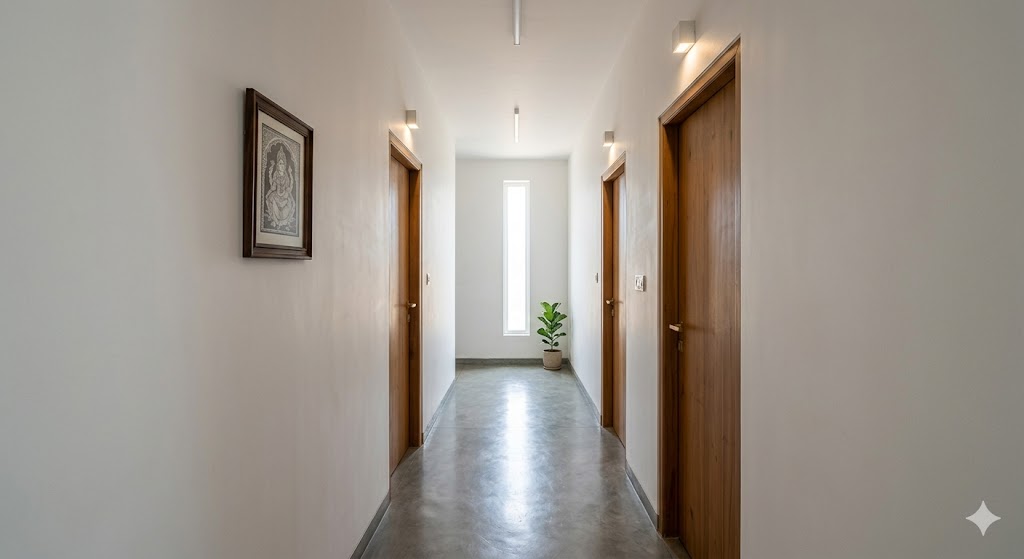
All three bedrooms should access via a single private corridor, not as star-pattern access from the public zone. The corridor:
- Width 1.0 - 1.2 m
- Lit by daylight from at least one end (ideally a window at the corridor terminus)
- Master at the far end for sound isolation
- BR2 in the middle, accessible to both BR3 and master
- BR3 near the corridor entry for arrival privacy
- Common bath cluster between BR2 and BR3 with back-to-back wet wall
Living, Dining, Kitchen — Four Configurations
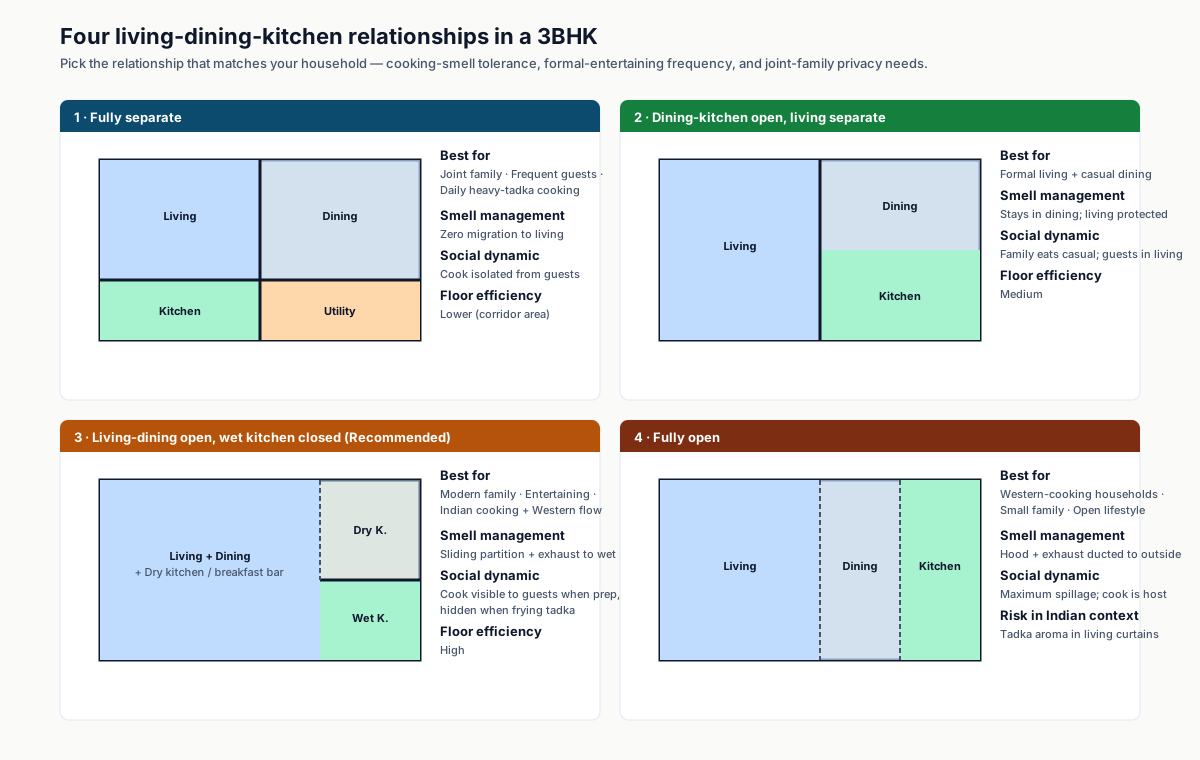
The single biggest decision after bedroom hierarchy is how to relate living, dining, and kitchen. Four canonical configurations cover the space.
Configuration 1 — Fully Separate
Walls between living, dining, and kitchen. The traditional joint-family Indian plan. Best for households with frequent guests, heavy daily cooking, and multi-generational privacy needs. Zero smell migration but lowest floor efficiency.
Configuration 2 — Dining-Kitchen Open, Living Separate
Living preserved as a formal volume; dining opens directly to the kitchen for casual family meals. Smell stays in the dining zone; the living is protected. Common in upper-middle-class 3BHKs in Bengaluru and Chennai.
Configuration 3 — Living-Dining Open, Wet Kitchen Closed (Recommended)
The modern Indian compromise — living, dining, and dry kitchen / breakfast bar as one open volume; wet kitchen behind a sliding partition with ducted exhaust. Best of both worlds: open flow for daily life, closed wet kitchen when frying tadka or guests arrive. The configuration most professional architects recommend in 2026.
Configuration 4 — Fully Open
Living, dining, and kitchen as a single volume with only partial dividers. The Pinterest open plan. Suits Western-cooking households (sandwiches, salads, light pan-frying) but risks tadka aroma in living curtains for Indian-cooking households.
Bath Count — Decision Tree
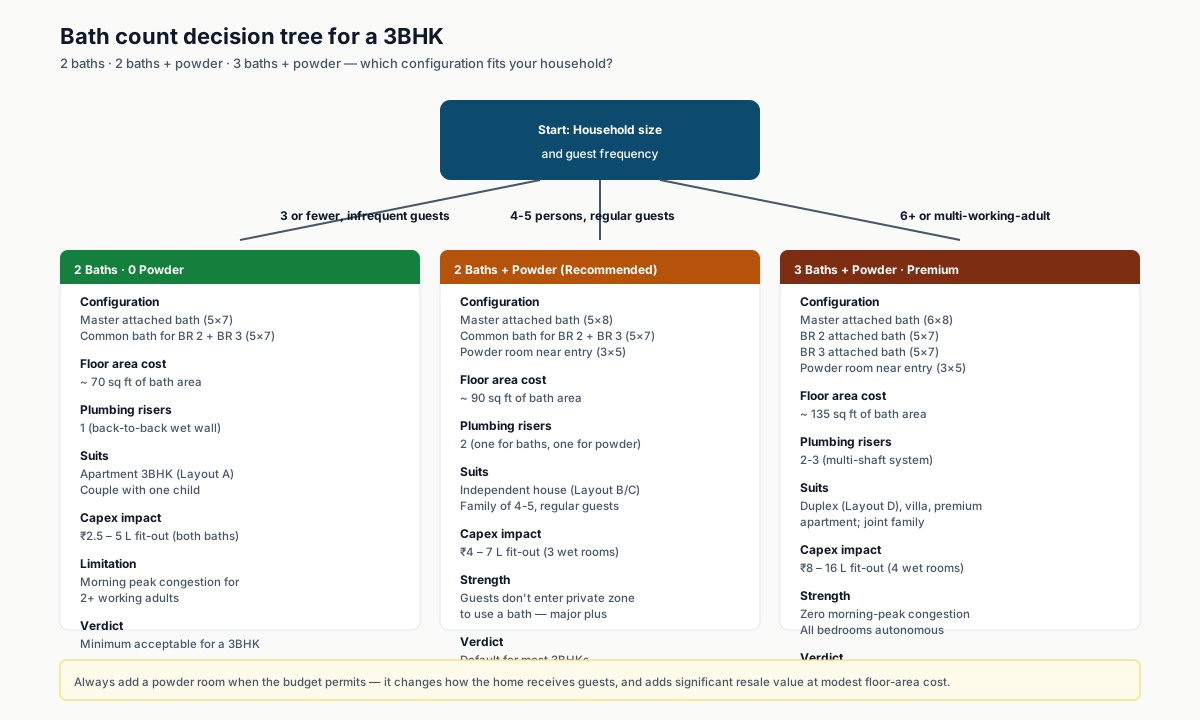
The bath-count question is the second most-asked planning question after bedroom sizing. Three outcomes are defensible; the figure above walks through the decision.
Option A — 2 Baths (No Powder)
Master attached bath + common bath for BR2 + BR3. The minimum acceptable 3BHK configuration. Suits apartment 3BHKs (Layout A) and small families. Plumbing simplest (1 riser, back-to-back wet wall). Limitation: morning peak congestion for 2+ working adults.
Option B — 2 Baths + Powder Room (Recommended Default)
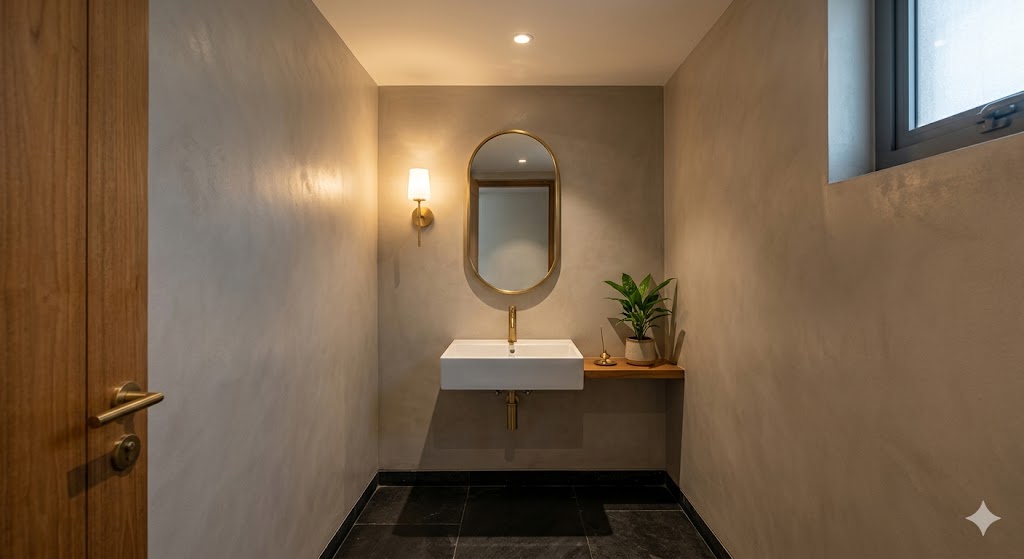
Same two baths + a powder room (WC + sink, 3 × 5 ft minimum) near the entry. The default recommendation for most 3BHKs. The powder room serves guests and daily visitors without entering the private zone — a significant social and security benefit. 2 plumbing risers, 3 wet rooms.
Option C — 3 Baths + Powder (Premium)
All three bedrooms with attached bath + powder near entry. The premium configuration. Suits joint families, large households, multi-working-adult families, and resale-positive premium properties. Eliminates morning congestion entirely. 2-3 plumbing risers, 4 wet rooms, higher capex (₹8-16 L fit-out vs ₹4-7 L for Option B).
The Powder Room Is Worth It
A consistent finding across architect practice: homeowners who skipped the powder room in their 3BHK regret it within 2-3 years. The retrofit is expensive (a new plumbing riser is the most expensive thing to add post-construction). Always add a powder room when the floor area and budget permit. Resale value uplift is real and measurable.
Vastu-Compliant 3BHK Reference
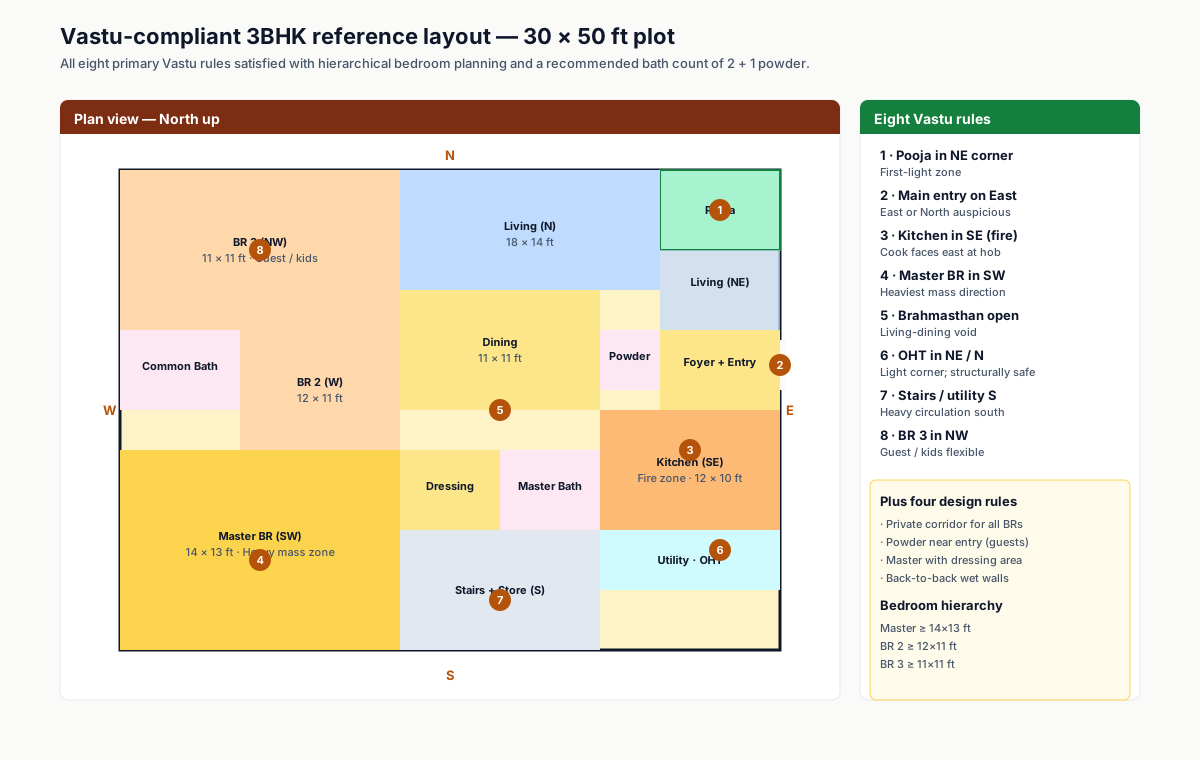
The reference layout above satisfies the eight primary Vastu rules on a 30 × 50 ft plot, with the bedroom hierarchy and corridor planning from the previous sections. It is the layout most professional architects produce when given a Vastu-compliant 3BHK brief.
The Eight Rules in This Reference
1. Pooja in the northeast corner — first-light corner
2. Main entry on the east face — east or north both acceptable
3. Kitchen in the southeast (fire zone) — cook faces east at hob
4. Master bedroom in the southwest — heaviest mass direction
5. Brahmasthan kept open — continuous living-dining volume
6. Overhead water tank in northeast — light corner; structurally safe
7. Stairs / utility in the south — heavy circulation away from main rooms
8. Third bedroom in northwest — guest / kids flexible zone
Plus Four Design Rules This Reference Honours
- Private corridor for all three bedrooms
- Powder room near the entry for guest privacy
- Master suite with dressing between bedroom and bath
- Back-to-back wet wall between common bath and master bath plumbing
See Vastu Shastra for Modern Homes for the complete treatment.
Room-by-Room Working Dimensions
| Room | Minimum | Comfortable | Generous |
|---|---|---|---|
| Master bedroom | 14 × 13 ft (182 sq ft) | 15 × 14 ft (210 sq ft) | 16 × 15 ft (240 sq ft) |
| Master attached bath | 5 × 8 ft (40 sq ft) | 6 × 9 ft (54 sq ft) | 7 × 10 ft (70 sq ft) |
| Master dressing | 4 × 6 ft (24 sq ft) | 6 × 8 ft (48 sq ft) | 8 × 10 ft walk-in (80 sq ft) |
| Bedroom 2 | 11 × 12 ft (132 sq ft) | 12 × 13 ft (156 sq ft) | 13 × 14 ft (182 sq ft) |
| Bedroom 3 | 10 × 11 ft (110 sq ft) | 11 × 12 ft (132 sq ft) | 12 × 12 ft (144 sq ft) |
| Common bath | 5 × 7 ft (35 sq ft) | 6 × 7 ft (42 sq ft) | 6 × 8 ft (48 sq ft) |
| Powder room | 3 × 5 ft (15 sq ft) | 4 × 5 ft (20 sq ft) | 4 × 5 ft + storage |
| Living | 14 × 15 ft (210 sq ft) | 16 × 17 ft (272 sq ft) | 18 × 20 ft (360 sq ft) |
| Dining (6-seater) | 10 × 11 ft (110 sq ft) | 11 × 12 ft (132 sq ft) | 12 × 14 ft (168 sq ft) |
| Kitchen | 9 × 9 ft (81 sq ft) | 11 × 10 ft (110 sq ft) | 12 × 12 ft (144 sq ft) |
| Family / Study | 10 × 11 ft (110 sq ft) | 12 × 12 ft (144 sq ft) | 14 × 12 ft (168 sq ft) |
| Utility | 5 × 6 ft (30 sq ft) | 6 × 7 ft (42 sq ft) | 6 × 8 ft (48 sq ft) |
| Foyer / Entry | 5 × 5 ft (25 sq ft) | 5 × 7 ft (35 sq ft) | 6 × 8 ft (48 sq ft) |
Total carpet — adding the "comfortable" column across — comes to approximately 1,500 sq ft, which corresponds to the Layout B / C range. Apartment 3BHKs (Layout A) typically operate at the "minimum" column.
See Space Planning Principles for Indian Homes.
Costing — 2026 Indicative Bands
Tier 1 — Standard Build (₹1,900 – 2,500 / sq ft built-up)
- Vitrified tile flooring (mid-grade)
- Cement plaster + exterior emulsion
- Aluminium fenestration (Indian brand)
- Mid-grade flush doors
- 2 baths fitted at ₹70 K each + powder ₹40 K
- Modular kitchen ₹4 - 7 L
- For 1,400 sq ft: total ₹27 - 36 L; for 2,200 sq ft: ₹42 - 55 L
Tier 2 — Mid Build (₹3,000 – 4,200 / sq ft built-up)
- IPS / Kota stone flooring + accent stone in baths
- Texture finish + premium exterior paint
- Premium anodised aluminium fenestration
- FSC teak doors
- 2-3 baths fitted at ₹1.2 - 1.8 L each + powder ₹70 K
- Modular kitchen ₹7 - 12 L
- 3-5 kWp solar + RWH + greywater
- Smart-switch backbone, Cat-6, EV-charging conduit
- For 1,400 sq ft: total ₹42 - 59 L; for 2,200 sq ft: ₹66 - 92 L
Tier 3 — Premium Build (₹4,500 – 6,500 / sq ft built-up)
- IPS + Italian / book-matched natural stone
- Imported aluminium / steel-thermal-break fenestration
- Solid teak / oak joinery throughout
- 3 baths fitted at ₹2.5 - 4 L each + powder ₹1.2 L
- Modular kitchen ₹12 - 20 L
- Full smart-home (Lutron / KNX), 5-10 kWp solar + battery
- Architectural lighting design
- For 1,400 sq ft: total ₹63 - 91 L; for 2,200 sq ft: ₹99 - 143 L
Cost-per-sq-ft Across Cities
| City | Tier-1 | Tier-2 | Tier-3 |
|---|---|---|---|
| Mumbai | ₹2,300 – 2,900 | ₹3,400 – 4,600 | ₹5,200 – 7,800 |
| Bengaluru | ₹2,000 – 2,600 | ₹3,100 – 4,200 | ₹4,800 – 7,000 |
| Delhi NCR | ₹2,100 – 2,700 | ₹3,200 – 4,400 | ₹4,900 – 7,200 |
| Chennai | ₹1,950 – 2,500 | ₹3,000 – 4,000 | ₹4,600 – 6,600 |
| Hyderabad | ₹1,900 – 2,500 | ₹2,900 – 3,900 | ₹4,500 – 6,500 |
| Pune | ₹1,950 – 2,550 | ₹3,000 – 4,000 | ₹4,700 – 6,800 |
Excludes land, statutory deposits, external development charges, sanction fees, architect fees. See Architect Fee Structures and Home Loan Affordability.
Six Common Mistakes in 3BHK Design
Mistake 1 — Three Bedrooms of Similar Size
The builder default: three bedrooms of 11 × 12 ft, no hierarchy. Fix: explicit hierarchy per the working dimensions table above. Master should be at least 50 sq ft larger than BR3.
Mistake 2 — No Powder Room
Floor-plan optimisation removed the powder room to add a few square feet to the second bedroom. Fix: always include a 3 × 5 ft powder room near the entry. Resale-positive and quality-of-life-positive.
Mistake 3 — Master Without Dressing Area
A master bedroom with a single 6-foot wardrobe and no dressing area. The couple loses any dignified clothes-storage and changing routine. Fix: dedicated 4 × 6 ft minimum dressing alcove between bedroom and bath.
Mistake 4 — Kitchen on the Wrong Side
Kitchen on the west or north — heat exposure and Vastu non-compliance simultaneously. Fix: southeast (per Vastu and per cooking-heat logic) or south.
Mistake 5 — Family Room as Afterthought
A "family room" carved from leftover floor area, with no daylight access and no clear function. Fix: family room designed as convertible bedroom — minimum 11 × 12 ft, with at least one external wall and a window, so it can become a fourth bedroom if family expands.
Mistake 6 — Star-Pattern Bedroom Access
All three bedrooms accessed directly from the living room or a central hall. Fix: single private corridor accessing all three bedrooms, separating the bedroom zone from the public living area.
Pre-Construction Checklist for 3BHK Homeowners
- [ ] Household composition analysed — is 3BHK truly right, vs 2BHK or 4BHK?
- [ ] 5-year household projection — children growing, parents joining, work-from-home?
- [ ] RERA registration verified (if buying apartment)
- [ ] Carpet area in writing — not super built-up
- [ ] Layout selected — Apartment / Independent / Wide-frontage / Duplex
- [ ] Bedroom hierarchy designed — Master ≥ 14×13, BR2 ≥ 11×12, BR3 ≥ 10×11
- [ ] Master suite includes dressing between bedroom and bath
- [ ] Living-dining-kitchen configuration selected matching household cooking + entertaining style
- [ ] Bath count decided — 2, 2+powder, or 3+powder
- [ ] Private corridor designed for bedroom zone
- [ ] Back-to-back wet walls verified for both bath clusters
- [ ] Vastu position taken — strict / consultative / cosmetic
- [ ] Powder room near entry (strongly recommended)
- [ ] Family / study room designed as convertible bedroom
- [ ] Cross-ventilation path verified for every habitable room
- [ ] Storage budget allocated — 8-10% of floor plate
- [ ] Furniture plan locked before joinery fabrication
- [ ] Smart-home scope frozen — what's in, what's out, what's conduit-only
- [ ] Solar / RWH / greywater designed in if sustainability is a goal
- [ ] Architect engaged with documented 3BHK portfolio
Cross-Links — Going Deeper
Planning fundamentals
- Functional House Layout Planning
- Space Planning Principles for Indian Homes
- Space Zoning in Indian Homes
- 2BHK House Plan — the smaller-format companion guide
Design pillars
- Modern House Design in India
- Indian House Front Elevation Design
- Vastu Shastra for Modern Homes
- Pooja Room Design
- Defining Luxury Residential Architecture
- Universal Design & Adaptable Homes
Room-specific
- Modular Kitchen Design Guide
- Storage Planning
- Wardrobe Finish Ideas
- False Ceiling Design Guide
- Staircase Design
Climate and orientation
- Designing for the Indian Climate
- Cross Ventilation in Indian Homes
- Natural Light Planning for Indian Homes
- Daylighting Indian Homes and Buildings
Money and process
- Complete Guide to Building a House in India
- RERA Guide for Homebuyers & Architects
- Home Loan Affordability in India — 2026 Guide
- Architect Fee Structures in India
- How to Choose the Right Architect or Interior Designer
- Building Plan Approval Process in India
Compliance
- Architect Compliance Map — Bengaluru
- Architect Compliance Map — Mumbai
- Building Setbacks Across India
- FSI / FAR Computation
References
1. Government of India (2017). Real Estate (Regulation and Development) Act, 2016. Ministry of Housing and Urban Affairs.
2. Bureau of Indian Standards (2016). National Building Code of India 2016, Parts 3, 4, 8, 11. New Delhi: BIS.
3. Bureau of Indian Standards (1980). IS 8888 — Guide for Requirements of Low Income Housing. New Delhi: BIS.
4. National Institute of Design (1997). Indian Anthropometric Data for Ergonomic Design Practice. Ahmedabad: NID.
5. Bureau of Energy Efficiency (2018). Eco-Niwas Samhita. New Delhi: Government of India.
6. Census of India (2011). Houses, Household Amenities and Assets — Tabulations. New Delhi: Office of the Registrar General.
7. Krishan, A., Baker, N., Yannas, S. & Szokolay, S.V. (2001). Climate Responsive Architecture. New Delhi: Tata McGraw-Hill.
8. CIDC (2024). Construction Cost Index — Urban India. New Delhi: Construction Industry Development Council.
9. NAREDCO (2024). India Real Estate Affordability Index. New Delhi: National Real Estate Development Council.
10. Vastu Shastra mainstream consensus. Manasara, Mayamatam, Samarangana Sutradhara.
Author's note: A 3BHK is one of the most-architecturally-significant rooms-count categories in Indian residential design because it is the one most households will live in for the longest stretch of their adult lives. The hierarchy thinking in this guide — three rooms with three distinct roles, three configurations for the social heart, three bath-count options — is not stylistic preference; it is a working framework for converting "I want a 3BHK" into "I want this 3BHK, planned this way, for these people, for the next twenty years." The framework will not produce a remarkable building on its own. But it will keep the family that lives in the building from arguing about it during the worst years — which is, in the end, what good residential architecture is asked to do.
Disclaimer: Working dimensions are based on Indian anthropometric data and 2026 furniture market standards; verify against specific furniture sizes before locking dimensions. Cost bands are 2026 indicative for Tier-1 and Tier-2 Indian cities and exclude land, statutory deposits, external development charges, and architect fees. Vastu prescriptions reflect mainstream practitioner consensus across regional schools; individual practitioners vary. RERA implementation varies by state authority. Studio Matrx, its authors, and contributors accept no liability for decisions made on the basis of this guide; engage a licensed architect and competent contractor for site-specific design and execution.
Export this guide
Related Guides — Deep-dive reading
Space-Efficient Homes — A 2026 Working Reference for Compact Indian Apartments
Five spatial multipliers · Floor plan tricks · Dual-purpose furniture
Room PlanningHow to Plan a Home for Multi-Generational Living
Designing for grandparents, parents and children under one roof — privacy, accessibility and harmony
Home PlanningEast-Facing House Plan — Complete Guide for India
Vastu Logic, Sun-Path, Room-Direction Matrix & Reference Plans for the Most-Asked Orientation in Indian Homes
Room PlanningRelated Tools — Try Free
Cross-Ventilation Analyzer
Estimate airflow and air changes per hour (ACH) from room size, window areas, layout, and local wind — with NBC 2016 Part 8 compliance check.
Ventilation CalculatorApartment Interior Planning Checklist
51-item checklist across structural, ceiling, lighting, furniture, storage, electrical, kitchen, bathroom.
ChecklistRainwater Tank Sizer
How big should your rainwater tank be? Computes annual harvest, recommended tank capacity in litres, water-bill savings, and payback — for 10 Indian cities.
RWH Calculator