
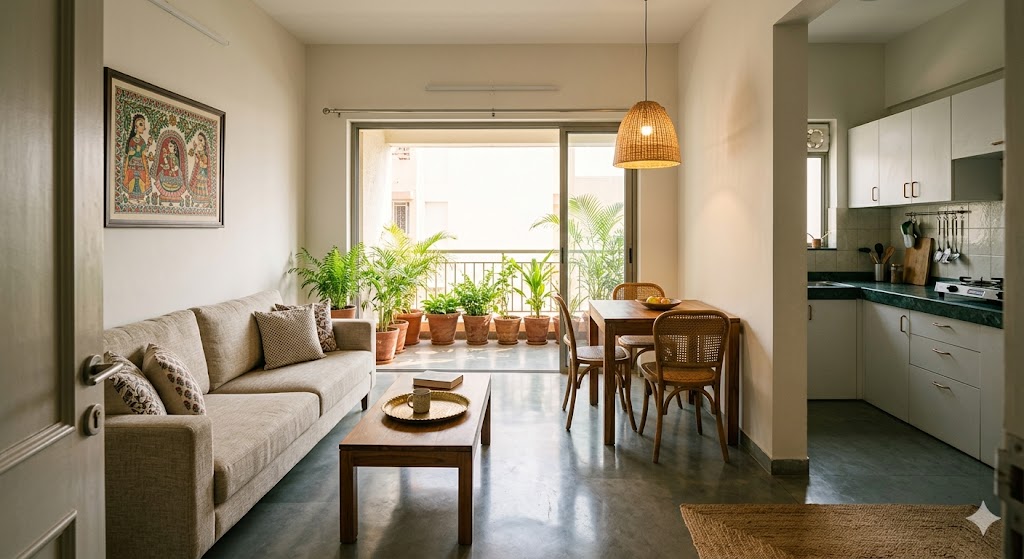
2BHK House Plan — Complete Guide for India
Layouts, Areas, Kitchen Typologies, Adjacency Rules, Vastu, Costs & Pre-Construction Checklist
The 2BHK — two-bedroom-hall-kitchen — is India's most-built residential format. By census household-survey data, it accounts for roughly 38% of urban Indian housing units and is the entry-level aspiration for young salaried families, the downsize choice for empty-nesters, the rental default for working professionals, and the buyer benchmark in Tier-1 and Tier-2 city real estate. Despite its ubiquity, the 2BHK is also the format that most often goes wrong — too small to absorb a family addition, too inflexible to accommodate work-from-home, too acoustically permeable to give privacy, or too poorly oriented to give daylight.
This guide is for the homeowner — whether buyer, builder, or self-builder — about to commit to a 2BHK. It covers the four canonical layouts you will encounter (apartment, independent house, wide-frontage, duplex), the area-definition trap that catches most first-time buyers, the kitchen typologies that suit a 2BHK plate, the three adjacency rules that separate a competent plan from a builder-default one, the Vastu reference layout that 65% of Indian buyers prioritise, room sizing tables you can spec against, 2026 costing bands across three tiers, and the pre-construction checklist that prevents the most common 2BHK mistakes.
A 2BHK is not a small 3BHK. It is its own discipline — about leverage, not subtraction.
What "2BHK" Means in the Indian Context
"BHK" — Bedroom, Hall, Kitchen — is a real-estate shorthand specific to India and a few South Asian markets. A 2BHK by convention contains:
- Two bedrooms (one master, one second)
- One hall (living-dining as one volume, or living + separate dining)
- One kitchen (any typology)
- Two bathrooms (one attached to master, one common) — though this is convention not definition
- One balcony / utility in apartment versions
The classification is by bedroom count, not by area. A 600 sq ft apartment 2BHK and an 1,800 sq ft villa with two bedrooms are both "2BHK" — but they serve radically different households.
Carpet, Built-up, Super Built-up — The Three Areas
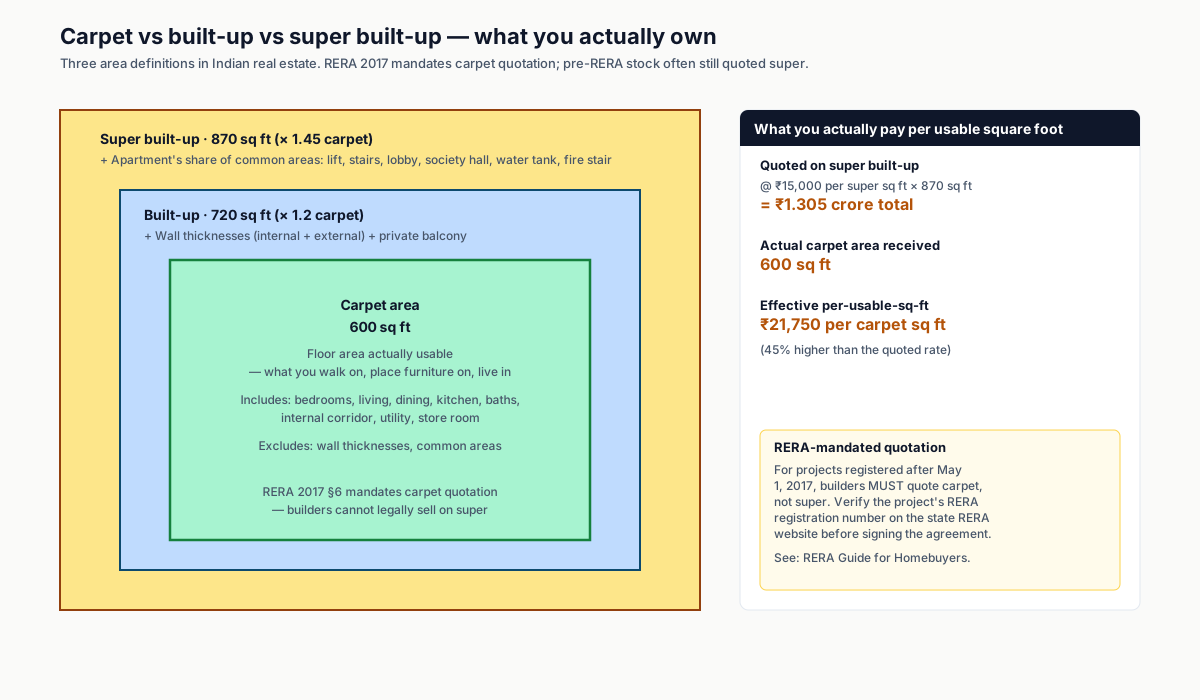
The single most-important number when buying or planning a 2BHK is the carpet area — the actually-usable floor space, after wall thicknesses and common-area shares are subtracted. The figure above shows how the three area definitions nest.
| Term | Definition | Typical 2BHK Range |
|---|---|---|
| Carpet area | Floor area inside the inner face of walls — what you walk on | 480 – 1,100 sq ft |
| Built-up area | Carpet + wall thicknesses + private balcony | 1.10 – 1.25 × carpet |
| Super built-up area | Built-up + share of common areas (lift, lobby, stairs, services) | 1.35 – 1.55 × carpet |
RERA 2017 § 6 mandates that builders quote carpet area, not super built-up, for any project registered after May 1, 2017. Verify the project's RERA registration number on the state RERA website. Pre-RERA stock and second-sale units are still often advertised on super built-up — translate before signing.
See the RERA Guide for Homebuyers & Architects for the complete treatment.
Four Typical 2BHK Layouts
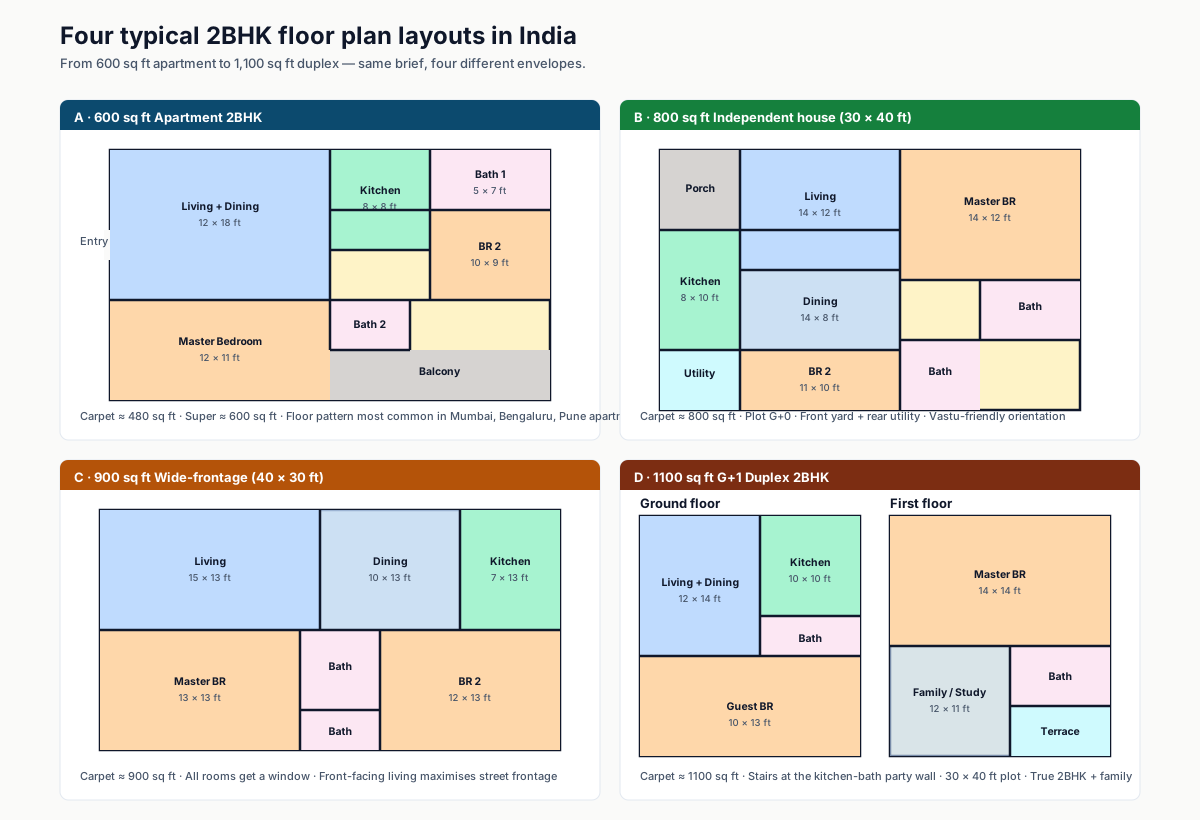
Indian 2BHK construction clusters into four canonical layouts. The figure above draws all four at the same scale so the differences in proportion, room sizing, and adjacency are visible at a glance.
Layout A — 600 sq ft Apartment 2BHK
The most-built configuration in Tier-1 apartment stock. Single living-dining volume (12 × 18 ft), L-shaped kitchen (8 × 8 ft) opening onto the dining, master bedroom (12 × 11 ft) with attached bath, second bedroom (10 × 9 ft) with common bath access, one balcony.
Carpet ≈ 480 sq ft. Super ≈ 600 sq ft. Suits a couple or a couple with one young child. Tight for two children or a multigenerational household.
Layout B — 800 sq ft Independent House 2BHK
Common in Tier-2 city plot developments and self-built homes on small urban plots. Separate living and dining (with optional courtyard), parallel kitchen (8 × 10 ft) with utility behind, master bedroom with attached bath in southwest, second bedroom in northwest, common bath between.
Carpet ≈ 800 sq ft. Suits a young family of 3–4. Allows G+1 expansion if FSI permits.
Layout C — 900 sq ft Wide-Frontage 2BHK
The 40 × 30 ft plot — wider than deep — produces a different planning logic. Front-facing living room (15 × 13 ft) maximises street frontage; dining occupies the centre; kitchen takes the side. Both bedrooms stack along the rear wall, with the master being larger (13 × 13) and the second slightly smaller (12 × 13).
Carpet ≈ 900 sq ft. Every habitable room gets a window. Common in plotted developments in Bengaluru, Hyderabad, and Pune extensions.
Layout D — 1,100 sq ft G+1 Duplex 2BHK
The premium end of the 2BHK range. Ground floor holds the public functions (living, dining, kitchen, one guest bedroom with attached bath); first floor holds the master suite with attached bath plus a family/study room and a small terrace. Staircase positioned at the kitchen-bath party wall.
Carpet ≈ 1,100 sq ft. Suits a young family planning to grow; the guest bedroom can become a kids' room. Common in 30 × 40 ft plot development.
Room-by-Room Sizing — Working Dimensions for a 2BHK
The single most-asked question by first-time 2BHK buyers and self-builders: "How big should each room be?" Indian builder-default sizes are smaller than international convention — driven partly by FAR / cost constraints, partly by furniture sizes available in the Indian market.
Bedrooms
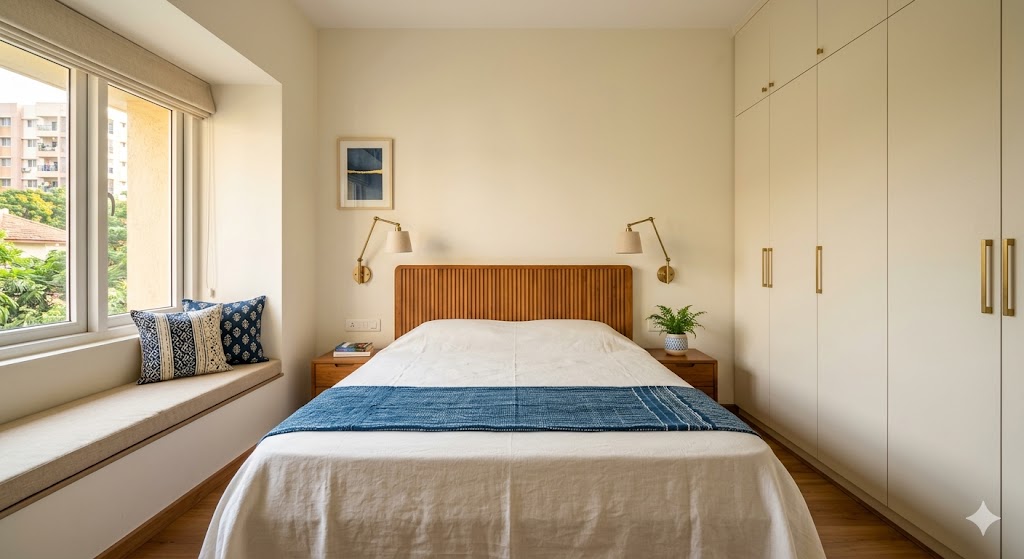
| Room | Builder-Min | Comfortable | Generous |
|---|---|---|---|
| Master bedroom | 10 × 11 ft | 12 × 12 ft | 14 × 14 ft |
| Master with king bed + dresser | 11 × 12 ft | 13 × 13 ft | 14 × 15 ft |
| Second bedroom | 9 × 10 ft | 10 × 11 ft | 11 × 12 ft |
| Children's bedroom (single bed) | 8 × 9 ft | 9 × 10 ft | 10 × 11 ft |
| Children's bedroom (twin beds) | 10 × 11 ft | 11 × 12 ft | 12 × 13 ft |
The Indian queen bed is 1830 × 1980 mm (6 ft × 6.5 ft); the king is 2030 × 2030 mm (6.7 ft × 6.7 ft). Allow at least 900 mm walking aisle on the side of the bed used for getting in and out, and 600 mm on the other side. A wardrobe needs 750 mm front clearance.
Living, Dining, Kitchen
| Room | Builder-Min | Comfortable | Generous |
|---|---|---|---|
| Living | 11 × 14 ft | 13 × 16 ft | 15 × 18 ft |
| Dining (4-seater) | 8 × 9 ft | 9 × 10 ft | 10 × 11 ft |
| Dining (6-seater) | 9 × 11 ft | 10 × 12 ft | 11 × 14 ft |
| Kitchen (L-shape) | 7 × 8 ft | 8 × 9 ft | 10 × 10 ft |
| Kitchen (parallel) | 7 × 9 ft | 8 × 10 ft | 9 × 12 ft |
| Kitchen (U-shape) | 9 × 9 ft | 10 × 10 ft | 11 × 12 ft |
Baths
| Bath Type | Min | Comfortable | Generous |
|---|---|---|---|
| Common bath (3-piece) | 4.5 × 6 ft | 5 × 7 ft | 6 × 8 ft |
| Master attached (3-piece) | 5 × 7 ft | 6 × 8 ft | 7 × 10 ft |
| Powder room (WC + sink) | 3 × 5 ft | 4 × 5 ft | 4.5 × 5 ft |
See Space Planning Principles for Indian Homes for the underlying logic.
Kitchen Typologies for a 2BHK
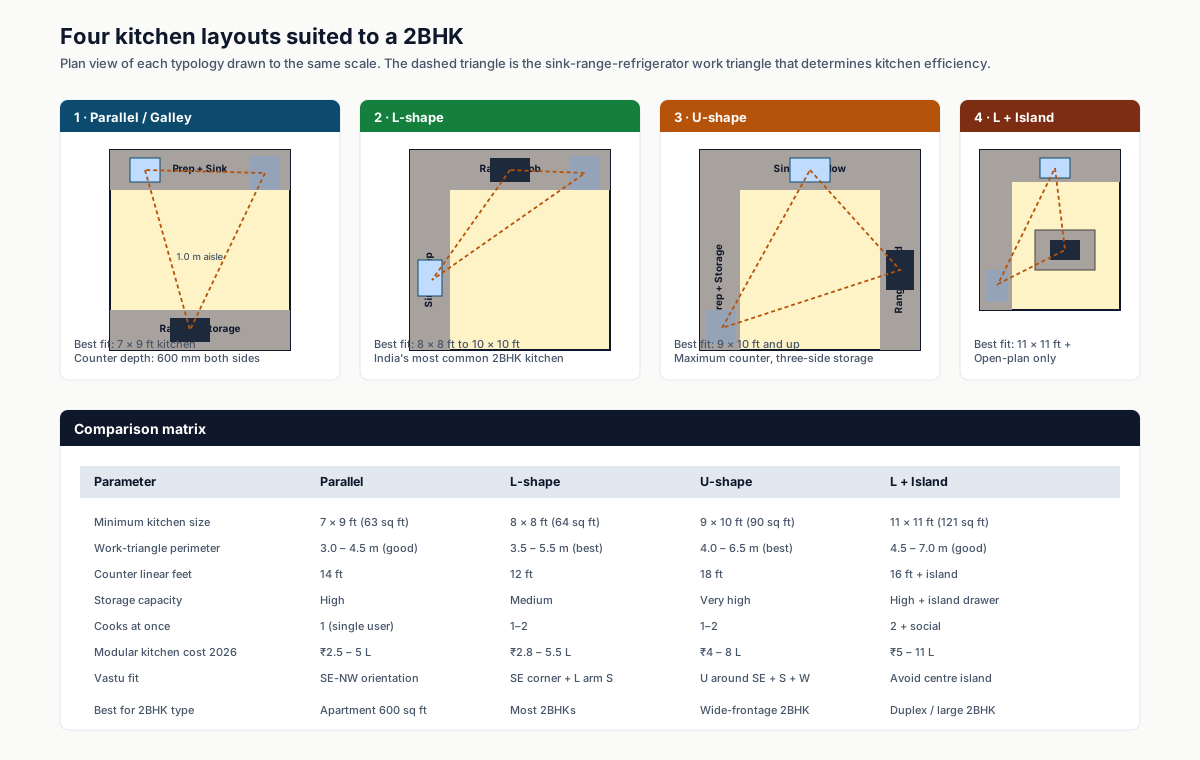
The kitchen is the most decision-dense room in any 2BHK. Four typologies are practical at the 2BHK scale.
Parallel (Galley) Kitchen
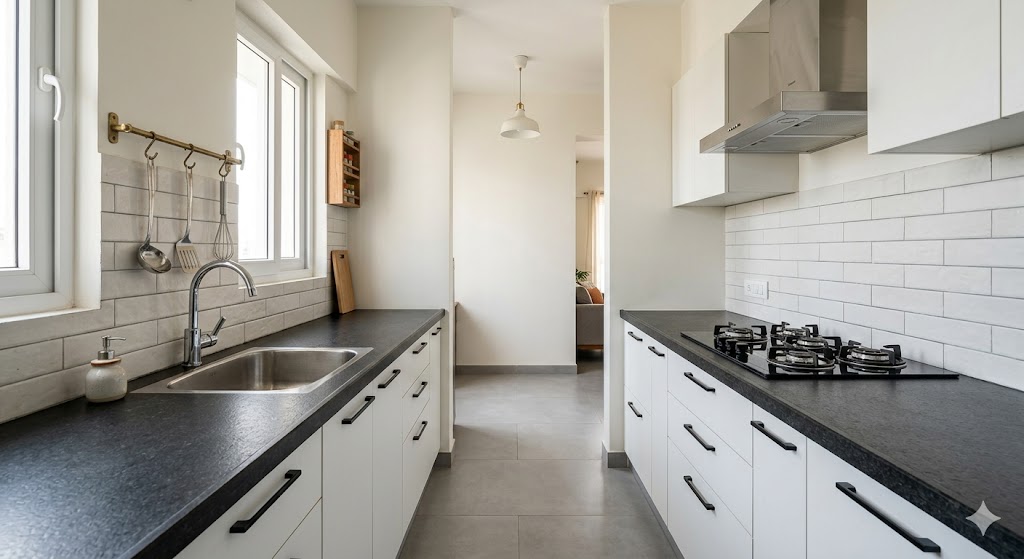
Two opposing counters with a 1 m walking aisle between them. Sink and prep on one counter, range and storage on the other. Fits a 7 × 9 ft kitchen efficiently. Single-user friendly; tight for two cooks. The standard apartment-2BHK kitchen.
L-Shape Kitchen
Two perpendicular counters forming an L. Range typically on the longer wall, sink + prep on the shorter. Fits 8 × 8 ft comfortably. Most-built 2BHK kitchen in independent houses; allows 1.5 cooks.
U-Shape Kitchen
Counters on three walls wrapping the user. Sink under the window on the central wall, range on one side wall, prep on the other. Demands at least 9 × 10 ft. Maximum counter (18 linear feet) and storage, but eats more floor area.
L + Island
L along two walls plus a free-standing 1.5 × 0.7 m island. Demands an open-plan kitchen of at least 11 × 11 ft and is only practical in larger 2BHKs (Layout D duplex). The island serves both as additional prep and as a social bar between cook and guests.
See Modular Kitchen Design Guide for the deep treatment.
Work-Triangle Discipline
The work triangle is the three-point path connecting sink, range, and refrigerator — the three most-frequently-used kitchen elements. Its perimeter is a standard kitchen efficiency metric:
| Perimeter | Efficiency |
|---|---|
| 3.6 – 6.0 m | Optimal — most movements within easy reach |
| 6.0 – 7.5 m | Acceptable — slightly more walking |
| < 3.6 m | Too tight — multiple users collide |
| > 7.5 m | Too dispersed — wastes time and motion |
Three Adjacency Rules — Bath, Bedroom, Door
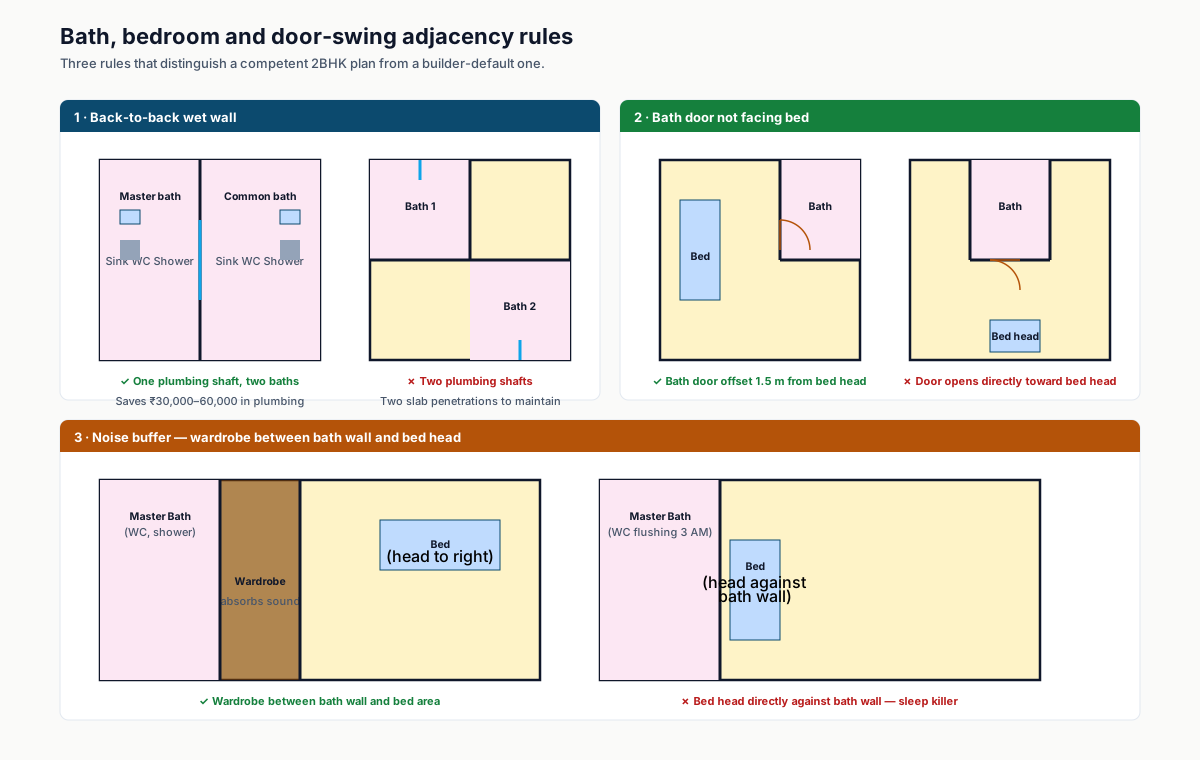
Three adjacency rules separate a competent 2BHK plan from a builder-default. They cost nothing to design in and are extremely expensive to retrofit.
Rule 1 — Back-to-Back Wet Wall
The master bath and common bath should share a single internal plumbing wall, so the plumbing rises through one shaft instead of two. Saves ₹30,000 – 60,000 in plumbing cost, halves the number of slab penetrations, halves the maintenance burden, and consolidates the wet stack — a real benefit in apartment construction where roof penetration access is restricted.
The bad alternative — baths on diagonally opposite corners — produces two separate plumbing risers, two soil-stack vents through the roof, two waste-line slab penetrations, and double the failure modes.
Rule 2 — Bath Door Not Facing Bed
The bath door should be offset by at least 1.5 m from the bed head, with the door swing into the bath (not into the bedroom). A bath door opening directly toward the bed head exposes the bed user to bath light at night, smells, and visual disruption when the door opens. The 1.5 m offset is enough to break the direct sight-line.
Rule 3 — Noise Buffer
The bath plumbing wall and the bed-head wall should have at least one storage element between them — a wardrobe, dresser, or built-in cabinet. The storage absorbs the sound of late-night WC flushing, water running, and bath ventilation fans.
The worst configuration is bed head against bath wall — the sleeper's head is 1.5 m from a flushing WC at 3 AM. The fix at design stage is to position the wardrobe against the bath wall and the bed perpendicular.
Vastu-Compliant 2BHK Reference Layout
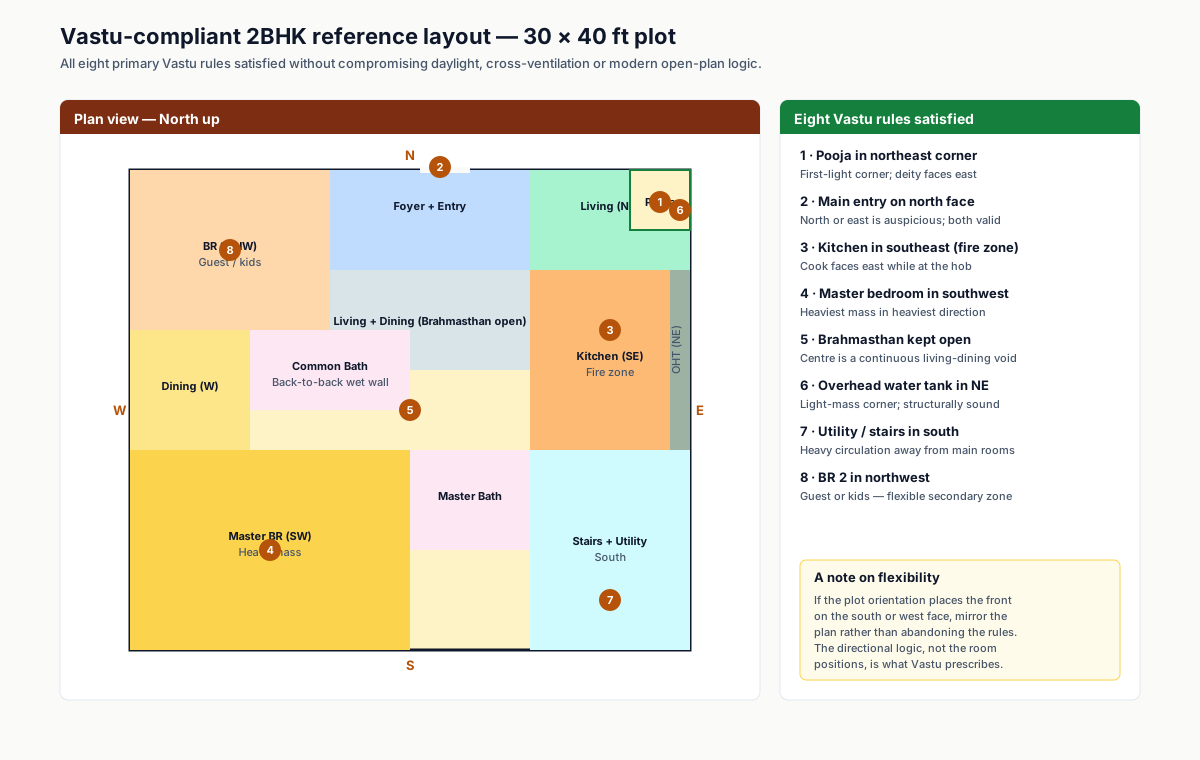
Roughly 65% of Indian 2BHK buyers prioritise Vastu compliance in plan selection. The reference layout above satisfies the eight primary Vastu rules without compromising on daylight, ventilation or modern open-plan logic.
The Eight Vastu Rules in This Reference
1. Pooja in the northeast corner — first-light corner; deity faces east.
2. Main entry on the north face — north or east are both auspicious.
3. Kitchen in the southeast (fire zone) — cook faces east while at the hob.
4. Master bedroom in the southwest — heaviest mass in heaviest direction.
5. Brahmasthan (centre) kept open — continuous living-dining void.
6. Overhead water tank in the northeast — light-mass corner; structurally sound.
7. Utility / stairs in the south — heavy circulation away from main rooms.
8. Second bedroom in the northwest — guest or kids; flexible secondary zone.
What If My Plot Faces South or West?
The Vastu rules govern the internal arrangement relative to the cardinal directions, not the plot frontage. If your plot faces south or west, you mirror the entire plan rather than abandoning the rules. The pooja still goes to the geometric northeast of the building, kitchen to the geometric southeast, master to the geometric southwest — regardless of which face the gate is on.
See Vastu Shastra for Modern Homes for the complete treatment.
Costing — 2026 Indicative Bands
2BHK costing varies by city tier, construction quality, and finishing tier. Bands below are for independent-house construction (Layouts B, C, D); apartment 2BHKs (Layout A) carry developer margin and land cost separately.
Tier 1 — Standard Build (₹1,800 – 2,400 / sq ft built-up)
- Cement plaster + exterior emulsion paint
- Vitrified tile flooring (mid-grade)
- Aluminium fenestration (Indian brand)
- Mid-grade flush doors
- Modular kitchen ₹2.5 – 4.5 L
- 2 baths fitted out at ₹70 K each
- Basic electrical, plumbing
- For 800 sq ft: total ₹14 – 19 L; for 1,100 sq ft: ₹20 – 26 L
Tier 2 — Mid Build (₹2,800 – 3,800 / sq ft built-up)
- Texture finish + premium exterior paint
- IPS or Kota stone flooring + accent stone in baths
- Premium anodised aluminium fenestration
- FSC teak doors
- Modular kitchen ₹4.5 – 8 L
- 2 baths fitted out at ₹1.2 – 1.8 L each
- Smart-switch backbone, Cat-6, EV-charging conduit
- 3 kWp solar + rainwater harvesting
- For 800 sq ft: total ₹22 – 30 L; for 1,100 sq ft: ₹31 – 42 L
Tier 3 — Premium Build (₹4,200 – 6,500 / sq ft built-up)
- IPS + Italian / book-matched natural stone
- Imported aluminium / steel-thermal-break fenestration
- Solid teak / oak joinery throughout
- Designer hardware (Hettich premium, Häfele Architech)
- Modular kitchen ₹8 – 15 L
- 2 baths fitted out at ₹2.5 – 4 L each
- Full smart-home (Lutron / KNX), 5 kWp solar + battery
- Architectural lighting design
- For 800 sq ft: total ₹34 – 52 L; for 1,100 sq ft: ₹46 – 72 L
Cost-per-sq-ft Comparison Across Cities
| City | Tier-1 / sq ft | Tier-2 / sq ft | Tier-3 / sq ft |
|---|---|---|---|
| Mumbai | ₹2,200 – 2,800 | ₹3,200 – 4,200 | ₹5,000 – 7,500 |
| Bengaluru | ₹1,900 – 2,500 | ₹2,900 – 3,800 | ₹4,500 – 6,500 |
| Delhi NCR | ₹2,000 – 2,600 | ₹3,000 – 4,000 | ₹4,700 – 6,800 |
| Chennai | ₹1,850 – 2,400 | ₹2,800 – 3,700 | ₹4,300 – 6,300 |
| Hyderabad | ₹1,800 – 2,400 | ₹2,700 – 3,600 | ₹4,200 – 6,200 |
| Pune | ₹1,850 – 2,450 | ₹2,800 – 3,700 | ₹4,400 – 6,400 |
Bands exclude land cost, statutory deposits, external development charges, sanction fees, and architect fees. See Architect Fee Structures and Home Loan Affordability in India — 2026 Guide.
Common Mistakes — Six Things 2BHK Buyers and Builders Get Wrong
Mistake 1 — Buying on Super Built-Up
Pre-RERA stock and second-sale units are still advertised on super built-up area. A "1,000 sq ft 2BHK" might have only 650 sq ft of carpet — a 35% over-payment. Always demand carpet in writing.
Mistake 2 — No Storage Beyond the Wardrobe
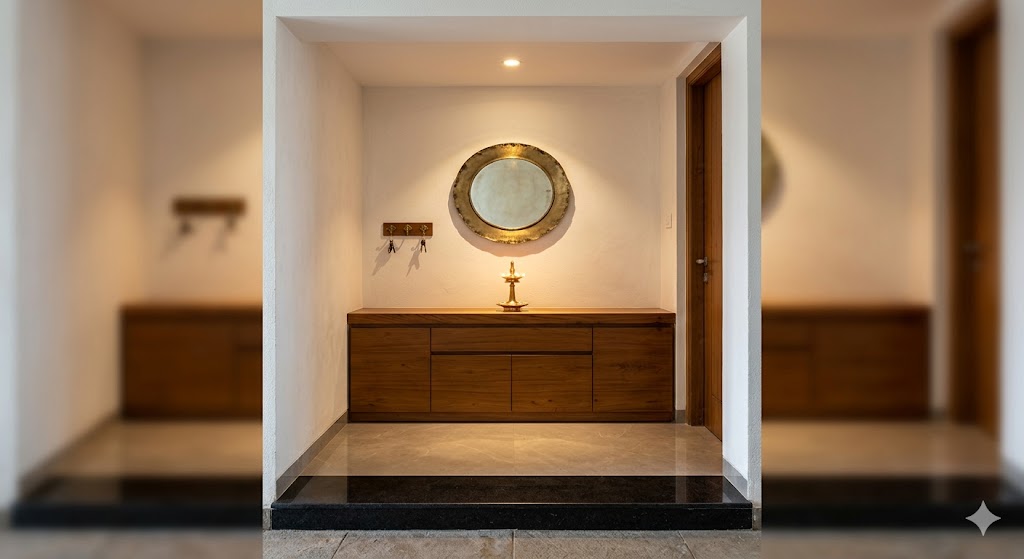
A 2BHK without dedicated storage beyond the bedroom wardrobes ends up cluttered within two years. Design in 8 – 10% of floor plate as built-in storage — entrance shoe rack, foyer console, kitchen pantry, utility cabinet, attic loft. See Storage Planning.
Mistake 3 — Master Attached Bath Too Small
The single most common space-cut in builder 2BHKs is the master attached bath — sized at 4 × 5 ft, fitting a WC and shower but no dresser or storage. The fix at design stage is to allocate at least 5 × 7 ft (35 sq ft) for the master bath.
Mistake 4 — Open Kitchen Without Exhaust Discipline
The Pinterest open kitchen, executed without a ducted exhaust fan and a separable wet kitchen, produces tadka-aroma curtains for the lifetime of the house. A 2BHK kitchen needs at least 600 CMH exhaust ducted to outside, never just an electric chimney with carbon filter.
Mistake 5 — Second Bedroom Without Cross-Ventilation
In layouts where the second bedroom has only one external wall (single window), cross-ventilation is impossible. The fix is a transom window or vent above the door opening to the corridor — a cheap retrofit at design, expensive afterward. See Cross Ventilation in Indian Homes.
Mistake 6 — Furniture Bought After Move-In
The single biggest determinant of how a 2BHK feels is the furniture. Buying it after move-in — based on what fits — produces a cluttered, mismatched, dimensionally-wrong house. Lock the furniture plan at the design stage: which sofa size, which dining table, which bed, which wardrobes.
Pre-Construction Checklist for 2BHK Homeowners
- [ ] RERA registration verified for the project (if buying)
- [ ] Carpet area in writing — not super built-up
- [ ] Plot orientation surveyed with sun-path overlay
- [ ] Vastu position taken — strict / consultative / cosmetic
- [ ] Layout selected — Apartment / Independent / Wide-frontage / Duplex
- [ ] Room sizing per the working dimensions table above
- [ ] Kitchen typology selected matched to kitchen footprint
- [ ] Back-to-back wet wall confirmed between baths
- [ ] Bath door offset ≥ 1.5 m from bed head in both bedrooms
- [ ] Noise-buffer storage between bath plumbing wall and bed-head wall
- [ ] Cross-ventilation path verified for every habitable room
- [ ] Storage budget allocated — 8-10% of floor plate
- [ ] Furniture plan locked before joinery is fabricated
- [ ] Builder / contractor referenced through at least 3 prior completed projects
- [ ] Soil test completed for independent house — see Soil Testing
- [ ] Municipal sanction process understood — see Building Plan Approval
Cross-Links — Going Deeper
Planning fundamentals
- Functional House Layout Planning
- Space Planning Principles for Indian Homes
- Space Zoning in Indian Homes
- Compact Urban Home Planning
Design pillars
- Modern House Design in India
- Indian House Front Elevation Design
- Vastu Shastra for Modern Homes
- Pooja Room Design for Indian Homes
Room-by-room
- Modular Kitchen Design Guide
- Storage Planning
- False Ceiling Design Guide
- Wardrobe Finish Ideas
- Staircase Design — Dimensions, Safety, Placement
Climate and orientation
- Designing for the Indian Climate
- Cross Ventilation in Indian Homes
- Natural Light Planning for Indian Homes
- Daylighting Indian Homes and Buildings
Money and process
- Complete Guide to Building a House in India
- RERA Guide for Homebuyers & Architects
- Architect Fee Structures in India
- Home Loan Affordability in India — 2026 Guide
- Stamp Duty in India 2026
- How to Choose the Right Architect or Interior Designer
- Building Plan Approval Process in India
Compliance and standards
- Architect Compliance Map — Bengaluru
- Architect Compliance Map — Mumbai
- Building Setbacks Across India
- FSI / FAR Computation for Indian Architects
References
1. Government of India (2017). Real Estate (Regulation and Development) Act, 2016. Ministry of Housing and Urban Affairs.
2. Bureau of Indian Standards (2016). National Building Code of India 2016, Part 4 (Fire and Life Safety) and Part 8 (Building Services). New Delhi: BIS.
3. Bureau of Indian Standards (1980). IS 8888 — Guide for Requirements of Low Income Housing. New Delhi: BIS.
4. Anthropometric Dimensions for Ergonomic Design Practice — National Institute of Design (1997). Indian Anthropometric Data. Ahmedabad: NID.
5. Bureau of Energy Efficiency (2018). Eco-Niwas Samhita. New Delhi: Government of India.
6. Census of India (2011). Houses, Household Amenities and Assets. New Delhi: Office of the Registrar General.
7. Krishan, A., Baker, N., Yannas, S. & Szokolay, S.V. (2001). Climate Responsive Architecture. New Delhi: Tata McGraw-Hill.
8. CIDC (2024). Construction Cost Index — Urban India. New Delhi: Construction Industry Development Council.
9. Various State RERA Authorities (2023-2026). Project registration data and carpet-area enforcement rulings.
10. Vastu Shastra mainstream consensus. Manasara, Mayamatam.
Author's note: The 2BHK gets too little design attention because it is "small" — most architects prefer to design 3BHKs and villas where the canvas is larger. This is a category error. The 2BHK is the most-built residential format in urban India and therefore the format whose collective design quality most shapes how Indians live. A poorly planned 2BHK condemns its occupants to two-bedroom-shaped frustration for decades; a well-planned one comfortably absorbs a family of four through fifteen years of household evolution. The discipline in this guide is offered as a framework for buyers to demand the second outcome from their builders, and for self-builders to design toward it themselves. The 2BHK deserves the same architectural rigour as any larger format — perhaps more, because the constraints are tighter.
Disclaimer: Carpet, built-up, and super built-up multipliers are indicative for typical Indian apartment construction and vary by state, project type, and builder convention. RERA implementation varies by state authority; always verify project registration status directly with the relevant state RERA. Cost bands are indicative for 2026 in Tier-1 and Tier-2 Indian cities and exclude land, statutory charges, and external development levies. Room-sizing recommendations are based on Indian anthropometric data and standard furniture dimensions; verify against your specific furniture sizes before locking dimensions. Vastu prescriptions reflect mainstream practitioner consensus across regional schools. Studio Matrx, its authors, and contributors accept no liability for decisions made on the basis of this guide; engage a licensed architect and competent contractor for site-specific design and execution.
Interactive · Size your plot
30×40 ft plot · G+1
Floors
Usable carpet area (all floors)
1,152 sqft
Comfortably supports 3 BHK.
Filled bars = configurations your carpet area can support.
Rough massing estimate. Real buildable area is set by your local setbacks, FSI/FAR limit and byelaws — always confirm against the sanctioned plan. See the FSI/FAR and setback guides.
Export this guide
Related Guides — Deep-dive reading
East-Facing House Plan — Complete Guide for India
Vastu Logic, Sun-Path, Room-Direction Matrix & Reference Plans for the Most-Asked Orientation in Indian Homes
Room PlanningPooja Room Design for Indian Homes
Vastu, Layouts, Materials, Lighting & Safety — A Complete Architect's Guide for Apartments, Villas & Compact Homes
Room Planning3BHK House Design — Complete Guide for India
Layouts, Bedroom Hierarchy, Living-Dining-Kitchen Configurations, Bath Counts, Vastu, Costs & Checklist
Room PlanningRelated Tools — Try Free
Cross-Ventilation Analyzer
Estimate airflow and air changes per hour (ACH) from room size, window areas, layout, and local wind — with NBC 2016 Part 8 compliance check.
Ventilation CalculatorRainwater Tank Sizer
How big should your rainwater tank be? Computes annual harvest, recommended tank capacity in litres, water-bill savings, and payback — for 10 Indian cities.
RWH CalculatorApartment Interior Planning Checklist
51-item checklist across structural, ceiling, lighting, furniture, storage, electrical, kitchen, bathroom.
Checklist