
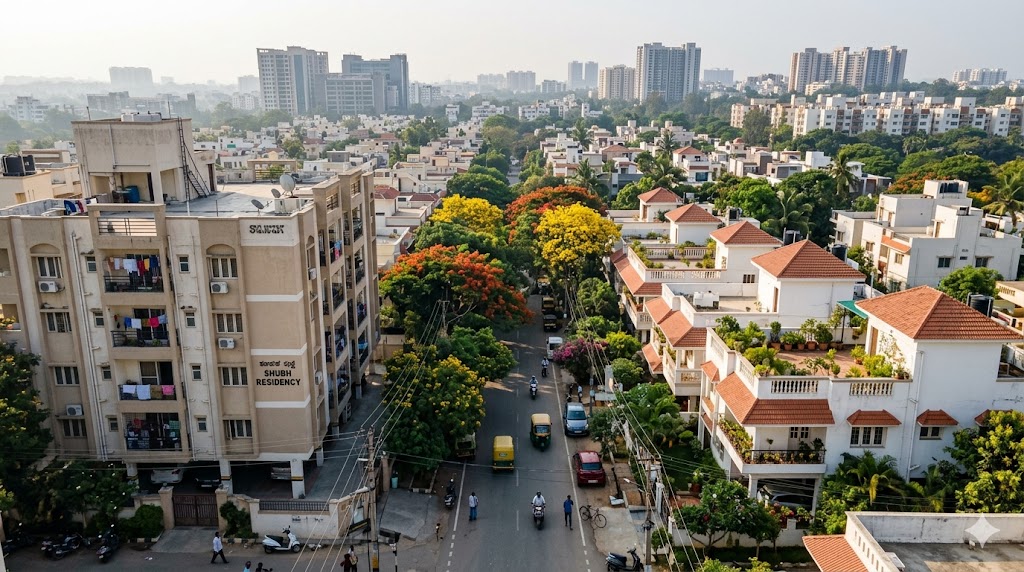
The Architect's Compliance Map — Bengaluru
BBMP, BDA, BMRDA, BWSSB, BESCOM, Karnataka RERA, KSPCB — the Permit Chain, Khata Disambiguation, and the Operational Workflow for Residential Practice in 2026
Bengaluru is the most fragmented residential-permit jurisdiction in India. A single 30 × 50 ft residential plot in the city may, depending on its history, sit under the jurisdiction of seven or more distinct authorities — corporation (BBMP), development authority (BDA or BMRDA), water utility (BWSSB), power utility (BESCOM), pollution board (KSPCB), real-estate regulator (K-RERA), revenue department (DC office), and possibly a panchayat or layout sangha. Each authority has its own application portal, its own document checklist, its own timeline, its own informal practice, and its own redress mechanism when something goes wrong.
The architect practising in Bengaluru cannot be expected to memorise every rule under every authority — but the map of which authority does what, in what sequence, with what deliverables, must be in working memory. This guide is that map. It is intended for the practising architect — independent or studio-employed — who is building, approving, or verifying residential projects within the Bengaluru Metropolitan Region in 2026, and who has been asked by a client "will this approval take three months or eighteen months?" and needs to give a defensible answer.
The treatment is operational, not statutory-exhaustive. The Karnataka Town and Country Planning Act 1961, the Karnataka Municipal Corporations Act 1976, the BBMP Building Bye-laws 2003 (with subsequent amendments), the Revised Master Plan 2031, and the Karnataka Real Estate (Regulation and Development) Rules 2017 are the underlying statutory authorities; this guide explains how they intersect in the day-to-day workflow of a Bengaluru residential architect. The companion OC/CC and Plinth Verification guide covers the pan-India occupancy and plinth-verification process; this guide takes the Bengaluru-specific instances of those processes.
The 2026 framework reflects current Bengaluru practice including the BBMP Sakala service-guarantee regime, the e-Aasthi digital land record system, the NBPDP (Nirmaan) online plan-approval portal, and the K-RERA registration framework. Architects must verify against the current circulars and notifications at the time of any specific project filing — Bengaluru's regulatory framework is unusually dynamic, with material amendments in roughly half of all twelve-month periods.
"In Bengaluru, every plot has a story; the architect's first task is to read the story before the design begins." — Local construction-law commentary, paraphrased from the practising bar
1. The Seven-Authority Map
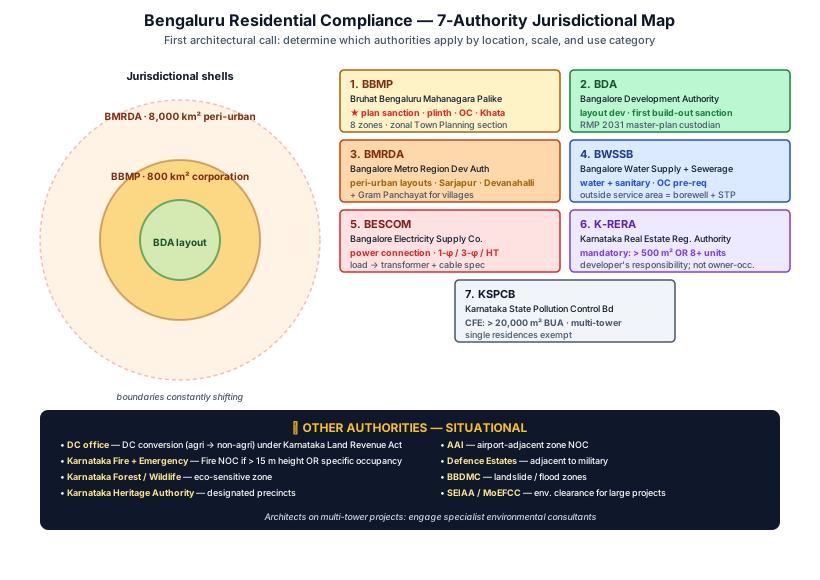
The first orientation is jurisdictional. A residential project in Bengaluru sits under one or more of seven authorities, depending on its location, scale, and use. The architect's first call is to determine which authorities apply.
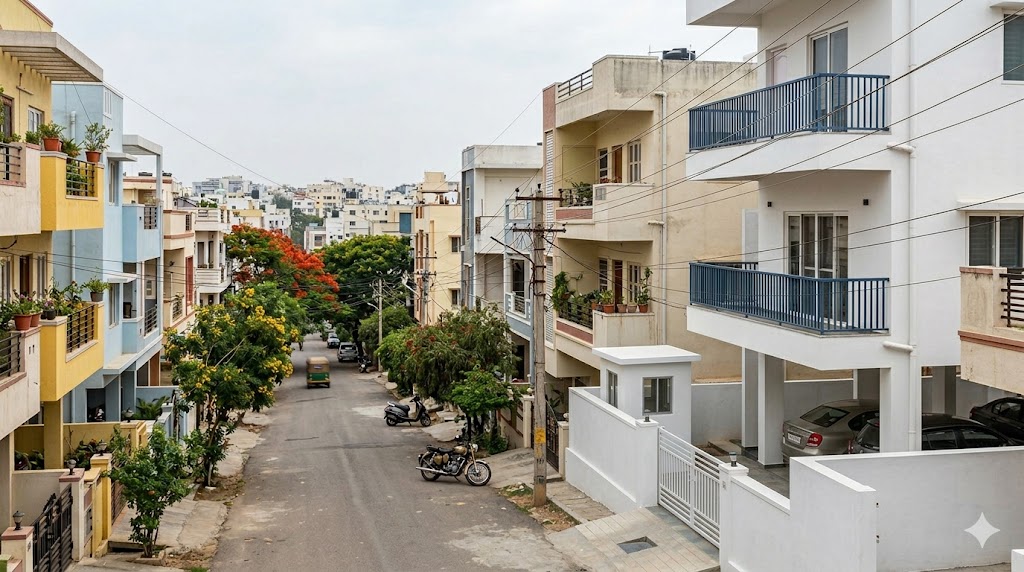
Authority 1 — BBMP (Bruhat Bengaluru Mahanagara Palike)
Bruhat Bengaluru Mahanagara Palike is the corporation-level authority for the 800-square-kilometre BBMP jurisdiction. For residential projects within BBMP limits, BBMP is the primary plan-sanctioning, plinth-verifying, and occupancy-certifying authority. BBMP also maintains the Khata (property tax record) and issues building licenses, completion certificates, and occupancy certificates.
BBMP operates through eight zones (East, West, South, North, Mahadevapura, Bommanahalli, RR Nagar, Yelahanka), each with a Joint Commissioner and a Deputy Director (Town Planning). The architect's interaction is typically with the Town Planning section of the relevant zone's office.
Authority 2 — BDA (Bangalore Development Authority)
Bangalore Development Authority is the development authority constituted under the Karnataka Urban Development Authorities Act, 1987. BDA's primary role is layout development — it acquires land, develops it into serviced plots, and allots them. For projects within BDA-developed layouts, BDA — not BBMP — is the plan-sanctioning authority for the first build-out. After the layout is handed over to BBMP (typically within 5–10 years of allotment), BBMP becomes the sanctioning authority.
BDA also has master-planning authority under the Karnataka Town and Country Planning Act, 1961, and is the custodian of the Revised Master Plan 2031 (RMP 2031) for the Bengaluru Metropolitan Area.
Authority 3 — BMRDA (Bangalore Metropolitan Region Development Authority)
Bangalore Metropolitan Region Development Authority covers the peri-urban zone surrounding BBMP — approximately 8,000 square kilometres. For residential projects in BMRDA jurisdiction (typical examples: Sarjapur Road periphery, Whitefield outer extensions, Hoskote, Devanahalli, Doddaballapur, Anekal), BMRDA is the layout-sanctioning authority and a coordinating authority across multiple agencies. Plan sanction within an approved BMRDA layout is typically by the Gram Panchayat (for villages), the BMRDA itself, or BBMP (where the area has been brought under BBMP).
The BBMP-vs-BMRDA-vs-Gram-Panchayat boundary is constantly shifting as Bengaluru expands; the architect must verify the current jurisdictional status of any plot before assuming.
Authority 4 — BWSSB (Bangalore Water Supply and Sewerage Board)
Bangalore Water Supply and Sewerage Board is the water and sewerage utility for BBMP and a portion of BMRDA limits. BWSSB issues water and sanitary connections; in BWSSB-served areas, an Occupancy Certificate cannot be issued without the BWSSB connection in place (or a documented borewell-and-STP arrangement). For projects outside BWSSB service area, borewell (with KGWA approval where applicable) and septic tank or STP (per the Septic Tank Design guide) substitute.
Authority 5 — BESCOM (Bangalore Electricity Supply Company)
Bangalore Electricity Supply Company Limited is the power utility for the BBMP and BMRDA region. BESCOM issues residential power connections; the connection load determines whether a single-phase or three-phase supply is required, which in turn determines transformer-and-cable specifications. For multi-unit projects, bulk LT-line or HT-line connections may be required.
Authority 6 — Karnataka RERA (K-RERA)
Karnataka Real Estate Regulatory Authority is the state-level RERA established under the Real Estate (Regulation and Development) Act, 2016. K-RERA registration is mandatory for any new project — promoter-developed multi-unit residential projects — exceeding 500 square metres of land area or 8 dwelling units, whichever is lower. K-RERA registration is not required for owner-occupier single residences.
For architects working with developers, K-RERA registration is typically the developer's responsibility but the architect's drawings, specifications, and approvals form the foundation of the registration package.
Authority 7 — KSPCB (Karnataka State Pollution Control Board)
Karnataka State Pollution Control Board is the state-level environmental authority. For residential projects, KSPCB Consent for Establishment (CFE) is required for projects exceeding built-up area thresholds (currently 20,000 sqm under MoEFCC EIA Notification 2006 as amended) or for specific use categories (multi-tower projects, integrated townships). Single residences and small-multi-unit projects are typically exempt.
For larger projects, the KSPCB process intersects with the State Environmental Impact Assessment Authority (SEIAA) for environmental clearance. The detailed treatment is outside this guide's scope; architects on multi-tower projects should engage specialist environmental consultants.
The Other Authorities
Several supporting authorities appear in specific situations:
- DC (Deputy Commissioner) office — for DC conversion of agricultural land to non-agricultural use under the Karnataka Land Revenue Act, 1964
- Karnataka Fire and Emergency Services — for Fire NOC on buildings exceeding 15 m height or specific occupancy categories
- Airport Authority of India (AAI) — for NOC on plots within designated airport-adjacent zones (Bengaluru International Airport reference points)
- Defence Estates — for plots adjacent to Defence Establishments
- Karnataka Forest Department / Wildlife Wing — for plots near forest boundaries or eco-sensitive zones
- Karnataka Heritage Authority — for plots in designated heritage precincts
- Bruhat Bengaluru Disaster Management Cell — for plots in landslide or low-lying flood zones
2. Khata Disambiguation — The Foundational Question
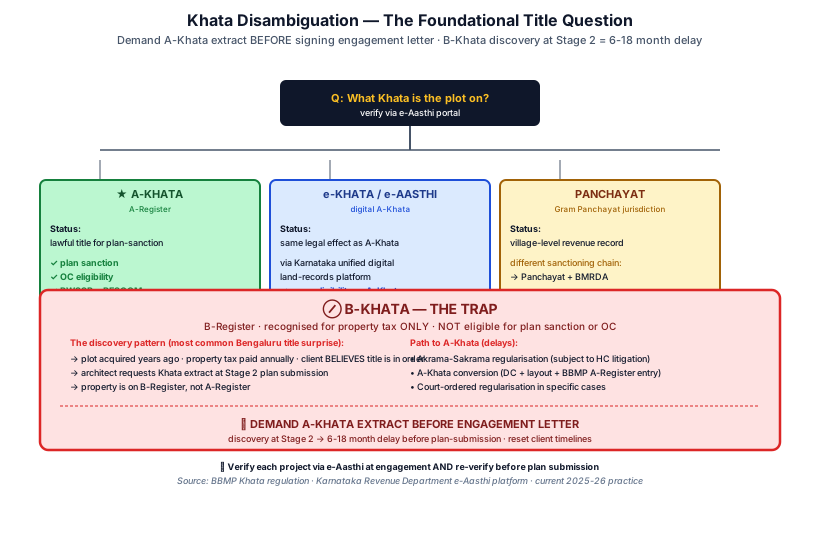
Before any approval is sought, the Khata status of the plot must be unambiguous. This is the single most consequential title-stage question in Bengaluru residential practice, and it is the one most likely to surprise the architect — and the client — late in the process.
The Khata Family
| Khata Type | Meaning | Approval Authority | Implications |
|---|---|---|---|
| A-Khata | Property tax assessment record + lawful title for plan-sanction purposes | BBMP (within BBMP limits) | Eligible for building plan sanction, OC, BWSSB / BESCOM connections, bank loans |
| B-Khata | Property tax assessment record only — not equivalent to lawful title | BBMP (B-Register) | Not eligible for building plan sanction or OC — typically requires regularisation under Akrama-Sakrama or A-Khata conversion |
| e-Khata | Digital A-Khata — same legal effect as A-Khata, issued via the e-Aasthi system | BBMP (digital portal) | Eligible for sanction; replaces physical A-Khata |
| e-Aasthi | Karnataka's unified digital land records platform — supersedes earlier paper systems | Karnataka Revenue Department + BBMP | The 2025–2026 default system for new transactions |
| Panchayat Khata | Village-level revenue record (within Gram Panchayat jurisdiction outside BBMP) | Gram Panchayat | Different sanctioning chain — Panchayat plus BMRDA |
| Revenue Pocket / Layout | Plots in non-converted layouts on agricultural land | DC + Panchayat | Building requires DC conversion plus subsequent layout approval |
The B-Khata Trap
The most common Bengaluru title surprise is the B-Khata discovery at Stage 2 of the architect's engagement. The plot was acquired by the client years ago, the property tax has been paid annually, the client has believed the title to be in order — and the architect, on requesting the Khata extract for the plan submission, finds the property is on the B-Register, not the A-Register.
The B-Khata indicates that the plot is recognised for property-tax purposes but is not eligible for plan sanction. The path to A-Khata typically requires:
- Regularisation under Akrama-Sakrama (Karnataka's regularisation scheme for unauthorised constructions and unconverted plots) — currently subject to Karnataka High Court litigation; status unclear in 2026
- A-Khata conversion under the BBMP Khata regulation procedures — requiring DC conversion, layout approval, and BBMP A-Register entry
- Court-ordered regularisation in specific cases
The architect's discipline is to demand the A-Khata extract before signing the engagement letter — not at Stage 2 design completion. A B-Khata discovery at Stage 2 imposes a 6–18 month delay on the project before any design work can be plan-submitted, and the client's expectation of timelines must be reset accordingly.
e-Aasthi Verification
The Karnataka e-Aasthi portal is the digital verification system for property records. Architects should verify each project's plot via e-Aasthi at engagement and re-verify before plan submission. The system reflects the current Khata status, registration history, and any encumbrances — critical for confirming the title chain.
The Studio Matrx Approval Roadmap utility provides a city-by-city checklist; the Bengaluru profile incorporates the Khata disambiguation steps.
3. The Permit Chain — From Title to Possession
The full permit chain for a Bengaluru residential project, in sequence:

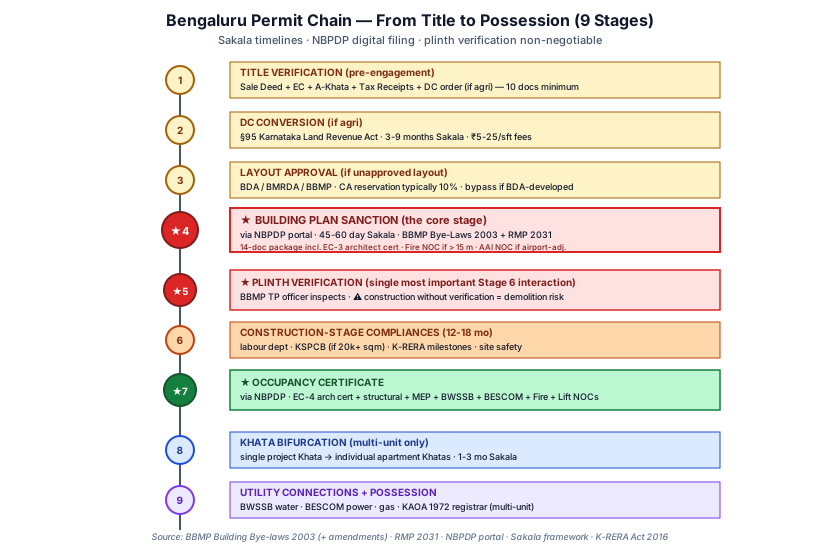
Stage 1 — Title Verification (Pre-Engagement)
Before any design work, the architect (or the client's lawyer) verifies:
| Document | Purpose | Source |
|---|---|---|
| Sale Deed (original or certified copy) | Establishes ownership chain | Sub-Registrar's office (Kaveri portal) |
| Mother / Parent Deed | Establishes the chain of title | Sub-Registrar's office |
| Encumbrance Certificate (EC) | Confirms no liens/mortgages within the search period (typically 30 years) | Kaveri Online portal |
| A-Khata Extract | Confirms property is on A-Register | BBMP zonal office or e-Aasthi |
| Property Tax Paid Receipts (last 3 years) | Confirms tax compliance | BBMP property-tax portal |
| Sketch and Mahazar | Plot dimensions and boundaries | Karnataka Survey Department |
| DC Conversion Order (if applicable) | Confirms agricultural-to-non-agricultural conversion | DC office |
| Khata Certificate / Khata Extract | BBMP-certified ownership reference | BBMP / e-Aasthi |
| Tahsildar Mutation (if recent transfer) | Updates revenue record | Tahsildar office |
| No-Objection Certificate from owners' association (in BDA layout if applicable) | Layout-internal compliance | Layout association |
If any of these documents is missing or anomalous, the architect must flag the issue at engagement and require resolution before design proceeds.
Stage 2 — DC Conversion (If Required)
For plots that are still classified as agricultural land in revenue records, DC conversion under §95 of the Karnataka Land Revenue Act is required before any non-agricultural use, including residential construction. The conversion is granted by the District Deputy Commissioner upon application supported by survey records, soil-status certificate, and (in agricultural-zone plots) approval from the Department of Agriculture.
DC conversion timelines: 3–9 months under the Sakala framework. Conversion fees are based on plot size and zone classification, ranging from ~₹5–25 per square foot.
Stage 3 — Layout Approval (If Within an Unapproved Layout)
For plots in unapproved revenue layouts (common in BMRDA periphery), the layout must be approved by:
- BDA — for layouts within BDA jurisdiction
- BMRDA — for layouts within BMRDA periphery
- BBMP — for layouts being absorbed into BBMP
Layout approval involves layout-plan submission, road-and-utility-corridor verification, conformity to RMP 2031 zoning, and (in many cases) handover of a percentage of land for civic amenities (CA reservation — typically 10% under BBMP norms). For an architect joining a project in a pre-existing approved layout (BDA-developed, BMRDA-approved, or BBMP-existing), this stage is bypassed.
Stage 4 — Building Plan Sanction
The core architectural-permit stage. The application is filed via the NBPDP (Nirmaan Building Plan Development Portal) — Karnataka's online plan-submission system that has progressively replaced the legacy paper system from 2017 onwards.
The plan-sanction package, as required by BBMP Building Bye-laws 2003 (with amendments) and RMP 2031:
| Package Element | Specification |
|---|---|
| Site plan | Showing plot dimensions, setbacks, north arrow, scale 1:200 minimum |
| Architectural plans | Each floor at scale 1:100 minimum, with FAR computation |
| Sections | Showing height, floor-to-floor, plinth, parapet |
| Elevations | All four (or applicable) faces |
| FAR / setback compliance certificate | Architect's certificate per RMP 2031 zoning |
| Parking layout | Per BBMP Bye-laws (1 car space per 100 sqm built-up minimum, varies by zone) |
| Drainage and rainwater layout | Per Karnataka Bye-laws |
| Soil-investigation report | For multi-storey or larger plots |
| Structural certificate | From a licensed structural engineer |
| EC-3 form (Architect's certificate) | Architect's compliance declaration |
| Title documents | Sale deed, Khata, EC, parent deeds |
| NOC from neighbours (in some zoning conditions) | For boundary-wall and proximity issues |
| Fire NOC (if 15m+ height) | From Karnataka Fire and Emergency Services |
| Airport NOC (if within designated zones) | From Airport Authority of India |
| Tree-cutting permission (if existing trees on plot) | From BBMP / Forest Department |
The Sakala timeline for BBMP residential plan sanction is 45–60 calendar days from complete submission. In practice, sanctions for fully-compliant submissions land within the timeline; non-compliant submissions enter a query-loop that can extend to 4–6 months.
Stage 5 — Plinth Verification
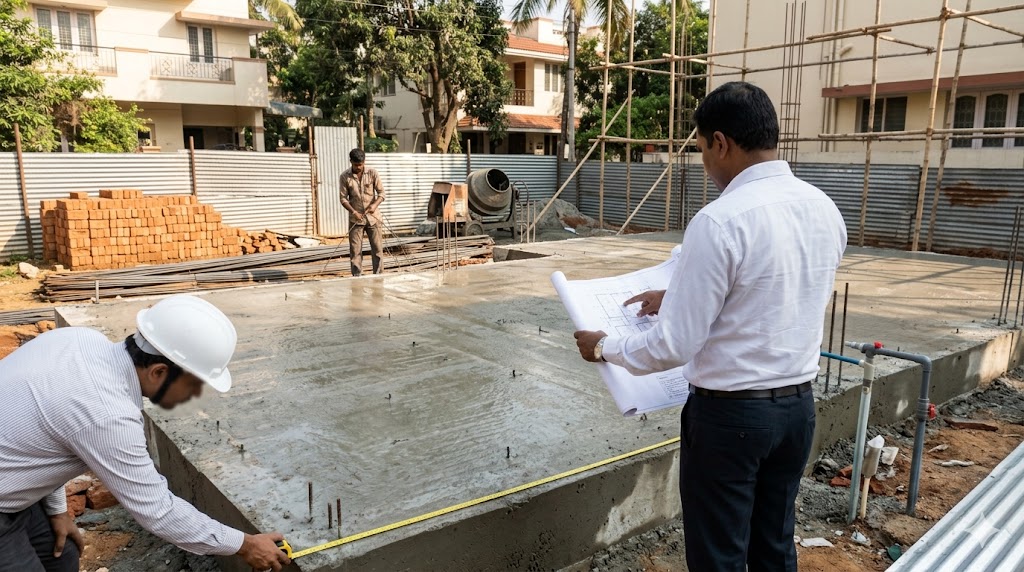
After the foundation and plinth (basement-and-ground-level slab) are constructed and before superstructure work begins, the architect submits an intimation of plinth completion to BBMP. A BBMP officer (Town Planning section) inspects the plinth, verifies that setbacks, plinth level, and footprint match the sanctioned plan, and either issues a plinth verification certificate or raises observations to be remedied before further work.
The plinth-verification stage is the single most important construction-stage compliance interaction with BBMP. Construction without plinth verification is a violation that can attract demolition orders for non-compliant work. The detailed treatment is in the OC/CC and Plinth Verification guide.
Stage 6 — Construction-Stage Compliances
During the 12–18 month typical construction period, the architect coordinates:
- Quarterly inspection visits by BBMP if scale warrants
- Karnataka Labour Department compliance under the Building and Other Construction Workers Act
- KSPCB consent if scale warrants (typically for 20,000+ sqm projects)
- K-RERA registration milestones for promoter-developed projects
- Site-safety compliance under Karnataka Factories Act (as applicable to construction sites)
Stage 7 — Occupancy Certificate (OC)
On completion, the architect submits the application for OC via NBPDP, accompanied by:
- Completion certificate from the architect (EC-4 form)
- Structural completion certificate from the structural engineer
- MEP completion certificates from the MEP consultants
- BWSSB connection certificate
- BESCOM connection certificate
- Fire NOC (if applicable, post-construction)
- Lift NOC (if applicable, from PESO)
- Tree-replantation certificate (if cutting was permitted)
- Any post-sanction variation drawings (revised sanction if material changes)
The Sakala timeline for OC is 30 calendar days from complete submission. In practice, OC takes 2–6 months because of the document-chain complexity.
Stage 8 — Khata Bifurcation (Multi-Unit Projects)
For multi-unit projects (apartments), after OC the Khata bifurcation is required — the single project Khata is split into individual apartment Khatas, each with its own property-tax record. The bifurcation is filed at BBMP zonal office; timelines are typically 1–3 months under Sakala.
Stage 9 — Utility Connections and Possession
The final stage — BWSSB water connection, BESCOM power connection, gas connection (for piped gas, typically GAIL or BPCL Indraprastha Gas), and registration of the apartment with the Karnataka Apartment Ownership Act 1972 registrar (for multi-unit projects).
4. The BBMP Building Bye-Laws — Key Dimensional Requirements
The BBMP Building Bye-laws 2003 (with subsequent amendments through 2024) and RMP 2031 set the dimensional framework for residential design in Bengaluru. The architect's working memory should include the headline numbers; project-specific verification against the current notification at filing time is essential.
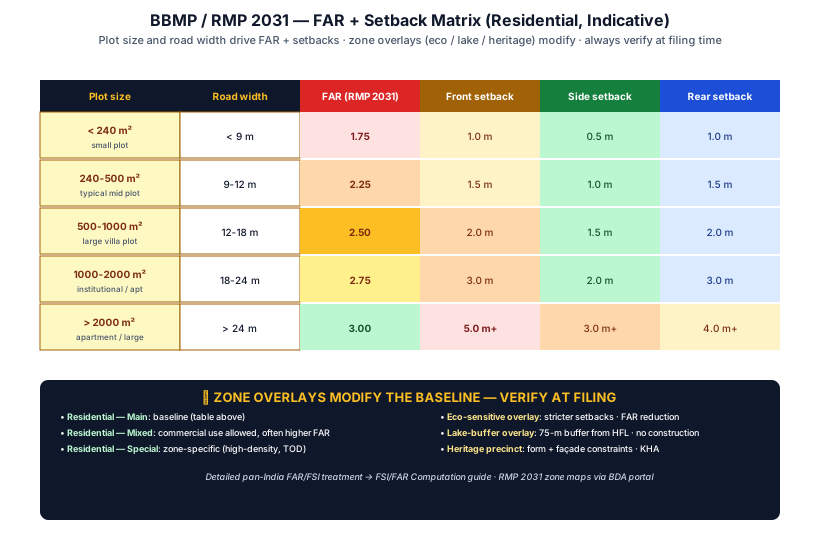
FAR and Setback Matrix (Residential, Indicative)
| Plot Size | Road Width | FAR (RMP 2031) | Setback Front | Setback Side | Setback Rear |
|---|---|---|---|---|---|
| < 240 sqm | < 9 m | 1.75 | 1.0 m | 0.5 m | 1.0 m |
| 240–500 sqm | 9–12 m | 2.25 | 1.5 m | 1.0 m | 1.5 m |
| 500–1000 sqm | 12–18 m | 2.50 | 2.0 m | 1.5 m | 2.0 m |
| 1000–2000 sqm | 18–24 m | 2.75 | 3.0 m | 2.0 m | 3.0 m |
| > 2000 sqm | > 24 m | 3.00 | 5.0 m+ | 3.0 m+ | 4.0 m+ |
These figures are indicative ranges drawn from RMP 2031 baseline tables; specific zone categories (Residential — Main, Residential — Mixed, Residential — Special) and plot-specific overlays (eco-sensitive, lake-buffer, heritage) impose modifications. The detailed pan-India FAR/FSI treatment is in the FSI/FAR Computation guide.
Premium FAR (Additional FSI Purchase)
RMP 2031 permits premium FAR — purchase of additional FAR over the baseline up to a ceiling, against payment of premium fees to BBMP. Premium FAR is typically 20–50% over baseline, depending on zone and infrastructure capacity. For mid-rise and high-rise residential, premium FAR is a primary economic lever.
Height and Setback Coupling
In RMP 2031, building height and setback are coupled — taller buildings require larger setbacks per the formula:
Setback = (Building Height ÷ 5) + a margin per zone
This is the light-and-air principle — taller buildings cannot crowd their neighbours. The architect's envelope analysis at concept stage must verify both FAR (volume) and the setback-height coupling (massing).
Parking Requirements
| Use | Parking Standard |
|---|---|
| Residential — single dwelling | 1 covered car space per dwelling |
| Residential — apartments < 100 sqm | 1 car space per 2 units (varies by zone) |
| Residential — apartments 100–200 sqm | 1 car space per unit |
| Residential — apartments 200+ sqm | 1.5–2 car spaces per unit |
| Visitor parking | 5–10% of total parking |
| Two-wheeler parking | 25–40% of car spaces, additional |
Stilt parking (one floor of parking under the residential floors) is typically excluded from FAR up to a height of 2.4 m. Basement parking is fully excluded from FAR. Architects routinely use this exclusion as a parking strategy for FAR-tight plots.
Other Dimensional Requirements
- Minimum room dimensions — habitable room: 9.5 sqm and 2.4 m minimum width; kitchen: 5.5 sqm; bath: 1.8 sqm
- Minimum ceiling height — habitable: 2.75 m clear; non-habitable: 2.4 m
- Staircase minimum width — 1.0 m for residential up to G+3; 1.2 m for taller
- Lift requirement — mandatory for residential G+4 and above
- Rainwater harvesting — mandatory per BBMP / KSPCB for plots above 2400 sqft (~223 sqm)
- Solar water heater — mandatory per Karnataka Solar Water Heater Rules for plots above 600 sqft
- STP (Sewage Treatment Plant) — mandatory for projects above 50 dwelling units; recommended for larger plots even where mandatory threshold is not crossed
5. The Sakala Framework — Service-Guarantee Timelines
Karnataka was the first Indian state to enact a service-guarantee law — the Karnataka Sakala Services Act, 2011 — which mandates time-bound delivery of citizen services. The Sakala framework applies to BBMP, BDA, BMRDA, and most state authorities; failure to deliver within timeline triggers compensation to the applicant and disciplinary action against the responsible officer.
Sakala Timelines (Indicative — Residential Architecture Relevant)
| Service | Sakala Timeline | Authority | Common Slippage |
|---|---|---|---|
| A-Khata transfer / mutation | 45 days | BBMP | Frequent — query loops |
| Building plan sanction (residential) | 45–60 days | BBMP / BDA | Moderate — query loops |
| DC conversion order | 90 days | DC office | Frequent — multi-department NOCs |
| Plinth verification | 14 days | BBMP | Low — typically issued promptly |
| Occupancy Certificate (OC) | 30 days | BBMP | Frequent — document completeness |
| Khata bifurcation (post-OC) | 45 days | BBMP | Moderate — multi-unit complexity |
| Encumbrance Certificate (EC) | 7 days | Sub-Registrar | Low — Kaveri portal automated |
| BWSSB connection | 30 days | BWSSB | Moderate — site-readiness checks |
| BESCOM connection | 30 days | BESCOM | Low — typically prompt |
| Fire NOC (residential 15m+) | 30 days | KFES | Moderate |
| Tree-cutting permission | 60 days | BBMP / Forest Dept | Frequent — environmental scrutiny |
| Karnataka RERA registration | 30 days | K-RERA | Low — automated portal |
Where Sakala deadlines slip, the applicant has the right to escalate to the next-higher authority and to claim compensation (₹20–500 per day of delay, capped per the rules). In practice, escalation triggers a swift response far more often than compensation is actually paid.
The Studio Matrx Approval Roadmap utility builds a project-specific Sakala-aware timeline against these benchmarks.
6. Common Red Flags and Risk Patterns
Six recurring issue patterns in Bengaluru residential plan sanction and OC, with their architectural prevention:
Red Flag 1 — B-Khata or Revenue Plot
The plot is on B-Khata, B-Register, or is an unconverted revenue plot. Plan sanction is not possible in current state. The architect's response: refuse engagement until the title is converted to A-Khata via Akrama-Sakrama (where currently available), DC conversion + layout approval, or court-ordered regularisation.
Red Flag 2 — Eco-Sensitive Zone or Lake Buffer
The plot falls within a designated lake buffer (typically 30–75 m from any lake within BBMP), eco-sensitive zone, or a recently-notified buffer. Plan sanction is restricted; building footprint may be heavily constrained. The architect's response: review the RMP 2031 zoning overlay and the latest KSPCB/Forest Department buffer notifications before design commitment.
Red Flag 3 — Setback Encroachment or Boundary Wall Dispute
The plot's existing fence or boundary wall does not match the survey sketch and Mahazar. Plan sanction will require clean boundaries. The architect's response: commission a surveyor's certificate before design; resolve any encroachment dispute (with neighbour or public way) before plan submission.
Red Flag 4 — Inherited Plot Without Mutation
The plot was inherited from a deceased family member but the Tahsildar mutation was not completed. The Khata is still in the deceased's name. The architect's response: require completion of mutation before plan submission; this is typically a 30–90 day process at the Tahsildar's office.
Red Flag 5 — Layout Without Final Handover to BBMP
The plot is in a BDA layout that has not yet been formally handed over to BBMP. Plan sanction is by BDA, not BBMP — and the BDA process timelines are different (often longer). The architect's response: confirm the layout's handover status; adjust client timelines accordingly.
Red Flag 6 — Shared / Joint-Owner Plot
The plot is jointly owned (e.g. multiple siblings post-inheritance) without a clear partition deed. Plan sanction requires the consent of all joint owners; absence of any one owner's signature blocks the application. The architect's response: require a partition deed or consent affidavit from all owners at engagement.
The Studio Matrx Red Flag Checklist and Risk Index utilities incorporate these patterns into project-specific risk registers.
7. The Construction-Stage Compliance Workflow
During the 12–18 month construction period, several touchpoints require architectural attention:
Monthly / Stage-Wise Touchpoints
| Stage | Action | Authority | Timeline |
|---|---|---|---|
| Pre-construction | Site mobilisation; labour registration | Karnataka Labour Dept | Before work commences |
| Foundation | Soil-test verification at footing level | Architect / Structural Engineer | Per design |
| Plinth completion | Plinth verification application | BBMP | At plinth slab cast |
| Superstructure 25%, 50%, 75%, 100% | Self-certified progress milestones (K-RERA projects) | K-RERA | Per registration |
| Structural completion | Structural completion certificate | Structural Engineer | At RCC complete |
| MEP installation | MEP completion certificates | MEP Consultants | At system commissioning |
| Fire systems (where applicable) | Fire NOC from KFES — installation stage | KFES | Pre-OC |
| STP / RWH commissioning | STP/RWH commissioning report | Specialist consultant | Pre-OC |
| Handover to society / occupant | Final account, DLP commencement | Architect / Owner | Post-OC |
The detailed pan-India construction-stage compliance treatment is in the Site Supervision Checklist guide.
8. The K-RERA Interface for Multi-Unit Projects
For developer-promoted multi-unit residential projects above the K-RERA threshold (500 sqm or 8 units), the architect's drawings, specifications, and approvals form the foundation of the K-RERA registration package.
K-RERA Registration Package (Architect's Inputs)
The architect provides, for K-RERA registration:
- Sanctioned plan (BBMP / BDA / BMRDA stamped)
- Project programme (timelines per phase)
- Specifications schedule (all materials and workmanship per BOQ)
- Common-area schedule (lifts, lobbies, amenities)
- FAR statement and area calculations
- NOC chain (fire, environmental, AAI as applicable)
- Architect's licensing details (CoA registration number, IIA membership where applicable)
The detailed K-RERA process is the promoter's responsibility; the architect's role is to ensure that the registration package matches the sanctioned plan and that no representations are made to K-RERA that conflict with the underlying sanction.
K-RERA Carpet Area Discipline
K-RERA mandates carpet area — not built-up area or super built-up area — as the only permissible area metric in marketing and sales documents. The architect's drawings must include a carpet area schedule per unit, conforming to RERA Section 2(k) — the net usable floor area, excluding external walls, ducts, and common areas.
This is a significant change from pre-RERA practice (where super built-up area was commonly quoted). Architects routinely advise developer clients on the carpet-area calibration; mis-stated carpet area in marketing is a K-RERA enforcement risk.
9. Bengaluru-Specific Sustainability and Compliance Layers
Beyond the core BBMP / BDA / BMRDA permit chain, several sustainability-and-compliance overlays apply to Bengaluru residential projects:
Karnataka Solar Water Heater Rules
For residential plots > 600 sqft, solar water heater installation is mandatory under the Karnataka Energy Conservation policy. The architect specifies the SWH system and integrates it into the roof and plumbing design. Failure to install attracts penalties at OC stage.
Rainwater Harvesting
For plots > 2400 sqft (~223 sqm), rainwater harvesting systems are mandatory under BBMP / KSPCB rules. The architect designs the rooftop catchment, downpipes, filtration, and recharge pits. The detailed treatment is in the Rainwater Tank Sizer utility.
Sewage Treatment Plant (STP)
For projects > 50 dwelling units (or specific large-plot thresholds), STP installation is mandatory under KSPCB consent. The treated water is typically used for landscape irrigation and flushing. STP design, capacity, and discharge specifications are governed by KSPCB norms.
Tree Cover and Tree-Replanting
The Karnataka Preservation of Trees Act, 1976, mandates that for any tree cut, two trees of native species must be replanted. Architects must conduct a tree census on the plot before design and incorporate retained trees into the plan; cutting permissions are filed with BBMP / Forest Department.
Heritage and Conservation Zones
Specific Bengaluru zones — Cubbon Park surrounds, Bangalore Cantonment area, traditional petes (Chickpet, Avenue Road, Doddapete) — have heritage overlays that restrict demolition, height, and material. The architect must verify heritage zoning at the e-Aasthi or BBMP planning portal before design.
IGBC / GRIHA Green Certifications (Optional)
For premium residential projects, IGBC Green Homes or GRIHA certification is increasingly market-standard. While not statutorily mandatory, certifications add 30–60 days to the design programme and require integration of energy, water, materials, and IAQ specifications. The detailed treatment is in the Passive Design — India Climate Zones guide; Bengaluru's tropical-savannah climate favours daylight and ventilation strategies.
10. The Architect's Working Toolkit for Bengaluru
The operational synthesis — the architect's working toolkit for Bengaluru residential practice in 2026:
Pre-Engagement
1. Title package collection (Sale deed, EC, A-Khata extract, parent deeds)
2. e-Aasthi verification of the plot
3. Surveyor's certificate for plot dimensions
4. Zone classification check via RMP 2031 portal
5. Buffer-zone check (lake, eco-sensitive, heritage, AAI)
At Engagement (Stage 1)
6. Engagement letter with Bengaluru-specific clauses (per Architect's Scope of Services)
7. Programme plan with Sakala-aware timelines
8. Risk register capturing the seven authorities and red flags
9. Fee structure per the Architect Fee Structures guide
Through Stages 2–4 (Design)
10. NBPDP application preparation in parallel with working drawings
11. NOC chain initiation (fire, AAI, tree-cutting) at Stage 3
12. Pre-DCR check with BBMP zonal office for any unusual configurations
At Construction (Stage 6)
13. Plinth verification application at plinth completion
14. Quarterly construction milestone documentation
15. K-RERA milestone reporting (for promoter projects)
16. MEP and structural completion-certificate coordination
At Completion (Stage 7)
17. OC application via NBPDP with full document chain
18. BWSSB and BESCOM connection coordination
19. Khata bifurcation for multi-unit projects
20. Final account and DLP documentation
The Studio Matrx Approval Roadmap, Bylaw Checker, Construction Approval Checklist, and Pre-Possession Checklist utilities are calibrated for Bengaluru's specific authority chain.
11. References and Further Reading
Karnataka Statutes
- Karnataka Town and Country Planning Act, 1961. Government of Karnataka.
- Karnataka Municipal Corporations Act, 1976. Government of Karnataka.
- Karnataka Urban Development Authorities Act, 1987. Government of Karnataka.
- Karnataka Land Revenue Act, 1964. Government of Karnataka. §95 (DC conversion).
- Karnataka Land Reforms Act, 1961. Government of Karnataka.
- Karnataka Apartment Ownership Act, 1972. Government of Karnataka.
- Karnataka Stamp Act, 1957. Government of Karnataka.
- Karnataka Registration Act, 1908 (as amended). Government of Karnataka.
- Karnataka Preservation of Trees Act, 1976. Government of Karnataka.
- Karnataka Sakala Services Act, 2011. Government of Karnataka.
- Karnataka Real Estate (Regulation and Development) Rules, 2017. Government of Karnataka.
Bye-laws and Master Plans
- BBMP Building Bye-laws, 2003 (with subsequent amendments). Bruhat Bengaluru Mahanagara Palike.
- Revised Master Plan 2031 (RMP 2031). Bangalore Development Authority.
- Bangalore Metropolitan Region Master Plan. Bangalore Metropolitan Region Development Authority.
- Karnataka State Building Bye-laws (where applicable to non-BBMP areas).
National Statutes (Applicable)
- Real Estate (Regulation and Development) Act, 2016 (RERA). Government of India.
- National Building Code of India, NBC 2016. Bureau of Indian Standards.
- Architects Act, 1972. Government of India.
- Building and Other Construction Workers Act, 1996. Government of India.
Online Portals and Authorities
- NBPDP — Nirmaan Building Plan Development Portal. Government of Karnataka.
- e-Aasthi Portal. Government of Karnataka.
- Kaveri Online (registration). Government of Karnataka.
- BBMP Property Tax Portal.
- Karnataka RERA Portal.
- KSPCB Portal.
- Sakala Mission Portal.
- BBMP Sahaaya / Public Grievance Portal.
Practice Notes and Commentary
- Indian Institute of Architects (IIA), Karnataka Chapter — practice notes and BBMP advisories.
- Confederation of Real Estate Developers' Associations of India (CREDAI), Bangalore Chapter — sectoral practice notes.
- Karnataka Bar Council and the Bangalore Construction Law Bar — published commentaries on Akrama-Sakrama, B-Khata regularisation, and the layout-handover process.
- BBMP Town Planning Section advisories (regular circulars, not always public — architects in active practice maintain a working file).
Companion Studio Matrx Guides
- The Architect's Scope of Services in India
- Architect Fee Structures in India
- FSI/FAR Computation for Indian Architects
- OC/CC and Plinth Verification in India
- Site Supervision Checklist for Indian Architects
- Working Drawings Documentation in India
- Residential MEP Coordination in India
- Septic Tank Design for Indian Sites
- Passive Design — India Climate Zones
Companion Studio Matrx Tools
- Approval Roadmap — city-by-city authority chain
- Bylaw Checker — FAR / setback / parking compliance
- Construction Approval Checklist
- Far/FSI Calculator
- Pre-Possession Checklist
- Rainwater Tank Sizer
- Site Inspection
- Risk Index
- Red Flag Checklist
Author's Note: Bengaluru is the most operationally complex residential-permit jurisdiction in India because seven distinct authorities, a constantly-shifting peri-urban boundary, the unique B-Khata-versus-A-Khata title regime, and the fast-amending RMP-and-bye-law framework all converge on every plot. The architect who masters the seven-authority map, the Khata disambiguation, the NBPDP workflow, the Sakala-aware programme planning, and the K-RERA interface for multi-unit projects is the architect whose Bengaluru projects close on time. The architect who treats BBMP as the only authority — as is the casual mental model — is the architect whose projects discover at month nine that the plot is actually in BMRDA jurisdiction or that the Khata is B-register or that the layout has not yet been handed over. The map in this guide is the discipline that prevents those discoveries.
Disclaimer: This article is for informational and educational purposes only. It does not constitute legal advice. Bengaluru's regulatory framework is unusually dynamic — material amendments occur regularly. Architects must verify against current BBMP, BDA, BMRDA, and other authority circulars and notifications at the time of any specific project filing. Engagement of qualified local counsel for title verification and conveyancing is strongly recommended for every project. Studio Matrx, its authors, and contributors accept no liability for decisions based on this guide.
Interactive · Bengaluru residential compliance flow
BBMP plan sanction · BBMP Town Planning · 6-12 wk
Stage 2 of 8
BBMP plan sanction
BBMP Town Planning · 6-12 wk · ~0.5-1% of construction value
Prerequisites
- ▸A-khata
- ▸Sale deed
- ▸Architect-sealed drawings
- ▸Soil test for >G+3
- ▸Setback / FAR compliance
Outputs
- ✓Sanctioned plan
- ✓Commencement Certificate (CC) — separately
Pitfalls + nuance
- • Plot under 1200 sqft uses Sakala express path; larger plots go through BPMS portal — different SLAs.
Sequencing tip
Cannot start until Khata is closed. Parallel-track BWSSB where possible.
Compliance landscape evolves — Karnataka introduced BPMS, Akrama-Sakrama, and online K-RERA portals in the last decade. Confirm current process with your architect or municipal liaison.
Export this guide
BBMP · regulatory atlas
Bengaluru-specific topic references
Companion to this compliance map — drill into Bengaluru's setback matrix, FSI mechanics, and authority quirks.
Related Guides — Deep-dive reading
Plot Due Diligence in India: The Complete Pre-Purchase Check (2026)
Before you pay a rupee for a plot, run the full pre-purchase check with your lawyer and a licensed surveyor - legal title, revenue records, planning approvals, physical survey and financial dues. This guide walks through each pillar, gives you a checklist and tells you when to walk away.
Buying LandRooftop Rainwater Harvesting Rules in India: Where It's the Law
In much of India, a rooftop rainwater harvesting system is not a green extra — it is a condition of your building sanction, completion and occupancy certificate. What the rule typically requires, the standard it points to (IS 15797), who designs and certifies it, and why the exact threshold, rebate and penalty are set by your city, not the country.
RoofingLand Documents Checklist Before Buying a Plot in India (2026)
Every document to collect and verify before you buy a residential plot in India - the title chain, encumbrance certificate, khata or patta, mutation, survey and layout, land-use conversion and tax dues - what each one proves, the red flag if it is missing, and how the same record is named differently in each state.
Buying LandRelated Tools — Try Free
Rainwater Tank Sizer
How big should your rainwater tank be? Computes annual harvest, recommended tank capacity in litres, water-bill savings, and payback — for 10 Indian cities.
RWH CalculatorPre-Possession Inspection Checklist
Inspect your flat before registration — 10 categories, 70+ checkpoints across legal, carpet area, structure, finishes, and deviations.
Homebuyer ChecklistCross-Ventilation Analyzer
Estimate airflow and air changes per hour (ACH) from room size, window areas, layout, and local wind — with NBC 2016 Part 8 compliance check.
Ventilation Calculator