
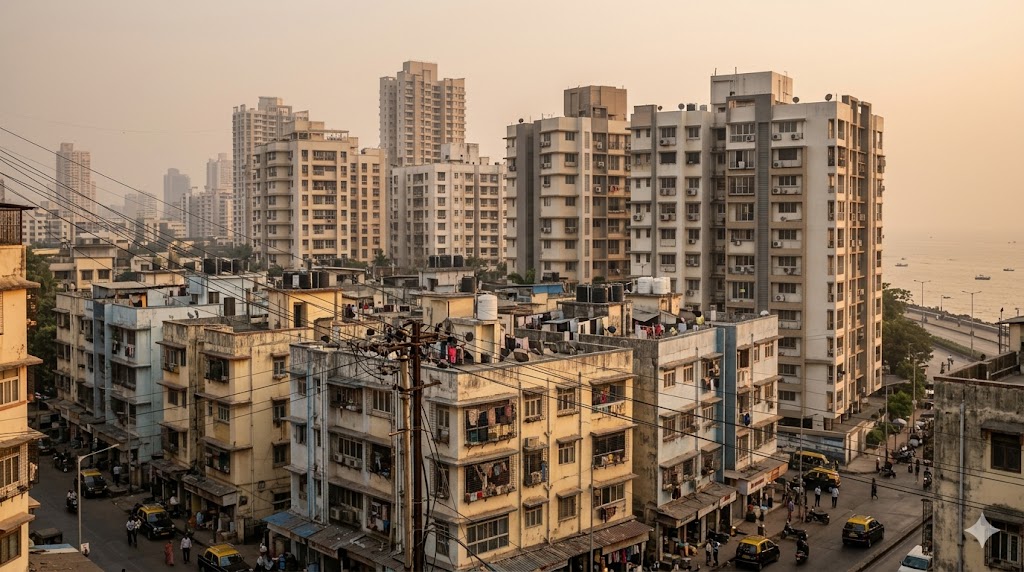
The Architect's Compliance Map — Mumbai
MCGM, MMRDA, SRA, MahaRERA, MPCB, CRZ — DCPR 2034, Premium and Fungible FSI, TDR, Heritage Overlays, and the Operational Workflow for Residential Practice in 2026
Mumbai is the densest residential market in India, the most expensive land market in India, and consequently the most regulatory-intricate jurisdiction in which an architect can practice. A single 5,000-square-foot plot in South Mumbai may sit simultaneously under MCGM (corporation), the Maharashtra Heritage Conservation Committee (heritage precinct), the Coastal Regulation Zone (CRZ) overlay, the Airports Authority of India (height NOC near Mumbai airport approach corridors), and a co-operative housing society (whose NOC is a contractual rather than statutory requirement, but binding nonetheless). A single plot in Bandra-East may be under MCGM, MHADA (if it sits within an MHADA-redeveloped layout), AGNI portal compliance, premium-FSI policy, and slum-cluster development regulation. A single plot in Thane or Navi Mumbai may be under MMRDA, CIDCO, MPCB, and a different DCR altogether (Thane DCR or Navi Mumbai DCR rather than DCPR 2034).
The architect practising in Mumbai cannot reduce this complexity by hope or intuition. The map of which authority does what, in what sequence, with which deliverables, must be in working memory — and the operational discipline of staying current with DCPR amendments, MahaRERA circulars, and SRA scheme notifications must be a continuous practice, not a project-by-project exercise. This guide is the working reference for that map. It is intended for the practising architect — independent or studio-employed — who is building, approving, or verifying residential projects within the Mumbai Metropolitan Region in 2026, and whose client has asked "can I redevelop this 1950s building under cluster development, or do I need to go SRA?" and needs to give a defensible answer.
The treatment is operational, not statutory-exhaustive. The Maharashtra Regional and Town Planning Act, 1966 (MRTP Act), the Mumbai Municipal Corporation Act, 1888, the Development Control and Promotion Regulations 2034 (DCPR 2034), the Maharashtra Real Estate (Regulation and Development) Rules 2017, the Slum Areas (Improvement, Clearance and Redevelopment) Act 1971, and the Coastal Regulation Zone Notification 2019 are the underlying statutory authorities; this guide explains how they intersect in the day-to-day workflow of a Mumbai residential architect. The companion Architect's Compliance Map — Bengaluru guide provides a parallel reference for that city; this guide takes Mumbai's specific instances.
The 2026 framework reflects current Mumbai practice including the AGNI (Auto DCR / Building Plan Auto Approval) portal, the DPMS (Development Permission Management System), MahaRERA's online registration framework, and the most recent DCPR 2034 amendments through Q1 2026. Architects must verify against current circulars and notifications at the time of any specific project filing — Mumbai's regulatory framework is the most-amended in India, with material changes in nearly every six-month period.
"In Mumbai, every plot has a complication; the architect's first task is to map the complication before the design begins." — Construction-law commentary, paraphrased from the Bombay High Court bar
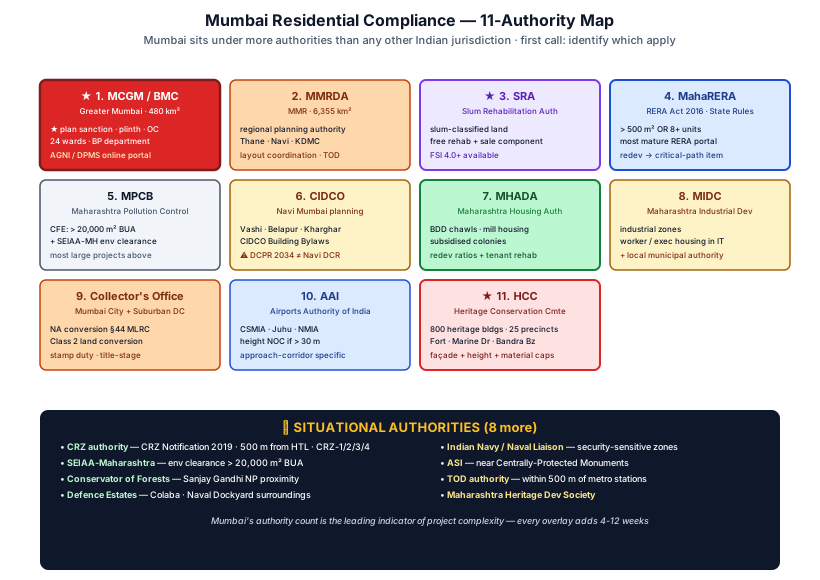
1. The Eleven-Authority Map
Mumbai's residential architecture sits under more authorities than any other Indian jurisdiction. The architect's first orientation is to identify which authorities apply to a specific project.
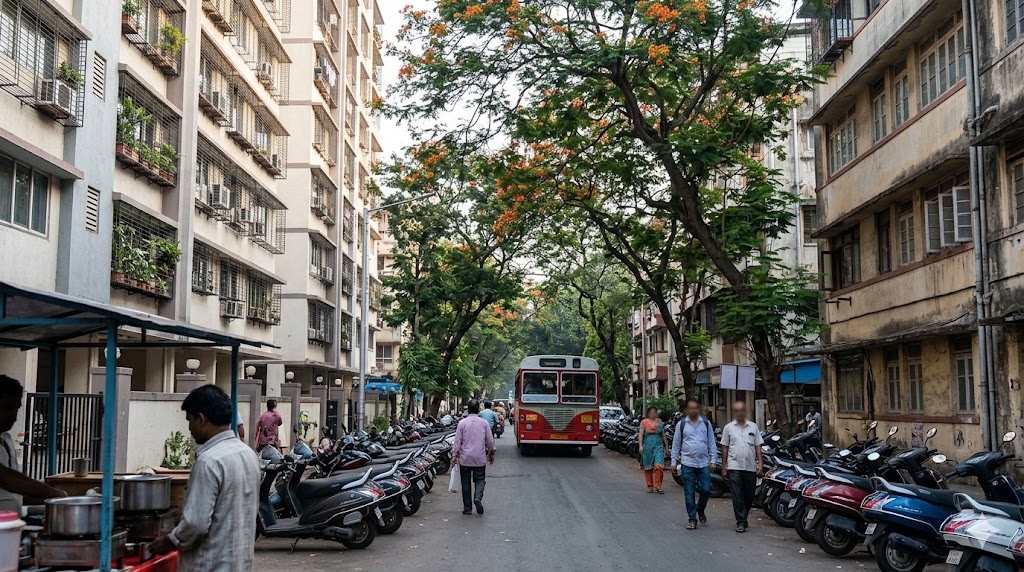
Authority 1 — MCGM (Municipal Corporation of Greater Mumbai) / BMC
Brihanmumbai Municipal Corporation (Marathi: बृहन्मुंबई महानगरपालिका) — operating as MCGM (Municipal Corporation of Greater Mumbai) for English-language correspondence — is the corporation-level authority for the Greater Mumbai region of approximately 480 square kilometres. MCGM is the primary plan-sanctioning, plinth-verifying, and occupancy-certifying authority for all residential projects within MCGM limits.
MCGM operates through 24 administrative wards (A through R-North) and the Building Proposal (BP) department within each ward. The architect's primary interaction is with the BP department of the relevant ward, and with the centralised AGNI/DPMS online portal for plan submissions.
Authority 2 — MMRDA (Mumbai Metropolitan Region Development Authority)
Mumbai Metropolitan Region Development Authority covers the broader Mumbai Metropolitan Region — approximately 6,355 square kilometres including Thane, Kalyan-Dombivli, Navi Mumbai, Mira-Bhayander, and surrounding municipalities. MMRDA is the regional planning authority and a coordinating authority across multiple agencies. For residential projects in MMRDA jurisdiction, the primary plan-sanction is by the local municipal corporation (Thane Municipal Corporation, Navi Mumbai Municipal Corporation, etc.) under their respective DCRs — but MMRDA-level coordination applies for layout-level approvals and major projects.
Authority 3 — SRA (Slum Rehabilitation Authority)
Slum Rehabilitation Authority is constituted under the Slum Areas (Improvement, Clearance and Redevelopment) Act, 1971, as amended for Maharashtra. SRA is the primary authority for any project on land that is officially classified as a slum — and a vast portion of Mumbai's residential land carries this classification, even where no informal habitation currently exists. SRA approves slum redevelopment schemes that combine free rehabilitation housing for eligible slum-dwellers with sale-component buildings for the developer.
The SRA scheme is one of the most lucrative redevelopment pathways in Mumbai because it permits very high FSI (often 4.0+) on the original plot in exchange for free housing delivery. The architect's role on SRA projects is significant — DPR (Detailed Project Report) preparation, sanction-package development, layout coordination with the existing slum, and post-sanction re-tenanting verification.
Authority 4 — MahaRERA (Maharashtra Real Estate Regulatory Authority)
Maharashtra Real Estate Regulatory Authority is the state-level RERA, established under the Real Estate (Regulation and Development) Act, 2016, and the Maharashtra Real Estate (Regulation and Development) Rules, 2017. MahaRERA registration is mandatory for any new project — promoter-developed multi-unit residential projects — exceeding 500 square metres of land area or 8 dwelling units, whichever is lower. MahaRERA's online portal is among the most operationally mature among Indian RERAs.
For owner-occupier single residences, MahaRERA does not apply. For redevelopment projects (the dominant category in Mumbai residential), MahaRERA does apply and the registration timeline is on the project's critical path.
Authority 5 — MPCB (Maharashtra Pollution Control Board)
Maharashtra Pollution Control Board is the state-level environmental authority. For residential projects, MPCB Consent for Establishment (CFE) is required for projects exceeding built-up area thresholds (currently 20,000 sqm under MoEFCC EIA Notification 2006 as amended) and for specific use categories. Larger Mumbai residential projects routinely fall above this threshold, triggering both MPCB consent and SEIAA-Maharashtra environmental clearance.
Authority 6 — CIDCO (City and Industrial Development Corporation of Maharashtra)
City and Industrial Development Corporation is the planning and development authority for Navi Mumbai (a planned satellite city) and parts of the wider Mumbai region. For residential projects in Navi Mumbai (the nodes — Vashi, Belapur, Kharghar, Panvel, Ulwe, etc.), CIDCO is the layout-and-plan-sanctioning authority. Navi Mumbai's DCR is distinct from DCPR 2034 — it follows the CIDCO Building Bylaws, with significantly different FSI, setback, and parking norms.
Authority 7 — MHADA (Maharashtra Housing and Area Development Authority)
Maharashtra Housing and Area Development Authority is the state housing authority. MHADA owns and manages a substantial inventory of residential land and buildings — particularly older affordable-housing layouts (BDD chawls, mill workers' housing, subsidised colonies). For any project on MHADA-allotted land or for redevelopment of MHADA buildings, MHADA is a critical authority — granting NOCs, prescribing redevelopment ratios, and approving the architect's drawings.
The MHADA redevelopment process is its own sub-discipline within Mumbai residential practice, with specific FSI ratios, free-component-to-sale-component ratios, and tenant-rehabilitation requirements.
Authority 8 — MIDC (Maharashtra Industrial Development Corporation)
Maharashtra Industrial Development Corporation governs land in Maharashtra's industrial development zones. While primarily commercial/industrial, MIDC zones occasionally include residential plots (worker housing, executive housing within industrial townships). For these, MIDC is a sanctioning authority alongside the local municipal authority.
Authority 9 — Collector's Office (Mumbai City / Mumbai Suburban)
The Collector's Office (District Collector / Sub-Divisional Magistrate offices) is responsible for: (a) NA conversion of land from agricultural to non-agricultural use under §44 of the Maharashtra Land Revenue Code, 1966; (b) Class 2 land conversion (where land is held under encumbered tenure); (c) certain occupation certificate approvals where MCGM has delegated authority; (d) Stamp Duty matters. For Mumbai City and Mumbai Suburban districts, the Collector's interaction with residential projects is mostly at the title-stage level.
Authority 10 — AAI (Airports Authority of India)
Airports Authority of India mandates height NOC for any plot within designated zones around Mumbai airports — Chhatrapati Shivaji Maharaj International Airport (CSMIA, Santacruz/Sahar), Juhu Aerodrome, and the upcoming Navi Mumbai International Airport. The NOC is mandatory for projects exceeding specified height thresholds in the approach-corridor zones — typically 30 m, though specific to plot location.
Authority 11 — Heritage Conservation Committee (HCC) and Heritage Precincts
The Heritage Conservation Committee of MCGM regulates approximately 800 heritage buildings and 25 heritage precincts in Mumbai (Fort, Marine Drive, Khotachiwadi, Bhuleshwar, Bandra Bazar, etc.). For plots within these precincts, design controls are significantly more restrictive — height caps, façade conformity, material restrictions, and demolition prohibitions all apply. The HCC's NOC is required before any sanction.
The Other Authorities
Several supporting authorities appear in specific situations:
- Coastal Regulation Zone (CRZ) authority — implementing the CRZ Notification 2019 for plots within 500 m of high-tide line; categorises into CRZ-1 (no development), CRZ-2 (existing-development zone with restrictions), CRZ-3 (low-density), CRZ-4 (water bodies)
- State Environmental Impact Assessment Authority (SEIAA-Maharashtra) — for environmental clearance of projects above 20,000 sqm built-up
- Maharashtra Heritage Development Society
- Chief Conservator of Forests — for plots near Sanjay Gandhi National Park or designated forest land
- Defence Estates — for plots in defence-controlled zones (Colaba, Naval Dockyard surroundings)
- Indian Navy / Naval Liaison — for plots in naval-security-sensitive zones
- ASI (Archaeological Survey of India) — for plots near Centrally-Protected Monuments (Gateway of India, Mani Bhavan, Elephanta-context proximity)
- MMRDA Transit Oriented Development (TOD) authority — for plots within 500 m of designated metro stations
The Studio Matrx Approval Roadmap utility's Mumbai profile maps these authorities to plot location.
2. The Property Card and Title-Stage Workflow
Before any approval is sought, the property card and title chain must be unambiguous. Mumbai's title regime is more complex than most Indian cities because of historical layered ownership (ground rent, freehold, leasehold), the Bombay Tenancy and Agricultural Lands Act overlays, and the coexistence of multiple title-record systems.
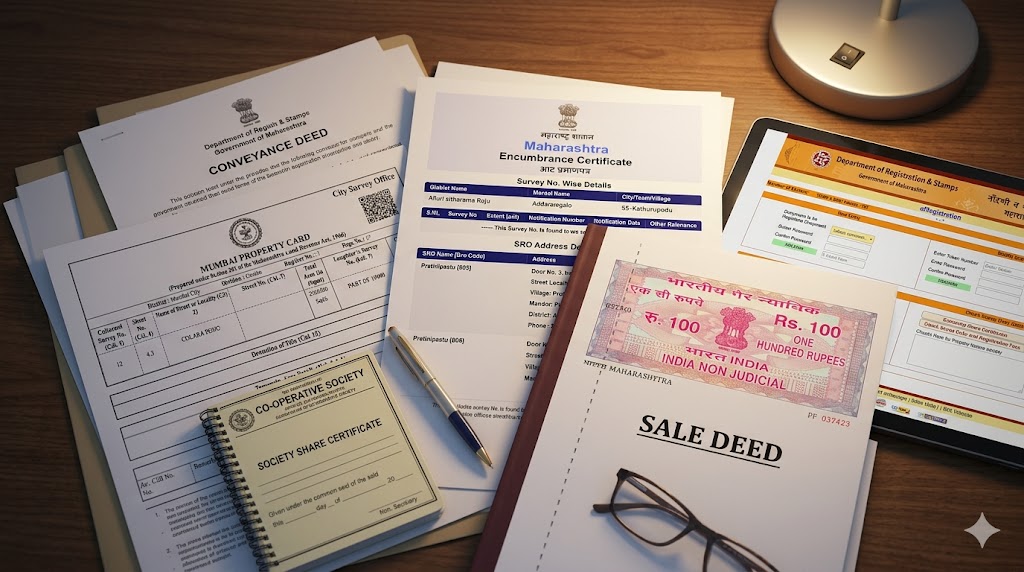
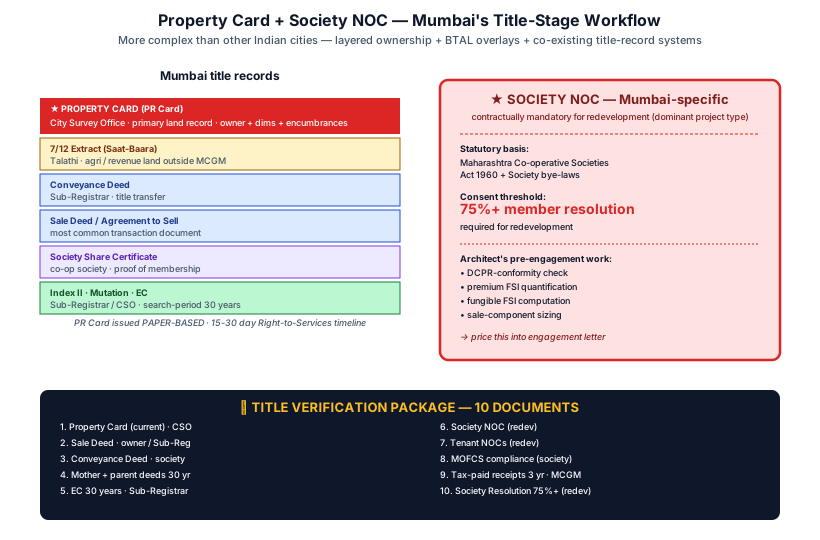
Mumbai's Title Records
| Record | Equivalent To | Authority | Purpose |
|---|---|---|---|
| Property Card (PR Card) | Bengaluru's Khata Extract | City Survey Office | Mumbai's primary land-record document; shows owner, plot dimensions, encumbrances |
| 7/12 Extract (Saat-Baara) | — | Talathi / Tahsildar | For agricultural and revenue land outside MCGM limits |
| Conveyance Deed | — | Sub-Registrar | Title transfer document |
| Sale Deed / Agreement to Sell | — | Sub-Registrar | Most common transaction document |
| Society Share Certificate | — | Co-operative Society | For apartments — proof of society membership |
| Index II | — | Sub-Registrar | Public record of registered transactions |
| Mutation Entry | — | City Survey Office | Updates ownership in the property card |
| Encumbrance Certificate | — | Sub-Registrar | Confirms no liens within search period |
The Property Card Procedure
For any new project in MCGM jurisdiction, the architect must obtain a current Property Card from the City Survey Office of the relevant zone. The Property Card lists:
- The current owner (or owners)
- Plot dimensions and bearings
- Plot boundary description
- Encumbrances and adverse remarks (society dues, tax arrears, court orders)
- Survey number and CTS (City Survey) number
Property Cards are issued paper-based in Mumbai (in 2026, with progressive digitisation underway). Order timelines from the City Survey Office are typically 15–30 days under the Maharashtra Right to Public Services Act, 2015.
Title Verification Package
The architect's title verification package for a Mumbai residential project comprises:
| Document | Source | Purpose |
|---|---|---|
| Property Card (current) | City Survey Office | Primary title record |
| Sale Deed (original) | Owner / Sub-Registrar | Title transfer |
| Conveyance Deed (for societies) | Society / Sub-Registrar | Society's title transfer |
| Mother Deed / Parent Deeds (chain of 30 years) | Sub-Registrar | Title chain |
| Encumbrance Certificate (30 years) | Sub-Registrar | Encumbrance chain |
| Society NOC (for apartment redevelopment) | Co-op Society | Authorisation for redevelopment |
| No-Objection Certificate from existing tenants | Tenants | For redevelopment projects |
| MOFCS (Maharashtra Ownership of Flats Cooperative Society Act) compliance for societies | Society | For multi-unit projects |
| Tax-paid receipts (last 3 years) | MCGM | Tax compliance |
| Society Resolution (for redevelopment) | Society | 75% member consent typically required |
The Society NOC — A Mumbai-Specific Critical Requirement
For redevelopment of apartment buildings in Mumbai (the dominant project type in Mumbai residential), the Society's General Body Resolution and NOC are not statutorily mandated by MRTP/DCPR but are contractually mandatory — without them, the developer cannot proceed and individual flat-owners cannot be displaced. The Maharashtra Co-operative Societies Act, 1960, and the model bye-laws of the Maharashtra State Co-operative Housing Federation set the consent thresholds (typically 75% member resolution for redevelopment).
The architect's role in the society-NOC process is to provide pre-sanction development feasibility — DCPR-conformity check, premium FSI quantification, fungible FSI computation, and the sale-component sizing — that supports the developer's offer to the society. This is pre-engagement design work and must be priced into the engagement letter.
3. The Permit Chain — From Property Card to Possession
The full permit chain for a Mumbai residential project, in sequence:
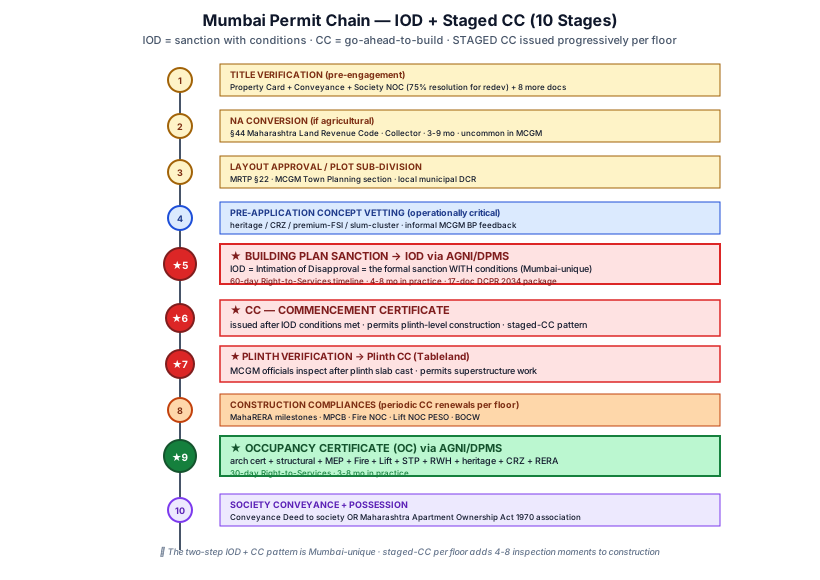
Stage 1 — Title Verification (Pre-Engagement)
(See §2 above — Property Card, conveyance deed, society NOC chain.)
Stage 2 — NA Conversion (If Required)
For plots that are still classified as agricultural in the 7/12 extract — uncommon within MCGM but common in MMRDA periphery — NA (Non-Agricultural) conversion under §44 of the Maharashtra Land Revenue Code, 1966, is required. The Collector grants NA conversion upon application supported by survey records, soil-status certificate, and zoning conformity.
NA conversion timelines: 3–9 months. Conversion fees vary by zone classification.
Stage 3 — Layout Approval / Plot Sub-Division (If Applicable)
For plots requiring sub-division or layout approval, the local municipal authority (MCGM, Thane, Navi Mumbai, etc.) sanctions the layout under MRTP §22 and the local DCR. Within MCGM, layout approvals are granted by the Town Planning section.
Stage 4 — Pre-Application Concept Vetting
Mumbai's residential market commonly involves a pre-application concept vetting with the MCGM BP department for any non-routine project — heritage-precinct work, CRZ-overlay plots, premium-FSI consumption, slum-cluster redevelopment. The architect submits a concept package and obtains informal feedback before the formal sanction application. This stage is not statutorily required but is operationally critical for non-standard projects.
Stage 5 — Building Plan Sanction (Building Permission / IOD)
The core architectural-permit stage. Within MCGM, the application is filed via the AGNI / DPMS portal — Mumbai's online plan-submission system. The sanction is issued in two parts:
- IOD (Intimation of Disapproval) — despite the negative-sounding name, this is the formal sanction with conditions (subject to which the permission is granted)
- CC (Commencement Certificate) — issued after the IOD conditions are met; permits actual construction to start
This two-step pattern is unique to Mumbai (and a few other cities) and surprises architects new to the jurisdiction. The IOD is the sanction; the CC is the go-ahead-to-build.
The plan-sanction package per DCPR 2034:
| Package Element | Specification |
|---|---|
| Site plan | Showing plot dimensions, setbacks, north arrow, scale 1:200 |
| Architectural plans | Each floor at 1:100 minimum, with FSI computation and Fungible FSI breakdown |
| Sections | Showing height, plinth, parapet, basement |
| Elevations | All four (or applicable) faces |
| FSI / setback compliance certificate | Architect's certificate per DCPR 2034 |
| Parking layout | Per DCPR 2034 norms (zone and unit-size dependent) |
| Drainage and rainwater layout | Per DCPR 2034 |
| Soil-investigation report | Mandatory for high-rise; recommended for all plots |
| Structural certificate | From a licensed structural engineer (registered with MCGM) |
| Architect's licensing details | CoA registration, MCGM-empanelled architect requirement |
| Title documents | Property Card, Conveyance, EC, parent deeds, society NOC |
| Heritage NOC (in heritage precincts) | From HCC |
| CRZ NOC (in CRZ zones) | From state CRZ authority |
| AAI height NOC (in approach corridors) | From AAI |
| MHADA NOC (for MHADA land or redevelopment) | From MHADA |
| Tree NOC (for any tree cutting) | From MCGM Tree Authority |
| Society 75% resolution (for redevelopment) | From the society |
| Existing-tenant rehabilitation plan (for redevelopment) | Architect-certified plan |
The Maharashtra Right to Public Services Act timeline for IOD is 60 calendar days from complete submission. In practice, IOD timelines extend to 4–8 months for complex projects.
Stage 6 — CC (Commencement Certificate)
After IOD conditions are met (NOC submissions, fee payments, structural-design vetting), the MCGM issues the Commencement Certificate. CC permits plinth-level construction; further-stage CCs (CC for first floor, CC for top floor) are issued progressively as the project advances. This staged-CC model is also Mumbai-specific.
Stage 7 — Plinth Verification
After plinth slab cast, MCGM officials inspect and verify plinth-level work; the Plinth CC (also known as Plinth Tableland verification) permits superstructure work. The detailed treatment is in the OC/CC and Plinth Verification guide.
Stage 8 — Construction-Stage Compliances
During construction:
- Periodic CC renewals as construction reaches each level
- MahaRERA milestone reporting for promoter-developed projects
- MPCB consent compliance for >20,000 sqm projects
- Fire NOC at structural completion (under Maharashtra Fire Prevention and Life Safety Measures Act, 2006)
- Lift NOC (PESO) at lift installation
- Labour Department compliance under the Maharashtra Building & Other Construction Workers Act
Stage 9 — OC (Occupancy Certificate)
On completion, the architect submits the application for OC via AGNI/DPMS, accompanied by:
- Architect's completion certificate
- Structural completion certificate
- MEP completion certificates
- Fire NOC
- Lift NOC
- STP commissioning certificate (where applicable)
- Rainwater harvesting commissioning certificate
- Solar provisions compliance (where applicable)
- MHADA NOC (for MHADA layouts)
- Heritage compliance certificate (for heritage precincts)
- CRZ compliance certificate (for CRZ zones)
- Final environmental clearance (for SEIAA-cleared projects)
- MahaRERA completion report
The Maharashtra Right to Public Services Act timeline for OC is 30 calendar days from complete submission. In practice, OC takes 3–8 months because of the document-chain complexity.
Stage 10 — Society Conveyance and Possession
For multi-unit projects, the developer executes Conveyance Deed in favour of the proposed co-operative housing society (or apartment ownership association under the Maharashtra Apartment Ownership Act, 1970). This is the final title-transfer step that converts individual flat-owners' agreements-to-sell into full ownership through the society structure.
4. The DCPR 2034 Dimensional Framework
The Development Control and Promotion Regulations 2034 — superseding the older DCR 1991 — are the dimensional framework for all Mumbai residential design within MCGM jurisdiction. The DCPR 2034 introduces several novel concepts that distinguish Mumbai from other Indian cities.
Base FSI (Floor Space Index)
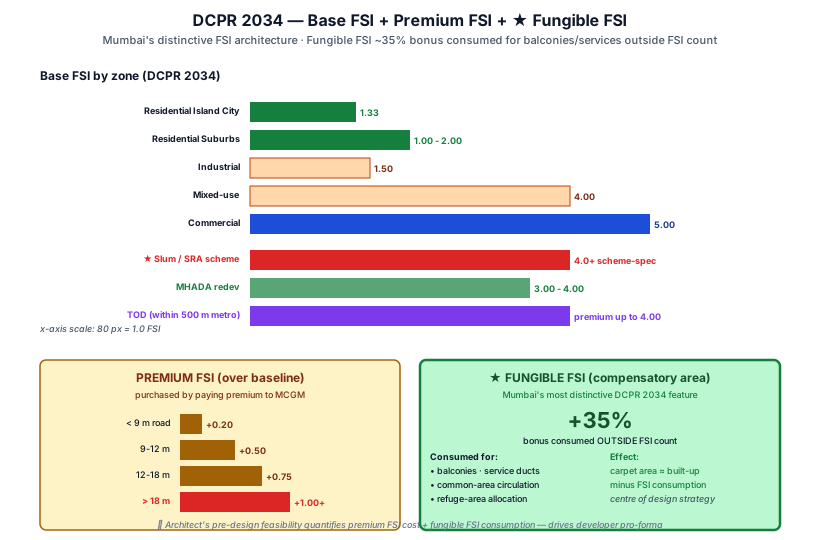
DCPR 2034 baseline FSI varies by zone:
| Zone / Category | Base FSI |
|---|---|
| Residential (R-zones in Greater Mumbai) | 1.33 (Island City) / 1.00–2.00 (Suburbs, varies) |
| Commercial | 5.00 |
| Mixed-use | 4.00 |
| Industrial | 1.50 |
| Slum land (under SRA scheme) | 4.0+ (scheme-specific) |
| MHADA layouts (redevelopment) | 3.00–4.00 (project-specific) |
| Cluster development scheme (CDS) | 4.00 |
| TOD zones (within 500 m of metro stations) | Premium-bonus FSI up to 4.00 |
These figures are indicative; specific plot zoning, road width, and overlay applications modify them. The architect must verify against the current DCPR 2034 with all amendments at filing time.
Premium FSI
DCPR 2034 permits Premium FSI — purchase of additional FSI over the baseline by paying a premium to MCGM. Premium FSI is calibrated by zone and road width:
| Plot Frontage Road | Premium FSI Available (over baseline) |
|---|---|
| < 9 m | Limited premium (typically 0.20) |
| 9–12 m | 0.50 |
| 12–18 m | 0.75 |
| > 18 m | 1.00 + (further negotiated) |
Premium FSI rates are revised periodically; the architect's pre-design feasibility study quantifies the premium FSI cost for the developer.
Fungible FSI (Compensatory Area)
The most distinctive DCPR 2034 feature is Fungible FSI — a compensatory area allowance of typically 35% of FSI that the developer may consume outside the conventional FSI count. Fungible FSI is consumed for:
- Balconies
- Service ducts
- Common-area circulation
- Refuge-area allocation
- Mezzanine in lobbies
The Fungible FSI mechanism allows a project to deliver carpet area to the buyer equivalent to roughly built-up area minus FSI consumption — a significant economic improvement over older DCRs. The architect's design strategy on Mumbai residential projects centres on optimal Fungible FSI consumption.
TDR (Transferable Development Rights)
Mumbai operates the largest TDR market in India. TDR is FSI that may be transferred from one plot (the generator — typically slum-cleared land or road-widening surrendered land) to another plot (the receiver). The receiver plot may consume the TDR over and above the baseline and premium FSI, subject to ceilings and zone-specific limits.
For mid-to-high-rise residential projects in Mumbai, TDR purchase is a common design strategy — buying TDR at market rates (typically ₹3,500–7,500 per square foot of TDR area, varying by source and zone) to hit the desired total FSI. The architect must coordinate the TDR-receiver-plot eligibility with the design intent.
Setback and Height
DCPR 2034 ties height to setback through the light-and-air-passage formula:
Setback = (Building Height × 0.5) + (zone-specific minimum)
Specific minimum setbacks by plot frontage:
| Plot Frontage Road | Front Setback | Side Setback | Rear Setback |
|---|---|---|---|
| < 9 m | 1.5 m | 1.5 m | 3.0 m |
| 9–12 m | 4.5 m | 3.0 m | 4.5 m |
| 12–18 m | 7.5 m | 4.5 m | 6.0 m |
| > 18 m | 10.5 m | 6.0 m | 7.5 m |
These figures apply progressively with building height under the formula above.
Parking Requirements
DCPR 2034 parking — distinguished by unit size and zone:
| Unit Carpet Area | Parking Standard |
|---|---|
| < 30 sqm | 0.25 car spaces |
| 30–60 sqm | 0.5 car space |
| 60–90 sqm | 1 car space |
| 90–120 sqm | 1.25 car spaces |
| 120–180 sqm | 1.5 car spaces |
| > 180 sqm | 2 car spaces |
Plus visitor parking (5–10% of dwelling-unit parking) and two-wheeler parking (typically 50% of car-space count).
Other Mandatory Provisions
- Refuge area — for buildings above 24 m height, a refuge floor every 7 floors per the Maharashtra Fire Prevention Act
- Fire-fighting infrastructure — water tank, hydrants, sprinklers per height
- Solar provisions — solar water heater (where applicable) and roof PV provision under Maharashtra Solar Building Rules
- Rainwater harvesting — mandatory for all plots > 300 sqm
- STP — mandatory for projects > 50 dwelling units
- Refuge area balcony — accessible balcony at each refuge floor
- Disability access — per NBC 2016 Part 3 §13 and Mumbai's universal-design regulations (per the Universal-Design Adaptable Homes guide)
5. The CRZ (Coastal Regulation Zone) Overlay
Mumbai's coastline imposes a regulatory layer that does not apply in inland cities. The Coastal Regulation Zone Notification 2019 (and earlier 2011, 1991 versions for legacy projects) categorises coastal land into four zones, each with distinct development restrictions.
| CRZ Category | Description | Development Permitted |
|---|---|---|
| CRZ-I | Eco-sensitive zone (high-tide line + sensitive habitats) | No development; existing uses only |
| CRZ-II | Existing developed area within 500 m of high-tide line | Existing uses + redevelopment with restrictions |
| CRZ-III | Low-density zone (rural/agricultural) | Limited residential development |
| CRZ-IV | Water bodies | No development |
A vast portion of Mumbai sits in CRZ-II, including the Bandra-Worli sea-link adjacent areas, Marine Drive, Walkeshwar, Cuffe Parade. For redevelopment in CRZ-II, the FSI is capped at the existing built-up area (no expansion beyond the original footprint), with limited incremental FSI permitted for safety and amenity additions.
The CRZ NOC is issued by the Maharashtra Coastal Zone Management Authority (MCZMA) — typically 60–120 day timeline. The architect's pre-design CRZ verification is essential for any plot within 500 m of the high-tide line; the latest CRZ map and notifications must be consulted.
The CRZ regime is the single most consequential regulatory overlay for Mumbai residential projects. Architects routinely lose 6–18 months on CRZ-related issues that were not flagged at engagement.
6. Heritage Precincts and Heritage Buildings
Mumbai has approximately 800 heritage buildings (Grade I, II, III) and 25 heritage precincts. The Heritage Conservation Committee of MCGM regulates demolition, redevelopment, and façade alteration in these zones.
The heritage classifications:
| Grade | Description | Restrictions |
|---|---|---|
| Grade I | Buildings of national importance | No demolition; only restoration permitted |
| Grade IIA | Buildings of regional/state importance | Demolition prohibited; sympathetic alterations only |
| Grade IIB | Buildings of local importance | Redevelopment with façade conservation |
| Grade III | Buildings contributing to heritage character | Redevelopment with sensitivity guidelines |
For plots within heritage precincts (whether or not the specific building is heritage-listed), the precinct-level controls apply — typically height caps (often 24 m or below), façade-alignment requirements, material restrictions (no glass-curtain-wall in heritage precincts), and window-rhythm conformity to neighbouring buildings.
The HCC's NOC is mandatory for any sanction in a heritage precinct. The architect's pre-design verification of heritage precinct status is essential; the MCGM heritage precinct map is the reference.
7. Slum Rehabilitation Authority (SRA) Schemes
Approximately 60% of Mumbai's residents live on land officially classified as slums; the SRA scheme is the redevelopment pathway. For architects working on SRA projects:
SRA Scheme Mechanics
- Eligibility: Slum-dwellers documented in the electoral roll before specified cut-off dates (varying by amendment, currently 2011 for most schemes)
- Free housing: Each eligible slum-dweller is entitled to a free 30-sqm carpet-area apartment in the redeveloped scheme
- Sale component: The developer constructs additional sale-component flats from the FSI bonus (typically 1.5–2.0× the rehab-component built-up area, depending on scheme type)
- FSI: Schemes can achieve total FSI of 4.0+ — significantly above the underlying zone baseline
- Approval: SRA, not MCGM, is the primary sanctioning authority for SRA projects
Architect's Role on SRA Projects
The architect prepares the Detailed Project Report (DPR) — the comprehensive scheme document that includes existing-condition survey, eligible-tenant list, layout plan, building plans, FSI computation, free-component sizing, sale-component sizing, financial viability statement, and rehabilitation programme. The DPR is the primary input to SRA scheme approval; it requires significantly more documentation than a conventional MCGM application.
The Studio Matrx Risk Index utility incorporates SRA-specific risk patterns (eligibility disputes, tenancy verification, scheme-mode changes).
8. The MahaRERA Interface
For developer-promoted multi-unit residential projects above the MahaRERA threshold (500 sqm or 8 units), the architect's drawings, specifications, and approvals form the foundation of the MahaRERA registration package.
MahaRERA Registration Package (Architect's Inputs)
The architect provides, for MahaRERA registration:
- Sanctioned plan (MCGM IOD-stamped)
- Project programme (timelines per phase)
- Specifications schedule (all materials and workmanship per BOQ)
- Common-area schedule (lifts, lobbies, amenities)
- FSI statement and area calculations
- Carpet-area schedule per unit (RERA-conformant)
- NOC chain (heritage, CRZ, AAI, MHADA, Society as applicable)
- Architect's licensing details
- Title-chain documentation
MahaRERA Carpet Area Discipline
MahaRERA mandates carpet area — not built-up area or super built-up area — as the only permissible area metric in marketing and sales documents. The carpet area is computed per RERA Section 2(k) — net usable floor area excluding external walls, ducts, and common areas.
In Mumbai's context, the divergence between super-built-up (historically 1.4–1.5× carpet) and carpet area is significant. Architects routinely advise developer clients on carpet-area calibration and on the marketing-vs-architecture truthfulness alignment.
9. Common Red Flags and Risk Patterns
Eight recurring issue patterns in Mumbai residential plan sanction and OC, with their architectural prevention:
Red Flag 1 — CRZ Overlay Surprise
The plot falls within CRZ-II or CRZ-III, restricting development. Discovered at the BP application stage. The architect's response: pre-design CRZ verification via MCZMA portal; if CRZ overlay applies, design within CRZ constraints rather than discovering at sanction.
Red Flag 2 — Heritage Precinct
The plot falls within a designated heritage precinct (often surprises owners who were unaware). Design controls cap height and require façade conformity. The architect's response: pre-design heritage precinct verification via MCGM heritage map.
Red Flag 3 — Title Defect / Society Non-Cooperation
For redevelopment projects, the Society's General Body fails to muster 75% consent for redevelopment. The architect's response: pre-engagement check of society dynamics; staged consent-building meetings; the developer's commercial-terms negotiation.
Red Flag 4 — MHADA Land Without NOC
The plot is on MHADA-allotted land but the MHADA NOC has not been obtained. Plan sanction is not possible without MHADA's permission. The architect's response: verify MHADA-land status at engagement; MHADA NOC takes 90–180 days.
Red Flag 5 — AAI Approach-Corridor Height Cap
The plot is within Mumbai airport approach corridors; height is capped well below DCPR base allowance. The architect's response: pre-design AAI verification via the AAI online height-NOC tool (which generates a preliminary opinion within hours).
Red Flag 6 — Slum Notification Without Rehabilitation Scheme
The plot has been officially notified as a slum (under the Slum Areas Act) but no rehabilitation scheme has been formed. Conventional development is blocked; only SRA-mode redevelopment is permitted. The architect's response: pre-engagement verification of slum-notification status; if applicable, pivot to SRA mode.
Red Flag 7 — Cluster Development Eligibility
The plot is within a cluster of old buildings that may be eligible for Cluster Development Scheme (CDS) — a specific DCPR 2034 mechanism for redeveloping clusters of dilapidated buildings. CDS produces higher FSI but requires multi-society coordination. The architect's response: feasibility analysis of CDS-vs-individual-redevelopment at engagement.
Red Flag 8 — Tenant Rehabilitation Disputes (Redevelopment)
For tenanted-building redevelopment, individual tenant disputes over rehabilitation areas, displacement timelines, or rent allowances during construction can paralyse the project for months or years. The architect's response: developer's pre-engagement tenant-mapping; clear rehabilitation-package documentation in society resolutions.
The Studio Matrx Red Flag Checklist and Risk Index utilities incorporate these patterns into project-specific risk registers.
10. The Architect's Working Toolkit for Mumbai
The operational synthesis — the architect's working toolkit for Mumbai residential practice in 2026:
Pre-Engagement
1. Property Card collection (City Survey Office)
2. Title chain verification (sale deed, conveyance, parent deeds, EC)
3. Society NOC and resolution status (for redevelopment)
4. CRZ verification via MCZMA portal
5. Heritage precinct verification via MCGM heritage map
6. AAI height NOC pre-check via AAI portal
7. Slum notification check via SRA portal
8. MHADA-land verification via MHADA portal
At Engagement (Stage 1)
9. Engagement letter with Mumbai-specific clauses
10. DCPR-conformity feasibility study (premium FSI, fungible FSI, TDR consumption strategy)
11. Programme plan with realistic Mumbai-specific timelines
12. Risk register capturing the eleven authorities and red flags
Through Stages 2–5 (Design)
13. AGNI/DPMS application preparation in parallel with working drawings
14. NOC chain initiation (heritage, CRZ, AAI, MHADA, Society) at Stage 3
15. Pre-application concept vetting with MCGM BP for non-routine projects
16. Premium FSI quantification and TDR-purchase strategy
At Construction (Stage 6)
17. IOD condition compliance to obtain CC
18. Plinth verification (Plinth CC) at plinth completion
19. Staged-CC renewals as construction progresses
20. MahaRERA milestone reporting for promoter projects
21. MEP and structural completion-certificate coordination
At Completion (Stage 7)
22. OC application via AGNI/DPMS with full document chain
23. MahaRERA completion report
24. Society conveyance for multi-unit projects
25. Final possession documentation
The Studio Matrx Approval Roadmap, Bylaw Checker, Construction Approval Checklist, and Pre-Possession Checklist utilities are calibrated for Mumbai's specific authority chain.
11. References and Further Reading
Maharashtra Statutes
- Maharashtra Regional and Town Planning Act, 1966 (MRTP Act). Government of Maharashtra. The foundational urban-planning statute.
- Mumbai Municipal Corporation Act, 1888. Government of Maharashtra. Governs MCGM.
- Maharashtra Land Revenue Code, 1966. Government of Maharashtra. §44 (NA conversion).
- Maharashtra Co-operative Societies Act, 1960. Government of Maharashtra.
- Maharashtra Apartment Ownership Act, 1970. Government of Maharashtra.
- Maharashtra Stamp Act, 1958. Government of Maharashtra.
- Maharashtra Slum Areas (Improvement, Clearance and Redevelopment) Act, 1971. Government of Maharashtra (and SRA scheme rules).
- Maharashtra Real Estate (Regulation and Development) Rules, 2017. Government of Maharashtra.
- Maharashtra Right to Public Services Act, 2015. Government of Maharashtra.
- Maharashtra Fire Prevention and Life Safety Measures Act, 2006. Government of Maharashtra.
Mumbai-Specific Regulations
- Development Control and Promotion Regulations 2034 (DCPR 2034). Municipal Corporation of Greater Mumbai. The current Mumbai DCR with all amendments.
- Mumbai Heritage Conservation Committee — Listings and Precinct Maps. MCGM.
- Coastal Regulation Zone Notification 2019. Ministry of Environment, Forest and Climate Change, Government of India.
- CIDCO Building Bylaws. City and Industrial Development Corporation. For Navi Mumbai.
- Thane Municipal Corporation DCR. For Thane Municipal area.
- Navi Mumbai Municipal Corporation DCR.
- MMRDA Regulations and Master Plan.
- MHADA Act and Redevelopment Rules.
National Statutes (Applicable)
- Real Estate (Regulation and Development) Act, 2016 (RERA). Government of India.
- National Building Code of India, NBC 2016. Bureau of Indian Standards.
- Architects Act, 1972. Government of India.
- Building and Other Construction Workers Act, 1996. Government of India.
Online Portals and Authorities
- AGNI / DPMS — Auto DCR / Building Plan Auto Approval. MCGM.
- MahaRERA Portal. Government of Maharashtra.
- SRA Portal. Slum Rehabilitation Authority.
- MCZMA Portal. Maharashtra Coastal Zone Management Authority.
- MHADA Portal. Maharashtra Housing and Area Development Authority.
- MCGM Property Tax Portal.
- Maharashtra e-Sub-Registrar (e-Search).
- MMRDA Portal.
- CIDCO Portal.
- Mumbai Heritage Conservation Committee. MCGM.
Practice Notes and Commentary
- Indian Institute of Architects (IIA), Maharashtra Chapter — practice notes and MCGM advisories.
- Confederation of Real Estate Developers' Associations of India (CREDAI), Mumbai-MCHI Chapter.
- Bombay Bar Association, Construction Law Group — published commentaries on DCPR 2034, SRA, MHADA, and CRZ jurisprudence.
- Maharashtra State Co-operative Housing Federation — model bye-laws and resolution templates for societies.
- MCGM BP department circulars and DCPR amendments (regular notifications, architects in active practice maintain a running file).
Companion Studio Matrx Guides
- The Architect's Compliance Map — Bengaluru
- The Architect's Scope of Services in India
- Architect Fee Structures in India
- FSI/FAR Computation for Indian Architects
- OC/CC and Plinth Verification in India
- Site Supervision Checklist for Indian Architects
- Working Drawings Documentation in India
- Residential MEP Coordination in India
- Universal-Design Adaptable Homes in India
- Contingency, Provisional Sums & Risk Allocation in Indian Construction Contracts
Companion Studio Matrx Tools
- Approval Roadmap — city-by-city authority chain
- Bylaw Checker — FSI / setback / parking compliance
- Construction Approval Checklist
- Far/FSI Calculator
- Pre-Possession Checklist
- Site Inspection
- Risk Index
- Red Flag Checklist
- Contract Template
Author's Note: Mumbai is the residential jurisdiction in which a fluent compliance discipline produces the largest competitive advantage and the deepest professional satisfaction. The architect who masters the eleven-authority map, the DCPR 2034 dimensional and FSI mechanics (premium, fungible, TDR), the CRZ overlay, the heritage precinct controls, the SRA scheme architecture, the MHADA redevelopment process, and the AGNI/DPMS workflow is the architect whose Mumbai projects close on time and within FSI strategy. The architect who treats DCPR 2034 as the only document and MCGM as the only authority is the architect whose projects discover at month nine that the plot has CRZ-II overlay, that the society resolution is short of the 75% threshold, that the MHADA NOC has been overlooked, or that the heritage precinct rules cap the height. The map in this guide is the discipline that prevents those discoveries — and that, properly internalised, makes Mumbai not a regulatory swamp but a precise and rewarding context for residential architecture.
Disclaimer: This article is for informational and educational purposes only. It does not constitute legal advice. Mumbai's regulatory framework — DCPR 2034 amendments, MahaRERA notifications, SRA scheme rules, CRZ updates, heritage precinct revisions, and the AGNI/DPMS portal evolution — is the most-amended in India. Architects must verify against current MCGM, MahaRERA, SRA, MCZMA, and other authority circulars and notifications at the time of any specific project filing. Engagement of qualified local counsel for title verification, conveyance, and society-level negotiations is strongly recommended for every project. Studio Matrx, its authors, and contributors accept no liability for decisions based on this guide.
Interactive · Mumbai (MCGM) compliance flow
IOD (Intimation of Disapproval) · MCGM Building Proposal (BPD) · 12-26 wk
Stage 2 of 10
IOD (Intimation of Disapproval)
MCGM Building Proposal (BPD) · 12-26 wk · 1-2% of construction cost
Prerequisites
- ▸Title clearance
- ▸Architect-sealed drawings (DCPR 2034)
- ▸Plot area + FSI compliance
- ▸Sub-zone classification (Island City vs Suburbs)
Outputs
- ✓IOD with conditional approvals
- ✓List of NOCs to be obtained before CC
Mumbai-specific pitfalls
- • IOD is conditional — does NOT permit construction. Builders who 'start on IOD' face stop-work notices.
Sequencing tip
Cannot start until Title is closed. Parallel-track CC where possible.
DCPR 2034 governs current Mumbai planning + building byelaws. Island City vs Suburbs have different FSI bands; redevelopment / SRA / MHADA tracks have separate compliance paths.
Export this guide
MCGM · regulatory atlas
Mumbai-specific topic references
Companion to this compliance map — drill into Mumbai's setback matrix, FSI mechanics, and authority quirks.
Related Guides — Deep-dive reading
Plot Due Diligence in India: The Complete Pre-Purchase Check (2026)
Before you pay a rupee for a plot, run the full pre-purchase check with your lawyer and a licensed surveyor - legal title, revenue records, planning approvals, physical survey and financial dues. This guide walks through each pillar, gives you a checklist and tells you when to walk away.
Buying LandLand Documents Checklist Before Buying a Plot in India (2026)
Every document to collect and verify before you buy a residential plot in India - the title chain, encumbrance certificate, khata or patta, mutation, survey and layout, land-use conversion and tax dues - what each one proves, the red flag if it is missing, and how the same record is named differently in each state.
Buying LandRERA Buyer Rights: A Homeowner's Guide (2026)
What RERA actually gives you as a home buyer -- registered projects, sale on carpet area, an escrow rule that curbs fund diversion, defined possession dates with delay compensation, a defects-liability period, and a real complaint route -- plus how to check a project on your state RERA portal before you pay a rupee.
Building RegulationsRelated Tools — Try Free
Pre-Possession Inspection Checklist
Inspect your flat before registration — 10 categories, 70+ checkpoints across legal, carpet area, structure, finishes, and deviations.
Homebuyer ChecklistRainwater Tank Sizer
How big should your rainwater tank be? Computes annual harvest, recommended tank capacity in litres, water-bill savings, and payback — for 10 Indian cities.
RWH CalculatorInterior Contract Clause Checklist
16 sections and 98 checkboxes covering scope, BOQ, milestones, penalties, warranty, and disputes.
Contract Checklist