
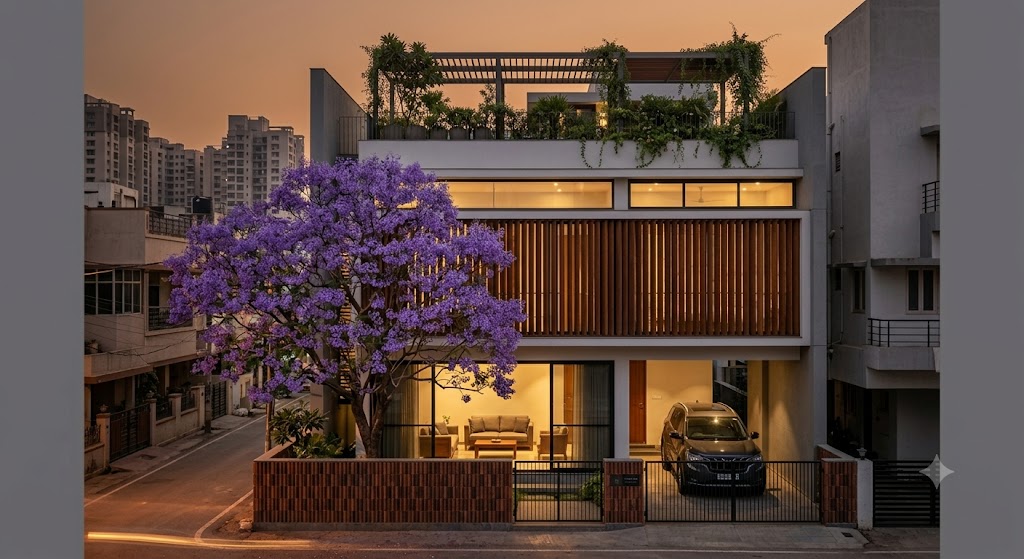
Urban Home Architecture in India — Density, Light, Parking & Acoustic Solutions
Eight Density Constraints, the Vertical G+2 Section, Six Light-and-Air Strategies, Five Parking Solutions & Acoustic Isolation
Roughly 22% of new independent-house construction in India today happens on urban plots smaller than 1,500 sft — tight plots in dense city neighbourhoods where party walls are shared with neighbours, parking is constrained to one car, and side facades have no light because of adjacent buildings 4 ft away. The design discipline for these plots is a different discipline from suburban-plot independent-house design — closer in spirit to apartment planning than to villa work.
This guide is the architect-led reference for urban-plot independent-house design in India. It covers the eight density constraints that distinguish urban planning from suburban, the vertical G+2 section that becomes the typical urban form, six strategies for getting light and air into a plot with blocked side facades, five parking solutions for tight plots (only one of which is "park on the street"), acoustic isolation strategies for six common urban noise sources, common mistakes, and a pre-construction checklist.
Most Indian urban houses are built without proper architect engagement — by builders working from generic plan books. The result: rows of identical houses that all suffer the same problems (dark middle floors, single bath queues, unusable rear yards, weekend-only rooftop). Working with an architect who understands urban-density constraints costs 5–8% of construction cost and converts the same plot footprint into a fundamentally better house. This guide is the brief.
An urban Indian plot is not a smaller version of a suburban plot. It is a different planning problem — vertical zoning, light extraction, party-wall acoustics, vertical-stack circulation, rooftop-as-outdoor. Apply suburban thinking and you build a cramped, dark, badly-ventilated house. Apply urban thinking and the same 25 × 50 ft plot delivers a contemporary G+2 home that works for a family of 4 across 30 years.
For the broader independent-house framework that complements this guide, see Building a House in India, Indian House Front Elevation Design, and Duplex House Plans.
The Eight Density Constraints — Urban vs Suburban
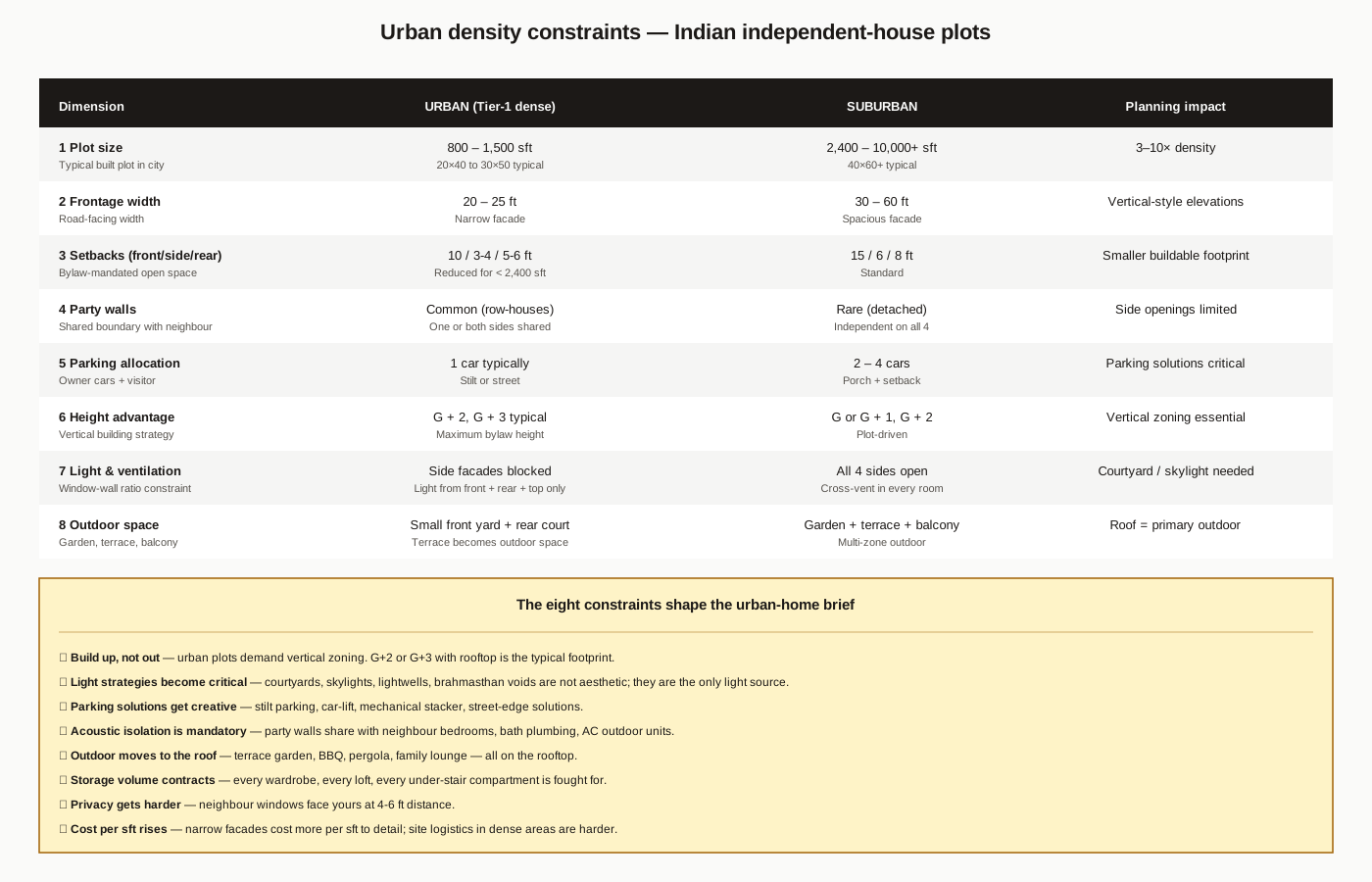
The figure above is the working comparison. Each constraint reshapes the design brief.
1. Plot Size
Urban plots: 800–1,500 sft typical (20×40 to 30×50 ft). Tier-1 cities (Mumbai, central Bengaluru, central Pune, central Delhi) frequently have plots at 800–1,000 sft. Suburban plots: 2,400–10,000+ sft.
The density implication: 3–10× more dwellings per acre in urban vs suburban. Plot acquisition cost per sft of land is 3–8× higher in urban.
2. Frontage Width
Urban: 20–25 ft frontage typical. Suburban: 30–60 ft. Narrow frontage forces the facade vertical — taller, with the main composition reading top-to-bottom rather than left-to-right. Entry door, car porch, balcony, parapet all stack vertically.
The narrow frontage is also a daylight constraint: less wall area on the road-facing side, less window area, less natural light from the front.
3. Setbacks
Urban setbacks (typical Tier-1 bylaws for plots < 1,500 sft):
- Front: 10 ft (reduced from suburban 15 ft)
- Sides: 3–4 ft each (reduced from 6 ft)
- Rear: 5–6 ft (reduced from 8 ft)
The reduced setbacks leave a smaller buildable footprint (typically 60–70% of plot vs 50–60% suburban) but in absolute terms still smaller. A 25 × 50 ft urban plot has roughly 16 × 38 ft = 608 sft buildable footprint after setbacks.
4. Party Walls
Urban: commonly shared with one or both neighbours. The side setback of 3-4 ft on each side often becomes a wall-to-wall shared boundary. The party wall is structural, acoustic, and visual — and it changes the design from independent-house thinking to row-house thinking.
Side openings on party-wall side are forbidden (visual privacy + structural concern). Light from those sides is impossible. The design must extract light from front + rear + top only.
5. Parking
Urban: 1 car typically allotted, with bylaw count tight. Some Tier-1 micro-markets (Bandra, Lodhi, Adyar) have 2-car requirements but no space for them. Parking solutions become a creative exercise (see section below).
6. Height Advantage
Urban: G+2 or G+3 typical, using the full height bylaw allowance. The standard urban bylaw height limit is 11.5 m for 30 ft road, 15 m for 40 ft road — generous enough for G+2 with parapet, sometimes G+3 with parapet on a 40+ ft road.
The height advantage is the urban-plot's primary creative resource. Build up, not out.
7. Light and Ventilation
Urban: side facades blocked, light from front + rear + top only. Cross-ventilation in habitable rooms must be designed through the courtyard / atrium / brahmasthan light-well — passive cross-ventilation between front and rear of plot.
Suburban: light and cross-vent from all four sides. Very different planning logic.
8. Outdoor Space
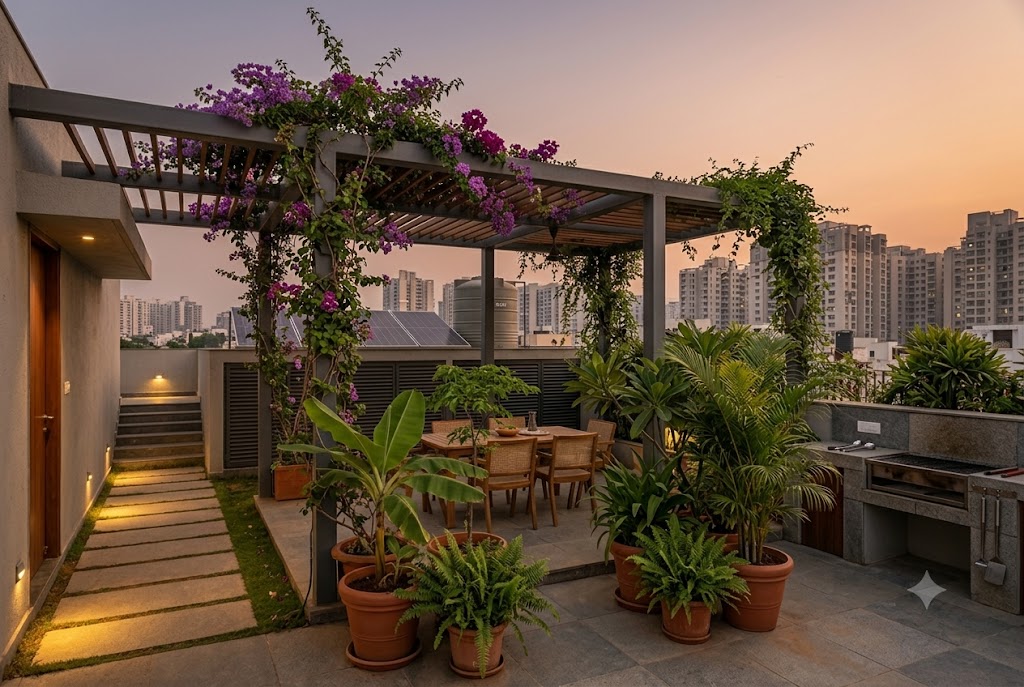
Urban: small front yard + rear court + rooftop. The rooftop becomes the primary outdoor entertaining space — pergola, garden, BBQ, family lounge. Garden ground-floor space is minimal.
Suburban: garden, terrace, balcony — multi-zone outdoor space at multiple floors.
Implications
The eight constraints reshape the urban-home brief: build up, not out; courtyard/atrium becomes the light source; party walls demand acoustic isolation; parking solutions get creative; outdoor space moves to the roof; storage volume contracts; privacy gets harder; cost per sft rises (narrow facade detailing, dense-area site logistics).
The Urban Vertical Section — G+2 on a 25 × 50 ft Plot
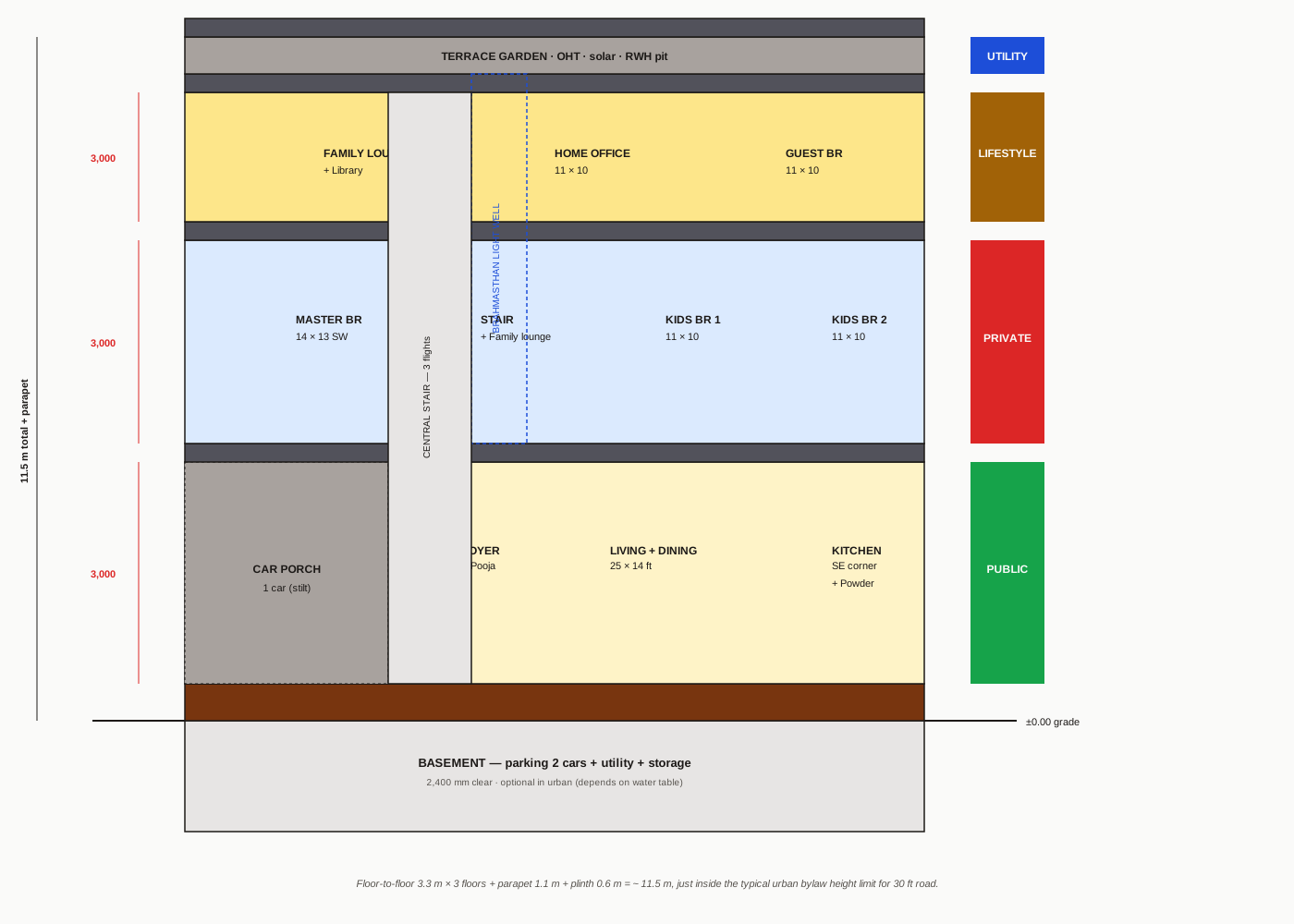
The figure above is the working section. G+2 with a central stair, a brahmasthan light-well, and four vertical zones (Public on ground, Private on first, Lifestyle on second, Utility on terrace) is the default urban-house typology.
Floor-by-Floor Programme
Basement (optional): parking + utility + storage. 2,400 mm clear height. Water-table dependent — many urban Indian plots have shallow water tables that make basements risky and expensive. If basement is viable, accommodates 2 cars + DG + utility + storage.
Ground floor: public zone — foyer, living, dining, kitchen, powder room, often a guest BR. If stilt-parking is used, ground floor moves up by 600 mm or more (plinth raised), and the building enters through a stair from grade. Total ground area ≈ 600 sft for 25×50 plot.
First floor: private zone — master BR, kids BR 1, kids BR 2, family lounge. Total ≈ 600 sft.
Second floor: lifestyle zone — family lounge expanded, home office, guest BR, library, sometimes the pooja terrace. Total ≈ 600 sft.
Terrace: utility + outdoor — OHT, solar PV, AC outdoor units, rainwater harvesting pit, terrace garden, pergola, BBQ, family party space.
Total Carpet Area
A 25 × 50 ft (1,250 sft) urban plot with G+2 typically delivers:
- Ground: 600 sft carpet
- First: 600 sft
- Second: 600 sft
- Terrace (covered area only, e.g. pergola, OHT box): 50 sft
- Total: ~1,850 sft carpet + 200–400 sft terrace outdoor
Compared to a 4 BHK 30 × 40 duplex (~2,100 sft carpet), this is similar in volume but distributed over 3 floors.
Vertical Zoning Logic
The urban-house zoning is four vertical zones (vs the duplex's three):
- PUBLIC (Ground) — foyer, living, dining, kitchen, guest receive
- PRIVATE (First) — master, kids, family lounge
- LIFESTYLE (Second) — home office, library, guest, family party
- UTILITY (Terrace) — service plant, outdoor entertaining
Each zone is one floor. The stair connects them; the brahmasthan light-well admits light through all four.
The Brahmasthan Light Well
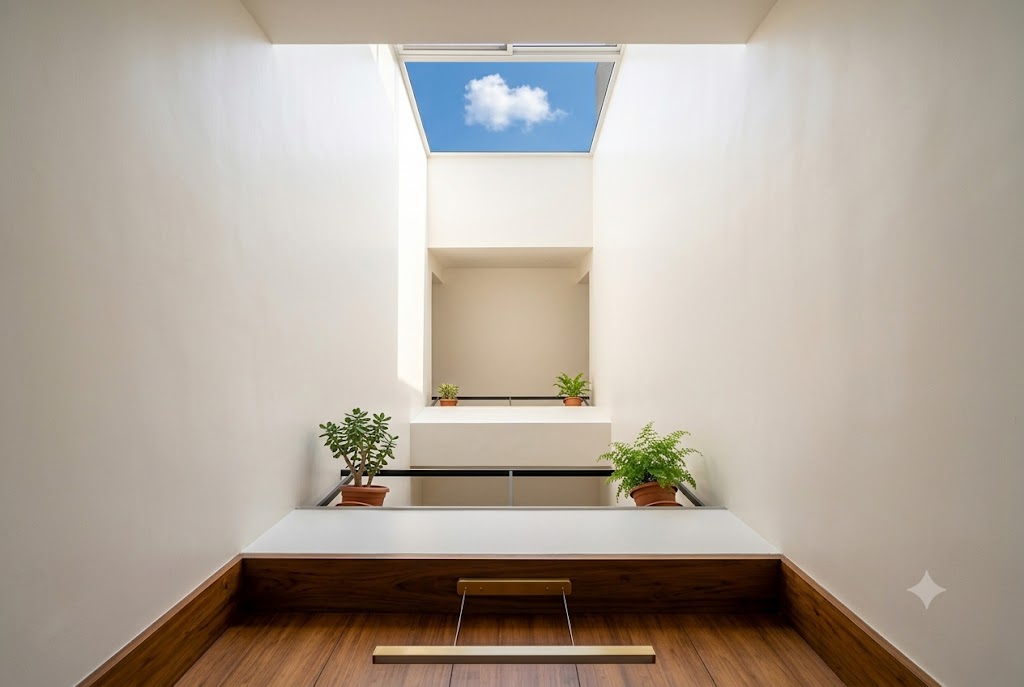
A vertical void running from the terrace skylight down to the central living/dining on the ground floor. 60 × 80 cm typical cross-section. Critical because it admits top-down daylight into the centre of the building where front-and-rear windows can't reach.
The brahmasthan light-well doubles as a buoyancy ventilation stack — warm air rises out, cool air enters via front and rear, creating a continuous gentle draft through the building. Drops AC running hours 30–40% in coastal Indian climates.
For the broader Vastu framework that informs the central-void positioning, see Vastu House Plan.
Six Light-and-Air Strategies for Dense Plots
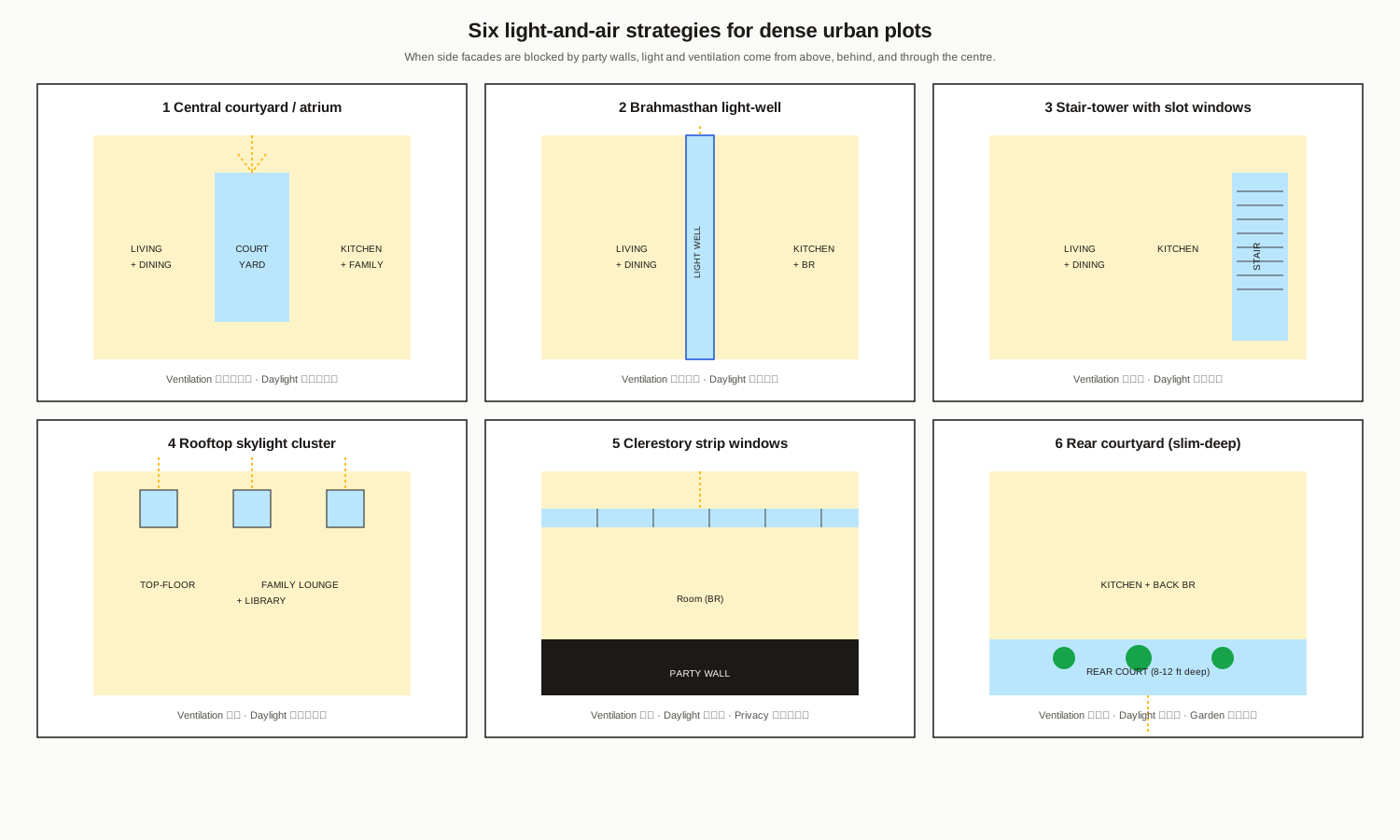
When side facades are blocked by party walls, the urban home gets light from three sources: front, rear, and top. The six strategies below extract maximum light and ventilation from those three sources.
1. Central Courtyard / Atrium (★★★★★)
A 4–6 × 4–6 ft open-to-sky courtyard at the centre of the plan, running from ground to terrace. The strongest light-and-air strategy — admits daylight to every floor, drives buoyancy ventilation, creates a green plant-zone visible from every room.
Use when: plot is 1,500+ sft and the budget allows the area sacrifice.
2. Brahmasthan Light-Well (★★★★)
A vertical void 60–80 cm cross-section running through all floors with an operable skylight on top. Less spatially demanding than a full courtyard; same light-and-vent function but in a slim slot.
Use when: plot is 800–1,500 sft and a full courtyard is impractical.
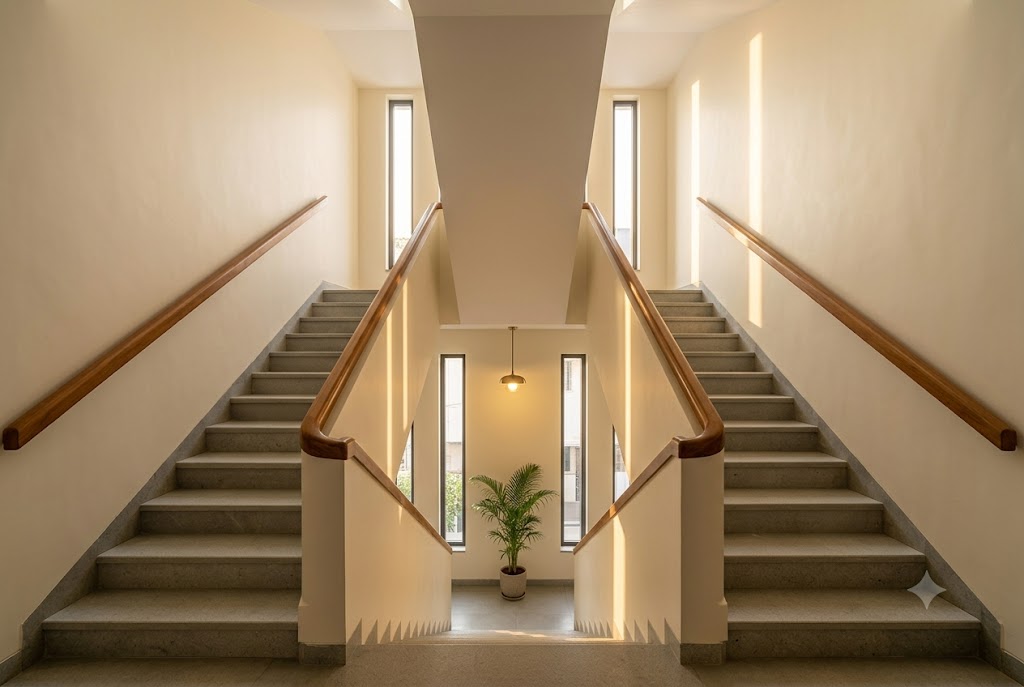
3. Stair-Tower Slot Windows (★★★★)
The stair core on the unblocked rear (or front) wall, with tall vertical slot windows admitting light at landings. The stair becomes a daylight tower.
Use when: the plot has at least one unblocked vertical edge (usually rear or front).
4. Rooftop Skylight Cluster (★★★★★ daylight, ★★ ventilation)
Two or three skylights in the terrace slab, admitting daylight to the top-floor lifestyle zone (family lounge, home office, library). Bright and warm but with limited cross-vent unless operable.
Use when: the top floor is the family lifestyle zone and daylight matters; pair with skylight blinds for summer.
5. Clerestory Strip Above Party Wall (★★★)
High-level horizontal windows running above the party wall line (above 2.1 m sill height). Admits daylight and preserves complete privacy from neighbour windows below.
Use when: bedrooms abut party walls and need daylight without sight-lines.
6. Rear Courtyard Slim-Deep (★★★)
An 8–12 ft deep rear courtyard at the back of the plot, with kitchen and a rear bedroom opening into it. Functions as a garden and as a ventilation source.
Use when: the rear setback can be expanded into a usable garden; pairs with rear-facing kitchen.
Combining Strategies
A well-designed urban house typically combines 3 strategies: brahmasthan light-well (centre) + stair-tower (rear) + rooftop skylight (lifestyle zone). The cumulative effect is daylight in every room of the house, ventilation through buoyancy and cross-flow, and a building that doesn't depend on AC + lights for 8 daylight hours per day.
Five Parking Solutions for Tight Urban Plots
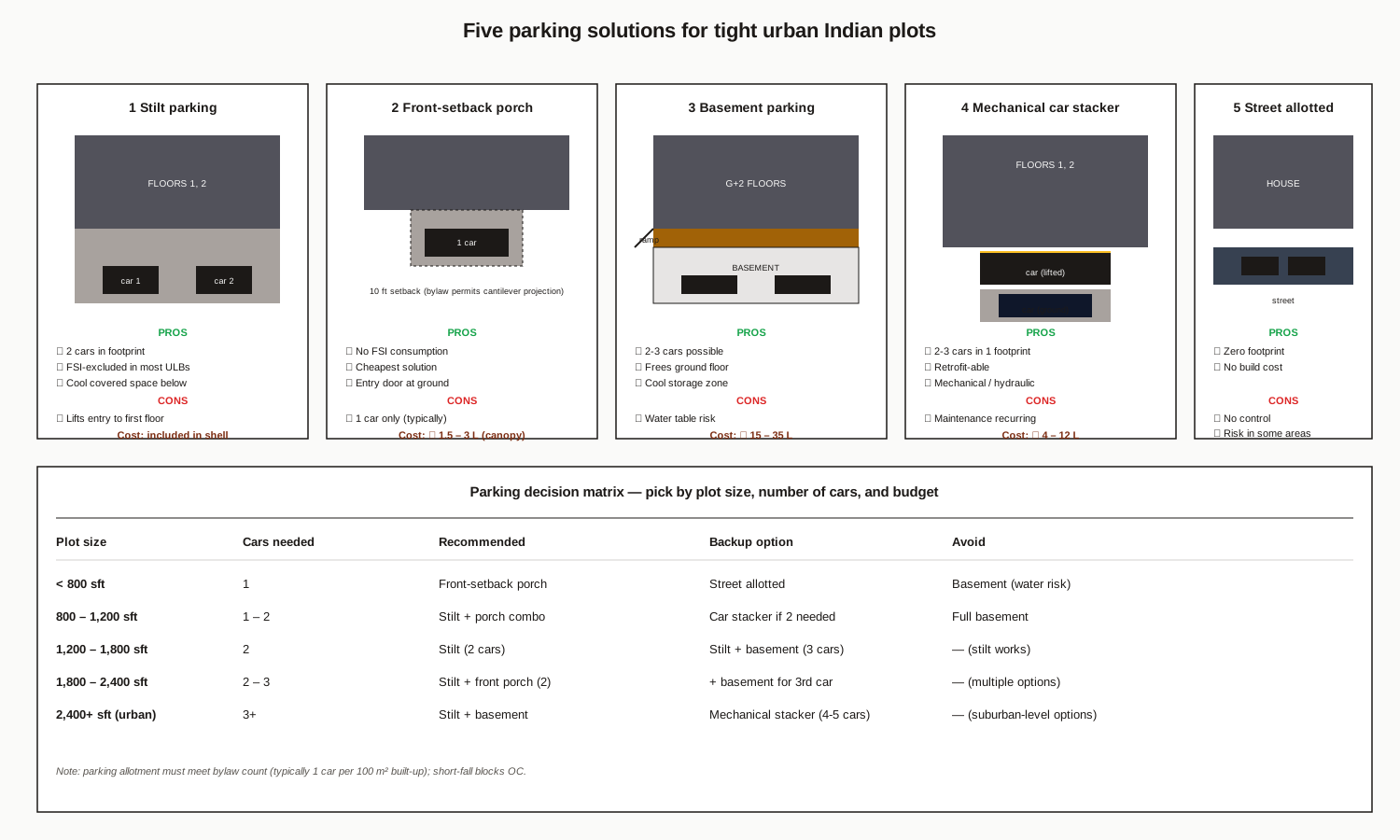
Urban parking is the design's most-constrained problem. Five solutions cover the typical Indian urban plot range.
1. Stilt Parking
The entire ground floor (minus utility room) becomes covered parking, with the residence starting from first floor. FSI-excluded in most ULBs (a major benefit — adds ~600 sft of parking without consuming FSI). Lifts entry to first floor (a disadvantage — requires stair to reach the front door from the gate).
Use when: the plot has G+2 or G+3 height allowance; the family is OK climbing a flight to the front door.
2. Front-Setback Porch
The car porch projects into the front setback as permitted cantilever projection (typically 2/3 of setback depth). 1 car fits. Cheapest solution. Doesn't disrupt the ground-floor programme.
Use when: only 1 car needed; plot is 800–1,500 sft.
3. Basement Parking with Ramp
A full basement (2,400 mm clear) accessed by a ramp from the front. Accommodates 2–3 cars + utility + storage. Frees the ground floor for full residential programme. Costs ₹ 15–35 lakh.
Use when: the plot has acceptable water-table depth (test before commitment) and the budget allows.
4. Mechanical Car Stacker
A 2-tier or 3-tier hydraulic stacker that stacks cars vertically in the footprint of one. ₹ 4–12 lakh for the system. Recurring maintenance ₹ 15–30 K/year. Retrofit-friendly.
Use when: the existing parking allotment is short by 1 car; needs FSI verification.
5. On-Street Allotted
The bylaw count is met by an allotment on the public street, with municipal or society arrangement. Zero footprint, zero build cost. No control over the actual space (often blocked by neighbours, civic damage).
Use when: the property is in a society with controlled street parking, or the bylaw count is otherwise unmet.
Parking Decision Matrix
| Plot size | Cars needed | Recommended | Backup option | Avoid |
|---|---|---|---|---|
| < 800 sft | 1 | Front-setback porch | Street allotted | Basement (water risk) |
| 800–1,200 sft | 1–2 | Stilt + porch combo | Car stacker if 2 | Full basement |
| 1,200–1,800 sft | 2 | Stilt (2 cars) | Stilt + basement | — |
| 1,800–2,400 sft | 2–3 | Stilt + front porch | + basement | — |
| 2,400+ sft (urban) | 3+ | Stilt + basement | Mechanical stacker | — |
Parking allotment must meet bylaw count (typically 1 car per 100 m² built-up); shortfall blocks Occupancy Certificate.
Acoustic Isolation — Six Urban Noise Sources
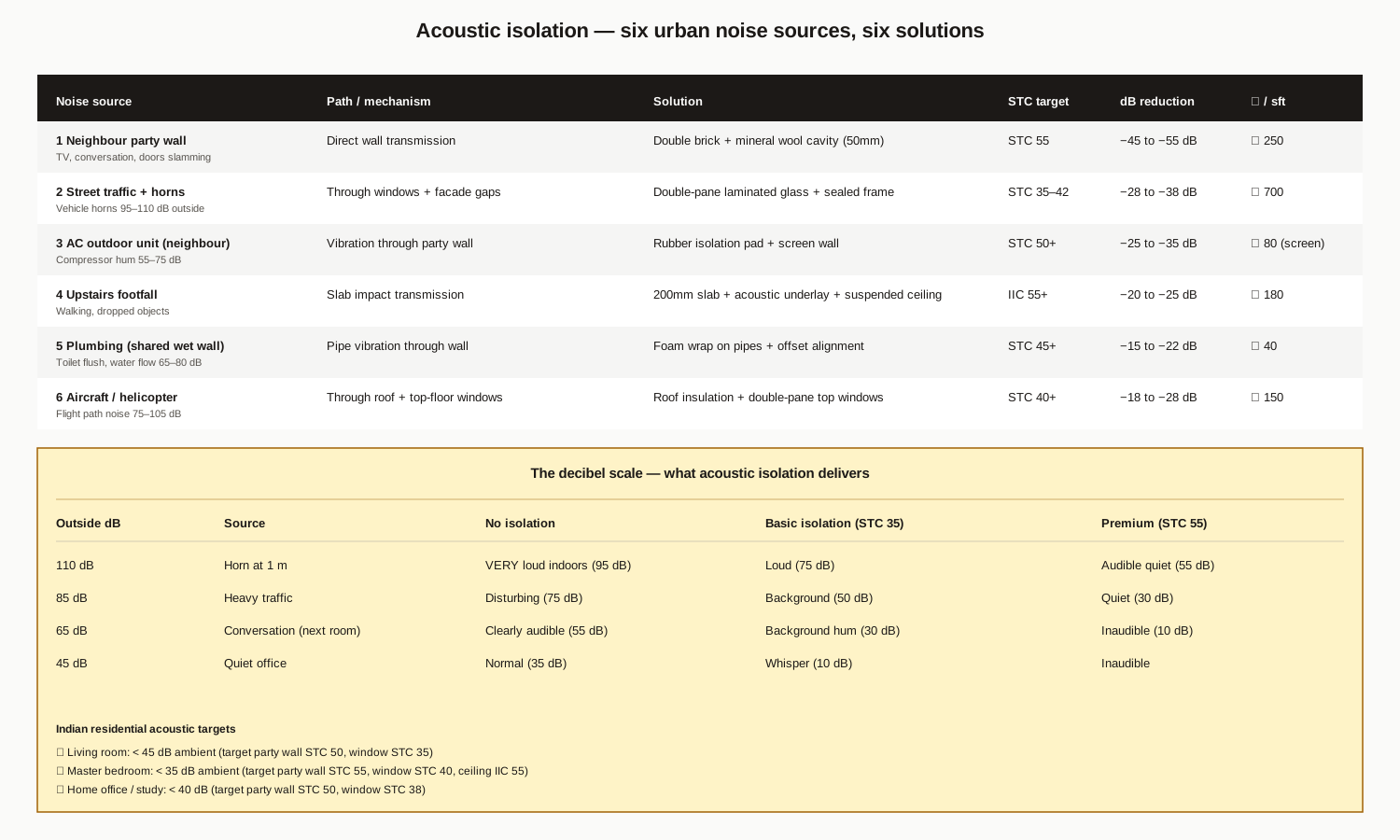
Urban acoustic isolation is not optional — it is what separates a livable urban house from a stressful one. Six noise sources and their mitigations:
1. Neighbour Party Wall
The bedroom-to-bedroom party wall transmits TV, conversation, doors. Solution: double brick + 50 mm mineral wool cavity. STC 55. Reduces 45–55 dB. Cost ₹ 250/sft.
2. Street Traffic + Horns
Indian street noise peaks at 95–110 dB (horns at 1 m). Solution: double-pane laminated glass + sealed UPVC frame. STC 35–42. Reduces 28–38 dB. Cost ₹ 700/sft.
3. AC Outdoor Unit (Neighbour)
Compressor hum 55–75 dB. Solution: rubber isolation pad under AC condenser + screen wall facing your facade. STC 50+. Reduces 25–35 dB. Cost ₹ 80/sft (screen).
4. Upstairs Footfall
The single most-common acoustic complaint in urban multi-floor houses. Solution: 200 mm slab + acoustic underlay + suspended ceiling with mineral wool. IIC 55+. Reduces 20–25 dB. Cost ₹ 180/sft.
5. Plumbing (Shared Wet Wall)
Toilet flush, water flow: 65–80 dB transmitted through wet-wall pipes. Solution: foam wrap on pipes + offset plumbing alignment (master bath above master bath, not above bedroom). STC 45+. Reduces 15–22 dB. Cost ₹ 40/sft.
6. Aircraft / Helicopter
Flight-path noise 75–105 dB. Solution: roof insulation + double-pane top-floor windows. STC 40+. Reduces 18–28 dB. Cost ₹ 150/sft.
Indian Residential Acoustic Targets
- Living room: < 45 dB ambient — party wall STC 50, window STC 35
- Master bedroom: < 35 dB ambient — party wall STC 55, window STC 40, ceiling IIC 55
- Home office / study: < 40 dB — party wall STC 50, window STC 38
These targets cost roughly ₹ 200–400 per sft of built-up area for the acoustic-treatment premium over standard construction. On a 1,850 sft urban house, ₹ 4–7 lakh additional spend. Compared to the daily quality-of-life difference, this is a high-ROI investment.
Eight Common Urban-Home Mistakes
1. Building a Suburban Plan on an Urban Plot
Forcing a generic 4 BHK suburban floor-plan onto a 25 × 50 ft urban plot, ending up with windowless bedrooms and a parking spot that doesn't fit. Fix: start with urban-specific section logic; commit to G+2 vertical zoning at concept.
2. Skipping the Brahmasthan / Courtyard
Dropping the light-well "to save area" — and getting a permanent dark zone in the centre of the house. Fix: invest the 24–48 sft of centre area; it pays back in daylight, ventilation, and resale value.
3. Ignoring Party-Wall Acoustic Treatment
Standard 230 mm brick party wall transmits 35 dB — the neighbour's TV is audible at conversational level. Fix: double-skin party wall with cavity at construction; cannot be retrofit.
4. Single-Car Parking on a 3-BHK House
Bylaw count met by allotted street parking, but the family has 2 cars. Daily friction. Fix: plan for 2 cars at concept; pick from the five solutions per the matrix above.
5. Roof-as-Forgotten
The roof becomes a maintenance zone — OHT, AC, solar — without a proper outdoor entertaining design. Family ends up never going up. Fix: plan the rooftop as the primary outdoor zone — pergola, garden, BBQ, seating.
6. Marble Flooring Above Bedrooms
Marble transmits 30–40% more footfall noise than vitrified tile. On a multi-floor urban house with adjacent bedroom-above-living, this is acoustic chaos. Fix: acoustic underlay + suspended ceiling below; or specify quieter floor finishes.
7. Window-on-Wall Bedroom
Single-window bedroom that's un-ventilable without AC. In urban tropical climates, mould risk + AC bill. Fix: every habitable room gets windows on two walls (front + rear, or front + light-well, or rear + clerestory).
8. Vastu Inflexibility on Tight Plot
Insisting on textbook Vastu (kitchen SE, master SW, pooja NE) on a 20 × 40 plot where geometry doesn't permit. Results in a forced compromise that fails both Vastu and functional logic. Fix: pragmatic Vastu — satisfy the eight authoritative rules (see Vastu House Plan); accept compromises in the folk-Vastu rules.
Pre-Construction Checklist for Urban Plots
Site & approval
- [ ] Plot survey + boundary marking
- [ ] Soil test (water table critical for basement decision)
- [ ] Setbacks confirmed (urban-reduced values)
- [ ] FAR within limits; height within bylaw
- [ ] Parking count meets bylaw (verify the solution chosen meets count)
- [ ] Party wall agreement with neighbour (in writing if shared)
- [ ] Society NOC (if gated colony) or municipal approvals
Design
- [ ] Vertical G+2 (or G+3) section drawn
- [ ] Four vertical zones planned (Public / Private / Lifestyle / Utility)
- [ ] Light strategy chosen (3 of the 6 typically combined)
- [ ] Parking solution committed (1 of the 5)
- [ ] Acoustic isolation planned for party walls + slabs
- [ ] Rooftop programme designed (not left as service-only zone)
- [ ] Vastu pragmatic compliance verified
Engineering
- [ ] Structural sign-off for G+2 (or G+3) with party walls
- [ ] Cantilevers > 1.2 m have explicit structural design
- [ ] MEP coordinated (electrical load, water tank, drainage)
- [ ] Slab thickness ≥ 200 mm for acoustic isolation
Commercial
- [ ] BoQ matched to typology cost per sft (₹ 2,500–4,500/sft for urban-built independent house)
- [ ] Contingency 10% on construction
- [ ] Acoustic-treatment line items budgeted (₹ 4–7 L for 1,850 sft house)
- [ ] Parking solution costed separately (basement/stacker if applicable)
References
1. NBC 2016, Parts 4 and 11. National Building Code of India — fire safety, acoustic, sustainability.
2. SP 41 (BIS 1987). Handbook on Functional Requirements of Buildings.
3. BBMP, HMDA, MMRDA, DDA Building Bye-Laws — urban setback, FAR, height, parking requirements.
4. Council of Architecture (2020). Architectural Practice Bylaws.
5. Krishan, A. (2017). Climate Responsive Architecture. TERI Press.
6. Lang, J., Desai, M., Desai, M. (1997). Architecture and Independence — India 1880-1980. Oxford University Press.
7. NBC 2016, Part 8 (Building Services), Section 4 (Acoustic). Acoustic design standards.
8. BIS IS 12433. Acoustic Privacy in Multi-Family Dwellings.
9. Acharya, P.K. (1933-46). Manasara on Architecture and Sculpture. (Pragmatic Vastu reference.)
10. JLL India (2025). Indian Urban Residential Market — Density and Land Pricing Report.
Author's note: Urban Indian residential design is the hardest residential discipline in 2026 India and the most overlooked in architectural training. Generic plan books fail urban plots; suburban thinking produces dark, narrow, badly-ventilated houses; builder-design produces commodity rows that nobody loves. The skill of urban-house design — extracting light from front-rear-top, parking 2 cars on a 25 × 50 plot, isolating party-wall acoustics, programming the rooftop as the family's primary outdoor zone — is genuinely architect-level work. Worth the 5–8% architect fee; not optional; not substitutable. The eight density constraints are the brief, the four-zone vertical section is the canvas, the six light strategies are the tools. Apply them properly and the same 1,250 sft urban plot delivers a contemporary G+2 house that works for a family of 4 across 30 years. Skip them and you build the same house your neighbour built — dark, hot, loud, and a maintenance burden.
Disclaimer: Setbacks, FAR, height limits, and parking requirements cited are 2023-24 ULB regulations and vary by municipality and plot category; verify against your specific ULB byelaws before design freeze. Acoustic STC and IIC values are theoretical maxima; field performance depends on workmanship and detailing. Cost ranges are 2025-26 indicative for Indian Tier-1 and Tier-2 cities and vary by micro-market and procurement channel. Vastu rules cited follow the framework in Vastu House Plan; urban plots routinely require pragmatic compromises that are acceptable to mainstream practitioners. Studio Matrx, its authors and contributors accept no liability for decisions made on the basis of this guide; engage a licensed architect with urban-plot experience, structural engineer, acoustic consultant, MEP consultant, and (if orthodox) a qualified Vastu consultant for project-specific application.
Interactive · Urban plot constraints
3-floor envelope · 2088 sqft built-up · FSI used 1.74 · bound by FSI limit
Plot top view · 30 × 40 ft (1,200 sqft)
Stacked section · 3 floors
Footprint
696 sqft
Built-up
2088 sqft
FSI used
1.74
Binding constraint
FSI caps your built-up at 2100 sqft. Even if you could go taller, the area allowance is already maxed.
Default values reflect typical Bengaluru intermediate-plot byelaws — actual setbacks/FSI vary by city, plot size, road width, and zone. Always verify with your architect / municipality.
Export this guide
Related Guides — Deep-dive reading
High-Rise Apartment Interiors — 15+ Floor Tower Specifics for Indian Cities (2026)
Wind-load glazing · Lift-time tax · Refuge floors · Post-tension slab limits · World One Worli ₹35 lakh example
Design StylesDesigning a Naturally Energy-Efficient Indian Home
Comfort first, gadgets last — passive design, orientation, insulation, ventilation and the climate wisdom that cuts Indian energy bills
SustainabilityWhy Setbacks Matter: A Homeowner's Guide to the Open Space Around Your House
What setbacks are, the daylight, air, fire-access and privacy jobs they do, how they scale with plot and height, and why eating them up costs you your occupancy certificate and resale value
Building Regulations & ComplianceRelated Tools — Try Free
Cross-Ventilation Analyzer
Estimate airflow and air changes per hour (ACH) from room size, window areas, layout, and local wind — with NBC 2016 Part 8 compliance check.
Ventilation CalculatorRainwater Tank Sizer
How big should your rainwater tank be? Computes annual harvest, recommended tank capacity in litres, water-bill savings, and payback — for 10 Indian cities.
RWH CalculatorAcoustic Privacy (STC) Visualizer
Indian healthcare acoustic visualizer — compare wall assemblies and noise sources, see received SPL after STC attenuation, and check FGI 2018 / IS 1950 / NABH speech-privacy compliance with live dual-canvas waveform.
Acoustic Tool