
FAR (FSI) in Bengaluru — A 2026 Architect's Working Reference
Floor Area Ratio under RMP 2031 — baseline values by plot and road, premium FAR mechanics, the exclusions that make Bengaluru's FAR computation distinct, and the height-coupling that turns FAR-eligible plots into footprint-incompatible ones.
Governing framework: BBMP Building Bye-laws 2003 + Revised Master Plan 2031 (RMP 2031)
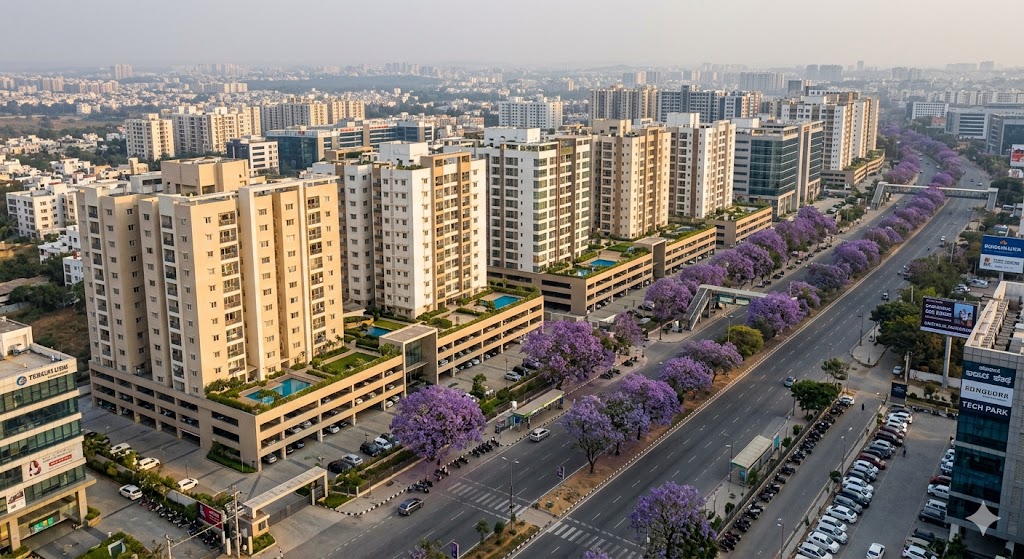
Working reference tables
Print or screenshot these for the studio wall. Cross-check against the current authority notification before any specific filing.
Residential FAR baseline (RMP 2031, indicative)
FAR scales with plot size and abutting road width. Premium FAR purchase extends the upper limit; eco-sensitive overlays reduce it.
| Plot Size | Road Width | Baseline FAR | Approx. ground coverage |
|---|---|---|---|
| < 240 sqm | < 9 m | 1.75 | 60% |
| 240–500 sqm | 9–12 m | 2.25 | 55% |
| 500–1,000 sqm | 12–18 m | 2.50 | 50% |
| 1,000–2,000 sqm | 18–24 m | 2.75 | 45% |
| > 2,000 sqm | > 24 m | 3.00 | 40% |
RMP 2031 baselines. Specific zone categories (Residential — Main, Mixed, Special) and overlays modify these. Verify the current zonal notification at sanction.
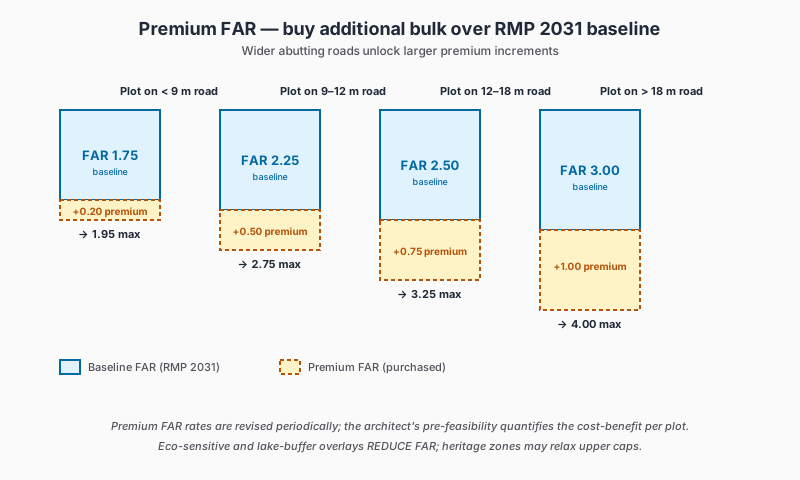
Premium FAR — purchasable additional bulk
Premium FAR is bought from BBMP against a premium fee, calibrated by abutting road width and infrastructure capacity.
| Abutting Road | Premium FAR (over baseline) | Effective ceiling (with premium) |
|---|---|---|
| < 9 m | + 0.20 | ≈ 1.95 |
| 9–12 m | + 0.50 | ≈ 2.75 |
| 12–18 m | + 0.75 | ≈ 3.25 |
| 18–24 m | + 1.00 | ≈ 3.75 |
| > 24 m | + 1.00 to 1.50 (negotiated) | ≈ 4.00–4.50 |
Premium-FAR rates are revised periodically and depend on infrastructure-capacity certification for the zone. The architect's pre-design feasibility quantifies the premium FAR cost as ₹/sqft of additional FAR consumed.
FAR exclusions — what does NOT count
These zones are excluded from countable FAR provided the dimensional and use conditions are met. The architect's FAR certificate must enumerate each exclusion clause-by-clause.
| Zone / Use | FAR treatment | Conditions |
|---|---|---|
| Basement parking | Fully excluded | Used solely for parking + services; no habitable rooms |
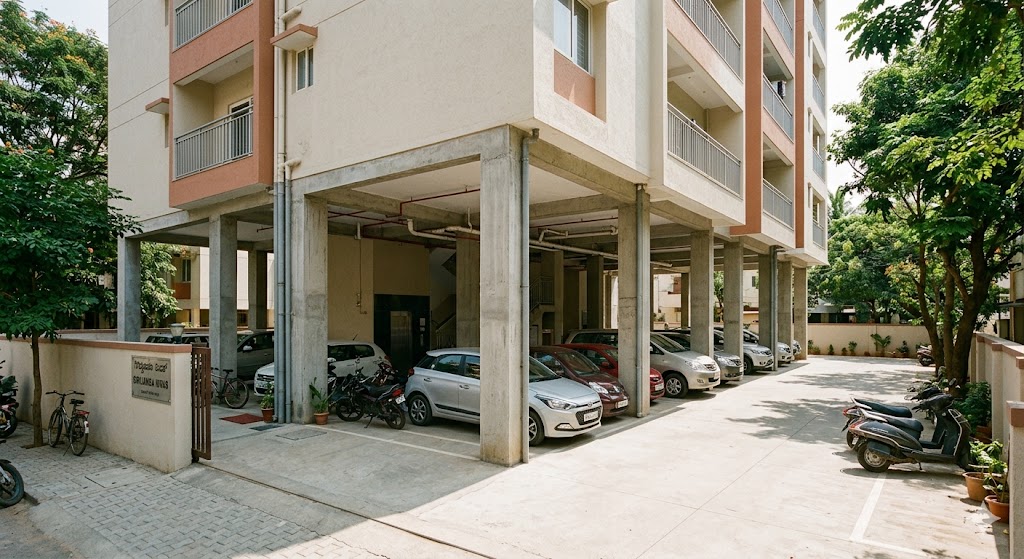
| Stilt parking | Excluded up to 2.4 m height | Open on all four sides; columns count as footprint for setback |
| Service ducts / shafts | Excluded | Dedicated and continuous through floors |
| Mumty, lift overrun, water tank | Excluded subject to area cap | Per RMP 2031 schedule; typically ≤ 25 sqm or ≤ 5% of terrace area |
| Refuge area (high-rise) | Excluded | Per fire-NOC requirements; one refuge floor every fourth occupied floor |
| Open balconies | Partially excluded | Per zone clause; depth and zone-specific limits apply |
Implicit exclusion claims fail at BBMP zonal review. Each excluded area must be cited against the specific bylaw clause in the architect's FAR computation certificate.
Eco-sensitive overlay FAR cuts (KTCDA + BCAP)
Plots within notified lake-buffer or eco-sensitive zones face FAR reductions below baseline. Overlays are not surfaced on standard Khata documents — pre-design overlay check is mandatory.
| Overlay | FAR treatment | Notes |
|---|---|---|
| Lake-buffer 0–30 m | No construction permitted | Total prohibition under KTCDA |
| Lake-buffer 30–75 m | Baseline FAR cut by 25–50% | Graduated buffer with supplemental setbacks too |
| Valley zone (RMP 2031) | Baseline FAR cut by 25% | Vrishabhavathi, Hebbal, Koramangala, Bellandur valley overlays |
| Eco-sensitive zone (Bannerghatta buffer) | Subject to MoEFCC clearance | Project-specific notification governs |
| Heritage precinct | FAR cap typically below baseline | Heritage Conservation Committee NOC required |
Verify against the BBMP Sakala portal or BDA RMP 2031 GIS layer before concept design. The Khata document does not surface overlay status.
The working reference, in full
FAR — Floor Area Ratio, the term Karnataka and Bengaluru use for what Mumbai, Delhi, and most of India calls FSI (Floor Space Index) — is the ratio of total countable built-up floor area to plot area. A 200 sqm plot with FAR 2.25 may be built up to 450 sqm of countable area distributed across all floors. FAR is the single most consequential dimensional control on residential bulk: it caps the developer's revenue side and the architect's design freedom in equal measure, and it is the lever every Bengaluru residential project optimises against.
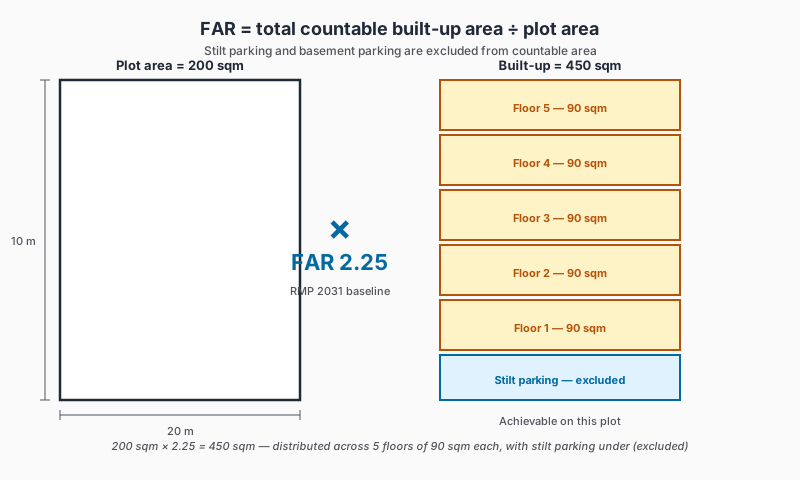
Baseline + premium — RMP 2031's two-tier FAR mechanics
RMP 2031 sets a baseline FAR as a function of plot size and abutting road width — narrow plots on narrow roads get FAR 1.75; large plots on wide arterial roads get FAR 3.00. Above baseline, BBMP permits premium FAR: additional FAR purchased against payment of a premium fee, calibrated by road width and zone infrastructure capacity. Premium FAR is the primary economic lever for mid-to-high-rise residential — typical premium increments range from 0.20 (narrow road) to 1.00+ (arterial road), pushing achievable FAR to 4.0–4.5 in eligible zones. The developer's pre-feasibility study quantifies the premium FAR cost in ₹ per square foot of additional countable area; the architect's role is to verify zone eligibility and run the FAR-against-height-coupling iteration before the developer commits.
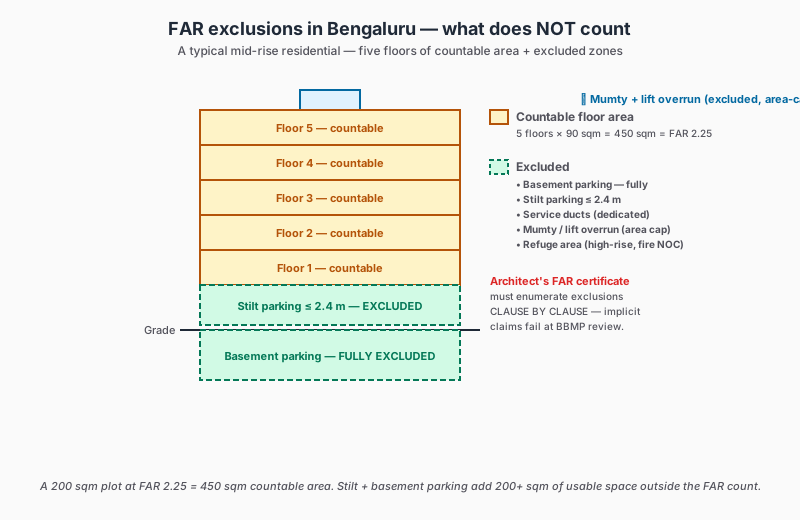
FAR exclusions — the categories that do not count
Several classes of floor area are excluded from FAR computation under BBMP bylaws read with RMP 2031: basement parking (fully excluded if used for parking and services), stilt parking (excluded up to 2.4 m height; columns still count as footprint for setback), service ducts and shafts (excluded if dedicated and continuous), mumty / lift overrun / water tank (excluded subject to area caps), refuge areas in high-rise (excluded per fire-NOC requirements), and open balconies (partially excluded per zone clause). The architect's FAR certificate must enumerate each exclusion clause-by-clause against the specific bylaw reference; implicit claims fail at BBMP zonal review and are the most common cause of resubmission.
Eco-sensitive overlays — when baseline FAR is cut, not extended
Bengaluru's chain of cascading lakes and its valley topography produce overlays that reduce baseline FAR. Plots within the 30–75 m lake-buffer notified by the Karnataka Tank Conservation and Development Authority (KTCDA) face FAR cuts of 25–50%. Plots within RMP 2031 valley-zone overlays — Vrishabhavathi, Hebbal, Koramangala, Bellandur — face a 25% FAR reduction plus supplemental setbacks. The Bannerghatta National Park buffer requires Ministry of Environment, Forest and Climate Change (MoEFCC) clearance for any construction. Heritage precincts (Cubbon Park area, Vidhana Soudha precinct) cap FAR below baseline through Heritage Conservation Committee NOCs. None of these overlays appear on the standard A-Khata or e-Aasthi printout; the architect's pre-design overlay check is mandatory.
Height coupling — FAR-eligible but footprint-incompatible
FAR sets the volume; the height-coupling setback formula sets the massing. An RMP 2031 setback of (building height ÷ 5) + zone minimum grows with each added floor — a plot may be FAR-compliant at G+5 but height-coupling-incompatible at G+8 because the wider setback at the higher height eliminates the buildable footprint. The architect's high-rise envelope study runs FAR consumption against height-coupled setbacks iteratively — most concept designs that fail at sanction do so on this combined check, not on FAR alone. For a Bengaluru residential project committing to premium FAR purchase, the height-coupling iteration must precede the premium-fee commitment; reversing the order is a costly rework.

Stilt and basement — invisible square footage
Two of the most powerful design levers in Bengaluru residential are FAR-excluded by design: stilt parking (excluded up to 2.4 m height) and basement parking (fully excluded if used solely for parking and services). On a typical 200 sqm plot at FAR 2.25, these two exclusions add roughly 200 sqm of usable space outside the countable FAR — effectively a 45% bonus on the FAR-deliverable area. The architect's role is to design the stilt and basement geometry against the bylaw clauses (stilt height ≤ 2.4 m; columns counted as footprint for setback; basement strictly for parking + services with no habitable rooms). Maximising this exclusion is the single highest-leverage move in Bengaluru residential design.
The FAR computation certificate — the architect's signed declaration
The sanction package per RMP 2031 includes the architect's FAR computation certificate — a clause-by-clause statement listing each floor's gross area, the exclusions claimed, the net countable area, and the resulting FAR ratio. The certificate enumerates: matrix row applied (plot size × road width), baseline FAR, premium FAR purchased (with premium-fee receipt cross-reference), every excluded area cited against bylaw clause, height-coupling check confirmation, and any overlay-driven adjustments. Signed by the registered architect under professional seal, the certificate is the document on which BBMP's plan-sanction approval rests. Errors are the most common single cause of resubmission, and repeated errors damage the architect's standing with the BBMP zonal office for future projects.

Common pitfalls
- Forgetting to declare basement-parking exclusion clause-by-clause in the FAR certificate — BBMP rejects implicit exclusions.
- Counting stilt-parking floor space above 2.4 m as excluded — only up to 2.4 m height qualifies; above that, it counts as countable area.
- Confusing baseline FAR with achievable FAR — premium FAR purchase is a separate transaction with its own approval, fee, and infrastructure-capacity certification.
- Ignoring the eco-sensitive overlay FAR reduction on plots near notified lakes or in valley zones — Khata documents do not flag overlays.
- Running the FAR computation without checking the height-coupling envelope — a project may be FAR-eligible at G+5 but footprint-incompatible at G+8.
- Treating private internal-society road width as gazetted road width when reading the matrix — only notified widths qualify for the row determination.
Frequently asked questions
›What is the maximum residential FAR allowed in Bengaluru?
›Is basement parking excluded from FAR in Bengaluru?
›Is BDA FAR different from BBMP FAR?
›Can FAR be transferred between plots in Bengaluru like TDR in Mumbai?
›What happens if my FAR computation is wrong at sanction?
›Does heritage status increase or decrease FAR in Bengaluru?
Sources & references
Karnataka Town and Country Planning Act, 1961
Act No. 11 of 1963, as amended; Sections 14A, 17, 76 governing master-plan dimensional controls
BBMP Building Bye-laws 2003
Bruhat Bengaluru Mahanagara Palike, Building Bye-laws 2003 (as amended), Schedules I–V — FAR computation and exclusions
Revised Master Plan 2031 (RMP 2031)
Bangalore Development Authority, RMP 2031 — Volume II Zoning Regulations and Volume III Land Use Plan; FAR matrix and premium-FAR framework
Karnataka Tank Conservation and Development Authority (KTCDA) Act, 2014
Act No. 41 of 2014; lake-buffer FAR cuts within notified tank areas
MoEFCC Eco-Sensitive Zone Notifications — Bannerghatta National Park
Ministry of Environment, Forest and Climate Change ESZ notification — Bannerghatta NP buffer FAR conditions
National Building Code of India (NBC) 2016
Bureau of Indian Standards, NBC 2016 — Volume 1 Part 3 Development Control Rules and General Building Requirements
BBMP Premium FAR Notifications
BBMP Town Planning section premium-FAR rate notifications, revised periodically
Disclaimer: Regulatory rates and dimensional rules change frequently and may be modified by mid-year notifications. Values reflect the framework as of 2026-05-10; verify against the current authority notification before any specific filing. This page is informational and is not legal or planning advice — engage a registered architect and a qualified planning consultant for project-specific compliance.
Related guides from the library
The companion deep-dives that practising architects keep alongside this reference.
Building Setbacks Across India
A State-by-State Guide to Development Control Regulations, Plot Setbacks, Ground Coverage, and FAR — for Architects, Planners, and Developers
42 min read · Open ConstructionBuilding Plan Approval Process in India
State-Wise Guide — BBMP, BMC, CMDA, GHMC, MCD, PMC & 14 More Cities
30 min read · Open ConstructionArchitect Fee Structures in India
Slab, Lump-Sum, Hourly, and Hybrid — A Working Reference for Indian Practice
21 min read · Open SustainabilityPassive Design Strategies for Indian Climate Zones
A Climate-Zone-by-Zone Working Reference for Indian Architects
24 min read · OpenCompare across cities
The same FAR / FSI topic, different regulatory frameworks, different city quirks. Architects practising across metros should bookmark the adjacent reference.
FAR / FSI in Mumbai
Development Control and Promotion Regulations 2034 (DCPR 2034)
Open DDA · Delhi (NCT)FAR / FSI in Delhi
Master Plan for Delhi 2021 (MPD 2021) + Unified Building Bye-laws 2016
Open CMDA · Tamil NaduFAR / FSI in Chennai
Tamil Nadu Combined Development & Building Rules 2019 (TNCDBR 2019)
Open HMDA · TelanganaFAR / FSI in Hyderabad
Telangana Building Rules 2012 + GO Ms No. 168
OpenFSI / FAR Computation in India
A State-by-State Working Reference for Indian Architects
Read the deep-dive Bengaluru compliance mapThe Architect's Compliance Map — Bengaluru
BBMP, BDA, BMRDA, BWSSB, BESCOM, Karnataka RERA, KSPCB — the Permit Chain, Khata Disambiguation, and the Operational Workflow for Residential Practice in 2026
Read the city map