
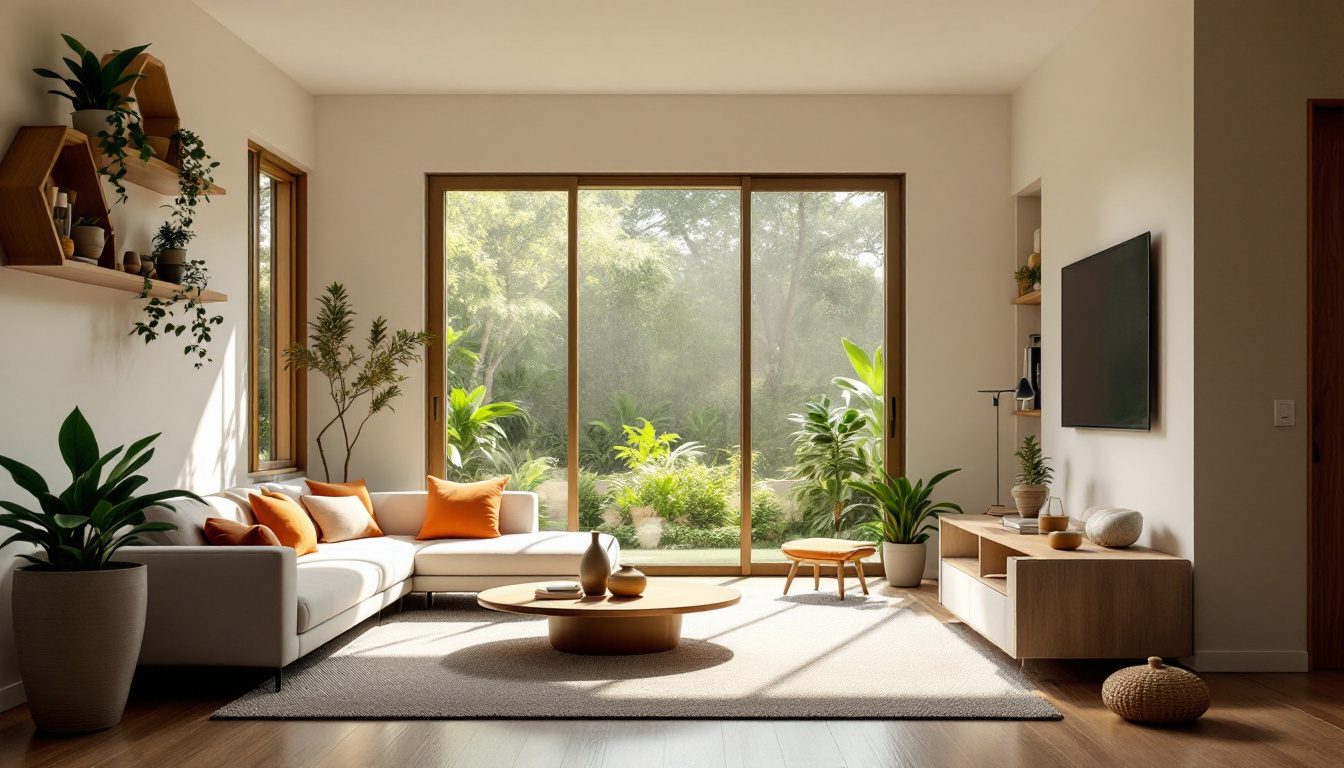
Orientation, Light & Views: Designing With Your Space, Not Against It
How reading your plot's sun, breeze and views — and placing each room on the right face — gives an Indian home that is cooler, brighter and quietly right, instead of one that fights its site forever.
There is a moment, on the morning you take possession of a plot or a flat, when you are standing in the most information-rich place you will ever occupy — and most of us walk straight past it. We arrive with a floor plan already in our heads, borrowed from a cousin's house or a Pinterest board or the builder's sample flat, and we set about imposing it on the ground. The sun rises and sets, a breeze comes off a particular corner in the afternoon, a neighbour's blank wall looms over one side while a gulmohar tree leans in over another, and we notice none of it because we are too busy deciding where the TV goes.
That habit — designing the home you imagined rather than the home this particular piece of earth wants — is the single most expensive mistake in Indian house-building, and you pay for it not once but every single day you live there. A west-facing bedroom that bakes from three in the afternoon until midnight. A kitchen that gets no morning light. A beautiful picture window that frames the neighbour's overflow tank. None of these is a decorating problem you can fix with curtains. They are siting decisions, made early and lived with forever.
Working with your site is not a constraint on good design — it is the source of it: the sun's path, the prevailing breeze, and the views worth keeping or hiding are free instructions that, if you read and obey them, give you a home that is cooler, brighter and more alive than anything you could have imposed from a magazine.
This guide is about judgement, not calculation
Before we go a step further, a clear boundary. This is a guide about design decisions — which room belongs on which face, how to frame a view, how to read your specific plot — and not about the physics that justifies those decisions. The physics matters enormously, but it already has its own homes on this site, and we will keep sending you there.
If you want to understand how daylight actually behaves inside a room — depth of penetration, glare, the difference between north light and direct sun — read natural light planning for Indian homes. If you want the climate-zone engineering of heat, shade, thermal mass and ventilation, read passive design across India's climate zones. If you want to know precisely where the sun will sit over your plot on the longest and shortest days of the year, use the sun-path analyzer, which will draw the arc for your latitude. And the volume above your head — the third dimension that lets hot air rise and escape — has its own treatment in the science of ceiling heights.
What follows assumes all of that and asks the next question: given how the sun and breeze and views behave, where do you put things, and what do you do about it? This is the part no calculator can do for you, because it is a series of human trade-offs — which room deserves the good morning light, whether a view is worth turning the whole plan to capture, how much summer discomfort you will trade for a winter benefit. It is, in the proper sense, a design problem. It belongs to the family of design principles that outlast magazine examples, the pillar this guide sits under.
Read the site before you draw a line
The architects who design genuinely comfortable homes nearly all share one unglamorous habit: they visit the site, repeatedly, before they design anything, and they watch. They watch where the sun falls at eight in the morning and at four in the afternoon. They stand where the kitchen might go and feel whether the breeze reaches it. They look out from where the bedroom window will be and ask what they will actually see. They come back in a different season if they can. The plot is not a blank rectangle of dimensions; it is a small piece of climate and context with its own daily rhythm, and the only way to know it is to be there while it performs.
This is harder than it sounds because the information is invisible on a measured drawing. A survey gives you boundaries, levels and the road; it does not tell you that the south-west corner gets a furnace of afternoon glare, or that the only pleasant outlook is a diagonal slice toward a distant hill, or that the neighbour runs a noisy generator at the back. You learn those by occupying the site with your senses on alert. Christopher Alexander, in A Pattern Language, devotes a whole pattern — "Site Repair" — to the idea that you should build on the worst part of the land and leave the best part untouched, precisely because you cannot make that judgement from a desk.
A simple discipline for reading your own plot, before any layout exists:
| What to observe | When to observe it | What it tells you |
|---|---|---|
| Sun position and shadows | Morning, noon, late afternoon — ideally same day | Which faces get gentle vs harsh sun; where to put living vs service |
| Prevailing breeze | Across a day; note summer vs monsoon if possible | Where to open up for cross-ventilation; where dust blows in |
| Views, good and bad | Standing at likely window heights, all four sides | What to frame, what to screen, where privacy is at risk |
| Noise and smell sources | Road, neighbour's kitchen, generator, drain | Where to place bedrooms and study away from disturbance |
| Neighbour overlooking | Their windows, balconies, terraces | Where your privacy gradient needs the most protection |
| Existing trees and shade | Note canopy, species, what stays | Free shade and cooling to design around, not cut down |
The site has already done half your design work and asks nothing in return. Most homes are uncomfortable not because the design was bad but because nobody listened to the ground it was built on.
Orientation: which room belongs on which face
In India, orientation is governed by one overwhelming fact — for most of the country, for most of the year, the problem is too much heat, not too little. The sun rises roughly in the east, climbs across the southern sky (because we are in the northern hemisphere), and sets in the west, and the low morning and evening sun, striking east and west walls almost horizontally, is far harder to shade than the high noon sun overhead. This gives a simple, robust hierarchy for the Indian plot.
North is the gentle face. It receives soft, indirect, glare-free light all day and almost no direct heat. This is the prize for rooms that want steady illumination without a furnace — a study, a home office, a painter's or tailor's corner, and the deeper-set living spaces. A north-facing plot, often dreaded because the front gets less sun, is in fact a gift for the rooms behind it.
East is the morning face. It gets cheerful, warm-but-soft light in the morning that is largely gone by midday, leaving the afternoon cool. This is ideal for the rooms you use early — the kitchen (morning prep in pleasant light, cool by lunch), the breakfast or dining area, the pooja room (traditionally east-facing in vastu, and here solar logic happily agrees), and bedrooms for people who wake early.
West is the difficult face. The afternoon and evening sun strikes it low, hot and relentless; a west wall and west window can stay warm late into the night, radiating heat into the room when you are trying to sleep. Put the things that can take the punishment here — staircases, toilets, stores, the utility, a buffer of cupboards along the wall — and never, if you can avoid it, the master bedroom. When west rooms are unavoidable, this becomes a design battle (see the next section).
South is hot but manageable. It gets strong sun, but because that sun is high, a modest horizontal overhang — a chajja, a deep verandah, a balcony above — shades it effectively, which a vertical western sun defeats. South can carry living spaces if you shade it deliberately.

This is the broad principle, not a rigid grid — your plot's views, road access and neighbours will bend it, and that bending is the actual design work covered in space-planning principles. A useful starting placement, with the reasoning attached:
| Room | Best face | Why | Avoid |
|---|---|---|---|
| Living room | North or east | Even light, cool, sociable; morning warmth | Unshaded west |
| Master bedroom | North-east, or shaded south | Cool for sleep; no late heat radiating at night | West (bakes till midnight) |
| Kitchen | East (or north-east) | Cool morning prep, heat gone by afternoon | West (compounds cooking heat) |
| Study / home office | North | Steady glare-free light all day | West, unshaded east-glare |
| Pooja room | East / north-east | Morning light; vastu and solar logic agree here | Under stairs, dark cores |
| Toilets / stores / stairs | West / south-west | Buffer the hot faces; don't waste good light | North (gentle light wasted) |
Where vastu and solar logic agree — and where they don't
Most Indian families weigh vastu shastra alongside everything else, and it is worth being even-handed rather than dismissive or credulous. Vastu is, in large part, a pre-modern systematisation of climate sense for the subcontinent, which is why it agrees with solar logic far more often than people assume.
Where they agree: vastu favours the kitchen toward the south-east (Agni, the fire corner) and the pooja or living activity toward the east and north-east, and it treats the north-east as the most auspicious, lightest zone. Solar logic arrives at almost the same place from a different direction — the east and north-east genuinely do get the gentlest, most pleasant light, and keeping the heavy, hot, service functions toward the south and west is exactly what an energy-conscious designer would do anyway. When vastu says keep the north-east open and light and the south-west heavy and grounded, it is, in climate terms, simply correct for most of India.
Where they can diverge: vastu's rules are directional absolutes that ignore your specific plot. It may insist the master bedroom go in the south-west regardless of whether that corner is the one your particular site bakes worst, or whether that is where your only good view lies. It prescribes the same orientations in Chennai's humid heat and in a Himachal hill town where you actually want winter sun on the bedroom. The honest position is this: treat vastu's directional logic as a strong prior that often coincides with good climate design, but let the observed behaviour of your sun, breeze and views — and your family's actual life — break the tie when they conflict. Where you can satisfy both, do; where you cannot, comfort you feel every day should usually outrank a rule you cannot feel.
Turning constraints into design moves
Almost no plot is ideal. The skill is not in finding the perfect site but in answering the imperfect one well. A constraint, faced honestly, usually contains the seed of the most interesting thing about the house.
The hot west wall. You cannot move the sun, so you defend against it in layers. Stack a "thermal buffer" of low-priority rooms — stores, stairs, toilets, a utility — along the west so the heat is absorbed before it reaches living spaces. Where a west window is unavoidable, use vertical shading (deep reveals, fins, a jaali, a louvered screen, a tree), because the low western sun laughs at a horizontal chajja that would have tamed the south. A double wall or a cavity, lighter exterior colours, and creeper-covered trellis all help. This is the design-judgement layer; the heat-transfer physics behind it lives in passive design across India's climate zones.
The ugly neighbour or blank wall. When a view is bad, you do not simply close the wall — you screen it while keeping the light. A jaali, a frosted or fluted glass band, a high clerestory that admits sky but not the eyesore, or a green screen of plants turns a liability into texture. The Japanese and the Mughals both mastered this: block the offending object, keep the daylight, and let the screen itself become something worth looking at.
The narrow north plot. A long, thin, north-facing site dreads the lack of front sun — but it can pull light down its length through a central courtyard or a light well, run a single-aisle plan with rooms strung along a sunny side, and use the north's even light as the asset it is for studios and work. Narrowness forces a clarity of circulation that wider plots never achieve.
The overlooked balcony. Dense neighbours mean privacy is the scarce resource. Stagger window positions so they don't line up with the neighbour's, raise sill heights, use the privacy gradient (public rooms toward the exposed side, private toward the protected), and let planting or screens do the rest — the full treatment of carving protected space is in zones of retreat, rest and privacy.
| Constraint | The lazy response | The design move |
|---|---|---|
| Hot west wall | Run the AC harder forever | Buffer rooms + vertical shading + light colours + tree |
| Ugly outlook | Wall it off, lose the light | Jaali / clerestory / fluted glass — screen but keep daylight |
| Narrow north plot | Cram rooms, accept gloom | Light well or courtyard; string rooms along the sun side |
| Overlooked by neighbours | Curtains permanently drawn | Stagger windows, raise sills, privacy gradient, planting |
| Noisy road side | Bedrooms face it anyway | Service rooms as a sound buffer; bedrooms to the quiet side |
Framing and capturing views: the window as a picture
A window does two jobs at once. It is a piece of building physics — daylight in, heat in or out, air in. And it is a frame, the deliberate edge around a picture you will look at thousands of times. Most Indian homes get the first job roughly right and ignore the second entirely, which is why so many windows look at nothing in particular, or at everything indiscriminately, including the things you would rather not see.
The traditional idea here is borrowed scenery — shakkei in the Japanese garden tradition, and a principle the Mughals used in their pavilions and the colonial builders in their verandahs. You borrow a good view that you do not own: a distant tree, a temple gopuram, a sliver of hills, a neighbour's mango tree, the changing sky. You compose the window so that view sits inside it like a painting, and you suppress everything around it that would spoil the composition. A small, well-placed window onto a beautiful thing is worth more than a vast glass wall onto a jumble.

This connects directly to prospect-refuge theory, set out by the geographer Jay Appleton in The Experience of Landscape (1975): humans feel most at ease in places that offer both prospect (the ability to see out, to survey, an open outlook) and refuge (a protected, enclosed spot to do the surveying from). A window seat looking out over a garden is the purest expression of it — refuge at your back, prospect through the glass. When you site rooms, you are also siting these prospect-refuge moments: the reading chair angled to the best window, the kitchen sink set under a view rather than a wall, the bed positioned so the first thing you see on waking is light and outlook rather than a cupboard.
A few practical rules of framing:
- A view worth having can earn the whole plan. If there is one genuinely good outlook, it is legitimate to turn the main living space toward it even at some cost to ideal orientation — then solve the resulting sun problem with shading. The view is felt every day; the orientation penalty is a manageable engineering problem.
- Frame deliberately; don't glaze indiscriminately. A wall of glass facing a poor view simply enlarges the problem and bakes the room. Choose the openings.
- Screen the bad while keeping the good. Jaalis, louvres, planting and clerestories let you keep daylight and breeze while editing out the eyesore — you are cropping the picture, not deleting it.
- Think about the view from the window too. Privacy runs both ways; a window that gives you a lovely outlook may also give the neighbour a clear look at your dining table.
Designing with the site versus against it
Here is the whole argument in one comparison. Take an identical plot — same size, same orientation, same neighbours — and design it two ways.
The home designed against the site starts from an imported plan. The master bedroom lands on the west because that is where the plan put it; it bakes every evening and the AC runs from April to October. The kitchen faces north-west and gets no morning light, so it is lit artificially even at breakfast. The living room's big window faces the neighbour's compound wall and is curtained shut. There is no cross-ventilation because the openings don't line up with the breeze, so fans run constantly. The house works, in the sense that you can live in it — but it fights its surroundings every hour, and you pay the bill in electricity, discomfort and the low-grade depression of rooms that never feel right.
The home designed with the site starts from observation. Bedrooms sit on the cool north-east; the kitchen takes the morning east; stores, stairs and toilets form a thermal buffer along the hot west. Living spaces open toward the one good view and toward the prevailing breeze, with openings placed across from each other so air moves through. A chajja shades the south, a jaali screens the west glare and the ugly tank, a courtyard pulls light into the deep middle. The same family, the same budget, the same plot — and a home that is several degrees cooler in summer, bright without lights for most of the day, and quietly right in a way the occupants feel but cannot always name.
The difference is not talent or money. It is the order of operations — whether you read the site first and design second, or design first and discover the site's revenge later. The second home costs essentially the same to build and far less to run, and it is the more beautiful of the two because its form actually means something: every shaded wall, every framed window, every aligned opening is an answer to a real question the site asked.
| Fighting the site | Designing with it | |
|---|---|---|
| Bedroom placement | Wherever the imported plan put it (often west) | Cool north-east; never the baking west |
| Cooling | AC runs constantly, fans always on | Cross-ventilation + shading; AC as backup |
| Daylight | Lights on by day; glare or gloom | Free daylight most of the day, glare screened |
| Views | Big window onto a bad outlook, curtained shut | Framed good view; bad view screened, light kept |
| Running cost | High and permanent | Low and permanent |
| How it feels | Vaguely wrong, never quite comfortable | Right in a way you feel but can't always name |
What this means for your home
1. Visit and watch before you design. Stand on the site morning, noon and late afternoon. Note where the sun bites, where the breeze comes from, what each side looks out on, where the noise is. This single unglamorous habit prevents the most expensive mistakes.
2. Map the sun's path for your latitude. Use the sun-path analyzer to see where the sun sits in summer and winter over your specific plot, then place rooms against that arc rather than against a generic rule.
3. Assign faces by function. North and east for the rooms that want gentle light and cool — living, study, kitchen, bedrooms. West and south-west for the buffer functions — stores, stairs, toilets, utility. Shade the south; defend the west.
4. Weigh vastu as a prior, not a tyrant. Where its directional logic agrees with your site's climate and views, follow it gladly. Where it fights the comfort you can actually feel, let the felt comfort win.
5. Turn each constraint into a move. A hot west wall wants vertical shading and a buffer; an ugly view wants a jaali or clerestory that keeps the light; a narrow north plot wants a light well; overlooking neighbours want staggered windows and a privacy gradient.
6. Frame your views like pictures. Find the one or two outlooks worth keeping and compose openings around them; screen the rest. A small window onto something beautiful beats a wall of glass onto a mess.
7. Align openings for cross-ventilation. Put openings on opposite or adjacent walls so the breeze you observed can actually pass through — the cheapest cooling there is. The physics is in passive design across India's climate zones.
How Studio Matrx helps
Reading a site well is a skill, and seeing the consequences of an orientation choice before you build it is exactly where most homeowners are flying blind. DesignAI lets you describe your plot — its orientation, its views, its problem walls — and visualise how rooms placed on different faces will actually look and feel in morning, midday and evening light, so you can test "bedroom on the north-east" against "bedroom on the west" and see, not just imagine, the difference before a single wall is built. It turns the invisible instructions of your site into something you can look at and decide on.
References
1. Appleton, J. (1975). The Experience of Landscape. John Wiley & Sons — the formulation of prospect-refuge theory: the human preference for places offering both outlook and shelter.
2. Alexander, C., Ishikawa, S. & Silverstein, M. (1977). A Pattern Language. Oxford University Press — patterns "Site Repair," "Light on Two Sides of Every Room," "Window Place," and "Zen View" on framing and borrowed scenery.
3. Bureau of Indian Standards. National Building Code of India 2016 (NBC 2016), Part 8 (Building Services) and Part 11 (Approach to Sustainability) — orientation, daylight and ventilation guidance.
4. Energy Conservation Building Code (ECBC), Bureau of Energy Efficiency, Government of India — orientation, shading and the building envelope's role in energy use.
5. Koenigsberger, O. H., Ingersoll, T. G., Mayhew, A. & Szokolay, S. V. (1973). Manual of Tropical Housing and Building. — orientation, shading and ventilation for hot climates, foundational for the Indian context.
6. Krishan, A. (ed.) (2001). Climate Responsive Architecture: A Design Handbook for Energy Efficient Buildings. Tata McGraw-Hill — Indian climate zones and orientation strategy.
7. Itoh, T. (1973). Space and Illusion in the Japanese Garden — on shakkei, the borrowing of distant scenery into a framed composition.
Part of the Studio Matrx Design Principles series. Continue with design principles over magazine examples, natural light planning for Indian homes, zones of retreat, rest and privacy, and the science of ceiling heights.
Export this guide
Related Guides — Deep-dive reading
Understanding Sun Path Analysis for Your Home
How the sun actually moves over an Indian site through the day and the year — and why that single fact quietly decides where your kitchen, bedroom and living room should sit.
Site PlanningDesigning a Naturally Energy-Efficient Indian Home
Comfort first, gadgets last — passive design, orientation, insulation, ventilation and the climate wisdom that cuts Indian energy bills
SustainabilityDesigning for Views and Privacy
The site-level craft of capturing the good view while screening the neighbour's window three metres away — tuned for dense Indian plots.
Site PlanningRelated Tools — Try Free
Brise-Soleil Visualizer
Interactive horizontal-louvre cut-off angle calculator — sun altitude, louvre depth, and spacing inputs with a live shadow preview. Computes θ = arctan(spacing/depth) for façade shading, ECBC envelope compliance, hospital daylight design, and tropical sun-control detailing.
Sun Shading ToolCross-Ventilation Analyzer
Estimate airflow and air changes per hour (ACH) from room size, window areas, layout, and local wind — with NBC 2016 Part 8 compliance check.
Ventilation CalculatorSun-Path & Shadow Studio
Sun path, altitude and azimuth, building shadows and overhang sizing for any Indian city and date.
Solar Tool